“Stop filling that ditch with useless weeds—the next flood will rip them out and take your father’s soil with them.”
Earl Brannigan stood above the drainage bank with both hands planted on his hips, staring down at nine-year-old Marin Hollis as though she had personally insulted every farmer in Warren County. His boots were caked with Iowa mud, and the late-afternoon wind pulled at the brim of his dusty cap. Behind him, rows of corn stretched toward the distant road.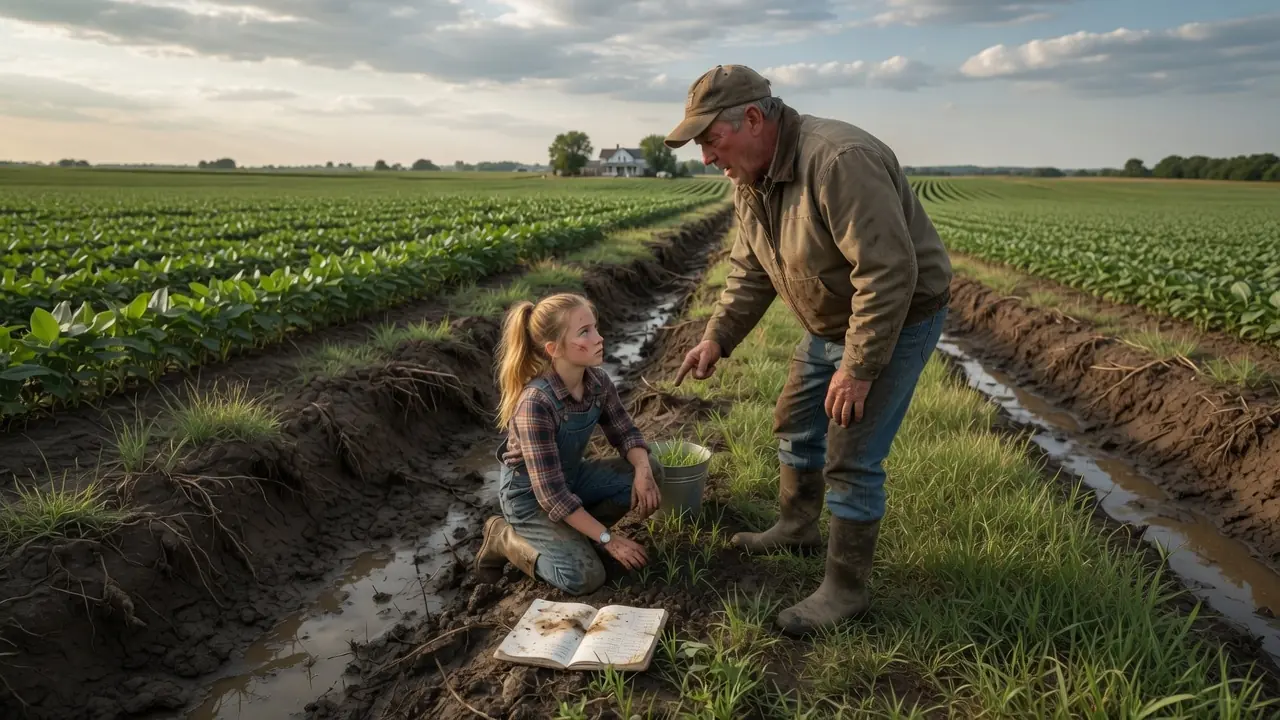
Marin pressed another switchgrass seedling firmly into the wet soil.
“The flood takes his soil because nothing here has roots deep enough to hold it,” she replied.
Earl pointed toward the galvanized bucket beside her knee. “You’re nine years old. Pull this childish mess out before your father loses another field.”
Marin raised her freckled face and met his eyes. “Come back after the storm, Mr. Brannigan—and see whose land is still standing.”
Earl gave a dismissive laugh and walked back toward his truck.
Marin waited until the engine disappeared down Caldwell Road before returning to her work. Her knees were soaked through her faded denim overalls, and mud had dried beneath her fingernails. A fresh scratch crossed her left cheek where a stiff grass blade had caught her earlier.
She did not stop.
For three generations, the Hollis family had farmed the same 280 acres in Warren County. Marin’s great-grandfather had first broken the land in 1938 with two horses and a plow that now rusted beside the machine shed. Her father, Dale Hollis, grew corn and soybeans on the main fields and kept a small herd of Black Angus cattle on the northern pasture.
The farm had survived droughts, collapsing grain prices, broken machinery, and years when the harvest barely paid for the seed. Dale believed endurance was the most important skill a farmer possessed. When something failed, he repaired it and returned to work.
The drainage ditch along the eastern boundary had always been considered one of those things that simply needed repairing.
It carried water from the rolling fields toward a creek half a mile away. In ordinary weather, it was little more than a shallow channel edged with weeds and exposed soil. During Iowa’s heavy spring rains, it became a fast-moving brown stream that chewed at its banks.
Marin had watched it since she was six.
Other children watched birds, clouds, or cattle. Marin watched water.
After every storm, she crouched near the bank and studied the current. She noticed how runoff entered clear from some sections but turned dark as it collected loose soil. She saw small chunks of the bank break away and disappear downstream.
The ditch widened a little every year.
When Marin asked her father about it, Dale barely looked up from repairing a planter.
“Ditches move,” he told her. “Always have.”
Marin wrote his answer in a small red notebook.
She wrote down everything.
Rainfall dates. Water levels. The color of the current. Places where the bank had cracked. Sections where grass grew naturally and sections where nothing remained but pale subsoil.
The notebook went with her everywhere.
The spring Marin turned eight, Warren County received two inches of rain in less than an hour. Water rushed through the Hollis property with enough force to collapse a twenty-foot section of the western ditch bank.
By morning, runoff had cut sideways into the soybean field.
Dale stood in the mud with his hands hanging helplessly at his sides. Nearly four inches of dark topsoil had disappeared from half an acre. What remained beneath it was pale, compacted ground that produced almost nothing.
He hired a neighbor with an excavator to reshape the bank.
The machine pushed soil back into place, packed it down, and restored the original channel. Dale paid the bill, thanked the operator, and returned to planting.
To him, the problem was fixed.
Marin stood beside the newly shaped bank and pressed her boot against the exposed dirt. It crumbled beneath the surface, dry and weak. The next hard rain would strike it with no roots, no plants, and nothing to hold it together.
The ditch looked repaired.
It was not protected.
That autumn, Marin began asking questions no one expected from a child.
Her grandfather Everett kept old agricultural bulletins inside a cardboard box in his garage. Most dated from the 1970s and 1980s, when he had attended county conservation workshops and collected every pamphlet the government printed.
Marin spent cold evenings reading beneath a hanging shop light.
She found words she did not understand: riparian buffer, sediment trapping, infiltration rate, vegetative filter strip. She copied each term into her notebook, then searched through an old dictionary and her mother’s farming magazines until the ideas began to make sense.
Water was not the enemy.
Speed was.
The faster runoff moved, the more soil it carried. Bare banks gave the water nothing to resist. Deep roots slowed it, spread it, and held the soil in place.
In March, Marin convinced her mother, Suzanne, to drive her to the county office of the Natural Resources Conservation Service. A field agent named Gerald Combs greeted them with the polite smile adults often gave children who wandered into professional places.
Then Marin opened her notebook.
She showed him diagrams of the ditch, measurements from collapsed sections, rainfall dates, and sketches marking where the water entered the property fastest. Gerald stopped smiling politely and began listening seriously.
For forty-five minutes, he answered her questions.
He explained that switchgrass could send roots five or six feet into the soil. Big bluestem could stabilize upper banks, while eastern gamagrass tolerated wetter sections closer to the water. Above the ground, the plants created friction that slowed runoff.
Below it, their roots formed a living net.
“It won’t stop a flood,” Gerald told her. “But slowing the water down can change what the flood takes with it.”
Marin wrote the sentence carefully.
Before she left, Gerald told her the agency operated a reduced-cost native-plant program. He could set aside several trays of grass plugs, but someone would still need to plant them and maintain them for years.
“I will,” Marin said.
Her mother looked at her blister-free hands and asked, “Do you understand how much work that is?”
“No,” Marin admitted. “But I’ll find out.”
She paid for part of the seedlings with money earned helping her grandmother at a summer farm stand. Gerald arranged the rest through a small conservation grant.
Planting began in April.
The first morning, Marin carried a bucket to the ditch before school. She dug holes with a narrow garden trowel and pressed switchgrass plugs into the bank every few feet.
The soil was heavier than she expected.
Some sections were so wet that her boots sank to the ankles. Other parts had dried into compacted clay that resisted the trowel. Within an hour, red blisters formed across both palms.
She wrapped them with cloth and continued.
Her two older brothers offered to help on the first Saturday. They planted for forty minutes, became bored, and wandered toward the barn. Marin thanked them anyway and completed the section alone.
People driving along Caldwell Road began noticing her.
Eleanor Brannigan told her husband that the Hollis girl was trying to make the ugly ditch look prettier. Earl glanced from his truck, saw the green shoots, and agreed.
Other neighbors thought it was a school project.
Dale called it “Marin’s experiment” when people asked, though he had never requested it and did not completely understand it. He neither encouraged nor stopped her.
That was enough.
Not every seedling survived.
A dry July burned the upper bank until one-third of the switchgrass turned yellow. Marin recorded which plants failed, returned to Gerald’s office, and asked for a more drought-tolerant variety.
The cattle damaged another section.
Three mornings in a row, the Angus cows crossed near the ditch and crushed the young stems into the mud. Dale finally helped her string a single wire along the vulnerable area.
“You’re stubborn,” he said while tightening the fence.
“You said endurance matters.”
Dale looked at his daughter, then at the seedlings. “I suppose I did.”
Winter turned the grass brown and brittle.
Neighbors assumed the project had failed.
Marin did not.
Gerald had taught her that native grass often appeared dead above ground while continuing to establish roots beneath the surface. She marked the planting locations with small wooden stakes and waited.
Spring proved him right.
Fresh green shoots pushed through the dead stems. By June, some stood three feet tall. The separated clusters began growing together, forming a dense line of vegetation along the bank.
Marin expanded the planting.
She used switchgrass in the center, gamagrass near wetter areas, and big bluestem where the bank rose toward the field. She measured the width of the buffer strip and recorded which combinations held best during moderate rain.
The ditch began changing.
Water no longer struck every exposed section directly. It spread through the grass, slowed around the stems, and deposited thin layers of sediment before entering the channel.
After one storm, Marin filled two glass jars.
One contained water collected where runoff entered the planted bank. The other held water leaving the eastern end of the ditch.
The second jar was noticeably clearer.
She placed both on the kitchen table.
Dale stared at them while drinking coffee.
“Where did this one come from?” he asked, pointing to the darker jar.
“Before the water crossed the grass.”
“And the clearer one?”
“After.”
He lifted both jars toward the window.
For the first time, he asked her to explain the project from beginning to end.
Marin showed him her notebook.
Dale turned the pages slowly, finding three years of observations he had dismissed as childhood curiosity. There were diagrams, calculations, rainfall totals, and notes from meetings with Gerald.
“You did all this yourself?”
“Gerald helped me understand the roots.”
Dale closed the notebook carefully. “I should have asked sooner.”
Marin shrugged. “You were busy.”
He heard no accusation in her voice, which made him feel worse.
That autumn, Gerald invited Marin to speak at a county conservation meeting in Indianola. The room was filled with farmers old enough to be her grandparents.
Several smiled when she walked to the front.
Their expressions changed when she began presenting measurements.
She explained how the bank had retreated after the first major storm, how root depth affected stability, and why different grasses were needed at different elevations. She showed photographs of the collapsed soybean corner and compared them with current images.
One farmer asked whether her father had designed the system.
“No,” Marin answered. “He let me try it.”
Gerald introduced her as the youngest conservation farmer he had ever assisted.
Marin corrected him.
“I’m not a conservation farmer yet. I’m just someone who watched the water long enough.”
By her third spring of planting, roots extended throughout most of the vulnerable bank. The upper growth had become so thick that Earl Brannigan complained it looked untidy.
“You’ll regret letting weeds take over,” he told Dale at the feed store.
Dale did not argue.
He had begun watching the weather.
May brought ten days of slow rain.
At first, farmers welcomed it. Corn seedlings needed moisture, and the pastures had been dry after a weak winter snowfall.
Then the rain continued.
The ground became saturated. Tractor tires left deep ruts. Creeks rose toward the bottoms of bridges, and water collected in every low field.
A new storm formed over central Iowa.
The forecast predicted several inches.
Gerald called the Hollis house the evening before it arrived. “This may be the test,” he said.
Marin stood beside the kitchen window, watching the first drops strike the glass.
“Will it hold?” her mother asked.
“I don’t know.”
It was the first time Marin admitted uncertainty.
The storm began after midnight.
Rain hammered the roof so loudly that no one slept. Thunder rolled across the fields, and wind bent the trees along Caldwell Road.
By dawn, nearly three inches had fallen.
Dale moved the cattle to higher pasture. Marin followed him toward the drainage ditch until he ordered her to remain behind the fence.
The water was already high.
It rushed toward the eastern boundary, dark with sediment and field debris. Along unplanted areas upstream, the current tore loose pieces of soil and carried them forward.
Then it reached Marin’s grass.
The tall stems flattened but did not uproot.
Water spread across the wider vegetated strip instead of striking the bank in one concentrated channel. The dense roots resisted the current, while trapped sediment collected around the base of the plants.
The ditch filled almost to the top.
But the bank held.
Across the road, Earl Brannigan’s bare drainage channel began collapsing. A section of water broke sideways through his lower pasture, tearing out fence posts and cutting a muddy path toward the county road.
Eleanor called the Hollis house asking for help moving cattle.
Dale and Marin’s brothers went immediately.
Marin remained near her own ditch beneath a raincoat, marking water levels in her notebook. She could hear the roar from the Brannigan property and see brown sheets of runoff crossing their field.
For the first time, she understood that proving someone wrong did not feel satisfying when their land was being destroyed.
By the second day, the storm total neared seven inches.
Culverts backed up across Warren County. Gravel roads disappeared beneath moving water. Several fields flooded from the edges inward.
The Hollis ditch continued carrying runoff.
The grass leaned flat under the force, yet its roots remained anchored. The current deposited soil rather than removing it.
When the rain finally weakened, the entire family walked the ditch together.
Not one major section had collapsed.
The channel remained where it had been. The soybean corner stayed intact. Dark topsoil still covered the field.
Dale stopped at the place where the bank had failed three years earlier. Water dripped from the brim of his hat as he looked toward his daughter.
“You saved this field.”
Marin shook her head. “The roots did.”
“You planted them.”
She looked down at her muddy boots.
Earl Brannigan arrived four days later.
He did not wear his usual confident expression. The flood had taken nearly half an acre of pasture and left a deep cut along his drainage line.
Marin found him standing beside the Hollis ditch, examining grass still bent from the storm.
“I thought it was decoration,” he admitted.
Marin said nothing.
“I told you the flood would rip it out.”
“Yes.”
“And you told me to come back afterward.”
“Yes.”
Earl looked across the intact field. “I suppose I’m back.”
Marin opened her notebook.
She walked him along the entire bank, explaining the purpose of each grass species. She showed him where sediment had collected and how the water had spread through the vegetation.
Earl listened without interrupting.
“What would I need to do on my property?” he asked.
Marin studied the slope beyond the road. “Your ditch is steeper. You’ll need wider planting near the bend and something stronger along the cattle crossing.”
“You’d help me?”
“You need help.”
He looked embarrassed by the echo of his earlier cruelty.
Marin did not mention it.
Within a year, the Brannigans and two neighboring families installed vegetative buffer strips. Gerald used the Hollis ditch in county workshops, and the extension office began distributing native-grass kits with simple planting instructions.
Marin helped neighbors choose species based on soil moisture and slope. She never gave speeches unless someone asked. She preferred standing beside a ditch with mud on her boots and a notebook in her hand.
By the time she turned twelve, the grass along Caldwell Road reached above her shoulders.
Birds nested in it.
Pollinators returned.
The water leaving the Hollis farm remained clearer after ordinary storms, and the bank stopped retreating into the soybean field.
Dale began consulting Marin before reshaping waterways or removing vegetation. He no longer called the planting an experiment.
He called it part of the farm.
One evening, father and daughter stood beside the ditch as the sun lowered behind the corn. Light moved across the grass in long green waves.
“I spent years teaching you how to farm,” Dale said.
“You taught me to keep going when something fails.”
“You taught me that repair isn’t always the same as solving.”
Marin smiled.
Her notebook had grown thick with additional pages, taped photographs, and measurements. The original cover was stained beyond recognition.
Dale handed her a new leather-bound journal.
On the front, he had written her name and three words:
WATCH THE WATER.
Years later, visitors would remember the flood that damaged roads, fences, and fields throughout Warren County. They would talk about how the Hollis farm escaped the worst erosion because a strip of native grass slowed the current before it could carry the land away.
Some called Marin unusually gifted.
Others said she had been lucky.
Marin disagreed with both explanations.
She had simply paid attention to what adults had accepted as unavoidable.
The greatest harvest from the Hollis farm that year was not corn, soybeans, or cattle.
It was the dark topsoil still lying where generations of her family had worked it.
The storm had tried to take that soil.
A quiet nine-year-old girl had given it something strong enough to hold on to.