Rain hammered the parking lot outside Mercer’s Auto Repair on County Route 12, turning the cracked pavement into a sheet of dark water. Caleb Mercer stood beneath the garage awning beside two motorcycles, finishing a paper cup of coffee while several riders waited for the storm to weaken. At forty-six, Caleb had a thick gray beard, tattooed arms, and the broad, weathered build of a man most strangers crossed the street to avoid. He was watching traffic crawl past the diner across the road when an eight-year-old girl came running through the rain.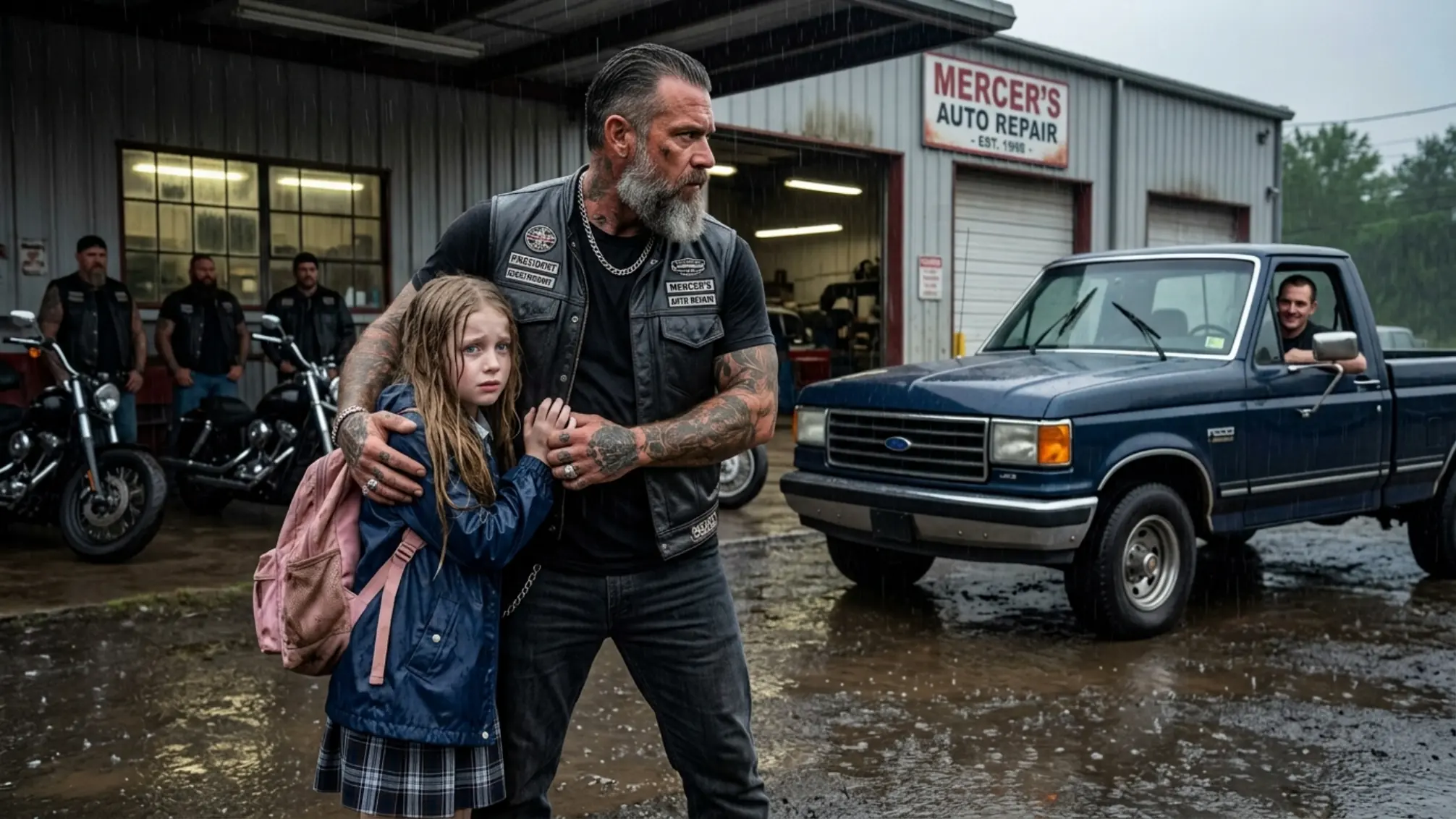
Her navy raincoat was soaked through, her pink backpack hung from one shoulder, and muddy water splashed from beneath her sneakers with every desperate step. She did not stop at the brightly lit diner or the pharmacy farther down the block. Instead, she ran directly toward Caleb, grabbed the front of his black leather vest, and pressed herself against his side. Her entire body shook as she tried to force the words past her breath.
“He’s following me,” the little girl whispered. “He said my mom sent him.”
Caleb did not spin around or make a scene. He shifted one step, placing his body between the girl and the road, then looked toward the dark blue pickup idling near the diner’s far entrance. A clean-cut man sat behind the wheel with one arm resting outside the open window, watching them through the rain. The driver did not look surprised that the child had found help.
“Stay behind me,” Caleb said. “Nobody is taking you anywhere.”
The man leaned toward the window. “She’s confused. Move aside—I know her mother.”
Caleb stepped slightly forward while keeping one protective arm around the girl. “Then wait for the police and explain why you followed her six blocks.”
The driver’s smile remained, but something behind it changed. Caleb recognized the moment when a man stopped believing charm would be enough and started measuring every witness around him. Wade Patterson placed his coffee on the windowsill, while Raymond Ortiz quietly moved closer to the garage door. Neither biker shouted or approached the truck.
Caleb lowered himself until the little girl no longer had to look up at him. Her wet light-brown hair clung to her cheeks, and fear filled her blue-gray eyes. He kept both hands visible and spoke slowly.
“What’s your name, sweetheart?”
“Madison. My mom calls me Maddie.”
“My name is Caleb Mercer. This is my shop, and you are safe here.”
Maddie’s grip loosened slightly, though she did not release his vest. Caleb asked where her mother was, and she explained that Rebecca Walker worked at a laundromat on Birch Street. School had dismissed early after a pipe burst near the cafeteria, and Maddie had decided to walk the six blocks to her mother’s workplace.
The blue pickup began following her outside the school fence. At first, she believed the driver simply happened to be traveling in the same direction. Then she crossed near the pharmacy, and the truck turned after her.
“He called my name,” Maddie said. “He told me Mom asked him to pick me up.”
“Did your mother tell you someone was coming?”
“No.”
“Did the man know your family password?”
Maddie shook her head quickly. “He said grown-ups don’t need passwords when they’re helping.”
Wade’s expression hardened. Rebecca had created the password precisely for a moment like this, and her daughter had remembered it while frightened and alone. Caleb looked toward the pickup again. The man remained inside, watching as though he expected the bikers to lose patience and give him the confrontation he could later blame on them.
“Wade, call 911,” Caleb said. “Tell them a child says an adult male followed her from school and tried to get her into a dark blue pickup.”
Wade already had his phone in hand. Raymond read the license plate from the front window and repeated it slowly for the dispatcher. Caleb opened the glass door and guided Maddie inside without touching her beyond the arm she still held.
The garage smelled of motor oil, rubber, and old coffee. Fluorescent lights hummed above the repair bays, and a wall clock ticked beside shelves of carefully labeled parts. Nothing inside was beautiful, but everything was ordinary. Caleb understood that ordinary surroundings could calm someone whose world had suddenly become dangerous.
He placed a chair near the office window, far enough from the entrance that the driver could not reach her but close enough that she would not feel hidden. Caleb set a clean towel on the counter and allowed Maddie to pick it up herself.
“Nobody is taking you outside,” he said. “We’re calling your mom now.”
Maddie recited Rebecca’s phone number from memory. Caleb dialed on the shop landline and activated the speaker so the girl could hear everything. A woman answered on the second ring.
“Rebecca Walker speaking.”
“Ma’am, my name is Caleb Mercer. Your daughter Maddie is safe inside my repair shop on County Route 12.”
Silence filled the room for half a second.
Then Rebecca asked, “Is there a man with a blue truck?”
Maddie’s face went pale. Wade stopped speaking to the dispatcher for a heartbeat before continuing his report. Across the road, the pickup’s headlights flashed once, and its driver opened the door.
“Rebecca, don’t hang up,” Caleb said. “The police are coming, the shop is locked, and Maddie is with several adults. Tell me who this man is.”
Rebecca’s breathing became uneven. His name was Darren Pike, she explained. He had started visiting the laundromat several months earlier and repeatedly tried to speak with her after work. When Rebecca made it clear that she was not interested, he began appearing near her apartment and grocery store.
She had reported him twice, but he had never made a direct threat. People told her his behavior might be awkward rather than dangerous and suggested she avoid embarrassing him publicly. Rebecca had started using the family password because she no longer trusted coincidence.
“Mom, he didn’t know it,” Maddie said. “I remembered.”
“You did exactly right,” Rebecca answered, her voice breaking. “Stay inside. I’m coming with my supervisor.”
Darren crossed the parking lot in a tan work jacket and clean boots. Rain ran from the brim of his cap, but he walked calmly, wearing the expression of a concerned adult arriving to correct a harmless misunderstanding. Caleb locked the front door before the man reached it.
Darren stopped beneath the edge of the awning and tapped the glass with two fingers. “She got confused. I know her mother.”
Caleb remained inside. “Her mother is on the phone.”
“That doesn’t concern you.”
“The police are coming. You can explain everything to them.”
Darren looked past Caleb toward Maddie. “Come on, kiddo. Tell them I was helping.”
Maddie pulled the towel tighter around her hands. Caleb moved sideways, blocking the driver’s view without approaching the door.
“You do not speak to her,” he said.
Darren’s polite expression weakened. “You people are turning this into something ugly.”
“We called her mother and emergency services. Nothing ugly about that.”
“I didn’t touch her.”
“No one accused you of touching her.”
The answer trapped Darren inside his own defense. His eyes moved upward and stopped on the security camera above the parts counter. Caleb watched the recognition pass across his face.
Innocent people usually looked toward the child they claimed to be helping. Men afraid of evidence looked toward cameras.
Caleb crouched several feet from Maddie. “I need three answers. Did your mother send Darren?”
“No.”
“Did he know the password?”
“No.”
“Did he keep following after you changed direction?”
“Yes. I crossed by the pharmacy, and he turned at the next corner.”
Caleb nodded. “That’s enough. You do not need to explain anything else to him.”
The first faint siren rose through the rain. Darren heard it and stepped back from the glass. His smile disappeared completely for one unguarded second, revealing anger and calculation beneath the performance.
Wade continued speaking calmly with dispatch. Raymond checked the side door and confirmed it was locked. Other bikers returning from a charity ride began arriving at the garage, but Caleb stopped them before they crowded the entrance.
“Keep it quiet,” he instructed. “There’s a child inside. Police are handling the man outside.”
The riders obeyed immediately. One lowered the bay door halfway to block the cold wind. Another turned down the old radio. Frank Ellis, a retired school bus driver, placed a wrapped granola bar on the counter near Maddie and moved away without asking her to speak.
Maddie stared at the group of intimidating men in soaked leather who were carefully avoiding sudden movements. Their silence confused her because every story she had heard about bikers involved noise, danger, and fighting.
“Loud isn’t the same as strong,” Caleb explained. “Sometimes strong means making enough room for someone else to breathe.”
A police cruiser entered the lot with blue lights reflecting across the flooded pavement. Officer Hannah Brooks stepped out beneath the rain, one hand raised as she approached Darren.
“Sir, remain where you are.”
Darren turned toward her with the same reasonable smile he had shown Caleb. “Officer, this has been completely misunderstood. I know the family.”
Hannah looked through the shop window and saw Maddie sitting safely inside. She did not ask the girl to come out or force her to face the man. Instead, she gave her a brief reassuring nod before directing Darren toward his pickup.
Caleb respected the officer immediately. A frightened child should not have to stand before the person who scared her merely to prove the fear was real.
Rebecca remained on speakerphone as she traveled toward the garage. Caleb tore a clean page from a notepad and wrote five headings: Who. Where. When. What happened. How you felt.
“You don’t need perfect words,” he told Maddie. “You only need what you remember.”
Together, without putting answers into her mouth, they organized the facts. Darren Pike had followed her from school along Maple Avenue. The school released students shortly after noon. He claimed Rebecca had sent him, did not know the password, and continued following when Maddie changed direction. She became frightened and ran toward a public business with lights and adults.
“What if I say something wrong?” Maddie asked.
“Truth does not need fancy language.”
Raymond reviewed the garage cameras. The east-facing camera showed Maddie running toward the property while the blue pickup moved slowly behind her. Another camera captured Darren stopping across from the diner, waiting with the engine running, then approaching the garage after Caleb brought Maddie inside.
“The building remembers too,” Caleb said.
“Buildings can remember?”
“Cameras can. That means you do not have to carry every detail alone.”
Rebecca arrived wearing a blue laundromat apron beneath her supervisor’s umbrella. She did not approach Darren. She went directly to Officer Brooks and spoke quickly while pointing toward the shop.
Hannah unlocked the door herself and allowed Rebecca to enter. Maddie rose immediately but waited until the officer confirmed it was safe before crossing the room. Rebecca dropped to her knees and opened her arms only after her daughter stepped forward.
Maddie folded against her mother, disappearing inside the embrace. Rebecca repeatedly told her that she had done everything right. Caleb looked away because the reunion belonged to them, not to the roomful of strangers who had helped make it possible.
Outside, Darren began speaking louder. A second patrol car arrived, and the growing line of motorcycles beneath the awning made him increasingly desperate.
“This is ridiculous,” he shouted. “You’re going to believe a bunch of bikers over me?”
Several riders stiffened, but Caleb raised one hand.
“Nobody answers that. Do not give him a fight to hide behind.”
The men remained still.
Officer Brooks guided Rebecca and Maddie into the office, away from the front windows. She sat low in a chair rather than standing over the child and placed a small recorder on the desk where everyone could see it.
“Madison, your mother will remain beside you,” Hannah said. “Mr. Mercer can stay near the doorway if that makes you comfortable. Nobody will answer for you because your words matter.”
“Can Caleb stay?” Maddie asked.
Rebecca nodded, and Caleb stood against the wall several feet away. Maddie used the five headings on the notepad to tell the story in her own order. Her voice trembled but did not stop.
“I thought nobody would believe me,” she admitted. “He sounded normal.”
“A person can sound normal and still be wrong,” Caleb said. “We listen to what happened, not only how someone sounds.”
Rebecca revealed that she had already reported Darren’s behavior twice. She had been told to wait for a clearer threat because he had never touched her or openly threatened violence.
“I kept thinking something worse had to happen before anyone could help,” she said.
Officer Brooks shook her head. “Patterns matter. Fear matters. A child saying no matters.”
Maddie looked down at her wet shoes. “So I was allowed to run?”
“You were allowed to run the moment something felt wrong,” Hannah replied.
“I thought it was rude.”
Rebecca kissed the top of her head. “Being safe is never rude.”
Across the road, Mrs. Bell, the diner owner, brought her security footage to the police. Her camera showed Darren’s truck parking where he could watch the garage while keeping Maddie in view. The school confirmed the early dismissal, and Rebecca confirmed that no one had permission to collect her daughter.
The story was no longer one frightened child’s word against one confident adult. It had timestamps, license plates, witnesses, previous reports, and video from two businesses.
Darren’s behavior changed as the evidence accumulated. He stopped pretending to be offended and began looking toward the open road. When Officer Brooks approached him again, he laughed nervously and moved toward the driver’s door.
“I don’t have to stand in the rain for this.”
“We are not finished, Mr. Pike.”
He took two faster steps. The second officer moved calmly between him and the truck while Hannah spoke into her shoulder radio. No biker rushed forward, no one raised a fist, and no threat was made.
Darren stopped because procedure had closed every exit he expected aggression to leave open.
Inside the office, Maddie watched through the partially open door. “Is he leaving?”
“Not without answering questions,” Caleb said.
Police recovered additional security footage from businesses along Maple Avenue. The pharmacy camera showed Maddie crossing the street while Darren turned after her. A traffic camera captured the truck driving slowly beside the school shortly before dismissal. Investigators also discovered Rebecca’s previous reports and messages Darren had sent after she told him to stop contacting her.
Officer Brooks placed Darren in the patrol car for further questioning. He had not touched Maddie, but attempted child luring, stalking behavior, and his false claim of parental permission were enough to justify a full investigation. A judge later issued a protective order preventing him from approaching Rebecca, Maddie, their apartment, or her school.
No one at the garage celebrated when the patrol car left. Caleb understood that the absence of immediate danger did not erase the fear Maddie carried through the rain. The riders returned to ordinary tasks, making coffee, moving vehicles, and helping Rebecca’s supervisor pull closer to the entrance.
Before leaving, Maddie removed Caleb’s oversized jacket from her shoulders. She reached into its pocket, found an old receipt and carpenter’s pencil, and slowly wrote several words across the back. She folded the paper and handed it to him.
Thank you for believing me.
Caleb read it twice before placing it inside his vest.
“Thank you for telling the truth,” he said.
Maddie and Rebecca walked through the line of bikers toward the waiting car. The men stepped apart without speaking, creating a wide path so mother and daughter could pass without lowering their eyes. When the vehicle pulled away, Maddie lowered her window and raised one small hand.
Caleb waved back.
The next morning, the town began talking about what happened, but no one told stories about a biker fight. There had been no beating, chase, or public revenge. People discussed Maddie’s password rule, the garage cameras, Rebecca’s previous warnings, and the riders who stood quietly in the rain while police gathered evidence.
A week later, Maddie’s school invited Rebecca, Officer Brooks, Mrs. Bell, and Caleb to speak inside the gymnasium. Parents filled folding chairs while children sat on the polished floor. Caleb stood beneath the basketball hoop wearing a clean black shirt and the same weathered vest, feeling more nervous than he ever had on a highway.
Officer Brooks explained family passwords, trusted adults, public businesses, emergency calls, and the importance of changing direction when someone appeared to be following. Rebecca asked parents to listen when children said someone made them uncomfortable, even if they could not yet describe precisely why.
Maddie sat in the first row holding her mother’s hand.
Caleb had not prepared a speech, but when she looked at him, he stepped toward the microphone.
“A child in danger doesn’t need perfect people,” he said. “A child needs present people. Adults who stop what they’re doing, remain calm, and listen the first time.”
The gym became silent.
“Strength is not making someone afraid of you. Strength is helping someone feel safe beside you.”
Within a month, Mercer’s Auto Repair became one of six official Safe Stop locations in the county. The diner, pharmacy, library, fire station, and grocery store joined the program. Bright window stickers told children they could enter, request help, contact family, and be believed.
Caleb kept Maddie’s folded note inside his vest.
Months later, she and Rebecca passed the garage on a clear spring morning. Maddie stopped beside the window and proudly pointed toward the Safe Stop sticker. Caleb rolled a repaired motorcycle into the sunlight and smiled when she waved.
People in town eventually stopped asking why a little girl had run toward a group of bikers. They began asking a more important question.
How many children might be saved if adults believed their first frightened sentence before something worse gave them no choice?