The barn door was red.
Faded.
Peeling.
But red.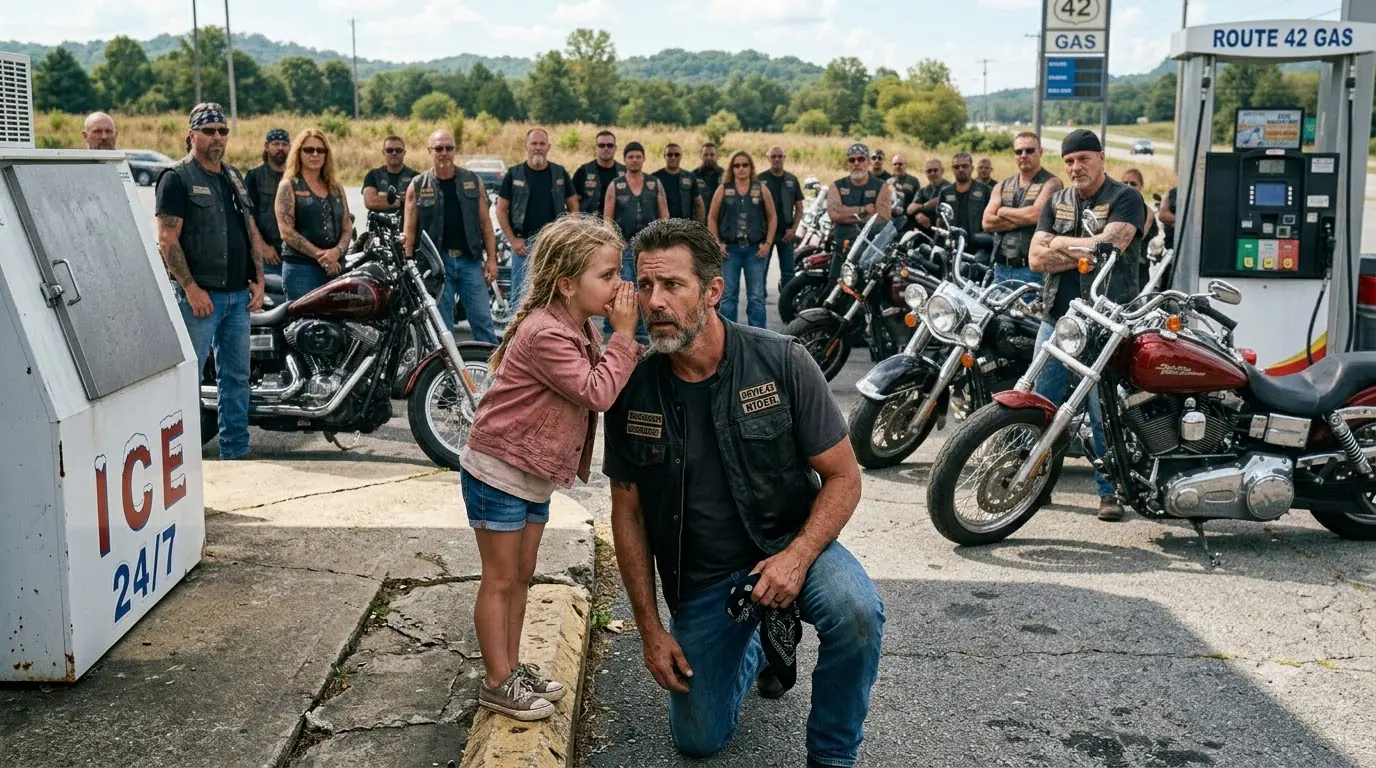
The kind of red that looks like it is trying to warn you.
Behind it, a ten-year-old girl had been missing for four days.
Seven hundred bikers lined every back road in the county, engines rumbling in the dark, waiting for a single word through their radios.
But none of this would have happened if a seven-year-old girl had not walked up to a complete stranger at a gas station, a man covered in tattoos and leather, the last person anyone would trust with a child’s life, and whispered six words that changed everything.
“I know where they hid her.”
What she told him next sent seven hundred motorcycles into the night.
The August heat in Ridgewood, Tennessee, pressed down on the cracked asphalt of Route 42 like a hand holding the whole town underwater. The air smelled of hot tar and cut grass, and the cicadas screamed from the tree line with a fury that made the silence between their bursts feel heavier.
Ridgewood was the kind of town that lived and died by its seasons.
Slow winters that emptied the streets by 6:00, and summers so thick with humidity that even the dogs refused to leave the shade of the porches.
At the Crossroads Fuel Stop, three miles south of the town square, Cole Harrington swung his leg off his black Harley-Davidson and pulled the bandana from his neck, wiping the sweat that had collected in the creases of his forehead.
He was forty-four years old, and the road had written its autobiography across his face. Deep lines framed his mouth. His salt-and-pepper beard was trimmed close, but uneven in places where he had stopped caring.
His leather vest carried the patches of the Iron Ridge Motorcycle Club, a roaring engine stitched in silver thread over a mountain ridge, with the words Ridgewood, TN curved beneath it.
His hands were rough, scarred across the knuckles from years of engine work.
To anyone glancing from across the parking lot, he was exactly what they expected to see, and exactly what they expected to avoid.
Cole filled his tank without hurry.
The fuel pump clicked and hummed.
A woman at the next pump glanced at him, then looked away quickly, pulling her purse closer to her body.
He noticed.
He always noticed.
He had stopped letting it bother him somewhere around his thirty-eighth birthday, when he realized that people would always see the leather before they saw the man.
Inside the gas station, the air conditioning hit him like walking into a different season. He grabbed a bottle of water and a pack of beef jerky, nodding to the teenager behind the counter who barely looked up from his phone.
A television mounted on the wall was playing the local news with the volume turned low.
Cole caught a flash of a photograph, a school portrait of a girl with brown hair and a shy smile, before the segment changed.
He had seen that photograph on every telephone pole between there and the town square.
Lily Ashford.
Ten years old.
Missing since Monday.
Through the window, he could see the Blue Ridge foothills shimmering in the distance, their edges softened by the haze.
That was when he saw her.
She was sitting on the curb outside near the ice machine, her knees pulled up to her chin.
A small girl, maybe six or seven, with blond hair tied in messy braids that were coming undone on one side. She wore a faded pink jacket despite the heat, the kind of jacket a child puts on not for warmth, but for comfort.
A familiar weight against the world.
Her sneakers had holes near the toes.
She was alone.
Cole stepped outside and scanned the parking lot.
No anxious parent rushing toward her.
Just the girl, the curb, and the brutal Tennessee sun.
A truck rumbled past on Route 42, its air horn blasting, and the girl did not flinch.
He crouched down three feet away from her, keeping his distance the way you would with a stray cat you did not want to frighten.
“Hey there,” he said.
His voice was low and rough, the kind of voice that sounded like gravel even when he was being gentle.
“You waiting on somebody?”
The girl looked up at him.
Her eyes were green, wide, and far too still for a child her age.
There was no fear in them.
That was the first thing Cole noticed, and it unsettled him more than fear would have.
She studied his face, his patches, and his tattooed forearms with the careful attention of someone who had learned to read adults before trusting them.
She did not answer his question.
Instead, she stood up, walked toward him, and leaned close.
Her small hand gripped the edge of his vest, and she rose on her tiptoes until her mouth was near his ear.
“I know where they hid her,” she whispered.
Cole felt the words land somewhere deep in his chest, in a place he had kept locked for five years.
He pulled back slowly and looked at the girl’s face.
She was not playing.
She was not confused.
Her eyes held the kind of certainty that children carry when they have seen something they were never supposed to see.
“Who?” Cole asked.
“Lily,” the girl said. “They took Lily, and I know where she is.”
Cole’s pulse shifted.
He had heard about Lily Ashford.
Everyone in Ridgewood had.
A ten-year-old girl who had vanished from her front yard four days ago while her father was inside making dinner. The search had consumed the town. Flyers on every lamppost. Volunteer teams combing the woods. A press conference where Glenn Ashford had broken down on camera, unable to finish his sentence.
The police had leads but no answers.
The town had prayers but no peace.
And now this child, this small quiet child sitting alone outside a gas station, was telling Cole Harrington she knew.
He took a slow breath.
He looked around once more.
Still no parent in sight.
“What’s your name?” he asked.
“Harper,” she said.
“Okay, Harper. Where’s your mama?”
“Working. She works at the diner until dark.”
Cole nodded.
He pulled out his phone and did the only thing that felt right.
He called Frank Brennan.
Frank Brennan answered on the second ring.
His voice was the deep, measured tone of a man who had spent twenty years in the Marine Corps before ever throwing a leg over a motorcycle. Frank had led convoys through deserts, briefed commanders under fire, and buried friends whose names he still whispered on their birthdays.
Nothing rattled him.
But Cole heard the shift in his breathing when the words registered.
“What’s going on, Cole?”
Cole kept his eyes on Harper while he spoke.
She had sat back down on the curb, her hands folded in her lap, watching a line of ants march across a crack in the concrete. She seemed patient in a way that no seven-year-old should be.
The kind of patience that comes not from peace, but from practice.
From waiting in too many rooms where adults were too busy to notice her.
“I’m at the Crossroads Station on 42. There’s a little girl here. Says her name’s Harper. She’s alone, Frank, and she just told me she knows where Lily Ashford is.”
The silence on the other end lasted three full seconds.
“You believe her?”
Cole looked at Harper again.
She was not fidgeting.
She was not crying.
She was sitting perfectly still, as if she had been carrying this secret for days and had finally found someone she was willing to hand it to.
“Yeah,” Cole said. “I do.”
“Don’t move. I’m calling Welden.”
Detective Patricia Welden arrived at the gas station twenty-two minutes later in an unmarked sedan, her badge clipped to her belt and her expression set in the careful neutrality of someone who had been running on three hours of sleep for four consecutive days.
She was thirty-eight, with sharp features and dark hair pulled back tight.
She had been the lead on the Ashford case since the first night, and the weight of it had settled into the skin beneath her eyes.
She had interviewed forty-six people, searched twelve properties, and followed every lead into every dead end.
She approached Cole first.
Her gaze moved over his vest, his patches, his boots, and Cole saw the calculation happen in real time.
The same calculation everyone made.
“Mr. Harrington,” she said.
It was not unfriendly, but it was not warm.
“Frank Brennan called the station. Said you have information about the Ashford girl.”
“Not me,” Cole said.
He gestured toward Harper, who was now standing behind his left leg, one hand gripping the leather of his vest again.
“Her.”
Welden crouched down to Harper’s level. Her voice softened, but her eyes stayed sharp.
“Hi, sweetheart. I’m Detective Welden. Can you tell me what you told this man?”
Harper looked up at Cole, then back at Welden.
She shook her head slowly.
“I told him,” Harper said. “I only told him.”
Welden stood up and pulled Cole aside, lowering her voice.
“She won’t talk to me. Has she said anything specific? A location? A vehicle?”
“She said she knows where they hid Lily. That’s all she gave me before you got here. She trusts me for some reason. I’m not going to break that.”
Welden studied him for a long moment.
Cole met her eyes without blinking.
“I know what you see when you look at me,” Cole said evenly. “But right now, that little girl chose to talk to me. Not you. Not her teacher. Not her mother’s co-workers. Me. So either we work together, or we stand here arguing while a ten-year-old girl is still out there somewhere.”
Something shifted behind her eyes.
Not trust.
Not yet.
But pragmatism overtaking prejudice.
“Fine. You stay with her. You ask the questions. But everything she says comes to me immediately. No side missions. No club business. Agreed?”
“Agreed.”
Cole walked back to Harper and sat down on the curb beside her.
The concrete was hot through his jeans.
He did not ask her anything right away.
He just sat there, letting the silence do its work, the way his own father had taught him to do with horses that had been spooked.
His father, a farrier in Knoxville, used to say that trust is not a door you push open. It is a door that opens toward you, and you have to stand still long enough for it to swing.
After two full minutes, Harper spoke.
“My mama and me live on Birch Lane. Lily lives across the street. She’s my friend. She’s the only one at school who sits with me at lunch because the other kids say my clothes smell like the diner.”
Cole’s throat tightened, but he kept his face steady.
“Four days ago, I was in my room. My window looks at Lily’s yard. I saw a white van pull up. Two men got out. They talked to Lily, and she went with them. She looked scared, but she went. She kept looking back at her front door like she was hoping her daddy would come out.”
“Did you know the men?”
Harper shook her head.
“But I saw the van again yesterday. It was parked behind the old Garrett farm on Millstone Road. The barn with the red door. I was riding my bike on the trail behind the creek, and I saw it through the fence. Same van, same dent on the back bumper.”
Cole felt the air leave his lungs.
He turned to Welden, who was standing six feet away, listening.
Their eyes met.
Welden’s face had gone pale.
She was already reaching for her radio.
“I need units at the Garrett property, Millstone Road,” Welden said, her voice tight and controlled. “Possible location on the Ashford girl. I need backup, and I need it quiet.”
Cole looked down at Harper.
“Why didn’t you tell your mama?”
Harper’s small fingers picked at a thread on her jacket.
“Mama’s always tired. She works all day and comes home and falls asleep on the couch with her shoes still on. I tried to tell her, but she said I was making up stories.”
She paused.
“And the police came to our street on Tuesday, and I tried to talk to one of them, but he told me to go inside and let the adults handle it. He didn’t even look at me.”
Cole felt something crack open inside his chest.
A child had tried.
She had tried to do the right thing, and every adult in her life had turned away.
Her mother, too exhausted to listen.
A police officer, too busy to kneel down.
Every adult except the one covered in leather and engine grease at a gas station on a Thursday afternoon.
“You did the right thing, Harper,” Cole said quietly. “You did exactly the right thing.”
Within the hour, the situation had shifted from a whispered secret at a gas station to a coordinated operation that stretched across three counties.
Detective Welden worked the phones from her sedan, confirming property records for the old Garrett farm, cross-referencing the van description with motor vehicle databases, and requesting a warrant.
The afternoon light had turned golden, casting long shadows across the parking lot.
But Cole knew something that Welden did not.
Or perhaps she knew it, but could not say it out loud.
The Ridgewood Police Department had fourteen officers for a town of nine thousand people. Every deputy in the county had been working doubles since Monday.
Volunteers had dwindled after the third day, the initial surge of outrage giving way to the quiet assumption that someone else was handling it.
Cole called Frank again.
“The girl gave us a location. Welden’s moving on it. But Frank, they’re running on fumes. If this thing goes sideways, if Lily’s been moved, if the location is wrong, they’re going to need eyes and ears across every back road and dead-end hollow in the county.”
Frank was quiet for a moment.
Then he said the words that would change everything.
“I’ll make some calls.”
What happened over the next three hours would later be described by the Ridgewood Gazette as the largest civilian mobilization in the county’s history.
Frank Brennan did not just call the Iron Ridge chapter.
He called every motorcycle club president within a two-hundred-mile radius.
He called chapters in Knoxville, Nashville, Chattanooga, and Bristol. He called clubs that had rivalries with Iron Ridge and clubs that had never spoken to them.
He called retired riders and men who had not been on a bike in years, but who kept their leathers in the back of the closet the way some people keep a uniform.
Not out of nostalgia.
Out of readiness.
The message was simple.
A little girl is missing.
A little girl found her.
We ride.
By 5:00 that evening, the first wave arrived.
Forty-seven riders from the Stone Valley Brotherhood rolled into Ridgewood in a formation so tight that the rumble of their engines shook the windows of the hardware store on Main Street.
Behind them came twenty-three riders from the Mountain State Riders out of Knoxville.
Then eighteen from the Cumberland Sons.
Then thirty-one from a club in Nashville whose president shook Frank’s hand like they had known each other their whole lives.
They kept coming.
Trucks pulling trailers loaded with bikes. Men and women in leather and denim, with beards and bandannas and tattoos that told stories longer than most novels.
They filled the parking lot of the Ridgewood Community Center, then the lot of the Baptist church next door, then the shoulder of Route 42 for a quarter mile in each direction.
The sound of idling engines created a low, constant vibration that you could feel in the pavement, in your chest, in your teeth.
The air smelled of exhaust and hot asphalt and the particular electricity that gathers when hundreds of people converge on the same point with the same purpose.
Cole stood on the steps of the community center and watched them arrive.
He had been riding for fifteen years, had attended rallies and charity runs across six states, and he had never seen anything like this.
These were people the world called outlaws, misfits, troublemakers.
People whose appearance alone made mothers pull their children closer and store owners watch the security cameras with one hand on the phone.
And yet here they were, hundreds of them, dropping everything on a Thursday evening because a ten-year-old girl they had never met needed help.
No one had offered them money.
No one had promised them recognition.
They came because a child was missing, and that was enough.
Detective Welden stood beside Cole, her arms crossed, her expression caught somewhere between disbelief and cautious hope.
“This is either the best thing that’s ever happened to this case,” she said, “or the biggest headache of my career.”
“Why not both?” Cole said.
Welden almost smiled.
Inside the community center, Frank stood at a folding table with a county map spread out in front of him, its edges held down by coffee mugs.
His military training took over without effort, the way a language you learned as a child comes back when you hear it spoken.
He divided the riders into groups of ten, assigned each group a grid section covering every road and trail within a ten-mile radius of the Garrett property, and laid out the rules with the authority of a man who expected to be obeyed.
“We are here to help. We are not here to be heroes. You find something, you call it in. You do not approach. You do not engage. You report to Detective Welden’s team, and you hold your position. Anyone who goes rogue answers to me personally, and I promise you that is worse than anything the law can do to you.”
A murmur of laughter rippled through the room, but everyone understood.
Ray Prescott, the club’s sergeant-at-arms, pulled Cole aside near the coffee machine.
Ray was stocky and red-haired, with a childhood spent in seven different foster homes that had given him a radar for suffering that never switched off.
“How’s the kid?” Ray asked.
“Harper? She’s with her mother now. Welden sent an officer to the diner to bring Donna Caldwell in. She’s terrified. Didn’t realize what Harper had been trying to tell her.”
Ray shook his head.
“Kid tried to talk and nobody listened. Story of my life.”
“Mine, too,” Cole said quietly.
They both knew what Cole meant.
Five years ago, Cole’s daughter Emma had been nine years old. She had complained of headaches for weeks. Cole had told her to drink more water. His wife had told her to get more sleep.
By the time they took her to a specialist, the tumor was the size of a golf ball.
Emma died eleven weeks later, and Cole’s marriage did not survive the year.
He had been riding ever since, filling the silence with engine noise because the quiet reminded him of a hospital room where a little girl’s breathing slowed and then stopped.
Harper had walked up to him at that gas station and grabbed his vest.
For a moment, just one sharp, breathless moment, Cole had felt Emma’s hand again.
“You okay?” Ray asked.
“No,” Cole said. “But that’s not what matters right now.”
By 9:00, the count had passed six hundred.
The local news had picked up the story, and a helicopter circled overhead.
Ridgewood had never seen this many motorcycles. The town had never seen this many people care about the same thing at the same time.
And somewhere in the dark hills east of town, on a forgotten piece of farmland behind a barn with a red door, Lily Ashford was waiting.
At 10:15 that night, Detective Welden received confirmation that the warrant for the Garrett property had been approved.
She gathered her team in the back room of the community center.
Four deputies. Two state police officers from the Knoxville field office. And the county sheriff himself, Douglas Barrett, who had driven in from the county seat with his jaw set tight.
The room smelled of burnt coffee and nervous sweat. A fluorescent light buzzed overhead, casting everyone’s face in a pale, unflattering glow.
Welden briefed them with the precision of someone who had rehearsed every word in her head during the drive, tested every sentence for gaps, and found none she could afford.
“The property is eighty-seven acres, mostly wooded. The main structure is a farmhouse that’s been vacant for six years since Walter Garrett passed. Behind it, approximately two hundred yards east, is a barn with a red painted door. That’s our target based on the witness description.”
She pointed to the map.
“The property records show no active lease, no utility accounts, no registered occupants. There’s a single access road off Millstone, unpaved, about a quarter mile long. We go in quiet. Headlights off for the last two hundred yards. No sirens, no radios until we have confirmation.”
Sheriff Barrett leaned forward.
“What about the army outside?”
Welden looked through the window at the sea of motorcycles.
“Seven hundred fourteen riders by the latest count. They hold the perimeter. Brennan’s got them organized covering every back road, fire trail, and logging path within a five-mile radius. If anyone tries to leave that area by vehicle, they will pass a checkpoint of riders who will radio our frequency.”
She paused.
“But they stay back. This is a law enforcement operation.”
She looked at Cole, who stood near the door with his arms crossed, his jaw tight.
“Harrington, you ride with me. If we find Lily in that barn, I want someone nearby who does not look like a uniform. Kids who have been through something traumatic sometimes shut down when they see badges. I need someone who looks like safety to a child, not authority.”
Cole nodded.
He did not trust his voice to say anything more.
His hands were trembling slightly, and he pressed them against his thighs to keep them still.
The convoy moved out at 10:40.
Welden’s sedan led, followed by two patrol cars with their lights off, and the sheriff’s truck. Behind them, at a distance of one mile, sixty riders followed in tight formation, their headlights cutting through the dark like a slow-moving constellation.
The rest spread out across the county.
Groups of ten fanned out to assigned positions, their presence turning every back road into a watched road.
A man on a motorcycle parked at an intersection.
Another pair near the old covered bridge.
Three more at the gas station on Highway 9.
Every exit, every route, every path that a vehicle could take was covered by someone who had driven hours to be there for a girl whose name they had learned only that evening.
The Garrett property appeared through the trees like a wound in the landscape.
The farmhouse was collapsing in on itself, its windows dark and broken.
But behind it, across a clearing of tall grass, the barn stood intact.
Its walls were weathered gray.
But the door was red.
Faded and peeling, but unmistakably red.
And parked beside the barn, half hidden beneath a canvas top, was a white van with a dent in the rear bumper.
Cole’s chest tightened.
Harper had been right.
Every detail.
A seven-year-old girl on a bicycle had seen what an entire police department had missed.
Welden killed her headlights and rolled to a stop two hundred yards from the barn.
The deputies fanned out, moving through the tall grass with their flashlights off.
The night was thick with cricket song and the distant steady pulse of motorcycle engines holding their positions on the surrounding roads.
A sound like a heartbeat.
Cole stayed by the car, his hands gripping the doorframe, every muscle screaming at him to move, to run, to tear that red door off its hinges.
But he had given his word.
This was Welden’s operation.
He was here because a seven-year-old girl had trusted him.
He was not going to betray that trust by becoming the reckless biker everyone expected him to be.
He would stand still.
He would wait.
He would let the door open toward him.
Then Welden’s voice came through the radio, sharp and clear.
“We have her. She’s alive. Requesting medical immediately.”
Cole’s knees buckled.
He caught himself on the car door and pressed his forehead against the cool metal.
His breath came out in a ragged exhale that carried five years of grief and four days of desperate hope.
Inside the barn, the deputies found Lily Ashford sitting on a cot in a small room partitioned off with plywood walls. She was thin and pale, with dark circles under her eyes, but she was conscious and responsive.
She had water bottles, canned food, and a battery-powered lantern. She had wrapped herself in a wool blanket and was drawing on the back of a cereal box with a crayon.
The two men responsible were identified through the van’s registration and fingerprints found inside the barn.
They were apprehended at a motel forty miles east before sunrise, found by a state patrol unit tipped off by a group of riders who had noticed a vehicle matching the description.
The riders called it in exactly as Frank had instructed.
No approach.
No confrontation.
Just information passed to the proper channels.
Welden walked Lily out of the barn wrapped in a silver shock blanket, the girl’s brown hair falling over her face, her small hand gripping the detective’s fingers.
An ambulance waited at the end of the access road, its lights painting the trees red and blue.
Glenn Ashford arrived twelve minutes later.
He had been waiting at the community center, unable to sit or stand, pacing the same twelve feet of linoleum until the tiles were scuffed.
When he saw Lily step out of the ambulance, alive, standing, wrapped in that silver blanket, he made a sound Cole had never heard a human being make.
Somewhere between a laugh and a cry and a prayer.
From a place so deep it did not have a name.
He dropped to his knees on the gravel, and Lily ran to him.
They held each other while seven hundred riders stood in the darkness and said nothing.
Because there was nothing to say that was better than what they were seeing.
Cole stood apart, his back against his motorcycle, his eyes burning.
He thought about Emma.
About how he had not been able to save her.
About how no amount of riding could outrun the fact that his little girl was gone and he had not listened when she told him her head hurt.
But tonight, a different little girl had spoken.
And this time, someone had listened.
Three days after Lily Ashford was found, Ridgewood held a community gathering at the park behind the library.
It was not planned by the mayor’s office or the chamber of commerce.
It was organized by Margaret Hensley, the seventy-one-year-old woman who lived across the street from the Ashfords and who had spent four days baking casseroles for Glenn while he waited for news about his daughter.
Margaret had called the library, reserved the pavilion, and posted a single flyer at the grocery store that read:
Thank You Gathering.
Saturday, 2:00 p.m.
Everyone welcome.
Bring a chair.
By 2:00, three hundred people filled the park.
Families with strollers. Teenagers sitting on the grass. The high school marching band director brought a portable speaker and played instrumental music. The hardware store owner brought lemonade in two ten-gallon coolers.
And among them, scattered through the crowd like stones in a river, were riders from Iron Ridge and a dozen other chapters who had not yet gone home.
Cole almost did not come.
He had spent two days alone in his apartment above the repair shop on Willow Street, sitting in the chair by the window where Emma used to read, feeling the strange emptiness that follows the end of something consuming.
The adrenaline was gone.
The purpose was gone.
And what remained was the same silence that had been there before Harper grabbed his vest.
But Ray showed up at his door at 1:30 with two coffees and a look that said he was not leaving without Cole.
“You don’t get to disappear,” Ray said. “Not today.”
So Cole went.
The park smelled like fresh-cut grass and barbecue smoke.
Children chased each other around the playground.
Cole sat on a bench near the edge of the pavilion. Frank was there, near the drink table, talking with Sheriff Barrett.
The two men shook hands, and Cole noticed that Barrett’s grip lingered.
A handshake between a badge and a patch that acknowledged the distance between them was smaller than either had believed.
Detective Welden found Cole on his bench.
Without the badge energy, she looked different.
Younger.
More tired.
More human.
“Mind if I sit?” she asked.
“Free country.”
She sat down and stretched her legs out.
“The men who took Lily have been charged. Both of them. Multiple counts. Federal charges are being added because they crossed state lines. The evidence from the barn, the van, the forensics, it’s solid. They’re not getting out.”
Cole nodded.
“I owe you an apology,” Welden said. “When I pulled up to that gas station and saw you standing there in your vest, I had already decided who you were. I had you categorized before I heard a single word. That was wrong, and it almost cost me the most important lead in this case.”
Cole looked at her.
“You did your job. You were skeptical. That’s what good detectives do.”
“Good detectives also listen. I almost didn’t.”
They sat in silence watching the crowd.
“How’s Harper?” Cole asked.
Welden smiled, the first real smile Cole had seen from her.
“She’s something else. We did a full interview, child psychologist present. She was calm, detailed, precise. She gave us descriptions, timelines, the license plate number, and distinguishing marks on the van. That kid has the observational skills of a trained investigator. She tracked its movements on her bicycle over three days and mapped the route to the Garrett farm in her head.”
“Seven years old.”
“She tried to tell people,” Cole said. “Nobody listened.”
“I know. That’s the part that keeps me up at night. We had officers canvassing that street. One of them told a seven-year-old to go inside and let the adults handle it. If he had stopped for two minutes, just two minutes, and asked her what she wanted to say, we might have found Lily days earlier.”
Cole watched a group of children running across the grass.
Among them, he spotted a small figure in a pink jacket, blond braids bouncing.
Harper.
Beside her, holding her hand, was a girl with brown hair and a shy smile.
Lily.
They were playing some game that involved running to a tree and back, and every time they reached the tree, they collapsed into giggles.
Something cracked open in Cole’s chest, but this time it did not feel like grief.
It felt like air filling a room that had been sealed shut for years.
Donna Caldwell approached Cole ten minutes later.
She was a thin woman with tired eyes and calloused hands. She stood in front of him, twisting her fingers together.
“I’m Harper’s mother,” she said.
“I know.”
“She tried to tell me about Lily, about the van, about everything she saw, and I was so tired from working sixteen-hour days that I told her she was making up stories.”
Her voice cracked.
“What kind of mother says that?”
“The exhausted kind,” Cole said gently. “The kind that’s working two shifts to keep the lights on. You didn’t fail her. You were surviving.”
Donna pressed her hand over her mouth and cried quietly.
Cole did not say anything because some moments do not need words.
They need presence.
When she composed herself, she looked at him with red-rimmed eyes.
“She talks about you every day since Thursday. She calls you the man who listened.”
Cole felt the words settle into his bones.
The man who listened.
He had spent five years wishing he had listened to his own daughter.
And now a different child had given him a name that meant exactly that.
Later that afternoon, as the sun descended behind the Blue Ridge foothills, painting the sky in amber and rose, Cole walked to his motorcycle in the library parking lot.
He ran his hand over the leather seat and looked out at the town that had changed around him.
Or maybe it was he who had changed within it.
Frank appeared beside him with two bottles of water.
“Seven hundred fourteen riders,” Frank said. “Final count. Eleven clubs across four states. Some drove six hours. Some had never met each other. A few were clubs with serious disagreements. Didn’t matter. Not that night.”
“All because of a seven-year-old girl,” Cole said.
“All because a seven-year-old girl trusted the right man.”
Cole took a slow drink of water.
The mountains were turning purple in the distance.
“I kept thinking about Emma,” Cole said.
It was the first time he had spoken her name aloud in months.
“When Harper grabbed my vest, for one second, I felt Emma’s hand. And I thought, maybe this is why. Maybe all the riding, all the years on the road, all the miles I put between myself and that hospital room, maybe it was all leading to that gas station. To that little girl who needed someone to listen.”
Frank did not respond with platitudes.
He put his hand on Cole’s shoulder and squeezed once, firm and brief, the way men do when words are too small for what they mean.
As Cole kicked his motorcycle to life and pulled onto Route 42, the rumble of the engine felt different.
It was no longer the sound of running away.
It was the sound of a man riding forward, carrying with him the weight of what he had lost and the grace of what he had found, and understanding for the first time that both could exist in the same chest without one destroying the other.
Behind him in the park, Harper Caldwell held Lily Ashford’s hand and watched the motorcycles disappear down the road, their taillights glowing like a string of red stars stretched across the darkening Tennessee sky.
She did not wave.
She just watched with those wide green eyes that saw everything and smiled the quiet smile of a child who had learned something most adults never do.
That the people who look the scariest are sometimes the ones who listen the closest.
And that a whisper, if it reaches the right ear, can move the whole world.