Three hundred bikers stood in the California desert heat, and not one of them made a sound. Not a whisper, not a cough, not the shuffle of a single boot on asphalt.
On the porch in front of them, a seven-year-old girl was doing something that should not have been remarkable. She was sitting down.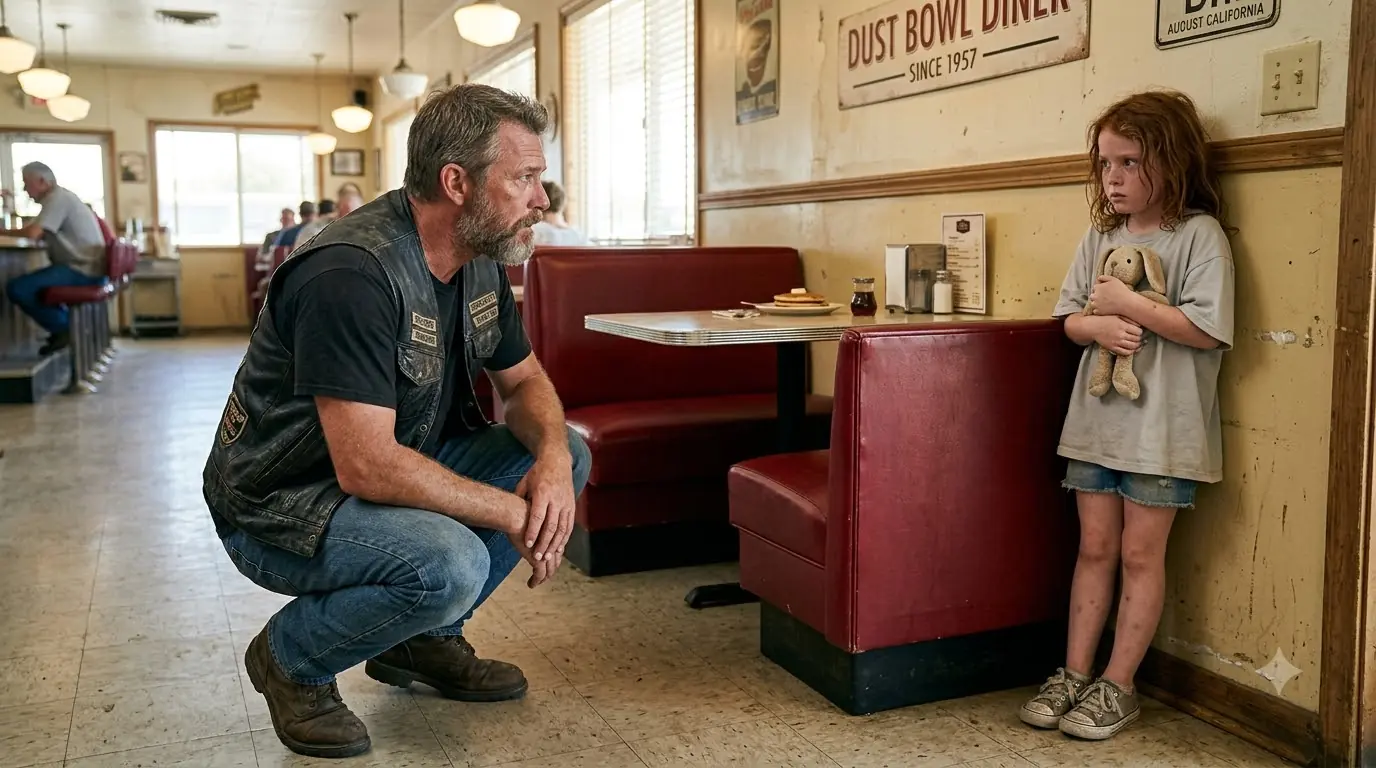
But for Shelby, sitting down was the one thing her body had learned to refuse. It had started two days earlier, when a biker named Hank Mercer walked into a roadside diner and found a little girl standing against a wall, clutching a stuffed rabbit and waiting for someone who was never coming back.
When he asked why she would not sit, her answer changed everything.
The August heat in Ridgecrest, California, did not ask permission. It arrived before dawn and stayed long past sunset, baking the high desert floor until the asphalt on China Lake Boulevard shimmered in the distance.
By ten in the morning, the air above the Mojave tasted like iron and dust. The few people moving along the sidewalks did so quickly, ducking from one air-conditioned doorway to the next.
Hank Mercer pulled his Harley Road King into the gravel lot of the Dust Bowl Diner and killed the engine. The silence that followed was immediate and heavy, broken only by the ticking of hot metal and the distant drone of a jet climbing into the desert sky.
He swung his leg over the seat and stood for a moment, stretching the stiffness from his lower back. Forty-seven years had put a permanent ache in his spine that no amount of riding could shake loose, though he kept trying.
The Dust Bowl was the kind of place that seemed to exist in every small desert town. It was a flat-roofed cinder-block building with sun-bleached paint, a neon sign that had not worked in decades, and a parking lot that saw more motorcycles than minivans.
Ruth Perkins had run the place for thirty years and had a simple philosophy: strong coffee, honest food, and no questions unless someone wanted to talk. That philosophy had made the diner the unofficial gathering point for the Desert Kings Motorcycle Club.
Hank pushed through the glass door and felt the wall of cold air hit his face. The bell above the door chimed once.
Inside, the diner was half full. A couple of truckers sat at the counter, an elderly man read a newspaper in a far booth, and two of Hank's brothers from the club, Ray Simmons and Eddie Brandt, were hunched over plates of eggs and bacon near the window.
"Mercer," Ray called, lifting his coffee cup in greeting. "Thought you were riding down to Bakersfield today."
"Changed my mind," Hank said, sliding into the booth across from them.
"Transmission's making a noise I don't like. Figured I'd let it cool before I push it."
Ruth appeared at his elbow with a mug of coffee before he had fully settled. She was tall, with silver hair pulled back tight, reading glasses perched on the bridge of her nose, and hands that moved with the practiced efficiency of someone who had poured more cups of coffee than she could count.
"The usual?" she asked.
"Please."
She nodded and turned, then paused. Her eyes shifted toward the back of the diner near the hallway leading to the restrooms.
Hank followed her gaze. A little girl stood against the wall.
She was small, seven or eight at most, with tangled auburn hair falling past her shoulders in uneven waves. She wore an oversized T-shirt that hung almost to her knees and sneakers scuffed nearly down to the rubber.
She stood perfectly still, her back pressed flat against the wall and her arms wrapped around a stuffed rabbit that had lost most of its fur to years of squeezing.
"She's been standing there almost an hour," Ruth said quietly, leaning closer to Hank.
"Came in with a woman earlier. The woman went to the restroom and told her to wait."
"That was forty minutes ago."
Hank frowned. "The woman come back?"
"Went out the back door. I saw her car pull out of the lot."
"I tried to get the girl to sit down and eat something. She won't sit."
"She just stands there holding that rabbit."
Hank looked at the girl again. She was not crying, and she was not fidgeting the way children do when they are bored or restless.
She was unnervingly still, watching the room with eyes that tracked every movement like a small animal deciding whether to freeze or run.
"She say anything?" Hank asked.
"Her name. Shelby."
"That's all I got out of her."
Ruth went to put in his order, and Hank sat with his coffee watching Shelby from across the room. There was something about the way she stood, not leaning or slouching, but pressed against the wall as if it were the only solid thing in her world.
There was also the way she held the rabbit. Not like a toy, but like a shield.
Hank had seen that posture before, though not often on a child. He had seen it in people who had learned that the world was something to brace against rather than lean into.
After ten minutes, he could not sit with it anymore. He picked up his coffee and walked slowly toward the back of the diner, making sure his boots were loud enough on the tile that Shelby could hear him coming.
He stopped about six feet away and lowered himself into a crouch, bringing his eyes level with hers.
"Hey there," he said, keeping his voice low and even.
"I'm Hank. Ruth says your name's Shelby."
"That right?"
The girl looked at him. Up close, he could see freckles scattered across her nose and cheeks and dark circles beneath her eyes that no seven-year-old should have carried.
She nodded once, barely.
"That's a good rabbit you've got," Hank said. "He got a name?"
A pause followed, then a voice so quiet he almost missed it.
"Captain."
"Captain. That's a solid name."
Hank took a slow sip of coffee.
"Listen, Shelby, Ruth makes the best pancakes in the whole Mojave Desert. You hungry?"
"I could have her bring you a short stack. You could sit right here in this booth and—"
"I can't sit down."
The words came out fast and flat, like a fact she had rehearsed. Not a complaint, not a request for help, just a statement.
Hank felt something shift in his chest. The noise of the diner seemed to pull away until there was nothing but the little girl and those four words.
"You can't sit down," he repeated carefully. "Why not, sweetheart?"
Shelby's arms tightened around Captain. Her eyes dropped to the floor, and she said nothing.
Hank did not push. He had learned at least that much from the people he had met on the road and from the daughter he had once failed to listen to until she stopped talking to him altogether.
He stood slowly, told Shelby he would be at his booth if she needed anything, and walked back to his seat. But he did not eat.
When Ruth brought his plate, he stared at it like it was written in a language he could not read.
"You all right?" Ray asked.
"That kid can't sit down," Hank said.
Ray glanced toward the back wall. Eddie looked, too.
Neither of them said anything for a moment, because in a life lived close to the margins, people learn to hear the words behind the words.
"Can't or won't?" Eddie asked finally.
"She said can't."
The silence at the table lasted longer than it should have. Ray set down his fork, and Eddie rubbed his jaw.
These were men in their forties and fifties who had seen the underside of the American landscape, places where polite society's promises wore thin. They understood that a seven-year-old saying she could not sit down meant more than simple discomfort.
"I'm going to call Ruth over," Hank said.
Ruth came, wiping her hands on her apron, and Hank asked her to sit. She glanced toward Shelby and lowered her voice.
"The woman who brought her in was mid-thirties, thin, brown hair. She looked like she hadn't slept in a week."
"Ordered a coffee and didn't drink it."
"She told the girl to stand right there and wait, then went to the restroom. I thought she was coming back."
Ruth paused.
"She left through the back. I saw her Pontiac pull out fast, heading south on the boulevard."
"You recognize her?" Hank asked.
"No, but the girl I've seen before. A few months back, she was in here with a man."
"Buzz cut, clean-shaven, wore a work shirt from Tate Salvage out on Inyokern Road."
"He ordered for both of them. She didn't say a word the entire time and looked tense the whole meal."
Ruth's eyes hardened behind her reading glasses.
"I remember thinking it was strange. Now I'm thinking it was more than strange."
Hank turned and looked at Shelby again. She had not moved.
She stood with her back against the wall, Captain pressed to her chest, her eyes fixed on the front door as if she expected someone to walk through it and was terrified of who it might be.
"Ray, call Dwight," Hank said quietly. "Tell him I need him down here."
"Hank?"
"Just call him."
Ray pulled out his phone and stepped outside. Eddie moved to a stool at the counter where he could keep an eye on the front door without making it obvious.
Ruth poured a glass of milk, carried it to Shelby with a plate of crackers, and placed both on the narrow window ledge beside her at standing height. She said nothing, only gave the girl a small nod and walked away.
Hank watched Shelby study the milk for a long time before reaching for it. She drank with one hand while the other still clutched Captain.
When she set the glass down, a thin line of milk traced her upper lip, and for just a moment she looked like exactly what she was: a little kid. Then the watchfulness returned.
Twenty minutes later, a black Harley Street Glide rumbled into the lot. Dwight Calloway walked through the door slowly, scanning the room, taking inventory of every face and every exit before committing to a direction.
He was fifty-two, six-foot-three, with a shaved head and a gray goatee trimmed close. His leather vest hung over a plain black T-shirt, and his arms were sleeved in tattoos that told the story of decades lived hard.
He slid into the booth across from Hank without a word. Hank told him everything.
He told him about Shelby, the woman who had left, Ruth's observations, and the four words that had rearranged something fundamental in his thinking.
Dwight listened completely and without interruption. When Hank finished, he turned his head and looked at Shelby.
She was watching them. Her eyes met Dwight's, and something passed between them—not recognition, but assessment.
She was measuring him the way a child who has learned to be afraid measures every adult in a room, calculating threat and distance to the nearest door.
Dwight turned back to Hank. "What do you want to do?"
"I want to find out who she belongs to. I want to know why a woman drops a seven-year-old in a diner and drives away."
"And I want to know why that child can't sit down."
"You know what you're walking into?"
"Yeah, I do."
Dwight nodded once, pulled out his phone, and sent a message to twelve people, the chapter's core members, the ones who showed up when things mattered.
The message was simple: "Dust Bowl, now."
Within the hour, a dozen motorcycles lined the gravel lot. Leather-vested men filed into the diner one by one, ordering coffee they barely touched and taking seats they did not need.
They filled the space with a presence that was less about intimidation than declaration: We are here. We are paying attention.
At the back of the diner, Shelby watched them all. For the first time in a long time, she did not flinch every time a man walked past her.
Ruth closed the diner to the public at noon. She flipped the sign to CLOSED, locked the front door, and lowered the blinds without discussing it with anyone.
The twelve Desert Kings sat in booths and at the counter while Hank laid out what they knew, which was not much, and what they suspected, which was enough to make every man in the room go still.
"I called a friend at the county," Dwight said.
"Tate Salvage is registered to a Glenn Tate. He's got a place on the south end of town, off South China Lake."
"No record, no warrants, clean on paper."
"Paper doesn't mean clean," said Boyd Hensley from the counter.
Boyd was the club's sergeant-at-arms, a compact, muscular man with a face shaped by a rough life. He had spent years proving to himself and others that the worst thing he had ever done did not have to be the final word on who he was.
"No, it doesn't," Dwight agreed.
Hank looked toward the back of the diner. Ruth had set up a small space for Shelby near the kitchen with a blanket, pillow, another glass of milk, and a plate of food.
Shelby stood beside it. She had eaten some crackers and a few bites of a sandwich, but she would not lie down and she would not sit.
She stood with Captain in her arms, swaying slightly the way exhausted children do when their bodies beg for rest but something stronger than tiredness keeps them upright.
Hank walked over and knelt again, keeping his distance.
"Shelby, you must be real tired. You could lie down on your stomach on that blanket there."
"You don't have to sit."
"Just lie on your tummy and rest. Captain could rest, too."
Shelby looked at the blanket, then at Hank. Something in her face shifted just enough—not trust, not yet, but the absence of active fear.
She lowered herself carefully to her knees and eased onto her stomach, wincing as she moved. She laid Captain beside her head and rested her cheek on the pillow.
The small reaction was enough. Hank saw it, Ruth saw it, and several of the men noticed the concern on Hank's face when part of Shelby's lower back became visible beneath the oversized shirt.
There were signs that she had been hurt. Hank stood and turned away so the girl would not see his expression.
He walked to the counter and gripped the edge with both hands. Ruth appeared beside him.
"I saw," she whispered.
Hank could not speak for a moment. When he finally did, his voice sounded strange in his own ears.
"Call the sheriff's department. Ask for someone who handles cases involving children."
"Someone who knows what they're doing."
"Already did," Ruth said.
"Deputy Walsh is on her way. Twenty minutes."
Hank nodded and looked down at his hands. They had rebuilt engines, gripped handlebars through rainstorms and desert winds, and done a hundred hard things.
They had never felt as useless as they did in that moment.
When Hank turned back to the room, every man was looking at him. They had seen him turn away, and they had read his face.
The diner filled with a silence unlike the quiet of an empty room. It was the silence of twelve men confronting something that made the hardest parts of their own lives seem small.
"The woman who dropped her off," Hank said, his voice steady again. "Ruth said she headed south."
"I think she was trying to leave the girl somewhere safe. Somewhere she'd be found."
"You think the mother dropped her?" Dwight asked.
"I think a mother who couldn't protect her daughter did the only thing she could think of. She put her in a room full of strangers and prayed someone would look closely enough to see what she couldn't say out loud."
The silence held.
Boyd spoke first. "What do we do?"
"We wait for the deputy. We let the law do what the law does."
"And we make sure that little girl knows every man in this room sees her."
"And if the law isn't enough?" Boyd asked.
It was not a threat. It was a genuine question from a man who had seen systems fail often enough to know good intentions did not always survive contact with procedure.
"Then we figure out what is," Hank said.
"But we do it right. We do it so that girl has a future, not just a rescue."
Deputy Karen Walsh arrived eighteen minutes later. She was a steady-eyed woman in her mid-thirties with brown hair pulled back in a practical bun and a manner that was professional without being cold.
She spoke to Shelby alone with Ruth present in the small office behind the kitchen. She was in there for forty-five minutes.
When Walsh came out, her expression was controlled, but Hank could see the tension in her jaw and the way she held herself as though she needed something solid beneath her feet.
"I've called Child Protective Services," she told Hank and Dwight.
"A caseworker is coming from Bakersfield. I'm going to need to talk to the stepfather."
"Glenn Tate," Dwight said.
Walsh looked at him. "You know him?"
"We know the name. That's all."
"Keep it that way," Walsh said.
It was not a request.
Hank nodded, but as Walsh walked back to her patrol car to radio dispatch, he felt the cold weight behind his ribs grow heavier. He knew how slow paperwork, investigations, home visits, and assessments could feel when a child was waiting for safety.
He looked through the diner window. Shelby was still lying on her stomach on the blanket with Captain tucked under her chin, her eyes open and watching the door.
The Desert Kings MC annual gathering had been planned for months. Every summer, chapters from across California, Nevada, and Arizona converged on Ridgecrest for a weekend of riding, brotherhood, and organized chaos.
This year, three hundred riders were expected. They would fill the parking lots of the Desert Rose Motel, line motorcycles along China Lake Boulevard, and turn the Dust Bowl Diner into a temporary headquarters smelling of leather, engine oil, and black coffee.
The gathering was scheduled for Saturday. It was now Thursday.
During the next two days, events unfolded with the grinding, methodical pace of institutional machinery.
Deputy Walsh interviewed Glenn Tate at his home. He was cooperative, polished, and convincing, presenting himself as a concerned stepfather who claimed his wife, Lorraine, had been behaving erratically and had taken Shelby without telling him.
He expressed worry and asked when his stepdaughter would be returned.
The CPS caseworker, Dennis Pratt, looked exhausted but acted quickly. He placed Shelby in emergency foster care with Bill and Margaret Overton, a retired Ridgecrest couple who had fostered eleven children over the previous decade.
Their home was known for warmth, structure, and patience, exactly what Shelby needed.
Lorraine Tate was also found. Deputy Walsh located her at a motel in Trona, about thirty miles north, sitting on the edge of a bed in a room she had paid for with cash.
Lorraine was thin, exhausted, and trembling. When Walsh sat across from her and asked her to explain, the story came out in fragments.
Not because Lorraine did not want to tell it, but because some truths have to be assembled from broken pieces.
She spoke about years of control and escalating cruelty, and about realizing that the man she had married had begun directing that cruelty toward her daughter. She spoke about finding Shelby standing in the kitchen before dawn because resting normally had become too uncomfortable.
She described the helplessness of knowing something was wrong and feeling powerless to stop it, trapped by fear, isolation, and the belief that no one would help.
Then she told Walsh about the Dust Bowl. She had seen the motorcycles there and the big men in leather vests who looked like they were afraid of nothing.
In the desperate logic of someone who had run out of options, she decided that if she left Shelby among people who looked that strong, maybe they would be strong enough to protect her until someone official stepped in.
Walsh documented everything. Glenn Tate was arrested Thursday evening and booked into county custody on serious charges connected to Shelby's abuse.
Hank learned much of this from Walsh, who told him more than she normally would have because she had seen something in that diner. A room full of men who looked intimidating at first glance had treated a frightened child with extraordinary gentleness.
Saturday morning, the gathering began. Riders came from Bakersfield and Barstow, Las Vegas and Tucson, Fresno and Flagstaff.
They arrived on Harleys and Indians and custom bikes built by hand. They wore leather, denim, and boots that had crossed every kind of weather the Southwest could throw at them.
They were mechanics, welders, truck drivers, construction workers, fathers, sons, brothers, and uncles. They were three hundred men who had built their lives around the idea that the road was often more honest than the world on either side of it.
By noon, the Dust Bowl parking lot and the vacant lot beside it were filled with motorcycles arranged in long rows. Ruth had set up folding tables under canvas shade structures, and the air smelled of burgers, exhaust, and sunscreen.
Dwight stood on the bed of a pickup truck parked at the edge of the lot. He did not need a microphone.
When Dwight Calloway spoke, people listened. Not because he shouted, but because he had earned the kind of authority that did not require volume.
"Brothers," he said.
The word settled over the crowd like a hand on a shoulder.
"Most of you rode a long way to be here, and I appreciate that. Before we get to the business of the weekend, I need to tell you something."
He told them about Shelby. He did not use graphic language or describe the visible evidence of what she had endured.
He simply told them that a seven-year-old girl had been brought to their diner by a mother who had nowhere else to turn, that the girl could not sit down, and that the reason she could not sit was enough to remind every man present that responsibility could extend far beyond the road and the club.
Three hundred men went silent.
It was not only the silence of shock, though some were shocked. It was not only the silence of anger, though anger moved through the crowd like heat lightning.
It was the silence of recognition, the collective acknowledgement that the world they rode through was full of people who needed someone to see them, and that seeing was not enough if nobody acted.
Hank stood near the front of the crowd and watched the faces of men he had ridden with for years. Hard faces, scarred faces, faces that had stared down difficult lives without blinking.
He watched those faces change. Tough men blinked rapidly and looked away, jaws clenched, fists tightened, then slowly released.
Three hundred men reached the same conclusion without anyone needing to say it out loud.
Dwight let the silence hold for thirty seconds before speaking again.
"Shelby is safe now. She's with good people."
"The man who hurt her is in a cell where he belongs."
"But safe today doesn't mean safe tomorrow. The system is going to do what the system does, and sometimes the system needs to know that people are watching."
He looked across the crowd.
"So here's what I'm asking, not ordering, asking. Anyone who wants to ride with me to the Overtons' house this afternoon, we're going to introduce ourselves."
"We're going to let that little girl and the family caring for her know that three hundred people in this world care about what happens to her. Then we're going to figure out how to make sure that doesn't stop when we ride home."
The first hand went up before Dwight finished his sentence. Then another, then dozens, until every hand in the crowd was raised.
The Overton house sat on a quiet street on the east side of Ridgecrest, a modest ranch-style home with a brown lawn that had surrendered to the desert years ago. A chain-link fence enclosed a yard where a sprinkler made a losing argument with the heat.
Margaret and Bill Overton had been told to expect visitors. Deputy Walsh called that morning, and Bill spent an hour moving lawn chairs and a folding table onto the porch, assuming perhaps a dozen people would show up.
Then the sound reached them. A low rolling thunder built from the west until the windows vibrated in their frames.
Bill stepped onto his porch, looked down the street, and stared.
Three hundred motorcycles came in formation, two abreast, stretching back along the road. They rode slowly and deliberately, engines throttled down to a respectful rumble.
At the front, Dwight Calloway and Hank Mercer rode side by side. Behind them came the Desert Kings and riders from a dozen chapters.
Bike by bike, they stopped until the entire block was lined with motorcycles and the men who rode them.
Shelby was inside the house. She had been there for two days, and in those two days Margaret Overton had already learned the rhythms of a child trained to be invisible.
Shelby moved along the edges of rooms, flinched at sudden sounds, and ate standing at the kitchen counter because chairs were still something she was not ready for. Margaret did not push.
She simply made sure there was always food at counter height, a blanket on the living-room floor, and a night-light in the hallway. Then she waited with the patience of someone who understood that trust was not given; it was grown slowly in difficult soil.
When the motorcycles arrived, Shelby stood at the living-room window holding Captain. Margaret came beside her and looked outside.
"Those are the men from the diner," Margaret said gently. "They came to see you."
Shelby watched through the glass. Three hundred men climbed off their motorcycles, removed their sunglasses, and stood in the desert heat on a street that had never seen anything like this.
They did not crowd the yard. They did not shout, whistle, or make the noise anyone might expect from three hundred bikers on a Saturday afternoon.
They simply stood along the sidewalk and into the street, and they waited.
Hank walked up the front path alone. Bill Overton met him at the porch steps, and the two men shook hands with the understanding of people united by circumstance rather than acquaintance.
"I know this is a lot," Hank said, gesturing behind him.
"We won't stay long. We just wanted her to see."
"See what?" Bill asked.
Hank thought about that. "That she's not invisible."
Bill Overton was a sixty-four-year-old retired electrician who had fostered eleven children and thought he had seen every version of human kindness and cruelty the world had to offer. He looked at three hundred bikers standing silently in the desert heat for a seven-year-old girl they had never met and had to remove his glasses for a moment.
"Come on in," he said.
Hank stepped inside. The house smelled like laundry detergent and cinnamon, the universal scent of a home trying its best.
He saw Shelby standing by the window with Captain in her arms and stopped a respectful distance away.
"Hey, Shelby. Remember me from the diner?"
She nodded. Her eyes moved past him through the window to the sea of men outside.
"Those are my friends," Hank said.
"All of them. They heard about you, and they wanted to come say hello."
He paused, choosing his words carefully.
"They wanted you to know you're not alone. You've got three hundred people out there who are going to make sure of that—not just today, but from now on."
Shelby looked at him, then out the window again. Then she did something that made Margaret Overton put her hand over her mouth and made Hank feel a crack run through every wall he had built around his own heart.
She walked to the front door, opened it, and stepped onto the porch.
Three hundred men looked up at a seven-year-old girl in an oversized T-shirt holding a worn stuffed rabbit. Three hundred men stayed perfectly, absolutely still.
Shelby stood on the porch for a long time. She did not wave or smile.
She simply looked at them the way a person looks at something they have never seen before and are trying to understand.
Then, slowly, she sat down on the porch steps.
She sat down.
It was the first time in weeks. Margaret later told Hank that Shelby had not sat on a chair, a couch, or even the edge of the bathtub since arriving.
She had stood or rested on her stomach because sitting was something her body had learned to refuse. But she sat on those porch steps with Captain in her lap and three hundred silent men before her.
She stayed there for eleven minutes. Margaret knew because she found herself watching the clock on the wall while tears ran down her face.
When Shelby finally stood, she turned and walked back inside without a word. Then, one by one, the men in the street began to clap.
Not loudly, not like a barroom celebration. It was a slow, steady applause that built until it filled the street and drifted across the desert like a promise.
In the weeks that followed, the Desert Kings did what Dwight had asked them to do. They figured out how to make it last.
A fund was established to cover Shelby's medical care and therapy. Members made regular visits to the neighborhood, not as vigilantes or surveillance, but as visible reminders that the community around Shelby extended beyond the walls of a courtroom or a caseworker's office.
Boyd Hensley organized a back-to-school supply drive that became an annual event for foster children across Kern County. It gave a man who had spent years trying to become more than his worst mistake a new way to measure who he was becoming.
Lorraine Tate entered a shelter program in Bakersfield. It would take months for her to rebuild what years of fear had dismantled—her confidence, independence, and belief that she deserved a life without intimidation.
But she rebuilt one day at a time, carrying the knowledge that her desperate decision to leave Shelby at the Dust Bowl had led her daughter to people who refused to look away.
Glenn Tate's case moved through the court system. He was convicted and sentenced, and the details mattered less than the fact that what happened to Shelby had been seen, named, and answered by a system that, this time, did not turn away.
Hank Mercer also made a decision of his own. For years he had carried the guilt of a father who had failed to listen to his own daughter until she stopped talking to him.
He picked up the phone and made a call he had avoided for five years. His daughter, now twenty-three and living in Sacramento, answered on the third ring.
Hank did not have a speech prepared. He did not have the right words, because there were no perfect words for the kind of failure he was trying to address.
He simply said, "I should have been paying attention. I'm sorry."
"And I'd like to start, if you'll let me."
She did not answer right away. The silence stretched across the line.
Hank waited because he had learned from a seven-year-old girl who could not sit down and from three hundred men who stood up for her that sometimes the most important thing a person can do is stay present in the silence and let the other person decide what comes next.
"Okay," his daughter finally said. "Okay, Dad."
On a Saturday in September, two months after the gathering, Hank rode his Harley to the Dust Bowl Diner for breakfast. He pushed through the glass door, heard the bell chime, and nodded to Ruth behind the counter.
He slid into his usual booth and ordered the usual: two eggs over easy, wheat toast, and bacon.
Across the diner, in a booth near the window, Shelby sat across from Margaret Overton eating pancakes. She was sitting in the booth.
Captain sat beside her on the vinyl bench, propped against the wall like a small, bald co-pilot.
Shelby saw Hank and raised her hand in a small wave, quick and shy, but real. Hank lifted his coffee cup in return.
Ruth set his plate down. "Anything else?"
Hank looked at the girl in the booth, sitting where seven weeks earlier she could not, eating pancakes in the diner where her life had changed because a stranger had asked one question and refused to look away from the answer.
"No," he said. "That's everything."