“You flashed fake credentials to enter my evidence room,” Captain Travis Harlan said. “Now you’re going into my cell.”
Supervisory Special Agent Marcus Reed stood on the sidewalk outside the Delwood County Sheriff’s Department, holding his open FBI credentials where every deputy could see them. His dark-brown leather field jacket remained unzipped over a black collared shirt, and an encrypted federal phone vibrated in his other hand with an overdue check-in warning. Across from him, Harlan wore a contemptuous smile, as though the badge in Marcus’s hand were nothing more than a cheap prop.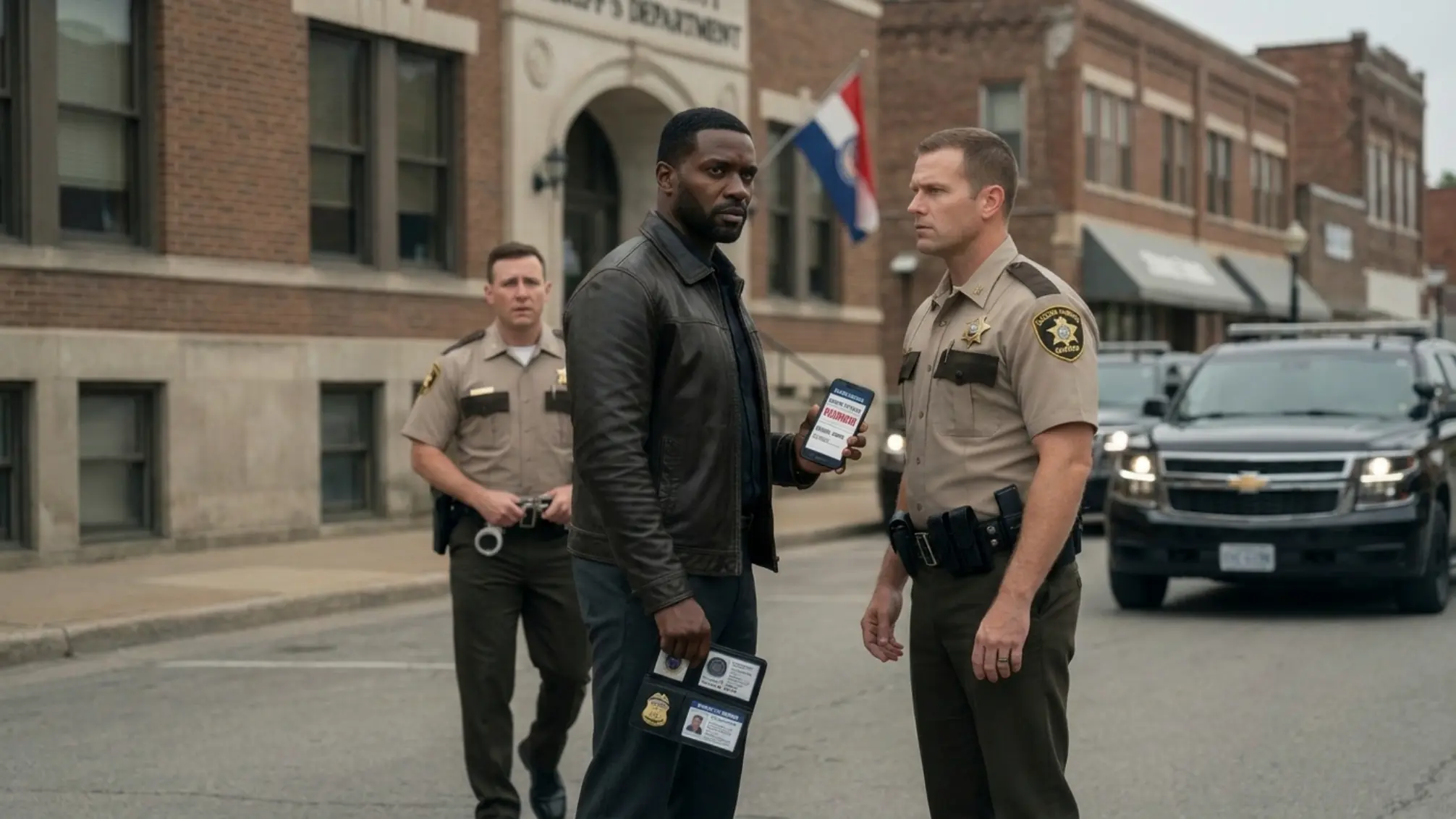
“Scan the serial number,” Marcus said, “before obstruction becomes your next charge.”
Harlan snatched a pair of handcuffs from the nervous deputy standing behind him. “No Black stranger walks into my county and interrogates my people.”
Marcus heard the low growl of engines approaching from the far end of Main Street. He looked past Harlan toward the intersection, where the first black SUV had just turned beneath the traffic light.
“Then turn around,” Marcus said. “My missed check-in just brought the FBI here to interrogate you.”
Harlan glanced over his shoulder.
Three black SUVs accelerated toward the sheriff’s department, followed by an armored evidence-response vehicle and two Missouri State Highway Patrol cruisers. Their lights remained off, but the formation was unmistakable. Federal agents filled the passenger seats, and the lead vehicle carried the warrants Marcus had spent eight months helping build.
For one fleeting second, fear appeared on Harlan’s face.
Then arrogance covered it again.
“This is theater,” he said. “You called your friends because you couldn’t intimidate a county officer.”
Marcus lowered his credentials. “I never called anyone.”
The encrypted phone in his hand displayed a red message:
FIELD CONTACT LOST. EMERGENCY PROTOCOL ACTIVE.
Harlan read it.
His grip loosened around the handcuffs.
Fifty minutes earlier, Marcus had entered Delwood expecting a quiet records inspection. The town sat between soybean fields and low wooded hills in southern Missouri, with one main road, an aging diner, a courthouse square, and a sheriff’s department that appeared too small to attract federal attention.
Appearances had protected Delwood for years.
Eight months earlier, the FBI field office in St. Louis received an anonymous package containing copies of evidence logs from the county sheriff’s department. The records showed that narcotics, firearms, and seized cash repeatedly disappeared after local prosecutions ended. Official reports classified the missing property as destroyed, transferred, or returned.
The signatures did not match.
The package contained one handwritten sentence:
The sheriff’s department sells what it claims to destroy.
Marcus led the preliminary inquiry because he specialized in public corruption and evidence diversion. He had investigated police officers before, but this case was different. Delwood’s missing property did not vanish randomly; it moved according to a disciplined schedule.
Methamphetamine disappeared from the evidence room two days after laboratory verification.
Unregistered firearms vanished before federal tracing requests arrived.
Cash seizures were reduced by twenty or thirty percent between roadside collection and official deposit.
Someone inside the department understood exactly when each item became difficult to track.
Marcus began by comparing county evidence reports with federal databases. He found fourteen firearms listed as destroyed that later appeared in criminal investigations across three states. Two rifles recovered during a trafficking arrest in Arkansas carried serial numbers connected to a Delwood seizure.
The drugs followed a similar path.
A federal laboratory identified packaging from a methamphetamine shipment in Kentucky as belonging to a batch Delwood deputies claimed to have incinerated sixteen months earlier. The chain-of-custody record showed Captain Travis Harlan personally supervising the destruction.
No independent witnesses were present.
No incinerator footage existed.
Marcus requested cooperation from Sheriff Leonard Pike, the elected head of the department. Pike answered with professional politeness and provided thousands of pages of records. The volume appeared helpful until analysts discovered that the department had buried every useful document among irrelevant traffic reports and duplicate files.
Pike insisted any discrepancies were clerical errors.
Harlan became openly hostile.
He called the federal inquiry an attack on rural law enforcement and told local reporters that “outsiders” were trying to criminalize officers for minor paperwork problems. Without naming Marcus, he repeatedly described the lead investigator as someone who “did not understand how small counties operate.”
The public comments were calculated.
Harlan wanted Delwood residents to believe the inquiry targeted the entire community rather than a specific criminal operation.
Marcus did not respond publicly.
He followed the money.
The missing cash rarely entered deputies’ personal accounts. Instead, it passed through a vehicle-repair business owned by Harlan’s brother-in-law. The shop invoiced the sheriff’s department for repairs that never occurred, while large cash deposits appeared in its accounts shortly after major seizures.
Money then moved into property purchases, livestock auctions, and prepaid debit cards.
Harlan purchased a lake house through an LLC managed by his wife.
Sheriff Pike acquired farmland through a company registered to his adult daughter.
Neither man’s salary could explain the properties.
The strongest evidence came from Deputy Evan Walsh, a twenty-eight-year-old patrol officer who had joined the department believing he would protect the town where he grew up. During his second year, Harlan ordered him to transport sealed narcotics from the evidence room to a supposed destruction site.
The destination was not an incinerator.
It was an abandoned feed warehouse outside town.
Harlan met two men there, removed several packages, and returned only a portion of the drugs to the vehicle. He warned Evan that questions destroyed careers faster than mistakes.
Evan remained silent for eleven months.
Then a seventeen-year-old student died from methamphetamine bearing the same packaging marks as the missing evidence. Evan recognized the pattern from the warehouse and mailed the anonymous records to the FBI.
Marcus contacted him through a secure channel.
Their first meeting occurred inside a roadside church after midnight. Evan entered through the back door wearing civilian clothes and carrying a flash drive hidden inside a Bible.
“I helped them,” he said before Marcus could ask a question.
“You transported evidence under orders.”
“I knew something was wrong.”
“When did you know?”
“At the warehouse.”
“Did you take money?”
“No.”
“Did you file a report?”
Evan lowered his eyes. “No.”
Marcus did not tell him silence was harmless. It was not. But guilt could either become another hiding place or the beginning of accountability.
“Then tell the truth now,” Marcus said. “And understand that cooperation does not erase what you ignored.”
Evan agreed.
The flash drive contained photographs, internal messages, and partial security footage copied before Harlan ordered the department’s system wiped. One video showed the captain entering the evidence room at 2:13 a.m. and leaving with two unlogged containers.
Another showed Sheriff Pike disabling the hallway camera.
The federal investigation widened.
Agents linked the stolen narcotics to a regional trafficking organization run by a man named Nathan Vale. Vale used county departments to convert seized drugs back into inventory, then paid officers through businesses and land deals.
Delwood was not the only participating agency.
It was the oldest.
Marcus obtained sealed warrants for Pike, Harlan, the evidence room, the vehicle shop, the lake house, and several digital accounts. The operation was scheduled for the following morning, but one problem remained.
Evan reported that Harlan had begun moving evidence.
If agents waited until sunrise, the captain might destroy the remaining records or relocate firearms already sold to Vale’s group.
Marcus traveled to Delwood one day early under the pretext of conducting a routine records clarification. His task was simple: enter the department, verify the evidence room remained intact, and check in every fifteen minutes.
If he missed two consecutive check-ins, the federal response team would assume he had been compromised.
At 2:05 p.m., Marcus entered the sheriff’s department and showed his credentials to the receptionist. She recognized his name and called Harlan immediately.
The captain appeared from the hallway wearing a tan uniform and an expression already prepared for confrontation.
“You’re early,” Harlan said.
“For what?”
“Whatever performance Washington planned.”
“My office is in St. Louis.”
“Same difference.”
Marcus requested access to several evidence logs covered by the existing federal inquiry. Harlan refused and claimed Sheriff Pike was unavailable.
Marcus displayed a signed preservation order.
“This requires you to maintain all records and permit verification that the evidence remains secure.”
“It doesn’t give you permission to walk through my department.”
“It gives me authority to confirm compliance.”
Harlan read only the first page before handing it back.
“You people arrive with paperwork and expect everyone to kneel.”
Marcus looked toward the hallway. “Is the evidence room intact?”
“Get out.”
“That is not an answer.”
Harlan called two deputies.
One was Evan Walsh.
The young deputy’s face tightened when he saw Marcus, but he gave no sign they had ever met. Harlan ordered him to stand near the exit while another deputy, Cole Ramsey, blocked the interior hallway.
Marcus sent his scheduled check-in at 2:15.
Inside. Hostile reception. Evidence access denied. Continuing verification.
He placed the phone in his hand rather than his pocket.
Harlan noticed.
“You recording me?”
“All official contacts are logged.”
The captain stepped closer. “Then log this. You are leaving.”
Marcus did not move. “Scan my credential number and contact the field office. You will receive immediate verification.”
“I know a fake badge when I see one.”
“You have seen my credentials during two prior meetings.”
“Those were at the courthouse. Today you walked in alone wearing street clothes.”
“Federal agents do that.”
“Not in my building.”
Marcus understood what Harlan was doing. The captain did not truly believe the badge was false. He wanted to create a justification for detention, seize Marcus’s phone, and discover how much the FBI knew before the warrants arrived.
Marcus raised the phone. “My next check-in is due in six minutes.”
Harlan smiled.
“Then you’d better make it from somewhere else.”
He ordered Ramsey to escort Marcus outside.
Marcus complied because resisting inside the narrow lobby would endanger Evan and the receptionist. On the sidewalk, he attempted to complete the check-in, but Harlan slapped the phone from his hand.
The device struck the pavement.
Its screen cracked.
Marcus bent to retrieve it.
Harlan stepped on the phone.
“Careful,” Marcus said. “Destroying federal property adds another problem.”
“You’re not federal.”
Marcus opened his credentials again.
“That can be verified in seconds.”
Harlan looked toward the badge without touching it. “Counterfeit.”
A small crowd formed across the street. The diner’s customers came outside, and courthouse employees raised phones from the steps. Harlan wanted witnesses because witnesses made his manufactured version appear official.
He pointed toward Marcus.
“This man attempted to force entry into a secure evidence facility using fake credentials.”
Marcus addressed Deputy Ramsey. “Call the number printed inside the wallet.”
Ramsey hesitated.
Harlan turned on him. “Do not take instructions from a suspect.”
Marcus looked toward Evan.
The younger deputy stood several feet behind the captain, pale and rigid. His eyes moved briefly toward the department windows.
It was a warning.
Someone inside was destroying evidence.
Marcus stepped toward the door.
Harlan shoved him backward.
“Where do you think you’re going?”
“Your people are moving property.”
The captain’s face revealed the truth before his words did.
“You don’t know what my people are doing.”
“I know you dragged me outside to keep me away from the evidence room.”
Harlan reached for handcuffs.
“No Black stranger walks into my county and interrogates my deputies.”
The sentence traveled across the sidewalk.
Several phones captured it clearly.
Marcus held Harlan’s stare.
“This is your final opportunity to verify my credentials and preserve that room.”
“Turn around.”
Marcus did not resist when Ramsey took his wrists. Every second of wrongful detention strengthened the obstruction case, but only if the response protocol worked.
His damaged phone lay beneath Harlan’s boot.
The 2:30 check-in passed.
No response was sent.
At the St. Louis field office, the monitoring system issued a silent alert.
Supervisory Special Agent Dana Bishop called Marcus’s phone.
No answer.
She contacted Delwood dispatch and asked whether a federal agent was on site. The dispatcher placed her on hold for three minutes, then claimed no FBI personnel had entered the department.
Dana checked Marcus’s vehicle tracker.
It remained parked outside the sheriff’s office.
She activated the emergency protocol.
The warrant team, already staged thirty miles away, moved immediately.
Harlan placed Marcus inside a holding cell and confiscated his credentials, wallet, and service weapon. He ordered Ramsey to record the arrest under the name “unknown impersonator.”
Marcus sat on the metal bench without speaking.
Harlan entered the cell corridor carrying the federal identification wallet.
“This is good work,” he admitted. “Where did you buy it?”
Marcus looked toward the hallway camera.
“You disabled that system last night.”
The captain stopped.
“You know less than you think.”
“I know fourteen guns you destroyed returned to the street.”
Harlan’s expression did not change, but a vein moved beside his temple.
“I know seized methamphetamine went from your evidence room to Nathan Vale.”
“You’re fishing.”
“I know your brother-in-law’s repair shop launders cash.”
Harlan entered the cell and closed the door behind him.
“Who talked?”
Marcus smiled faintly. “That question just confirmed someone did.”
The captain gripped his collar and pulled him to his feet.
“Give me a name.”
Marcus glanced at the closed cell door. “You have fewer than ten minutes before this building belongs to the warrant team.”
Harlan struck him once in the ribs.
Pain moved through Marcus’s side, but he remained standing.
“You came alone,” Harlan said. “No one knows where you are.”
“My phone checked in every fifteen minutes.”
Harlan looked toward the cracked device in his hand.
Understanding arrived.
He rushed from the cell.
Marcus heard shouted orders in the hallway. Doors slammed, drawers opened, and someone wheeled a heavy cart across the floor. The department had stopped pretending.
They were destroying evidence.
Evan appeared outside the cell less than a minute later.
His hands shook as he inserted a key.
“Harlan ordered the furnace started.”
“Where is Pike?”
“In the evidence room with two men from Vale’s organization.”
Marcus stepped into the corridor. “How many armed deputies are loyal to them?”
“Ramsey doesn’t know. The receptionist doesn’t know. Four others do.”
“Get the civilians out.”
“What about you?”
“Open the rear exit, then stay visible and keep your hands empty when the federal team arrives.”
Evan unlocked the cell.
Before Marcus reached the hallway, Harlan returned with his pistol drawn.
“You should have stayed seated.”
Evan froze.
Harlan looked between them and understood everything.
“You.”
Evan slowly raised both hands.
“I sent the files.”
The captain aimed at him.
Marcus moved before the pistol settled.
He struck Harlan’s wrist against the bars. The gun fired into the ceiling, and plaster fell across the corridor. Marcus drove the captain into the wall while Evan kicked the weapon beneath a bench.
Harlan elbowed Marcus in the injured ribs and broke free.
Sirens erupted outside.
Not county sirens.
Federal vehicles surrounded the building.
A loudspeaker commanded every person inside to place weapons on the floor and exit with visible hands.
Harlan looked toward the front windows.
Black SUVs blocked both ends of the street. Agents in tactical vests moved behind armored shields, while state troopers secured the perimeter.
The captain’s shoulders dropped.
“You did this,” he whispered to Evan.
“No,” the deputy replied. “You did.”
Sheriff Pike attempted to escape through the rear loading entrance carrying a duffel bag containing cash, narcotics, and three unregistered pistols. Federal agents arrested him before he crossed the parking lot.
Two members of Vale’s organization surrendered inside the evidence room.
Deputy Ramsey exited with the receptionist and immediately cooperated.
Harlan remained in the corridor until Marcus picked up the fallen pistol with a gloved hand and placed it beyond his reach.
Dana Bishop entered the station carrying the warrants.
She saw the blood near Marcus’s lip and the way he protected his ribs.
“Status?”
“Evidence destruction underway, but the primary room appears intact. Sheriff Pike is involved. Four deputies need separation and interviews.”
Dana looked at Harlan.
“And him?”
“False arrest, obstruction, assault on a federal officer, destruction of federal property, conspiracy, evidence trafficking, and whatever the search finds.”
Harlan laughed bitterly. “You think this town will believe him over us?”
Dana held up a phone displaying the sidewalk video already spreading online.
“They heard you clearly.”
By sunset, agents had seized the department’s servers, evidence logs, financial records, weapons, and vehicles. A false wall inside the evidence room concealed narcotics worth more than $2 million and cash from dozens of seizures.
The furnace contained partially burned packaging and property labels.
Investigators also recovered a ledger listing payments to officers across four counties.
The Delwood operation became the doorway into a regional corruption network.
Nathan Vale was arrested three weeks later.
Sheriff Pike pleaded guilty after learning that Harlan intended to blame him for the entire scheme. Harlan refused cooperation and went to trial, where prosecutors played the sidewalk confrontation, the cell-corridor gunshot, financial records, and Evan’s testimony.
His attorney claimed Marcus provoked the arrest by acting aggressively.
The video showed otherwise.
Marcus had offered verification repeatedly.
Harlan rejected it because recognizing the badge would have ended his opportunity to control the situation.
The jury convicted him on every major charge.
He received thirty-one years in federal prison.
Pike received twenty-four.
Five deputies lost their badges, three received prison sentences, and two avoided charges after proving they had no knowledge of the scheme. Evan pleaded guilty to a lesser obstruction offense for his earlier silence but received probation because of his cooperation.
At sentencing, Evan addressed the family of the teenager who died from the stolen methamphetamine.
“I did not sell the drugs,” he said. “But I saw the door they passed through and stayed quiet because I was afraid. I cannot ask you to call that innocence.”
The boy’s mother did not forgive him.
She did thank him for eventually opening the case.
The Delwood County Sheriff’s Department was placed under state supervision. New evidence procedures required independent witnesses, digital tracking, and external audits.
Months later, Marcus returned to the same sidewalk.
The department sign had been replaced, and the diner across the street had reopened after changing owners. A new sheriff met him at the entrance and scanned his credentials before shaking his hand.
The procedure took eleven seconds.
Marcus looked toward the place where Harlan had crushed his phone beneath his boot.
The captain believed the badge was powerful only when worn by someone he respected. He believed race, clothing, and location gave him permission to decide which authority was real.
But Marcus’s identity had never depended on Harlan accepting it.
The serial number was real.
The investigation was real.
The missed check-in was real.
And when the black SUVs turned onto Main Street, they were not arriving to prove Marcus belonged there.
They were arriving because the corrupt men inside had finally run out of places to hide.