The sound of a woman crying on a lonely Oklahoma trail was the last thing Benjamin Quincy expected to hear that spring morning. He had been repairing the northern fence of his ranch, carrying a heavy cedar post across the sun-baked grass, when the faint sob drifted toward him on the warm wind. It was not the ordinary frustration of a delayed traveler or the sharp cry of someone injured. It was the exhausted sound of a person who had carried too much for too long and had finally reached the end of her strength.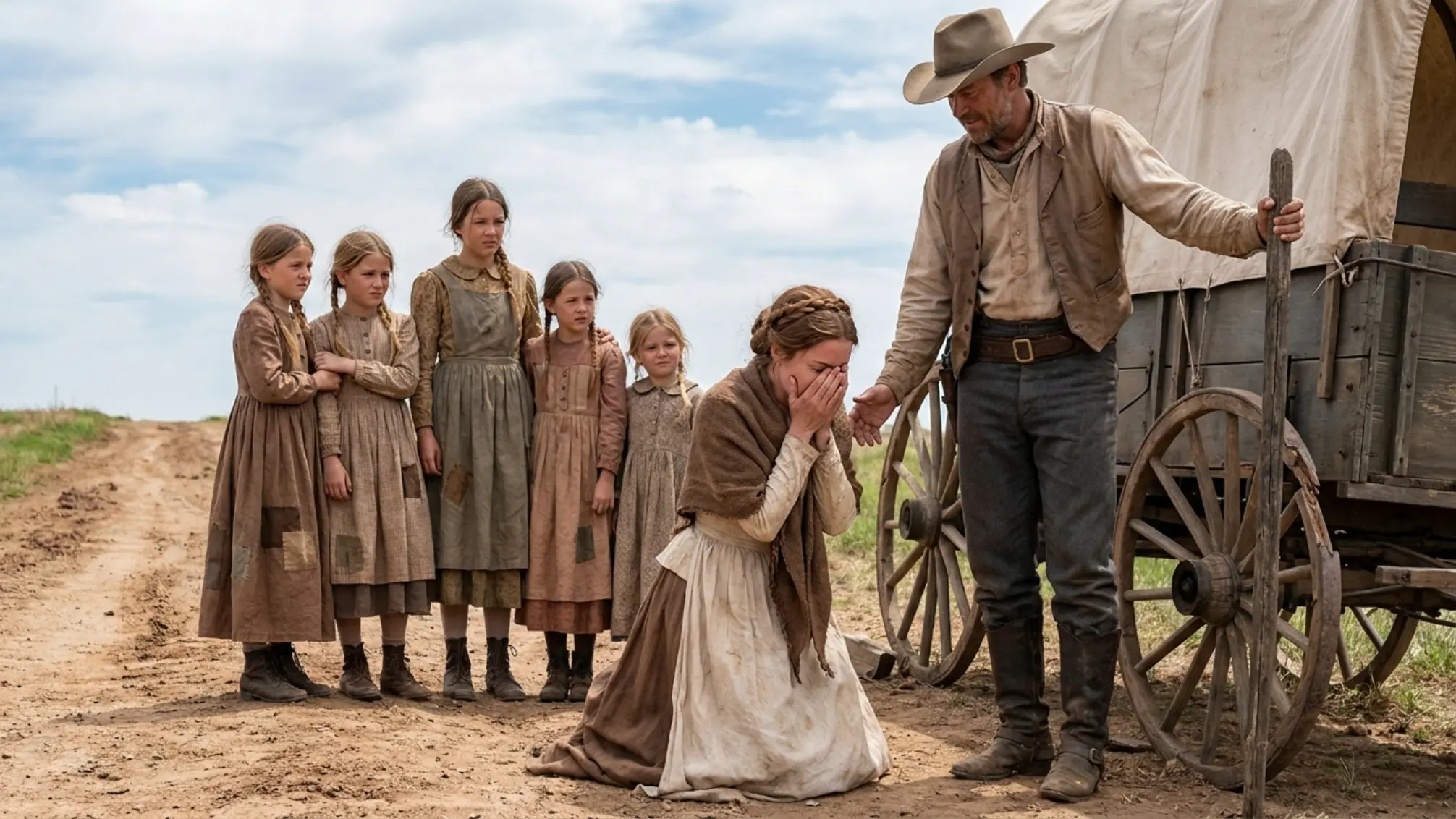
Benjamin lowered the fence post and listened.
Beyond the slope near his property line, a covered wagon sat crooked in the road. One wheel had collapsed beneath the wagon bed, and the axle rested heavily in the dirt. A tired mare stood in the traces with her head hanging low, while scattered belongings lay near a broken wooden crate. Beside the wreckage, a woman knelt with both hands covering her face.
Five little girls stood around her.
The oldest appeared to be eleven, with sun-reddened cheeks and a protective arm around one of her younger sisters. Two girls stood near the wagon wheel, their patched brown dresses coated with dust. A smaller child clutched a rag doll with only one button eye, while the youngest—perhaps four years old—pressed herself against her mother’s shoulder without speaking.
Benjamin had lived alone long enough to recognize frightened silence.
He removed his hat before approaching.
“Ma’am,” he called gently. “I don’t mean to alarm you. Do you need help?”
The woman lifted her head.
Even beneath the dust and tears, Benjamin was struck by her beauty. She had fair skin warmed by weeks beneath the sun, luminous green eyes, soft full lips, and long chestnut hair twisted into a heavy braided bun. Loose curls clung to her damp cheeks. Her cream frontier dress was faded and stained from travel, and a worn brown shawl hung from her shoulders, yet there was a quiet grace in the way she immediately tried to stand for her daughters’ sake.
“I’m sorry,” she said, wiping her face quickly. “I didn’t know this was private land.”
“You’ve done no harm.”
“The wagon wheel broke. I tried to brace it, but the axle cracked too.” Her voice trembled. “We don’t have money for repairs. I don’t know what I’m going to do.”
Benjamin crouched beside the damaged wagon.
The wheel had split through the hub, and the axle was twisted badly enough that it could not be repaired beside the road. Even with proper tools, the wagon would need several days of work. He examined the wood, then glanced toward the exhausted mare and the frightened children.
“You won’t get far with this,” he said quietly. “Where were you headed?”
“Oklahoma City.”
“Family there?”
The woman lowered her eyes. “No.”
“Someone expecting you?”
“I have a letter about work. A boardinghouse owner said she might need someone to cook and clean.”
“Might?”
“She could not promise the position would still be available when we arrived.”
Benjamin looked at the five girls again.
The oldest met his gaze bravely, though hunger and worry showed plainly in her face. The youngest hid behind her mother’s skirt. None of them complained, despite the heat and the empty water bucket beside the wagon.
“What’s your name?” Benjamin asked.
“Martha Lancaster.”
“I’m Benjamin Quincy. My ranch begins at that ridge.”
Martha gathered her shawl around herself. “My husband died six months ago. John was a farmer in Missouri. A horse kicked him, and the wound became infected. He was gone three days later.”
Benjamin’s chest tightened.
“I’m sorry.”
“We sold the farm to pay his medical debts,” Martha continued. “Then I sold the furniture, the livestock, and nearly everything else. We used the last of the money for food and wagon supplies.” Her eyes moved toward her daughters. “I thought if we reached the city, I could work. I thought I could keep them safe.”
“You brought them across the territory alone?”
“There was no one else.”
Benjamin stood slowly.
Three years earlier, his wife, Sarah, had died from consumption in the bedroom at the eastern end of his house. Before the illness took her, they had spoken often about filling the ranch with children. Sarah wanted daughters because, as she liked to say, a house full of girls would prevent Benjamin from becoming an unbearable old grouch.
After her death, the house had remained painfully clean and unbearably quiet.
He had continued building fences, raising cattle, planting wheat, and repairing rooms no one used. He sat alone at a table meant for a family and listened each night to the sound of an empty house settling around him.
Now six strangers stood beside a broken wagon at the edge of his land.
Martha looked at him with visible embarrassment. “I’ll find a way to move the wagon. You don’t have to concern yourself.”
“The wheel is ruined, and I’m too tired to carry them any farther,” she admitted when her composure finally broke.
Benjamin looked toward the girls, then back at her.
“Then let me carry what life has forced you to bear alone.”
Martha stared at him.
The oldest girl tightened her arm around her sister. Benjamin could see that all six of them expected kindness to disappear the moment they trusted it.
“You would open your home to five children,” Martha whispered, “and a woman you barely know?”
Benjamin offered his hand.
“Take my hand, Martha. Come see the home that may have been waiting for all six of you.”
The wind moved softly through the prairie grass.
For several seconds, Martha did not move. Then her trembling fingers settled into his palm.
Benjamin helped her stand.
He returned to the ranch and brought his freight wagon, two fresh horses, food, and water. The girls ate bread and dried apples beneath the shade of the covered wagon while Benjamin transferred their belongings. Martha tried repeatedly to help, but exhaustion caused her knees to weaken.
“You should sit,” he said.
“I’ve been sitting half the journey.”
“You’ve also been worrying the whole way.”
“I cannot allow you to do all this alone.”
“I’ve done nearly everything alone for three years. One more afternoon won’t defeat me.”
A faint smile touched her lips.
It was the first time Benjamin saw what her face looked like without fear.
By late afternoon, he had secured the damaged wagon beside the road and loaded the family’s belongings into his own. The five girls crowded onto the rear bench beneath a canvas cover. Martha sat beside Benjamin in front, keeping enough distance between them to make her caution clear.
He did not take offense.
The road to the Quincy ranch followed a shallow creek through fields of wildflowers. Benjamin drove slowly so the children would not be frightened by the uneven trail. The youngest girl leaned over the side whenever she saw a rabbit, and the others whispered excitedly when a herd of antelope crossed the distant plain.
“What are their names?” Benjamin asked.
Martha looked over her shoulder. “The oldest is Abigail. She’s eleven. Then there’s Rose, who is nine, Clara is seven, Nell is six, and little Elsie turned four last month.”
Elsie raised four fingers proudly.
Benjamin smiled. “That is a considerable number.”
“She tells everyone.”
“I would too.”
Martha studied him as though kindness remained suspicious.
“You truly live alone?” she asked.
“Yes.”
“No hired men?”
“Two ranch hands come during branding season. Otherwise, it’s just me.”
“How much land?”
“Six hundred acres, though most of it is grazing pasture. I keep cattle, horses, chickens, and enough wheat to cause trouble every harvest.”
“That is too much work for one person.”
“That’s what Sarah used to say.”
Martha’s expression softened. “Your wife?”
Benjamin nodded.
“I’m sorry.”
“So am I.”
He expected the familiar ache to sharpen, but speaking Sarah’s name beside Martha felt different. It did not erase the loss. It simply made the memory warmer than the silence surrounding it.
The ranch house appeared shortly before sunset.
It stood on a low rise, built of pale wood with a wide front porch and a stone chimney. A red barn rested beyond the corral, and cottonwood trees shaded the yard. Chickens wandered near a vegetable garden, while a black gelding lifted its head from the pasture.
The girls fell silent.
Martha stared at the house. “This is all yours?”
“It belongs mostly to the bank until another twelve years of payments convince them otherwise.”
She glanced at him, surprised by the joke.
Benjamin stopped the wagon near the porch. Before he could climb down, Abigail jumped from the rear and immediately helped her sisters. She moved like a child accustomed to carrying adult responsibility.
Benjamin noticed Martha watching her with guilt.
“You raised a strong girl,” he said.
“She had to become strong too young.”
“So did you.”
Martha lowered her eyes.
Inside, the house was larger than it appeared from the trail. The main room contained a stone fireplace, a long wooden table, and shelves filled with preserved vegetables and tools. A narrow staircase led to three bedrooms upstairs, while two more rooms occupied the ground floor.
The girls entered cautiously, afraid to touch anything.
Benjamin opened the eastern bedroom. He had not slept there since Sarah’s death. Her embroidered curtains remained at the window, and a quilt she had begun lay folded inside a cedar chest.
“This room is yours,” he told Martha.
Her eyes widened. “I could not take your room.”
“It hasn’t been mine for years.”
“What do you mean?”
“My wife died here.”
Martha stepped back. “Then I certainly should not—”
“She loved this room. It receives the first sunlight every morning.” Benjamin looked through the window toward the garden Sarah had planted. “She would be angry if it stayed empty simply because I was afraid to open the door.”
Martha touched the bedpost.
“And the girls?”
“There are two rooms upstairs. We can arrange beds.”
“We?”
Benjamin nodded toward the barn. “I have lumber. By tonight, I can build two frames. Tomorrow, I’ll make the others.”
“You cannot build five beds in two days.”
“Is that a challenge?”
A quiet laugh escaped her.
The sound changed the house.
By nightfall, Benjamin had carried their trunks inside and moved two spare mattresses upstairs. The girls bathed one at a time using warm water Martha heated over the stove. Benjamin cooked beans, fried potatoes, and bacon while Martha cut the remaining bread into careful portions.
When he placed the food on the table, none of the girls began eating.
“Is something wrong?” he asked.
Abigail looked at her mother.
Martha folded her hands. “We say grace first.”
Benjamin removed his hat, embarrassed that he had forgotten. Sarah had always led their prayers. After she died, he stopped because thanking God alone at an empty table had begun to feel like lying.
Martha bowed her head.
“Thank You for bringing help when we had no hope left,” she prayed. “Thank You for this roof, this meal, and the kindness of a stranger. Please give us the wisdom not to take more than we should.”
Benjamin looked at the six faces illuminated by lamplight.
When the prayer ended, he quietly added, “And give the stranger enough sense to understand that kindness is not something to regret.”
Martha met his eyes.
The girls ate ravenously despite their efforts to remain polite. Elsie fell asleep before finishing her potatoes, her cheek resting against the table. Benjamin carried her upstairs after receiving Martha’s cautious permission.
The small child stirred in his arms.
“Are you our new papa?” she murmured.
Benjamin nearly missed a step.
“No, little one.”
“Oh.”
The disappointment in her voice followed him back downstairs.
Martha stood alone near the fireplace after the others had gone to bed. She had removed her shawl, revealing the graceful shape of her cream dress and the exhaustion held in her shoulders. Firelight turned her chestnut hair to deep copper.
“I should explain something,” she said.
Benjamin waited.
“I cannot pay you.”
“I didn’t ask for money.”
“I can cook, mend clothes, preserve food, tend chickens, milk cows, and keep accounts. The girls can help with light chores. We will work for our room and board until I find employment in the city.”
“You’re not taking five children into Oklahoma City until you know that position exists.”
“Then what do you suggest?”
“Stay here.”
“For how long?”
“As long as necessary.”
Martha shook her head. “People do not offer a house indefinitely without expecting something.”
“I expect help. This ranch needs it.”
“What kind of help?”
“The practical kind. Meals that don’t taste like boot leather. Someone to remind me chickens need feeding before noon. Children who might prevent this place from sounding like a tomb.”
Her expression changed at the final word.
Benjamin looked away. “You need shelter. I have more shelter than I know what to do with. It doesn’t need to be complicated.”
“What will people say?”
“People have said worse things about me than generous.”
“You hardly know us.”
“I know you crossed hundreds of miles with five daughters and did not abandon a single one when the road became difficult. That tells me enough for tonight.”
Martha’s eyes filled with tears, though she did not let them fall.
“Thank you,” she whispered.
The following morning began before sunrise.
Benjamin woke to the sound of footsteps overhead and feared one of the girls had fallen. He pulled on his boots and hurried into the main room, only to find Martha standing at the stove with her hair loosely braided down her back.
The smell of biscuits filled the house.
“You found the flour,” he said.
“I hope you don’t mind.”
“I mind that I may have forgotten what real breakfast smells like.”
She smiled over her shoulder.
Benjamin stopped moving.
Without travel dust, swollen eyes, and despair masking her features, Martha was astonishingly beautiful. Her green eyes seemed brighter in the morning light, and soft color warmed her cheeks. She was full-figured and graceful, with the kind of beauty no fashionable dress or expensive jewelry could create.
Martha noticed his stare and looked down self-consciously.
“Is something wrong?”
“No.”
“You looked surprised.”
“I am.”
“By the biscuits?”
Benjamin cleared his throat. “Among other things.”
Her cheeks turned pink.
During the next week, the ranch changed faster than Benjamin thought possible. Abigail organized the pantry. Rose discovered she could calm nervous horses by singing to them. Clara followed Benjamin everywhere with endless questions about cattle, while Nell collected eggs and named every chicken. Elsie declared the black gelding her personal horse despite being too small to reach its stirrup.
Martha transformed the house.
She washed curtains, opened windows, planted herbs, and repaired shirts Benjamin had intended to discard. She kept careful account of every supply she used, as though preparing to repay him for a handful of flour. Each evening, she served meals at the long table and listened while the girls described their adventures.
Benjamin began returning from the fields before dark.
He told himself it was because the northern fence no longer required attention after sunset. The truth was that he wanted to hear their voices before bedtime. He wanted to see Martha standing near the stove and watch her face soften when he entered.
One afternoon, he returned to find her attempting to repair the garden fence. She carried a heavy board across the yard while two nails rested between her lips.
Benjamin took the board from her.
“I could have managed.”
“I know.”
“Then why did you take it?”
“Because I wanted to.”
Martha removed the nails from her mouth. “You cannot keep carrying every heavy thing for me.”
“I’m beginning to suspect you’ve carried enough.”
The tenderness in his voice left them both silent.
Benjamin set the board against the fence. Martha stood close enough that he could see faint gold flecks in her green eyes.
“I was married for thirteen years,” she said quietly. “John was not unkind, but life with him was difficult. There was always another field to plant, another debt, another winter to survive. He believed worrying was a woman’s work.”
“That doesn’t sound fair.”
“He was raised to believe providing money was enough. When the harvest failed, he grew distant. After he died, I discovered how many debts he had hidden.”
Benjamin leaned against the fence. “You’re angry with him.”
“I loved him.”
“That wasn’t my question.”
Martha looked toward the girls playing near the barn. “Yes. I’m angry. Then I feel guilty for being angry with a dead man.”
“Death doesn’t erase what someone left you to carry.”
Her eyes moved back to him.
“You loved Sarah very much,” she said.
“I still do.”
Martha’s expression tightened, and Benjamin realized how his answer sounded.
“But loving her memory doesn’t mean my life ended with hers,” he added.
Something hopeful and frightened passed between them.
Before either could speak again, a rider appeared on the southern road.
The man wore a dark town coat despite the heat. Benjamin recognized Nathaniel Crowe, an agent from Oklahoma City who bought indebted farms cheaply and sold them to cattle companies. Crowe dismounted without invitation and looked from Benjamin to Martha.
“Mrs. Lancaster,” he said.
Martha became pale.
“You know him?” Benjamin asked.
“He worked with the bank that seized our farm.”
Crowe smiled. “I’ve been looking for you.”
“You found her,” Benjamin said. “Now state your business.”
Crowe removed a folded document from his coat. “Mrs. Lancaster owes one hundred and eighty dollars in unpaid estate fees. Her husband signed a personal guarantee before his death. Since she departed Missouri without settling the account, I have authority to seize her remaining property.”
“There is no property,” Martha said.
Crowe glanced toward her daughters. “The oldest girls are capable of employment. Domestic service contracts could settle part of the debt.”
Benjamin stepped between them.
“You will not speak about children as property on my land.”
“The law recognizes labor agreements.”
“The law also recognizes trespassing.”
Crowe’s smile vanished. “This is not your concern.”
Martha moved beside Benjamin. Her hands trembled, but her voice remained steady. “Show me John’s signature.”
Crowe held out the document without surrendering it.
Martha studied the page.
“That is not his handwriting.”
“You expect a court to believe you?”
“I kept every letter he wrote during our courtship. I can prove it.”
Crowe folded the paper. “Then come to Oklahoma City and argue before the judge.”
“She won’t go alone,” Benjamin said.
Crowe looked between them. “What arrangement have you made here, Quincy?”
“The kind that doesn’t concern you.”
“I know your reputation. A widower takes in a beautiful woman and five daughters, and you expect decent people not to wonder?”
Benjamin’s jaw tightened.
Martha stepped forward before he could answer.
“The only indecent man standing here is the one trying to sell children to collect a forged debt.”
Crowe’s face darkened. “You will regret that accusation.”
“Leave,” Benjamin said.
Crowe mounted his horse. “I’ll return with the sheriff.”
Benjamin watched until he disappeared beyond the ridge.
Martha turned toward him. “You should make us leave.”
“No.”
“He may threaten your ranch.”
“Let him.”
“You don’t understand. Men like that do not stop because they’re told no.”
Benjamin looked at her. “Neither do I.”
Two days later, Benjamin drove Martha to Oklahoma City. Abigail stayed at the ranch with her sisters under the care of a neighboring couple. Martha wore her cleanest blue dress, and Benjamin wore a dark coat Sarah had once bought for church.
At the courthouse, Crowe presented the supposed guarantee before Judge Harrison Cole. He claimed John Lancaster had borrowed money for seed and pledged future family labor if the estate could not repay the loan.
Martha produced twelve letters written by her husband.
The difference in handwriting was obvious.
Benjamin then presented testimony from a traveling notary whose seal appeared on Crowe’s document. The notary had died four months before the alleged agreement was signed. Crowe attempted to leave the courtroom before the judge ordered a deputy to stop him.
A search of his office uncovered dozens of forged guarantees involving widows and indebted families.
The debt against Martha was dismissed.
Outside the courthouse, she stood on the steps clutching the judge’s written order. For several moments, she could not speak.
“You’re free,” Benjamin said.
“I thought I was going to lose them.”
“You didn’t.”
“What if you hadn’t found us?”
Benjamin did not want to imagine it.
Martha looked into his eyes. “You keep appearing whenever the road beneath me breaks.”
“Perhaps you should stop traveling roads without me.”
Her breath caught.
Benjamin immediately feared he had said too much. “I didn’t mean—”
“I know what you meant.”
“Do you?”
She stepped closer. “I hope I do.”
They returned to the ranch beneath a sunset that painted the prairie gold. When the house came into view, the five girls ran down the road to meet them.
Elsie reached Benjamin first.
He lifted her into his arms without thinking.
“Did the bad man take Mama?” she asked.
“No.”
“Did you stop him?”
“Your mother stopped him. I merely stood nearby looking useful.”
Martha laughed.
That evening, after the girls were asleep, Benjamin found her on the porch. She stood beneath the stars with her shawl around her shoulders. The Oklahoma night stretched quietly around them, broken only by crickets and the distant movement of cattle.
“I received another letter from the boardinghouse,” Martha said.
Benjamin’s heart sank. “The position is available?”
“Yes.”
“When do they expect you?”
“Next Monday.”
He nodded, forcing his voice to remain steady. “I’ll repair your wagon before then.”
Martha looked at him. “Is that what you want?”
“What I want doesn’t determine what is best for you.”
“Then tell me anyway.”
Benjamin rested both hands on the porch rail. “I want to hear Abigail correcting my accounts. I want Rose singing to the horses and Clara asking more questions than any human being should possess. I want Nell naming chickens and Elsie insisting she owns my best gelding.”
Martha’s eyes shone.
“And you?” she whispered.
Benjamin turned toward her.
“I want to wake up to the sound of you in the kitchen. I want to watch you make this house warmer simply by walking through it. I want to help carry the burdens you’ve been lifting alone, though I know you’re strong enough to lift them without me.”
Martha drew a trembling breath.
“I cannot promise I will stop being afraid,” she said.
“I won’t ask you to.”
“I have five daughters.”
“I counted.”
“They are loud.”
“I’ve noticed.”
“They may come to love you.”
His voice softened. “That would be an honor.”
“And if I stayed, I might love you too.”
Benjamin stepped closer but did not touch her.
“Martha, I believe my heart began waiting for you before either of us knew the other existed.”
A tear slipped down her cheek.
She took his hand and placed it against her face.
“Then perhaps we should stop keeping it waiting.”
Benjamin kissed her beneath the Oklahoma stars. It was a gentle kiss, filled not with urgency but with the quiet certainty of two people who had survived enough loneliness. When they separated, Martha rested her forehead against his chest.
They married at the ranch one month later.
The girls scattered wildflowers across the porch. Abigail stood beside her mother, Rose sang a hymn, Clara asked the preacher whether vows were legally binding in every territory, Nell carried the rings, and Elsie announced to every guest that Benjamin was now officially her papa.
Martha wore the blue dress from the courthouse.
Benjamin could not look away from her.
Years later, travelers passing the Quincy ranch often commented on the laughter coming from the house. They saw children running between the barn and garden, smelled fresh bread cooling near the kitchen window, and watched a broad-shouldered rancher return from the fields before sunset.
Benjamin and Martha eventually had two more children, but he never referred to the first five as anything except his daughters.
The broken wagon remained beside the barn.
Benjamin repaired the wheel and axle, yet Martha asked him never to sell it. In spring, she planted climbing roses around its wooden frame until blossoms covered the place where her journey had nearly ended.
Whenever visitors asked why they kept an old wagon that no longer traveled, Martha smiled toward the man who had found her beside it.
“That wagon did not break down,” she would say. “It finally brought us home.”