Hannah Brooks went completely still beside the narrow bed. Her fingertips remained pressed against the faded blue quilt, but the color drained from her face as hoofbeats stopped outside the farmhouse. Through the window, Cole Turner saw a polished black horse beside the porch and the silver-tipped cane of Grant Mercer striking the ground. Grant had attended their wedding less than an hour earlier, yet he had returned without the preacher, without witnesses, and without the pleasant smile he wore whenever Red Creek was watching.
Cole placed his hat on the chair and stepped into the hallway. “Stay here with Noah.”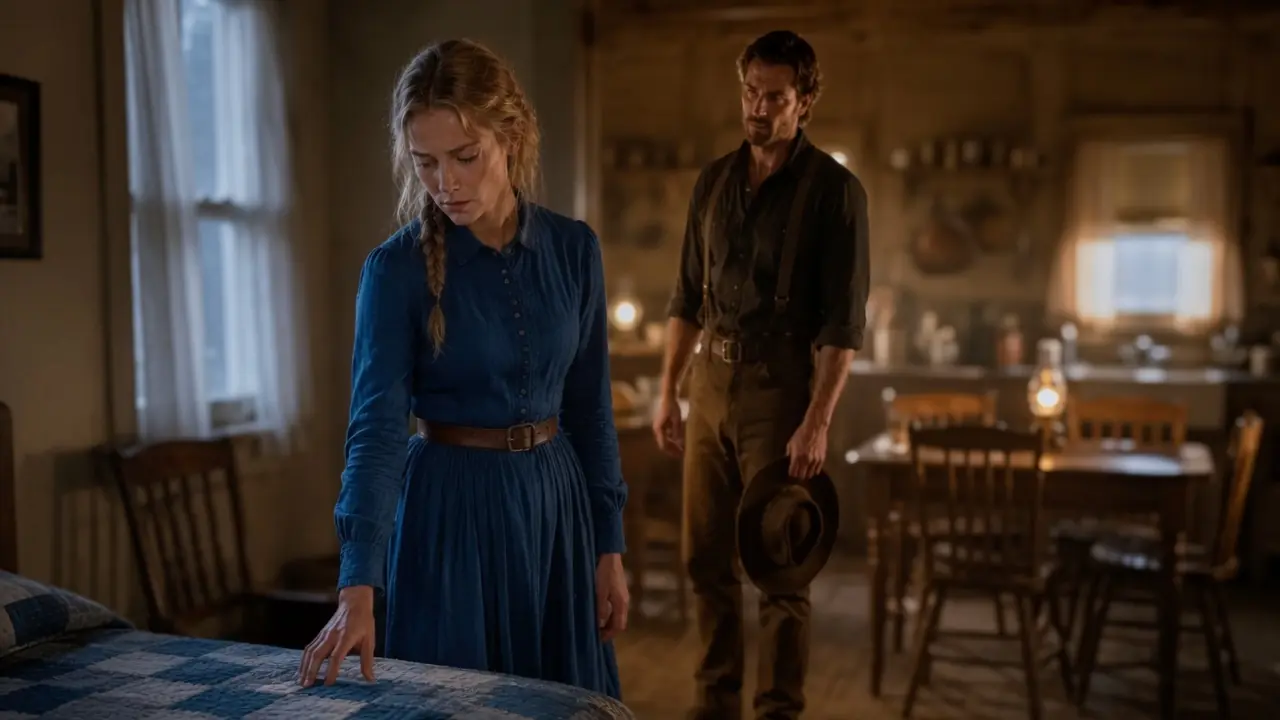
Hannah caught his sleeve before he could leave. The gesture was so sudden that both of them looked down at her hand. She released him immediately and whispered an apology, but Cole had already seen the fear beneath it.
“You know him,” Cole said.
Hannah’s eyes moved toward the doorway. “I know what happens when he comes back.”
Downstairs, Grant entered without knocking. He removed his gloves slowly and looked around the farmhouse as though measuring what it might sell for after foreclosure. Nine-year-old Noah stood near the kitchen table, holding an old livestock catalog against his chest like a shield.
Grant smiled at the boy. “Go outside.”
“This is my house,” Noah replied.
“It belongs to the bank more than it belongs to you.”
Cole stepped into the kitchen. “Say that again.”
Grant turned. His smile remained, but the friendliness left it. “I came to discuss your new wife before she creates a misunderstanding that could become expensive.”
Hannah appeared at the bottom of the stairs. She had not remained in the room, though every careful movement suggested she wanted to disappear into the wall. Grant’s eyes settled on her with the quiet ownership of a man recognizing property that had moved without permission.
“There you are,” he said. “You left before our arrangement was settled.”
Cole positioned himself between them. “She married me this morning.”
“A church ceremony does not erase debt.”
“What debt?”
Grant removed a folded paper from inside his coat. “Food, lodging, transportation, medical attention, and placement services. Miss Brooks owes my household one hundred and eighty-six dollars.”
Hannah’s breathing changed. Cole heard it before he saw her hand tighten around the stair rail. One hundred and eighty-six dollars was enough to trap a poor worker for years, especially when the person collecting it controlled the records.
Grant laid the paper on the table. The charges began eighteen months earlier and increased every week. Each meal carried a fee, each night in the servants’ quarters carried another, and every dress Hannah wore had been priced as though it were imported silk rather than repaired cotton. At the bottom appeared a sentence stating that repayment could be transferred to a husband approved by Grant Mercer.
Cole read the line twice. “You’re saying you arranged this marriage?”
“I introduced an opportunity.”
“You told Reverend Pike she answered my advertisement through the church network.”
“She did, after I allowed her to see it.”
Hannah finally spoke. “You said Mr. Turner had already agreed to assume the debt.”
Grant tilted his head. “And you believed me because hunger makes people practical.”
Cole folded the paper once, then tore it through the center. Grant did not flinch. He merely glanced toward the stove, where an iron pot held enough stew for three adults and a child.
“Destroying a copy changes nothing,” Grant said. “The original is filed with my attorney.”
“No lawful contract allows you to sell a woman.”
“Do not become theatrical. I provided shelter when no one else would take her. I found her respectable employment, protected her reputation, and arranged a marriage before her usefulness declined further.”
Hannah looked down as though the insult confirmed something she already believed. Cole saw the reaction and understood that Grant had not come for money alone. He had come to remind her that even in another man’s house, his voice still determined her value.
Cole opened the front door. “Leave.”
Grant adjusted one cuff. “Your cattle note comes due in twelve days. Refuse this debt, and the bank may decide not to extend your payment.”
The threat landed because it was real. Two failed seasons had weakened the Turner ranch, and Grant held influence over Red Creek Savings through his uncle. If Cole lost another extension, the bank could seize the property before winter.
Grant stepped onto the porch, then looked back at Hannah. “When hunger returns, you will remember who fed you.”
Cole closed the door hard enough to shake the window glass. For several seconds, nobody spoke. Then Noah placed the livestock catalog on the table and pushed a chair toward Hannah.
“You can have my place,” he said.
Hannah stared at the chair. “Where will you sit?”
“Next to you.”
Cole served the stew into four equal bowls. Hannah watched each ladleful as though expecting him to stop before reaching hers. When he placed bread beside her plate, she touched neither the food nor the spoon.
“You don’t have to earn supper,” Cole said.
She swallowed. “Everyone earns supper.”
“Not in this house.”
“That is not how houses work.”
“It is how this one will.”
Hannah lifted the spoon, but her hand shook badly enough for broth to spill. Noah pretended not to notice and began telling her which floorboards creaked at night. His voice filled the silence until she managed the first bite.
She ate slowly, pausing after every mouthful as though waiting for someone to take the bowl. When she finished half, she wrapped the remaining bread inside her handkerchief and slipped it into her sleeve. Cole saw but said nothing.
Later that night, he found three pieces of bread beneath the mattress in her room. Beside them lay half an apple and a small strip of dried meat from supper. Hannah stood in the doorway behind him, her face pale with shame.
“I wasn’t stealing,” she whispered.
“I know.”
“I save it in case morning changes.”
Cole turned toward her. “Morning does not change whether you eat.”
“It always did before.”
He replaced the food on the washstand rather than beneath the mattress. “If you need something during the night, the pantry is open.”
Hannah looked at him as though he had described a room in another world. “No lock?”
“No lock.”
The next morning, she rose before anyone else and cleaned the entire kitchen. By sunrise she had scrubbed the floor, repaired a torn curtain, kneaded bread, and carried water until the palms of her hands split open. Cole found her dragging a heavy sack of flour from the pantry.
“Put it down.”
Her body stiffened. “I’m working.”
“You’re bleeding.”
“I can finish.”
“I said put it down.”
The command frightened her more than the injury. She released the sack and immediately raised both hands as though preparing to protect her face. Cole stepped backward.
“I am not angry with you,” he said.
“You sounded angry.”
“At the sack.”
“It cannot hear you.”
That answer almost made him smile, but the fear in her eyes stopped him. He cleaned her palms, wrapped them in cloth, and told her to rest. Hannah obeyed for less than five minutes before attempting to mend Noah’s coat.
Over the following days, Cole began understanding that Grant had starved her in more ways than one. She asked permission before opening doors, lighting lamps, sitting on chairs, or using more than one cup of water to wash. Compliments made her suspicious, kindness made her anxious, and silence convinced her she had made a mistake.
At meals, she waited until Cole and Noah began eating. If either paused, she lowered her spoon. She never took the last piece of bread, even when both of them said they were finished.
Noah noticed everything. He began dividing food before placing it on the table so that Hannah’s portion could not appear borrowed. He also stopped asking how long she planned to stay.
One evening, Cole returned from checking cattle and found Hannah teaching Noah how to repair a torn book binding with flour paste and thin cloth. The boy was laughing for the first time in months. Hannah smiled too, though the expression vanished when she noticed Cole watching.
“You don’t have to stop,” he said.
“I thought supper might be late.”
“It can survive ten minutes.”
Hannah looked genuinely startled by the idea that a household could adjust around a moment of happiness. Cole walked outside before she saw how deeply that realization affected him.
The peace lasted six days.
On the seventh morning, a bank representative arrived with a revised notice. Cole’s cattle loan had been called in early, and full payment was due within seventy-two hours. The document cited concerns about household instability and newly assumed personal debt.
Grant had attached Hannah’s fabricated account to the ranch.
Cole rode into town with the notice and demanded to see the bank ledger. The clerk refused until Cole mentioned filing a complaint with the territorial banking commissioner. After an hour of argument, the man produced the loan records.
The entries did not match Cole’s receipts.
Two payments had been credited late, creating penalties. A third had been placed into a holding account rather than applied to principal. The cattle note was not merely difficult; someone had adjusted it to make foreclosure possible.
Cole asked who authorized the changes.
The clerk glanced toward the upstairs office. “Mr. Mercer advised the board.”
Grant was waiting outside the bank. “You should have accepted the arrangement.”
“What do you want with Hannah?”
“Nothing sentimental.”
“Then why risk fraud over her?”
Grant leaned closer. “Because she knows how my household was managed, and frightened women become talkative when men start treating them kindly.”
Cole’s anger became colder. “What did she see?”
Grant smiled. “Ask her. Then decide whether you still want her under your roof.”
At the ranch, Hannah was standing beside the chicken yard when Cole returned. One look at his face told her Grant had spoken.
“He said you know something,” Cole told her.
Hannah lowered the basket she was carrying. “I know many things I was told never to repeat.”
“Start with the one he fears.”
She looked toward Noah, who was repairing a fence nearby. “Not where the boy can hear.”
Inside the barn, Hannah finally told the truth. She had not arrived in Red Creek as a servant. She came three years earlier with her younger sister, Lucy, after their father died and left them nothing but a rented room.
Grant offered both women work at the Triple M ranch. The wages were modest but included food and housing. For the first month, the arrangement appeared honest.
Then deductions began.
Grant charged for broken plates nobody remembered breaking, medicine they never requested, and bedding already present when they arrived. Their wages disappeared into an account they were never allowed to inspect. When Lucy became ill, Grant charged her for every bowl of broth and every visit from the doctor.
“She died owing him money,” Hannah said.
Cole’s jaw tightened. “What happened after?”
“He wrote to my mother and said Lucy abandoned her employment. He did not tell her where she was buried.”
Hannah knew because she had helped prepare the body alone. Grant refused to pay the undertaker and ordered two workers to place Lucy in an unmarked grave beyond the north pasture.
Afterward, Hannah found Grant’s private ledger. It contained the names of dozens of workers, widows, immigrants, and orphaned teenagers trapped through invented debts. People arrived believing they had accepted employment, then discovered that food, beds, tools, and transportation cost more than their wages.
Some were transferred to other ranches. Others disappeared from the records.
Hannah copied several pages before Grant caught her. He took the copies and locked her inside a storage room for three days with almost no food. When he released her, he warned that no one in Red Creek would believe a penniless woman over the county’s richest landowner.
“Where is the ledger?” Cole asked.
“In his office.”
“Then we get it.”
Hannah shook her head immediately. “He keeps the room locked.”
“You copied it once.”
“And he found me.”
Cole softened his voice. “You are not alone this time.”
That evening, they visited Reverend Pike. Hannah expected disbelief, but the preacher listened without interruption. Mrs. Bell from the mercantile joined them and quietly admitted she had seen young workers purchasing food on credit despite supposedly receiving meals at the Triple M.
A former ranch hand named Silas Green confirmed that Grant withheld wages through debt accounts. He had escaped after nearly two years and still carried a paper claiming he owed forty-three dollars.
One story became six. By midnight, the church office contained enough testimony to establish a pattern but not enough written proof to stop the foreclosure or force an investigation.
They needed the ledger.
Grant held a harvest supper at the Triple M two nights later, inviting bankers, merchants, and county officials. Cole attended openly, allowing Grant to believe the visit concerned negotiation. Hannah entered through the kitchen wearing a plain servant’s dress borrowed from Mrs. Bell.
She knew every hallway and every stair.
While Grant entertained guests downstairs, Hannah reached the office and found the door unlocked. The ease of it frightened her. She stepped inside and saw the ledger lying open on the desk.
Then the door closed behind her.
Grant stood against it.
“I knew kindness would make you reckless,” he said.
Hannah did not move toward the ledger. “You wanted me to come.”
“I wanted Cole Turner caught trespassing while his wife stole private records.”
Two deputies entered from the adjoining room. Grant ordered them to arrest Hannah, but Sheriff Caleb Dunn appeared behind them before either touched her.
Reverend Pike had brought the witness statements directly to him. Dunn had agreed to observe the supper after learning the bank and Grant were accelerating Cole’s foreclosure.
Grant attempted to close the ledger. The sheriff stopped him.
Every page showed the scheme. Workers’ wages appeared in one column, manufactured expenses in another, and transfers to neighboring operations in a third. Several names carried the word deceased, followed by continued charges entered for months after their deaths.
Lucy Brooks’s account remained open.
Grant had continued adding food and housing fees after she was buried, then transferred the false balance to Hannah. The one hundred and eighty-six dollars he claimed she owed included her dead sister’s imaginary meals.
Hannah stared at the page. For years, she believed Lucy died indebted and disgraced. The ledger proved something different: Grant had been feeding his fortune with the names of people too powerless to challenge him.
Sheriff Dunn seized the records and placed Grant under temporary arrest for fraud, unlawful confinement, and falsifying accounts. By morning, territorial investigators were traveling toward Red Creek.
The bank board suspended the foreclosure after discovering Grant had altered Cole’s payment history. Several directors claimed ignorance, but the official ledger showed they profited from properties acquired through the same debt scheme.
The investigation lasted through winter.
Grant had trapped more than forty workers over eight years. Some escaped, some were transferred, and seven had died while their accounts continued accumulating charges. The money passed through the Triple M, the bank, and several businesses that purchased laborers’ debts at reduced prices.
Red Creek had believed hunger meant empty cupboards and failed crops. Investigators showed them another kind: a wealthy man whose appetite grew each time someone else was denied enough food, rest, wages, or dignity to resist him.
Grant’s property was placed under court control. The Triple M cattle were sold to repay workers, and the land was divided among those whose wages had been stolen. A proper marker was placed on Lucy’s grave with her real name and the date Hannah had never been allowed to record.
Cole’s loan was corrected. Without false penalties, he owed less than half the amount claimed. Compensation from the bank allowed him to repair the ranch before the first snow.
Hannah remained in the small room beside the kitchen, though the nature of the arrangement changed slowly. Cole never demanded affection as payment for protection. He asked before entering her room, gave her access to the ranch accounts, and placed half the household money in a box only she could open.
At first, Hannah counted every coin each night because she expected some to disappear. Then she began using the money without permission to purchase flour, cloth, and schoolbooks for Noah.
By December, she no longer hid bread beneath the mattress.
The first time she took the final slice at supper, Noah stopped chewing and looked toward Cole. Cole pretended not to notice, while Noah’s smile became so wide Hannah finally laughed.
Winter settled heavily over Red Creek. Snow covered the pasture where Grant once threatened to starve anyone who resisted him. Inside the Turner farmhouse, the kitchen remained modest, the roof still leaked near the chimney, and the floor continued creaking in three places.
Yet the table held four bowls whenever Reverend Pike visited and three on ordinary evenings. Nobody waited beneath it. Nobody asked permission to finish what was placed before them.
One night, Hannah stood beside the stove while Cole repaired a broken chair. She asked whether the marriage remained only a practical arrangement.
Cole set down the tool. “It can remain whatever makes you feel safe.”
“What if safe is not all I want anymore?”
He looked at her carefully. “Then tell me what you want.”
Hannah moved closer and placed her hand over his. She did not flinch.
“I want to stay even when I am not useful.”
Cole turned his palm beneath hers. “Then stay because you are wanted.”
Outside, the wind moved across the fields and pressed snow against the windows. Inside, Noah slept beneath the blue patchwork quilt Hannah had repaired, unaware that the adults in the kitchen had finally stopped confusing survival with living.
The following spring, Hannah helped establish a workers’ kitchen near Reverend Pike’s church. Anyone arriving in Red Creek could receive a meal without signing a debt, surrendering wages, or explaining why hunger had found them.
A wooden sign above the door read:
Food Given Here Creates No Owner.
The county remembered Grant Mercer as a wealthy rancher who appeared well-fed at every public table. But once his ledgers were opened, people understood that his hunger had been greater than Hannah’s ever was.
She had asked only for scraps.
He had consumed wages, years, graves, and lives—and still believed he deserved more.