The knife beneath Nora Brennan’s pillow was ten inches long, broad through the middle, and heavy enough to split bone.
She had selected it from a wooden block in the ranch kitchen less than twenty minutes after her new husband carried her cracked leather satchel into the bedroom. It was not particularly sharp, but sharpness mattered less than weight. If Eli Brennan entered after she told him not to, Nora intended to swing hard enough that he would remember she had not crossed half the country merely to become another man’s possession.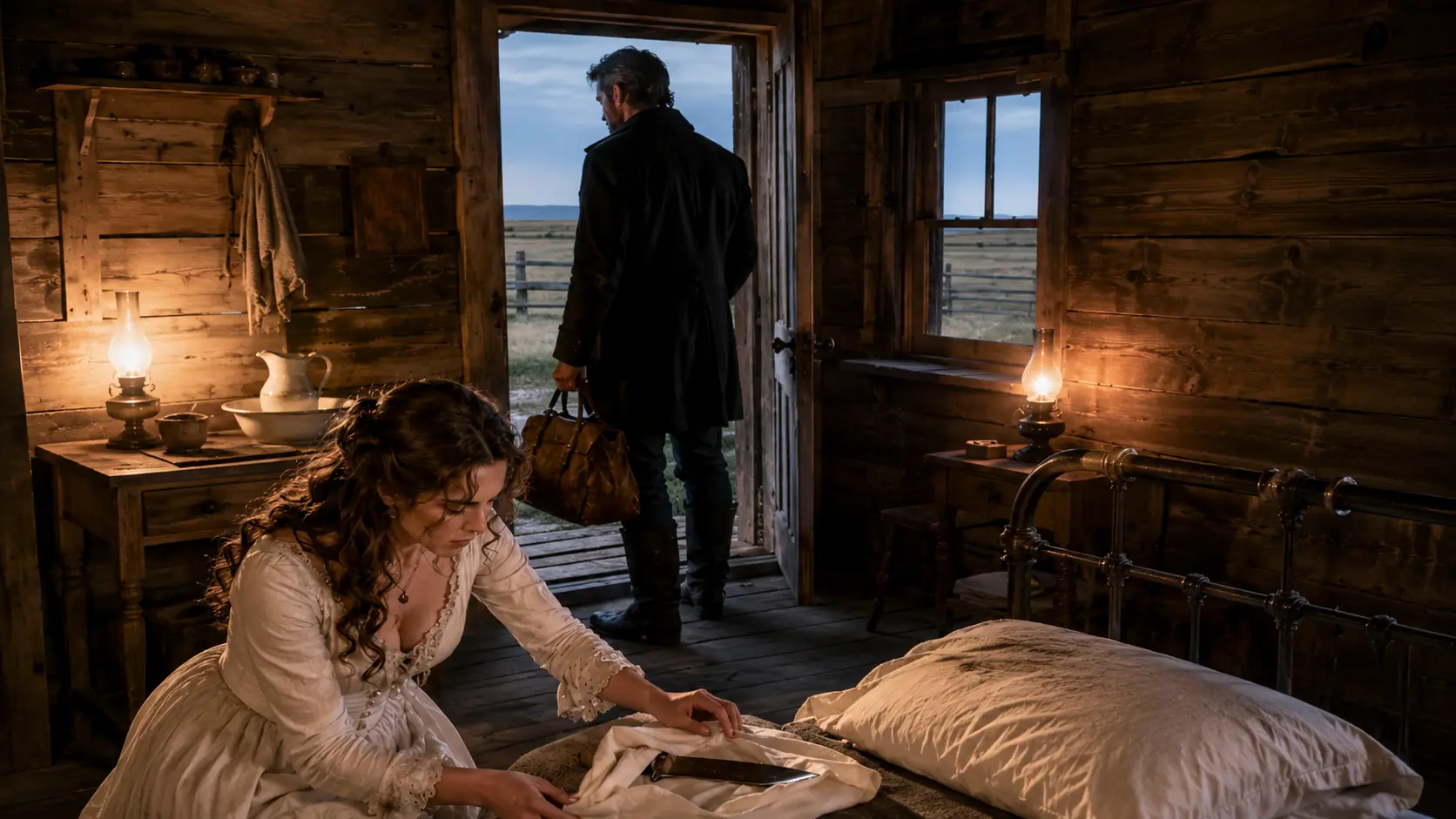
Now she sat on the edge of an iron bed, still wearing the ivory wedding dress in which she had arrived from Missouri. Coal smoke darkened the lace sleeves, prairie dust stained the hem gray, and one pearl button was missing from the tightly fitted bodice. Her long brown curls had partly fallen from their pins, leaving damp strands against her flushed cheeks.
Outside, Wyoming wind struck the cabin walls with the flat palm of winter.
At 6:03, a horse stamped near the corral.
At 6:06, a metal bucket knocked lightly against the porch rail.
At 6:09, Eli’s boots crossed the floorboards outside her room.
Nora slid one hand beneath the pillow and wrapped her fingers around the knife handle.
The steps stopped.
She waited for the latch to turn.
Instead, wood scraped slowly across the hallway floor.
Once.
Twice.
Then harder.
Nora rose from the bed, dragging the knife free and hiding it within the folds of her skirt. Every warning she had heard before leaving Missouri returned at once. Her aunt’s cold voice. Gideon Price’s patient smile. The dressmaker tightening the wedding bodice until Nora could barely breathe while explaining that suffering made women beautiful.
She had escaped one locked house.
Had she crossed the country only to enter another?
The chair struck the outside of her bedroom door.
Nora’s pulse hammered.
Then Eli spoke through the wood.
“Mrs. Brennan?”
His voice was low, careful, and tired.
“What are you doing?” she demanded.
There was a pause.
“That chair isn’t there for the reason you’re thinking.”
Nora tightened her grip. “Why are you blocking the door? Are you keeping me in?”
“No, ma’am. I’m keeping everyone else out.”
She stared at the latch.
“There is no one else here.”
“Not tonight.”
“Then why?”
“The outside bolt on your window is broken. Until I fix it, the chair will make enough noise to wake me if somebody tries that side of the house.”
Nora glanced toward the narrow window. Darkness pressed against the glass, reflecting her pale face and the knife partly visible beside her skirt.
“You saw the knife,” she whispered.
Another silence followed.
“Yes.”
“And you’re not angry?”
“No.”
“You married me this afternoon.”
“I remember.”
“Most husbands would say that gives them rights.”
“Most husbands say many things that make me ashamed of the word.”
The chair creaked as Eli lowered himself onto it outside the doorway.
“Keep the knife tonight,” he said. “I’ll stay here until you learn you’re safe with me.”
Nora stood motionless for so long that the oil lamp began to sputter.
She had prepared for anger.
She knew how to respond to shouting, insults, threats, and hands that moved too quickly. Cruelty announced itself clearly. It could be studied, anticipated, and survived.
Kindness frightened her because kindness had always arrived first.
Gideon had once brought flowers before explaining that a wife required discipline. Her aunt had offered warm tea before announcing Nora should be grateful a man with land was willing to overlook her size. Even the dressmaker smiled while pulling the corset strings until Nora’s vision blurred.
Every trap she had known began with gentleness.
She returned the knife beneath the pillow but did not release it.
“Are you sleeping in that chair?”
“Yes.”
“You have a bed.”
“So do you.”
“This is your bedroom.”
“It is yours tonight.”
Nora sat slowly.
“And tomorrow?”
“Tomorrow we discuss what makes you comfortable.”
“You speak as though I can refuse you.”
Eli’s answer came without hesitation.
“You can.”
The word was so unfamiliar that Nora did not trust it.
She lay down fully clothed, keeping the lamp burning and one hand beneath the pillow. For hours, she listened to the wind, the shifting roof beams, and Eli’s breathing outside the door. He coughed once near midnight, adjusted his boots against the floor, then became still again.
Nora slept for perhaps twenty minutes.
When she woke before dawn, the chair remained outside.
Eli was gone.
A folded blanket rested across the seat, still warm from his body.
Beside it stood a tin cup of coffee and a small plate holding bread, cheese, and two boiled eggs.
No note.
No request.
No reminder that he had spent the night protecting her.
Nora lifted the coffee and carried it into the bedroom, suspicious even of gratitude.
The cabin looked different in daylight.
It was small but solid, built from hand-cut logs sealed with pale clay. The main room contained a stone fireplace, a square table, two chairs, and shelves holding flour, beans, coffee, salt, and several preserved jars. The kitchen was cleaner than she expected from a man living alone, though nearly every pan was blackened and one cabinet door leaned crookedly from its hinge.
Outside, the Brennan Ranch stretched across a broad Wyoming valley beneath distant blue mountains. Cattle stood near the southern fence, their backs dark against the frost. A weathered barn leaned toward the east, and beyond it a narrow creek cut through grass burned gold by winter.
Eli stood beside the corral repairing a broken gate.
He had removed his long dark coat and worked in a faded brown shirt with the sleeves rolled above his forearms. He was thirty-eight, broad-shouldered and tall, with sun-browned skin, dark hair that refused to remain combed, and a short beard threaded with the first signs of gray. A pale scar crossed the back of his left hand.
Nora watched him through the window.
He had known she carried a weapon.
He had not taken it.
That disturbed her more than if he had demanded it.
At breakfast, Eli spoke only after she entered the kitchen.
“I can leave while you eat.”
Nora stopped. “Why would you?”
“You may not want company.”
“I crossed three states to marry you.”
“That does not mean you know me.”
“You did not seem concerned about that yesterday.”
“I was concerned. I simply hoped you would still step off the train.”
The honesty surprised her.
Eli pulled out the second chair but did not sit until she did.
He had cooked oatmeal too thin to remain on the spoon, along with bacon burned nearly black on one side and raw on the other. Nora examined the meal without comment.
“I know it’s poor,” he said.
“It is ambitious.”
His mouth moved slightly.
“Is that a kinder word for terrible?”
“It is a word that means you attempted several things at once and succeeded at none.”
He looked down at his plate. “My first wife cooked.”
Nora’s spoon stopped.
The marriage agency had described Eli as widowed, but he never mentioned his late wife in their letters. Nora had wondered whether he still loved her, resented her death, or simply required someone to occupy the empty space she left.
“What was her name?”
“Sarah.”
“How long ago?”
“Five years.”
“Did she die here?”
Eli glanced toward the bedroom.
“No. Fever took her in Cheyenne. I brought her there because I thought the doctor could save her.”
“And he couldn’t.”
“No.”
Nora watched his expression close.
“Was she afraid of you?”
The question came more sharply than she intended.
Eli looked up.
“Sometimes.”
Nora tightened her fingers around the spoon.
His voice remained steady. “Not because I struck her. I never did. But I was younger and believed silence made a man strong. When I was angry, I left the house for hours. When she asked what troubled me, I told her it was not her concern. She spent years trying to guess which version of me would come through the door.”
“That sounds like fear.”
“It was.”
“Why tell me?”
“Because you asked whether she was afraid.”
Most men would have defended themselves, blamed the dead woman’s sensitivity, or recast coldness as masculine restraint.
Eli did not.
“I learned gentleness too late for Sarah,” he continued. “I do not intend to learn honesty too late for you.”
Nora looked down at the oatmeal.
Her appetite had vanished, but not from fear.
“You should fix the window bolt,” she said.
“I will.”
“And the bedroom door needs an inside lock.”
“I bought one in town yesterday.”
Her eyes lifted sharply.
“You expected me to ask?”
“I hoped you would not need to.”
He stood, retrieved a small iron lock from the mantel, and placed it on the table.
“You may install it yourself or watch me do it.”
Nora touched the cold metal.
For the first time since leaving Missouri, she believed she might have chosen correctly.
The belief lasted less than a day.
Near sunset, three ranch hands rode in from the northern pasture. Eli had told Nora he employed six men, though half slept in a bunkhouse two miles from the cabin. The three who arrived that evening were hungry, muddy, and openly curious about the new bride.
The oldest introduced himself as Samuel Hart, a gray-haired Black American cowboy with a calm voice and a permanent stiffness in one knee. Beside him stood twenty-year-old Caleb Dunn, who blushed whenever Nora looked at him, and thirty-four-year-old Wesley Price, whose surname made her stomach tighten despite the lack of relation to Gideon.
Wesley removed his hat.
“So you’re the Missouri bride.”
Nora remained near the stove. “I am Nora Brennan.”
His eyes traveled over her ivory dress, her full figure, and the knife now resting openly beside the breadboard.
“Eli neglected to mention you were—”
Samuel struck Wesley’s boot with his cane.
Wesley stopped.
“That I was what?” Nora asked.
Eli entered through the back door carrying firewood.
The room tightened.
Wesley laughed awkwardly. “That you were a fine-looking woman.”
Nora did not believe him.
Neither did Eli.
But Eli did not defend her by speaking over her.
He placed the wood near the stove and waited.
Nora looked directly at Wesley. “I have crossed farther distances than this ranch to escape men who believed women should feel grateful for being inspected. You may eat at my table without examining me, or you may remain hungry outside.”
Caleb looked at the floor.
Samuel’s mouth twitched beneath his mustache.
Wesley flushed. “No insult intended.”
“Then none will need forgiving.”
He nodded.
Eli said nothing until the men went to wash.
“You handled that well.”
“I handled it myself.”
“Yes.”
Nora looked at him, searching for resentment.
There was none.
That evening, she cooked her first meal at Brennan Ranch.
The pantry contained dried beans, salt pork, onions, and flour. She softened the beans with a small pinch of baking soda, fried the pork until the fat rendered clear, and made biscuits from sour milk Eli had intended to throw away. The meal was simple, but the men ate in near silence until Samuel leaned back and released a satisfied breath.
“Mrs. Brennan,” he said, “I have survived twenty-seven winters west of the Missouri River, and this is the first biscuit that made me glad to be alive for another.”
Nora smiled despite herself.
Eli watched her from the opposite end of the table.
He did not look proud as though he had purchased a skilled woman.
He looked relieved that she had smiled.
The days that followed settled into careful routine.
Nora moved from the bedroom into a smaller room beside the kitchen once Eli repaired its ceiling. He did not question the choice. He slept in the original bedroom and never approached hers without knocking.
Each evening, he placed his revolver on the mantel before entering the house.
The knife remained beneath Nora’s pillow.
At first, she checked it several times a night.
Then only once.
She began learning the ranch.
Brennan cattle grazed nearly eight hundred acres, though drought had reduced the herd and forced Eli into debt. A northern neighbor named Silas Crowe controlled the easiest road to town and repeatedly threatened to close it unless Eli sold him the western pasture.
Eli refused.
“Why?” Nora asked while reviewing his account book.
“Because Crowe wants the spring.”
“The spring is barely flowing.”
“It feeds the lower creek in summer.”
“And without it?”
“The ranch dies.”
Nora examined the numbers.
“Your ranch may die before summer anyway.”
Eli’s face hardened.
“You asked for honesty,” she reminded him.
“I did.”
“You owe the bank nine hundred dollars by May. Two hundred to the feed store. Another hundred and eighty for fencing.”
“I know my debts.”
“Then why are six calves missing from the sale ledger?”
He hesitated.
Nora looked at him.
“Eli.”
“I sold them privately.”
“Where is the money?”
“I sent it to Missouri.”
Her blood chilled.
“To whom?”
“The address you gave the marriage agency.”
Nora stood so quickly the chair struck the wall.
“You sent money to my aunt?”
“She wrote that you stole jewelry when you left.”
“I owned no jewelry.”
“She claimed Gideon Price paid for your travel clothing and demanded repayment.”
Nora could barely breathe.
“You answered them?”
“I sent enough to end the matter.”
“You told them where I was.”
“No.”
“They know I reached Wyoming.”
“The letter carried no ranch name.”
“They know I married you.”
Eli rose. “Nora—”
“Do not touch me.”
He stopped immediately.
That obedience prevented panic from becoming violence.
Nora crossed toward the door, her body shaking. For years, Gideon had controlled her through debt he invented. He paid for dinners she never requested, brought gifts she refused, then listed their cost as proof she owed him obedience. When she escaped, she carried only clothing she already owned and the money her mother left before dying.
Gideon would not care.
He required only an excuse.
“You should have asked me,” she said.
“Yes.”
“You believed a man’s accusation before your wife’s silence.”
“I did not believe him.”
“You paid him.”
“I wanted him to leave you alone.”
“You thought money could purchase my safety.”
“I thought—”
“That was the failure.”
Eli lowered his head.
“You are right.”
She expected an explanation.
None came.
“I need air,” Nora said.
He moved away from the door.
Outside, the cold struck her lungs. She walked beyond the barn, through dry grass, and stopped beneath a cottonwood near the creek. The land spread silent around her.
Eli remained by the cabin.
He did not follow.
When Nora returned an hour later, the table held the letter from Missouri, opened and flattened. Beside it lay a second sheet written in Eli’s hand.
She read the original first.
Her aunt claimed Nora had stolen a pearl necklace belonging to the family. Gideon demanded one hundred dollars for “expenses incurred in preparation for the marriage.” He promised no further action if Eli paid immediately.
The second letter was Eli’s confession.
He documented the money, the date, and his mistake. He wrote that the debt belonged to him alone because Nora had not authorized it. He also promised that no future communication concerning her would be answered without her knowledge.
At the bottom he added:
I treated your past as a problem I could solve without you. That was not protection. It was another way of taking your choice.
Nora found him in the barn repairing a harness.
“You understood,” she said.
Eli put down the leather strap.
“Too late.”
“Not entirely.”
“I exposed you.”
“Yes.”
“I thought if I paid him, he would disappear.”
“Men like Gideon do not disappear when paid. They learn the price of access.”
Eli’s jaw tightened. “Tell me about him.”
Nora had never told anyone the full truth.
She spoke until the lantern burned low.
Gideon Price belonged to a wealthy St. Louis family that owned warehouses and river interests. He met Nora through her aunt, who considered his attention a miracle. He praised Nora’s softness, called her substantial and womanly, then gradually began describing what would change after marriage.
Her meals.
Her clothing.
Her friendships.
Her money.
When she objected, he smiled and said frightened women often mistook guidance for cruelty.
One evening, after she refused to marry him before winter, he trapped her inside the pantry and held the door shut while she begged to leave. He kept her there two hours, then opened it with flowers in his hand and asked whether she had learned calmness.
That night, Nora began corresponding with the marriage agency.
“I did not come west searching for romance,” she told Eli. “I came because Wyoming was farther than he could reach easily.”
Eli’s face was pale with controlled anger.
“What do you want me to do?”
“Nothing without asking.”
He nodded.
“What do you want now?”
Nora looked toward the cabin.
“Fix the lock.”
He did.
By Christmas, trust had grown quietly between them.
Nora moved back into the larger bedroom but kept Eli sleeping in the small room. She explained that she wanted more space for sewing and did not wish to climb over stored provisions every morning.
Eli accepted the explanation even though both understood it was not the full reason.
The knife remained beneath her pillow.
It no longer rested in her hand.
They worked together through early winter. Nora reorganized the ranch accounts, negotiated lower feed prices in town, and discovered that Crowe’s men had been cutting Brennan fence wire to scatter cattle across the road. Eli taught her to ride a patient brown mare named Honeybell, though Nora spent the first three lessons convinced every movement signaled impending death.
“You’re gripping too tightly,” Eli said while leading the mare.
“I prefer control.”
“So does the horse.”
“Then we understand each other.”
Honeybell sneezed.
Eli smiled. “She disagrees.”
Nora began laughing more often.
Sometimes she caught Eli watching her across the table, not hungrily and not with the careful distance he had maintained at first. Something warmer had entered his expression.
It frightened her.
She felt the same warmth growing inside herself.
That frightened her more.
One snowy evening, Eli returned from the northern fence with blood along his temple. Crowe’s men had confronted him, and one struck him with a rifle stock before Samuel arrived.
Nora forced Eli into a chair beside the stove.
“You should have taken more men.”
“I expected conversation.”
“You have a romantic understanding of criminals.”
“I married through letters. My judgment is questionable.”
She pressed a cloth against the wound.
Eli winced.
“Hold still.”
“Yes, ma’am.”
Nora’s hand brushed his cheek.
They both became quiet.
Eli’s eyes lowered toward her mouth, then rose again.
He did not move closer.
“May I kiss you?” he asked.
No man had ever asked.
Gideon took her wrist before touching her face. Her aunt ordered her to tolerate affection because refusal embarrassed everyone. Even the justice in Laramie told Eli he could kiss his bride before either of them agreed.
Nora swallowed.
“Not tonight.”
Eli nodded.
“Thank you for answering.”
There was no disappointment sharpened into punishment.
No silence.
No slammed door.
He simply allowed her to finish tending the wound.
Three nights later, Nora found the courage herself.
Eli stood at the sink washing his plate when she entered the kitchen. He turned, surprised to find her so close.
“Is something wrong?”
“No.”
She touched his shirt near the collar.
“May I kiss you?”
His breath caught.
“Yes.”
The kiss was brief.
Nora pulled away almost immediately, pulse racing. Eli did not pursue her. He remained exactly where he stood, hands lowered, allowing her to decide whether the moment continued.
She kissed him again.
Longer.
When she stepped back, tears filled her eyes.
Eli’s expression changed to concern. “Did I frighten you?”
“Yes.”
“I’m sorry.”
“Not because you did anything wrong.”
He waited.
“I wanted it,” she whispered.
He understood.
Wanting something meant she could lose it. Trust meant another person had power to wound her. Love, if it came, would require entering a room without checking where every exit stood.
Eli touched her face only after she nodded.
“You may be afraid,” he said. “You do not have to be ashamed.”
By February, the knife moved from beneath the pillow to the bedside drawer.
That was where it remained when Gideon Price arrived.
Three riders appeared near sunset, their horses dark with sweat despite the freezing wind. Gideon dismounted first, dressed in a fine black coat unsuited to ranch work, polished boots, and leather gloves. He looked exactly as Nora remembered—handsome, controlled, and smiling as if every person before him already belonged to his plan.
Her aunt sat inside the covered wagon behind him.
Nora saw them through the window and nearly dropped the cup in her hand.
Eli entered from the yard.
“Do you know them?”
“Yes.”
He looked at her face.
“What do you want?”
The question steadied her.
“Lock the door.”
Eli obeyed.
Gideon knocked politely.
“Nora,” he called. “I have come to bring you home.”
She stood behind the door without answering.
Her aunt’s voice followed.
“Do not humiliate us further. Open this door.”
Eli looked toward Nora.
She opened the bedside drawer and removed the knife.
His gaze settled on it.
“Would you like my revolver?”
“No.”
“Would you like me beside you?”
“Yes.”
They opened the door together.
Gideon smiled when he saw Nora.
“My poor girl. Look what this place has done to you.”
Nora wore a dark green wool dress she had sewn herself, fitted comfortably rather than painfully. Her hair fell in a long braid over one shoulder. She had gained strength from ranch work and lost the habit of apologizing before speaking.
“What do you want?” she asked.
“To correct a terrible mistake.”
“I made no mistake.”
“You married a stranger.”
“I married a man who knocks on my door.”
Gideon’s smile weakened.
Her aunt climbed down from the wagon. “That is enough. You stole from me, disgraced Mr. Price, and entered an invalid marriage under deception.”
Eli shifted, but Nora touched his arm.
Her choice.
Her voice.
“What did I steal?”
“The pearls.”
“You sold Mother’s pearls three years ago to pay your gambling debt.”
Her aunt’s face changed.
Gideon intervened smoothly. “This discussion should remain private.”
“It is private property,” Nora said. “You are standing on it without invitation.”
“I came as your lawful fiancé.”
“I never married you.”
“You agreed.”
“I refused.”
“You accepted gifts.”
“I returned them.”
“You owe me.”
“No.”
The word crossed the cold air without trembling.
Gideon looked toward Eli. “Mr. Brennan, I paid one hundred dollars for the return of stolen property and expenses. You knowingly married a woman contractually promised to me.”
Eli’s voice remained calm. “I paid because I was a fool.”
“Then surrender her and consider the loss tuition.”
Nora felt Eli’s body tense beside her.
He did not speak.
He waited.
She stepped forward.
“No man will surrender me because no man owns me.”
Gideon’s smile disappeared.
“You have become bold.”
“I was always bold. You simply kept me frightened enough to hide it.”
He moved suddenly and caught her wrist.
For one heartbeat, Nora returned to the pantry.
Darkness.
Closed door.
Flowers afterward.
Then Eli reached forward.
Nora stopped him.
“No.”
Eli froze.
Gideon tightened his hand. “You see? Even now she obeys whoever speaks loudest.”
Nora lifted the knife.
The edge rested against his coat sleeve.
“Release me.”
He stared at it.
“You would not dare.”
Nora looked into his eyes.
“That is what you have misunderstood about frightened women. Fear teaches us exactly how much force survival may require.”
Gideon released her.
Eli stepped between them only after Nora moved back.
Samuel, Caleb, and two other ranch hands had appeared near the barn. Crowe’s illegal fence cutting had made the ranch careful about visitors, and every man now carried a rifle.
No weapon pointed directly at Gideon.
None needed to.
Eli spoke quietly.
“You will leave.”
Gideon looked toward Nora. “You think he loves you? He needed a cook, a housekeeper, and a warm body in winter.”
Nora waited for pain.
Instead, she remembered the chair outside her door.
The new lock.
The letter of confession.
Every question Eli asked before touching her.
“He needed a wife,” she said. “But he never required me to become less of myself to remain one.”
Her aunt stepped forward. “You will regret choosing this poverty.”
Nora looked across the ranch.
The barn needed repair. Debt remained. Winter had reduced the cattle, and one window leaked during strong storms. Nothing about the life was easy.
It was hers.
“I choose it.”
Gideon returned to his horse.
Before mounting, he faced Eli. “This is not over.”
Nora answered.
“Yes, it is.”
Samuel rode behind the visitors until they reached the county road. Two days later, Eli and Nora traveled to Laramie with letters, witnesses, and a statement describing Gideon’s assault. The justice confirmed their marriage was lawful. An attorney sent formal notice warning Gideon that any further attempt to remove Nora would result in criminal charges.
Her aunt’s claim collapsed when Missouri records confirmed the pearls had been sold years earlier.
Gideon never returned.
Spring reached Brennan Ranch in slow patches of green.
Calves appeared across the lower pasture, the creek swelled with snowmelt, and Eli’s debt became manageable after Nora arranged a wool contract with a Cheyenne merchant. Crowe abandoned his effort to seize the road after the county investigated the cut fences.
One evening in May, Nora stood beside the bedroom window while Eli installed a new curtain rod.
The chair from their wedding night remained in the hallway.
Nora had never allowed anyone to remove it.
Eli finished the work and stepped down.
“Anything else?”
“Yes.”
She opened the bedside drawer.
The knife lay inside, wrapped in the same handkerchief she used on their first night.
Nora placed it in his hands.
Eli looked at her.
“You may keep it.”
“I don’t need it there anymore.”
He seemed afraid to understand too quickly.
“Where should it go?”
“The kitchen.”
He carried it to the wooden block and slid it into the empty space.
When he returned, Nora stood beside the bed with her hands clasped nervously.
“You may sleep here tonight,” she said.
Eli did not move.
“Are you certain?”
“Yes.”
“You may change your mind.”
“I know.”
“If you want me to leave at any moment—”
“I know, Eli.”
He smiled faintly.
Nora reached for him.
Their first night as husband and wife in more than name was not perfect. She trembled. Twice she asked him to stop, and twice he did without frustration. She cried when he touched the scar on her wrist left by Gideon’s hand.
Eli kissed the mark.
Not as though claiming it.
As though grieving that anyone had made it.
In the morning, Nora woke before him.
Sunlight crossed the quilt, and Eli’s hand rested open between them, not closed around her. The bedroom door remained unlocked.
She studied the peaceful face of the stranger she had married nine months earlier.
Then she placed her hand inside his.
Years later, their children heard a softened version of the story. Nora told them she traveled west to marry a rancher whose cooking threatened human life. Eli claimed she saved him primarily by improving the oatmeal.
Neither mentioned the knife until their eldest daughter discovered it in the kitchen and asked why the handle was wrapped in an old handkerchief.
Nora held it carefully.
“Because once, I thought this was the only thing standing between me and danger.”
The girl looked toward Eli, now grayer and still broad through the shoulders.
“What changed?”
Nora smiled.
“Your father sat outside my door.”
Eli shook his head. “One uncomfortable night does not make a good husband.”
“No,” Nora agreed. “But every night afterward proved the first one was not an act.”
The chair remained in the hallway for the rest of their lives.
Its legs were scratched from the night Eli dragged it across the floor, and one spindle had cracked beneath his weight. Visitors often asked why the Brennans preserved such an ordinary, damaged piece of furniture.
Nora never called it ordinary.
The knife represented the woman she had needed to become to survive.
The chair represented the first man who looked at that frightened woman, saw the weapon in her hand, and did not demand that she surrender it before earning her trust.
On their twentieth anniversary, Wyoming wind battered the cabin much as it had on their wedding night. Nora sat beside the fire while Eli locked the barn and crossed the porch.
His boots stopped outside the bedroom door.
He knocked.
After two decades, he still knocked.
“Mrs. Brennan?”
Nora looked toward the old chair.
“Yes?”
“May I come in?”
Her throat tightened with the same emotion she had felt when he first promised to guard the door. But the fear was gone now, replaced by something deeper and steadier.
“You may,” she answered.
The latch turned.
Eli entered carrying two cups of coffee, closed the door gently behind him, and crossed the room toward the woman who no longer slept with a knife beneath her pillow.
Not because the world had become harmless.
Not because fear had vanished.
Because the man she loved had spent twenty years proving that safety was not a locked door, a hidden blade, or a promise spoken once.
Safety was someone who kept asking permission long after he knew the answer would be yes.