The dust of the Julesburg stagecoach was still settling on Clara Whitmore’s skin when she saw the man watching her from beside the livery stable. He did not stare the way men in Boston had stared, measuring her face, her figure, or the value of the clothes she wore. He simply watched with quiet concern, as though he had noticed something fragile in her and feared that one careless movement might send her running. Clara tightened both hands around her valise and reminded herself that she had crossed nearly two thousand miles for this moment.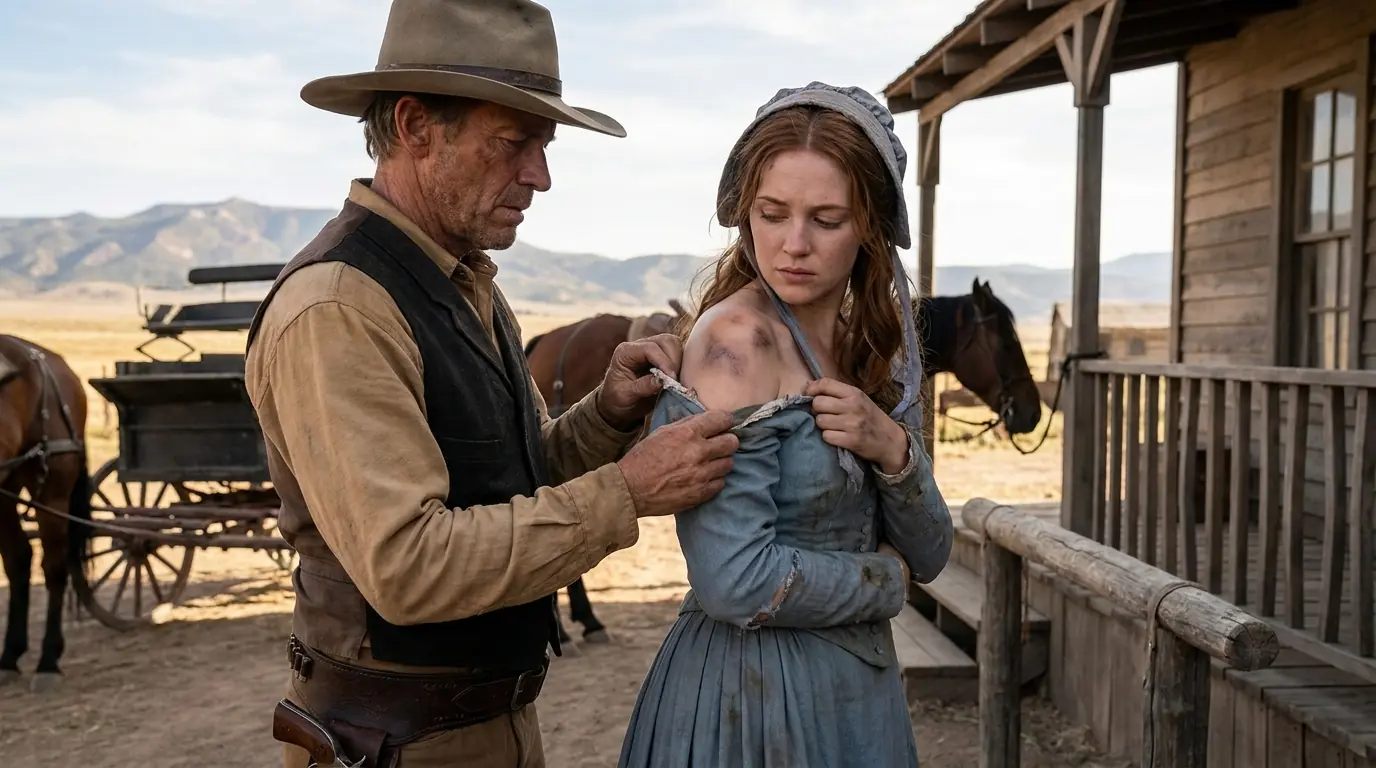
The man removed his brown hat as he approached, revealing wind-tossed dark hair and a face marked by years beneath the Colorado sun. He was tall and broad through the shoulders, dressed in a faded tan shirt, dark vest, worn trousers, and boots coated with prairie dust. A gun rested at his hip, but his hands remained visible and open. Most importantly, he stopped several feet away from her.
“Miss Whitmore?”
“That’s me.”
“Samuel Cross,” he said. “Most folks call me Sam.”
His voice was deep but gentle, carrying clearly over the clatter of wagons and the distant ringing of a blacksmith’s hammer. Clara had imagined dozens of versions of the man who had written the advertisement in the Matrimonial News. In her darkest imaginings, he had been cruel, drunken, or desperate enough to treat a wife as purchased property. The man standing before her appeared nervous instead.
“Your telegram said the afternoon stage,” Sam continued. “I’ve been waiting since ten.”
Clara blinked. “Since ten?”
“Didn’t want you arriving with nobody here to meet you.”
The simple answer unsettled her more than suspicion might have. Kindness had become unfamiliar enough to feel dangerous. She looked toward the crowded street, searching unconsciously for the face of her cousin Silas among the travelers, though she knew he could not possibly have followed her so quickly.
“The stage was delayed near Plum Creek,” she explained. “A rockslide blocked the road.”
“Was anyone hurt?”
“No. Only frightened.”
Sam nodded, apparently satisfied that no one had suffered. Then he gestured toward a sturdy wagon waiting beyond the stable. “My ranch is about an hour west. I can take your valise, provided you’re comfortable with that.”
The fact that he asked permission nearly broke something inside her.
Clara handed it to him. “Thank you.”
Sam carried the valise as though it contained fine porcelain rather than two dresses, a Bible, and everything left of Clara’s former life. At the wagon, he placed the luggage carefully in the back before offering his hand. She accepted, but the moment she lifted herself onto the wooden bench, pain flashed through her ribs.
A sharp breath escaped her.
Sam immediately released her hand and stepped back. “Did I hurt you?”
“No.”
“You’re pale.”
“It was a long journey.”
His eyes lingered on her face, but he did not challenge the lie. He climbed onto the bench, leaving a respectful distance between them, and took up the reins. The horses started forward, carrying Clara out of Julesburg and toward a life she could neither picture nor trust.
The prairie opened around them beneath an enormous blue sky. Low grasses rolled toward distant mountains, and sunlight flashed across shallow streams winding through the plain. Clara had spent her entire life in rooms crowded with furniture, streets crowded with carriages, and houses crowded with people who listened through walls. Here, the horizon seemed to offer more space than one human heart could hold.
“It’s beautiful,” she whispered.
Sam glanced at her. “Most eastern folks call it empty.”
“I’ve had enough of crowded places.”
He heard the weight beneath her words, but he did not ask her to explain. Instead, he told her about the ranch. He owned sixty head of cattle, two milk cows, a flock of unruly chickens, and a brown dog named Duke who believed every visitor had come solely to see him.
“The house has two bedrooms,” Sam added. “You’ll have one to yourself.”
Clara turned toward him. “The advertisement was for a wife.”
“It was.”
“Then you understand what that means.”
“I understand what people expect it to mean.” His jaw tightened. “But you’re not freight I ordered from Boston. We’ll marry only if you still want to after you’ve had time to know me.”
“You would let me refuse?”
“I’d prefer the disappointment to a wife who fears me.”
Clara looked away before he could see her expression crumble. Silas had told her that no man offered kindness without expecting something in return. He had repeated it whenever she protested his demands, whenever she resisted surrendering her inheritance, and whenever his fists left marks that her high collars could not hide. Yet Sam had given her space before asking for anything.
The Cross ranch appeared against the mountains an hour later. The house was modest, built of timber with a stone chimney and a porch stretching across the front. A red barn stood nearby, and several horses raised their heads as the wagon approached. Duke came racing through the yard, barking with joyous enthusiasm.
Sam stopped the wagon and climbed down. When he came around to Clara’s side, he raised both hands but waited. She hesitated before placing her palms in his.
His grip was warm and steady. Clara lowered herself carefully, but her boot slipped against the wheel. Sam caught her around the waist before she fell.
Pain tore through her bruised side.
She gasped and jerked away so violently that the shoulder of her dusty-blue dress snagged against the wagon latch. The worn fabric pulled downward, exposing pale skin darkened by purple bruises. Several marks crossed her shoulder blade, while another spread along her ribs in the unmistakable shape of a man’s boot.
Clara froze.
Sam stared at the injuries. His face changed, not with disgust or suspicion but with a terrible stillness. He released the fabric immediately, allowing her to gather the dress across herself.
“Those weren’t made by the journey,” he said.
Clara lowered her eyes.
Sam’s voice softened. “Who hurt you?”
“Please don’t ask unless you truly want the truth.”
“I do.”
“You may not after you hear it.”
His hands curled at his sides, but when he spoke, the anger was directed nowhere near her. “No one will ever lay a hand on you again while you’re with me.”
Clara looked up. There was no demand in his expression, no expectation that she reward him for his promise. He looked heartbroken, as though the bruises on her skin had wounded him too.
“Then take me inside,” she whispered. “And I’ll tell you what I had to run from.”
Sam did not touch her again. He retrieved her valise and led her into the house while Duke followed quietly, sensing that the moment did not call for barking. Inside, sunlight warmed a simple main room furnished with a wooden table, two chairs, shelves of preserved food, and a stone fireplace.
Sam opened the smaller bedroom. A patchwork quilt covered the bed, fresh water waited in a porcelain pitcher, and a sprig of dried lavender rested on the pillow, tied with a blue ribbon. Clara touched it with trembling fingers.
“Mrs. Birch helped prepare the room,” Sam explained. “She lives north of here and knows more about medicine than most doctors.”
“You prepared this before knowing whether I would come?”
“You said you would.”
“People break promises.”
Sam’s expression grew distant. “I know.”
He left her alone to change, then rode to fetch Mrs. Birch without making Clara ask. The older woman arrived before sunset, carrying a leather medical bag and the brisk authority of someone who had delivered half the county. She examined Clara behind the closed bedroom door while Sam waited outside on the porch.
The bruises covered more of Clara’s body than even she had realized. Some were yellow and fading, while others remained black and swollen. Two ribs were badly bruised but not broken, and a cut near her shoulder had begun to heal poorly.
Mrs. Birch cleaned the wound and wrapped Clara’s ribs. “You’re fortunate,” she said. “Another blow in the wrong place could have killed you.”
“I know.”
“Does Sam know who did it?”
“Not yet.”
“He’ll listen when you’re ready.” Mrs. Birch tied the final bandage. “That man has his faults, but cruelty isn’t among them.”
“What faults?”
“He thinks fences repair themselves if he avoids looking at them long enough.”
Clara laughed despite the ache in her side. Mrs. Birch smiled and squeezed her hand.
When Clara emerged, Sam stood near the fireplace with his back to her. A pot of stew simmered over the flames, and bread waited on the table. He turned only after she spoke his name.
“Mrs. Birch says I’ll recover.”
Relief moved visibly through him. “Good.”
“She also says you neglect your fences.”
Sam glanced accusingly at the older woman. “I knew there was a reason I shouldn’t have invited her.”
Mrs. Birch left after supper, making Sam promise that Clara would rest. The silence that followed was not uncomfortable, but it carried the weight of the story Clara had promised to tell. She sat near the fire with a blanket around her shoulders while Sam occupied the chair across from her.
“My parents died when I was seventeen,” Clara began. “My father left me a small house and an inheritance. My cousin Silas became executor until I turned twenty-one.”
Sam listened without interrupting.
“By the time I reached twenty-one, he claimed the money was gone. He said my father had debts, but he never showed me any papers. When I asked questions, he reminded me that an unmarried woman had few choices.”
“How long did he strike you?”
“The first time was two years ago. The worst was six weeks ago, after I found a ledger proving he had been withdrawing money from my account.”
Sam leaned forward, his forearms resting on his knees. “Do you still have it?”
“No. He caught me with it.”
“And beat you.”
Clara nodded. “He said no respectable man would want a woman who accused her own family of theft. Then he told me he had arranged my marriage to one of his business partners. The man was nearly sixty and had already buried two wives.”
Sam’s face hardened.
“I saw your advertisement the next morning,” Clara continued. “I answered before I could lose my courage. When your letter came, I sold my mother’s jewelry for the fare and left while Silas was away.”
“So you came because you needed somewhere he couldn’t reach.”
“I came because I was afraid.”
“There’s no shame in surviving.”
“He would disagree.”
“Then he’s a fool as well as a coward.”
Clara’s eyes filled with tears. “You wanted a strong wife.”
Sam rose slowly, careful not to alarm her. He crossed to the fireplace, added another piece of wood, then looked at her over his shoulder.
“You crossed half the country with bruised ribs and no guarantee I’d be a decent man,” he said. “I reckon that’s stronger than anything I’ve ever done.”
Clara wept quietly. Sam did not approach or attempt to stop her tears. He simply remained nearby until she was ready to lift her head again.
During the days that followed, Clara learned the rhythms of the ranch. Sam rose before dawn but made little noise, and he always left coffee warming near the stove. He refused to allow her to perform heavy work until her ribs healed, though he accepted her help with the accounts after discovering she understood numbers better than he did.
She learned that Sam hummed when repairing harnesses and spoke to his cattle as though negotiating business agreements. He learned that Clara loved mountain sunsets, hated boiled turnips, and could transform flour, lard, and dried apples into a pie Duke once attempted to steal from the windowsill. Their companionship grew through ordinary moments rather than declarations.
One evening, Clara found Sam mending the torn shoulder of her blue dress. His large fingers struggled with the needle, and the stitches wandered across the fabric like a drunken trail.
“What are you doing?”
Sam looked guilty. “Attempting a repair.”
“It appears you’re attacking it.”
“I can stop.”
Clara sat beside him and gently took the dress. “My mother taught me to sew when I was young.”
“Mine did too. Apparently, none of it remained.”
Their hands touched as he passed her the needle. Clara tensed instinctively, but Sam withdrew at once.
“I’m sorry.”
“You didn’t do anything.”
“Your face said otherwise.”
She studied his weathered features. “You always notice.”
“I try.”
Clara slipped the needle through the fabric. “Perhaps one day I won’t be afraid every time someone reaches toward me.”
Sam’s voice was barely above a whisper. “You’ve got all the time you need.”
The preacher was expected on Sunday, but when Sunday arrived, Clara told Sam she was not ready to marry. Her heart pounded as she spoke, preparing for anger or disappointment. Sam merely nodded and informed the preacher that the ceremony would wait.
That evening, he placed the marriage advertisement in the fireplace and watched it burn.
“You don’t need to do that,” Clara said.
“Yes, I do.”
“Why?”
“Because I don’t want you wondering whether you owe me the woman described in that notice.”
The flames consumed the words good character and hearty constitution. Sam looked at Clara rather than the fire.
“If you marry me someday, I want it to be because you choose me.”
Before Clara could answer, Duke began barking furiously outside.
A rider entered the yard beneath a darkening sky. He wore an expensive black coat unsuited to ranch work, and even from the porch Clara recognized his rigid posture. Her blood turned cold.
Silas Whitmore dismounted with a revolver visible beneath his coat.
“There you are,” he called. “You’ve caused your family considerable embarrassment.”
Clara stepped backward. Sam moved in front of her but did not reach for his gun.
“She’s not leaving with you,” he said.
Silas smiled. “You must be the lonely rancher. I’m afraid Clara misrepresented herself. She’s mentally unwell and stole property before fleeing Boston.”
“That property belonged to my mother,” Clara said, though her voice shook.
Silas’s eyes sharpened. “Be quiet.”
Sam’s entire body went still.
Silas reached into his coat and produced folded documents. “I have legal authority to return her to my custody. She is indebted to my household and promised in marriage to another man.”
“There is no legal agreement,” Clara said.
“You signed it.”
“You forced my hand while I could barely stand.”
Silas walked toward the porch. “Come down here before this becomes unpleasant.”
Sam descended the steps and stopped several feet from him. “You’ve already made it unpleasant.”
“This is family business.”
“No. Family doesn’t leave boot marks on a woman’s ribs.”
Silas looked toward Clara with sudden fury. “You showed him?”
Clara’s fear remained, but another emotion rose beneath it. For years Silas had controlled her through secrecy. Every lie depended on her silence.
“Yes,” she said. “I showed him.”
Silas reached for his revolver.
Sam moved faster.
In one motion, he knocked the weapon aside and drove Silas backward against the hitching post. The revolver landed in the dirt. Sam could have struck him, but he did not. Instead, he held Silas by the coat and stared into his face.
“If I were the sort of man you are,” Sam said quietly, “you wouldn’t leave this ranch breathing.”
Silas laughed nervously. “Then release me.”
“Not until the sheriff arrives.”
As though summoned by the words, hoofbeats sounded beyond the barn. Mrs. Birch rode into the yard beside Sheriff Amos Bell and another deputy. Clara stared at Sam.
“You sent for them?”
“The morning after you told me your story.”
Sheriff Bell dismounted. “Samuel came to town with your name and asked me to wire Boston. Turns out authorities there have questions about missing trust funds and a forged marriage contract.”
Silas’s confidence vanished. He twisted against Sam’s grip, but the sheriff stepped forward with handcuffs.
“This proves nothing,” Silas snapped. “She is a frightened, unstable woman.”
Clara entered the yard despite the pain in her ribs. “There is a hidden compartment beneath the bottom drawer of your Boston desk. My father’s original bank records are inside. You never found the key because I kept it sewn into my coat.”
She removed a small brass key from the hem of her traveling cloak.
Silas stared at it.
Sheriff Bell took the key carefully. “That should help.”
“You ungrateful little—”
Sam stepped between them before Silas could finish. “Choose your next word wisely.”
The sheriff took Silas away beneath a sky streaked with crimson. Clara remained in the yard long after the horses disappeared, holding her arms around herself. Sam stood several paces away, waiting.
“He came all this way,” she said.
“He won’t come again.”
“You can’t promise that.”
“No.” Sam looked toward the empty road. “But I can promise you won’t face him alone.”
Clara crossed the distance between them.
Sam did not move as she placed her hands against his chest. She felt his heartbeat beneath her palms, strong and unexpectedly fast. Then she leaned forward and rested her forehead against him.
His arms remained at his sides. “May I hold you?”
“Yes.”
Sam embraced her gently, careful of her healing ribs. Clara closed her eyes and allowed herself to be supported. For the first time in years, being held did not feel like being trapped.
News from Boston arrived six weeks later. The records found in Silas’s desk proved that he had stolen nearly all of Clara’s inheritance and forged documents to conceal it. He would stand trial in Massachusetts after answering charges in Colorado for assault and unlawful pursuit.
Some of the stolen money was recovered. Clara could have returned east, purchased a respectable house, and lived independently. Sam told her as much when the attorney’s letter arrived.
“You have choices now,” he said.
“I know.”
“You don’t have to stay because you’re afraid of going back.”
“I’m not afraid of going back anymore.”
Something in his face fell, though he tried to hide it. “Then I’ll take you to the stage whenever you’re ready.”
Clara stepped closer. Her bruises had faded, and she wore the blue dress she had repaired, though the crooked stitches Sam had made remained hidden beneath the proper ones.
“I didn’t say I was leaving.”
Sam stared at her.
“I came here because I was running,” Clara continued. “But that isn’t why I’m staying.”
“Why are you staying?”
She smiled through sudden tears. “Because somewhere between your terrible sewing and your refusal to let me lift a flour sack, I fell in love with you.”
Sam removed his hat, apparently forgetting what to do with it. “Clara, I—”
“You once said we would decide together what our marriage should look like.”
“I remember.”
“I would like it to look like this ranch, this home, and you beside me—provided you still want me.”
Sam’s eyes glistened. “I’ve wanted you since the day you looked at this empty prairie and called it beautiful.”
He reached toward her face but stopped before touching her. Clara closed the final inch herself, pressing her cheek into his palm.
“Who hurt you?” he had asked on the day she arrived.
Now, standing beneath the Colorado sunset, Clara understood why those words had changed her life. He had not asked because he wanted to own her pain or become the hero of her story. He had asked because her suffering mattered to him, even before her love did.
They married the following Sunday beneath a cottonwood tree near the house. Mrs. Birch placed lavender in Clara’s hair, Sheriff Bell stood beside Sam, and Duke interrupted the vows by chasing a chicken through the gathered guests. Clara laughed until tears ran down her face.
When the preacher asked whether she took Samuel Cross as her husband, she looked into the winter-blue eyes that had watched her arrive without judgment. Sam had not rescued her by fighting Silas or providing a house. He had given her the safety and patience to rescue herself.
“I do,” Clara said.
Sam’s voice trembled when he answered the same.
Years later, Clara kept the dusty-blue dress folded in a cedar chest. The bruises were long gone, but she never removed Sam’s crooked stitches from the shoulder. They reminded her that healing was not always neat or skillful.
Sometimes it looked like a hardened cowboy struggling with a needle because he could not bear to leave one more tear in her dress.
Sometimes it sounded like a quiet question spoken without accusation.
And sometimes it was simply a man standing three feet away, leaving enough space for a frightened woman to choose whether she wanted to come closer.