At 9:17 on a Tuesday morning, Nia Sterling stood across Fifth Avenue from a store she owned and waited for somebody to treat her badly.
It was not a sentence she would ever use in a board meeting.
But it was accurate.
Traffic moved slowly through Manhattan.
Black SUVs.
Delivery trucks.
Taxis.
Pedestrians crossing beneath cold September sunlight.
Across the avenue, Veyra Maison occupied three levels of pale limestone, brass-framed windows, and discreet gold lettering designed to communicate wealth without looking as though it needed to mention money.
There were no giant sale signs.
No bright advertising.
No merchandise piled near the entrance.
Only handbags placed individually beneath soft lighting, as though each one deserved its own small museum.
The flagship had opened eleven years earlier.
Sterling Luxe Group acquired the Veyra Maison brand eight months ago for 1.4 billion dollars.
That transaction included seventeen stores, two ateliers, intellectual property, distribution contracts, and a Fifth Avenue lease so valuable that Nia’s real-estate team had spent nearly three weeks arguing over whether the lease itself should be modeled like an asset.
Nia had not bought Veyra because she liked handbags.
She did.
But not 1.4 billion dollars' worth.
She bought the company because the brand had something money could not easily manufacture.
History.
Veyra had been founded in Paris in 1938 by a leather craftsman named Lucien Veyra, then rebuilt after the war by his daughter Celeste.
The bags became known for restraint.
No enormous logos.
No trend chasing.
The kind of product wealthy women carried for twenty years.
But the company had drifted.
Margins remained strong.
Culture did not.
And culture, Nia had learned, could destroy things financial statements described as healthy.
Her phone vibrated inside the bright red handbag hanging from her left hand.
She did not answer immediately.
She looked through the flagship window.
A doorman opened the glass entrance for an older white couple.
Both wore expensive coats.
He smiled warmly.
Bent slightly at the waist.
The couple entered.
Thirty seconds later, a young Black man in jeans and a university sweatshirt approached.
The doorman's posture changed.
Not much.
Enough.
He stepped half in front of the door.
Said something.
The young man showed his phone.
The doorman looked.
Then opened the entrance.
Nia watched.
Her phone vibrated again.
She answered.
“Sterling.”
A familiar voice replied.
“You're already there.”
Adrian Shaw, chief operating officer of Sterling Luxe Group.
Fifty.
British-born.
Precise.
Chronically suspicious of unplanned executive activity.
Nia smiled.
“How would you know?”
“Because your driver told security you dismissed him three blocks away.”
“I walked.”
“You own comfortable shoes.”
“I'm wearing heels.”
“That somehow makes this worse.”
Nia looked toward the flagship.
“Anything new?”
Adrian's tone changed.
“Three more complaint files overnight.”
“Flagship?”
“Two flagship. One Madison Avenue pop-up.”
“Categories?”
“Selective service denial. One alleged bag-access refusal.”
“Any names?”
“Vanessa appears in one.”
Nia became still.
Vanessa Caldwell.
Forty-eight.
Flagship general manager.
Seven years with Veyra.
Promoted twice.
Strong sales.
Excellent top-client retention.
Low inventory shrinkage.
High conversion rates among appointment customers.
And seventeen customer complaints in twenty-six months.
Not seventeen formal findings.
Seventeen complaints.
Most had been closed.
Insufficient evidence.
Unclear interaction.
Customer became confrontational.
Associate followed policy.
Manager exercised discretion.
Words Nia had read too often.
She asked:
“Employee complaints?”
“Still five.”
“Anonymous?”
“Three.”
“Named?”
“Two former sales associates.”
“Interviewed?”
“Legal has contact.”
“Good.”
Adrian paused.
“Nia.”
“Yes?”
“You could send an investigator.”
“I have.”
“You could send three.”
“I did.”
“You could put compliance in the store.”
“They know compliance.”
“Exactly.”
Nia smiled faintly.
Adrian continued.
“If Vanessa recognizes you?”
“She won't.”
“You've been on magazine covers.”
“People overestimate how much retail managers read private-equity profiles.”
“You spoke at the Veyra acquisition town hall.”
“Video.”
“She attended.”
“Maybe.”
Adrian sighed.
“You enjoy this too much.”
“I don't enjoy needing it.”
That silenced him.
Nia looked again toward the store.
The complaint that had changed her mind arrived three days earlier.
A handwritten letter.
Not email.
Not social media.
A letter addressed to Sterling Luxe Group headquarters.
The writer was Margaret Holloway, sixty-eight, a retired public-school principal from Queens.
She had spent eighteen months saving to purchase a Veyra handbag for her daughter's fortieth birthday.
Margaret entered the Fifth Avenue flagship carrying the exact product number she wanted.
According to her letter, she waited twelve minutes while associates repeatedly served people who entered after her.
When she finally asked to see the bag, an associate said it was “appointment inventory.”
Margaret pointed out that another woman had just handled the same model.
The associate called a manager.
Vanessa arrived.
Instead of showing Margaret the bag, Vanessa asked whether she had previously purchased from Veyra.
No.
Whether she had a client profile.
No.
Whether she intended to “make a serious purchase today.”
Margaret replied that she had the money and knew the exact item.
Vanessa allegedly told her:
“We have other options downstairs that may be more appropriate.”
Margaret left.
She bought a handbag somewhere else.
The letter ended:
I am not writing because I need an apology. I am writing because I taught children for thirty-seven years, and I know when somebody has decided what a person is worth before asking their name.
Nia read that sentence six times.
Then booked the visit.
Adrian said:
“I still don't like you going alone.”
“I'm not alone.”
“Where's security?”
“Nearby.”
“How nearby?”
“Enough.”
“Nia.”
“Adrian.”
He sighed again.
“You're impossible.”
“Send me the new complaint files.”
“Already did.”
“And do not call the store.”
“I know.”
“If anyone warns them…”
“I know.”
“Good.”
She ended the call.
Then crossed Fifth Avenue.
The doorman saw her approaching.
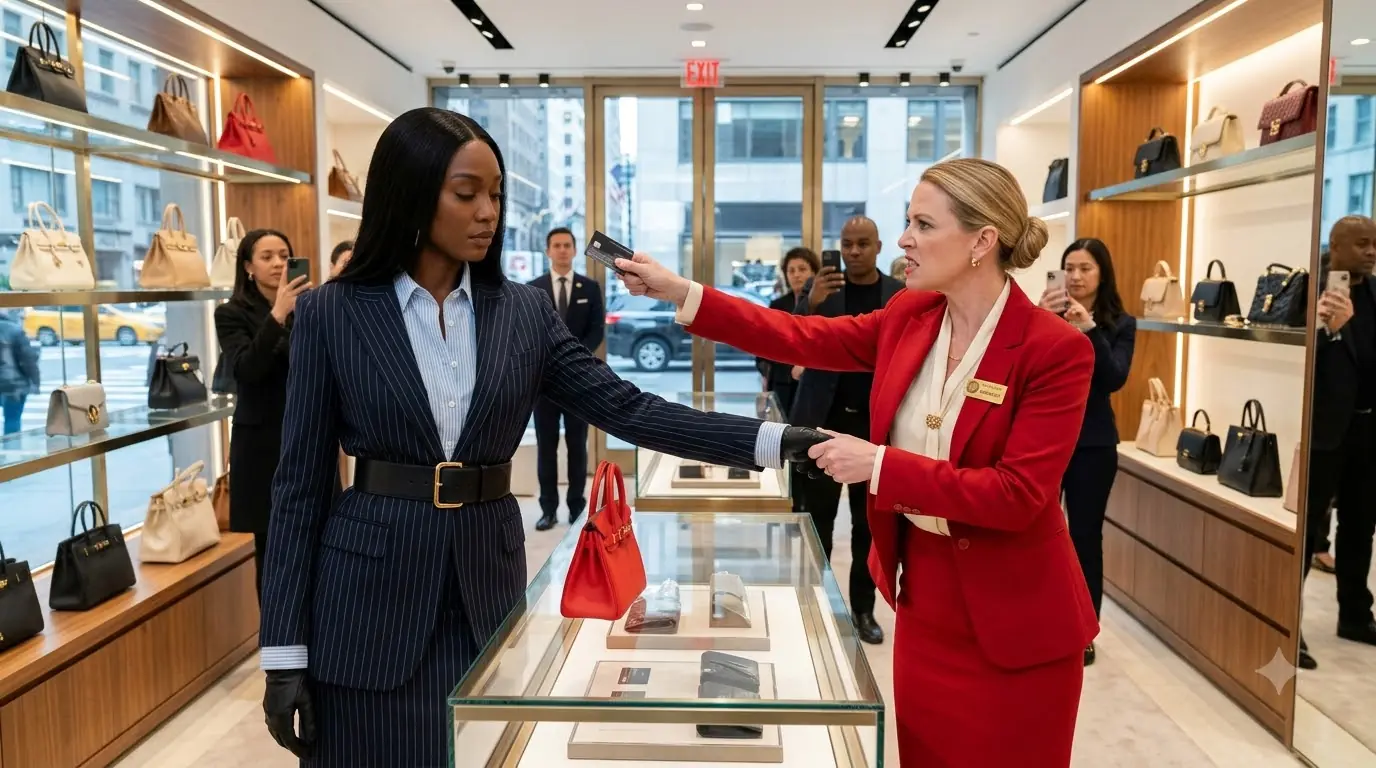
Nia wore exactly what she intended.
Navy pinstripe blazer.
Matching below-the-knee skirt.
Pale blue striped shirt.
Wide black belt with gold buckle.
Black gloves.
Pointed heels.
Small bright red handbag.
Expensive.
Very expensive.
But not loudly branded.
The suit had been cut in Milan.
The handbag was not Veyra.
That was deliberate.
She wanted to know whether staff recognized wealth only when it wore the correct uniform.
The doorman opened the door.
“Good morning.”
“Morning.”
No extra question.
Better.
Inside, pale marble reflected warm recessed light.
Glass counters formed islands through the first floor.
Handbags sat in wall niches.
Gold trim.
Cream leather seating.
Soft instrumental music.
The air smelled faintly of cedar and something floral designed specifically for the brand.
Nia knew because Sterling Luxe had spent eighty-three thousand dollars developing that scent.
She walked slowly.
Nobody greeted her.
She counted.
Twenty-four seconds.
Thirty.
Forty-five.
A white woman in a camel coat entered behind her.
Associate approached immediately.
“Good morning, welcome to Veyra Maison.”
Nia continued.
One minute.
No greeting.
Interesting.
A young sales associate stood behind a counter arranging scarves.
Black woman.
Maybe twenty-five.
Her badge read TARA.
Tara looked up.
Saw Nia.
Started forward.
Then stopped.
A blonde woman in a red suit had entered from the rear.
Vanessa.
Nia recognized her from employee files.
She was striking in the polished corporate sense.
Perfect blonde bun.
Pearls.
Red skirt suit.
Ivory blouse.
Gold badge.
Her eyes moved first to Nia.
Then Tara.
One look.
Tara returned behind the counter.
Nia noticed.
Vanessa approached.
“Good morning.”
“Good morning.”
“Are you meeting someone?”
Nia almost smiled.
Not: