“Excuse me. Could I see the watch in that display case?”
The manager turned toward the voice.
His polished smile disappeared the moment he saw the elderly man standing before him in a worn coat.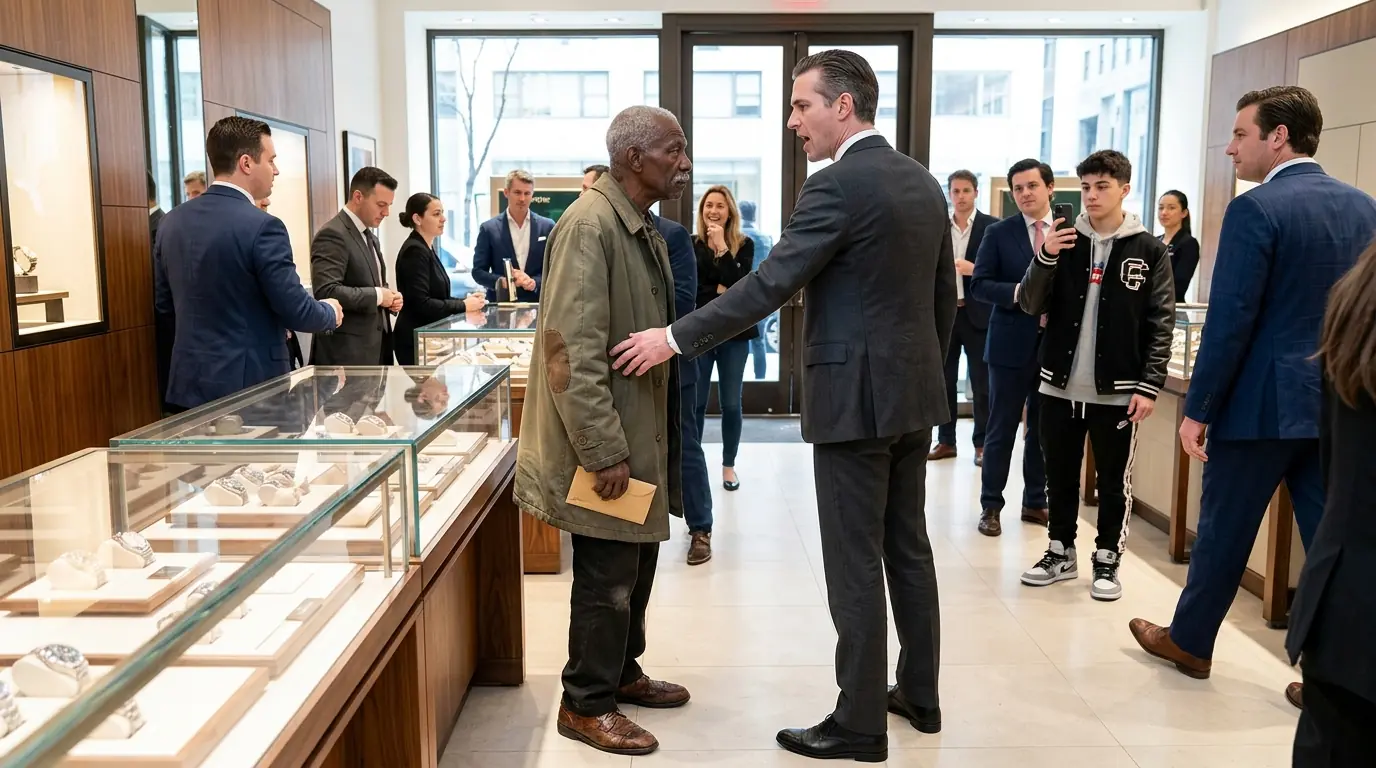
“Are you lost?” he asked. “This is a luxury store, not a homeless shelter.”
The old man did not move.
“God, I can smell you from here. That ragged coat, those dirty shoes.”
The manager looked around the showroom as though expecting the other customers to share his disgust.
“People like you crawl into places where you clearly do not belong.”
He snapped his fingers toward security.
“Get this filthy man out of my store. Now.”
A woman beside the jewelry counter smirked.
A teenager raised his telephone and began recording.
Several employees looked away.
Not one person spoke.
The old man remained still. His scarred hands were steady, and his eyes were quiet.
Almost too quiet.
None of them could have imagined who was about to walk through the door and call that man Dad.
It was a Tuesday morning in late October, the kind of morning when Manhattan smelled of roasted chestnuts, bus exhaust, and cold concrete.
Benjamin Wells, seventy-two years old, stepped off the M5 bus on Fifth Avenue with a folded envelope inside his coat pocket.
The coat was thirty years old.
Its olive-green fabric had faded, both elbows had been patched, and one button was missing near the collar.
It was the same coat Benjamin wore on the day he opened his first store.
He had never been able to throw it away.
Inside the envelope was eight thousand dollars in cash.
Benjamin had saved every bill from his pension over eleven months.
Today was the forty-fifth birthday of his son, Nathan, and Benjamin wanted to buy him a watch.
A real watch.
One purchased from the company Nathan now owned.
Benjamin had not told his son he was coming.
That was the point.
A father did not announce his arrival before bringing his child a birthday gift.
Sterling and Hale stood at the corner of Fifth Avenue and Fifty-Second Street.
Its floor-to-ceiling glass windows displayed watches, jewelry, and handbags under carefully positioned white lights. The showroom had polished marble floors, gold-framed mirrors, and silent security cameras in every corner.
Even the air seemed expensive.
Benjamin pushed open the front door.
Megan Cole, a young woman seated at the reception desk, looked up.
Her eyes moved from Benjamin’s face to his worn coat and then down to his cracked shoes.
She hesitated.
After a moment, she forced a polite smile and gestured for him to enter.
Benjamin had taken only four steps when Derek Ashton appeared.
Derek was the forty-one-year-old general manager of the flagship location. His dark hair was slicked neatly into place, and his fitted charcoal suit looked as though it had been tailored that morning.
He operated Sterling and Hale as though the showroom were his personal kingdom.
Every customer was evaluated the moment they entered.
Derek’s measuring system had nothing to do with clothing sizes.
He noticed Benjamin from across the floor.
An elderly man.
A faded coat.
Cracked shoes.
Hands rough from decades of physical work.
Derek’s jaw tightened.
He walked directly toward Benjamin and blocked his path to the watch counter.
“Sir.”
Derek spoke loudly enough for the entire room to hear.
“I believe you wandered into the wrong place. The Goodwill store is two blocks east.”
Three customers standing near the jewelry display turned toward them.
A sales associate stopped speaking in the middle of a sentence.
Benjamin met Derek’s eyes calmly.
“I would like to see the Patek Philippe in the front case. The one with the midnight-blue dial.”
Derek blinked.
Then he smiled in the manner of someone who believed a joke had become even funnier.
“The Patek Philippe?”
He pronounced the name slowly, as though speaking to a child.
“Do you even know what it costs?”
Benjamin nodded.
“Approximately thirty-two thousand dollars. Midnight-blue dial, Calatrava collection, reference 5227G.”
Something flickered behind Derek’s eyes.
Surprise appeared for only a moment.
Then it hardened into something worse.
“Anyone can search a reference number online.”
Derek crossed his arms.
“That does not mean you can afford the watch. It certainly does not mean you belong anywhere near it.”
He turned sharply toward the reception desk.
“Megan, did you allow him inside?”
Megan’s face became pale.
“He walked in, sir. I did not think…”
“That is the problem. You did not think.”
Derek lowered his voice, though it remained loud enough for the showroom to hear.
“The next time a man enters looking as though he slept beneath a bridge, you contact security first. You do not welcome him inside.”
Benjamin remained where he was.
His hands stayed beside him.
His expression had not changed since he entered the showroom.
He looked patient and steady, like a man who had survived storms far more dangerous than Derek Ashton.
“Sir,” Benjamin said quietly, “I have money. Cash. I would like to make a purchase.”
Derek laughed.
He genuinely laughed.
“You are telling me that you entered Sterling and Hale carrying cash inside that coat?”
He leaned closer.
“Where did you get it? Did you steal it? Did someone feel sorry for you?”
The accusation struck the room like a hammer against glass.
Two women beside the handbag display stopped talking.
A man wearing a navy blazer lowered his sunglasses.
Every pair of eyes now focused upon Benjamin.
Almost none of them carried sympathy.
Derek continued.
“Let me explain something to you, old man.”
He slowly circled Benjamin, the way an animal might circle something it did not respect.
“Our customers fly here from Dubai, London, and Monaco. They wear coats worth more than your home, assuming you have one.”
He stopped directly in front of Benjamin.
“They do not smell like mothballs and bus exhaust.”
Benjamin could see a vein moving in Derek’s temple.
“You are not one of our customers. You will never be one of our customers.”
Derek’s voice became colder.
“The fact that you walked in here dressed that way and looking that way is an insult to everyone in this room.”
A woman wearing a red dress leaned toward her companion.
“He is right,” she whispered. “Why would someone like that come into a place like this?”
Her companion nodded and smiled.
A teenager near the entrance lifted his telephone.
A red recording light appeared on the screen.
Within seconds, another telephone rose.
Then a third.
Nobody pointed the cameras at Derek.
They recorded Benjamin.
To them, he was the spectacle.
The joke.
Derek noticed the telephones.
He did not stop them.
He fed upon their attention.
“Do you see that?” he asked Benjamin. “You are entertainment now. That may be the most value you have ever brought into a place like this.”
Benjamin’s jaw tightened.
For the first time, something moved behind his eyes.
It was not anger.
It was not shame.
It was something older and deeper.
He reached into his coat and removed the envelope.
Benjamin held it toward Derek.
“Eight thousand dollars. I saved it myself over eleven months.”
His voice remained quiet.
“I want to buy my son a birthday gift. That is all I came here to do.”
The room became silent for half a breath.
Then Derek snatched the envelope from Benjamin’s hand.
He opened it and began counting the bills.
Twenties.
Fifties.
Several hundreds.
Some were wrinkled.
Others had been folded at the corners.
It was pension money.
The kind of money that smelled of sacrifice and time.
Derek turned toward the customers and held up the stack.
“Look at this.”
His voice traveled to every corner of the showroom.
“Old, wrinkled bills. He probably counted these at a kitchen table somewhere.”
Derek fanned the money in front of Benjamin’s face.
“This is not how our clients pay. Our clients have cards. Our clients do not walk into luxury stores carrying envelopes.”
He threw the envelope onto the glass counter.
Several bills slid across the polished surface.
Benjamin reached toward them.
Derek slapped his hand away.
“Do not touch the counter.”
His voice was no longer theatrical.
It had become simply cruel.
“Your hands are filthy. I do not want you leaving marks on my display.”
Benjamin slowly withdrew his hand.
He looked down at his fingers.
They were scarred and calloused.
They were the hands of a man who had built things throughout his entire life.
Things Derek could not begin to imagine.
Allison Harper, a twenty-six-year-old sales associate hired three months earlier, stood beside the watch display.
Her eyes had filled with tears.
She opened her mouth.
Then she closed it.
Allison looked toward the other employees.
Nobody moved.
Nobody wanted to be the first person to challenge Derek.
Derek grabbed Benjamin’s worn leather satchel from the counter.
Without permission, he unfastened it and emptied the contents before everyone.
A bus pass.
A folded handkerchief embroidered with the initials N.W.
A creased photograph of a young man wearing a graduation gown.
A bottle of heart medication.
Derek picked up the photograph.
“Is this your son? The one who supposedly needs a Patek Philippe?”
He held the picture up for the room to see.
“He looks as though he would feel more comfortable inside a pawn shop.”
Benjamin’s voice broke for the first time.
“Please. Give me the photograph.”
Derek threw it onto the floor.
The picture landed faceup against the white marble.
The young man in the image continued smiling.
Nobody picked it up.
A woman near the entrance glanced toward the photograph and stepped over it on her way to the handbag section.
A man in a gray suit pretended he had not noticed.
The teenager continued filming.
Benjamin bent down slowly.
His knees ached, and his back resisted the movement.
He lifted the photograph with both hands.
Benjamin held it against his chest the way a person held something sacred.
Derek called security.
Two guards emerged from the rear of the showroom.
Both were tall and expressionless.
Derek pointed toward Benjamin.
“Remove him. He is trespassing and harassing our customers.”
He added one more instruction.
“Check his pockets on the way out. I do not trust that he has not taken something.”
The security guards approached.
One of them placed a firm hand around Benjamin’s upper arm.
Benjamin did not resist.
He allowed them to turn him toward the exit.
His faded coat brushed a display of silk scarves worth more than his monthly pension.
As they passed the reception desk, Megan lowered her gaze.
She could not look into his eyes.
Allison did not look away.
Her attention shifted toward the founder’s portrait mounted on the wall behind the register.
It was a -and-white photograph of a young man wearing a simple coat and standing outside the original Sterling and Hale storefront in 1981.
Then Allison looked at Benjamin being escorted toward the door.
She looked back at the portrait.
Then at Benjamin again.
Her lips parted.
Allison removed her telephone beneath the counter and began typing an urgent message.
Her fingers trembled.
Derek did not notice.
He was too busy straightening his cuffs while a customer in a cashmere coat quietly praised him for handling the situation.
The front doors opened.
The guards pushed Benjamin onto the sidewalk.
Cold October air struck his face.
The glass doors closed behind him with a soft, expensive click.
Inside, Derek clapped his hands once.
“Everyone, return to work. The show is over.”
The employees obeyed.
That was what people often did when cruelty wore an expensive suit.
Benjamin sat on the bench beside the entrance.
He placed the photograph on one knee and smoothed the crease with his thumb.
Then he returned the embroidered handkerchief to his pocket.
Benjamin did not cry.
He did not curse.
He sat in the October wind, seventy-two years old, holding a picture of his son.
And he waited.
Across the street, a woman walking her dog paused.
She noticed Benjamin seated outside the luxury store, his coat buttoned to the collar and his eyes fixed upon nothing.
The woman crossed to the opposite sidewalk.
She did not want to become involved.
A delivery driver stopped his van nearby.
He glanced at Benjamin and whispered something to his partner.
Both men laughed.
Benjamin heard them.
He pretended not to.
Inside Sterling and Hale, the atmosphere shifted from tension to amusement.
Derek stood near the watch counter, retelling the confrontation like a comedian repeating his best performance.
“You should have seen his face when I opened that envelope.”
He imitated Benjamin’s expression.
“Wide eyes and trembling hands.”
Several staff members laughed.
Not all of them.
Enough.
“Eleven months of saving,” Derek said, shaking his head. “Eleven months, and he still could not afford the least expensive watch in the case.”
He smiled.
“That is not determination. It is delusion.”
Terrence Blake, a polished sales associate who had worked for the company for ten years, chuckled.
“At least he knew the reference number. Give him credit for that.”
“He searched it online,” Derek replied. “Any homeless man with a telephone can search for a watch. That does not make him a buyer.”
Allison remained silent.
She stood near the stockroom entrance with her telephone in one hand, looking at the message she had sent.
A reply arrived thirty seconds later.
“How long ago?”
Allison typed quickly.
“He is outside. They just threw him out.”
Three dots appeared on the screen.
Then came the response.
“Do not allow anyone to touch the security footage. I am fifteen minutes away.”
Allison locked the telephone and placed it inside her pocket.
Her hands continued trembling, but her expression was calm now.
It was different from Benjamin’s calm.
It was the calm of someone who knew the direction of the tide was about to change.
Derek returned to Benjamin’s money.
He lifted one of the bills from the counter and pretended to smell it.
“Smells like a laundromat.”
He dropped it.
“Put all of this into a bag and leave it outside. If he is still sitting there, throw it at him.”
Kyle Patterson, a young sales associate, gathered the bills and returned them to the envelope.
He placed the envelope inside a small shopping bag.
Kyle walked toward the entrance, then stopped.
“Sir, should I hand it to him, or…”
“I said throw it.”
Derek did not look up.
“He is fortunate I did not call the police.”
Kyle pushed open the door.
Benjamin remained on the bench.
Kyle dropped the bag beside him without care.
He avoided eye contact.
Benjamin looked at the bag.
Then he looked up at Kyle.
“Thank you, young man.”
Kyle flinched.
He had not expected politeness from the man Derek had just humiliated.
He turned and entered the store without answering.
Benjamin opened the bag and carefully counted the money.
Every bill remained.
He folded the notes and returned them to the envelope before placing it inside his coat.
Then he looked through the storefront window.
From the bench, he could see the founder’s portrait mounted on the far wall.
The young man in the photograph wore a simple coat and stood outside a small Brooklyn shop forty-five years earlier.
Benjamin smiled.
It was a private smile carrying an entire lifetime.
Mrs. Dorothy Graves, a seventy-eight-year-old white woman and longtime customer, had observed the entire confrontation from the cashmere section.
She had not laughed.
She had not filmed.
She had also failed to intervene.
Dorothy walked through the entrance and sat beside Benjamin on the bench.
“Are you all right?”
Benjamin looked at her.
“I will be.”
“What they did was wrong.”
Dorothy lowered her gaze.
“I am sorry nobody said anything. That includes me.”
“You are saying something now.”
She removed a handkerchief from her purse and offered it to him.
Benjamin did not need it.
He was not crying.
He accepted it because the gesture was the first kindness anyone had offered him in nearly two hours.
“That manager speaks to people as though they are beneath him,” Dorothy said. “I have seen it before, but never as badly as today.”
“He is afraid,” Benjamin replied.
“Afraid of what?”
“People who do not resemble the picture inside his mind.”
Benjamin paused.
“That is the most dangerous kind of fear. The kind that wears a suit and a name badge.”
Dorothy remained beside him for several minutes.
She did not ask his name.
She simply sat there.
Then she rose, gently squeezed his shoulder, and walked toward her car.
Benjamin was alone again.
The metal bench was cold.
The wind became stronger.
Fifth Avenue moved around him like a river flowing around a stone.
Everyone continued moving.
Almost nobody stopped.
Benjamin removed the graduation photograph one more time.
The young man’s smile remained unchanged.
It was the same smile from twenty years earlier.
The same smile Benjamin had seen during their telephone call the previous Sunday.
“Happy birthday, son,” Benjamin whispered. “I will get you that watch. I promise.”
He did not know that within eleven minutes, the watch would no longer matter.
What was coming through the store entrance would change everything.
Inside Sterling and Hale, Derek Ashton was enjoying a sense of power he had not felt in months.
He stood behind the main counter with his jacket unbuttoned and his sleeves pulled back enough to reveal the edge of his Rolex.
The staff moved around him like planets orbiting a sun.
Obedient.
Quiet.
Careful not to move too close.
“Megan.”
Derek did not look toward the desk.
“Open today’s security recordings. Find the old man. I want everything from the moment he entered until security removed him.”
Megan hesitated.
“All of it, sir?”
“All of it.”
Derek adjusted his watch.
“Then delete it. Every frame.”
Megan stared at him.
“I do not want one second of that encounter remaining on our system.”
“Company policy requires us to retain recordings.”
“I am company policy inside this building.”
Derek’s voice did not rise.
It did not need to.
“Delete it. If anyone from corporate asks, tell them the system malfunctioned. Do you understand?”
Megan lowered her eyes.
“Yes, sir.”
She walked toward the security office.
Allison watched from the watch counter.
Three minutes earlier, while Derek continued entertaining the customers, she had saved a complete copy of the footage to a private cloud account.
Her telephone vibrated inside her pocket.
She did not need to check the message.
She already knew who had sent it.
Derek addressed the showroom staff.
Six employees gathered loosely before him.
“Let me make something clear.”
He clasped his hands behind his back like a general speaking to troops.
“What occurred today was a security issue. A man entered who did not meet our standards.”
Derek looked from one employee to another.
“He was asked to leave. He resisted. Security assisted him outside.”
He allowed the statement to settle.
“That is the account. It is the only account.”
Derek’s expression hardened.
“If anyone discusses this outside the building, I will personally make certain that person never works in luxury retail again.”
He moved his gaze slowly across the group.
“Not in New York. Not anywhere.”
Terrence Blake straightened his tie and nodded.
Kyle Patterson stared at the floor.
Shelby Cross, another sales associate, folded her arms and remained silent.
That silence was its own form of agreement.
Allison kept her expression empty.
She had worked for Sterling and Hale for ninety-one days.
She had never personally met the company’s owner, but she studied the founder’s photograph during every shift.
Allison recognized the eyes in that portrait the moment Benjamin walked through the door.
She said nothing.
She did not need to.
Within twelve minutes, someone else would speak.
Outside, the sidewalk had become less crowded.
The lunchtime rush had passed.
Most pedestrians treated Benjamin as part of the street furniture, something invisible that had always been there.
A police officer on foot patrol slowed near the bench.
He saw an elderly man in a worn coat sitting outside a luxury store where he appeared not to belong.
“Sir, are you waiting for someone?”
Benjamin looked up.
“Yes, Officer. I am waiting for my son.”
The officer studied him.
“This bench belongs to the store. They may not want you sitting here.”
“I understand.”
“I am going to need you to move along.”
Benjamin did not argue.
He slowly stood.
His knees were stiff and his back ached.
He took three steps toward the curb.
Then he stopped.
Benjamin turned and returned to the bench.
“With respect, Officer, I am not leaving until my son arrives.”
The officer’s hand moved toward his radio.
His thumb rested on the button.
Then he hesitated.
Something about Benjamin’s voice gave him pause.
The steadiness.
The complete absence of fear.
“Five minutes,” the officer said. “After that, I am calling this in.”
Benjamin nodded.
“Five minutes is all I need.”
The officer walked ten feet away and leaned against a parking meter.
He continued watching.
Inside the store, Derek had moved on to another customer.
He displayed a diamond bracelet to Mrs. Vivian Holt, a woman wearing a white fur coat who spent six figures at Sterling and Hale each year.
Vivian witnessed the entire confrontation with Benjamin.
She had not shown the slightest concern.
“Honestly, Derek,” she said while holding the bracelet beneath the light, “you handled that beautifully.”
She smiled.
“People like that need to understand where they are welcome and where they are not.”
“It is about standards, Mrs. Holt,” Derek replied. “That is all it has ever been.”
“Of course.”
She admired the diamonds.
“Standards.”
The word lingered like expensive perfume.
Terrence Blake restocked the cuff link display near the window.
He glanced outside.
Benjamin remained on the bench, holding the graduation photograph.
Terrence watched for several seconds before turning away.
He did not feel guilty.
That was the worst part.
Terrence watched Derek humiliate a seventy-two-year-old man, and the only emotion he felt was relief that Derek had not chosen him.
Kyle stood inside the stockroom, leaning against a shelf filled with watches worth more than his yearly salary.
His hands were shaking.
He kept remembering the moment he dropped the bag beside Benjamin.
Then he heard the old man’s voice again.
“Thank you, young man.”
There had been no anger or bitterness in the words.
That patience made Kyle feel sick.
He wanted to walk outside and apologize.
He did not because Derek was always listening.
Allison entered the employee bathroom and locked the door.
She removed her telephone and read the latest message.
“I am three blocks away. Is he still outside?”
Allison replied immediately.
“Yes. A police officer is asking him to leave. Hurry.”
The response came almost instantly.
“No one touches him.”
Allison stared at the four words.
She released a slow breath.
Then she washed her face and studied her reflection.
For the first time in ninety-one days, she felt that staying inside the company might serve a purpose.
She returned to the showroom.
Derek was laughing at something Vivian Holt had said.
The employees smiled around him.
The store remained beautiful.
The background music was soft.
Every object appeared to be in its proper place.
Everything except justice.
Justice was three blocks away and approaching quickly.
Benjamin heard the vehicle before he saw it.
The deep, controlled sound of a powerful engine moved through the traffic.
It was not the sound of something rushing.
It was the sound of something arriving.
A Mercedes-Maybach turned onto Fifth Avenue.
Benjamin straightened his coat.
He smoothed the graduation photograph one final time and placed it inside the breast pocket over his heart.
The car stopped directly in front of Sterling and Hale.
The police officer stood upright.
He looked at the vehicle.
Then Benjamin.
Then the vehicle again.
The rear door opened.
A polished Oxford shoe touched the pavement.
A strong hand gripped the doorframe.
Nathan Wells emerged and stood at his full height.
He was forty-five years old and six feet two inches tall.
His dark navy suit fit so precisely that it appeared to have been formed around him.
A Patek Philippe rested on his left wrist.
Midnight-blue dial.
Calatrava collection.
Reference 5227G.
The same watch Benjamin had requested to see.
Nathan’s driver remained inside the vehicle.
There was no entourage.
No assistant.
Only Nathan.
He did not initially look at the store or the police officer.
His attention went directly to the bench.
His father sat there with his worn coat fastened to the collar and his hands folded across his lap.
Nathan walked toward him.
Each step became slower than the one before it.
Not because Nathan was uncertain.
Because he was furious.
The only thing controlling that fury was the sight of his father’s face.
Nathan reached the bench.
He knelt on one knee on the Fifth Avenue sidewalk and took Benjamin’s hands.
“Dad.”
His voice broke around the word.
“I’m here.”
Benjamin smiled.
It was the private smile he had worn before, only warmer now.
“I know, son. I knew you would come.”
Nathan pulled his father into his arms.
He held him in front of the glass doors of Sterling and Hale, the police officer, and the passing city.
The officer stepped backward.
His hand moved away from the radio.
Inside the showroom, Megan looked up from the reception desk.
She saw the Maybach first.
Then Nathan.
Then the embrace.
Her face became completely white.
Megan recognized him.
Every Sterling and Hale employee recognized Nathan Wells.
His photograph appeared inside the training manuals, quarterly reports, and corporate emails beginning with the words, “A message from our CEO.”
Megan opened her mouth.
No sound emerged.
Derek had not yet noticed.
His back remained turned toward the entrance while he assisted Vivian Holt.
Allison had seen everything.
She stood beside the watch case and watched through the glass.
For the first time that morning, she smiled.
Nathan helped Benjamin stand.
Then he gently brushed dust from his father’s coat, handling the old fabric as though it were precious.
“Did they hurt you?”
“No, son. Only words.”
“Words can break bones too, Dad.”
Nathan’s jaw tightened.
His eyes moved toward the glass entrance.
“Remain here for one minute.”
Nathan turned and approached the doors.
His stride was measured and controlled.
It did not advertise power.
It assumed it.
Nathan pushed open the door.
The entrance chime rang once, sounding soft and almost cheerful.
Derek heard it and turned.
He saw the suit, the posture, and the face.
His entire body language transformed.
Shoulders back.
Chin lifted.
Smile widened.
“Mr. Wells.”
Derek crossed the showroom in four quick steps and extended his hand.
“What an honor. We were not expecting you until next week’s quarterly review.”
He laughed nervously.
“I would have prepared.”
Nathan did not accept his hand.
Derek maintained the smile, but his arm slowly fell back to his side.
A small crack appeared inside the performance.
“Is everything all right, sir?”
Nathan examined the showroom.
Slowly.
Methodically.
He looked first at Megan, who gripped the reception counter until her knuckles were white.
Then Terrence, who had suddenly discovered something fascinating about his shoes.
Kyle stood beside the stockroom entrance with all color drained from his face.
Allison met Nathan’s eyes directly.
She gave him one small nod.
Finally, Nathan looked at Derek.
“Where is he?”
Derek blinked.
“I’m sorry, sir. Where is who?”
“The man you threw out of this store forty minutes ago.”
Nathan’s voice remained quiet.
“The elderly man wearing the green coat. Where is he?”
The room became cold.
Allison would later say she genuinely felt the temperature change.
Nathan did not speak loudly.
His voice was barely above conversation.
It carried enough weight to press against the walls.
Derek’s smile weakened.
“There was a man here earlier. A vagrant, actually.”
He attempted a casual shrug.
“He wandered inside and made unreasonable demands. Security escorted him out. Standard procedure. Nothing that requires your attention.”
“A vagrant?”
Derek swallowed.
“I mean, he was not exactly…”
Nathan waited.
“He did not meet our customer profile, sir. He was disheveled and disruptive.”
Nathan took one step closer.
“What was his name?”
Derek stared at him.
“Did you ask his name?”
Derek opened his mouth.
Nothing came out.
He had not asked.
Why would he ask the name of a man he had already decided was worthless?
“No, sir,” Derek finally admitted. “I did not believe it was necessary.”
Nathan’s expression did not change.
“His name is Benjamin Wells.”
The words struck the showroom like falling crystal.
Every person heard them.
They understood at different speeds and in different ways, but they all reached the same conclusion.
Derek arrived last.
His mind turned the surname over, desperately searching for an interpretation that would not destroy him.
“Wells?”
He almost whispered it.
“Is he related to…”
Nathan turned away.
He walked back toward the front doors and stepped outside.
The showroom watched through the glass.
Nathan extended one hand to Benjamin, helped him stand, and wrapped an arm around his shoulders.
Together, they entered Sterling and Hale.
Benjamin’s cracked shoes touched the same white marble across which he had been dragged forty minutes earlier.
His worn coat rested beneath the crystal chandeliers.
Nathan stood beside him.
He placed one hand on Benjamin’s shoulder and faced the room.
“This is my father.”
Nathan’s voice filled the showroom without effort.
“Benjamin Arthur Wells.”
Nobody moved.
“He founded this company in 1981 with two hundred dollars and a handshake.”
Nathan gestured around them.
“The store where you are standing, the floor beneath your feet, the name on the doors, and the brand printed on every box exist because this man built them with his hands.”
Nathan pointed toward the portrait behind the reception desk.
The -and-white photograph showed the young man in a simple coat outside the first Brooklyn location.
“That is him forty-five years ago.”
Nathan looked at Benjamin’s faded jacket.
“The same coat.”
Every person turned toward the portrait.
Then Benjamin.
Then the portrait again.
The resemblance was unmistakable.
The same jawline.
The same steady eyes.
The same quiet strength that money could not purchase and cruelty could not destroy.
Derek’s face had changed from pale to gray.
His lips moved without producing words.
One hand reached behind him and gripped the counter for support.
“Mr. Wells, sir, I had no idea.”
“That is the problem.”
For the first time, Nathan’s voice sharpened.
He still did not shout.
It was worse than shouting.
It was the quiet fury of someone whose authority required no volume.
“You had no idea, and you did not care enough to learn.”
Nathan moved closer.
“You saw a man wearing a worn coat, and you decided he was nothing.”
Derek began shaking.
“You decided he did not deserve to enter a store his own hands built.”
Nathan pointed toward the glass counter.
“You called him trash. You threw his money across the counter.”
His voice remained controlled.
“You emptied his personal belongings in front of strangers. You threw a photograph of me, his son, onto the floor.”
Derek tried to speak.
“I…”
“You told a seventy-two-year-old man that he smelled, that he did not belong, and that his humiliation was entertainment.”
Nathan’s voice began trembling.
Not from weakness.
From the effort required to restrain himself.
“You did all of that inside my store.”
He looked at Benjamin.
“To my father.”
The silence that followed was absolute.
Nobody shifted.
Nobody appeared to breathe.
The soft jazz coming from the ceiling speakers sounded offensive against the weight inside the room.
Vivian Holt quietly placed the diamond bracelet back onto the counter.
She collected her handbag and moved toward the exit.
Her heel caught the edge of a rug.
She stumbled slightly.
That brief loss of balance seemed to contain all the shame she refused to express aloud.
The teenager who recorded Benjamin lowered his telephone.
The camera continued operating.
Now it pointed toward Derek.
Tears moved down Megan’s face.
She did not wipe them away.
Terrence Blake stared at the cuff links he had been arranging.
His hands trembled.
Kyle Patterson leaned against the stockroom door with his eyes closed.
He remembered dropping the bag beside Benjamin.
He remembered the words, “Thank you, young man.”
The man he had treated with contempt was the founder.
Benjamin built everything Kyle touched, sold, and wore to work each morning.
Benjamin remained in the center of the showroom.
He had not spoken since returning.
He did not need to.
His presence was enough.
The worn coat.
The scarred hands.
The steady gaze of a man who had survived worse treatment and still built an empire.
Nathan faced Allison.
“Miss Harper, I believe you have something to show us.”
Allison stepped forward.
She removed her telephone and connected it to the large display screen behind the reception desk.
Then she pressed play.
The security recording began.
Full color.
Clear audio.
It showed Benjamin entering the store.
It showed Derek blocking his path.
Every word played through the showroom speakers.
Every insult.
Every laugh.
The envelope being snatched away.
The bills being waved in Benjamin’s face.
The photograph being thrown onto the floor.
The security guards escorting him outside.
Kyle dropping the bag on the bench.
Nothing had been removed.
Derek stared at the screen.
His own face looked back at him, smiling and mocking.
The man in the recording appeared like a stranger.
Perhaps, for the first time, Derek saw exactly who he had always been.
His knees weakened.
Derek reached for the counter and missed.
He caught himself against the edge of a display case.
“I deleted that footage,” he whispered. “I told Megan to delete it.”
“You ordered an employee to destroy evidence,” Nathan replied.
He looked toward Allison.
“Miss Harper preserved a copy because at least one person inside this building remembered what integrity looks like.”
Derek turned toward Allison.
She met his gaze without apology.
He had nothing left.
No performance.
No defense.
No audience willing to laugh.
Only the sound of his own recorded voice calling a seventy-two-year-old man trash inside the company that man had created.
The footage ended.
The screen became .
Nobody spoke.
Benjamin walked toward the founder’s portrait.
He stood before the photograph and studied the young man he had once been.
His expression did not carry anger.
It carried exhaustion.
Seventy-two years of being judged by the wrong things.
Skin.
Clothing.
Hands that built what other people only inherited.
Nathan watched his father.
He had seen that expression before.
At kitchen tables.
Inside hospital waiting rooms.
In every place where a man was required to prove he deserved to stand.
Nathan straightened his tie.
“Every employee and every security officer, gather in front of the counter.”
Nobody hesitated.
Twelve staff members and two guards formed a half circle.
Some were crying.
Others stared at the floor.
Derek stood at the end with his hands hanging beside him like dead weight.
“What happened inside this store today will never happen again,” Nathan said.
He faced the group.
Then he called one name.
“Derek Ashton.”
Nathan said it the way a judge might read a verdict.
“Step forward.”
Derek obeyed.
His legs barely supported him.
The Rolex he had proudly displayed throughout the morning now looked obscene against his wrist.
“Explain what occurred today in your own words,” Nathan said. “Do it before everyone.”
Derek swallowed.
“Mr. Wells, there was a misunderstanding. I did not know he was…”
“You did not know he was my father.”
Nathan cut him off.
“That is what you intended to say.”
Derek lowered his gaze.
“Let me ask you something.”
Nathan’s voice became even quieter.
“If he were not my father, if he were simply an elderly man wearing an old coat and carrying cash, would your conduct have been acceptable?”
Derek opened his mouth.
Then closed it.
“Answer me.”
“No, sir.”
His voice barely emerged.
“No. It would not have been acceptable.”
“But you did it anyway.”
Nathan’s words carried across the marble.
“You looked at him and saw someone less than human. You saw skin color and worn clothing.”
He took another step.
“You made a decision no person in authority should ever make.”
Derek stared at the floor.
“You decided who deserved dignity and who did not.”
Nathan turned toward the assembled staff.
“My father did not enter this store to test anyone. He was not inspecting the business.”
His voice softened.
“He came here to buy me a birthday present.”
Nathan looked toward Benjamin.
“He saved eight thousand dollars from eleven months of pension payments because he wanted to give his son a watch from the company he built.”
His voice broke on the final word.
Nathan paused until he regained control.
“Instead of being assisted, he was insulted and humiliated.”
He gestured toward the counter.
“His money was thrown in his face. His belongings were displayed before strangers.”
Nathan’s eyes moved toward the floor where the photograph had landed.
“A photograph of me on my graduation day was treated like garbage.”
He looked at the security guards.
“Then my father was dragged from the store and left on the sidewalk as though he were nothing.”
Nathan pointed toward them.
“You two.”
Both guards straightened.
“You grabbed a seventy-two-year-old man and pushed him outside.”
Nathan addressed the taller guard.
“Did he resist?”
The guard’s name was Victor Shaw.
He slowly shook his head.
“No, sir.”
“Did he raise his voice?”
“No, sir.”
“Did he threaten anyone?”
“No.”
“Then why did you touch him?”
Victor lowered his eyes.
“Mr. Ashton ordered us to remove him.”
Nathan waited.
“If Mr. Ashton instructed you to remove every customer who entered this store, would you obey that order too?”
Nobody answered.
The silence burned.
Nathan turned toward Derek again.
“You also instructed Megan Cole to delete the security recording.”
Derek’s chin trembled.
“You told her to destroy evidence of discrimination and abuse.”
Nathan’s voice hardened.
“Evidence that would end your career.”
“I panicked,” Derek whispered. “I was not thinking clearly.”
“You were thinking clearly throughout the entire encounter.”
Nathan’s reply came immediately.
“Every insult was calculated. Every humiliation was performed for an audience.”
He pointed toward the dark display screen.
“You did not lose control, Derek. You possessed complete control.”
Nathan allowed the truth to settle.
“That is what makes your actions unforgivable.”
He reached inside his jacket and removed a folded sheet of paper.
Nathan opened it.
“This is your termination notice.”
Derek’s eyes widened.
“Effective immediately, you are removed as general manager of this location.”
Derek’s knees weakened again.
He caught himself against the same display case Benjamin had been forbidden to touch because his hands were supposedly dirty.
Nathan placed the letter on the counter.
“Termination is the minimum consequence.”
He continued.
“You will complete two hundred hours of service with organizations supporting elderly residents in underserved communities.”
Nathan looked directly at him.
“You will attend a twelve-week racial-bias and cultural-awareness program.”
He added one final requirement.
“You will write a personal apology to my father. Not to me.”
Nathan gestured toward Benjamin.
“To the person you harmed.”
Derek nodded.
He could not speak.
His face was wet.
Nathan turned toward the rest of the employees.
“Anyone who participated by laughing, recording for amusement, or encouraging the abuse will receive a formal written warning and disciplinary review.”
Several people lowered their heads.
“Those who remained silent because they were afraid should understand something too.”
Nathan paused.
“Fear is real, but silence has a cost.”
He looked toward Benjamin.
“Today, every one of you saw what that cost looks like.”
Nathan faced Allison.
“Miss Harper.”
She stepped forward.
“You preserved the recording. You contacted me.”
Nathan’s expression softened slightly.
“You did what nobody else inside the room had the courage to do.”
Allison held her breath.
“Effective immediately, you are acting general manager of this location.”
Her eyes widened.
She looked toward Benjamin.
He gave her a small nod.
It was the kind of nod a father might offer when proud of someone else’s child.
Nathan then noticed Dorothy Graves standing near the entrance.
She had quietly returned to the store.
“Mrs. Graves, I am told you were the only customer who offered my father kindness today.”
Nathan approached her.
“You sat beside him and spoke to him.”
His voice softened.
“On behalf of my family, thank you.”
Dorothy pressed her lips together.
Her eyes glistened.
“I should have done more. I should have spoken while I was inside, not only after they threw him out.”
“You spoke.”
Nathan nodded.
“That was more than anyone else did.”
He walked toward his father.
Benjamin remained beside the portrait with his hands clasped before him.
Nathan stood next to him and looked at the -and-white image.
Brooklyn.
A young man wearing a simple coat.
“Dad, would you like to say anything?”
Benjamin turned toward the assembled employees and customers.
These were the same faces that had laughed, filmed, remained silent, and stepped over his photograph.
Now they were listening.
Benjamin spoke quietly.
There was no desire to punish in his voice.
He only wanted to be heard.
“I built the first store with these hands.”
He raised them.
Scarred.
Calloused.
Unashamed.
“I carried lumber. I installed tile. I painted the walls at two in the morning because I could not afford to hire anyone.”
Benjamin touched the collar of his green coat.
“I did all of that while wearing this.”
He looked around the showroom.
“You looked at the coat and saw a poor man.”
His eyes moved toward Derek.
“This coat has entered boardrooms, construction sites, hospital waiting rooms, and my son’s graduation.”
Benjamin allowed a small smile.
“It has lived more life than anything displayed inside this store.”
He looked directly at Derek.
“I do not hate you, son.”
Derek began crying harder.
“I pity you because you measured a man by what he wore rather than what he built.”
Benjamin lowered his hands.
“That is a kind of poverty no suit can repair.”
Sterling and Hale closed early that day.
For the first time in the company’s forty-five-year history, the Fifth Avenue flagship lights went dark before five o’clock.
Nathan drove Benjamin home.
They spoke very little during the journey.
Benjamin looked through the window at the city moving past them.
It was the same city where he had poured concrete, swept floors, and carried lumber at twenty-seven years old.
In those days, he had possessed nothing except a borrowed truck and a name nobody recognized.
They arrived at Benjamin’s modest two-bedroom apartment above a Brooklyn barbershop.
He had lived there since 1986.
Nathan stopped the engine but did not immediately leave the car.
“Why didn’t you call me before entering the store?”
Benjamin smiled.
“Because I wanted to walk into my son’s business and buy him a present like any father.”
He looked toward Nathan.
“I did not believe I needed permission.”
Nathan closed his eyes.
The sentence struck him harder than anything Derek said that day.
“You should never need permission.”
Nathan’s voice became a whisper.
“Not inside my store. Not anywhere.”
They remained in silence.
Then Benjamin reached inside his coat.
He removed the same envelope containing the wrinkled bills.
Eight thousand dollars.
“I still want to buy you the watch.”
Nathan laughed.
It was a broken, tearful laugh.
“Dad, I own the company. I can have any watch I want.”
“That is not the point.”
Benjamin pressed the envelope into Nathan’s hand.
“I saved this for eleven months. Every dollar means something.”
He looked at his son.
“A birthday gift from a father should cost the father something. Otherwise, it is only inventory.”
Nathan accepted the envelope.
He held it against his chest the same way Benjamin had held the graduation photograph on the sidewalk.
“Happy birthday, son.”
“Thank you, Dad.”
The following morning, Nathan called an emergency board meeting.
He presented the security footage.
Then he distributed a seven-page policy written overnight.
Nathan called it the Wells Dignity Code.
Every Sterling and Hale location worldwide would implement mandatory education concerning racial bias, customer profiling, and dignity-first service.
A framed copy of the code would hang beside the founder’s portrait in every store.
Every employee, from security personnel to senior executives, would sign a personal commitment to follow it.
The board approved the proposal unanimously.
Their decision was not entirely motivated by conscience.
The footage had already reached the public.
Allison’s preserved copy was provided to a local journalist before midnight.
By the following morning, the video appeared across every major social platform and news outlet.
Within seventy-two hours, it had been watched forty million times.
The Wells Dignity Code became an international topic.
News programs repeatedly showed two moments.
Derek throwing Benjamin’s photograph onto the floor.
Nathan kneeling beside the bench and saying, “Dad, I’m here.”
The contrast affected millions of people.
Comments came from viewers who recognized their own fathers and grandfathers in Benjamin.
customers described being followed inside stores.
Others recalled being ignored, questioned, or treated as though they did not belong because of their clothing, age, accent, or skin color.
Sterling and Hale’s stock price fell for three days.
Then it rose higher than before.
The public did not want to reward what happened inside the store.
People responded to the company’s willingness to acknowledge it and change.
Derek Ashton completed two hundred hours of community service at a senior-care center in the Bronx.
He served meals.
He cleaned rooms.
He sat with elderly men and women who told him about being denied service inside shops, restaurants, hospitals, and schools.
Their experiences sounded almost identical to what he had done to Benjamin.
Many of their stories had occurred fifty years earlier.
Derek’s actions had occurred yesterday.
On the final day of his service, Derek wrote the apology Nathan required.
It was not addressed to Nathan.
It was addressed to Benjamin.
Three pages.
Handwritten.
Derek personally delivered it to the apartment above the barbershop.
Benjamin opened the door wearing the same green coat.
Derek initially could not speak.
He stood in the hallway holding the letter and looking at the man he had called trash.
“Come inside,” Benjamin said. “I just made coffee.”
They sat at the kitchen table for two hours.
Neither man ever publicly revealed what they discussed.
When Derek left, his eyes were red.
He carried a small wooden box Benjamin had made by hand.
Nathan later asked his father why he had given Derek a gift.
Benjamin offered a simple answer.
“Growth is the only apology that matters, and that boy is growing.”
Every Sunday after that, Benjamin Wells entered the Fifth Avenue Sterling and Hale store.
He wore the same faded coat and the same cracked shoes.
His hands remained steady.
Allison met him at the entrance with a cup of coffee.
The staff greeted him warmly, not only because they now knew his identity, but because they had learned what could happen when a person’s worth was decided before he spoke.
The Wells Dignity Code eventually hung inside Sterling and Hale stores across nine countries.
Beside every copy was the same portrait.
A young man in a simple coat.
Brooklyn, 1981.
Benjamin never replaced that coat.
He never needed to.
Dignity had never depended upon what a person wore.
It depended upon how others treated the person wearing it.
The eight thousand dollars, the Maybach, and Nathan’s arrival were not the most important parts of Benjamin’s story.
The most important part occurred before anyone knew who he was.
An elderly man stood inside a store he had created and was treated as though he did not belong there.
The employees did not know that he was the founder.
The customers did not know that his son owned the company.
None of them knew a powerful man was approaching.
That should not have mattered.
Had Nathan never arrived, Benjamin would still have been a father carrying eleven months of savings and a photograph he treasured.
He would still have deserved respect.
The worn coat did not erase the lifetime of work beneath it.
Scarred hands did not make his money less valuable.
Being seventy-two, , and underdressed on Fifth Avenue was never a crime.
Benjamin had built an empire and was still treated like an outsider inside it.
The revelation changed how everyone saw him.
The lesson was that they should never have needed a revelation at all.