Jerome Washington collapsed against his apartment door, sobbing uncontrollably. In his trembling hands was a check with more zeros than he had ever seen in his life.
"I don't understand," he whispered to the woman in the business suit. "Yesterday I lost my job.
Today you're telling me that fixing an old lady's bicycle just changed my life forever."
Patricia Morrison looked at him quietly. "It changed more than your life, Jerome."
Twenty-four hours earlier, Jerome had been a broke mechanic who could not afford his daughter's school books. When an elderly woman needed help with a broken bicycle, he had used his time, his tools, and what little security he had left to help her.
That decision cost him his job. Jerome had no idea who the woman really was or why a simple act of kindness was about to change everything.
The alarm screamed at 5:30 a.m. Jerome rolled off the mattress on the floor, every muscle aching from the previous day's twelve-hour shift.
His studio apartment above a laundromat barely held the mattress and a milk crate that served as his kitchen table. On top of that crate sat a stack of bills that told the whole story: electric past due, rent final notice, groceries stretched thin.
His phone buzzed with a text from his sister, Maya. "Jerome, Jasmine needs $200 for school supplies.
I know money's tight, but she needs them this week."
Jerome opened his banking app. The balance read $180.43.
His daughter, Jasmine, was eight years old and lived with Maya because Jerome could not afford child care while working sixty-hour weeks. Every night he did the same math and arrived at the same impossible answer.
Rent, utilities, child support, groceries, gas, and school expenses always left him hundreds of dollars short. Somehow, he kept getting up anyway.
By 6:00 a.m., Jerome was already under the hood of Mrs. Carter's Honda at Eddie's Auto Repair. Steam rose around his face as he worked, his uniform clean but worn thin, the name patch slightly crooked from too many washings.
"Third car today," he muttered. "Mrs. Carter needs this running for her cleaning jobs.
Can't let her down."
Jerome had a gift with machines. He listened to engines the way musicians listened to instruments, catching sounds other mechanics dismissed and tracing them back to problems that often saved customers hundreds of dollars.
People asked for him by name. Mrs. Rodriguez brought homemade tamales, and old Mr. Peterson saved lottery tickets for him because he insisted Jerome was due for some luck.
"You're going to make it big someday," Mr. Peterson always told him. "You've got that special touch."
Jerome dreamed of opening his own shop. He kept notebooks filled with floor plans, pricing models, training ideas, and sketches of a garage with WASHINGTON AUTOMOTIVE painted across the front window.
Late at night, he calculated startup costs he could never afford. He imagined teaching neighborhood kids about engines and giving people a place where honest repair work mattered more than squeezing every dollar from them.
Dreams did not pay rent, though. For now, Eddie Morrison owned the shop and signed Jerome's paychecks.
Eddie was not a cruel man. He was a tired man trying to keep a small repair business alive while chain stores and dealership service centers swallowed more of the market every year.
He had hired Jerome when other shops would not even give him an interview. Jerome never forgot that.
That gratitude was one reason he worked harder than anyone else. He stayed late without overtime, took difficult jobs nobody wanted, and quietly charged at cost when customers were struggling.
When Mrs. Carter needed transmission work she could barely afford, Jerome charged her only for parts. When Mr. Peterson's truck failed before a cancer treatment appointment, Jerome stayed two hours after closing to get it running.
Eddie noticed. Sometimes he shook his head when Jerome waved away payment from an elderly customer, and sometimes he reminded him that charity did not pay the shop's bills.
Jerome understood the warning, but helping people was almost automatic. His grandfather had raised him on one rule: "Fix what's broken.
Help who needs help."
The responsibility still crushed him some nights. He knew every discount affected Eddie's already thin margins, and he knew the shop could barely support two full-time mechanics.
He also knew what it felt like to need help and not get it. When Jerome was Jasmine's age, his mother worked three jobs just to keep the lights on.
Mrs. Williams from down the hall brought him dinner when his mother worked late. Mr. Santos taught him to change oil behind their apartment building and let him borrow tools he could never have afforded.
Community takes care of community, his grandfather used to say. "You give what you can when you can."
Jerome still believed that. It was why he taught free Sunday car-maintenance classes for neighborhood kids in the shop parking lot.
He showed them how to understand warning lights, how to inspect a tire, and how to recognize when a vehicle needed professional attention. More than anything, he wanted them to know that practical knowledge could make them less helpless.
"Learn how things work," he told them. "Then nobody can make you feel powerless just because you don't know what's under the hood."
His phone buzzed during lunch. Maya had sent another message.
"Jasmine made honor roll. She wants to call Daddy tonight and tell him about her science project."
Jerome's heart swelled and broke at the same time. Jasmine was brilliant, curious, and obsessed with anything involving machines.
She wanted to become an engineer someday, maybe design cars instead of repairing them. Jerome had missed her science fair the previous month because he needed a double shift to make rent.
Maya sent him photographs afterward. Jasmine stood beside a homemade volcano with a huge smile, while in the background other children posed with fathers who had helped build their displays.
Jerome saved every penny he could for her future. The college fund held $127, which felt almost insulting compared with the future she deserved.
That afternoon, the heat settled over the shop like a heavy blanket. Jerome wiped sweat from his forehead, leaving a streak of grease across his brow, and kept working through the ache in his back.
His hands were permanently calloused and stained from years of labor. He still believed taking care of people made life meaningful, especially when you had little left to spare.
He did not know that belief was about to be tested. Helping one more person would cost him the job he desperately needed and open a door he had never imagined.
Tuesday afternoon, 3:47 p.m., the temperature hovered around ninety-five degrees. Jerome was beginning to close the shop when he heard a voice behind him.
"Excuse me, young man."
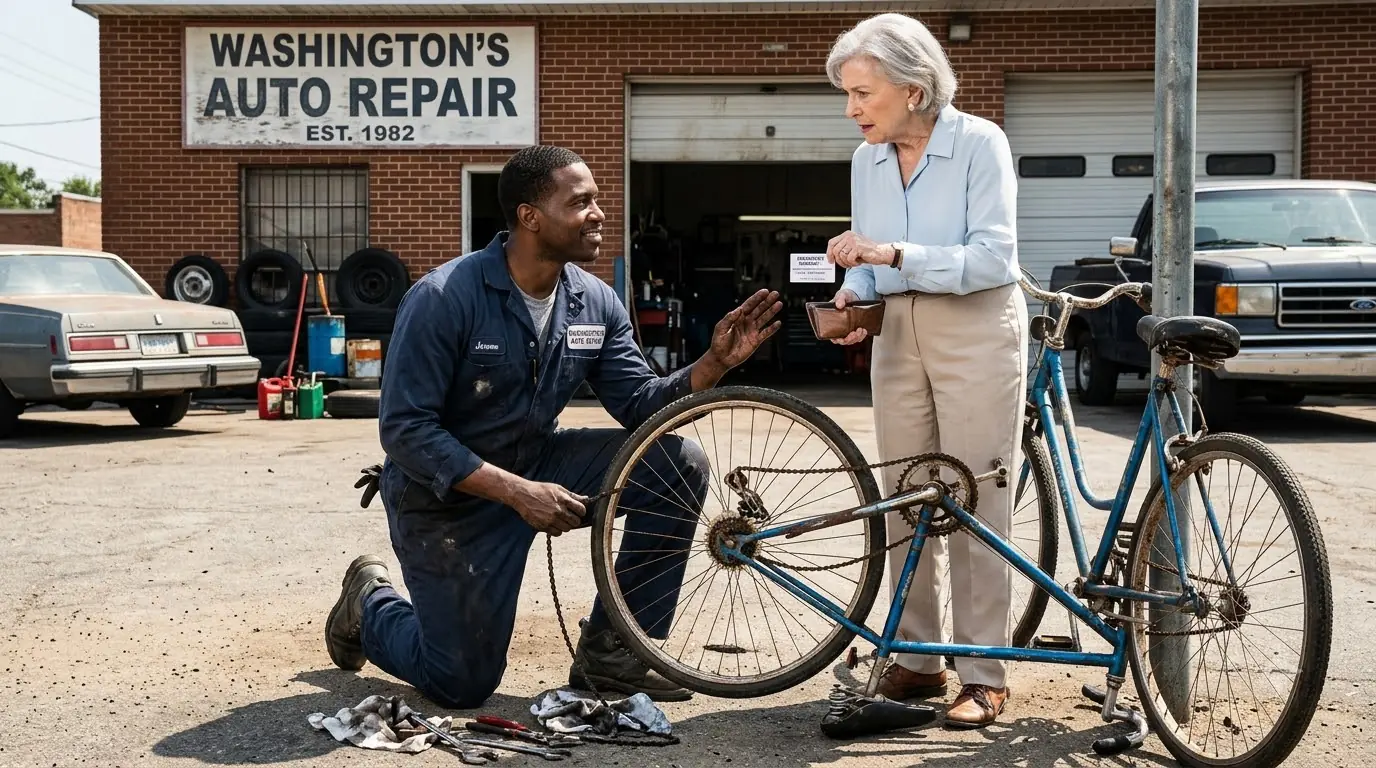
He turned and saw an elderly white woman standing beside an old blue bicycle. Despite the heat, she was carefully dressed in pressed slacks, pearl earrings, and sensible leather shoes.
Her handbag looked expensive but old. Her face showed the kind of strain people tried to hide when they did not want to become anyone else's problem.
"I'm sorry to bother you," she said, slightly breathless. "My bicycle chain broke, and I desperately need to get to the pharmacy before they close."
Jerome noticed her hands trembling. He also noticed the pharmacy discount card peeking from her wallet when she opened it.
"I don't drive anymore," she explained, checking her watch. "I walked here hoping someone could help.
The pharmacy closes in forty-five minutes, and I need my heart medication."
Jerome's mechanic instincts took over. He knelt beside the bicycle and examined the drivetrain.
The problem was worse than a broken chain. Rust had seized several components, turning a quick repair into something much more difficult.
"Ma'am, what's your name?"
"Elizabeth," she said. After a brief hesitation, she added, "Just Elizabeth is fine."
Something about the pause registered, but Jerome focused on the bicycle. "The chain is badly corroded, and part of the mechanism is seized.
This isn't a five-minute repair."
Eddie emerged from the shop with his keys jingling. "Jerome, we're closed.
I need to lock up and get out of here."
Then he noticed Elizabeth, and his expression softened slightly. "Ma'am, try the bike shop on Elm Street.
They might still be open."
Elizabeth's face fell. "I already called.
They close early on Tuesdays. I've been walking around for two hours trying to find help."
Jerome saw the few crumpled bills in her wallet. They looked barely sufficient for medication, much less a repair.
Eddie exhaled sharply. "Jerome, I've got somewhere to be.
We can't stay open for every person who walks in here."
Jerome watched Elizabeth dab sweat from her forehead. She was trying to stay composed, but fear had started showing around her eyes.
Missing heart medication was not a small inconvenience. Jerome understood enough to know that a delay could become dangerous.
"How far is the pharmacy?" he asked.
"About two miles. I thought I could walk, but..."
Elizabeth looked toward the shimmering pavement.
Jerome made his decision. "I can fix this.
Give me twenty minutes."
Eddie's face darkened. "Jerome, we're done for the day."
"Just twenty minutes. I'll lock up afterward."
"No overtime," Eddie snapped. "You understand?
Fix it fast and get out."
Jerome nodded and wheeled the bicycle into the shop. Elizabeth followed, apologizing repeatedly.
"Please don't apologize," he said, selecting tools. "My grandfather always said, 'Fix what's broken.
Help who needs help.'"
As he worked, Elizabeth watched closely. She noticed the organized bench, the thank-you cards from customers, and the careful way Jerome inspected each part before touching it.