The steel gate separated two different worlds.
On one side stood nineteen-year-old Caleb Mercer in a faded olive-green canvas jacket, dusty jeans, and work boots worn smooth by years of Montana dirt. Behind him stretched 280 acres of dry pasture, leaning fence posts, a weathered farmhouse, and the cattle ranch his family had worked for four generations. A brass pocket watch that had belonged to his grandfather hung from Caleb’s belt, tapping softly against his thigh whenever the mountain wind moved his jacket.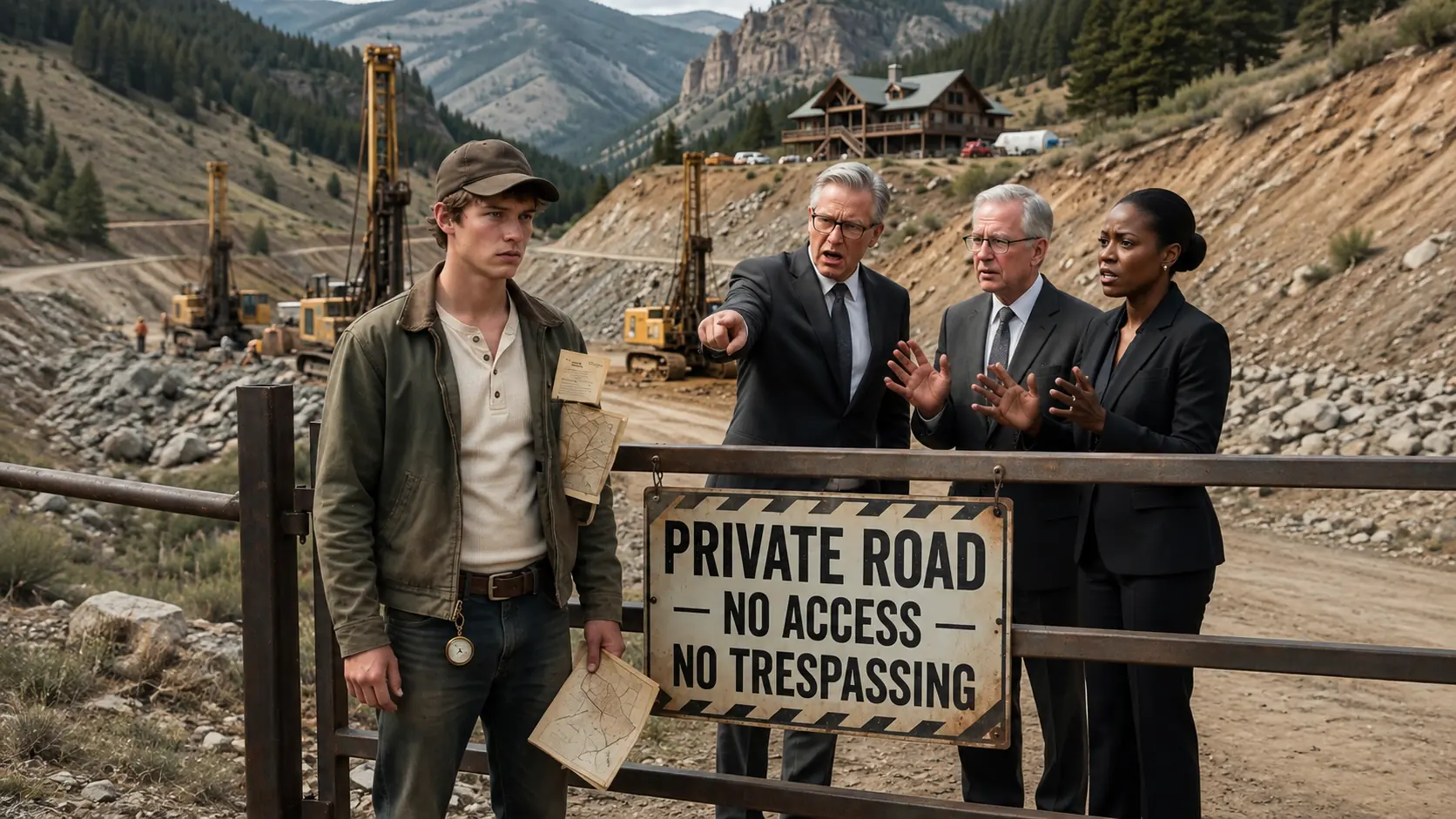
On the other side of the gate stood an $87 million mining operation.
Drilling rigs rose against the pine-covered cliffs. White company trucks moved along newly cut roads while diesel smoke rolled across the valley. Survey flags marked the ground every fifty feet, and a large lodge for visiting executives overlooked the site from the mountainside.
Victor Stadler stood behind the gate in a charcoal suit that had never been designed for ranch dust. The fifty-two-year-old white American mining executive had swept-back gray hair, frameless glasses, and the impatient expression of a man accustomed to speaking only with people who needed something from him. Beside him, company attorney Leonard Price lifted both hands in a nervous attempt to keep the confrontation under control.
A Black American hydrologist named Dr. Naomi Brooks stood several feet away holding a silver clipboard. She was forty-one, sharp-eyed, and far more interested in the rolled map beneath Caleb’s arm than in the executive’s performance.
Stadler pointed down the road.
“Go home, farm boy. Grown men are working here.”
Caleb did not move. “Drill near that creek, and you’ll lose everything.”
Stadler grabbed the gate latch. “Say that again, and I’ll throw you off my site.”
Caleb pulled the old geological map from his jacket.
“Touch me,” he said, “then explain why your mine sits over my water.”
The attorney’s hands rose higher.
Naomi’s eyes fixed on the faded blue lines crossing the map.
Stadler laughed.
The sound carried across the dry valley, where hundreds of workers and millions of dollars in equipment waited for his order. To him, Caleb was only a thin teenager trying to sound like the grandfather who had recently died. The young rancher had no engineering degree, no corporate title, and no team of lawyers standing behind him.
Stadler owned three thousand acres.
Caleb owned a struggling cattle ranch with a barn that needed a new roof.
“Everything behind this gate belongs to Ridgeline Resources,” Stadler said. “We have the land, the mineral rights, the surveys, and the permits.”
“You don’t have the water.”
“We have six approved wells.”
“For now.”
Stadler stepped forward until the steel bars separated their faces. “You think because your family watched cattle drink from one creek for a hundred years, you understand geology?”
Caleb rolled the map again. “I understand that Dalton Creek sits downhill from your blast line.”
“Get off this road.”
“I warned you.”
The young rancher turned and walked away without waiting for an answer. Stadler watched him cross the pale grass toward an old pickup parked beside the county road.
“Who is that kid?” he asked.
Naomi continued staring after Caleb. “Caleb Mercer. His property borders the eastern edge of the project.”
“I know where he lives. I asked why he thinks he understands our aquifer.”
“I don’t know.”
Stadler pointed toward the map disappearing beneath Caleb’s arm. “Find out.”
Three days later, Ridgeline Resources began blasting.
The first explosion struck the valley shortly after sunrise. Windows rattled inside the Mercer farmhouse, dust fell from the ceiling, and a coffee mug moved slowly across the kitchen counter before falling onto the tile.
Caleb stood beneath the doorway as a thin crack appeared in the plaster above him.
His border collie, Dutch, barked toward the eastern ridge.
Another blast followed ninety minutes later.
Caleb looked at the brass pocket watch on his belt. His grandfather, Howard Mercer, had carried it every day for thirty-seven years. On the back, scratched beneath the tarnish, were four words:
Listen before the ground speaks.
Howard had understood the valley better than anyone Caleb knew. He walked the fence lines before breakfast, checked Dalton Creek every afternoon, and kept records of snowfall, rainfall, and well depth inside small black notebooks.
Seven months earlier, Howard collapsed in the barn and died before an ambulance reached the ranch.
He left Caleb the cattle, the house, the land, and more debt than cash.
He also left one strange instruction.
A gray steel lockbox sat on a shelf in the cellar with masking tape across its lid. Howard’s handwriting appeared in careful block letters:
DO NOT OPEN UNTIL THEY START BLASTING.
Caleb walked down the narrow concrete stairs.
A bare bulb illuminated shelves of old jars, tools, wire, and blankets. The lockbox waited against the far stone wall exactly where Howard had placed it.
Caleb removed the brass skeleton key attached to his key ring. He had found it among his grandfather’s belongings after the funeral but had never known what it opened.
The lock clicked.
Inside were three documents and a handwritten note.
The first was a Montana water-right certificate filed in 1952 by Amos Mercer, Caleb’s great-grandfather. The yellowed paper described the family’s legal claim to Dalton Creek and the underground watershed supplying it. The language extended far beyond the visible stream crossing the ranch.
It covered the aquifer beneath eleven square miles of the surrounding valley.
The second document was a private geological survey dated 1961. Hand-drawn cross sections showed layers of shale, limestone, and pressurized groundwater beneath the ridge. Blue pencil marks traced the aquifer from Ridgeline’s recently purchased land toward the lower Mercer pasture.
A note from Howard lay beneath the survey.
Caleb recognized the shaking handwriting from the final year of his grandfather’s life.
They will need water for the processing plant. If they blast through the caprock, the aquifer will move downhill. When it moves, it will come toward us. Do not sell the ranch. Do not sell the water. Take these papers to Margaret Adler.
A business card rested beneath the note.
Margaret Adler was a water-rights attorney in Billings.
Caleb placed every document back inside the protective sleeves and drove three hundred miles that afternoon.
Margaret’s office occupied the third floor of an old sandstone building. She was a sixty-four-year-old white American attorney with silver hair pulled into a low bun, tortoiseshell glasses, and a worn leather satchel beside her desk.
She rose when Caleb entered.
“You have Howard’s eyes,” she said.
“You knew my grandfather?”
“For twenty-five years.”
Caleb placed the papers on her desk. “He told me to bring these after the blasting started.”
Margaret read each document slowly.
When she finished, she removed her glasses and looked at him.
“Your grandfather built a legal dam.”
Caleb frowned. “There’s no dam on Dalton Creek.”
“Not one made of concrete.”
She tapped the 1952 certificate.
“Montana follows prior appropriation. First in time, first in right. Your great-grandfather registered this claim decades before Ridgeline Resources existed. If this certificate remains valid—and I believe it does—your family holds the senior right to the aquifer.”
“They have permits.”
“Permits do not create water.”
Margaret opened the geological survey.
“Howard believed their blasting would fracture the rock sealing the aquifer. If that happens, pressure could redirect the groundwater toward your land.”
“And away from their wells.”
“Exactly.”
Caleb looked at his grandfather’s note.
“Did he know they were coming?”
“Ridgeline tried to buy your ranch before he died.”
Caleb had seen the unopened letters stacked near the kitchen sink but had never examined them. Margaret explained that the company first offered Howard $1.4 million, then $2.1 million. When he refused, Stadler visited the farmhouse personally.
“He told your grandfather the mining operation would surround him,” Margaret said. “He said the ranch would become worthless and Dalton Creek would be poisoned.”
“What did Grandpa say?”
“He asked Stadler what was beneath the creek.”
“And Stadler?”
“He said the company knew every inch of the valley.”
Margaret gave a faint smile.
“Howard knew better.”
For six weeks, Ridgeline blasted from dawn until evening.
The valley shook at regular intervals. Cattle avoided the eastern pasture, birds abandoned several nesting areas, and fine dust coated the Mercer windows. Stadler received daily reports showing that excavation remained on schedule.
Then Naomi Brooks noticed the pressure falling in Well Seven.
Eleven pounds per square inch disappeared overnight.
Well Six had lost nine.
The primary production well had lost twenty-two over two weeks.
Naomi recalibrated the equipment twice. The numbers remained unchanged. She compared them with the blasting schedule and discovered that every major pressure drop followed a detonation near the southern ridge.
She walked into the site office carrying fourteen pages of data.
“We fractured the aquifer cap,” she told the regional manager.
He barely looked up. “The blasting plan was approved.”
“The approval assumed the caprock was thicker.”
“Our consultants modeled it.”
“Their model was wrong.”
Naomi spread the charts across his desk. “The water is migrating east.”
“How much?”
“Enough to threaten every supply well on this property.”
Ridgeline ordered four emergency test wells drilled at a cost of more than one million dollars.
Every well reached dry rock.
The aquifer had not vanished. Water followed gravity through the new fractures, moving toward lower land on the eastern side of the valley.
Toward Mercer Ranch.
Dalton Creek began running stronger than Caleb had ever seen it during late summer. A spring that had been dry for decades reappeared near his southern fence. Water rose inside an old livestock well Howard stopped using when Caleb was a child.
Naomi arrived at the ranch carrying testing equipment.
Caleb met her beside the gate.
“Mr. Mercer, I need permission to examine your well.”
“Are you here for Ridgeline?”
“I work for them.”
“That wasn’t my question.”
She considered him carefully. “I’m here because the numbers say your warning was right.”
Caleb unlocked the gate.
For three hours, Naomi measured pressure, flow, mineral content, and well depth. Her results confirmed that Ridgeline’s groundwater had migrated beneath the Mercer property.
Before leaving, she looked toward the mining site.
“They won’t admit this easily.”
“They don’t have to admit it for the water to stay here.”
“They may try to take it.”
Caleb touched the pocket watch at his belt. “Grandpa expected that.”
Ridgeline sent three executives to the farmhouse the following Tuesday.
They arrived in a black SUV carrying a written offer of $4.5 million for permanent access to the aquifer. The lead negotiator spoke about partnership, regional development, and financial security.
Caleb listened from the porch.
When the man finished, Caleb said, “You were warned.”
“The offer is significantly above market value.”
“You don’t know the market value. There is no mine without this water.”
The negotiator’s smile tightened. “This may be the last friendly offer.”
Caleb stood.
“So make sure you remember how friendly I was when I said no.”
He entered the house and closed the screen door.
Ridgeline’s representatives stood in the ranch dust holding a multimillion-dollar contract no one wanted.
When money failed, the company turned to the courts.
Ridgeline filed an eminent-domain petition claiming that its mining project served the public interest by creating jobs, tax revenue, and access to strategically important minerals. Its attorneys asked the court to force a water-access easement across Mercer property.
The company brought four attorneys, two paralegals, and rolling cases filled with documents to the hearing.
Margaret Adler arrived carrying one folder.
Caleb sat beside her in the same faded jacket he wore at the gate. Stadler watched from the gallery, his black portfolio resting across his knees.
Ridgeline’s lead attorney spoke for twelve minutes about economic development.
When he finished, Margaret stood.
She removed the 1952 certificate from her folder and placed it before Judge Rebecca Harwell, a Black American judge known for reading every page submitted to her court.
“Your Honor, Ridgeline’s entire case depends on treating Mr. Mercer’s water as a resource acquired after their project began,” Margaret said. “It was not.”
She explained the senior water right.
Amos Mercer filed his claim sixty-seven years before Ridgeline acquired the neighboring land. The company’s permits could not erase the earlier legal priority.
Then Margaret presented Naomi’s hydrology report.
The company’s own data showed that its blasting fractured the aquifer cap and caused the water to migrate. Ridgeline had not discovered a shortage beyond its control.
It had destroyed its own access.
Naomi testified.
Stadler’s attorneys attempted to suggest that her conclusions were uncertain. She answered every question with measurements, pressure logs, dates, and diagrams.
“Did Caleb Mercer warn company personnel about this risk before blasting began?” Margaret asked.
“Yes.”
“Was his warning investigated?”
“No.”
“What happened after the company ignored him?”
“The aquifer moved in the direction he predicted.”
Margaret presented the 1961 geological survey.
A ranching family had mapped the underground water system more accurately than the mining company’s expensive consultants. Howard’s handwritten note entered the record next.
Judge Harwell read it in silence.
Then she looked directly at Stadler.
“Mr. Mercer warned your company. Your employees dismissed him, proceeded with blasting, damaged the aquifer, and now ask this court to take his senior water rights so you may repair the consequences of your own decisions.”
Ridgeline’s attorney rose. “The economic importance of the project—”
“Does not convert private negligence into public necessity.”
The judge denied the eminent-domain petition.
She issued an injunction stopping all Ridgeline operations until a lawful water agreement was reached. She also ordered the company to pay $6.2 million for aquifer damage, environmental monitoring, and ranch remediation.
The gavel fell once.
Seventy-two hours later, every drill rig stopped.
The compressors went silent. Trucks remained parked. Conveyor systems stood motionless against the ridge like monuments to arrogance. Security guards watched over machinery no one was legally permitted to operate.
Ridgeline’s stock price fell.
Board members resigned.
Victor Stadler was removed as project director and quietly pushed out of the company weeks later.
For five months, the mine produced nothing.
Ridgeline eventually returned to the negotiating table under new leadership. This time, its executives did not arrive at Caleb’s gate or threaten him from behind lawyers.
They sat across from Margaret in a conference room and asked what terms he required.
Caleb refused to sell the ranch or the water rights.
Instead, he offered a controlled lease.
Ridgeline could access a limited amount of water for $1.1 million per year. Independent monitors would measure aquifer levels, water quality, and environmental effects. Any violation would suspend access immediately.
The company would repair damaged county roads, fund long-term groundwater testing, and establish a restoration bond large enough to protect the valley if the mine failed.
The Mercer fence would not move.
No drilling equipment could enter Caleb’s ranch.
Ridgeline’s attorneys attempted to negotiate the annual payment downward.
Margaret pointed toward the injunction.
“You have already spent five months deciding how much dry machinery is worth,” she said. “You may spend another five.”
They signed that afternoon.
When the first payment entered his account, Caleb did not buy a luxury truck or leave Montana.
He repaired the ranch.
The barn received a new foundation, locally milled timber, and a roof that no longer leaked. Caleb replaced broken fencing, restored the creek banks, and paid the ranch debts Howard had carried silently during his final years.
He also created a legal fund to help neighboring farmers examine water and mineral agreements before signing them.
Naomi left Ridgeline and became the independent hydrologist supervising the valley. She visited Dalton Creek every month, reporting her findings publicly so no corporation could hide the condition of the aquifer again.
One afternoon, she found Caleb carving words into the main beam of the rebuilt barn.
THEY’LL NEED THE WATER.
“Your grandfather’s message?” she asked.
Caleb nodded.
“He knew all this would happen?”
“He knew people like Stadler would eventually arrive.”
Naomi looked through the open barn doors toward the silent ridge and the mine operating under strict limits.
“He could have sold for millions.”
“He didn’t want millions.”
“What did he want?”
Caleb closed the pocketknife.
“For the ranch to still be here when they were gone.”
Years later, Ridgeline’s mining project continued, but only because the company followed terms written by the young rancher it once mocked. Every annual payment supported the Mercer land, local water protection, and scholarships for rural students studying agriculture, geology, and environmental science.
Caleb never forgot the day Stadler pointed down the road and told him to go home.
The executive believed adulthood came from money, power, and the number of people waiting for your orders.
Caleb’s grandfather had taught him differently.
A grown man listened to the land before forcing it to obey. He studied what others ignored, prepared before the danger arrived, and protected what he intended to leave behind.
Ridgeline had eighty-seven million dollars, helicopters, drilling rigs, consultants, and attorneys.
Caleb had one warning, one brass key, and a dead grandfather’s lockbox.
In the end, the company discovered that all its machinery was useless without the water beneath the farm boy’s boots.