The dining hall of Black Ridge fell so silent that Hannah Mercer heard snow brushing against the windows.
Elijah Boone stood beside her chair with one hand resting lightly beneath her chin. His beard was cold from the weather, his repaired mountain boots were wet with melting snow, and his deep blue eyes remained fixed on hers as if the dozen stunned faces around them did not exist. Hannah’s sewing needle slipped from her fingers and landed soundlessly in the folded glove on her lap.
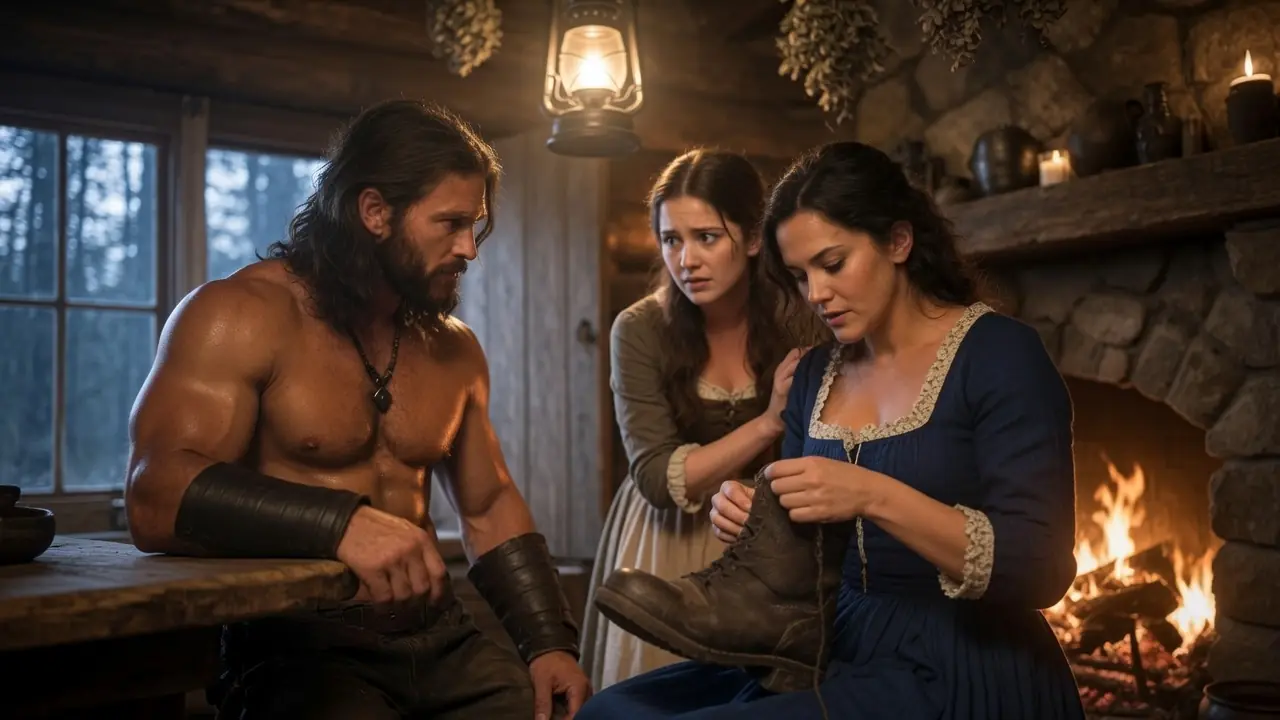
For years, no man in Black Ridge had crossed a room to sit beside her.
Now the one man every unmarried woman had watched for fifteen springs had kissed her in front of them all.
Beatrice Cole recovered first. She was the young widow of a wealthy cattle broker, beautiful enough that men forgot their own names when she entered a room. Her fitted burgundy dress had been ordered from St. Louis, and the pearls at her throat cost more than Hannah earned in two years repairing boots.
“This is cruel, Elijah,” Beatrice said, forcing a smile. “Hannah will misunderstand your gratitude.”
Elijah turned slowly.
“I haven’t misunderstood anything.”
Beatrice’s smile tightened. “She repaired your boots.”
“She saw what a military surgeon, two physicians, and every man who hunted beside me failed to see.”
Hannah rose from the chair, her cheeks burning beneath the attention. She was thirty-two, with a soft, full figure that shopkeepers treated as an inconvenience whenever she squeezed between crowded counters. Her brown dress was neat but old, its cuffs repaired so many times that the original stitching had disappeared.
She had spent most of her life learning how not to occupy too much space.
“Elijah,” she whispered, “you shouldn’t have done that here.”
“Where should I have done it?”
“Somewhere people would not turn it into entertainment.”
His expression softened. “Then they would still believe they had the right to speak for you.”
Across the room, several women looked away.
They had spoken for Hannah all her life.
They called her shy when she was simply ignored. They called her simple because she rarely corrected them. They said she was fortunate to work for her uncle at Mercer Cobbler Shop, though none of them knew that Hannah performed nearly every repair while Silas Mercer placed his own stamp inside the finished boots.
Elijah offered her his hand.
“Walk with me.”
Hannah glanced toward the windows. “It’s snowing.”
“I noticed.”
“You live twelve miles into the mountains.”
“I noticed that too.”
A faint smile pulled at her mouth despite herself. She placed her hand in his, and the room began breathing again only after they stepped outside.
Snow covered Black Ridge’s main street in a clean white layer. Lanterns glowed behind shop windows, horses shifted beneath blankets, and the wooden buildings seemed gentler beneath winter. Elijah walked slowly beside Hannah, adjusting his pace so his injured leg did not force her to hurry.
She noticed that too.
“Does it still hurt?” she asked.
“Less than it has in eleven years.”
“When the leather softens, bring the boots back. The left heel may need another layer.”
“You’ll repair them?”
“If my uncle allows it.”
Elijah stopped.
Hannah took two steps before realizing he was no longer beside her. She turned and found him standing beneath the light outside the closed general store.
“Why would your uncle decide which work you accept?”
“He owns the shop.”
“He owns the building.”
“He owns the business.”
“Who repaired my boots?”
Hannah looked down.
Elijah stepped closer. “Who designed the unequal reinforcement beneath the heels?”
“I did.”
“Who cut the leather?”
“I did.”
“Who shaped the sole so my right hip would stop turning?”
“I did.”
“Then why is his name stamped inside them?”
Hannah’s fingers tightened around the edge of her shawl. “Because customers trust a man’s mark.”
“Customers trust work that lasts.”
“That is not the way Black Ridge sees it.”
“It is the way I see it.”
The certainty in his voice frightened her. Hope had always been more dangerous than disappointment because disappointment required no courage. Hope asked a person to step forward where everyone could see them fail.
“You don’t know me,” she said.
Elijah looked toward the dark mountain ridge beyond town. “I know you watched me take three steps across the shop and understood what eleven years of pain had done to my spine.”
“That is leatherwork, not knowing a person.”
“You reinforced the inside seam instead of replacing the outer panel.”
“The outer panel had been repaired by someone important to you.”
His eyes shifted back to hers.
The boots had belonged to Elijah’s older brother, Thomas, who died during the final winter of the war. Thomas had stitched the damaged panel himself before giving the boots to Elijah. Every cobbler who examined them wanted to replace it.
Hannah preserved every uneven stitch.
“How did you know?” he asked.
“Men don’t keep ruined leather unless the damage means something.”
For a long moment, Elijah said nothing.
Then he reached inside his vest and removed a small folded paper. “I came to town for more than supper.”
Hannah opened it.
It was a land notice issued by the county office. Elijah’s mountain property would be auctioned in thirty days unless he paid an old debt attached to his late father’s name. The amount was impossible for an isolated trapper to raise before winter’s end.
“This debt is twenty-two years old,” Hannah said.
“My father never mentioned it.”
“Who filed the claim?”
“August Cole.”
Beatrice’s late husband.
Hannah read the legal description twice. The claimed debt was secured against a parcel containing the only reliable pass through the northern ridge. Railroad surveyors had been asking questions about that pass for months.
“This isn’t about money,” she said. “Someone wants your land.”
“I reached the same conclusion.”
“Then why show this to me?”
Elijah looked at the boots she had repaired. “Because you see where weight has been placed unevenly.”
Hannah understood the question hidden beneath the statement.
He believed she might notice where the document had been altered.
She carried the notice to the cobbler shop and unlocked the rear door. Her uncle slept in the rooms above, though his snoring usually continued through thunderstorms. Elijah lit an oil lamp while Hannah spread the paper across her workbench.
The shop smelled of leather, wax, iron nails, and the dried cedar shavings she placed inside finished boots. Tools hung in precise rows along the wall. Wooden lasts of different sizes filled the shelves, each labeled in Hannah’s handwriting.
Elijah looked around slowly.
“This is yours.”
“My uncle would disagree.”
“Your hands have polished every handle.”
She leaned closer to the paper. “The county seal is genuine.”
“So the debt is real?”
“The seal is real. The page is not.”
Hannah pointed toward the bottom edge. The fibers beneath the signature ran in a slightly different direction from those at the top. Someone had cut the lower portion from an older legal document and attached it to a newly written claim with a nearly invisible overlap.
Most men saw paper.
Hannah saw joined material.
“The same skill?” Elijah asked.
“Leather, paper, cloth—anything cut leaves a direction behind.”
She warmed the page gently above the lamp. A thin line of hardened paste appeared across the document. Beneath the attached section, faint traces of original writing became visible.
Elijah leaned closer.
The old document had not been a debt agreement.
It was a paid receipt.
His father had settled the amount in full two decades earlier.
“Can this stop the auction?” he asked.
“Not by itself. Your copy could be called damaged or false.”
“Where would the original be kept?”
“The county archive.”
“Sheriff Mallory guards the courthouse at night.”
Hannah gave him a dry look. “Then we should go during the day.”
The next morning, Silas Mercer discovered them in the workshop.
Hannah’s uncle was a narrow man with thinning gray hair and a habit of rubbing his fingers together whenever money entered a conversation. He looked at Elijah, then at the land notice on the table, and finally at Hannah standing beside him.
“You brought a man into my shop after midnight?”
“My workroom,” Hannah corrected quietly.
Silas laughed. “Your workroom?”
Elijah’s expression hardened, but Hannah touched his arm before he spoke.
She had spent twenty years allowing Silas to claim her labor. She did not want Elijah fighting a battle she had never dared name for herself.
“I need the morning away,” she said. “We’re going to the county archive.”
“No.”
“I have no repairs due before noon.”
“You have six pairs waiting.”
“Four are finished.”
“Then finish the other two.”
Elijah stepped forward. “She said she needs the morning.”
Silas looked him over. “A kiss in a restaurant does not make you her husband.”
“No,” Hannah said before Elijah could answer. “And being my uncle does not make you my owner.”
Silas stared at her.
The sentence had existed inside Hannah for years, but speaking it aloud changed its weight. It no longer felt like rebellion. It felt like a fact everyone had politely agreed not to mention.
Her uncle’s face reddened. “You live above my shop.”
“I sleep in a storage room you call wages.”
“I fed you after your mother died.”
“And I repaid every meal before I turned eighteen.”
Silas slapped his palm against the workbench. “Without my name, nobody would bring you a boot to mend.”
Elijah lifted one repaired hunting boot from the shelf. Inside it, Silas’s stamped mark covered the lining.
“Did you make this?” Elijah asked him.
Silas hesitated.
Elijah placed the boot upright. “Tell me why the inner ankle is cut higher than the outer.”
“That is how mountain boots are made.”
“No. It compensates for a healed break in the wearer’s left leg.”
Silas glanced at Hannah.
Elijah picked up another pair. “And these?”
“Riding boots.”
“The toe is reinforced because the owner drags one foot while mounting.”
Silas’s silence answered everything.
Hannah removed her apron and folded it across the bench. “I’m taking the morning.”
Her uncle pointed toward the door. “Walk out now, and don’t return.”
Fear tightened around her ribs. The storage room above the shop contained every dress she owned, her mother’s Bible, and the small tin box where she saved coins. Walking out meant losing shelter, work, and the only routine she had known since childhood.
Elijah did not tell her what to do.
He simply waited.
Hannah looked at the tools she had maintained, the shelves she had organized, and the stamp that placed another person’s name inside every piece of work she completed.
Then she took her mother’s awl from the wall.
“I won’t.”
She walked out beside Elijah.
The county courthouse stood at the far end of Black Ridge beneath a stone clock that had not kept accurate time in years. Clerk Milton Gray resisted their request until Elijah placed the altered claim on his desk and asked whether the territorial auditor would enjoy examining its construction.
Gray’s face changed.
He led them into the archive room.
Dust-covered ledgers filled floor-to-ceiling shelves. Hannah searched by parcel number while Elijah examined tax rolls. After an hour, she found the original receipt confirming that Nathaniel Boone had paid August Cole’s father in full.
A second paper had been inserted beside it.
It authorized the county to destroy the receipt after the coming auction.
The signature belonged to Beatrice Cole.
“She is not a county official,” Elijah said.
“No,” Gray replied nervously. “But her husband financed the courthouse expansion.”
“He’s dead.”
“His influence isn’t.”
Hannah examined the destruction order. “This signature is copied.”
Gray swallowed. “Copied from what?”
She searched the surrounding files until she found Beatrice’s application for her husband’s estate. The signature matched too perfectly—every curve, pause, and ink spread identical.
“A hand cannot repeat itself exactly,” Hannah said. “Someone traced it.”
The clerk moved toward the door.
Elijah blocked him.
“Where are you going?”
“To notify the sheriff.”
“Why?”
“Because forged county records are a crime.”
Hannah saw fear in his eyes, not outrage. “You already knew.”
Gray reached beneath his desk.
Elijah caught his wrist before he could pull the small pistol hidden there. A short struggle knocked files to the floor. The clerk broke free and ran into the corridor, shouting that Elijah Boone was attacking courthouse staff.
Sheriff Mallory arrived with two deputies.
By noon, Elijah was locked in the town jail.
Hannah stood outside the cell while Beatrice Cole entered wearing a blue traveling dress and an expression of practiced concern.
“This can still end quietly,” Beatrice said.
Elijah remained seated on the wooden bench. “I doubt that.”
Beatrice turned to Hannah. “You have embarrassed yourself enough.”
Hannah held the original receipt beneath her shawl. “Your clerk forged the claim.”
“My clerk?”
“Milton Gray.”
“He says Elijah threatened him and stole county documents.”
Elijah looked at Hannah. “Take the receipt to the territorial judge in Helena.”
Beatrice smiled. “The mountain road closed after last night’s snow.”
“Then we wait for it to open.”
“The auction is tomorrow.”
Hannah’s heart sank.
Beatrice stepped closer to the bars. “Sign the land transfer tonight, Elijah. I’ll withdraw the assault complaint and allow you to keep your cabin for the winter.”
“Why do you want the pass?”
“Business.”
“Railroad business?”
Her smile disappeared.
The northern pass would save the proposed railway nearly forty miles of construction. The company had offered Beatrice a private payment if she delivered clear ownership before its survey became public.
She had forged the debt because Elijah refused to sell.
“You could have asked,” Hannah said.
Beatrice looked at her as though furniture had spoken. “Men like Elijah do not listen to sensible women.”
“He listened to me.”
The insult landed exactly where Hannah intended.
Beatrice’s gaze became cold. “Do you believe that kiss made you special? He needed someone useful, and you happened to notice a seam.”
Elijah rose.
“Hannah,” he said without looking away from Beatrice, “the first time I entered that cobbler shop was not the first time I saw you.”
Hannah turned toward him.
He continued. “Three winters ago, a miner collapsed outside the general store. Everyone stepped around him because he smelled of whiskey. You removed your own shawl, wrapped his hands, and sat beside him until the doctor came.”
She remembered the man but not Elijah.
“The following spring,” he said, “a widow could not pay for her son’s boots. You told Silas the leather had been ruined, then worked through the night to make them and charged nothing.”
Beatrice’s face tightened.
Elijah stepped closer to the bars. “I did not choose Hannah because she repaired my leg. I brought her the boots because I had spent three years trying to find a reason to speak to her.”
Hannah forgot the sheriff, the cell, and the auction.
“Why didn’t you?” she whispered.
“I’ve faced bears with better manners than I possess.”
Despite everything, she laughed.
Beatrice left in anger.
That evening, Hannah returned to the cobbler shop. Silas had changed the lock, but the storage-room window above the alley remained loose. She climbed through and retrieved her belongings, then searched the records her uncle kept beneath the counter.
For years, Silas had performed repairs for August Cole and later Beatrice. Hannah remembered unusual orders—soft leather covers fitted to document cases, special paste made from rabbit glue, and narrow cutting blades sharper than those used for boots.
She found invoices for all of them.
One entry listed payment from Milton Gray for “archive binding assistance.” Another recorded a large amount from Beatrice two days before Elijah received the debt notice.
Silas had helped construct the forgery.
The floor creaked behind her.
Her uncle stood in the doorway holding a lamp.
“You never knew when to stop looking,” he said.
“I learned from studying your work.”
“You learned everything from me.”
“No. I learned because you made me repair every mistake you were too proud to admit.”
Silas set down the lamp. “Give me the ledger.”
Hannah held it behind her back.
“You will lose the shop,” she said.
“It is my shop.”
“Built on my hands.”
He lunged.
Hannah moved aside, but Silas caught her sleeve and tore the fabric. The ledger fell. Before he reached it, the rear door opened and three townsmen entered.
The miner Hannah once helped stood in front.
Behind him was the widow whose son received the free boots, along with the owner of the livery stable. Word of Elijah’s arrest had spread, and people had begun comparing the workmanship inside their footwear.
Every exceptional repair bore Silas’s mark.
Every customer remembered Hannah’s hands.
“We came for our boots,” the widow said. “And to hear who actually made them.”
Silas released Hannah.
By sunrise, half the town stood outside the jail.
Hannah presented the original receipt, the traced signature, Silas’s ledger, and the invoices for document paste. Customers testified that Hannah—not Silas—performed nearly every skilled repair in Black Ridge.
The sheriff refused to release Elijah until a territorial marshal rode into town with two railway investigators. The company had discovered Beatrice was attempting to sell property she did not legally own.
Milton Gray confessed before noon.
He admitted Beatrice paid him to replace the receipt with a forged debt claim. Silas joined old and new paper so skillfully that Gray believed no one would detect it. They planned to destroy the original after Elijah’s land was auctioned.
Beatrice was arrested at the station while trying to board a southbound coach.
Elijah’s land was restored before sunset.
Silas lost the cobbler shop after investigators discovered unpaid taxes and fraudulent accounts. The building was placed for sale, along with its tools and inventory.
Hannah expected to leave Black Ridge.
Instead, dozens of customers gathered outside the shop carrying repaired boots, gloves, saddles, and harnesses. The miner placed a jar on the counter containing three dollars. The widow added fifty cents. Ranchers, workers, shopkeepers, and families contributed what they could.
By evening, the jar held enough for the first payment.
Elijah covered the remainder as a loan secured by nothing except her word.
The new sign read:
HANNAH MERCER — COBBLER AND LEATHERWORKER
Her name appeared in letters larger than she had ever allowed herself to imagine.
Elijah returned to the mountains after the pass reopened, but he came into town every Saturday. Sometimes he brought work. Sometimes he brought meat, herbs, or cedar branches for the shop.
Sometimes he brought nothing at all.
By spring, Black Ridge had stopped asking why he chose Hannah.
The answer stood inside every pair of boots that no longer caused pain, every child’s shoe repaired without charge, and every traveler whose damaged saddle held through another hundred miles.
One evening, Elijah found Hannah closing the shop.
He placed an old leather bag on the counter.
“Another repair?” she asked.
“No.”
Inside was a pair of newly made women’s mountain boots. The stitching was rougher than hers but strong. Elijah had shaped each piece himself.
Hannah lifted one. “The left seam is uneven.”
“I was hoping you would overlook that.”
“I don’t overlook much.”
“I know.”
He came around the counter and rested his hands at her waist. “They’re for the walk to my cabin.”
“That is twelve miles.”
“Thirteen if you take the trail with the better view.”
“And why am I walking to your cabin?”
Elijah looked suddenly less comfortable than he had while facing armed men.
“Because I built another room.”
Hannah’s breath caught.
He continued before courage left him. “A workroom with a broad window. Shelves for leather. A table at the right height. And a stove that does not smoke unless the wind turns east.”
“You built me a room?”
“I built the room. Whether it belongs to you is your choice.”
Hannah touched the uneven seam of the boot.
For most of her life, people offered her whatever space remained after everyone more important had chosen first. Elijah had built space with her in mind and asked for nothing until she decided whether to enter it.
“What if I keep the shop?” she asked.
“Then we walk between them.”
“What if I am too tired to cook?”
“I know how to burn stew.”
“What if people keep asking why you chose me?”
Elijah smiled beneath his beard.
He lifted her chin, just as he had in the crowded dining hall months earlier.
“Then I’ll keep answering.”
This time, when he kissed her, no jealous women watched from behind him and no room waited to judge whether she deserved the moment. Only the scent of leather, the fading spring light, and the quiet certainty that someone had finally seen her before asking her to become anything else.
Years later, travelers still told the story incorrectly.
They said Elijah Boone ignored every beautiful woman in Black Ridge and suddenly chose the quiet cobbler nobody noticed. They spoke as though love had made him blind to beauty.
The people who truly knew Hannah understood the opposite.
Elijah had not failed to see what everyone else saw.
He had simply been the first man who looked long enough to see what they had missed.