The stagecoach left hours ago.
The dust settled, leaving only a battered trunk and a woman her prospective husband did not want.
She was too big, he had said.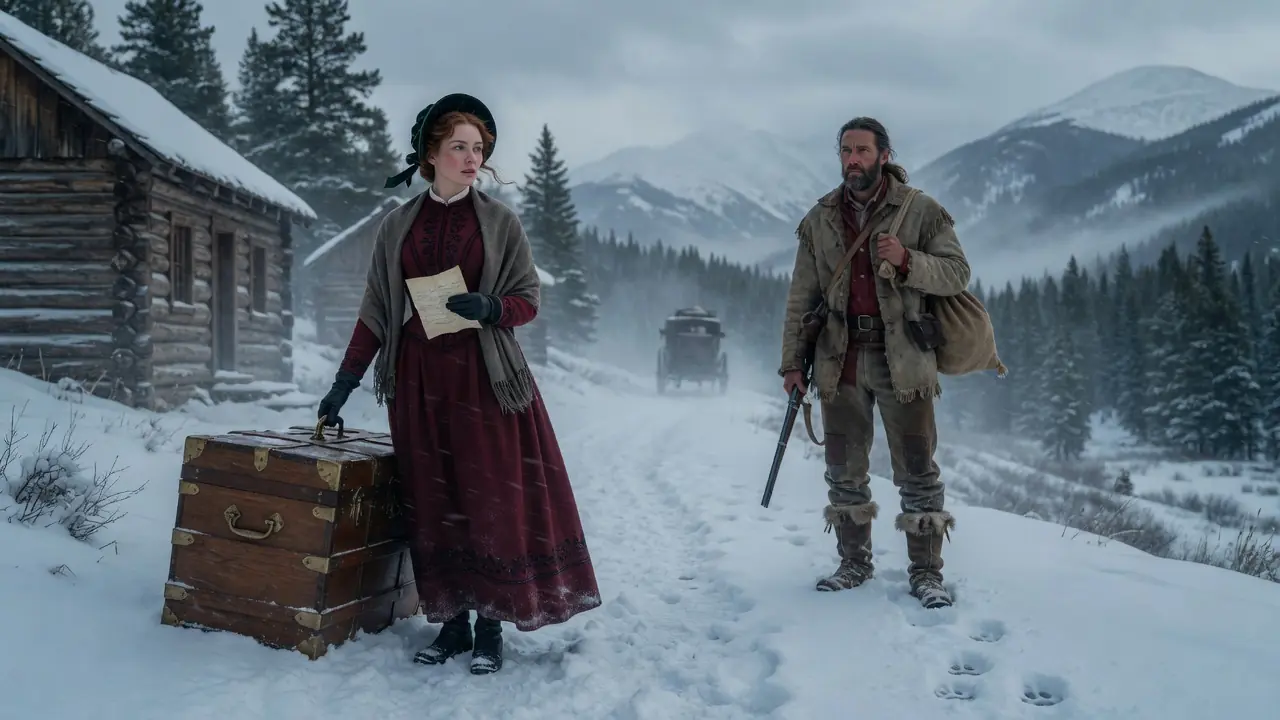
Too much.
Charles only wanted his winter salt.
Now he was staring at a stranger who was about to ruin his quiet life.
The trading post at the base of the Blackroot Grade smelled of spilled kerosene, damp sawdust, and the sour tang of rotting potatoes.
Charles pushed the heavy oak door open, and the leather hinges screamed in protest. He did not like coming down the mountain. The air down here felt thick, clogged with the sweat and noise of too many people trying to scrape a living out of unforgiving dirt.
He stomped the mud off his boots.
It was late October. The frost was already hardening the mud into jagged ridges by nightfall, and he needed salt, fifty pounds of flour, and enough coffee to keep his blood moving until April.
Jeb, the post proprietor, was leaning over the counter, picking at his teeth with a splinter. He did not look up at Charles’s entrance. His eyes were fixed on the far corner of the room.
Charles followed the man’s gaze.
Sitting on a brass-bound trunk by the dead cast-iron stove was a woman.
She was not the sort of woman you usually saw in Blackroot.
The women there were stringy, worn thin by wind and labor, whittled down to bone and sinew.
This woman was vast.
She was broad-shouldered and heavy-hipped, her flesh straining against the seams of a dark, heavy wool traveling dress that was entirely unsuited for the lingering afternoon heat. Her face was flushed, a blotchy red creeping up her thick neck.
She stared straight ahead, her hands folded over a beaded reticule in her lap.
Her knuckles were white.
“Got salt?” Charles rasped.
His throat was dry.
He had not spoken to another human being in three weeks.
Jeb spat onto the floorboards.
“Got salt in the back.”
He gestured lazily toward the woman with his chin.
“You want a wife to go with it? Here she is. Going cheap.”
The woman flinched.
The movement was small, just a tightening of her jaw and a rapid blink.
But Charles saw it.
“I want salt,” Charles repeated, his voice flat.
He leaned against the counter. He smelled like pine pitch, wood smoke, and stale sweat. He knew it. He did not care.
“Amos Miller ordered her out of Chicago,” Jeb said, leaning in, his voice dropping to a conspiratorial murmur that was entirely too loud. “Paid her fare. Stage dropped her off four hours ago. Amos took one look at the size of her, said he ain’t paying to feed a draft horse, and rode back to his claim. Left her sitting right there.”
Charles looked at her again.
She was staring at a knothole in the floor. Her breathing was shallow, lifting the heavy fabric of her bodice in uneven jerks.
She was humiliated.
The air around her practically vibrated with it.
“Not my problem,” Charles said.
“Ain’t mine either,” Jeb said, wiping down the counter with a filthy rag. “I’m locking up in an hour. Heading to town for the week. She can’t stay here.”
“Then she can take the stage back.”
“Stage don’t come back for ten days, Charles. And she ain’t got a copper to her name. Amos kept the return fare.”
Charles frowned.
He looked at the door, then out the window. The sky was bruising purple over the jagged peaks. The temperature was going to drop below freezing tonight.
Leaving her on the porch meant he would be stepping over a frozen corpse the next time he came down.
He hated dead things that did not have a pelt he could sell.
He walked over to the woman.
“What’s your name?” he asked.
She looked up.
Her eyes were a flat, muddy brown, but they were sharp. There were no tears in them. Crying was for women who had someone left to comfort them.
“Iris,” she said.
Her voice was surprisingly deep, raspy from dust.
“You got a place to go?”
“If I did, I wouldn’t be sitting by a cold stove.”
Charles ground his teeth.
He hated this.
He hated Amos Miller for being a coward. He hated Jeb for being a bastard. And he hated himself for what he was about to do.
He did not do it out of charity.
He did it because leaving a dog to drown in a rain barrel ruined a man’s sleep, and this did not feel much different.
“I live up the ridge,” Charles said. “Five miles. It’s a steep walk. You can stay in my shed until the stage comes back. You earn your keep. No crying. No complaining.”
Iris studied him.
She took in his matted beard, the greasy buckskin jacket, the dirt packed deep into the lines of his face.
She did not look grateful.
She looked like a woman evaluating the lesser of two terrible evils.
“I don’t complain, mister.”
“Charles.”
“I don’t complain, Charles. But I will need help with my trunk.”
Charles glared at the trunk.
It was massive.
“I ain’t hauling that up the mountain. I got flour to load.”
“Then I suppose I’ll freeze,” Iris said, her voice completely devoid of emotion, “because all my winter clothes are in it.”
Charles swore under his breath, a harsh, ugly sound.
He turned back to Jeb.
“Put the trunk on the mule. I’ll carry the flour myself.”
Jeb laughed, a wheezing, unpleasant sound.
“You’re a fool, Charles. She’ll eat you out of house and home.”
“Just load the damn trunk,” Charles snapped.
The trail to Charles’s cabin was not really a trail.
It was a suggestion of a path carved out by elk and stubbornness, winding through tight stands of lodgepole pines and over treacherous scree slopes.
Charles walked in front.
He carried the fifty-pound sack of flour balanced across his shoulders, his rifle slung across his chest. The mule, heavily laden with the rest of his supplies and Iris’s ridiculous brass-bound trunk, plodded behind him.
Iris brought up the rear.
He did not slow down for her.
He walked at his usual grueling, relentless pace, his boots finding purchase on the loose rocks with practiced ease.
Behind him, the sounds of her struggle were impossible to ignore.
The heavy rustle of her wool skirts dragging through the brush.
The sharp snaps of twigs under her awkward, heavy footfalls.
The desperate, whistling pull of her breath as the altitude thinned the air.
She sounded like a bellows with a hole in it.
After the first mile, Charles stopped to let the mule rest. He did not turn around, but he listened.
Iris stumbled into the small clearing a full minute later.
He glanced at her from the corner of his eye.
Her face was no longer red.
It was a pale, dangerous gray. Sweat had plastered her thin hair to her forehead and was leaving tracks through the trail dust on her cheeks.
She braced her hands on her thick thighs, bending over as she fought for air.
“You’re too slow,” Charles said.
The words tasted like ash.
He wanted her to quit so he could justify leaving her, but the thought brought no comfort.
Iris straightened up.
It took visible effort.
She wiped her mouth with the back of her raw, scratched hand.
“Then keep walking,” she gasped. “I’ll follow the mule’s droppings. I assume they lead to your house.”
Charles narrowed his eyes.
Then he turned and kept walking.
The temperature plummeted as they climbed above the tree line. The sun dipped over the peaks, and the shadows stretched out, cold and blue. The wind picked up, carrying the sharp metallic bite of coming snow.
Charles adjusted the flour sack, his shoulders burning.
Then he heard a heavy thud, followed by the clatter of loose rocks sliding down the slope.
He stopped.
He turned.
Iris was on the ground.
She had tripped over an exposed root. Her heavy skirt was tangled around her legs, and she was lying on her side in the dirt.
Charles stood there.
He did not drop the flour.
He did not rush back.
He watched her for a long moment.
She did not move. She just lay there, her face pressed against the pine needles.
Charles felt a hot spike of irritation.
Get up, he thought.
Don’t make me carry you.
I can’t carry you.
Slowly, painfully, Iris pushed herself up.
Her hands were scraped bloody from the rocks. She brushed the dirt from her front, her movements stiff.
She did not look at him.
She reached down, grabbed a thick dead branch from the ground to use as a walking stick, and took a step forward.
Then she walked past him, smelling of dust, crushed pine, and iron from the blood on her hands.
“Which way?” she rasped.
Charles pointed with his chin.
“Up.”
They reached the cabin an hour after dark.
It was a squat, ugly structure built against the side of a granite outcropping. The logs were rough-hewn, the chinking a messy mix of mud and dry grass.
It looked like a scab on the mountain.
Charles unlocked the heavy wooden door and shoved it open.
The smell hit them immediately.
It was a dense, physical wall of odor. Unwashed bedding, old grease, the coppery reek of drying pelts, and the stale ash of a dead fire.
Iris stood in the doorway, her large frame blocking out the moonlight. She took one breath, and her nose wrinkled involuntarily.
Charles dropped the flour sack onto the floorboards with a heavy thud.
He struck a match against the doorframe, the sudden flare of sulfur burning the inside of his nose. He lit the oil lantern on the table.
“Home,” he said, his voice dripping with defensive sarcasm.
Iris stepped inside.
The floorboards groaned ominously under her weight.
The cabin was barely ten by twelve feet. There was a rusted stove, a small table covered in animal traps and rifle parts, and a single narrow cot shoved into the corner.
Animal skins hung from the rafters, brushing against the top of Charles’s head.
Iris looked at the pelts, then at the single bed, then at the dirt-caked floor.
“You said you had a shed,” she said.
“Shed roof caved in last winter,” Charles replied, unbuckling his gun belt. “You’ll sleep on the floor.”
Iris looked at him.
She was exhausted, battered, and freezing, but her muddy brown eyes flared with a sudden dark heat.
“I am a heavy woman, Mr. Charles. If I sleep on that floor, I will likely not be able to get back up. And if I cannot get up, you will have to step over me to get to your coffee.”
Charles froze, his hand on the buckle of his belt.
He looked at her.
Really looked at her.
She was not pleading.
She was stating a logistical fact.
He looked at the narrow cot.
He looked at the floor.
He hated her.
“Fine,” he spat, grabbing a moth-eaten wool blanket from the bed and tossing it onto the floor by the stove. “Don’t break the bed frame.”
The first three days were a suffocating exercise in spatial awareness.
Charles’s cabin was not built for two people.
It certainly was not built for a woman of Iris’s size.
Every time she moved, the entire structure seemed to shift. The rustle of her skirts was a constant, maddening abrasion against the silence Charles had cultivated for five years.
He woke up on the second morning, his back aching from the hard, drafty floorboards, to the sound of metal scraping metal.
He sat up, the thin blanket falling to his waist.
The air in the cabin was freezing, his breath pluming in white clouds.
Iris was at the stove.
She had taken off the heavy wool traveling dress and was wearing a faded, oversized men’s flannel shirt she had presumably dug out of her trunk, belted tightly around her thick waist over a plain brown skirt.
She was attempting to scrape the hardened layer of black grease off his favorite cast-iron skillet with a hunting knife.
“What are you doing?” Charles demanded, his voice thick with sleep and hostility.
Iris did not stop scraping.
“I am attempting to find the bottom of this pan. I believe there is iron under here somewhere.”
“Put the knife down. You’ll dull the blade.”
“It was already dull,” Iris shot back, finally turning to look at him. “And covered in dried blood. I washed it.”
Charles scrambled up, ignoring the cold.
He snatched the knife from her hand.
“You don’t touch my tools. You don’t wash my knives. The oil keeps them from rusting.”
“Filth is not oil,” Iris said, her voice steady, though he saw her swallow hard. “I was going to make oats, but I refuse to cook them in a pan that smells like a dead badger.”
“Then don’t eat.”
Charles slammed the knife down onto the table, displacing a pile of brass casings. They rolled onto the floor with a clatter.
He grabbed his boots and stormed out into the biting morning air, slamming the door behind him.
He stayed out until noon, chopping wood until his shoulder screamed, furious at the invasion of his space.
When he finally went back inside, his stomach hollow with hunger, the cabin felt different.
The overwhelming reek of old grease and curing hides was still there, but it was undercut by something else.
Lye soap and boiling water.
Iris was sitting on the edge of the cot.
She had moved his traps from the table to the corner. The table had been scrubbed raw. In the center of it sat a tin plate with a dense, unappealing lump of gray oats, completely cold.
Charles looked at the oats, then at her.
“I didn’t have milk,” she said, staring at her hands. They were still raw from her fall on the trail, the knuckles split red. “Or sugar. So I used water and a pinch of your salt.”
Charles walked over, picked up the spoon, and took a bite.
It was awful.
It tasted like hot, salty mud.
He swallowed it without changing his expression.
“It’s cold,” he said.
“You were outside pouting,” she replied.
Charles stopped chewing.
He stared at her, expecting a smirk, but she was entirely serious.
He felt a weird, unfamiliar pressure in his chest. A laugh, maybe, buried under years of dirt.
He killed it before it could rise.
“Don’t touch my traps again,” he muttered, taking another bite of the terrible oats. “Springs are touchy. You’ll take a finger off.”
Over the next few days, the tension did not vanish, but it morphed.
It changed from a sharp, stabbing irritation into a dull, heavy friction.
They existed in an awkward, jagged dance.
When Charles needed to cross the room to get to the woodbox, Iris had to press herself flat against the wall by the cot. When she cooked, he had to sit on the floor by the door to stay out of her way.
He noticed things he did not want to notice.
He noticed the way she moved.
Despite her bulk, she was deliberate.
She never bumped into the lantern. She never knocked over his coffee tin. She knew exactly how much space she took up in the world, and she navigated it with a tight, contained precision that spoke of years spent trying to make herself invisible.
He noticed the smell of her.
The sour sweat of the journey was gone, scrubbed away by freezing water and harsh lye soap.
Now she smelled like clean wool, oatmeal, and a faint powdery scent that must have been dusting powder from her trunk.
It began to override the scent of the dead things in the cabin.
On the fourth night, the wind began to howl.
It was a true high-country blow, screaming down the chimney and rattling the poorly chinked logs.
The temperature inside the cabin plummeted. Charles lay on his pallet on the floor, shivering violently.
He had given her his thickest blanket, leaving himself with a thin, moth-eaten quilt that did nothing against the draft seeping through the floorboards.
He curled his knees to his chest, his teeth clicking together.
He heard the cot creak loudly.
A moment later, a heavy, solid weight descended on him.
It was the thick wool blanket.
Charles opened his eyes.
In the dim moonlight filtering through the icy window, he saw Iris standing over him. She was shivering, clutching her arms around her chest.
“Take it back,” Charles rasped, his voice trembling from the cold.
“You are freezing,” she said, her teeth chattering. “I have insulation. You do not.”
“I said take it back.”
He tried to push the blanket off, but his fingers were numb.
Iris sighed, a heavy, frustrated sound.
She dropped down onto her knees. The floor groaned.
“Charles, don’t be an idiot.”
She did not take the blanket.
Instead, she lay down on the floor next to him.
Charles stiffened, his entire body going rigid.
“What are you doing?”
“I am pooling our resources,” she said grimly.
She pulled the thick blanket over both of them, then grabbed his thin quilt and threw it on top. She rolled onto her side, her back facing him.
She was a furnace.
The sheer mass of her radiated heat like a cast-iron stove.
Charles lay perfectly still, pressed against the edge of the blanket, trying not to touch her.
But the cold was a physical agony, and the heat radiating from her back was a magnetic pull.
Slowly, carefully, he shifted closer.
The gap between them closed.
His cold back met the solid, soft, intensely warm expanse of hers.
Iris did not speak.
She did not move away.
She just breathed.
A steady rhythmic sound that was no longer a wheeze, but a deep, grounding hum in the dark.
Charles closed his eyes, surrounded by the smell of lye soap and warm wool.
For the first time in five years, he did not feel the cold.
The snow started on the fifth day, not as a gentle dusting, but as a violent, horizontal wall of white that swallowed the mountain whole.
It did not fall.
It drove, hammering against the rough-hewn logs of the cabin like fistfuls of gravel.
For three days, the sun simply ceased to exist.
The only reality left in the world was the howling wind that rattled the chinking and the oppressive, suffocating heat of the cast-iron stove. They had to keep it burning at a furious, hungry roar just to keep the water bucket from freezing solid.
They were trapped in ten by twelve feet of breathable air.
It was a suffocating exercise in enforced intimacy.
The cabin smelled of aggressively boiling wood tar, simmering pinto beans, and the dense, damp, inescapable scent of two unwashed adult bodies existing in a tightly confined space.
Every breath either of them took felt loud.
Every shift of weight on the floorboards sounded like a gunshot.
Charles spent the grueling hours sitting cross-legged on the floor near the stove. Working a stiff beaver hide, he scraped the residual yellow fat from the leathery skin with a smooth bone tool.
The rhythmic, repetitive scrape, scrape, scrape was the only sound cutting through the monotonous screaming of the wind outside.
Across the tiny room, Iris sat on the edge of the narrow cot.
A pile of his torn, hopelessly frayed flannel shirts gathered in her wide lap. She had rummaged through a rusted tin on the shelf and found his meager sewing kit, a dull, thick needle and a spool of heavy wax thread.
She was methodically reattaching buttons and closing ragged tears.
Charles kept catching himself watching her.
He did not mean to.
He wanted to look at the fire or the door or the pelt in his hands, but the cabin was simply too small. His eyes naturally, inevitably snagged on her movements.
She was not graceful.
There was no delicate, bird-like fluttering to her hands. No refined parlor-room elegance.
Her fingers were thick, her knuckles broad, the nails cut blunt and short.
Yet she worked with a brutal, mesmerizing efficiency.
She shoved the dull needle through the heavy, stubborn fabric with the heel of her hand, pulling the waxed thread taut with a sharp, definitive snap that echoed off the low ceiling.
She owned her space now.
She did not shrink into herself the way she had while sitting on that trunk at the trading post.
The cabin was far too small to hide in, so she simply occupied it, settling her heavy frame onto the cot with a grounded permanence.
It irritated Charles.
But the irritation was slowly mutating into a strange, low-level hyperawareness.
He knew exactly where she was in the room at all times.
He knew the specific heavy rustle of her skirt when she shifted her weight.
He dug the bone scraper a fraction too hard into the beaver pelt.
The slick fat gave way unexpectedly.
The tool slipped.
The jagged edge of the bone sliced deep across the meaty part of his left palm.
The pain was immediate and absolute, a hot, bright flare that tasted instantly like old copper in the back of his throat.
“Damn it.”
He hissed through his teeth.
He dropped the bone tool. It hit the floorboards with a dull clack.
Blood welled up instantly from the gash. Thick, shockingly warm, and dark crimson. It spilled over his calloused, dirt-stained skin, pooling in the center of his palm before dripping over the edge of his hand and splattering onto the floorboards.
Iris dropped the flannel shirt.
She did not gasp.
She did not press a hand to her chest or faint.
The floor groaned a heavy protest as she pushed herself off the cot. She stepped right over his outstretched buckskin-clad legs, went straight to the wash basin in the corner, and poured a splash of freezing water from the pitcher into a tin cup.
Then, without asking, she reached up and grabbed the half-empty bottle of harsh raw corn whiskey Charles kept hidden behind a tin of coffee on the top shelf.
“Give it here,” she said.
Her voice was an absolute command, deep and flat.
Charles clutched his bleeding hand to his chest, his jaw set.
“I can tie it off myself.”
“You only have one working hand, Charles, and I don’t want blood on the floorboards I just spent two hours scrubbing. Give it here.”
He hesitated for a fraction of a second, his pride warring with the throbbing ache in his palm.
Then he thrust his hand out toward her.
Iris took his wrist.
Her grip was startlingly strong, her wide fingers wrapping completely around the joint. Her hands were hot, the skin slightly rough and parched from the harsh lye soap she insisted on using.
She poured the icy water directly over the cut to clear the pooling blood, her muddy brown eyes narrowing to slits as she clinically assessed the damage.
It was deep.
The strike had split the thick yellowish callus wide open, exposing the raw red tissue beneath.
“This will sting,” she stated, devoid of any bedside manner.
Before he could even draw a breath to brace himself, she upended the bottle and poured the raw corn whiskey straight over the open wound.
Charles’s jaw clamped shut so violently his teeth ground together with an audible click.
A sharp, involuntary breath ripped fiercely through his nose. His entire arm jerked, trying to pull back from the agonizing fire, but her thick fingers clamped down on his wrist like an iron vise, holding him utterly, helplessly still.
“Stop twisting,” she muttered, not looking at his face.
She reached into the deep pocket of the apron she had tied over her dress and pulled out a long, jagged strip of clean white cotton.
He recognized the fabric.
She must have torn it from one of her own petticoats.
She wrapped his hand tightly, brutally so, pulling the cotton fabric taut across his palm to force the gaping edges of the cut together.
She was standing directly over him, leaning close to get leverage.
He could see the faint silvery lines of stretch marks mapping the skin of her throat where it disappeared into the collar of her dress. He smelled the lingering scent of plain oatmeal on her breath, mixing dizzily with the sharp medicinal bite of cheap alcohol and the underlying scent of her dusting powder.
“Amos Miller,” Charles said.
His voice was a low, gravelly scrape that barely broke through the sound of the wind rattling the glass pane.
“Why did you come all the way out here for a man like him?”
Iris paused.
She did not look up. She tied a neat, punishingly tight knot at the base of his thumb.
She kept her eyes fixed firmly on his bandaged hand.
“Because a fat spinster in Chicago is a joke,” she said.
Her voice carried no self-pity, only the heavy, blunt weight of a heavily repeated fact.
“She is the pathetic aunt who sits in the corner of the parlor and knits booties while her younger, prettier sisters have children. Amos wrote to me. He said he needed a woman who wouldn’t blow away in a stiff prairie wind. He explicitly said he needed a worker, a partner to survive the winter, not a delicate parlor ornament.”
She let go of his wrist and stood up straight, turning her broad back to him as she methodically drove the cork back into the whiskey bottle with the heel of her hand.
“Turns out,” she continued, her tone turning bitter, “a man’s pride matters a hell of a lot more than his harvest. He wanted a draft horse to do the work, but he wanted a wife he could show off to the other men on the neighboring claims.”
She paused.
“I embarrassed him.”
Charles looked down at his throbbing hand.
The knot was perfect. The bleeding had completely stopped.
“He’s a fool,” Charles said to her back.
Iris turned around slowly.
Her muddy brown eyes searched his face, tracking the lines around his mouth, looking for the mockery, waiting for the inevitable punch line.
But Charles just stared back at her from the floor.
His expression was hard, unreadable, and unyielding as the granite peaks outside.
She swallowed hard, the thick muscles in her neck working visibly.
She did not say thank you.
She did not smile.
She just walked heavily back to the cot, picked up his torn flannel shirt, threaded the dull needle, and went back to work.
That night, the fire in the stove burned down to glowing red embers. The screaming wind finally died down to a low, mournful moan against the logs.
Charles lay on his thin pallet on the floor, the bitter cold rapidly seeping up through the loose floorboards, biting into his spine.
He curled his knees up, shivering, and waited.
Ten minutes later, the heavy, scratchy wool blanket dropped over his shoulders in the dark.
Then the floor groaned, and the solid, immovable weight of Iris settled onto the floorboards beside him.
He did not stiffen this time.
He did not tell her to take the blanket back.
He simply rolled onto his side in the pitch black, fitting his freezing back against the broad, soft, furnace-like expanse of hers, anchoring himself to her heat while the mountain froze solid around them.
On the tenth day, the mountain broke open.
The sky cracked into a brilliant, piercing blue, and the sun hit the snow with blinding violence. The ice on the eaves began to drip. The heavy drift slumped against the door, softening into wet, heavy slush.
The stagecoach would be back in Blackroot by midafternoon.
Charles packed the mule in silence.
The air was unnaturally loud with the sound of running water as the melt began. Every strap he tightened, every buckle he fastened, felt like a loud, grating punctuation mark at the end of a sentence he did not want to finish.
Iris came out of the cabin.
She was wearing her dark, heavy wool traveling dress again. It looked worse now, stained from the trail and wrinkled from being crammed in her trunk.
She carried her beaded reticule in both hands.
She looked exactly the way she had the day he found her.
Except she was not.
The fear was gone from the set of her shoulders.
Her face was weathered, windburned across the cheeks, and her jaw was set with a grim, familiar resilience.
Charles hauled the brass-bound trunk onto the mule’s back and tied it down with a vicious yank on the rope.
“Let’s go,” he said.
He did not look at her.
The descent was worse than the climb.
The trail was a treacherous ribbon of mud, slick roots, and half-melted ice. Charles walked in front, his boots sinking deep into the muck.
He did not hear the frantic gasping this time.
Iris still breathed heavily, her large frame fighting gravity and the slick ground, but she planted her walking stick with rhythmic, practiced thuds.
She did not fall.
They reached the trading post as the sun began to dip behind the pines, casting long, bruised shadows across the muddy road.
The stagecoach was there.
Four exhausted horses stood in the traces, their sides heaving, steam rising off their wet coats in the cooling air. The driver, a skinny man with a face like a chewed apple, was throwing mailbags onto the roof.
Jeb was standing on the porch, a lit cigar clamped in his teeth.
He grinned when he saw them emerge from the tree line.
“Well, I’ll be damned,” Jeb called out. “You didn’t eat each other. Or maybe she just couldn’t catch you, Charles.”
Charles ignored him.
He led the mule right up to the coach. He unknotted the rope and dragged the heavy trunk off the saddle, dropping it into the mud with a wet slap.
Iris walked up to the driver.
She stood tall, her heavy skirts caked in wet dirt.
“I need passage,” she said.
Her deep voice cut through the noise of the horses and the squeaking leather.
“Denver, or wherever this line terminates.”
The driver looked her up and down, taking in her size, the dirt, the lack of an escort.
“Fare is twelve dollars to Denver, lady. Up front.”
Iris tightened her grip on her reticule.
Her knuckles turned white.
She did not have twelve dollars.
She did not have a dime.
She turned to look at Charles.
It was the same look she had given him in the cabin when he told her to sleep on the floor.
It was a look that accepted the cruelty of the world without begging for a reprieve.
Charles reached into his coat pocket.
He pulled out a leather pouch heavy with the silver coins he had made from his winter trapping last season.
It was his stake for the year.
He untied the drawstring, counted out twelve silver dollars, and shoved them into the driver’s hand.
The driver bit one of the coins, nodded, and gestured to the open carriage door.
“Get in.”
Iris did not move immediately.
She turned to Charles.
The noisy, muddy street seemed to fade back, leaving just the two of them standing by the steaming horses.
“You kept your word, Mr. Charles,” she said.
Her voice was perfectly steady, but her flat brown eyes were violently bright.
“I am obliged to you.”
She turned away, grabbed the iron rail of the carriage, and hauled her heavy frame up the first step.
The carriage suspension groaned loudly.
Jeb let out a short, barking laugh from the porch.
Something inside Charles snapped.
It was not a heroic, clean break.
It felt ugly and desperate and entirely selfish.
The thought of going back up the mountain hit him.
The thought of opening that heavy wooden door to a silent, freezing room.
The thought of eating cold gray oats without someone sitting on the cot, taking up too much space, breathing too loud, smelling of lye and powder.
He did not want his quiet anymore.
The quiet felt like a grave.
Charles lunged forward.
He grabbed the brass handle of her trunk in the mud and hoisted it up. He marched past the driver, ignoring the man’s shout of protest, and threw the trunk violently back onto the mule saddle.
Iris froze on the carriage step.
She turned her head, looking down at him over her broad shoulder.
“What are you doing?”
Charles walked over to the carriage door.
He looked up at her.
He was filthy, smelling of horse sweat and wet wool, his beard tangled, the bandage on his hand stained brown with dried blood.
“Get down,” he said.
His voice was a harsh rasp.
Iris stared at him, her chest rising and falling heavily.
“I am not a charity case, Charles. I told you that. You bought my ticket. Let me leave.”
“I ain’t offering charity,” Charles gritted out, his jaw tight.
He hated the crowd.
He hated the sun.
He just wanted to be back in the cramped dark with her.
“My floorboards are loose. The stove draft is busted. And you left blood on my knife. You ain’t done working off your keep.”
Iris’s grip on the iron rail tightened.
“I am a heavy woman, Charles. I take up a lot of room.”
“I got a reinforced floor,” he shot back, his eyes locked on hers. “And I sleep better when the draft is blocked. Get down.”
The silence stretched.
The driver coughed impatiently.
Jeb’s cigar hung forgotten from his lips.
Slowly, the tension drained from Iris’s thick shoulders.
A small, almost imperceptible twitch pulled at the corner of her mouth.
Not quite a smile.
But a breaking of the frost.
She let go of the rail.
She turned, her heavy skirt swishing, and stepped down from the carriage.
She did not stumble.
She landed squarely in the mud right in front of him.
“I refuse to cook your oats until you buy decent salt,” she said.
Charles let out a breath he did not know he had been holding.
He reached out with his good hand and grabbed the sleeve of her coat.
“I’ll buy the damn salt.”
He turned, leading the mule away from the stagecoach, away from the trading post, and back toward the tree line.
Iris walked beside him.
She was slow.
She was heavy.
Her footsteps broke branches and crushed the mud.
Charles listened to the sound of her breathing, loud and steady in the crisp mountain air.
It was the best thing he had ever heard.