Derek Foss closed his hand around Emma’s wrist before she reached the door.
Diner owner.
Four months of this.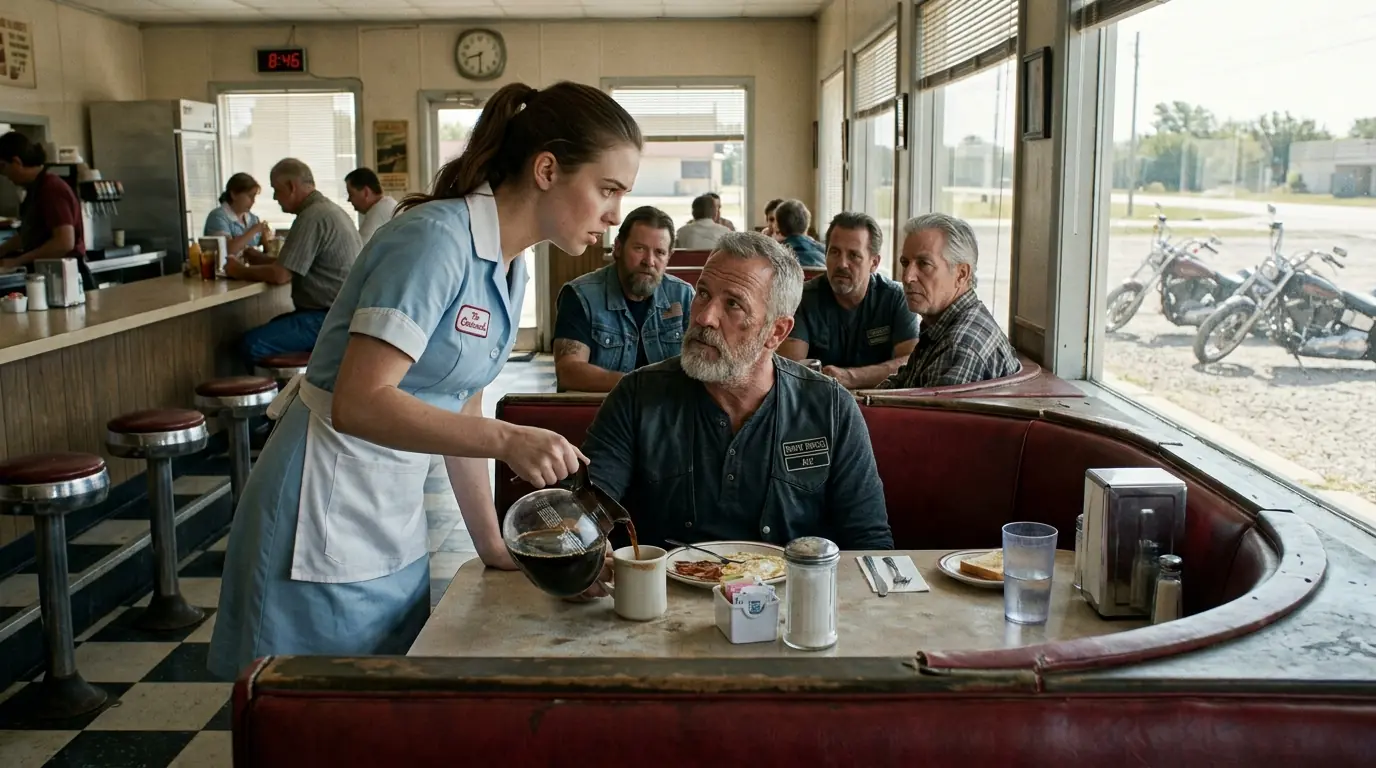
She didn’t pull away. Her breath went flat. Her free hand pressed against her apron, fingers spread, knuckles white.
He leaned in and said something quiet and reasonable and terrible.
Then he let go, smoothed his jacket, and walked back to his corner table like nothing had happened.
Eleven days ago, her father had told her, “If you’re ever trapped and you see a 1979 Shovelhead in the lot, say my dad has your exact bike. One chapter in Oklahoma runs that machine. They’ll know what it means.”
Her hand was shaking when she picked up the coffee pot.
Derek was already watching.
Then she glanced out the window.
Four motorcycles in the gravel lot.
And at the end of the row, a chrome tank. That specific curved frame. The one her father had described down to the last bolt.
A 1979 Shovelhead.
Her chest locked.
This was it.
The only shot she was ever going to get.
She walked to table nine, set down the coffee, and looked at the man with the gray beard and the road-worn vest.
“My dad has your exact bike.”
Cole Harker set his cup down.
Very slowly.
And the table went completely silent.
What he did next, not one person in that diner was prepared for.
Nobody.
Callaway’s Roadside Diner had been sitting on the edge of Route 61 for 32 years. The sign out front had faded from red to the color of old brick. The floor tiles had a crack running from the door to the counter that nobody had ever fixed. The regulars knew the crack. They stepped over it without looking.
Emma Nolan had been working the morning shift there for eight months. She was 23 years old, with dark hair pulled back tight and her father’s eyes, the kind that noticed things before the rest of the face reacted. She was good at her job, the way people get good at things they didn’t choose, but learn to survive inside of.
She hadn’t chosen Callaway’s.
Derek Foss had found her.
She had been 22, three weeks out of a lease that fell through. Derek had handed her a card at the unemployment office on Fourth Street. He said he ran a place on 61. Weekly cash. Start Monday.
She said yes because she had $41 in her account and a duffel bag in a friend’s car.
The first two months were fine.
Then she tried to leave.
She had found a better position and given Derek two weeks’ notice.
He had listened. Nodded.
And then he mentioned, very quietly, that she hadn’t paid back the signing advance.
She remembered the $200. She hadn’t thought of it as an advance.
He showed her the paper she had signed.
Interest accrued monthly.
$200 had become $640 in eight months.
She didn’t have $640.
He knew that.
She stayed.
The number never got smaller.
Uniform fees. Glass breakage charges. Dockings for complaints she couldn’t verify.
The number moved. Derek watched it move with the calm satisfaction of a man tending a garden he had planted deliberately.
He sat at the corner table every morning from 7:45 to 9:30. He drank black coffee. He read the paper. He watched.
She had called her father once. Three months in.
Michael Nolan picked up on the second ring.
She tried to explain without explaining.
He listened.
And then he said, “I’m going to tell you something. You listen and you remember it. You don’t need to use it. But you remember it.”
The 1979 Shovelhead in his garage on Renner Street. The chapter that ran it. The six words.
He said it once, plainly, like a man leaving a key under a mat. Not because he expected the door to be locked, but because he wanted her to know the key was there.
That morning, a Thursday, 7:58 by the clock above the pass-through, Derek had taken her wrist in the corridor. She had been carrying two plates of eggs and a coffee pot, and he had simply reached out as she passed, closed his hand around her wrist, and told her she had been smiling too much at the table by the window.
She had nodded, kept her face still, waited until he let go, then went to the floor. She set down the eggs, refilled the coffee, and stood at the window for four seconds.
That was when she saw them.
Four motorcycles came off Route 61 at 8:02 in the morning.
They arrived the way heavy things arrive, a low rolling thunder that came up through the floor and registered in the chest before the ears caught it.
Emma watched them park.
She looked at the bikes the way her father had taught her. Not at the chrome, but at the shape, the frame geometry, the tank profile.
The bike at the end of the row had not been modified.
Low at the front.
That specific rake.
The tank curved in the exact proportion her father had traced on the kitchen table 11 years ago.
Chrome and black. Narrow front end.
1979 Shovelhead.
Her hand went still on the coffee pot.
There was no version of this where she waited for a better time.
She crossed the floor.
She did not look at Derek’s corner.
The four men had taken the big booth at the back, backs to the wall, eyes on the exit. The man on the inside had a gray beard, kept neat, big weathered hands, and pale washed-out blue eyes that didn’t miss much.
She poured coffee without being asked.
“Morning,” she said.
Steady.
She was proud of that.
She took their orders.
Then she looked out the window at the lot, at the one at the end of the row.
And when her eyes landed on that tank, something in her chest locked into place like a key turning.
She looked back at the man with the gray beard.
“I’m sorry,” she said. “My dad has your exact bike.”
The table stopped.
All at once, as if someone had pressed pause on four separate human beings simultaneously.
Cole Harker set his coffee cup down with the particular care of someone who understood that whatever he did with his hands in the next ten seconds was going to matter.
He looked at her.
Not at her face the way people look at a waitress.
At her.
The steadiness she was performing and the shake underneath it.
“What year?” he said.
“’79.”
“Shovelhead.”
Three full seconds.
Then, quietly, “Who taught you that?”
“My father.”
“Michael Nolan.”
Something moved across Cole Harker’s face.
Fast.
Complex.
He picked up his coffee slowly, took a sip, and let his eyes move just once to the corner table where Derek Foss sat with his newspaper.
Then he looked back at Emma.
“Thank you,” he said. “For the coffee.”
She turned back toward the counter. Her legs were steady. She didn’t know how. But they were steady.
Behind her, she heard Cole say something low to the man beside him. She couldn’t make out the words.
She didn’t need to.
She had done her part.
Cole Harker had not thought about Michael Nolan in three years. Not because he had forgotten. Men like Cole didn’t forget the people who had ridden with them.
Michael Nolan had been on that shelf for 15 years. The one high up where you knew the thing was there but didn’t have to look at it every morning.
The girl had just pulled it off the shelf.
1979 Shovelhead.
Exactly one of those in Oklahoma belonged to a man who had ridden with the Tulsa chapter.
Michael had rebuilt the engine himself over one winter in a garage on Renner Street, with Cole on an overturned bucket handing tools and telling him he was doing it wrong. Michael had laughed and done it right anyway.
He had ridden that bike for 11 years.
Then his wife died.
And the bike went under a tarp.
And Michael went somewhere inside himself that none of them had known how to follow.
Cole hadn’t followed.
He had called twice. Maybe three times.
Michael’s voice on those calls was the voice of a man speaking from underneath something very heavy. Cole hadn’t known what to do with that.
So the calls had stopped.
And the space had grown.
And 15 years had passed.
Now Michael’s daughter was standing 20 feet away with a coffee pot and eyes that were asking for something she couldn’t say out loud.
Cole looked at the corner table without moving his head.
He had clocked the man the moment they walked in.
Slightly forward. Newspaper open but not being read. Eyes moving in a pattern that wasn’t casual.
Watching Emma.
Forty-five seconds of watching.
That was enough.
He looked at Gunner and said quietly, “Stay at the table. Don’t look at the corner.”
Then he slid out of the booth, walked to the front door, stepped out into the Oklahoma morning, stood beside his Shovelhead, and took out his phone.
Four words when someone picked up.
“Callaway’s on 61.”
He hung up.
Looked at the pale blue sky for a moment.
Went back inside.
Sat down.
And finished his coffee.
Across the diner, Derek Foss turned the page of his newspaper and did not look up. He had no way of knowing that the next 15 minutes were going to be the last ordinary 15 minutes of his life for a very long time.
They heard them before they saw them.
That low rolling sound building from out on 61, growing in the chest before it reached the ears.
Derek Foss lowered his newspaper by two inches.
Emma was refilling a sugar dispenser when the first bike turned into the lot.
Then the second.
The gravel lot filled the way a tide fills a bay. Steadily. Inevitably.
She counted 17 before she stopped counting.
Derek stood up from his corner table.
It was the first time she had seen him do that without a purpose.
His newspaper fell to the seat.
His face, normally so controlled, had done something she had never seen in eight months.
It had gone uncertain.
Cole Harker came through the front door first.
He didn’t scan the room. He simply walked in and stood inside the doorway for one full second.
In that second, every person in Callaway’s performed the same unconscious recalibration. The trucker in the back booth sat up straighter. The couple by the window stopped mid-sentence. The cook went still.
Derek Foss recognized him.
It was visible in the way Derek’s chin came up.
A man who had just understood that the situation he was managing had changed categories entirely.
Cole looked at Emma.
“You doing okay?”
She nodded.
Throat too tight for words.
“Good. That yours?”
He nodded at her phone behind the counter.
She reached over and took it. Hands shaking.
She didn’t make a call.
She just held it.
The weight of having it without Derek between her and it was enough.
Derek made his move.
He picked up his coffee cup, walked toward the counter as though heading for a refill, and when he reached Emma, he lowered his voice.
“We should talk privately before this gets out of hand.”
The voice he always used.
Quiet.
Reasonable.
Eight months of that voice.
Cole was beside her before Derek finished the sentence.
Nobody had seen him cross the floor. He was simply there, looking at Derek with the patient, steady attention of a man who had already decided how this ended.
“This is a private business matter,” Derek said, still trying.
“I know what it is,” Cole said. “We’re going to need the documents.”
Derek set his cup on the counter, buying three seconds.
“I don’t know what you think gives you the authority.”
“I called someone who has it. They’re on their way.”
From outside came a different engine. One vehicle. Then the flat quality of footsteps that belong to people who wear duty boots.
Two Tulsa County sheriff’s vehicles were in the lot.
Deputy Marsh came through the front door.
Mid-40s. The practiced bearing of someone who had walked into difficult rooms for 20 years.
“Mr. Harker.”
“Deputy Marsh.”
She looked at Derek.
“Sir, we’ve received a complaint regarding violations of Oklahoma labor statutes, unlawful wage deductions, and coerced employment. We need you to come with us, and we’ll need access to your employment records.”
Derek turned back to Cole.
And in that turn, something went out of his face that Emma had never seen leave it.
Not anger.
Not the reasonable voice.
Just the architecture of it.
The careful structure of a man who had built a very specific version of himself and had just watched it stop working.
“I’d like to call my attorney.”
“After we secure the records,” Deputy Marsh said.
Emma watched from behind the counter as Derek was moved toward the office, toward three filing cabinet drawers.
Eleven employee folders.
Six years of documentation.
She watched his shoulders drop incrementally, like a structure losing its load-bearing points one by one.
Cole came back to the counter.
“Your dad, Michael Nolan. He taught you the bike.”
“Yes. Eleven years ago. I was twelve.”
Something moved through Cole’s expression.
Old.
Complicated.
“He still on Renner Street?”
Emma looked at him.
“How do you know Renner Street?”
“Because I spent about a hundred hours in that garage,” Cole said. “Handing your father tools and telling him he was doing it wrong.”
In the quiet between them, across the counter of a diner she had been trapped inside for eight months, something settled.
“He still on Renner Street?” Cole asked again.
She nodded.
Derek Foss walked out the front door of Callaway’s for the last time.
He didn’t look at Emma as he passed.
He looked at the floor.
And in that single small failure of composure, Emma saw something she had never seen from him in eight months.
He was afraid.
She breathed a real breath.
Full and uncontrolled for the first time since October.
Cole turned back to her.
“There’s one more thing.”
She looked at him.
“The man who taught you those six words. I owe him something. And I’ve been owing it for 15 years.”
He held her gaze.
“I’m going to go see him.”
Emma thought about her father on Renner Street. About the bike under the tarp. About the way Michael Nolan went quiet whenever she asked about the people he used to ride with.
“East end of Renner,” she said. “Brown house. Fig tree in the front yard.”
Cole looked at her for a long moment.
“Thank you.”
The second time that morning.
But this time it meant something different entirely.
Renner Street was 23 minutes from the diner.
Cole had ridden it before.
Fifteen years ago.
When Michael still had people coming by.
Back then, the street had a liveliness to it. Now it was quiet. Tidy. In the way of a man who had simplified his life down to what he could manage.
Number 47 had a fig tree in the front yard.
Cole cut his engine and sat for a moment.
The house was brown. Curtains drawn at 9:44 in the morning.
Either Michael was asleep, unlikely, because he had always been a 5:30 man, or he had heard the engine and was deciding.
Cole knocked.
The silence had texture.
Someone on the other side making a decision.
“Michael,” he said. “It’s Cole.”
Fifteen seconds.
Twenty.
The deadbolt turned.
Michael Nolan stood in the frame.
Fifty-two years old. Lean where he had been broader. Hair fully gray.
His face had the quality of someone who had processed a very large amount of experience and come out the other side not empty, but quieter. Stripped down to something essential.
“How did you find me?” he said.
Not a question.
“Emma,” Cole said.
Something moved through Michael’s face too fast to name.
He stepped back from the door.
“She called you.”
“She didn’t call anyone.”
“She came to work this morning.”
“She was in trouble.”
“She used the signal you taught her.”
Michael put one hand on the door frame.
Cole told him.
The diner.
The advance.
The eight months.
The corner table.
He told it plainly because Michael had never needed things dressed up.
When he finished, Michael was looking at the floor of his porch.
“She’s okay?”
“Deputies have Foss.”
“She’s okay?”
“Yes.”
“She never told me.”
He said it the way you say a number when the math is the thing that hurts.
“Eight months. Twenty minutes away?”
“She was protecting you,” Cole said.
Michael looked up.
Gray-green eyes.
Very still.
“I told her about the bike when she was twelve. I didn’t think she’d ever need to use it.”
“She used it,” Cole said. “It worked.”
“Come in,” Michael said finally.
Without warmth exactly, but without the absence of it.
Just a decision made plainly.
They sat at the kitchen table. Michael made coffee without asking.
No photographs on the walls.
Books everywhere.
Fifteen years of things Cole hadn’t known about the man he had called his brother.
“Fifteen years,” Michael said.
Just the number set on the table between them.
“Yes.”
“I called you. After Carol died, you didn’t answer.”
“No.”
“I wasn’t asking you to fix anything. I just needed someone to answer.”
Cole held that.
Let it sit where it landed, which was somewhere in the chest, where true things land when you have no defense against them.
“I know that now,” Cole said. “I didn’t know how to sit with it then. That’s not an excuse. It’s what happened.”
Michael’s thumb moved along the handle of his mug.
Then he stood.
Walked toward the back of the house.
And Cole followed because that was what you did.
The garage smelled like motor oil and time.
Tools hung in their places. Workbench clear.
The motorcycle was against the far wall, under a dark green canvas tarp faded at the edges. The dust of years rather than weeks.
Michael stood in front of it and didn’t touch it.
“I kept it,” he said. “After Carol died, I didn’t ride it. Didn’t sell it. Just kept it.”
Cole said nothing.
“I kept it because some part of me was still that person. The one who rode. The one who was part of something. Even when I couldn’t feel it.”
He took his hand off the tarp.
“I kept it because I wasn’t ready to say that person was gone.”
Cole looked at the covered motorcycle.
Then at Michael.
“He’s not gone,” Cole said. “Your daughter used a signal you taught her 11 years ago to get herself out of something she couldn’t escape any other way. That man, the one who thought to give her that key, he is not gone.”
Michael looked at the tarp for a long time.
Then he went to the workbench, opened the bottom drawer, and took out a shoebox.
Inside were papers. Envelopes. Photographs.
And on top of everything, a single folded piece of paper, worn soft along the creases.
He held it out to Cole without a word.
Cole unfolded it.
Read it slowly.
A letter.
Handwritten.
Dated 12 years ago. Three years after Carol died.
Addressed to Cole.
It said that Michael had been angry, then had tried to understand. That he wasn’t asking for an apology. Just for Cole to come back. To be present.
Because without Carol and without the people he had called his brothers, he was becoming someone he didn’t recognize.
And he was frightened.
The letter had never been sent.
Cole lowered it.
“Why didn’t you send it?”
“By the time I finished writing it, I talked myself out of believing it would matter.”
Cole set the letter on the workbench between them.
Carefully.
Like something that deserved to be set down carefully.
“It would have mattered,” he said.
“I know that now,” Michael said.
Cole looked at the Shovelhead under its tarp. At 15 years of stopped time.
“Let us help you get her running again,” he said. “When you’re ready.”
Michael looked at the tarp for a long moment.
“Ask me again on Saturday.”
And for the first time since Cole knocked on that door, something in Michael Nolan’s face moved in a direction that wasn’t managed or held at a careful distance.
Something small.
The quality of a door that had been sealed for a very long time discovering it was not actually locked.
Just closed.
Just waiting.
Derek Foss was processed at the Tulsa County Sheriff’s Office at 11:53 that same Thursday morning.
Three filing cabinet drawers. Eleven employee folders. The same structure in each.
Advance agreements with compounding interest buried in paragraph four. Uniform replacement fees that reset quarterly. Breakage ledgers that bore no relationship to actual breakage.
Six years.
Emma Nolan was not the first.
She was the most recent.
By 4:00, Derek sat across from Investigator Hartwell with his attorney beside him.
He performed, for the last time, the version of himself that had worked so well for so long.
Calm.
Reasonable.
A businessman protecting his investment.
Hartwell let him finish.
Then she opened the folder and went through it line by line.
He watched his own system laid out in plain language under fluorescent light and understood something he had never let himself understand before.
Knowing what you are doing and being confronted with its documentation are two entirely different experiences.
He had given these women opportunities.
He had extended credit.
The system was fair.
In his private language, looking at it across from Investigator Hartwell, the private language stopped working.
He looked at Emma Nolan’s file.
$640 from $200.
Uniform replacement fees, three in eight months, at $80 each, for a uniform he never replaced.
The broken glass charges.
There had been one broken glass. A juice glass. In February.
He had charged her for eleven.
He sat with that.
Really sat with it.
And felt something shift in his chest that was not legal strategy.
Quieter than that.
The specific discomfort of a man who had spent years not seeing himself clearly, suddenly unable to stop.
“I want to cooperate,” he said.
His attorney put a hand on his arm.
“I want to cooperate,” Derek said again to Hartwell. “Whatever the other employees need.”
She wrote something on her notepad.
“Cooperation affects disposition. It doesn’t affect the facts.”
“I understand.”
Derek sat.
For the first time in the interview, he sounded like a man who actually did.
Six counts of unlawful wage deduction.
Two counts of coerced employment.
One count of fraudulent contract.
He walked out of the Tulsa County Sheriff’s Office at 7:22 that evening and stood beside his car without getting in.
Ordinary life went about itself in the parking lot.
A family loading groceries. A kid complaining. A mother telling him to get in the car.
Derek got in, sat without starting the engine for four minutes, and thought about eleven glass charges for one broken glass.
He thought about Emma’s hand on the coffee pot.
Shaking.
He drove home and did not sleep well that night.
Or for many nights after.
Which was not a punishment exactly, but was the closest thing to one that a man in the early stages of understanding what he had actually been is capable of imposing on himself.
It was a beginning.
Incomplete and late.
But it was a beginning.
Saturday morning, 8:00.
All four of them. Cole, Tank, Gunner, and Reaper.
Engines cutting one by one in front of number 47 Renner Street.
The front door opened before they reached the path.
Michael was already on the porch.
Jacket on.
He looked at the four of them and said nothing for a moment.
Then, “Coffee’s on.”
At 8:47, Emma arrived with a paper bag from a bakery and stopped in the kitchen doorway.
Five large men filled her father’s kitchen.
She looked at them the way you look at something you have needed to see for a very long time and find it is both exactly what you hoped and more than you were prepared for.
“Pastries,” she said, setting the bag on the counter. “Before you go destroy something mechanical.”
Tank looked at Gunner.
“I’m going to like her.”
Michael said, dry and completely unguarded, “She already knows.”
They went to the garage.
Michael pulled the tarp off the Shovelhead himself.
His hands on the canvas.
His choice.
He pulled it clear, folded it once, and set it on the workbench.
The motorcycle underneath was exactly what it had always been.
Dusty.
Complete.
Preserved with the patience of a machine that has no opinion about how long it waits.
Cole crouched beside it.
“Better shape than I expected.”
“I kept the fluids current,” Michael said. “Every two years. In case.”
In case.
Two words that contained 15 years of quietly maintained hope.
Emma made a sound from the doorway, hand to her mouth.
Michael looked at her.
Their eyes met.
The whole story compressed into a second.
“Don’t,” Michael said, voice rough.
“I’m not doing anything,” Emma said, in the same rough register.
Identical to his.
The way children absorb their parents’ emotional architecture without anyone intending it.
They worked for three hours and 40 minutes.
Tank on the engine. Gunner fetching tools. Reaper on the electrical system with the focused precision of a man most himself when he has something specific to fix.
At one point, Tank said something about the carburetor that made Gunner laugh.
A real laugh.
And the sound of it in the garage was like a window being opened in a room that had been closed for a long time.
At 11:23, Reaper sat back on his heels.
“She should turn over.”
The garage went quiet.
Michael walked to the bike and stood over it.
His body remembered. The muscle memory was still there, embedded so deep that 15 years hadn’t touched it.
The way the body remembers how to swim even when it has been years since the water.
He kicked.
The engine turned over but didn’t catch.
He adjusted the choke.
Kicked again.
The Shovelhead fired.
It caught and stumbled and caught again, uneven, rough, finding its rhythm the way a voice finds itself after a long silence.
It shook, settled, evened out into something low and rolling and unmistakably alive.
Nobody said anything.
Michael stood over his running motorcycle with both hands on the bars and his face completely unguarded.
Not crying.
Something deeper than crying.
The look of a man being returned to himself, finding that the person he was before the loss is still there. Changed but present. Altered but not erased.
Tank put his hand on Gunner’s shoulder.
Gunner covered it with his own without looking at him.
Michael let it run for a full minute.
Then he cut it.
The silence that followed was the loudest silence Cole had ever stood in.
“She runs,” Michael said, voice rough.
He cleared his throat and said it again, steadier.
“She runs.”
“Yeah,” Cole said. “She does.”
Emma came into the garage all the way, walked to her father, and stood beside him.
Michael put his arm around her shoulders, and she leaned into him.
Not the careful, managed lean of a daughter monitoring her weight against a fragile father, but the full, unguarded lean of a person trusting another person to hold them.
Michael held her completely, without flinching.
He held her like a father.
After a while, Emma looked up at him.
“Take me somewhere on it,” she said. “I’ve never been on it.”
Michael looked at the Shovelhead. At the tarp folded on the workbench. At Cole across the garage with 15 years of wrong turns behind him and a Saturday morning in front of him that felt, against considerable odds, like a beginning.
“Next Saturday,” Michael said. “All of us.”
“You sure?” Cole said.
Michael looked at his daughter, then back at the bike.
“Next Saturday,” he said again. “I know a road.”
Pay attention to the people around you.
Not every call for help is loud.
Not every cage has visible bars.
Sometimes the person standing across from you with a coffee pot and a steady face, and a hand that isn’t quite steady, is doing the bravest thing they have ever done.
And it looks like nothing at all.
A father left a key under a mat 11 years ago.
He didn’t know if his daughter would ever need it.
She kept it anyway.
And on a Thursday morning in Oklahoma, when there was no other door left to open, she used it.
That is what parents do when they love their children the right way. They don’t just protect them from the danger in front of them. They prepare them for the danger they can’t see yet.
They hand them something small and say, you won’t need this, but now you have it.
There is also a man who rode away from a friend 15 years ago because grief made him uncomfortable and discomfort made him move.
The space grew.
Fifteen years passed.
And then a young woman said six words.
And the only honest direction left was back.
Turning around is harder than riding away.
It always is.
But it is the only move that actually counts.
If there is someone in your life you have been meaning to call, call them. Not when it is easier. Not when you have figured out what to say.
Now.
Before the silence grows into something neither of you knows how to cross.