My daughter-in-law pointed at me from inside my own doorway and shouted, “Get out of my house right now!”
She said it standing in a home that had never once belonged to her.
My son was behind her, staring at the floor like the carpet had suddenly become more important than his mother. 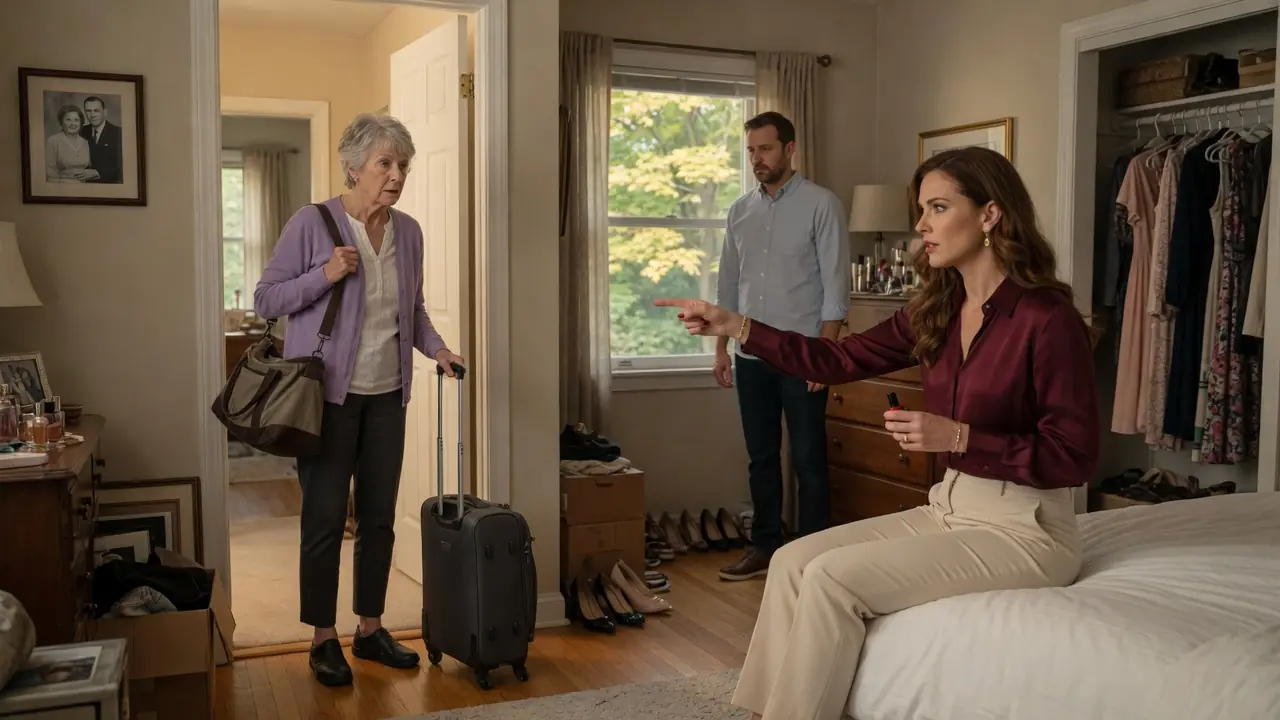
He did not raise a hand. He did not speak my name. He did not even look embarrassed enough to save me from the shame of seeing him silent.
I set my bag down.
Then I stepped inside without rushing.
“This house is mine, Jessica,” I said. “Not yours.”
Then I pointed to the door.
My son said nothing.
And in that moment, both of them realized the mistake they had just made.
My name is Margaret Adler.
I am seventy-two years old, and I bought my house with hands that still remember every floor I scrubbed for other people.
All my life, I worked.
Not fancy work. Not the kind people put on plaques or brag about at luncheons. I cleaned houses for women who never learned my last name. I ironed shirts for men who left money on the counter without looking at me. I watched other people’s children when mine was sick because I needed the cash. I sewed hems late into the night, sitting under a yellow lamp with my shoulders burning and my eyes watering from strain.
I did not complain.
Not because I did not suffer, but because complaining did not pay bills.
Every dollar I earned, I saved carefully. I kept grocery receipts in envelopes. I bought meat only when it was marked down. I wore shoes until the soles thinned enough to feel pebbles through them. I told myself that one day, if I kept going, I would have a roof no one could take from me.
And I did.
Twenty years ago, I bought a small two-bedroom house on a quiet street lined with maple trees and cracked sidewalks. It had a modest kitchen, a narrow hallway, a living room just big enough for my old armchair, and a small yard where I planted mint, tomatoes, lavender, and roses that came back every spring no matter how hard the winter had been.
It was not grand.
But when I signed the papers and held the keys in my palm, I cried in the parking lot of the county office.
It was mine.
Not rented.
Not borrowed.
Not offered by a man who could later throw it in my face.
Mine.
My husband, George, had already been gone five years by then. Cancer took him slowly and meanly, the way cancer does when it wants to remind everyone in the house who is in charge. He had been a quiet man, patient, not perfect, but kind.
When he died, the house we rented felt too full of his absence, so I worked harder and saved more until I could buy a place where grief had room to breathe.
Matthew was grown by then, though grown children never stop being children in a mother’s heart. He had moved out, married Jessica, and started his own life. I never asked him to stay. I never wanted to be one of those mothers who clung so tightly that her child could not breathe.
But I did expect respect.
That was all.
A phone call now and then.
A visit for coffee.
A little concern when the weather turned bad or my knees acted up.
Instead, Matthew called once a month, sometimes less. When he did, the conversations were thin.
“You okay, Mom?”
“I’m fine.”
“Good. Work’s been busy.”
“I understand.”
“I’ll come by soon.”
He rarely did.
I told myself this was normal. Modern life was busy. Young couples had their own problems. I should not expect too much.
My friend Carol Peterson told me I excused too much.
Carol lived three houses down in a yellow bungalow with flower boxes and a front porch swing that creaked when the wind blew. She was a widow too, one year younger than me, with silver hair she kept in a neat bob and children who visited every Sunday with groceries and grandchildren.
I never envied her.
Not exactly.
But sometimes, when I saw her son carrying a case of water into her kitchen or her daughter walking beside her to church, something small and lonely pressed against my ribs.
Carol noticed.
She always noticed.
“Matthew should come around more,” she said one morning while we sat in my kitchen drinking coffee.
“He has his own life,” I replied.
“So do you. That doesn’t mean he gets to forget who raised him.”
I changed the subject, because mothers are experts at protecting children who are no longer children.
Jessica made forgetting easier for him.
She was pretty in a hard, polished way. Dark bob cut perfectly at her jaw, sharp eyebrows, white nails, expensive handbag, always smelling like perfume and laundry beads. She spoke softly in front of strangers, but there was something underneath her softness that always sounded like a closed door.
She never called me Mom.
I did not expect her to.
But she also stopped calling me Mrs. Adler after the wedding.
To Jessica, I became Margaret very quickly.
At first, that did not bother me. I told myself young people were less formal. Then Margaret became a word she used when she wanted to move me aside.
“Margaret, you don’t need to bring anything.”
“Margaret, we already made plans.”
“Margaret, Matthew is tired. Don’t make him feel guilty.”
“Margaret, maybe you should think about downsizing.”
That last one came six months before everything happened.
We were standing in my kitchen. Jessica had opened three cabinets without asking while looking for tea.
“You have so much space here,” she said.
“It is a two-bedroom house.”
“For one person, that’s a lot.”
I looked at her.
“My sewing things are in the second room.”
She smiled.
“That’s sweet. But don’t you ever get lonely?”
“Sometimes.”
“Exactly. A condo might be easier. No yard. No stairs. Less upkeep.”
“There are no stairs here, Jessica.”
She glanced around as if the walls themselves irritated her.
“You know what I mean. At your age, you don’t want to hold on to more than you need.”
At your age.
People begin saying that to you when they want your things but not your opinion.
I said nothing then.
Silence had become one of my habits, and like many habits, it had once protected me before it began shrinking me.
Then my sister Helen called from another state.
Her voice sounded thin and frightened.
“Margaret,” she said, “I need help.”
Helen had been sick for a while, but she had hidden how bad it had become. Her children lived overseas and could not come quickly. She needed someone to cook, help her bathe, manage her medication, and sit with her through the worst hours.
Of course I went.
That is what family does.
Or at least, that is what I still believed.
I told Matthew I would be away for two weeks.
“Don’t worry, Mom,” he said. “Your house will be fine.”
I should have asked what that meant.
I should have noticed the quickness in his voice, the way he sounded relieved rather than concerned.
But I trusted him.
Before leaving, I watered the plants, locked the windows, cleaned the kitchen, and changed the sheets on my bed. I left my favorite mug on the shelf above the coffee maker, the blue one George had given me for our anniversary, with a tiny chip near the handle.
I left a spare key with Matthew because he had asked for it months earlier.
“In case of emergencies,” he said.
Emergencies.
It is strange how often betrayal enters through doors opened for emergencies.
Those two weeks with Helen were hard.
My sister was weaker than I expected. I cooked soup, cleaned her apartment, helped her sit up, helped her lie down, brushed her hair, rubbed lotion into her dry hands, and listened when she cried from pain and humiliation.
At night, I slept on her sofa beneath a thin blanket, listening to the hum of her oxygen machine. I missed my own bed with an ache that surprised me. I missed my quiet kitchen. I missed the little morning ritual of coffee by the window, the way sunlight touched the leaves of my plants.
Helen apologized almost every day.
“I hate that you have to do all this.”
“You would do it for me.”
She smiled sadly.
“I would complain more.”
“You always did.”
By the end of the second week, her neighbor and a home aide had worked out a schedule. Helen was still fragile, but she was safe enough for me to go home.
I packed my bag and took the bus back.
I remember sitting by the window, watching the fields and strip malls pass, thinking of the first thing I would do when I arrived.
Coffee.
A hot shower.
My armchair.
Peace.
By the time I reached my street, late afternoon light had turned soft and gold. My knees hurt from sitting too long, but my heart felt light. I walked slowly, pulling my small suitcase behind me.
Then I saw the car.
A silver sedan I did not recognize, parked in front of my house.
At first, I thought it belonged to a neighbor’s visitor. Then I saw the front window open, curtains pulled back in a way I never left them.
My stomach tightened.
I took out my keys.
The lock turned.
When I opened the door, the first thing I noticed was the smell.
Not coffee.
Not lemon cleaner.
Not old wood and lavender.
Perfume.
Sweet, heavy, and cloying, the kind sold in department stores by women who spray your wrist before you can refuse.
The entryway had shoes in it.
Women’s shoes.
High-heeled sandals, sneakers, a pair of boots kicked against the wall.
I stepped inside slowly.
The living room television was on.
Matthew sat in my armchair.
My armchair.
He turned when he heard the door, and his face did something strange. It did not brighten. He did not jump up. He did not say, “Mom, you’re home.”
Instead, he looked afraid.
That was when I understood, before I knew details, that something had been done.
“Matthew,” I said.
He stood halfway.
“Mom. You’re back early.”
“Early?”
“I thought you were coming tomorrow.”
“I told you Friday.”
He looked toward the hallway.
I followed his eyes.
A woman’s voice came from my bedroom.
“Matthew, did you bring my charger in here?”
My bedroom.
My hand tightened around the handle of my suitcase.
Jessica appeared in the hallway wearing my robe.
My robe.
The pale blue one with the worn sleeves that George bought me the first Christmas after his diagnosis, when he was already too tired to shop but insisted on going anyway because he wanted to choose something himself.
Jessica had tied it loosely around her waist. Her hair was damp from my shower. Her toenails were freshly painted red.
She stopped when she saw me.
For one brief second, surprise crossed her face.
Then irritation replaced it.
“What is this witch doing here?” she snapped.
Matthew closed his eyes.
I felt the sentence strike me.
Not because witch was the worst word I had ever heard.
At seventy-two, a woman has been called enough things to know words rarely kill unless they come from someone who should have stopped them.
What hurt was that my son stood there and let the word land.
Jessica came farther down the hallway.
“This is ridiculous,” she said. “You weren’t supposed to be back yet.”
I looked at the robe.
“Take that off.”
Her mouth opened.
“Excuse me?”
“That robe is mine.”
She laughed.
Not happily.
Meanly.
“Matthew, are you going to say something?”
Matthew stared at the floor.
I walked past him.
Not quickly.
My knees would not have allowed that.
But steadily.
When I reached the bedroom, I stopped in the doorway.
For a moment, I could not breathe.
My clean white sheets were rumpled and stained with red nail polish near the edge.
Jessica’s clothes were hanging in my closet, pushed between my dresses and winter coat.
Her perfumes sat on my dresser.
Her makeup bag was open beside George’s photograph.
My jewelry box had been moved.
Her shoes were kicked under the window where my late husband used to stand every morning to open the curtains.
My bed.
My sheets.
My closet.
My dresser.
My house.
Jessica stepped behind me and folded her arms.
“We needed a place to stay for a while,” she said. “Matthew said you wouldn’t mind.”
I turned around slowly.
Matthew stood in the hallway behind her, pale and silent.
“You said I wouldn’t mind?”
He swallowed.
“We were going to talk to you when you got back.”
“After you moved into my bedroom?”
Jessica rolled her eyes.
“You were away. It’s not like you were using it.”
That was the sentence that did it.
Not witch.
Not the robe.
Not the perfume.
You were away.
It’s not like you were using it.
As if ownership only existed when guarded.
As if an old woman’s absence created vacancy.
As if I had become so small that my own bed could be claimed if I slept elsewhere for two weeks.
I slipped the bag from my shoulder and set it on the floor.
Then I walked into the room, looked Jessica straight in the eyes, and said, “This house is mine. Not your personal dump.”
Her mouth opened.
Matthew finally lifted his head, but still he did not defend me.
That was when I knew.
The battle coming next would not be between me and Jessica.
It would be between the woman I had always been and the woman I needed to become.
Jessica’s eyes narrowed.
“Get out of my house right now.”
The room went still.
Even the television in the living room seemed suddenly too loud.
I looked at my son.
“Matthew?”
He said nothing.
Not one word.
I waited.
There are silences that ask for mercy.
There are silences that reveal guilt.
This one revealed a son who wanted his mother to absorb the damage so he would not have to stand between two women.
I nodded once.
Not to him.
To myself.
Then I turned back to Jessica.
“This house is mine,” I said. “Not yours.”
She laughed again, but less confidently.
“You don’t get to just throw us out. Matthew lives here now.”
“No,” I said. “Matthew has been allowed in here. That is not the same thing.”
Jessica looked at him.
“Say something.”
Matthew’s mouth moved.
Nothing came out.
She pointed at me.
“You are unbelievable. We are family.”
“Family does not move into a woman’s bedroom while she is caring for her sick sister.”
“We needed help.”
“Then you should have asked.”
“We knew you would make it difficult.”
I took a slow breath.
“I am about to show you difficult.”
Jessica’s face changed.
For the first time, uncertainty flickered behind her eyes.
I walked to the dresser and picked up George’s photograph.
The glass was smudged with powder from her makeup.
I wiped it with the sleeve of my cardigan.
George stared back at me from that old picture, smiling gently under the maple tree in the front yard, one hand raised as if he had been caught mid-wave.
When he was alive, he had always said I was too quick to forgive Matthew.
“He is your son,” George told me once, “but he is not too old to learn shame.”
I had scolded him then.
Now I wished I had listened more closely.
I carried the photograph into the living room and placed it on the coffee table.
Then I picked up the house phone and called Carol.
She answered quickly.
“Margaret? Are you home?”
“Yes.”
“Good. I saw a car out front and was wondering—”
“Carol,” I said, and my voice sounded strange even to me, “can you come over?”
There was a pause.
“I’m putting on shoes.”
She arrived in less than five minutes, carrying her purse and wearing the expression of a woman prepared to be useful or dangerous, depending on what the situation required.
When she stepped inside and saw Jessica in my robe, Matthew near the hallway, and my suitcase by the door, her face hardened.
“Oh,” Carol said. “So it’s that kind of foolishness.”
Jessica frowned.
“Who is this?”
“My witness,” I said.
Carol lifted her chin.
“And neighbor. And friend. And person who knows exactly whose name is on this deed.”
Matthew finally spoke.
“Mom, please. We can talk about this calmly.”
I looked at him.
“You found your voice.”
He flinched.
Good.
“Mom, Jessica and I had problems with our apartment.”
“What problems?”
He hesitated.
Jessica cut in.
“Our lease ended, and the new place fell through.”
Carol crossed her arms.
“So you moved into Margaret’s house without asking.”
Jessica glared at her.
“This is a family matter.”
Carol smiled.
“Lucky for Margaret, I’m nosy.”
I nearly laughed.
The sound rose and died in my chest.
I was still too hurt.
I looked at Matthew.
“You had an apartment problem and did not call me?”
“I didn’t want to worry you while Aunt Helen was sick.”
“But you were willing to move your wife into my bed.”
His face reddened.
“It wasn’t like that.”
“What was it like?”
He opened his mouth.
Jessica snapped, “We thought it made sense. She has this whole house to herself. We are trying to save money. She should want to help.”
She.
Not Mom.
Not Margaret.
She.
Carol’s eyes flashed.
“Careful.”
Jessica ignored her.
“I mean, honestly, at her age, why does she need all this space? We could help with bills, fix things up, make it more livable. Matthew is her only son. Eventually, this will probably be his anyway.”
There it was.
The thing under everything.
Eventually.
That soft, poisonous word.
I looked at Matthew.
He looked away.
My heart broke again, but this time it broke cleanly enough to become sharp.
“You thought I was already halfway gone,” I said.
“No,” Matthew whispered.
“Did you tell her this house would be yours?”
He looked miserable.
“Mom—”
“Answer me.”
He swallowed.
“I said someday maybe.”
“Someday after I die?”
His face crumpled.
Jessica threw up her hands.
“Oh, please. Everyone knows how inheritance works.”
Carol stepped forward.
“Inheritance is what people leave you. Theft is what you take while they’re still breathing.”
Jessica’s mouth tightened.
I looked at Carol, grateful and ashamed at the same time.
Grateful she was there.
Ashamed that I had needed a witness inside my own home.
Then I straightened.
“I am going to say this once,” I said. “You have forty-eight hours to leave.”
Jessica stared.
“What?”
“Forty-eight hours. Take your clothes, your perfumes, your shoes, and anything else you brought into my house. You will return my robe. You will wash or replace my sheets. You will put my closet back exactly as you found it.”
Matthew stepped forward.
“Mom, please. We don’t have anywhere to go.”
“You should have considered that before treating my home like a vacancy.”
“It was wrong,” he said quickly. “I know it was wrong.”
I looked at him.
“Do you?”
He nodded.
Tears filled his eyes.
“I panicked. The apartment situation got bad, and Jessica said we could stay here until you came back. Then she said it would be easier if we just settled in, and I told myself you wouldn’t mind because you always help.”
That was the truth, ugly and small.
Because you always help.
I had trained him to expect my forgiveness the way people expect the sun to rise.
“That is my fault,” I said quietly.
“No, Mom—”
“Yes. I made helping you so easy that you forgot I was a person making a choice.”
He covered his face with one hand.
Jessica scoffed.
“So what, you’re going to put your own son on the street to prove a point?”
“No,” I said. “I am going to put two adults out of a house they entered without permission.”
“We had a key.”
“You had trust.”
The sentence silenced even Jessica.
I walked to the front door and opened it.
“Carol, would you please stay with me while they pack my bedroom?”
“With pleasure,” Carol said.
Matthew looked at Jessica.
Jessica looked at the open door.
For a moment, I thought she would scream again.
Instead, she untied my robe with jerky movements and disappeared down the hallway to change.
Matthew did not follow her.
He stood in the living room with his head bowed.
“Mom,” he whispered, “I am sorry.”
“I believe you are ashamed,” I said. “I do not yet know if you are sorry.”
That was the first time I had ever answered him without cushioning the truth.
He looked like he deserved it.
For the next hour, Carol and I sat in the living room while Jessica packed her things from my bedroom. I heard hangers scrape against the closet rod. Drawers open and shut. Makeup bottles clink into a bag. Once, I heard her mutter something under her breath.
Carol started to rise.
I touched her arm.
“No.”
“You sure?”
“I am done chasing disrespect down hallways.”
Carol sat back.
A little later, Jessica came out wearing jeans and a sweater, carrying the blue robe bunched in one hand.
She held it out like dirty laundry.
I did not take it.
“Wash it,” I said.
Her jaw tightened.
“It’s just a robe.”
“Then you should not mind returning it clean.”
She threw it toward the laundry basket.
Matthew winced.
I said nothing.
That silence frightened him more than yelling would have.
By evening, they had moved most of Jessica’s belongings into the living room. Carol went home only after I promised to call if I needed anything. She hugged me at the door.
“I am proud of you,” she whispered.
I almost cried.
Not because I had been brave.
Because I had waited seventy-two years to hear those words when I most needed them.
That night, I slept in the second bedroom.
Not because Jessica had won.
Because my own room smelled like her perfume, and I could not bear it yet.
I locked the bedroom door before lying down.
Then I stared at the ceiling until dawn.
In the morning, I called an attorney.
His name was Mr. Bell, a quiet man with careful manners and half-moon glasses. George and I had used him years before for our wills, and he still had my file.
“Mrs. Adler,” he said, “what can I do for you?”
“I need to make sure my house is protected.”
“From whom?”
I looked toward the hallway, where Jessica’s suitcase wheels had left a black mark on the floor.
“My son.”
There was a pause.
Not judgment.
Understanding.
“Come in at two,” he said.
At noon, Matthew knocked on the kitchen doorway.
I was sitting at the table drinking coffee from George’s chipped blue mug.
He looked at it, then at me.
“I made a mistake.”
“Yes.”
“I should have stopped her.”
“Yes.”
“I should have asked you before we came.”
“Yes.”
He pulled out a chair, then stopped.
“May I sit?”
That question should not have felt like progress.
But it did.
“Yes.”
He sat across from me, shoulders rounded like he had aged overnight.
“Our lease ended because I lost my job,” he said.
I had suspected money, but hearing it still hurt.
“When?”
“Three months ago.”
“Three months?”
He nodded.
“I was embarrassed.”
“So you lied.”
“Yes.”
“And Jessica?”
“She was furious. She said I had failed her. She said we needed to maintain appearances until I found something else. We kept paying rent with credit cards. Then we couldn’t keep up.”
I closed my eyes briefly.
“My God, Matthew.”
“I know.”
“Why did you not tell me?”
“Because I didn’t want to see that look on your face.”
“What look?”
“The one that says you’re disappointed.”
I looked at him for a long moment.
“I have been disappointed before. It did not make me stop loving you.”
His eyes filled.
“But this might.”
I sat back.
“No. I love you. But love is not the same as access.”
He nodded slowly, as if the sentence hurt but made sense.
“Jessica said once we were here, you would adjust. She said you’d be glad not to be alone.”
“And you believed her?”
“I wanted to.”
That was the kindest answer and the weakest.
I looked toward the hallway.
“You let her call me a witch.”
His face broke.
“I know.”
“You let her tell me to leave my own house.”
“I know.”
“You let her wear my robe and sleep in my bed.”
He started crying then.
Quietly.
Like the boy he had once been when he broke my favorite vase and tried to glue it together before I came home.
“I am so sorry, Mom.”
I believed him more than I had the day before.
But belief did not erase consequence.
“I have an appointment with Mr. Bell this afternoon,” I said.
He looked up.
“The lawyer?”
“Yes.”
“Are you pressing charges?”
“Not today.”
He swallowed.
“What are you doing?”
“Protecting myself.”
He nodded.
He did not argue.
That gave me a small piece of my son back.
At two o’clock, Carol drove me to Mr. Bell’s office. I brought my deed, insurance papers, tax records, will, and the spare key Matthew had returned that morning without being asked.
Mr. Bell listened carefully.
Then he explained things I should have done years earlier.
A revocable trust.
Clear inheritance terms.
A written occupancy policy.
Revocation of all informal permissions.
New locks.
Security cameras.
A medical power of attorney that did not automatically place decisions in the hands of someone who had just proven too weak to defend me.
Each item felt like a door closing.
Or opening.
I could not tell which at first.
“Mrs. Adler,” Mr. Bell said gently, “many parents assume love will guide adult children through these matters. Sometimes it does. But documents exist for the times love arrives late.”
I signed what could be signed.
Arranged what needed arranging.
Then I went home and called a locksmith.
Jessica was furious when the locksmith arrived the next morning.
She was standing in the living room surrounded by boxes, her phone in one hand, her expression tight.
“You’re changing the locks while we’re still here?”
“Yes.”
“That’s illegal.”
The locksmith glanced at me.
I handed him proof of ownership.
“It is not,” I said.
Jessica looked at Matthew.
“Are you just going to let her do this?”
Matthew looked at the floor.
Then, slowly, he lifted his head.
“Yes.”
Jessica stared at him.
“What?”
“It’s her house,” he said.
The room shifted.
It was not much.
But it was the first time he had said it in front of her.
Jessica’s face reddened.
“You are unbelievable.”
Matthew’s voice shook, but he kept going.
“No. What we did was unbelievable.”
I looked away before he could see what that cost me.
Jessica threw her phone onto the sofa.
“I cannot believe you are choosing your mother over your wife.”
Matthew said nothing.
I turned to him.
“Matthew, choosing right is not the same as choosing me.”
He looked at me.
Then nodded.
By the end of the forty-eight hours, Jessica had packed.
Not gracefully.
Not quietly.
But fully.
Her sister arrived with a minivan and a face that suggested she had heard a very different version of events. She glanced around my living room as if expecting to see evidence that I was cruel.
Instead, she saw Matthew carrying boxes to the door, Jessica crying angrily, and me sitting in my armchair with Carol beside me like a small silver-haired guard dog.
Jessica’s sister softened slightly.
“Are you Margaret?”
“I am Mrs. Adler.”
She blinked.
Then nodded.
“Mrs. Adler. I’m sorry this happened.”
Jessica snapped, “Don’t apologize to her.”
Her sister looked at her.
“Jess, you were in her bedroom.”
That shut Jessica up.
They left just before sunset.
Matthew stood on the porch after the minivan drove away. He had a duffel bag at his feet.
I opened the door.
“Where will you go?”
“A motel for tonight.”
“And after?”
“I don’t know.”
His voice was hoarse.
I looked at my son.
He looked tired.
Ashamed.
Lost.
Still my child.
But no longer a child I could save from himself by sacrificing my own peace.
“There is a shelter program through St. Mark’s that helps with job placement,” I said. “Carol knows the coordinator. I will ask her for the number.”
He nodded.
“Thank you.”
“You may come for dinner on Sunday if you call first.”
His eyes lifted.
“Really?”
“Yes. Dinner. Not lodging. Not money. Dinner.”
“I understand.”
“Do you?”
He nodded again.
“I think I’m starting to.”
I stepped onto the porch.
The evening air smelled like rain and turned leaves.
“Matthew, I love you.”
His face crumpled.
“I love you too, Mom.”
“I know. But you need to become a man who can stand upright when it matters.”
He wiped his eyes with the heel of his hand.
“I know.”
Then he picked up his duffel bag and walked to his car.
I watched him go.
Not because I did not trust him to leave.
Because mothers remember every version of their children, and for a moment I saw the little boy with scraped knees, the teenager slamming doors, the groom smiling nervously at the altar, and the grown man who had finally said, “It’s her house.”
All of them walked away together.
When his car disappeared, I went back inside.
The house was silent.
For the first time in three days, it was my silence.
I started in the bedroom.
I stripped the sheets and threw them away. I washed the mattress cover twice. I opened every window despite the chill. I wiped down the dresser, the mirror, the windowsill, the closet shelves, the doorknob.
I took George’s photograph from the living room and placed it back on the dresser.
“I handled it,” I told him.
Then I sat on the edge of the bed and cried.
Not pretty tears.
Not gentle tears.
The kind of crying that makes your chest ache and your throat hurt. I cried for the insult. I cried for the robe. I cried for the way Matthew looked at the floor. I cried for all the years I had made myself smaller so no one would call me difficult.
Then I slept.
The next morning, I woke in my own bed.
The air smelled like lavender again.
Not perfume.
Lavender.
I made coffee in George’s blue mug. I watered my plants. I sat in my armchair. I watched sunlight move across the living room carpet.
At ten, Carol knocked and entered with a plate of biscuits.
She looked around.
“It feels like your house again.”
“It is.”
She smiled.
“There she is.”
I did not understand what she meant at first.
Then I did.
She meant the woman I had misplaced under years of softness.
Over the next few months, the shape of my life changed.
Not dramatically.
No marching band arrived to celebrate my boundaries.
The world did not applaud an old woman for keeping what was hers.
But I changed the locks.
I installed a camera doorbell.
I updated my will and trust.
I made Carol my medical power of attorney, with Matthew added only after certain conditions were met.
I joined a senior walking group at the library.
I started attending Thursday bingo at the community center, though I disliked bingo and mostly went for the lemon bars.
I stopped waiting for Matthew to call before making plans.
On Sundays, he came for dinner.
At first, he called from the driveway to ask if it was still okay to come in. The first time he did that, I nearly cried before answering.
“Yes, Matthew. Come in.”
He brought flowers once.
Then groceries.
Then nothing, because I told him gifts were not a substitute for honesty.
He found work at a warehouse within six weeks. Not a dream job, but honest work. He rented a small studio apartment. He began therapy after Carol told him bluntly that shame without change was just self-pity with better manners.
Jessica did not last long.
Their marriage had been built partly on Matthew’s willingness to bend and partly on Jessica’s belief that bending was proof of love. Once he stopped bending so easily, there was not much structure left.
They separated four months after leaving my house.
I did not celebrate.
I also did not mourn.
One Sunday, Matthew came to dinner looking hollow.
“She says I ruined everything,” he said.
I set down the serving spoon.
“What do you think?”
He looked at me.
“I think I helped build something that was already rotten.”
That answer was painful.
It was also growth.
A year after the day I came home and found Jessica in my robe, Matthew arrived with a small wooden box.
He set it on my kitchen table.
“What is this?”
“Open it.”
Inside was my old robe, folded carefully.
Not the same one Jessica had worn. I had thrown that one away after washing it twice and still feeling angry when I touched it.
This robe was new.
Pale blue.
Soft.
Simple.
Beside it was a handwritten note.
Mom,
I cannot undo what I allowed in your house.
I cannot erase the moment I stayed silent.
But I can spend the rest of my life becoming someone who does not look at the floor when the truth needs defending.
I am sorry.
Matthew.
I touched the robe.
Then the note.
He stood near the sink, waiting like a boy outside the principal’s office.
“Thank you,” I said.
His shoulders lowered.
“I don’t expect forgiveness all at once.”
“You have some,” I said. “Not all. Some.”
He nodded.
“I’ll keep earning the rest.”
That was the right answer.
Two years have passed now.
I am seventy-four.
My knees still hurt when rain is coming. My hands still ache if I sew too long. My roses still return every spring with more courage than beauty. The kitchen drawer still sticks when the air is damp. George’s photograph still watches over the bedroom, though I have moved it slightly so the morning light does not fade it.
Matthew visits every Sunday.
He knocks first.
Always.
At first, I thought that was unnecessary.
Now I understand it is his way of remembering.
Sometimes we eat quietly. Sometimes we talk about George. Sometimes we talk about Helen, whose health remains fragile but steady. Sometimes Matthew tells me about work, about therapy, about how hard it is to recognize selfishness after calling it weakness in other people.
One evening, he stood in the hallway and looked toward my bedroom.
“I still hate myself for that day,” he said.
I was folding napkins at the table.
“I know.”
“How do I stop?”
“You don’t stop by hating yourself more. You stop by becoming someone who would never do it again.”
He nodded.
“I’m trying.”
“I see that.”
Those three words seemed to matter to him.
They mattered to me too.
Carol still comes for coffee.
She still tells me Matthew should bring more fruit and fewer apologies.
She is usually right.
The house is mine.
Legally, yes.
But more than that, it feels mine again.
There was a time when I thought kindness meant keeping the door open no matter who walked through it. I thought being a mother meant giving until nothing was left but gratitude, and if gratitude did not come, giving anyway.
I know better now.
A home is not love if it requires you to disappear inside it.
A son is not honored by being spared every consequence.
A daughter-in-law is not family because she knows where you keep the towels.
And an old woman is not cruel because she finally remembers the deed has her name on it.
The day I came home from caring for my sister, Jessica told me to get out of my house.
For a moment, the old me almost did.
The old me almost apologized for surprising them.
The old me almost slept in the second bedroom, made breakfast the next morning, and pretended the ache in my chest was just age.
But then I looked at my son staring at the floor.
I looked at my robe on another woman’s body.
I looked at my late husband’s photograph smudged with someone else’s powder.
And something in me stood up before my tired knees could.
“This house is mine,” I said.
Those four words saved more than a house.
They saved the woman who had bought it.
The woman who had scrubbed floors, ironed shirts, raised a son, buried a husband, nursed a sister, planted roses, paid taxes, changed furnace filters, patched walls, and kept going long after everyone assumed she would simply keep giving.
I still keep my porch light on at night.
Not for Matthew.
Not for Jessica.
Not for anyone who thinks love means access without respect.
I keep it on for myself.
Because this is my house.
My key.
My chair.
My bed.
My life.
And anyone who forgets that now has forty-eight hours to remember somewhere else.