My daughter-in-law called me uneducated while I was serving dinner in the house I owned.
She said it lightly, with a laugh, as though humiliating an older woman were nothing more than entertainment between glasses of wine.
Her friends laughed with her.
My son heard every word.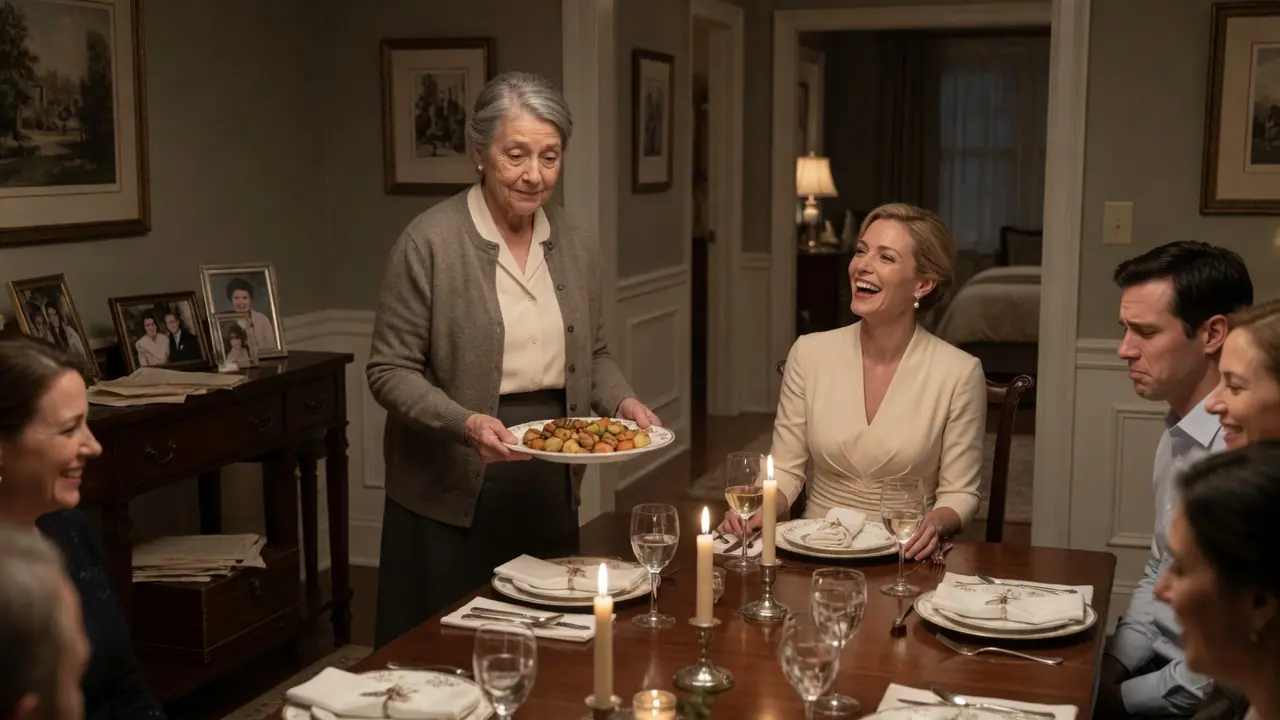
And no one at that table knew that the quiet woman carrying their plates had once stood before judges, argued cases in crowded courtrooms, and earned the law degree framed inside a box at the back of her closet.
They did not know the house belonged entirely to me.
They did not know I had spent nearly five years allowing them to live there without paying a single dollar in rent.
And they certainly did not know that before the evening was over, I would place three things on the table.
My law degree.
The deed to the house.
And a rent bill large enough to wipe the smile from my daughter-in-law’s face.
Until that night, my son and his wife believed I was quiet.
Ordinary.
The woman who folded their clothes, set the table, remembered how everyone took their coffee, and understood exactly when to disappear from the room without being asked.
They never bothered to wonder who I had been before I became someone’s mother, someone’s wife, and eventually someone’s shadow.
They preferred me useful.
They preferred me agreeable.
Most of all, they preferred me easy to overlook.
My name is Eleanor Whitaker. I am seventy-two years old, and I live in a quiet suburb just outside Chicago, in a brick house with blue shutters, a narrow garden behind the garage, and an old maple tree leaning over the driveway.
The house is not enormous, but it is lovely. Three bedrooms, a bright kitchen, a living room full of afternoon light, and a small study where my late husband, Thomas, used to read the newspaper with his glasses slipping down his nose.
When Thomas died six years ago, I sold the larger house we had shared for more than thirty years. It was too big, too quiet, and too full of echoes. Every hallway carried his footsteps. Every room reminded me of a conversation that would never happen again.
So I bought the smaller house with my own money.
Not with my son’s money.
Not with family money.
Mine.
I paid for it outright. No mortgage. No lien. No one else’s name on the deed.
I chose that house because I wanted peace. After decades of working, raising a child, caring for a husband through illness, and holding everyone else together, I wanted a place where I could finally hear my own thoughts.
For one year, I had exactly that.
I made tea in the mornings and drank it by the kitchen window. I planted lavender and tomatoes. I read novels in the living room without anyone asking what was for dinner. Sometimes I went whole afternoons without speaking, and I found that silence did not have to be lonely when it belonged to me.
Then my son came to stay.
“Just for a while,” Andrew said.
That was how he described it.
Just for a while.
He and his wife, Cassandra, had let their apartment lease expire. The housing market was impossible, he said. Prices were ridiculous. Interest rates were brutal. They wanted to save for a down payment.
“You have three bedrooms, Mom,” he told me one evening while standing in my kitchen. “It doesn’t make sense for you to be wandering around here alone when we’re paying thousands every month for a place we don’t even like.”
I remember the way he smiled when he said it.
Not cruelly.
Almost lovingly.
As though he were offering me a solution rather than asking for one.
“You could use the company,” he added.
That sentence softened me.
You could use the company.
A widow can be strong and still miss being needed.
I looked at my son, my only child, and remembered him at seven years old with jam on his face, at twelve with a backpack too heavy for his shoulders, at twenty-three calling from college because he did not know how to cook chicken without drying it out.
I wanted to believe this was family helping family.
A son making sure his widowed mother was not alone.
A mother giving her child a little time to get ahead.
So I said yes.
At first, I was careful to make room for them.
I cleared out the second bedroom for Andrew and Cassandra. I moved my sewing machine into my own room. I gave them the hall bathroom and most of the linen closet. I told them not to worry about utilities until they were back on their feet.
Cassandra hugged me when they moved in.
It was one of the few real hugs she ever gave me.
“Oh, Eleanor, this is going to help us so much,” she said. “Just until we get settled.”
I believed her.
In the beginning, I helped with everything because helping had always been the language I used for love.
I woke before them and prepared breakfast. I washed and folded their laundry, leaving it in neat piles outside their bedroom door. I shopped at Jewel-Osco, clipped coupons from the Sunday newspaper, and remembered the exact brand of almond creamer Cassandra preferred.
She never once remembered how I liked my tea.
Still, I told myself it did not matter.
Young people were busy. They had careers to build, appointments to keep, meetings, social obligations, and lives that moved faster than mine.
Andrew worked in finance. Cassandra worked in public relations for a boutique lifestyle firm downtown. Their days were filled with client calls, train schedules, professional events, networking lunches, and something Cassandra called “brand positioning,” which seemed to involve taking photographs of everything before anyone was allowed to eat it.
They were ambitious.
I admired ambition.
I had once been ambitious myself.
But they did not know that.
Or perhaps Andrew had simply forgotten.
Before I was an old woman in a cardigan, before I became the person people asked to check the oven and fold the towels, I was Eleanor Hayes Whitaker, attorney at law.
I earned my law degree in 1978, when women in my class were still asked whether they were attending law school to find husbands. I passed the Illinois bar the following year. I spent twenty-eight years practicing civil litigation, family law, and estate disputes.
I stood in courtrooms where men twice my size tried to speak over me, and I learned how to lower my voice until judges leaned forward to listen.
I represented women whose husbands hid money.
Small business owners whose partners tried to push them out.
Elderly clients whose children suddenly became very interested in power of attorney.
I saw greed dressed as concern so many times that I could recognize it even when it smiled.
I worked while raising Andrew. I drafted motions after midnight, packed his lunches before sunrise, attended parent-teacher conferences between hearings, and once argued an emergency injunction with a fever because the client had nowhere else to go.
Thomas had been proud of me.
He never treated my mind as a threat.
But after retirement, after Thomas died, after I packed my old suits into garment bags and placed my law books in storage, that version of me seemed to disappear from everyone else’s memory.
I stopped correcting people.
That was my mistake.
At first, invisibility felt like rest.
Then it became a role assigned to me.
Cassandra rearranged my kitchen two months after moving in.
She labeled the spice jars, not because I had forgotten what cumin looked like, but because she disliked the way I arranged them. She replaced my dish soap with expensive eco-friendly bottles that left my hands dry and cracked. She moved my cast iron skillet to the garage because it looked “too heavy” on the stove.
She replaced my floral cushions with beige ones because mine made the living room look “busy.”
She moved framed photographs of Thomas and me from the mantel to a shelf in the hallway.
At first, I said nothing.
Every change seemed too small to argue about.
That was the cleverness of it.
Small things accumulate when they happen every day.
A paper cut does not have to be deep to make you bleed.
Soon, even my place inside the house began to feel conditional.
The living room became Cassandra’s “hosting space.” The kitchen became her “content-friendly kitchen.” The dining room became the place where she held dinner parties for people whose names I heard often but whose faces blurred together over time.
My bedroom became the only space that felt fully mine.
I kept my books there. My sweaters. My old framed certificates in a box at the back of the closet. My photographs of Thomas. My life, reduced to a room in a house I owned.
Andrew noticed.
I know he did.
But noticing and acting are not the same.
He would give me apologetic smiles sometimes when Cassandra corrected me or spoke around me. Once, when she told me not to use the good glasses because they were “for guests,” Andrew looked uncomfortable.
He did not correct her.
That became the pattern.
Cassandra would take.
Andrew would notice.
Then he would say nothing.
Silence can become a habit as dangerous as cruelty.
My daughter-in-law was rarely openly cruel at first.
That might have been easier.
Open cruelty leaves something solid to confront.
Instead, she was polite in public and dismissive in private. She called me “Mom” when guests were around and “she” when she thought I could not hear.
“Did she move the mail?”
“Can you ask her to keep the television down?”
“Does she always cook with so much butter?”
“Maybe she should spend more time with people her own age.”
She never had to use my name.
Objects do not require names.
I told myself not to take it personally.
They were young.
They were stressed.
They were saving money.
They would move out soon.
But one year became two.
Two became three.
Three became five.
During those five years, they did not pay rent. They did not pay property tax. They contributed a little toward groceries when reminded, then stopped. They paid for streaming subscriptions, boutique fitness classes, weekend getaways, designer furniture, luxury skincare, and a car lease Andrew swore was necessary for work.
They did not pay me a dollar for the roof over their heads.
I paid for repairs.
I paid for the water heater when it failed.
I paid for the roof patch after a storm.
I paid the property taxes.
I paid the insurance.
I paid the utilities.
And every month, I told myself that helping my son was not the same as being used.
Then came the dinner party.
Cassandra had been planning it for two weeks.
Six friends from her firm and Andrew’s office were coming. She wanted the evening to feel “elevated but effortless,” which meant she spent days making it difficult for everyone else.
She ordered flowers and complained they were too ordinary.
She bought candles that cost more than a week of groceries.
She asked me if I could make my roast chicken because “older people do know comfort food.”
I looked at her.
She smiled as if she had complimented me.
I made the chicken.
I also made herb potatoes, glazed carrots, a winter salad, fresh rolls, and a lemon tart because Andrew had loved lemon tart since he was a boy.
At six-thirty, the guests arrived.
There was Vanessa, Cassandra’s closest friend, who wore red lipstick and laughed before jokes were finished.
There was Priya, a brand consultant who used the word aesthetic as if it were a legal standard.
There was Lauren, who asked what wine was being served before removing her coat.
There were two men from Andrew’s office, Blake and Simon, both polished, both loud in the careless way of men who believed a dining room became more important when they spoke in it.
The final guest was Cassandra’s younger cousin, Mia, who seemed quieter than the others and looked at me with something close to embarrassment each time Cassandra spoke over me.
I served wine first.
Then appetizers.
Then dinner.
Not because anyone forced me.
Because I had cooked it, and because old habits are hard to put down. I still believed that if people ate well enough, they might behave better.
That was another mistake.
The table looked beautiful.
White candles, deep green napkins, my grandmother’s blue-and-white serving platter in the center. Cassandra had placed it there herself, though she had once told a guest she found it in a vintage shop in Brooklyn.
That platter had belonged to my grandmother.
Then my mother.
Then me.
It had survived moves, holidays, funerals, and decades of family dinners.
Cassandra had never been to the shop she claimed it came from.
I carried in the first platter of chicken while Cassandra was telling a story about a client who had used the wrong fork at a fundraising dinner.
Everyone laughed.
I set the platter down.
Vanessa looked up at me and smiled.
“This smells incredible. Cassandra, I didn’t know you cooked like this.”
Cassandra gave a little laugh.
“Oh, I don’t. Eleanor made it. She’s very traditional that way.”
Traditional.
A soft word.
Not cruel yet.
I stepped back.
Andrew reached for the serving tongs but did not look at me.
Then Priya said, “That’s sweet. My grandmother used to cook like this too. She never understood anything modern, but she made amazing food.”
Cassandra lifted her wine glass.
“Oh, Eleanor is exactly like that. She doesn’t understand half of what we talk about, but she knows her way around a roasting pan.”
A few people laughed.
My hand tightened around the serving spoon.
Mia looked down at her plate.
I turned toward the kitchen.
Then Cassandra added the sentence that changed everything.
“She’s basically uneducated in the modern sense, but useful. Honestly, there’s something comforting about that generation. They don’t need much. Just give them a kitchen and a routine.”
The laughter came quickly.
Not loud.
Not all at once.
But enough.
Her friends laughed with her.
My son heard every word.
He sat at the table with a glass of wine in his hand and did not say my name.
He did not say, “That’s my mother.”
He did not say, “Do not speak about her that way.”
He did not even look ashamed enough.
He looked uncomfortable.
There is a difference.
Uncomfortable means you wish something had not happened.
Ashamed means you understand you allowed it.
I stood in the doorway between the dining room and kitchen, holding a serving bowl of carrots.
No one looked directly at me.
That was when something shifted.
Not snapped.
Not broke.
Shifted.
Something old and firm unfolded inside me, something I had pressed flat for years so everyone around me could remain comfortable.
I set the bowl down gently on the sideboard.
I smiled.
Not because I was amused.
Because I was done.
Then I turned and walked quietly down the hallway.
Behind me, Cassandra said, “Oh, I think she heard me.”
Vanessa laughed nervously.
Andrew said, “Cass.”
Not enough.
Not nearly enough.
I entered my bedroom and closed the door.
At the back of my closet, beneath winter blankets and a stack of old photographs, was the box I had not opened in years. It was heavy, brown, and slightly dusty. Thomas had labeled it in black marker after I retired.
Eleanor’s victories.
I had scolded him for that.
He said, “Someone needs to remember.”
I pulled the box toward me, lifted the lid, and took out the truth.
My framed law degree from Northwestern University.
My bar admission certificate.
A photograph of me at thirty-two, standing on the courthouse steps in a navy suit after winning the first major case of my career.
The deed to the house.
And the ledger.
The ledger was something I had begun three years earlier during a sleepless night when I finally admitted to myself that “just for a while” had become indefinite. I had not created it to use. I created it because the lawyer in me needed facts, even if the mother in me refused to act on them.
Fair market rent for a comparable room and shared household arrangement in our area.
Utilities.
Property tax share.
Household expenses paid.
Repairs.
Five years of occupancy.
Five years of no contribution.
Five years of being treated like a servant in a house they did not own.
I had printed the final statement weeks earlier and placed it in the box, then told myself I would never need it.
I was wrong.
I carried everything back down the hallway.
The laughter at the table had grown softer by then.
Perhaps they had noticed my absence.
Perhaps Cassandra had realized she had gone too far and was trying to move the conversation along.
When I entered the dining room, every face turned toward me.
I held the framed law degree in one hand, the deed and ledger beneath my arm.
Cassandra blinked.
“Eleanor?”
I did not answer.
I walked to the table and placed the law degree in front of her wine glass.
The frame touched the wood with a clear, final sound.
Then I placed the deed beside it.
Then the rent bill.
No one spoke.
Andrew stared at the degree.
Cassandra’s eyes moved across the words.
Northwestern University School of Law.
Juris Doctor.
Eleanor Margaret Hayes.
Class of 1978.
I watched the color drain slowly from her face.
Priya leaned forward.
“You went to law school?”
I looked at her.
“Yes.”
Blake coughed.
“Wait. You’re an attorney?”
“Retired,” I said. “Not deceased.”
Mia’s mouth twitched as though she wanted to smile but knew better.
Cassandra looked from the degree to me.
“I didn’t know.”
“No,” I said. “You never asked.”
Andrew finally spoke.
“Mom.”
I turned to him.
He stopped.
Maybe he heard something in the silence after that word.
Maybe he remembered all the times he had called me that when he needed help, money, a meal, a place to live, forgiveness.
I picked up the deed and placed it in the center of the table.
“This is the warranty deed to this house. My name is the only name on it. Not Andrew’s. Not Cassandra’s. Mine.”
Cassandra sat back slowly.
“No one said it wasn’t your house.”
I looked around the room.
“You moved my furniture. You used my dishes. You hosted guests here. You referred to my belongings as if they were yours. You allowed your friends to praise my grandmother’s platter while claiming it came from Brooklyn. You did all of that because you believed ownership was irrelevant as long as I remained quiet.”
Cassandra’s face tightened.
“That is not fair.”
“No,” I said. “It is accurate.”
Andrew set down his wine glass.
“Mom, maybe we should talk privately.”
I looked at him.
“Why?”
He swallowed.
“This is embarrassing.”
I almost laughed.
But nothing about the moment was funny.
“You sat here while your wife called me uneducated and useful. You did not feel the need for privacy then.”
The room went completely still.
Andrew looked down.
Cassandra’s jaw clenched.
“I made a joke,” she said. “You are overreacting.”
There it was.
The familiar rescue attempt.
Minimize the insult.
Question the injury.
Make dignity look unreasonable.
I placed one hand on the rent bill.
“For nearly five years, you and Andrew have lived in this house without paying rent. During that time, I have paid the property taxes, insurance, utilities, maintenance, and most of the household expenses. I have cooked, cleaned, shopped, laundered, and made myself smaller inside my own home so you could feel comfortable.”
Cassandra’s eyes flashed.
“We are family.”
“Family is not a rental agreement you never intend to honor.”
Andrew’s face reddened.
“Mom, we never asked you to do all that.”
I looked at him for a long moment.
“No, Andrew. You simply accepted it. Every day.”
The words landed.
His eyes flickered.
Good.
Painful, but good.
I slid the rent bill toward Cassandra.
“This is a use and occupancy statement calculated at below-market value for the past fifty-eight months, including proportional utilities and documented household expenses. I did not include labor for cooking, cleaning, laundry, errands, hosting preparation, or emotional endurance, because there is no fair market rate for being slowly erased.”
No one breathed.
Cassandra stared at the number.
$186,400.
Her mouth opened.
Closed.
Opened again.
“That is insane.”
“No,” I said. “It is generous.”
Vanessa whispered, “Oh my God.”
I looked at Cassandra’s guests.
“I apologize for interrupting dinner. I imagine this is uncomfortable.”
No one answered.
“Good,” I said. “It should be.”
Mia lowered her eyes, but not before I saw the respect there.
Cassandra stood suddenly.
“You cannot seriously expect us to pay this.”
I remained seated in my dignity though I was standing in my dining room.
“I expect you to understand what your comfort has cost someone else.”
Andrew pushed back his chair.
“Mom, please.”
I turned to him.
“Please what?”
His eyes were wet now, but I did not let that move me too quickly.
Motherhood is dangerous that way.
A son can wound you for years and one tear can make you reach for bandages.
I held still.
“Please don’t do this in front of everyone,” he said.
I looked at the table.
At the friends.
The wine.
The platter.
The candles.
The son I raised, who had let me become the help in my own home.
“Andrew,” I said quietly, “you let it happen in front of everyone.”
He sat down as though his legs had lost strength.
Cassandra crossed her arms.
“So what now? You’re evicting your own son because of one joke?”
“No. I am ending a five-year arrangement that has become disrespectful, exploitative, and unhealthy.”
“You can’t just throw us out.”
The lawyer in me woke fully.
“I can require occupants without a lease to vacate with proper legal notice. I can also establish a written lease if I choose to allow continued residence. I have prepared both options.”
Andrew looked up sharply.
“You prepared?”
“Yes.”
“When?”
“When I finally accepted that loving you did not require being blind.”
That sentence hurt him.
I saw it.
I let it.
Cassandra’s voice rose.
“This is ridiculous. Andrew, say something.”
For once, he did not obey her immediately.
He stared at the law degree.
Then the deed.
Then the rent bill.
Then me.
“I didn’t know you kept all this.”
That almost undid me.
Not the insult.
Not the money.
That sentence.
I did not know you kept all this.
As if my life had become old papers in a box because no one thought to look.
“You used to know,” I said.
His face changed.
I saw the boy in him then. The child who sat at the kitchen table doing homework while I prepared cross-examination questions. The teenager who fell asleep on the couch waiting for me to come home from court. The young man who once told his college roommate, “My mom is a lawyer. She can win any argument.”
“You used to be proud of me,” I said.
Andrew covered his mouth with one hand.
Cassandra looked between us, sensing the room slipping away from her.
“Oh, come on,” she said. “This is so manipulative.”
Mia stood.
Everyone turned.
She was the youngest person at the table, maybe twenty-seven, quiet until then.
“It isn’t,” she said.
Cassandra stared at her.
“What?”
Mia’s voice shook, but she continued.
“You’ve been rude to her all night. Not just tonight. Every time I’ve been here. You talk about her like she’s staff.”
Cassandra’s mouth fell open.
“Mia.”
“No,” Mia said. “You asked me last month if I thought you could convince Andrew to put the house in your names for tax reasons.”
Andrew’s head snapped toward Cassandra.
“What?”
Cassandra went pale.
Mia looked frightened now, but she did not stop.
“You said Eleanor didn’t need ownership because she was old and wouldn’t understand the paperwork anyway.”
The room froze.
There are moments when truth arrives like a chair pulled out from under someone.
This was one of them.
Andrew stood slowly.
“Cass, is that true?”
Cassandra’s eyes darted around the table.
“It was a conversation. I was thinking long term.”
“Long term for whom?” I asked.
She pointed at me.
“You are twisting this. All of you are twisting this. We have been helping you. You were alone. You needed us.”
I stepped closer.
“No. I was alone. Then I was useful. Those are not the same thing.”
Cassandra looked at Andrew.
“Are you really going to let her talk to me like this?”
Andrew’s face was ashen.
For years, he had avoided choosing.
Now the room gave him nowhere to hide.
He looked at his wife.
Then at me.
“I should have stopped this a long time ago.”
Cassandra recoiled as if slapped.
“Excuse me?”
Andrew’s voice broke.
“I heard how you talked about her. I saw what you did with the house. I told myself it was easier to keep peace. But it wasn’t peace. It was cowardice.”
I closed my eyes briefly.
Not because everything was fixed.
Because, finally, one true thing had been said.
Cassandra grabbed her wine glass, then set it down before she could do something foolish.
“This is unbelievable.”
“No,” Mia said softly. “It’s just finally being said out loud.”
The dinner party ended within ten minutes.
Guests collected coats in strained silence. Vanessa avoided my eyes. Priya muttered an apology that sounded more like self-preservation than remorse. Blake and Simon left quickly, embarrassed by having witnessed something no office story could make funny.
Mia lingered at the door.
“I’m sorry, Mrs. Whitaker,” she said.
I looked at her.
“Thank you for speaking.”
She nodded, eyes wet.
After the door closed behind the last guest, the house felt different.
Not peaceful.
Not yet.
But honest.
Cassandra stood in the living room, arms crossed, face hard.
Andrew remained by the dining table, looking at the papers as though they had rearranged the laws of his world.
I gathered the plates.
Old habits again.
Then I stopped.
I set them down.
“No,” I said quietly.
Andrew looked up.
“What?”
“I am not clearing this table.”
No one moved.
“I cooked the dinner. I served it. I was insulted during it. I will not clean up after it.”
Andrew looked at the plates.
Then at me.
“I’ll do it.”
Cassandra scoffed.
“Of course you will.”
He turned toward her.
“Stop.”
The word was not loud.
But it was new.
Cassandra’s eyes widened.
Andrew began clearing the plates.
His hands shook.
I left him there and went to my bedroom.
That night, I did not sleep.
Neither did anyone else.
I heard low voices downstairs. Then raised ones. Then Cassandra crying. Then silence. Around two in the morning, Andrew knocked on my door.
I was sitting in my chair with a blanket over my knees, holding the photograph of myself on the courthouse steps.
“Come in,” I said.
He opened the door.
He looked younger than he had in years.
“Mom.”
I waited.
“I’m sorry.”
It was not enough.
We both knew it.
He stepped inside.
“I’m not saying that because of the house or the money. I’m saying it because I forgot who you were.”
I looked at him carefully.
“No, Andrew. You remembered when you needed me. You forgot when respecting me became inconvenient.”
His face crumpled.
He sat on the edge of the bed, not too close.
“I let her take over everything.”
“Yes.”
“I told myself you didn’t mind.”
“Yes.”
“I think I wanted to believe that because if you minded, then I was failing you.”
I did not soften my voice.
“You were failing me.”
He nodded.
Tears slid down his face.
“I know.”
For a moment, the mother in me wanted to cross the room and hold him.
The lawyer in me knew better.
Not because he did not deserve comfort.
Because he needed accountability before comfort could mean anything.
“I love you,” I said.
His shoulders shook.
“But love does not mean I will continue letting you live here while treating me like a guest you tolerate.”
“I know.”
“Do you?”
He looked at me.
“I think I’m starting to.”
The next morning, I placed two documents on the kitchen table.
Andrew and Cassandra came downstairs separately.
That told me plenty.
I had made coffee for myself only.
That told them plenty.
Cassandra looked exhausted. Her hair was tied back, her face bare of makeup, and her eyes red. For the first time since she moved into my house, she looked uncertain inside it.
I gestured to the papers.
“You have two choices.”
Neither spoke.
“The first is a thirty-day notice to vacate. You leave by the date listed, and I do not pursue the use and occupancy balance. I consider the money a painful education and close that chapter.”
Cassandra reached for the second document.
I placed my hand on it.
“I am not finished.”
She withdrew her hand.
“The second option is a twelve-month lease. Market rent, paid on the first of each month. Utilities split proportionally. Written household boundaries. No use of my belongings without permission. No guests without prior discussion. No moving my furniture, removing my photographs, or claiming my family heirlooms as your own. Missed rent ends the lease.”
Andrew read silently.
Cassandra’s face flushed.
“You want us to pay rent to live with your mother?”
I looked at her.
“No. I want adults living in my house to behave like adults.”
She swallowed.
“And the big bill?”
“A record of what has already been given. Not a demand if you leave respectfully. A legal claim if you force me to prove what you have taken.”
Andrew’s head lowered.
Cassandra stared at the papers.
“This is humiliating.”
I held her gaze.
“So was being called uneducated while serving dinner in my own home.”
She looked away first.
Three days passed.
They did not decide immediately.
For three days, the house was painfully quiet. Andrew cleaned without being asked. Cassandra stayed mostly in their room. I stopped cooking for them. I stopped doing laundry. I bought my own groceries and labeled nothing because it was my refrigerator.
On the fourth day, Andrew came into the kitchen.
“We’re leaving.”
I nodded.
“When?”
“Within thirty days.”
“Good.”
He flinched slightly.
Not because I was cruel.
Because he had expected me to beg him to stay.
Cassandra entered behind him.
Her expression was tight, but something in it had changed. Not humility exactly. Humility takes longer. But the certainty had cracked.
She stood near the doorway.
“I owe you an apology,” she said.
I waited.
She looked uncomfortable, as people often do when they realize apology is not a performance but a debt.
“I was disrespectful. I treated your home like it was mine. I spoke about you in a way that was cruel and unfair. Calling you uneducated was ignorant. And I said it because I thought it would make me look superior.”
That was more honest than I expected.
I gave a small nod.
“Thank you.”
She looked relieved.
Too relieved.
So I added, “I accept the apology as words. I will need time to see if they become character.”
Her face tightened, then she nodded.
Fair enough.
They found an apartment twenty minutes away. Smaller than they wanted. More expensive than they liked. Real life often is.
On the day they moved, Andrew carried boxes to the truck while Cassandra cleaned the guest bathroom without being asked. She placed my grandmother’s platter on the kitchen table, wrapped carefully in cloth.
“I’m sorry about this too,” she said.
I looked at the platter.
“You wanted the appearance of history without respecting the person who carried it.”
She swallowed.
“Yes.”
I appreciated that she did not argue.
When the truck was loaded, Andrew stood in the foyer.
The house looked larger already.
Or perhaps I did.
He hugged me carefully.
“I don’t want this to be the end of us.”
“It does not have to be.”
“What does it have to be?”
I looked at my son, this man I had raised, loved, forgiven too easily, and finally confronted.
“Different.”
He nodded.
“I can do different.”
“I hope so.”
After they left, I walked through the house room by room.
The living room was quiet.
The beige cushions were still on the couch. I removed them and brought back my floral ones from the closet.
I returned Thomas’s photograph to the mantel.
I moved my law degree from the dining table to the study wall.
Then I opened the windows.
Cold air moved through the house, clearing out years of swallowed words.
For the first time in a long time, the whole house felt like mine.
Not just legally.
Mine.
In the weeks that followed, I began putting myself back into my own life.
I called an old colleague, Judith Ramirez, who had been after me for years to volunteer with a legal aid program for elderly homeowners. I told her I was ready.
She laughed and said, “Eleanor, you were born ready. You just retired prematurely from being terrifying.”
Every Tuesday, I began helping older women review deeds, leases, powers of attorney, and family agreements they did not fully understand. Some came embarrassed. Some came angry. Some came with daughters who spoke over them or sons who answered questions not addressed to them.
I recognized the patterns.
I had lived one.
One woman, seventy-nine, brought in a document her nephew wanted her to sign transferring half her house to him “for tax purposes.”
I read it twice and said, “Absolutely not.”
She started crying.
No one had told her no on her behalf in years.
Another woman had let her adult son move into her basement “temporarily” eight years earlier. He paid nothing, yelled often, and told her she was lucky to have him around.
I helped her draft a formal notice.
She held the paper like it was a weapon and a prayer.
Word spread quietly.
Soon, Judith asked if I would lead a monthly workshop at the community center.
I titled the first one:
Your Name On The Deed Matters.
Thirty-two people came.
Mostly women.
Mostly older.
Many with careful hair, nervous hands, and stories they had not told anyone because they were ashamed of being mistreated by people they loved.
I stood at the front of the room in a navy blazer I had not worn in years, my law degree printed on the flyer, my voice steady.
“Kindness is not a legal document,” I told them. “Family is not a substitute for paperwork. Love does not require you to surrender your home, your savings, your name, or your dignity.”
Some cried.
Some took notes.
Some sat straighter.
I understood all of them.
Andrew came to the third workshop.
He stood in the back, hands in his coat pockets, listening as I explained occupancy agreements and elder financial coercion. I saw his face when I said, “Sometimes the person taking advantage of you is not evil. Sometimes they are entitled, frightened, selfish, or simply accustomed to your silence. The result can still harm you.”
Afterward, he approached me.
“I didn’t know you were doing this.”
“You never asked.”
He winced.
Then he smiled sadly.
“I deserved that.”
“Yes.”
He looked around the room as people gathered their papers.
“You’re good at this.”
“I know.”
His eyes filled.
This time, the tears did not feel like a hook pulling me back into old patterns. They felt like recognition arriving late.
“I forgot how good,” he said.
I softened then.
“A person is not gone simply because you stop seeing them.”
He nodded.
“I’m trying to see you now.”
That was a beginning.
Not an ending.
Cassandra came months later.
Not to a workshop.
To my house.
She called first.
That mattered.
I opened the door and found her holding flowers, not expensive ones, just grocery store tulips wrapped in paper.
“I know flowers don’t fix anything,” she said.
“No, they do not.”
She nodded.
“I brought them anyway.”
I let her in.
We sat at the kitchen table. I made tea for myself and asked if she wanted any. She looked surprised.
“Yes, please.”
“How do you take it?”
She paused.
Then laughed softly, not with humor exactly.
“I don’t think I ever asked how you take yours.”
“No.”
“I’m sorry.”
“You said that already.”
“I’m still sorry.”
I poured the tea.
For a while, we sat in silence.
Then she said, “My mother was never respected in her house. My father made all the decisions. When I got older, I swore I would never become her.”
I listened.
“I think I confused being powerful with making sure no one else had power near me,” Cassandra said. “You were kind, and I treated your kindness like weakness because I was afraid of becoming invisible.”
I looked at her carefully.
“That may explain the behavior. It does not excuse it.”
“I know.”
“Good.”
She wrapped her hands around the mug.
“I’m in therapy.”
“I am glad.”
“Andrew and I are trying to figure out if we can be better than we were.”
“That is between you and him.”
“I know.”
Another silence.
Then she looked at me.
“I don’t expect you to see me as family right now.”
I answered honestly.
“I see you as someone who hurt me and may be learning not to.”
She swallowed.
“That is fair.”
It was.
And for the first time, fairness felt better than politeness.
A year after the dinner party, I hosted Thanksgiving in my house.
Not because anyone expected me to.
Because I wanted to.
The guest list was smaller. Andrew came. Cassandra came. Mia came too, because I had grown fond of her and because courage should be invited back. Judith came with her husband. Two women from the legal aid program came because they had nowhere else to go.
I used my grandmother’s platter.
When Cassandra saw it, she said quietly, “That is beautiful.”
I looked at her.
“It belonged to my grandmother.”
She nodded.
“I know.”
Then she added, “Would you tell me about her sometime?”
I studied her face.
No performance.
No audience.
No theft.
Just a question.
“Yes,” I said. “Sometime.”
During dinner, Andrew stood and raised his glass.
“I want to say something.”
The table quieted.
He looked nervous.
I let him be.
“My mother spent a lot of years being the strongest person in every room, and somehow I let myself forget that. Worse, I benefited from forgetting. I let her carry things she should never have had to carry. I let silence stand where respect should have been.”
His voice shook.
“I’m grateful she made me face that. I’m grateful she gave me the chance to become a better son, even though she did not owe me that chance.”
He looked at me.
“I’m proud of you, Mom.”
The words entered me slowly.
Not because I needed them to know my worth.
I no longer did.
But because part of me had waited a long time to hear my son remember.
I lifted my glass.
“Thank you.”
That was enough.
Later that night, after everyone left, I stood alone in the dining room.
The table was messy. Candles burned low. Plates needed clearing.
I smiled.
Then I left them there for a while.
The world did not end because I did not clean immediately.
A woman can learn freedom in small ways.
I walked to the study and looked at my law degree on the wall. Beside it, I had framed a copy of the deed to the house. Not for visitors. For myself.
A reminder.
Of who I was.
Of what I owned.
Of what I had allowed.
Of what I would never allow again.
My daughter-in-law once called me uneducated while I served dinner in the house I owned.
She thought my silence meant ignorance.
She thought my kindness meant dependence.
She thought an older woman with flour on her hands and gray in her hair could not possibly understand power, law, money, dignity, or strategy.
She was wrong.
They were all wrong.
I was not uneducated.
I was not helpless.
I was not a shadow in someone else’s home.
I was Eleanor Whitaker, attorney at law, widow of Thomas Whitaker, mother of Andrew, owner of the house on Maple Ridge Lane, and a woman who had finally remembered that peace built on self-erasure is not peace at all.
It is surrender.
And I was done surrendering.
So I placed my law degree on the table.
Then the deed.
Then the bill.
And with those three things, I did not just reclaim my house.
I reclaimed the woman who had been living quietly inside it all along.