The night I stopped feeding Lauren, the dining room smelled like butter, roasted chicken, and peach cobbler.
It should have been a beautiful smell. It should have been the kind of smell that made a house feel safe before anyone even took off their coat.
The chicken had been in the oven since midafternoon, rubbed with herbs from the little clay pots on my kitchen windowsill.
The biscuits were stacked inside a towel-lined basket, still soft enough that steam escaped when I lifted the cloth.
The gravy waited in my old blue saucepan, the one with a chipped handle Michael had fixed three different times because he said good pans deserved loyalty.
I had spent the entire day in my kitchen, moving from counter to stove to sink the way I had done for most of my adult life. I rolled biscuit dough with the same maple rolling pin I had used when Ryan was little. I stirred gravy until it was smooth. I checked the pot pie crust with the edge of a fork. I tasted the green beans twice, then added a little more salt because Michael always said vegetables should be treated with respect, not apology.
By five o’clock, the table was set exactly the way he used to like it. The good plates, not because they were expensive, but because Sunday dinner deserved care. Cloth napkins folded into simple rectangles. Water glasses shining beneath the dining room light. A small dish of butter in the center of the table, softened just enough to spread without tearing the biscuits.
My grandchildren, Emma and Benjamin, had arrived early with their father. Emma was twelve, tall and thoughtful, always pretending she was too grown for excitement until dessert appeared. Benjamin was eight and still young enough to believe that if he looked at the peach cobbler long enough, I might let him have a corner piece before dinner.
“Grandma,” he whispered while I carried the rolls to the table, “is that the cobbler with the cinnamon top?”
“It might be,” I said.
He looked at the sideboard like it was a treasure chest.
Emma nudged him with her elbow. “Don’t beg. It makes you look desperate.”
“I am desperate,” he whispered back.
I laughed because for a few minutes, everything felt almost normal.
Ryan stood near the doorway, checking his phone more than he needed to. My son had grown into a handsome man, forty now, with Michael’s eyes and my habit of tightening his jaw when he was worried. When he was a boy, he used to sit on the kitchen counter and steal bits of pie dough when he thought I was not looking. He had been the child who asked for chicken pot pie every birthday from age twelve to age nineteen. Even in college, when he came home for the weekend, he would ask, “Mom, do you think you could make the pot pie?”
Now he looked tired most of the time. Not unhappy exactly. Just pressed thin, as if every room he entered required him to choose which part of himself to hide.
Lauren arrived last, as usual.
The front door opened, bringing in a gust of cold Ohio air and the expensive smell of her perfume. She stepped into my house wearing cream-colored trousers, a fitted coat, and gold earrings that caught the light every time she moved her head. Her hair was smooth, her makeup perfect, her smile practiced.
“Hi, Erica,” she said, leaning in for a kiss near my cheek, not quite touching me. “Smells very traditional in here.”
Traditional.
That was one of her words. It meant old. It meant heavy. It meant something she wanted to enjoy while pretending she was above it.
“Dinner is ready,” I said.
For the first ten minutes, I let myself believe it might be peaceful.
Emma told me about a science fair project she was considering. Benjamin explained, in great detail, why his teacher had unfairly moved him away from his best friend even though they had only been whispering “a little bit.” Ryan served himself chicken and potatoes. Lauren took a small portion of everything, arranging the food on her plate as if she were styling it for a photograph.
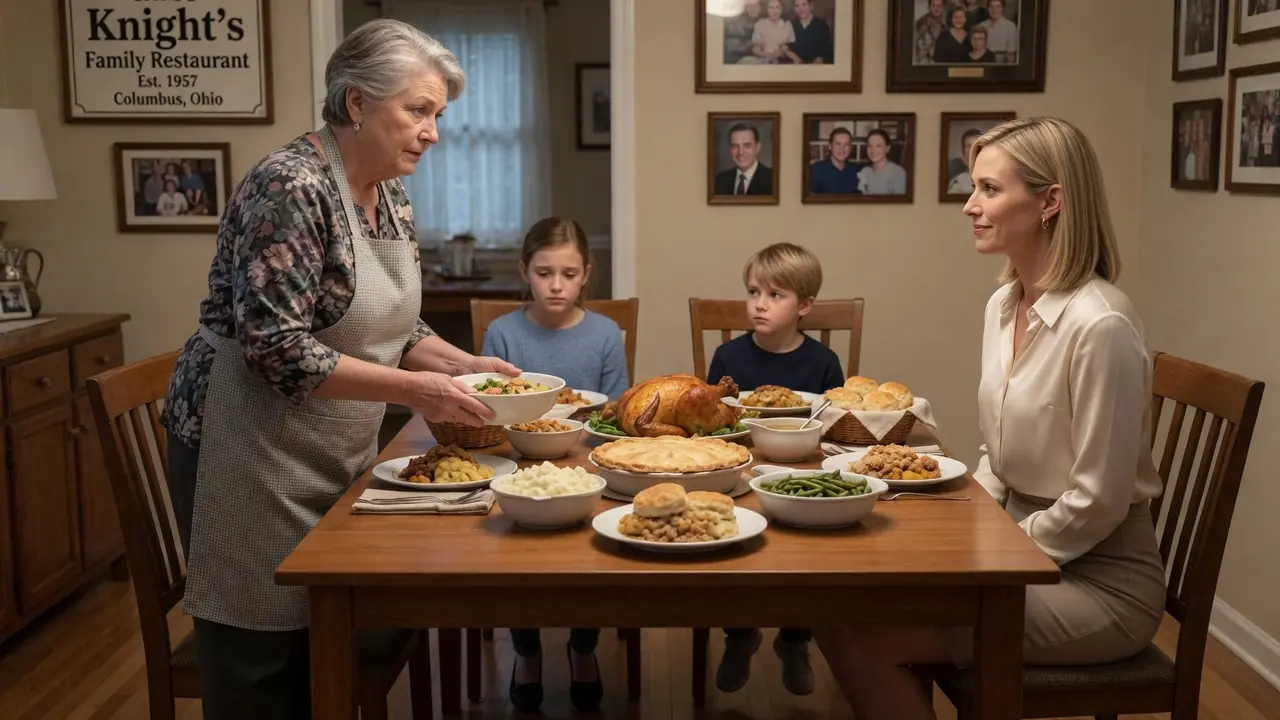
Then she slid her plate away from her with two fingers.
She did it slowly. Deliberately. Her manicured nail tapped the rim once, then twice, as if the food had personally offended her.
“Nobody eats food like this anymore, Erica,” she said with a smirk.
The room went still.
Not quiet in the natural way a dinner table sometimes goes quiet while people chew or think. This silence had weight. It landed on the table between the chicken and the biscuits. It made the gravy seem suddenly too thick, the candles too bright, the room too small.
Ryan looked down at his plate. His shoulders tightened, but he did not say a word.
Emma stopped reaching for a roll.
Benjamin looked from his mother to me with the confused expression children wear when adults turn cruel in front of them and expect everyone to pretend nothing happened.
I stood beside the table holding the serving bowl, feeling the warmth from the food rise against my hands.
Lauren leaned back in her chair. “Honestly, the only thing you’re good at is feeding people,” she added. “And even that feels outdated.”
A few people gave nervous little laughs.
Not Emma. Not Benjamin. Not Ryan.
The laughs came from Lauren’s friend Natalie and Natalie’s husband, who had been invited because Lauren had insisted Sunday dinner should be “more social.” They barely knew me. Their laughter was thin and uncomfortable, the kind people make when they do not want to be the first person brave enough to say, That was unkind.
Ryan still did not look up.
That silence hurt more than Lauren’s words.
I could have handled her sharp tongue if my son had looked up and said, “That’s enough.” I could have swallowed the insult if he had touched my arm beneath the table or given me one apologetic glance. I could have told myself, as I had told myself many times, that Lauren spoke before thinking, that she did not mean harm, that families were complicated.
But Ryan sat there like a man hoping the storm would pass if he did not move.
And something in me, something tired and old and too long ignored, finally stopped trying to make excuses for everyone.
My name is Erica Knight, and for most of my life, food was the way I said love.
Some women wrote long letters. Some bought expensive gifts. Some remembered birthdays with cards so perfect they made people cry. I cooked. I cooked when people celebrated. I cooked when people grieved. I cooked when babies were born, when neighbors had surgeries, when church members lost spouses, when Ryan came home from school with a bruised heart and did not know how to talk about it.
My husband Michael understood that language because he spoke it too.
Michael and I once owned a small family restaurant outside Columbus, Ohio, called Knight’s Kitchen. It sat between a hardware store and a laundromat in a strip of old brick buildings that looked ordinary until the sun went down. Then our windows glowed, and the smell of roast beef, yeast rolls, onions, coffee, and pie slipped into the parking lot like an invitation.
Knight’s Kitchen was never fancy. We never had sleek chairs, Edison bulbs, or menus printed on thick paper with tiny descriptions nobody understood. We had wooden tables that rocked if you leaned too hard on one side. We had coffee mugs that did not match. We had a bell above the door that jingled every time someone came in. We had a chalkboard near the register where Michael wrote the daily special in handwriting so terrible I had to rewrite it before we opened.
But people came.
On cold evenings, men came in with sawdust still on their boots and ordered beef stew. Nurses from the hospital sat in the back booth after long shifts and ate chicken and dumplings with their eyes half closed. Families came after church. Widowers came at four-thirty because they did not like eating alone at home. Teenagers came before dances, smelling of hairspray and nerves, sharing baskets of fries and pretending they were not hungry.
Michael used to say people might forget the recipe, but they would never forget how the meal made them feel.
For thirty years, we cooked side by side. I made the biscuits, pies, soups, pot pies, and cobblers. Michael handled the roasts, the breakfast rush, and the customers who wanted to talk longer than anyone else had time for. He was better with people than I was. He remembered names, jobs, children, surgeries, and favorite booth numbers. He could refill a coffee cup without interrupting a story.
At closing time, after the last customer left and the chairs were turned upside down on the tables, he would stand in the kitchen doorway, wiping his hands on a towel, and say, “Well, Erica, I think we fed the world again.”
Not the town. Not the customers.
The world.
Then cancer took him faster than I knew how to understand.
At first, he complained of back pain. Then he lost weight. Then the doctors said words that sounded too large for the room. Pancreatic. Advanced. Treatment. Time. We tried everything they offered. We hoped in the stubborn way people hope when surrender feels like betrayal.
Six months later, I came home from the hospital alone.
After Michael died, I sold the restaurant.
People thought I sold it because I was tired. I let them believe that. I was tired, but not of work. I was tired of hearing his voice in every corner. The back counter remembered his laugh. The stove remembered his hands. The dining room remembered him moving table to table with a coffee pot, calling everyone “friend.” Even the bell above the door sounded like grief.
I told everyone I was retiring.
The truth was quieter and sadder.
I was hiding from a life that hurt too much to keep living in the same way.
Cooking for my family became the one part of that old life I could still bear. Ryan loved my chicken pot pie. Emma loved baking apple pie with me. Benjamin would eat three rolls before dinner if no one watched him closely enough. So I kept cooking, not because anyone forced me to, but because feeding them made me feel connected to who I had been before grief shrank my world.
I did not realize that generosity without boundaries can slowly turn into something people expect instead of appreciate.
Lauren had not always been openly cruel.
When Ryan first brought her home, she was polished, confident, and quick with compliments that sounded almost sincere. She worked in marketing and spoke about trends, branding, image, and presentation as if every part of life had to be packaged properly. She had a way of looking around a room like she was silently deciding what needed improvement.
At first, I thought she was simply different from us.
Michael had still been alive then. He was the one who pulled me aside after Lauren’s first dinner at our house and said, “That woman measures things before she loves them.”
I told him he was being unfair.
He kissed my forehead and said, “Maybe. But keep both eyes open.”
The first little comment came a few months after Ryan and Lauren’s wedding. I had made roast chicken, mashed potatoes, green beans, and homemade biscuits, the same meal Ryan had requested every birthday since he was twelve. Lauren took one bite, laughed softly, and said, “Wow, people really ate like this every week back then?”
I laughed too because I wanted to believe she was joking.
Back then.
Two words, small enough to hide inside a smile.
Too much butter. Too many carbs. Too heavy. Too plain. Too old-fashioned. Too much like church-basement food. Too Midwestern. Too beige. Too rustic, but not in the stylish way. Too much of whatever I was and not enough of whatever Lauren thought mattered.
She always cleaned her plate.
That was the strange part.
She wanted the food. She packed leftovers in my containers and returned only half of them. She asked whether I had “any extra” rolls for Ryan’s lunches. She requested my pies for birthdays, my casseroles when someone was sick, my soups when the weather turned cold.
But she wanted to look down on it too.
One Thanksgiving, after I spent two full days preparing dinner, Lauren walked around the table and said, “Every meal here feels like a museum exhibit.”
Everyone laughed.
Ryan smiled weakly and said, “Lauren.”
That was all.
Another time, she posted a picture of my casserole online with a caption about recipes that should have stayed in the last century. A church friend showed me the post by accident. We were standing in the church fellowship hall after Sunday service, beside a folding table covered with coffee urns and store-bought cookies. She held out her phone and said, “Erica, is this your casserole? I thought it looked like yours.”
I saw Lauren’s caption. I saw the laughing comments below it. People I did not know had made jokes about canned soup, old ladies, cholesterol, and “grandma food.”
I handed the phone back and said, “Oh, Lauren just likes to tease.”
My face burned all the way home.
It mattered.
Of course it mattered.
Food was never just food to me. It was Michael, our restaurant, our hard years, our good years, and the way we held families together one meal at a time. Every insult from Lauren felt like she was laughing at pieces of my life.
Still, I kept cooking.
I kept setting the table. I kept wrapping leftovers. I kept preparing birthday cakes, holiday pies, after-school snacks, and comfort meals. I kept pretending I was not hurt because I thought keeping the family together was more important than defending myself.
Ryan’s answer was always the same when I mentioned anything.
“She doesn’t mean it, Mom.”
As if intentions mattered more than the wound they left behind.
But that Sunday evening, watching Lauren push the plate away and hearing my son’s silence, something inside me finally became clear.
I did not raise my voice.
I did not cry.
I did not defend the meal, my recipes, or myself.
I simply smiled, picked up the serving bowl, and walked back into the kitchen.
Behind me, the dining room remained quiet in that heavy way people get when they know something has shifted but do not yet understand what.
I placed the bowl on the counter. I untied my apron. I folded it once, then again, because my hands needed something to do. Then I stood for a long moment looking at the food I had made with love.
The pot pie. The biscuits. The roasted chicken. The cobbler. The gravy smooth as silk.
I thought of Michael.
I thought of all the nights we had locked the restaurant door after feeding strangers who treated our food with more gratitude than my own daughter-in-law had shown in years.
Then I made a decision so quietly that no one in the dining room heard it.
Lauren Knight would never eat another meal from my kitchen.
The rest of that dinner passed in a strange blur.
When I returned to the table, Lauren was talking about a new restaurant downtown with small plates and exposed brick. Natalie nodded like she was receiving wisdom. Ryan ate quickly. Emma kept glancing at me. Benjamin ate his biscuit in tiny bites, as if the room might crack if he made noise.
After dessert, Lauren took two servings of peach cobbler.
“Your cobbler is always dangerous,” she said, as though the insult from earlier had never happened.
I smiled. “I’m glad you like it.”
“Do you have extra?”
“Yes.”
“Can I take some home? Ryan likes it for breakfast.”
I looked at my son.
He looked at his coffee.
“Of course,” I said.
I wrapped a portion for Ryan, Emma, and Benjamin. Not for Lauren. I did not announce that. I did not make a scene. I simply placed enough in the container for three people.
Lauren noticed.
Her eyes flicked from the container to my face. Something small and sharp passed between us.
But she said nothing.
The next morning, I woke before sunrise and sat at the kitchen table with coffee growing cold in my hands.
For the first time in years, I was not planning the next family meal. I was not thinking about what Ryan liked, what Emma wanted to bake, what Benjamin would sneak from the cooling rack, or what Lauren would complain about while still asking for seconds.
I was just thinking.
The house was quiet in that deep morning way, when the refrigerator hums and the floors settle and the world has not yet asked anything from you. I sat in my robe, looking at the recipe notebook on the table.
It was not really a notebook anymore. It was a stack of papers, cards, receipts, napkins, and handwritten pages held together by a faded rubber band. Some recipes were mine. Some were Michael’s. Some came from customers who brought them in after insisting I simply had to try their mother’s version of something.
The page on top was Michael’s handwriting.
Chicken pot pie filling. Add thyme near the end. Erica says not too much.
I touched the words with my fingertips.
Memories returned in painful little waves.
Christmas dinners. Birthday parties. Graduation gatherings. Sunday meals. School bake sales. Church events. Every tray I had carried into someone else’s celebration. Every time I had told myself one more insult did not matter. Every time I had laughed when something hurt because making everyone comfortable seemed easier than telling the truth.
I remembered Lauren’s comments. Ryan’s silence. My own weak laughter.
I saw the pattern clearly, and once I saw it, I could not pretend anymore.
Around nine, Ryan called.
I let it ring twice before answering.
“Morning, Mom,” he said.
“Good morning.”
His voice carried that careful brightness he used when he wanted to step around something rather than through it. “Dinner was great last night.”
“Thank you.”
“The cobbler was incredible.”
“I’m glad you liked it.”
A pause.
“Lauren said you seemed quiet.”
I looked at my coffee.
“I was thinking.”
“Oh.” Another pause. “About what?”
“About how long I have allowed people to insult me at my own table.”
Silence.
I could almost see him standing somewhere in his house, phone in hand, glancing over his shoulder to make sure Lauren was not listening.
“Mom,” he said softly, “you know Lauren just talks like that.”
“Yes,” I said. “I do know that.”
“She doesn’t mean…”
“Ryan,” I interrupted.
He stopped.
“I need you to stop telling me what Lauren does not mean and start paying attention to what she does.”
His breath changed on the line.
“I know last night was awkward.”
“It was not awkward,” I said. “It was cruel.”
He did not answer.
“And what hurt most,” I continued, my voice steadier than I felt, “was not what she said. It was that you sat there and let her say it.”
“Mom, I was trying not to make it worse.”
“For whom?”
The question hung there.
For whom?
Not for me. Not for Emma or Benjamin. Not even for himself. The only person protected by his silence had been Lauren.
Ryan exhaled slowly.
“I’m sorry,” he said, but the apology came out tired, automatic, already worn from use.
“I know you are,” I said. “But I need more from you than being sorry after the fact.”
He said he had to get the kids ready for school.
I let him go.
Three days later, someone from my past reminded me who I used to be.
I was standing in the produce section of the grocery store, choosing peaches by smell the way Michael had taught me, when I heard a familiar voice.
“Erica Knight?”
I turned and saw Samuel Whitmore.
For a second, I only saw the man he had been thirty years earlier. Work shirt with paint on the sleeves. Big hands. Dust on his boots. Friday nights at booth six, always ordering pot roast with extra carrots. Back then, Samuel owned a small construction company and came in after long days with crews who smelled of sawdust and cold air.
Now his hair was gray, his glasses were expensive, and his wool coat looked tailored. People in town knew him as a developer with office buildings, apartment renovations, and a reputation for taking old places and giving them a second life.
But his smile was the same.
“Well, look at you,” he said. “Still judging peaches like they owe you money.”
I laughed before I could stop myself. “Samuel Whitmore. I haven’t heard that joke in years.”
“And yet it remains excellent.”
“It was never excellent.”
“It made Michael laugh.”
That softened me.
“Yes,” I said. “It did.”
We stood beside the peaches for nearly twenty minutes. He asked about Ryan, about my grandchildren, about the old restaurant, and finally, gently, about Michael.
I told him what people always tell acquaintances after death has aged into something socially manageable. I said Michael had been gone a while now. I said the cancer was fast. I said we had good years. I said I missed him.
Samuel did not rush to fill the silence.
That was one of the kindest things he could have done.
Then he asked, “Do you still cook?”
I smiled sadly. “Every week.”
“Good,” he said, and he meant it. “You have no idea how many people still talk about your food.”
I assumed he was being kind because people often praise the past when they do not know how to talk about loss.
But Samuel’s expression stayed serious.
“Erica, I am not exaggerating,” he said. “Knight’s Kitchen comes up all the time when people talk about places this town misses. Your pot pies. Michael’s roasts. Those rolls. That peach cobbler that made grown men quiet.”
I looked away because I did not know how to receive that.
After years of Lauren calling my food outdated, hearing someone speak of it with respect felt almost impossible to believe.
Samuel noticed more than I wanted him to.
“Who made you forget?” he asked quietly.
I looked back at him.
“What?”
“People don’t look like that when they’re praised unless someone has spent time teaching them not to believe it.”
My throat tightened.
“I’m just not used to compliments anymore.”
“That’s a shame,” he said. “Because you earned more than a few.”
Before he left, he handed me a business card.
“Have lunch with me this week,” he said. “I want to talk to you about something.”
I looked at the card, then back at him. “Do you need cooking lessons?”
He laughed. “No. I need you to remember who you are.”
That sentence followed me home.
It sat beside me while I made coffee. It stood behind me while I folded towels. It watched with me as I stared at the old photograph of Michael and me standing in front of Knight’s Kitchen on opening day.
We looked young in that photograph. Young and tired and hopeful. Michael had one arm around me and one hand resting on the doorframe like he could hold the whole place up through sheer stubbornness. I wore a blue dress under my apron because I had wanted the opening day picture to look nice, even though by noon I had gravy on the hem.
I had spent years letting Lauren’s voice become the loudest one in my head.
Samuel’s voice sounded like a door opening.
That evening, Ryan called again.
His voice had the cheerful tension he used when he wanted something but hoped I would make it easy.
“Mom,” he said, “Lauren is planning a dinner party next month.”
I closed my eyes because I already knew where the conversation was going.
“What kind of dinner party?”
“For my firm. Well, not officially the whole firm. Just some senior partners, a few clients, some people Lauren knows. It could be important.”
“How many people?”
“Maybe thirty-five.”
I said nothing.
“Could be closer to forty,” he added.
I looked at my quiet kitchen. At the recipe notebook still resting on the counter. At the spot near the stove where Michael used to lean when he tasted soup.
“And Lauren wants me to cook?”
“Well,” Ryan said, “help with the food.”
Help was a soft word for what he meant.
Lauren wanted me to shop, prep, cook, bake, package, deliver, and probably clean up while she took credit for the presentation.
I could hear the old expectation underneath his careful voice.
“What exactly does she want?”
“She has some ideas. Appetizers, sides, maybe desserts. She thought your pot pies could be done as small individual portions. Like updated comfort food.”
“Updated,” I repeated.
“You know what I mean.”
“No,” I said. “I’m not sure I do.”
Ryan rushed on. “She just wants it to look professional, so she doesn’t really want people to know family prepared it.”
The kitchen seemed to grow colder.
“So she wants my food,” I said, “but she does not want people to know I made it.”
“Mom, it’s not like that.”
It was exactly like that.
Lauren wanted the benefits of my labor without the embarrassment of acknowledging me. She wanted my cooking hidden behind her image.
“If my food embarrasses Lauren so much,” I asked, “why does she keep asking me to cook?”
Ryan went quiet.
The silence lasted long enough to answer for him.
When he finally whispered, “I don’t know,” I almost believed him.
Two days later, Lauren appeared at my front door without calling.
She wore expensive sunglasses, a cream coat, and boots that had never known a muddy sidewalk. She carried a designer handbag that probably cost more than the oven I used every week.
“Hi, Erica,” she said brightly. “I’m so glad I caught you.”
“You didn’t call.”
“I was in the neighborhood.”
Lauren was never simply in the neighborhood. My house was fifteen minutes from anywhere she considered worth visiting.
She stepped inside before I invited her, sat at my kitchen table, and pulled papers from her purse.
They were not requests.
They were instructions.
The menu was detailed. Appetizers, main courses, side dishes, desserts, serving times, plating suggestions, and even notes about what should be carried in first. There were words like elevated, curated, nostalgic, and rustic-modern. There were sketches of serving boards. There were quantities written in neat columns.
At the bottom of the second page was a section labeled staff instructions.
Under it, one line read, Kitchen personnel should remain in preparation areas during guest hours.
I looked up slowly.
“Am I the kitchen personnel?”
Lauren shifted in her chair. “Erica, don’t make this weird.”
I tapped the paper gently. “You made it weird when you asked me to cook for forty people and hide in the kitchen.”
Her smile thinned. “This dinner matters.”
“I understand.”
“It could be a big deal for Ryan.”
“I understand that too.”
“So you’ll do it?”
The answer had already been settled in her mind. I could see it. Lauren did not believe I would say no. Why would I? I had never truly said no before. Not to Ryan. Not to the children. Not even to her.
She looked around my kitchen with faint impatience, as if the room itself was taking too long to agree with her.
I thought of Sunday dinner.
Nobody eats food like this anymore.
The only thing you’re good at is feeding people.
And even that feels outdated.
I folded the papers and slid them back across the table.
“I’ll think about it,” I said.
Lauren looked satisfied. She stood, kissed the air near my cheek again, and said, “Great. I knew we could count on you.”
After she left, I sat at the table for a long time.
I did not cry.
That surprised me.
For years, Lauren’s comments had made me cry when no one was watching. In the pantry. In the laundry room. In the bathroom after Thanksgiving dinner while the family watched football. I had cried quietly, washed my face, and returned with coffee.
But this time, there were no tears.
There was only a clear, hard calm.
Three days later, Ryan called again.
I could hear Lauren somewhere in the background, probably pretending not to listen.
“Mom,” he said, “you’re helping with the dinner, right?”
I took a breath so deep it almost hurt.
“No, Ryan,” I said. “I’m not.”
The silence on the line was so complete that I wondered if he had dropped the phone.
Then he said, “What?”
“I’m not cooking for the dinner.”
“Mom.”
My name sounded like a warning in his mouth.
“My voice is shaking,” I said, “so I’m going to keep this simple. I have spent ten years being criticized, laughed at, and treated like my work is embarrassing until someone needs it. I love you, but loving you does not mean accepting disrespect forever.”
“Mom, I didn’t know you felt that strongly.”
That almost broke my heart because part of me believed him.
I had smiled too often. Swallowed too much. Laughed at jokes that hurt me. Maybe I had taught everyone that hurting me had no consequence.
“I should have said it sooner,” I admitted. “But you should have seen it sooner too.”
He breathed out.
“This dinner is important.”
“I know.”
“Lauren is under a lot of pressure.”
“So am I.”
“She’s going to be upset.”
“I imagine she will be.”
“Can’t you just do this one thing? For me?”
There it was.
For me.
The old key that had opened every locked door in my heart.
For Ryan, I had babysat on short notice. For Ryan, I had cooked holidays after surgeries. For Ryan, I had smiled at Lauren’s insults. For Ryan, I had kept the peace until peace looked exactly like my own silence.
“No,” I said softly. “Not this time.”
He did not know what to do with that answer.
Neither did I, really.
But I stayed with it.
Lauren left six voicemails the next morning.
I listened to one.
Her voice was sharp and controlled at first, then increasingly emotional.
“Erica, I think this is incredibly unfair. You know how much this matters to Ryan. I don’t understand why you’re making everything about yourself because of a few jokes. Honestly, this feels manipulative. Family is supposed to support family. I would never refuse to help you if you needed me.”
I stared at the phone.
Lauren had refused me kindness in my own home for years, but now she was fluent in family loyalty.
The voicemail continued.
“You’re being dramatic. And bitter. And frankly, selfish.”
I deleted it before the end.
For once, I did not call back to smooth things over.
The dinner party fell apart faster than anyone expected.
The catering company Lauren hired canceled less than a week before the event, something about staffing and a double booking. Every replacement wanted double the price because of the short notice. Lauren posted frantic little updates online about “professional unreliability” and “doing everything yourself because standards matter.”
That Thursday night, she came back to my house.
This time, she knocked.
I opened the door and found her looking stressed and sleep-deprived. Her hair was still smooth, but the perfection had cracks in it. She clutched her phone in one hand and a folder in the other.
“We need your help,” she said.
Not hello.
Not I’m sorry.
We need your help.
I stepped aside and let her in because I wanted this conversation to happen inside, where my neighbors would not hear.
She sat at my kitchen table, in the same chair where she had laid out her instructions.
“The caterer canceled,” she said.
“So Ryan told me.”
“I’ve called everyone. No one can do it properly on short notice.”
“I’m sorry to hear that.”
Her eyes narrowed. “But your answer hasn’t changed?”
“No,” I said. “It hasn’t.”
She stared at me like I had spoken a foreign language.
“This could hurt Ryan’s career.”
There it was.
Guilt wrapped in my son’s name.
A month earlier, it might have worked.
That night, it did not.
“I love Ryan,” I said. “But this dinner is not my responsibility.”
Lauren laughed bitterly. “I can’t believe you’re doing this.”
“I’m not doing anything. You made choices. Actions have consequences.”
Her face flushed. “You’re punishing me.”
“No,” I said. “If I were punishing you, I would be trying to hurt you. I’m not. I’m simply no longer offering my labor to someone who disrespects it.”
“It was a joke.”
“It was never a joke to me.”
“You’re too sensitive.”
“And you are too comfortable being cruel.”
She stood so quickly the chair scraped the floor.
For a moment, I thought she might yell. Instead, she smiled in that thin way of hers.
“I hope you feel good about yourself.”
I looked at her calmly.
“I’m learning to.”
She left angry, and I sat in my kitchen shaking after the door closed.
Standing firm still felt unfamiliar, like walking on legs that had been asleep for years. But underneath the fear was something stronger.
Peace.
Meanwhile, Samuel’s mysterious lunch became the beginning of something I never expected.
He took me to a small café downtown, not trendy, thank goodness, just quiet enough to talk. He had a folder with him and a look in his eyes that reminded me of Michael when he had an idea he already loved.
“I’m developing a new restaurant,” he said after we ordered coffee.
I laughed. “Samuel, I sold my restaurant because I did not want another restaurant.”
“I know.”
“I’m not looking to work twelve-hour days again.”
“I’m not asking you to.”
He opened the folder and turned it toward me.
The first page showed a drawing of a dining room. Long wooden tables. Soft light. Shelves with old dishes. An open kitchen window. Not sleek. Not cold. Not trying too hard.
“The Sunday Table,” I read.
“A place built around family-style meals,” Samuel said. “Comfort food. Tradition. Community. Food that reminds people what it feels like to belong somewhere.”
I sat back.
“That sounds beautiful.”
“It will be if you help.”
“Samuel…”
“I want your recipes. Your memory. Your sense of hospitality. Your understanding of how food can make strangers feel like someone was waiting for them.” He leaned forward. “I don’t want to put your name in tiny letters. I don’t want you hidden in the kitchen. I want people to know exactly where this came from.”
I looked down at the drawings again.
Something in my chest ached.
“It can’t be Knight’s Kitchen,” I said.
“No,” Samuel agreed. “It shouldn’t be. That was yours and Michael’s. This would be something new. Built from the same roots, but not pretending the old tree didn’t fall.”
That was the sentence that made me cry.
Not loudly. Not dramatically. Just tears slipping down before I could stop them.
Samuel pushed a napkin toward me and looked away kindly while I gathered myself.
A week later, he introduced me to Olivia Bennett, the young project manager helping shape the restaurant. Olivia was thirty-two, sharp as a tack, with curly hair always escaping whatever clip she used to hold it back and a notebook filled with color-coded tabs.
When Samuel introduced me, Olivia nearly gasped.
“You’re Erica Knight?”
I smiled uncertainly. “I am.”
“My grandmother loved Knight’s Kitchen,” she said. “She used to talk about your peach cobbler like it was a religious experience.”
I laughed. “That sounds excessive.”
“No, you don’t understand,” Olivia said. “When she was in hospice, she barely wanted to eat. One day she mentioned your cobbler. My mom found an old frozen portion from your restaurant in my aunt’s freezer, and Grandma ate three bites. She said it tasted like Sunday.”
I had to sit down.
I had never met Olivia’s grandmother. I did not remember that family, though maybe I had served them many times. That was the thing about restaurants. You feed people and never know which meal becomes a memory.
For the first time in years, I spent my afternoons testing recipes with people who respected them.
Olivia tasted my chicken pot pie and closed her eyes like she had found exactly what she was looking for.
“The filling is rich, but it’s not heavy,” she said. “It tastes like someone paid attention.”
Samuel called my rolls “the anchor of the table.”
I kept waiting for someone to laugh at me, but no one did.
At home, my kitchen changed too.
It no longer felt like a room where I prepared offerings for people who might criticize them. It became a place where I worked again. Really worked. I tested pie crust ratios. I adjusted soup seasonings. I wrote notes in the margins of Michael’s old recipes.
Too much thyme for larger batch.
Roll dough needs longer second rise in commercial oven.
Peaches should be ripe, not soft. Michael was right.
Sometimes I talked to him while I cooked.
“You would like Olivia,” I said once while peeling apples.
The house, of course, did not answer.
But for the first time in a long while, the silence did not feel empty.
Lauren’s dinner party happened on a Saturday night.
I did not attend.
I made myself tea at seven o’clock and tried not to imagine the table, the guests, Ryan’s tense smile, Lauren’s frantic need for everything to look effortless. At eight, I folded laundry. At nine, I watched half an episode of a show I did not care about.
At ten o’clock, Ryan texted me four words.
It’s a disaster.
I stared at the message.
For a moment, the old Erica rose up in me. The mother. The fixer. The woman who would put on shoes, drive across town, roll up her sleeves, and save everyone from the consequences of their own behavior.
Then I set the phone down.
At ten-thirty, he called.
I answered because he was my son, and I loved him, even when love required boundaries.
“Mom,” he said.
His voice sounded exhausted.
“What happened?”
“The caterers were late. Two dishes were missing. The chicken was cold. One of the desserts collapsed in the car. Lauren tried to pass off store-bought rolls as artisanal, and Benjamin told one of the partners that Grandma’s rolls were better.”
Despite myself, I almost laughed.
“Oh, Benjamin.”
“Then one executive asked quietly if everything was all right.” Ryan sighed. “Lauren cried in the bathroom. Natalie got drunk and told everyone the original plan was for you to cook, but you refused because of drama.”
I closed my eyes.
“I’m sorry it went badly.”
“Are you?”
“Yes,” I said. “For you. Not for Lauren’s pride.”
He was silent.
Then he said, “I thought this was about food.”
I looked out my kitchen window into the night.
“No, sweetheart. It was never just about food.”
After that, things got worse before they got better.
Lauren posted online the next morning. She did not use my name, but she did not need to.
Some people weaponize kindness. They offer love only when they can control the room. Last night taught me that family loyalty means nothing to people who would rather make a point than support someone they claim to love.
I read it once.
Then I set down the phone because my hands had begun to tremble.
By noon, people were commenting. Some offered sympathy. Some asked what happened. Some posted heart emojis without knowing anything. Lauren replied to certain comments with vague little phrases.
You never really know people.
Some wounds come from unexpected places.
I’m just protecting my peace.
Protecting her peace.
The phrase made me sit back in my chair.
For years, I had protected everyone else’s peace with my silence. Now Lauren was using the language of healing to avoid accountability.
But the comments did not go the way she expected.
At first, people supported her because wounded vagueness invites easy sympathy. Then former customers, church friends, and old neighbors began asking questions.
Was this about Erica Knight?
The Erica Knight who cooked for half the town after the flood?
The Erica Knight from Knight’s Kitchen?
Wait, if her food was so bad, why did you want her to cook for an important dinner?
Didn’t Erica make your baby shower food?
Didn’t she cook after your surgery?
My church friend Marlene, who had accidentally shown me Lauren’s casserole post years earlier, commented with the directness of a woman who had finally had enough.
Interesting how Erica’s cooking is embarrassing until someone needs forty people fed for free.
I did not “like” the comment.
But I read it three times.
Questions are dangerous when someone’s story depends on missing information.
Ryan called me the next day.
His voice was quiet.
“Lauren lied,” he said.
For a long moment, I could not answer.
Hearing my son say those words after years of excuses felt like a door opening in a room where I had been locked inside.
“What happened?”
“She told people you promised to cook and backed out the week before. She told Natalie you were jealous because Lauren wanted the food plated professionally. She told one of my coworkers you were trying to sabotage her because you don’t like her.”
I held the phone tighter.
“And what did you say?”
He swallowed. I could hear it.
“I told them the truth.”
The words landed softly.
Not enough to erase years. Nothing could do that. But enough to matter.
“What truth?”
“That she has been rude to you for years. That you never agreed to cook. That she expected you to do it after insulting your food at Sunday dinner. That I should have stopped it sooner.”
My eyes filled.
“Ryan.”
“I should have protected you,” he said.
That sentence nearly undid me.
For years, I had waited for him to say something. At the table. At holidays. On the phone. Anywhere. Now the words had finally come, and they carried more sadness than victory.
“I should have protected you,” he said again. “And I didn’t because I didn’t want to deal with the fight.”
I pressed my hand over my mouth.
“I told myself I was keeping peace,” he continued. “But I was letting you pay for it.”
That was the truth.
It hurt.
Truth often does before it heals.
Two days later, Ryan came to my house alone.
He looked nervous standing on my porch, like a boy who had broken a window and come to confess before anyone found out. I let him in. I made coffee because I am still Erica, and coffee is what I make when hard conversations need somewhere to sit.
We sat at the kitchen table for nearly two hours.
At first, he apologized in circles.
I’m sorry I didn’t say something.
I’m sorry I made excuses.
I’m sorry I asked you to help with the dinner.
I’m sorry I didn’t understand.
Finally, I reached across the table and placed my hand over his.
“Ryan, I hear you. But I need you to stop apologizing long enough to understand.”
He nodded, eyes red.
“I loved cooking for you,” I said. “I still love cooking for you. But somewhere along the way, love turned into expectation. You began assuming I would give and give, no matter how I was treated. That hurt me.”
“I know.”
“And Lauren did not become cruel overnight. She tested what she could say. And every time no one stopped her, she learned she could say more.”
He looked down.
“I hate that Emma and Benjamin heard it,” he said.
“So do I.”
“Emma asked me if Grandma’s food was bad.”
My heart squeezed.
“What did you say?”
“I said Grandma’s food is wonderful, and adults sometimes say things they shouldn’t.”
“And did you say their mother was wrong?”
He looked up, startled by the directness.
Then he nodded slowly. “Yes.”
“Good.”
We talked about Michael. About Knight’s Kitchen. About how Ryan’s childhood had smelled like yeast rolls and coffee. About how he had avoided conflict in his marriage until avoidance became its own kind of harm.
“I don’t know what happens with Lauren,” he admitted.
“That is between you and Lauren.”
“I don’t want the kids to think this is normal.”
“Then show them it isn’t.”
Before he left, he stood in my kitchen doorway, looking smaller than I remembered.
“Can I ask you something?”
“Of course.”
“Do you still want me at The Sunday Table opening?”
I had told him about Samuel’s restaurant a week earlier, carefully, not wanting it to sound like I was asking him to choose sides.
“Yes,” I said. “I do.”
“Can I bring Emma and Benjamin?”
“Always.”
He hesitated.
“Lauren?”
I took a breath.
“If Lauren wants to come respectfully, she may come as your wife and the children’s mother. But she will not be centered. She will not be rescued from discomfort. And if she insults me there, I will ask her to leave.”
Ryan nodded.
“That’s fair.”
When he hugged me before leaving, it was the first real hug I had felt from him in years. Not the quick holiday hug, not the distracted one-arm squeeze. This was my son holding his mother because he knew he had hurt her and wanted, at last, to begin repairing what could be repaired.
Lauren made one final attempt to regain control.
She came to my house on a Tuesday afternoon, wearing sunglasses even though the sky was cloudy. This time, she waited after knocking. I almost did not open the door.
But I did.
Not because I owed her anything.
Because I was no longer afraid of hearing what she had to say.
“Can we talk?” she asked.
I stepped aside.
She sat at the kitchen table, the place where so much had changed, and placed her phone beside her.
“I’ve been thinking,” she began.
I waited.
“I think there may be an opportunity here.”
That was when I knew the conversation would not be an apology.
“What opportunity?”
She leaned forward, suddenly animated. “Your story. Knight’s Kitchen. Your recipes. The whole traditional food thing. People are clearly attached to it. I was thinking we could work together on recipe videos. Maybe short clips. Family traditions, generational cooking, that kind of thing. I could handle the branding and social media. You would be the face, obviously, but I’d help shape it.”
For a moment, I was too stunned to speak.
The irony was almost breathtaking.
“You spent years insulting my recipes,” I said. “You embarrassed me publicly. You told people my food belonged in the past. Why would you suddenly want to build a brand around it?”
Lauren looked uncomfortable, not sorry.
“People change.”
“People can change,” I answered. “But change requires honesty.”
She shifted.
“I am trying to move forward.”
“No,” I said. “You are trying to move past the part where you have to be accountable.”
Her face tightened.
“That’s unfair.”
“What exactly are you sorry for, Lauren?”
She blinked.
“What?”
“If you came here because you’ve changed, tell me what you’re sorry for.”
She looked toward the window. “I’m sorry you felt disrespected.”
“That is not an apology. That is a sentence designed to sound like one.”
She exhaled sharply. “Fine. I’m sorry for some of the jokes.”
“Which jokes?”
“Erica.”
“Which ones?”
Her mouth opened, then closed.
I watched her realize that general apology was easier because it required no memory, no humility, no actual reckoning.
“You called my food outdated. You posted it online so strangers could laugh. You asked me to cook for your dinner and hide like hired help you were ashamed of. You told people I abandoned the family when I refused. Are you sorry for those things?”
Lauren’s eyes shone, but not with the kind of tears that come from remorse. These were tears of being cornered.
“I was under pressure.”
“Yes,” I said. “And under pressure, you showed me who you were willing to sacrifice.”
She stood.
“I don’t know what you want from me.”
“I want nothing from you.”
That stopped her.
She looked almost offended.
“Nothing?”
“No. Not right now.”
“What would it take to fix this?”
There it was. The language of transaction. The belief that respect could be negotiated like a sponsorship package.
I stood too.
“You’re not trying to fix this, Lauren. You’re trying to benefit from it.”
Her face changed because the truth had finally reached a place she could not cover with a smile.
Before she left, she stopped at the door.
“Do you hate me?”
I looked at her carefully.
Once, maybe, that question would have pulled softness from me. I would have rushed to reassure her. I would have said no, of course not, don’t be silly, we’re family. I would have made her feel better so I did not have to watch her feel bad.
But I was done paying for other people’s comfort with my own truth.
“No,” I said. “I don’t hate you. Hate requires more energy than I want to give.”
She flinched.
“I’m not doing this to you,” I told her. “I’m finally doing something for myself.”
Lauren left without another word.
The Sunday Table opened on a crisp Friday evening in early autumn.
All day, I felt as if I had swallowed a flock of birds. My hands shook while I tied my apron. I checked the pot pie filling three times. I adjusted the biscuit trays. I walked through the dining room before the doors opened, touching the backs of chairs, straightening forks that were already straight.
The restaurant looked beautiful.
Not fancy. Not cold. Beautiful.
The walls held framed photographs from local families who had gathered around tables across generations. There was one of Knight’s Kitchen too, near the host stand. Michael and me on opening day. I had protested when Samuel asked to use it.
“You don’t have to hide him to move forward,” he said.
So there we were, young and hopeful, watching over the new place.
The sign outside read The Sunday Table in deep green letters. Beneath it, smaller words said Food for people who come hungry for more than dinner.
Samuel stood beside me before the doors opened.
“You earned this,” he said.
“I’m terrified.”
“Good. Means you care.”
Olivia rushed past us with a clipboard, then backed up. “Erica, the rolls are perfect. Don’t touch them.”
“I wasn’t going to.”
“You were thinking about it.”
“I was looking respectfully.”
“You were about to interfere.”
Samuel laughed. “She knows you already.”
At five o’clock, the doors opened.
Inside, the tables filled quickly. Families laughed. Friends leaned across plates. Children reached for rolls. The scent of pot pie, roast chicken, biscuits, soup, and cobbler moved through the dining room like memory finding its way home.
At first, I stayed near the kitchen, not hiding exactly, but uncertain of where I belonged.
Then people started recognizing me.
“Mrs. Knight?”
“Erica?”
“My parents used to bring me to Knight’s Kitchen.”
“You made my wedding rehearsal dinner in 1998.”
“My father ate your beef stew every Friday after my mother died.”
One woman took my hands and cried because she said my chicken soup was the only thing her son would eat during chemotherapy. A man in his fifties told me he had proposed to his wife in booth three at Knight’s Kitchen because they could not afford anywhere nicer, and she had said yes over meatloaf and mashed potatoes.
All those years, I thought the restaurant had ended.
But parts of it had been carried away in people.
At seven o’clock, Ryan arrived with Emma and Benjamin.
The children ran to me first.
“Grandma!” Benjamin shouted so loudly half the restaurant turned.
Emma hugged me tight and whispered, “This place is so cool.”
Ryan stood behind them, nervous.
“I’m glad you’re here,” I said.
His eyes reddened.
“Me too.”
Lauren did not come.
Emma mentioned it before Ryan could stop her.
“Mom said she wasn’t feeling well.”
Maybe it was true. Maybe it was not.
For the first time, I did not care enough to wonder.
I seated them near the window. Benjamin ate three rolls before his meal arrived. Emma ordered the chicken pot pie and said, with dramatic seriousness, “This crust is elite.”
Ryan looked around the dining room like he was seeing my life clearly for the first time.
“This is what you built,” he said when I stopped by their table.
“No,” I said. “This is what I remembered.”
Later that night, Samuel gave a short speech.
I had begged him not to make it about me. He promised it would not be long, which in Samuel’s world meant it would be exactly long enough to embarrass me.
He stood near the center of the dining room, lifted a glass of tea, and waited for the room to settle.
“Thank you all for being here,” he began. “The Sunday Table was built around a simple belief. A good meal can do more than fill a stomach. It can remind a tired person that they are welcome. It can turn strangers into neighbors. It can make grief sit down for a while and let love speak.”
The room grew quiet.
“Many years ago, this town had a place called Knight’s Kitchen. Some of you remember it. Some of you grew up there. Some of you only heard about it from parents or grandparents who refused to stop talking about the rolls.”
People laughed.
“Michael and Erica Knight created more than a restaurant. They created a place where people felt known. When Michael passed and Knight’s Kitchen closed, many of us thought that chapter had ended. But the truth is, the best parts of a place like that never really disappear. They live in recipes, in stories, in families, and in the hands of the person who still remembers why it mattered.”
He turned toward me.
“The Sunday Table exists because Erica Knight taught an entire town how food could make people feel at home.”
The applause started slowly.
Then it grew.
People stood.
For a moment, I could not move.
I cried.
Not because I needed applause. Not because clapping could heal every insult or erase every silence. I cried because for years I had believed I was becoming invisible. I had believed Lauren’s voice because it was the loudest one at my table.
Now I understood I had never been invisible at all.
I had simply listened to the wrong voices.
After the restaurant closed, Ryan found me near the kitchen.
The dining room was empty except for a few staff members cleaning tables. The lights had been lowered. The last pan of cobbler sat cooling near the pass. My feet hurt. My back ached. My heart felt strangely young.
Ryan looked around at the stacked plates, the empty chairs, the soft glow from the lamps.
“I’m proud of you,” he said.
Three simple words.
They reached a place in me that had waited a long time.
“Thank you,” I whispered.
He stepped closer.
“I mean it, Mom.”
“I know.”
“I told the kids about Grandpa tonight,” he said. “On the drive here. About the restaurant. About how you two built it together.”
I smiled.
“They should know him.”
“They should know you too.”
That was when I hugged him.
Not because everything was repaired. Not because his silence had never hurt. But because healing had to start somewhere, and sometimes it begins with one person finally telling the truth.
I never cooked another meal for Lauren.
Not because I wanted revenge, and not because I wanted to punish her forever. I simply learned that access to my love, my labor, and my table required respect.
Without respect, there would be no meal.
I still cook for Emma and Benjamin. I cook with them, actually. That is different. Better.
Emma has careful hands and too little patience with pie crust, which means she will either become excellent at it or avoid it completely. Benjamin measures flour like a man gambling with fate. He still eats too many rolls before dinner, but now he helps make them, so I consider it quality control.
Ryan joins us sometimes.
The first time he came over after The Sunday Table opened, he brought his own dish towel.
“What’s that for?” I asked.
“Dishes,” he said.
“You don’t have to.”
“I know.”
He washed every plate afterward without being asked.
That small thing meant more than he probably knew.
As for Lauren, our relationship became distant and polite. She came to a few family events. She did not insult my cooking because I did not serve her any. At restaurants, she spoke carefully. Around the children, she seemed aware that they were listening in a way they had not before.
Maybe one day she will understand what she broke.
Maybe she will not.
That part is no longer mine to manage.
One Sunday afternoon, months after the opening, Emma and I stood in my kitchen rolling dough for apple pie while Benjamin sat at the table peeling apples with the concentration of a surgeon. Ryan was outside taking a call. The windows were open, and the house smelled like cinnamon and butter.
Emma looked up suddenly.
“Grandma?”
“Yes, sweetheart?”
“Did Mom really hurt your feelings about your food?”
I set down the rolling pin.
Children always find the questions adults hope they can avoid.
“Yes,” I said. “She did.”
Emma’s face tightened. “Why didn’t you say something before?”
I could have made myself look better. I could have said I was trying to keep peace, that adults are complicated, that I did not want to cause trouble.
Instead, I told her the truth.
“Because sometimes people get used to being hurt quietly. And after a while, quiet starts to feel like the only way to be loved.”
Emma stared at the dough.
“That’s sad.”
“It is.”
“Are you still quiet?”
I smiled gently.
“Not about that.”
Benjamin looked up from his apples. “I like your food, Grandma.”
“I know you do.”
“I like it better than restaurant food.”
Emma rolled her eyes. “Grandma has a restaurant now.”
“Oh,” Benjamin said. “Then I like it better than other restaurant food.”
I laughed so hard I had to wipe my eyes.
That evening, after they left, I sat alone in the kitchen with a cup of tea. The recipe notebook was open in front of me. I had added new pages now. The Sunday Table recipes. Notes from Olivia. Samuel’s terrible suggestions crossed out in red pen. Emma’s first pie crust attempt. Benjamin’s roll recipe, which included the instruction, add flour until Grandma says stop.
I turned to a fresh page and wrote a sentence at the top.
Respect belongs at every table.
Then I closed the notebook.
Lauren once said the only thing I was good at was feeding people.
For years, those words hurt me. They followed me around my kitchen. They stood beside me at my stove. They whispered when I folded napkins and wrapped leftovers. They made me wonder if the thing I had given most freely was something small, something old, something laughable.
Now I know she was wrong in more ways than one.
I was not valuable because I cooked.
I cooked because I was valuable.
Because my hands knew how to turn flour and butter into comfort. Because my heart knew that hunger is not always about food. Because love, when given freely and received with respect, can make a table feel like shelter.
And once I remembered that, I finally stopped serving people who only came to the table to look down on what I gave them.
I did not stop feeding people.
I stopped feeding disrespect.
And that made all the difference.