“What a gorgeous house,” Brenda said, sliding her polished fingers across the oak dining table my husband had built thirty years earlier. “My mom is going to love it. We’re moving in next month.”
I sat at the head of my own table with coffee warming my hands and watched her pull a yellow measuring tape from her purse. My son Trevor stared down at the slice of Black Forest cake on his plate as though the cherries might offer him a safer place to hide. Behind Brenda stood her mother, Lorraine, inspecting my window frames with the solemn attention of a buyer evaluating property she had already purchased.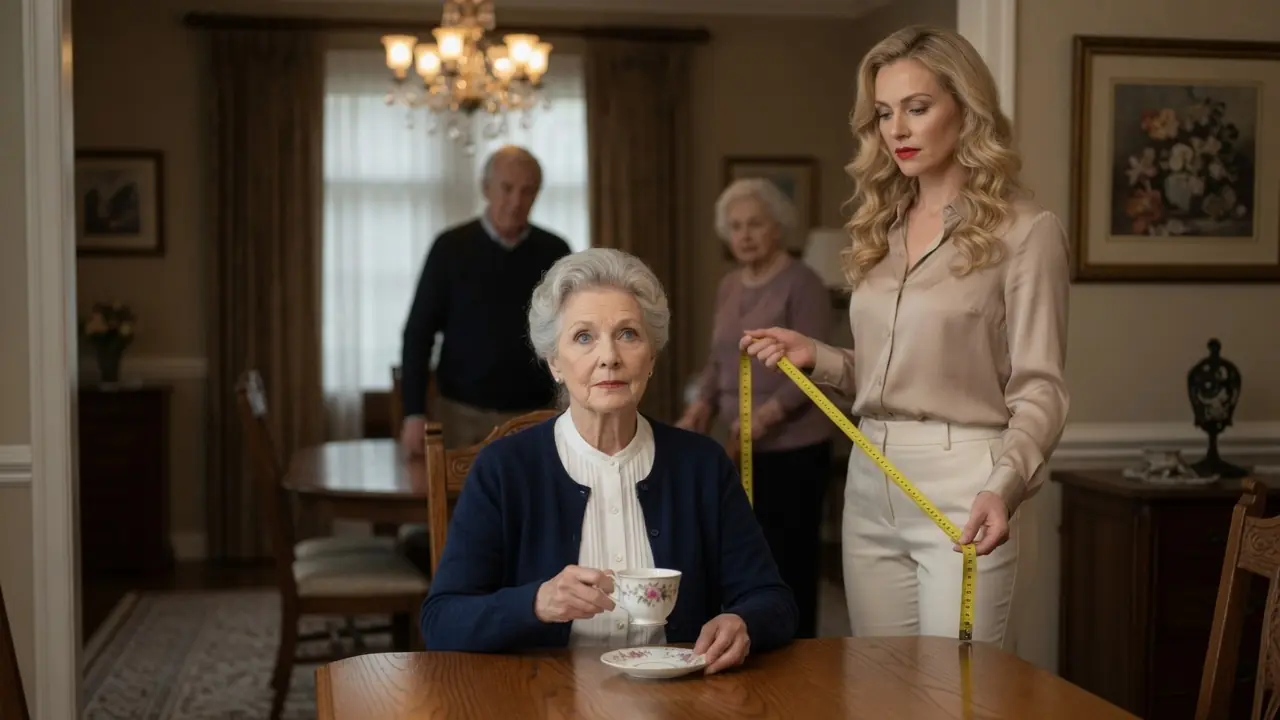
They spoke around me, not to me. Brenda decided that the upstairs guest room would become her office, the larger bedroom would belong to Lorraine because of the attached bathroom, and Trevor and Brenda would use my late husband’s study as a private sitting room. Lorraine suggested removing the antique bookcases because they made the room appear “heavy.” Trevor nodded occasionally without lifting his eyes.
When Brenda finally paused, I placed my cup on its saucer.
The porcelain made a soft, precise clink.
“No,” I said.
The room froze.
Brenda’s smile tightened, but it remained in place. She had always believed that an attractive expression could turn disrespect into concern if she held it long enough.
“I think you misunderstood,” she said. “We’re not trying to take over. This house is simply too large for you to manage alone, and we’ve been discussing the most practical arrangement.”
“I understood perfectly.” I folded my hands on the table. “Lorraine is not moving into this house. Neither are you.”
Trevor cleared his throat. “Mom, we’re worried about you. There are stairs, yard work, maintenance—”
“I swam forty laps this morning and trimmed the back hedge before lunch.”
“That isn’t the point,” he replied.
“It seems exactly like the point.”
Brenda let the measuring tape snap back into its case. “We already ended Mom’s lease in Phoenix.”
The confidence in her voice told me she expected that statement to settle the matter. She believed the inconvenience she had created would become my obligation simply because she announced it at my table. Lorraine looked down, but she did not appear surprised, which meant she had known about the plan before arriving.
“That was your decision,” I said.
Brenda blinked. “We did it because this was settled.”
“Not with me.”
“Trevor said you would understand.”
I looked at my son. He still had not touched his cake. “Did he?”
Trevor finally raised his eyes. “I said you’d probably come around.”
“You discussed moving two adults and Lorraine into my house without asking whether I wanted any of you here.”
“We are family,” he said defensively.
“Family knocks before entering. It doesn’t measure the curtains while the owner is still drinking coffee.”
Lorraine shifted near the window. “I never wanted to be a burden.”
I turned toward her. “Then you should have asked me directly before allowing your daughter to cancel your lease.”
Brenda’s face hardened. “This is unbelievable. My mother is sixty-six and alone.”
“I am sixty-eight and alone.”
“That’s different.”
“How?”
“You own this enormous house.”
There it was.
Not concern. Not love. Square footage.
My home sat on three wooded acres outside Raleigh, North Carolina. My husband, Robert, and I had purchased the land when there was little around it but pine trees and a narrow county road. Over three decades, we had built the house slowly, room by room, paying cash whenever possible and doing much of the work ourselves.
Robert built the oak table where Brenda now stood measuring my life. He designed the arched doorway, installed the library shelves, and carved small initials beneath the porch railing where no one else knew to look. After he died seven years earlier, the house became more than property. It was the physical record of a marriage.
I did not worship it, and I was not afraid of change. But I refused to be erased inside it while I was still alive.
Brenda gathered her purse. “We’ll discuss this when you’re feeling less emotional.”
“I am not emotional.”
“You’re being defensive.”
“I’m being clear.”
Trevor pushed his chair back. “Come on, Brenda.”
She looked at him sharply. “You’re just going to let her speak to me this way?”
“This is her house,” he murmured.
Brenda’s eyes narrowed. “For now.”
The words were quiet, but I heard them.
So did Trevor.
He looked at her with surprise, but Brenda had already turned toward the hallway. Lorraine followed without saying goodbye. Trevor remained near the table for another moment, caught between shame and habit.
“Mom, she didn’t mean that.”
“Yes, she did.”
“She’s under pressure.”
“So am I, apparently.”
He rubbed his forehead. “What is Mom supposed to do now?”
I almost reminded him that Lorraine was not his mother, but I knew what he meant. Brenda had trained him to use her language, her priorities, and her version of every conflict. The more peace he tried to keep, the less courage he seemed to have.
“She can renew her lease,” I said.
“It’s already rented.”
“Then she can find another apartment.”
“Prices are high.”
“So is the value of my home. That does not make it available.”
Trevor looked exhausted. “I wish you would just try to understand how difficult this is for us.”
“I understand that you made a major decision involving my property and expected me to obey.”
“We thought you’d be relieved to have help.”
“I did not ask for help.”
He left without finishing his cake.
For the rest of the afternoon, I cleaned the dining room more carefully than necessary. I wiped away the ring Lorraine’s water glass had left on the table and folded the unused napkins. Outside, summer rain began tapping against the windows, soft at first and then steady.
Robert used to love that sound.
Whenever storms rolled in, he sat near the screened porch with a book and claimed rain made the house feel completed. I stood in the doorway and remembered how much space one person could occupy without ever making another feel crowded.
Three days later, Brenda arrived without calling.
I saw her car stop in the driveway and watched her unload two large cardboard boxes from the trunk. Each box had LORRAINE—BEDROOM written across the side in black marker.
Brenda carried them directly toward the front door.
I opened it before she could ring.
“What are those?”
“Just a few of Mom’s things. Her storage unit is full, and we need somewhere safe to keep them.”
“No.”
She kept walking.
I stepped into the doorway.
“Evelyn, they’re boxes.”
“They are the beginning of you ignoring me.”
“You’re being ridiculous.”
“You brought belongings for someone I already said is not moving here.”
“I don’t have time to argue.”
“Then return them to your car.”
Brenda stared at me, then pushed past my shoulder before I expected it. She set both boxes beside the coat rack and exhaled dramatically.
“There. That wasn’t so difficult.”
I looked at the boxes.
Then I looked at her.
“Remove them.”
“I have a meeting.”
“Brenda.”
She walked back toward the door. “We’ll collect them later.”
I did not raise my voice. “They will be outside.”
She laughed once, dismissively, and left.
I waited until her car disappeared beyond the trees. Then I brought my small furniture dolly from the garage, loaded both boxes, and wheeled them onto the covered porch. I placed them far enough beneath the overhang that the rain would not reach them, then took a photograph.
I texted it to Trevor.
These need to be collected before tomorrow evening.
He called within two minutes.
“Mom, you can’t put Lorraine’s things outside.”
“They are dry.”
“That isn’t the point.”
“I said no to storing them.”
“It’s temporary.”
“So is trespassing.”
“Brenda didn’t trespass.”
“She pushed past me after I told her not to enter.”
Trevor sighed heavily. “Why are you making this into a war?”
“I am not the person moving troops onto someone else’s land.”
“Can you stop talking like that?”
“No. It’s accurate.”
He lowered his voice. “Brenda thinks you don’t respect her.”
“I don’t respect the way she is behaving.”
“That’s her mother’s property.”
“Then her mother should keep it.”
He was silent for several seconds.
“Fine,” he said. “I’ll come after work.”
He arrived alone near sunset. I watched through the window as he loaded the boxes into his SUV. Before leaving, he stood on the porch and looked toward the door, but he did not knock.
I almost opened it.
Then I remembered the way he had allowed Brenda to divide my rooms while sitting at my table. Love did not require me to rescue him from every uncomfortable consequence of his silence.
The following Thursday, I woke to the sound of metal turning inside my front door.
At first, I thought I had imagined it. Then the lock clicked, and the door opened.
Brenda entered carrying shopping bags.
She wore cream trousers, a beige blouse, and an expression of ordinary entitlement. She kicked the door shut behind her and began walking toward the basement stairs.
I stepped from the kitchen. “What are you doing?”
She startled, then recovered. “I’m clearing space downstairs for Mom’s sewing machine.”
“No, you’re not.”
“She needs somewhere to keep it.”
“She has a storage unit.”
“It doesn’t fit.”
“That is not my problem.”
Brenda continued toward the basement.
I moved in front of her.
She stopped so close that I could smell her perfume.
“Move,” she said.
“Give me the key.”
Her hand tightened around the shopping bags. “Trevor gave it to me years ago.”
“For emergencies.”
“This is a family matter.”
“No. This is my home.”
She laughed coldly. “You sit here alone like a queen on a throne while my mother has nowhere stable to live.”
“Your mother had an apartment until you canceled it.”
“We expected you to be generous.”
“You expected me to be easy to overrule.”
Brenda’s eyes sharpened. “Maybe Trevor was right. Maybe you’re becoming confused.”
The insult was deliberate.
It was not about concern. It was strategy.
“Give me the key,” I repeated.
“You can’t keep shutting your family out.”
“I am shutting you out because you entered without permission.”
She reached around me toward the basement door.
I held out my hand.
For several seconds, neither of us moved.
Then Brenda dropped the key into my palm.
“You are going to regret humiliating us,” she said.
“No, Brenda. You are going to regret mistaking politeness for surrender.”
She left the shopping bags in the hallway and walked out.
I carried them to the porch.
Then I called a locksmith.
Within an hour, every exterior lock had been replaced. I changed the garage code, the alarm password, and the access code to the side gate. I also installed a small camera above the front door.
The locksmith, a cheerful man named Malcolm, noticed my tension but asked no intrusive questions. When he finished, he handed me four new keys.
“Be careful who gets these,” he said.
“I intend to be.”
That afternoon, Trevor called.
“You changed the locks?”
“Yes.”
“Without telling me?”
“I am telling you now.”
“I’m your son.”
“You do not live here.”
“What if there’s an emergency?”
“Then emergency services can enter.”
“This is insane.”
“Your wife used an emergency key to begin clearing my basement after I explicitly told her not to.”
“She was trying to help Lorraine.”
“She was testing whether my refusal had consequences.”
Trevor’s voice turned harder. “You’re choosing a house over your family.”
“No. I am choosing the right to live in my house without being invaded by family.”
He ended the call.
For two weeks, neither he nor Brenda contacted me. Lorraine sent one short message.
I am sorry this became unpleasant.
I read it several times before replying.
It became unpleasant because decisions were made about me instead of with me. I hope you find a comfortable home.
She did not respond.
The silence in my house felt different after that. It was not peaceful exactly, but it was honest. I swam every morning, tended the garden, attended my book club, and continued volunteering at the local literacy center twice a week.
I was not isolated.
I was simply no longer available for occupation.
Then the attorney’s letter arrived.
It came by certified mail in a thick cream envelope addressed to me from a firm in downtown Raleigh. The letter stated that Trevor and Brenda were concerned about my ability to manage my property and finances. It requested a voluntary capacity evaluation and suggested discussing a family trust “for my protection.”
I read it once.
Then I laughed.
The sound surprised me.
Brenda had failed to enter through the front door, so she had chosen a more respectable form of intrusion.
I called my attorney, Daniel Morris, who had handled Robert’s estate. Daniel asked me to bring the letter, recent medical records, financial statements, and any evidence of Brenda’s unauthorized entry.
I brought everything.
The security camera showed Brenda arriving, entering with the old key, and leaving fifteen minutes later without the shopping bags she had carried inside. My phone contained the messages about Lorraine moving in, the boxes, and the demands that I surrender space.
Daniel reviewed each item carefully.
“This is not a guardianship petition yet,” he said. “It is pressure.”
“Can they force an evaluation?”
“They can file, but they would need evidence that you lack capacity. From what I see, they have none.”
“What should I do?”
“Document everything. And make your estate plan impossible to misunderstand.”
Robert and I had created a simple will years earlier. Trevor would inherit the house, savings, and most personal property. At the time, it had seemed natural.
Now I understood that Brenda had not merely assumed she could move in.
She believed she was entering property that would eventually belong to her husband, and therefore, in her mind, already belonged partly to her.
That belief needed correction.
Over the next month, Daniel helped me establish a revocable trust. I remained the sole trustee while alive and competent. The house could not be sold, transferred, occupied, or borrowed against without my written authorization.
After my death, Trevor would not receive the house directly.
Instead, the property would be sold unless he met specific conditions. Part of the proceeds would fund scholarships for widowed women returning to education. Another portion would support the literacy center where I volunteered.
Trevor would receive a fair inheritance.
But Brenda would never own my house.
I did not make that choice out of spite. I made it because inheritance should be a gift, not a weapon used against the living.
Daniel also prepared an advance directive, financial power of attorney, and medical power of attorney naming my younger sister, Helen, rather than Trevor. Helen lived in Virginia but understood my wishes and had never once measured my rooms.
When the documents were signed, I invited Trevor to lunch.
He arrived without Brenda.
We sat at a small restaurant near his office. He looked thinner than usual, with shadows beneath his eyes.
“Are you going to apologize?” he asked.
“For protecting my home?”
“For treating Brenda like a criminal.”
“She entered after I said no.”
“She used a key I gave her.”
“Which is why you no longer have one.”
Trevor looked away.
I placed a copy of the attorney’s letter on the table. “Did you approve this?”
He did not answer immediately.
“Brenda said it was only a precaution.”
“Did you tell that firm I was confused?”
“We said you were making decisions that didn’t seem like you.”
“I have always disliked being ignored. The difference is that now I respond.”
He rubbed his hands together. “We were desperate. Lorraine has been staying in our guest room, and it’s causing tension.”
“So you tried to move the tension into my house.”
“That’s not fair.”
“It’s exactly fair.”
He leaned forward. “Brenda thinks you never accepted her.”
“I welcomed her into this family. I paid for part of your wedding, hosted holidays, and treated her mother with courtesy. What I did not do was surrender ownership of my home.”
“She says you embarrassed her.”
“She tried to establish that I was mentally incapable because I changed my locks.”
Trevor looked ashamed.
I softened my voice, but not my meaning.
“You have spent years avoiding conflict by agreeing with whoever becomes angriest. That is not kindness, Trevor. It is surrender, and you have been spending my peace to purchase your own.”
His face changed.
For the first time, he looked less defensive than tired.
“I don’t know how to fix this,” he admitted.
“You start by telling the truth.”
“To Brenda?”
“To yourself.”
He stared at the table.
I told him about the trust.
He looked up sharply when I explained that the house would not pass directly to him.
“So you’re cutting me out.”
“No. You will receive an inheritance. But this house will no longer be treated as your future property while I am alive.”
“Brenda will say you’re punishing us.”
“Brenda may say anything she likes.”
He left without finishing lunch.
For several months, our relationship remained strained. Lorraine found a small townhouse ten minutes from Trevor and Brenda, though Brenda complained constantly about the rent. I later learned Lorraine had enough retirement income to cover it comfortably.
She had never been homeless.
She had simply preferred my larger house.
Brenda’s behavior became more obvious once her plan failed. She criticized Trevor for not controlling me, mocked his reluctance to pursue guardianship, and accused him of losing an inheritance that had never belonged to him.
Their marriage began cracking under the weight of the entitlement that had previously been directed outward.
One evening, Trevor appeared at my door.
He did not use a key.
He knocked.
That mattered.
When I opened the door, he stood on the porch holding Robert’s old toolbox. His father had given it to him years earlier, but Trevor had rarely used it.
“Can I come in?” he asked.
“Yes.”
He stepped inside and looked around as though seeing the house differently.
“I’m sorry,” he said.
I waited.
“I’m sorry I discussed your home without you. I’m sorry I gave Brenda the impression that your answer didn’t matter. And I’m sorry I helped that attorney write the letter.”
The last confession hurt, though I had already suspected it.
“Why did you do it?”
“Because Brenda said if we proved you needed help, the house could be placed in a family trust. She said it would solve everything.”
“For whom?”
He swallowed. “For us.”
I walked into the dining room and touched the back of the chair where he had sat while Brenda measured the table.
“Your father built this because he wanted our family to gather here,” I said. “Not because he wanted me removed from it.”
“I know.”
“Do you?”
Trevor’s eyes filled.
“I do now.”
He opened the toolbox and removed a small brass plate engraved with Robert’s initials. It had fallen from the underside of one of the dining chairs years earlier.
“I found it in the garage,” he said. “I thought it belonged here.”
Together, we turned the chair over and fastened the plate beneath the seat.
It was not forgiveness.
But it was a beginning.
Trevor moved into a small apartment three months later after separating from Brenda. I did not celebrate the marriage ending, and I did not tell him I had warned him. He had painful lessons to learn without my satisfaction making them harder.
Brenda called me once.
Her voice was cold.
“You destroyed my family.”
“No, Brenda. I refused to let you reorganize mine around your demands.”
“You turned Trevor against me.”
“I told him the truth. What he did with it was his choice.”
“You’ll die alone in that house.”
I looked through the kitchen window at Helen helping me plant herbs while two friends from book club carried lemonade onto the porch.
“No,” I said. “I live here by choice. That is very different from being alone.”
I ended the call.
A year later, I hosted Thanksgiving at the oak table.
Trevor came early and helped prepare the meal. Lorraine attended after asking me directly, and I said yes because she had finally learned the difference between an invitation and an assumption.
Brenda was not there.
The house did not feel empty without her.
Before dinner, Trevor stood near the doorway and noticed the faint pencil marks Brenda had made while measuring the wall for Lorraine’s imagined furniture. I had never erased them.
“Why did you leave those?” he asked.
“To remember.”
“What?”
“That no can be a complete sentence.”
He nodded.
Then he pulled out my chair.
I sat at the head of the table, not because I needed a throne, but because it was my place in my home. Around me were people who had knocked, asked, listened, and waited for an answer.
The porcelain cup beside my plate made the same soft clink when I set it down.
This time, no one froze.
No one measured the windows.
And no one spoke around me as though I were already gone.