The day she looked me in the eye and said she was going to force me to pay for her life, I didn't cry. I didn't yell back. I picked up my phone and I started scrolling. What I found on her social media destroyed every single argument she had ever made in court, in front of a judge, with my lawyer sitting right beside me, watching the whole thing fall apart in real time.
But before I tell you what I found, I need to take you back to where this really started. Because this story doesn't begin with a threat. It doesn't begin with a courtroom or a lawyer or a stack of screenshots printed on copy paper. It begins with love, with a grandmother who believed, truly believed, that pouring into her grandchildren was the most beautiful thing she could do with the life she had spent decades building. And with a woman who decided to turn that love into leverage.
My name is Dorothy. I'm 67 years old. I live in the same house I have lived in for 31 years. The roses in my backyard were planted by my husband Harold the spring after we moved in, and every year they come back without me asking them to. I tell you that because it matters later.
For years, without anyone asking, without any obligation, without a single conversation about whether it was appropriate or expected, I paid for my grandchildren's private school tuition. Both of them. Every year, every August. One check. Because I wanted to.
That is the part I need you to hold on to before anything else in this story. Nobody sat me down and told me this was my job. Nobody implied it. Nobody asked. I saw an opportunity to give my grandchildren something real.
A foundation, a head start, a good school with good teachers, and I had the means to do it. And giving has always felt better to me than spending on myself ever has. I still remember the first morning I drove them to that school. The little uniforms, the backpacks almost bigger than they were. My grandson, he was 6 years old, turned around on the steps before going through the door and waved at me with his whole arm.
Not a little wave, his whole arm side to side like he wanted to make sure I saw him. I cried the whole drive home. Happy tears. You know that kind? The ones that come not from pain but from fullness, from the feeling that your life is exactly where it's supposed to be.
Those were good years. My son Marcus would call me every Sunday morning. Always between 9 and 10, always while I was having my second cup of coffee. "Mom, you have no idea what this means to our family. You have no idea."
And I believed him. I felt it every time I wrote that check. Every time I picked those kids up from school and they ran to my car like I was the best thing that had happened to their whole week. I believed in all of them. That was my mistake. Not the giving, the believing.
Fee fi fo fum, before I tell you what changed everything, what comes next is something I never spoke out loud until I had to say it in that courtroom. The news came from my financial advisor on a Tuesday morning. I remember it so clearly because my roses had just started blooming in the backyard. That first deep pink that comes every spring. And I had been standing at the kitchen window looking at them when the phone rang.
I thought it was going to be a routine call, an update. The kind of call where you say, "Mhm," a few times and then go back to your coffee. It was not that kind of call. My retirement income had dropped, not disappeared, not collapsed entirely, but reduced significantly following a portfolio restructuring I had approved the year before. At the time, it had seemed like the smart long-term decision.
And maybe it still was in the long run, but right now, in practical terms, what it meant was this: two private school tuitions were no longer something I could carry without slowly, steadily drawing down the principal of everything Harold and I had spent our whole lives building together. And I had made him a promise before he passed. I would never touch the principal. That was our agreement, our foundation, the thing that would protect me if I ever needed care, real care, the kind that age eventually asks for whether you're ready or not.
The thing that meant I would never be a burden to anyone. I sat with that phone call for 3 days, three full days before I picked up the phone to call Marcus, because I didn't want to say it wrong. I rehearsed what I would tell him. I thought about every word, every tone, every pause. I didn't want him to feel guilty.
I didn't want the grandchildren to feel like they had done something wrong. I wanted to hand them the news as gently as I possibly could and make it clear that we would figure out the next step together. When I finally called, I explained everything calmly, clearly. I told him about the portfolio adjustment. I gave him the numbers, not all of them, but enough for him to understand.
I told him I was sorry, and I meant it, even though I had nothing in the world to apologize for. And I offered, I could still contribute something smaller while they transitioned. I would help them look into scholarships. We would work through it together. Marcus listened to all of it.
Then he said, "Okay, Mom, I understand. Let me talk to Renata." Calm, even, like I had just told him I was switching my cable provider. That calm should have told me something. I should have heard what wasn't being said. I didn't.
Renata called me 4 days later, not Marcus. Renata. She did not say hello. She did not ask how I was. She did not warm up to anything.
She went straight into it, and I'm going to tell you exactly what she said because I grabbed a notepad the moment I hung up the phone, and I wrote down every single word while my hand was still shaking. "Dorothy, I want you to understand something. Those children are used to their life. You started this. You built their expectations, and you don't get to just walk away because it's inconvenient for you now.
I will get a lawyer, and I will make you legally responsible for 30% of our household education expenses. You owe this family." Then she hung up. I sat there at my kitchen table with the phone still in my hand, and the afternoon light coming through the window, and I didn't move for a long time. Then I got up, went to the drawer where I keep notepads, found one, sat back down, and wrote down every single word she had said because something in me, something quiet and old and very calm, already knew I was going to need it.
The lawsuit arrived several weeks later, formal paperwork, my full name and home address of the first page. The legal argument was that I had established a consistent pattern of financial support that the children had come to depend upon as part of their standard of living, and that withdrawing that support without adequate transition constituted emotional and psychological harm to minors. She was asking for 30% of my monthly retirement income every month permanently. No end date, no review clause, no acknowledgement that I was a retired woman living on a fixed income who had given freely for years and had simply reached the limit of what was sustainable.
Just 30% forever. I read the document twice at my kitchen table. Then I called Catherine. Catherine is my lawyer. She helped me through Harold's estate, and she is one of those women who speaks quietly and moves slowly and has never, in all the years I have known her, raised her voice, not once.
I have always admired that about her. I needed it more than I ever had. She listened to everything without interrupting, the call, the lawsuit, all of it. When I finished, she was quiet for a moment. Then she said, "Dorothy, before we meet, I need you to do something.
I need you to look at their social media accounts, all of them, Instagram, Facebook, everything you can find. Go back as far as the platforms will let you and screenshot everything that catches your eye. Everything, even if you're not sure why it matters." I told her I wasn't entirely sure I knew how to do that. She said, "Dorothy, learn."
So I did. I started with Instagram. Renata's account was public. Of course it was. I poured myself a cup of tea, sat down at my kitchen table with my reading glasses on, and I started scrolling back through her feed.
And within the first few minutes, I stopped cold. There she was, standing next to a brand new white SUV, smiling at the camera. One hand on the hood like she was posing for a magazine. The caption said, "New chapter, new ride. Grateful for this season."
The post was from months after I had called Marcus to explain my financial situation, months after the family had allegedly entered a period of hardship caused by my withdrawal. I screenshotted it. Then I kept going. A resort vacation, photos of both grandchildren in a beautiful pool, a beachfront view behind them, the kind of hotel that costs real money. I opened a new tab and looked up the property.
It was not a budget trip, not even close. A shopping haul posted on a Saturday afternoon. Bags from stores laid out across a bed, tagged brands I have never bought for myself in my life. Caption, "Treating myself because I deserve it." E, Christmas morning, the living room completely buried in gifts, wrapping paper everywhere.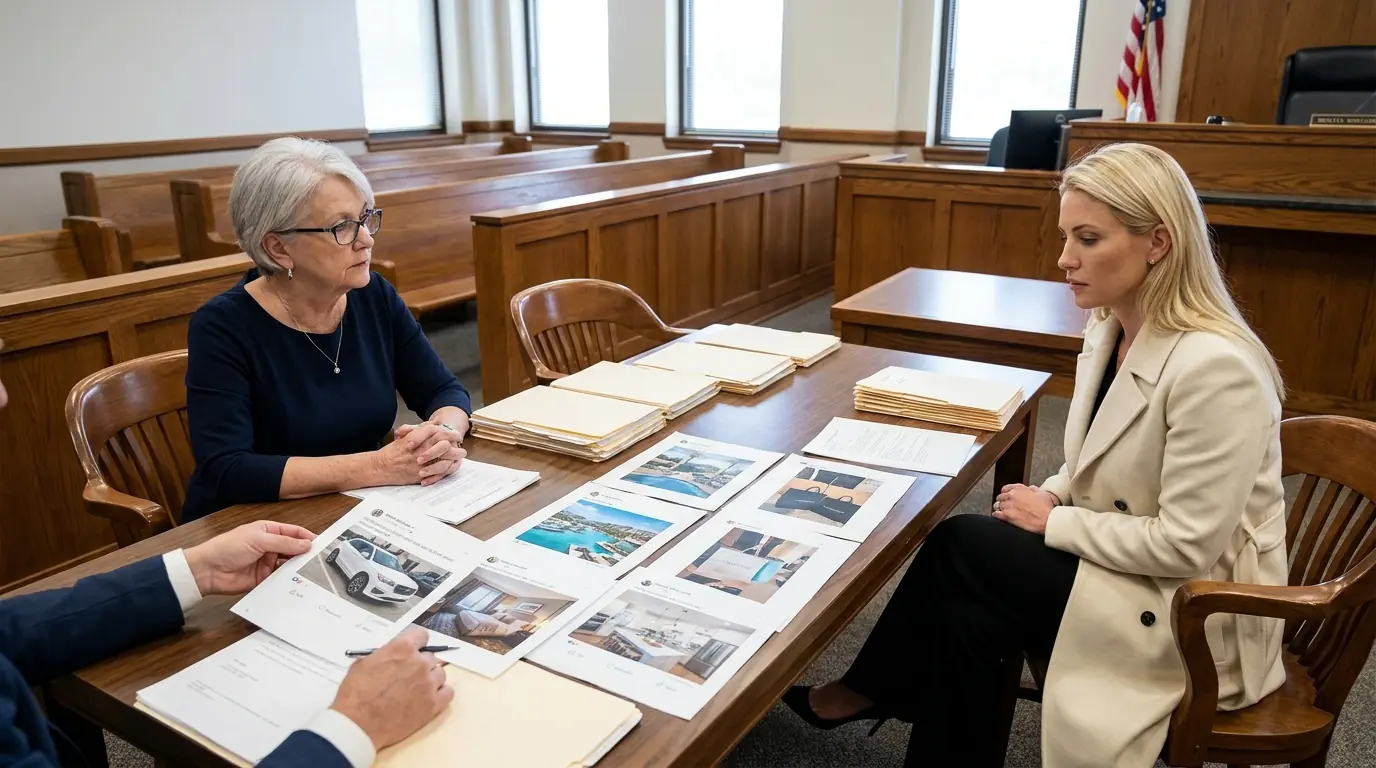
A gaming console in one child's hands with the price sticker still faintly visible if you zoom the photo in. I zoomed in. A Pinterest board, still public, titled in her own words, "dream kitchen reno." I scrolled through it slowly. Custom cabinetry, imported stone countertops, high-end appliances with brand names I recognized.
I added up the pins in my head as best I could. It was not a small dream. A weekend trip, photos from a rooftop restaurant, a theater marquee, a hotel room with a city view, tagged location New York. I screenshotted all of it.
Every post, every caption, every tagged location and visible price tag, and smiling vacation photo taken during the months that she was simultaneously building a legal case claiming her children were being psychologically harmed by the loss of their school funding. By the time I stopped, I had more than 60 screenshots. 60. From one public Instagram account. I sat back in my chair and I took off my reading glasses and I looked out at the backyard for a moment.
The roses were doing fine. I read every single message and I mean that genuinely. I brought the folder to Catherine's office 2 days later. Printed, organized, 63 pages. She opened it at her desk and went through it page by page, slowly, without saying a word.
I sat across from her and watched her face. She has a very still face, Catherine. Years of practice, I imagine. When she reached the last page, she closed the folder. She looked at me over the top of her glasses, and she said, "Dorothy, we're going to be just fine."
Four words. That's all I needed. The hearing was on a Thursday morning. I wore a simple navy dress, nothing statement-making, nothing designed to perform anything. I sat beside Catherine at the defendant's table, hands folded in front of me, and I kept my breathing slow and my face still.
Renata came in with her lawyer and sat across the room. She was wearing a coat I recognized from one of her posts. I said nothing. The judge was a woman with silver-framed glasses and the kind of absolute stillness that makes an entire room go quiet just by her sitting down. She had reviewed the submitted evidence before the session began.
Catherine had organized everything into a clear chronological presentation. Every screenshot, every date, every caption, every price. When Renata's lawyer began presenting the argument, the pattern of dependency, the children's emotional well-being, the trauma of reduced circumstances, the judge listened without expression. Then Catherine stood up.
She didn't speak dramatically. She didn't perform. She simply and methodically walked the court through what the evidence actually showed. A household that, during the precise period they were claiming financial distress caused by my withdrawal, had purchased a new vehicle, taken multiple vacations, including an out-of-country resort trip, made significant retail purchases, spent a weekend in New York, and was actively planning a high-budget home renovation.
She laid it all out, quietly, completely. When she finished, the judge turned toward Renata's side of the room and asked one question. Just one question. "How do you reconcile this pattern of discretionary spending with the plaintiff's claim of financial hardship?" The silence that followed was very long.
There was no good answer. There was no answer at all. The ruling came 3 weeks later. Case dismissed. And then, the part I hadn't anticipated, the judge determined the lawsuit had been filed without sufficient merit and ordered that all legal fees be paid by the plaintiff.
Both sides. My attorney's fees, their attorney's fees, everything. When Katherine called to tell me, I was sitting in my kitchen. Same chair. Same table where I had written down Renata's words the day of that phone call.
I listened to Katherine's voice and I said, "Thank you." And I stayed very still for a while after we hung up. I thought about Marcus, my son, who had known about every step of this, who had watched his wife file that lawsuit and had said nothing to me. Not a call to ask how I was holding up. Not a message.
Not anything. He had chosen his silence deliberately and consistently from the very first phone call where he told me he'd talked to Renata, all the way through to the day that ruling came down. That silence cost him more than he knew. I stopped answering his Sunday calls. Not from anger.
I want to be clear about that. Not from anger. From clarity. There is a real difference between a son who doesn't know what's happening and a son who knows and chooses to look the other way. Marcus knew. He always knew.
And the choice he made told me everything about where I stood when it came down to it. Some things, once you see them clearly, you cannot unsee. I've thought about this a lot since. What I would say to a woman sitting somewhere right now, maybe watching this at her kitchen table or in her bedroom or on her phone in a parking lot, who recognizes something in this story.
Maybe someone in your family has taken your generosity and decided it was a debt you owed them. Maybe someone you loved and trusted has chosen convenience over loyalty when it cost them something. Maybe you've been so busy being careful with other people's feelings that you forgot to protect your own. Here is what I want you to hear from one woman to another.
Kindness is not a contract. Generosity is not an obligation. And love, real love, does not file paperwork. The moment someone tries to take you to court for choosing to give freely and then choosing to stop, they have already told you everything you will ever need to know about who they are. I didn't lose a daughter-in-law in that courtroom.
I lost the version of her I had invented in my own mind, and I walked out of that building in my navy dress, got in my car, drove home, pulled into my driveway, and went straight to the backyard. I sat in the garden chair Harold bought the summer before he got sick. I made a cup of tea, and I looked at the roses, still there, still blooming, still holding the way some things do, quietly, without needing to be asked.