“Who cook like that?”
The metal ladle struck the side of my head before I could turn around. Hot soup splashed across my silver hair and ran down my temple, soaking the shoulder of my gray blouse. I gripped the edge of the stove to keep myself upright while my daughter-in-law, Dawn, stood over me in her blue satin robe, holding the dripping ladle like a weapon she had every right to use. From the living room, the television suddenly grew louder.
“Are you trying to poison us?” Dawn shouted. “Robert works all day, and this is what you make for him?”
“It is the same vegetable soup he loved as a child,” I whispered.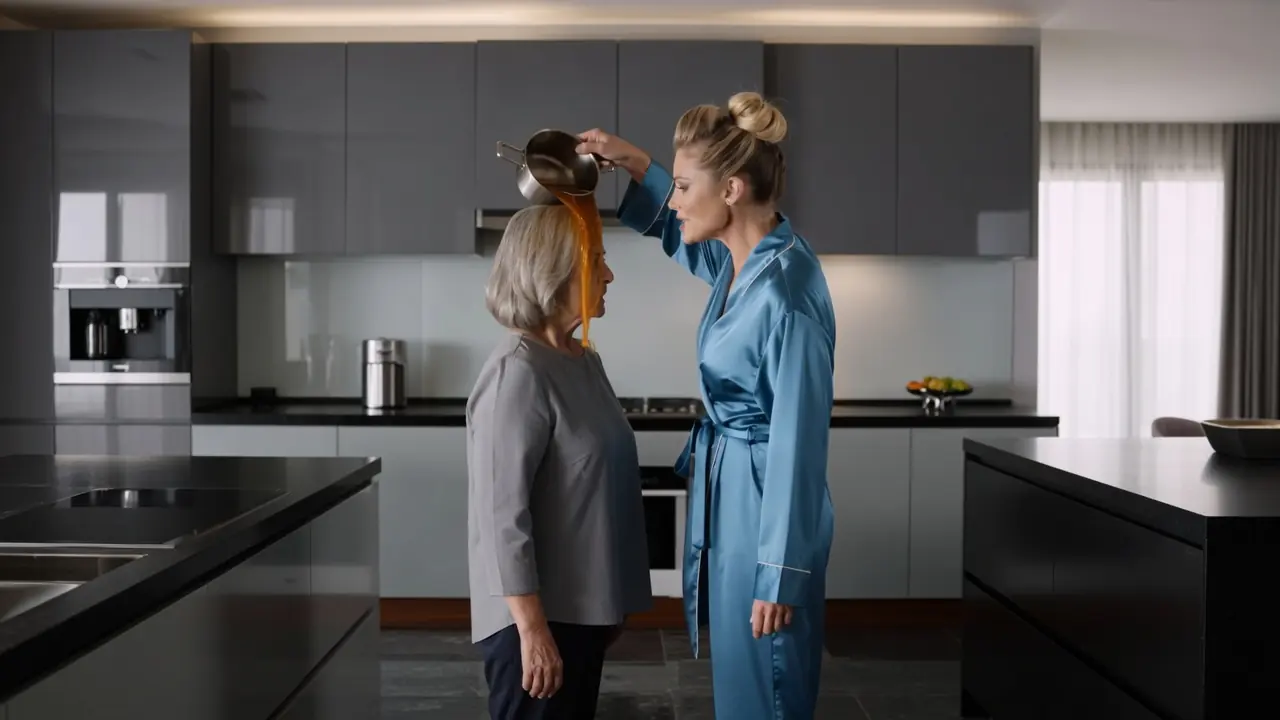
“He is not a child anymore, Helen.” She looked into the pot and twisted her mouth with disgust. “Too much salt, vegetables cut unevenly, grease floating everywhere. You cannot do one simple thing properly.”
My head throbbed where the ladle had struck. I raised one trembling hand and touched my temple, then looked toward the living room doorway. Robert sat less than twenty feet away in his favorite recliner, staring at the television as though the program required every piece of his attention.
“Robert,” I called.
He lifted the remote and increased the volume again.
That sound hurt more than the ladle.
Dawn saw me looking toward him and smiled. It was not a happy smile. It was the satisfied expression of a woman who had just proven that no one in the house would stop her.
“You see?” she said. “Even your own son is tired of your complaining.”
I had lived in their home for six months. During that time, I cooked every meal, washed every towel, scrubbed every floor, organized their bills, collected Robert’s prescriptions, ironed his work shirts, and cleaned Dawn’s home office after she left coffee cups and food containers scattered across the desk. I had done it because I wanted to be useful, and because grief had convinced me usefulness was the closest thing I had left to belonging.
Six months earlier, my husband Henry had died in our backyard while watering the geraniums.
We had been married for fifty years. I found him kneeling beside the flowerbed with the hose still running over his brown shoes. For weeks after the funeral, I could not enter the backyard without hearing the sound of water striking the soil.
Robert called every evening during that first month.
“You should not be alone at your age,” he told me. “Move in with us. Dawn and I have plenty of room.”
I wanted to believe concern had brought him back into my life. Robert had grown distant after marrying Dawn, but grief made every invitation feel like rescue. When he suggested selling my house because maintaining it would become difficult, I listened.
My house sold for four hundred and twenty thousand dollars.
After paying the remaining mortgage, taxes, and fees, I had a little more than three hundred thousand left. Robert told me he and Dawn were struggling after their adjustable mortgage increased, but he insisted he did not want a gift.
“We can create a family agreement,” he said. “You contribute toward the house, and this becomes your permanent home too.”
A lawyer prepared documents granting me a forty-percent ownership interest in exchange for one hundred and ten thousand dollars. I also agreed to pay the mortgage and utilities for one year while Robert reorganized his finances. The agreement required repayment if they asked me to leave before twelve months had passed.
Robert smiled when we signed it.
“We will never ask you to leave, Mom.”
I had believed him.
After I moved in, Dawn placed me in the smallest bedroom at the end of the hall. She called it the guest room, although half the closet remained filled with boxes of holiday decorations and old exercise equipment. My four suitcases barely fit beside the narrow bed.
At first, the insults were small enough to excuse.
The coffee was weak. The towels were folded incorrectly. I used too much detergent, not enough fabric softener, the wrong plates, the cheap napkins, the noisy vacuum cleaner, the ugly flowers from the supermarket. Dawn never thanked me, but I told myself gratitude was not necessary between family members.
Robert watched most of it happen.
Sometimes his face tightened when Dawn spoke cruelly, but he never defended me. If I questioned him privately, he asked me to be patient.
“She is stressed,” he said. “You know how hard her work is.”
Dawn worked from home as a marketing consultant. She spent several hours a day on video calls and several more ordering clothes online. Her stress somehow required me to make breakfast before six, prepare lunch at noon, and have dinner ready by seven.
My stress required silence.
That afternoon, standing beside the stove with soup dripping through my hair, I finally understood the arrangement. They had not invited me because they feared I would be lonely. They had invited my bank account, my cooking, my labor, and my willingness to accept whatever treatment kept my son near me.
“You are pathetic,” Dawn said. “Look at the mess you made.”
She had struck me, yet somehow the soup on the floor was my failure.
“Clean it before Robert comes in,” she ordered.
“He already heard.”
“He does not care.”
The words entered me like cold air through an open door.
Dawn dropped the ladle into the sink and walked out of the kitchen. A few seconds later, I heard her laughing at something on the television. Robert lowered the volume slightly, and then their voices blended together as though nothing had happened.
I stood alone in the steam.
For the first time since Henry died, I stopped asking what he would want me to endure. Henry had loved our son, but he had never taught me to accept cruelty. If he had seen what Dawn did, he would have taken my hand and walked me out before the soup cooled.
I emptied the pot into the sink.
The broth rushed down the drain, carrying carrots, potatoes, celery, and every remaining hope that dinner could restore peace. Then I placed the pot on the counter harder than necessary.
It struck a stack of plates.
The plates slid, hit the tile floor, and shattered.
I did not stop them.
I swept two more pots from the stove and let them fall. A bowl broke beside my feet. Cutlery scattered across the floor, and a glass container struck the cabinet with a crash loud enough to overpower the television.
Robert came running.
He stopped in the doorway, his face pale as he stared at the wreckage. Soup covered the sink and floor, dishes lay broken around me, and a thin line of red marked the skin near my temple.
“Mom, what did you do?”
He did not ask what Dawn had done.
He did not cross the room to examine my injury.
Behind him, Dawn appeared with one hand pressed dramatically against her chest.
“She has lost her mind,” she said. “Look at my kitchen.”
“Your kitchen?” I asked.
Dawn pointed at me. “Robert, call someone. She needs to be evaluated before she hurts us.”
Robert looked at the broken plates and shook his head. “Mom, why do you do these things?”
That question ended whatever remained of the mother I had been inside that house.
“Why did I break your dishes?” I asked quietly. “Or why did your wife strike me while you turned up the television?”
His eyes flickered toward Dawn.
“She did not strike you.”
“You heard it.”
“I heard arguing.”
“You heard me call your name.”
Robert’s face hardened because guilt often disguises itself as anger. “This is exactly what I mean. You make everything dramatic.”
I pointed toward the mark on my temple. “Does this look dramatic?”
Dawn crossed her arms. “You probably hit yourself when you started throwing things.”
I stared at her.
She had expected me to cry, apologize, and clean the kitchen. She had expected Robert’s silence to keep me obedient. Until that moment, both of them had mistaken grief for weakness.
Robert rubbed his forehead. “Mom, maybe staying here is not working.”
Dawn moved closer to him. “She cannot remain after this.”
He avoided my eyes.
“I think you should leave tonight.”
There it was.
The sentence the agreement had prepared for, and the sentence my heart had refused to imagine.
I stepped carefully over the broken dishes. “You want your injured seventy-one-year-old mother to leave tonight?”
“You destroyed our kitchen.”
“After your wife struck me.”
“We are not discussing that right now.”
“Of course not. You have avoided discussing it for six months.”
Dawn disappeared down the hall and returned with one of my suitcases. She dropped it beside the front door.
“You heard him,” she said. “Pack your things.”
I went to my room without answering.
My hands no longer trembled.
I packed Henry’s photographs first, wrapping each frame in a blouse. Then I folded my dresses, placed my medicine inside my handbag, and removed a blue folder from beneath the bottom drawer.
The folder contained the ownership agreement, bank records, mortgage statements, utility receipts, and copies of every transfer I had made since moving in. Henry had taught me never to rely on memory when money and promises were involved. After his death, that habit became the one part of him that still protected me.
When I returned to the front hall, Dawn had placed all four suitcases beside the door.
Robert stood several feet away, holding his phone but refusing to look at me.
I took out my own phone and opened the banking application. The mortgage payment was scheduled to leave my account the following morning. Electricity, water, insurance, and two credit-card payments were also connected to the account because Robert had claimed he needed temporary help.
I canceled every automatic transfer.
Then I called the bank and froze the household card Robert had been using for groceries. In six months, that card had paid for restaurants, clothing, cosmetics, and three expensive weekend trips Dawn had described as business expenses.
Robert’s phone began to vibrate.
The first notification confirmed the mortgage transfer had been canceled. A second warned that his access to the household account had been removed. Then came alerts from the utility companies and credit-card providers.
He finally looked at me.
“What did you cancel, Mom?”
I lifted the handle of my suitcase.
“Enjoy kicking me out—because tonight, my money leaves with me.”
His face lost its color. “You cannot cancel the mortgage.”
“I just did.”
“We will lose the house.”
“You told me this was your house when you ordered me out.”
Dawn stepped forward. “What else did you cancel?”
“The mortgage, utilities, insurance contribution, and every debt I paid while you called me useless.”
“You cannot leave us with nothing!”
“You left me with nothing the moment you struck me—and he turned up the television.”
Robert reached for my suitcase. “Mom, wait. We are upset. We said things too quickly.”
I pulled the suitcase away from him.
“The agreement requires you to repay my one hundred and ten thousand dollars if you remove me before the end of the first year.”
His mouth opened, but no words came.
Dawn looked at him. “What agreement?”
“The one Robert signed before I sold my home.”
“You told me she gave us that money.”
Robert said nothing.
Dawn’s fury shifted toward him. “You said it was a gift.”
“It was complicated.”
“No,” I said. “It was documented.”
I opened the blue folder and removed the signed contract. Robert recognized the pages immediately.
“You cannot enforce that,” he said.
“The lawyer who wrote it believes otherwise.”
“You spoke to him?”
“I am about to.”
Dawn tried to grab the folder, but I stepped back.
“Touch me again,” I said, “and the next conversation will happen in front of the police.”
That stopped her.
Robert finally looked at the injury on my head. “You are not really going to report Dawn.”
“She assaulted me.”
“It was one moment.”
“It was the final moment.”
His voice dropped. “I am your son.”
“Yes. That is why your silence hurt more than her hand.”
I walked out before either of them could answer.
My neighbor, Mrs. Walsh, had seen me sitting alone on the porch several times and once quietly given me her phone number. I called her from the driveway. She arrived ten minutes later in her old sedan and helped place my suitcases in the trunk.
When she saw my temple, she did not ask whether I wanted to cause trouble.
She asked whether I needed a hospital.
That simple question nearly broke me.
At the emergency room, a nurse cleaned the injury and documented swelling consistent with being struck by a hard object. A social worker photographed the mark and asked several careful questions about what had happened inside the house. I told the truth without protecting Robert.
A police officer took my statement shortly after midnight.
I did not enjoy it.
I did not feel victorious.
I felt tired, embarrassed, and frightened that my son would hate me. But every time I considered minimizing what happened, I remembered the television growing louder.
Dawn was charged with misdemeanor assault. The broken dishes became part of the incident report, but the medical documentation and my account explained the sequence. Robert tried to tell the officer that I was emotionally unstable after Henry’s death.
Mrs. Walsh, who had heard Dawn shouting through open windows on several occasions, provided her own statement.
The next morning, my lawyer, Samuel Greene, met me at a small hotel near his office. He reviewed the agreement and confirmed that Robert and Dawn had violated it by removing me from the property. He sent them a formal demand for repayment and notice of my ownership interest.
“They cannot sell, refinance, or transfer the house without addressing your claim,” Samuel explained. “You are not powerless here.”
I looked at the papers in front of me.
“I do not want revenge.”
“This is not revenge. This is the boundary they assumed you would never enforce.”
That afternoon, Robert called sixteen times.
I answered the seventeenth.
“Mom, the bank says the payment is due tomorrow,” he said. “I need you to restore the transfer until we sort this out.”
“No.”
“We could default.”
“You both earn salaries.”
“We have other expenses.”
“So did I.”
He lowered his voice. “Dawn is terrified.”
“I was terrified when she struck me.”
“She did not mean to hurt you.”
“She lifted a metal ladle and brought it down on my head.”
“She lost control.”
“And you chose not to intervene.”
Silence filled the line.
“I did not know what to do,” he finally said.
“You could have stood up.”
“She would have turned on me.”
There it was: the truth beneath every excuse.
Robert had sacrificed me because defending me might have made his own life uncomfortable.
“You allowed her to turn on me instead.”
He began to cry. Hearing it hurt, but not enough to erase what had happened.
“I am sorry, Mom.”
“I believe you feel sorry now.”
“Isn’t that enough?”
“No.”
That answer surprised both of us.
I had spent my life teaching Robert that apologies mattered, but I had failed to teach him they did not cancel consequences.
“You need to repay what you owe,” I said. “Dawn must face the assault charge, and neither of you may access my accounts again.”
“Are you cutting me out of your life?”
“I am refusing to let you consume it.”
Within two weeks, I rented a small apartment near the town library. It had one bedroom, a narrow balcony, and morning sunlight across the kitchen floor. It was nothing like the home Henry and I had shared, but every object inside it belonged where I placed it.
Mrs. Walsh helped me unpack.
I hung Henry’s photographs beside the balcony door. Then I bought a pot of red geraniums and set it outside, although my hands shook while touching the soil.
For the first time since his death, the memory of finding him in the garden did not make me turn away.
“I am still here,” I whispered.
Robert and Dawn could not repay the full amount immediately. Samuel negotiated a binding repayment plan secured against the house. They sold Dawn’s luxury vehicle, canceled several credit cards, and refinanced the property under terms that recognized my legal interest.
The agreement also required them to return seventeen thousand dollars in unauthorized household-card purchases.
Dawn pleaded no contest to the assault charge. She received probation, mandatory anger-management counseling, and an order prohibiting her from contacting me directly. She told mutual acquaintances that I had destroyed her life over one mistake.
I stopped explaining myself to people committed to misunderstanding me.
Robert began therapy.
For several months, I refused to meet him. We communicated only through brief emails concerning repayment. He apologized repeatedly, but his early apologies focused on losing the house, the criminal charge, and the embarrassment at work.
Then one email arrived that sounded different.
“I kept turning up the television long before that day,” he wrote. “Every time Dawn insulted you, I increased the volume inside my own head because protecting you would have required admitting what kind of husband and son I had become. I am not asking you to forgive me. I am trying to understand why I believed your pain was easier to sacrifice than my comfort.”
I read that paragraph many times.
It did not repair us.
But it was the first honest tool placed on the table.
Six months later, I agreed to meet Robert in a public café.
He looked older. His shoulders curved forward, and he no longer wore the expensive watch Dawn had bought with my household card. He stood when I approached but did not try to hug me.
“I am glad you came,” he said.
“I have not come back.”
“I know.”
We sat across from each other.
Robert told me he and Dawn were separated. He had moved into a small apartment and continued making the required payments. He said the decision to leave had come after Dawn blamed him for failing to control me.
“I realized she spoke about you the way she had begun speaking about everyone,” he said. “But I also realized blaming her completely would let me avoid my own responsibility.”
I held my coffee with both hands.
“You were not helpless, Robert.”
“I know.”
“You heard me.”
“I know.”
“You turned up the television.”
His eyes filled. “I know.”
For once, he did not defend himself.
I did not forgive him that afternoon. Forgiveness is not a door someone opens because the offender finally knocks correctly. It is a road, and I had only decided not to block it forever.
“You may call me once a week,” I said. “Do not come to my apartment without an invitation. Do not ask me for money. Do not bring Dawn into any conversation.”
He nodded. “I understand.”
“And if you ever hear someone begging for help again, you do not increase the volume.”
His voice broke. “I won’t.”
A year after I left their house, the final repayment arrived.
I used part of the money to purchase my apartment and placed the remainder into a protected trust. Robert was not the trustee. My lawyer and I updated my will, medical directives, and financial powers so no family member could control my life merely because I grew older.
I also began volunteering twice a week at a community center for widowed and displaced women.
Many of them had stories like mine. Adult children took their savings, relatives turned them into unpaid servants, and people dismissed their suffering because age made cruelty easier to hide. I helped them organize records, contact legal services, and understand that boundaries were not betrayal.
One afternoon, a woman named Ruth asked how I had found the courage to leave.
“I did not feel courageous,” I told her. “I felt finished.”
Sometimes courage begins there.
Robert continued calling every Sunday. Some conversations lasted five minutes, others nearly an hour. He stopped asking when I would forgive him and started asking how I was doing.
Slowly, I began answering honestly.
On the second anniversary of Henry’s death, Robert came with me to the cemetery. He brought red geraniums and placed them beside his father’s stone.
“I failed her, Dad,” he whispered.
I heard him, but I did not rescue him from the truth.
Afterward, we returned to my apartment. I made vegetable soup using Henry’s old recipe. Robert stood near the kitchen doorway, uncertain whether he was welcome to sit.
I placed a bowl on the table.
“This is not the same as before,” I told him.
“I know.”
“You are here because I invited you.”
“I know.”
“And if you ever allow anyone to humiliate me again, there will not be another invitation.”
He met my eyes. “I understand.”
We ate quietly.
The soup was not perfect. The carrots were uneven, and I may have added slightly too much salt. Robert finished every spoonful without pretending the meal erased the past.
Before leaving, he washed his own bowl.
I stood by the window after the door closed, looking at the red geraniums on my balcony. My life was smaller than the one I had shared with Henry, but it was mine again.
Dawn once called me useless.
Robert once chose a television over my voice.
Neither of them understood that the old woman cooking in their kitchen was not powerless. I had money, documents, legal rights, and people willing to help—but the most important thing I recovered was the part of myself that no longer begged family to recognize my worth.
They had thrown me out believing I would lose everything.
Instead, I carried the only thing I truly needed through that door.
Myself.