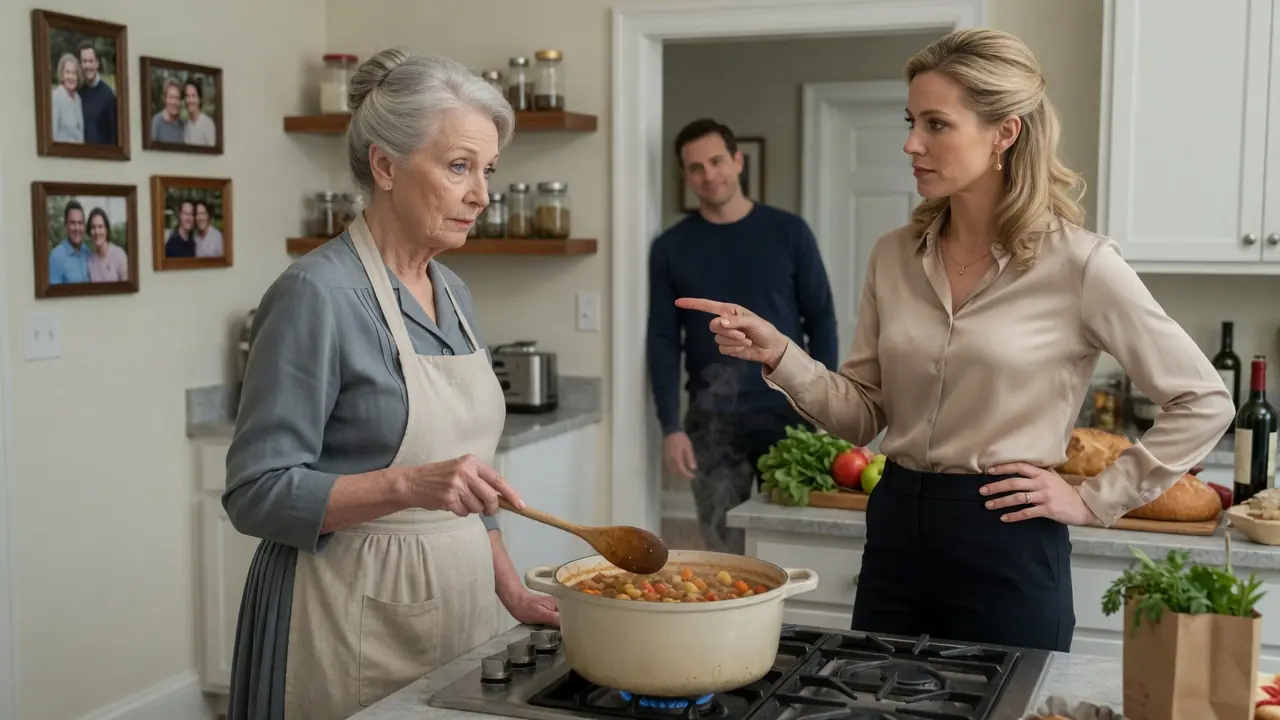
The day my daughter-in-law screamed at me in my own kitchen, I was holding the same wooden spoon I had used for more than thirty years.
My right hand was wrapped around the smooth handle, my apron was tied neatly around my waist, and a pot of beef stew simmered on the stove I had bought with my own money.
The scent of onions, carrots, rosemary, and slow-cooked meat filled the room, the kind of smell that once made my son run downstairs barefoot when he was little.
Diana stood in front of me in her beige blouse and tailored pants, pointing toward the doorway as if she had the right to send me anywhere.
Then she said the words that finally broke through five years of silence.
“Get out of this kitchen, Martha,” she snapped. “Nobody wants your old-fashioned hands ruining lunch.”
For a moment, I honestly thought the room had tilted.
This was my kitchen.
My house.
My stove.
My ingredients.
My clean counters.
My family photographs on the wall.
Yet there she stood, glaring at me like I was hired help who had forgotten her place.
Before I could answer, my son Chris walked in.
I looked at him with the desperate hope only a mother can feel, expecting him to defend me, or at least remind his wife that she was standing in my home. I did not need a grand speech. I only needed one sentence.
Mom lives here.
Mom owns this kitchen.
Mom deserves respect.
Instead, Chris glanced at Diana, then at me, and gave a small, cruel clap.
“She’s right, Mom,” he said. “For once, just do what you’re told.”
That was the moment something inside me went completely still.
I did not shout, though my heart was pounding hard enough to hurt. I did not throw the spoon, slam the pot, or cry in front of them.
I simply looked from Diana’s satisfied face to my son’s smug expression and understood that the humiliation had not begun that day.
It had only become too loud to ignore.
My name is Martha Reynolds, and I was sixty-three years old then.
I had lived in that house outside Cleveland for twenty-five years, most of them after my husband Harold passed away and left me to raise Chris alone. It was a yellow house with white trim, a wide porch, a deep backyard, and a kitchen that caught morning light better than any room I had ever known.
I cooked in that kitchen when Chris had fevers.
I cooked there when he had school projects due the next morning and needed someone awake with him while he glued cardboard planets onto poster board. I cooked there when he came home heartbroken at seventeen, pretending he did not care that a girl named Lisa had chosen someone else for prom.
I cooked there the night before he left for college.
He had stood in the doorway with his duffel bag over one shoulder, too grown to hug me first and too young to know how badly he still needed to. So I hugged him anyway, because mothers learn early that pride is a poor substitute for tenderness.
Every tile in that kitchen had a memory attached to it.
The small burn mark near the left burner came from the Thanksgiving Harold tried to fry onions and nearly set off the smoke alarm. The dent in the pantry door came from Chris hitting it with a plastic baseball bat when he was nine.
The spice rack beside the stove had been Harold’s anniversary gift to me the year before he died.
It was handmade, slightly crooked, and more precious than anything Diana had ever brought into my house.
When Chris first brought Diana home six years earlier, I tried to welcome her with an open heart.
She was pretty, polished, and confident, the kind of young woman who entered a room already expecting attention. Her hair was honey-brown and perfectly curled, her nails were pale pink, and her smile looked practiced enough to have been rehearsed in mirrors.
At dinner, she barely spoke to me.
But she laughed loudly at Chris’s jokes and touched his arm every few minutes, looking at him like he was the center of a room he had not yet earned. I told myself she was nervous and that I should not judge too quickly.
That was what Harold would have said.
“Give people time, Martha,” he used to tell me. “The first version of someone is rarely the whole person.”
So I gave Diana time.
Too much of it, perhaps.
The wedding came a year later, and I helped pay for more than Chris ever admitted.
Diana told everyone her parents had covered most of the ceremony, but I knew whose checks had cleared the florist, the venue deposit, the catering balance, and the photographer. I knew because I had written them from my own account and smiled when Chris said he would pay me back after things settled.
Things never settled.
They only became more expensive.
At the reception, they seated me far from the main table beside relatives I had never met. Diana’s mother, Betty Caldwell, sat near the front in a silver dress, laughing loudly and telling anyone who would listen how proud she was of the beautiful wedding “their family” had made possible.
I sat near the back with a cousin of Harold’s who kept asking whether I wanted more rolls.
I smiled through it because mothers are taught to swallow little hurts for the sake of their children’s happiness.
That is one of the most dangerous lessons a mother can learn.
Eight months after the wedding, Chris and Diana moved into my home.
They said it was temporary.
Just until their finances improved.
Just until Chris got a promotion.
Just until Diana found a better position.
Just until life became easier.
I had three bedrooms and too much quiet, so I opened the door.
“Of course, son,” I said. “This will always be your home.”
Chris hugged me tightly then.
For one foolish second, I believed I had been given my family back.
Temporary became five years.
Diana quit her boutique job after six months because she said she needed time to find herself. Apparently, finding herself required my sofa, my food, my washing machine, my electricity, my car on days when hers was in the shop, and my patience every morning.
Chris kept telling me she was stressed.
Marriage was hard.
The economy was hard.
Diana was sensitive.
Diana needed support.
Diana did not like feeling judged.
I was not judging her.
At least, not at first.
At first, the disrespect came dressed as small requests.
“Martha, can you wash these towels?”
“Martha, don’t use that detergent.”
“Martha, chicken sounds better than fish tonight.”
“Martha, can you not watch your old shows in the living room? Diana needs quiet.”
She never said please unless someone else was listening.
She never said thank you unless Chris was watching.
Little by little, I stopped feeling like the owner of the house and started feeling like a quiet old woman allowed to remain there because I was useful.
Chris changed too.
That hurt more than anything.
The boy who used to run into my arms after school had become a man who sighed whenever I spoke about boundaries. If Diana complained about dinner, he blamed my cooking. If Diana wanted the living room rearranged, he told me I should be more flexible.
If I asked them to contribute to utilities, he told me they were trying.
If I asked them not to leave dishes in the sink overnight, he told me I was making Diana feel unwelcome.
If I asked him to speak to his wife about respect, he looked at me like I had embarrassed him by needing it.
I endured it because I loved him.
I told myself marriage made sons complicated, that wives became their priority, that mothers needed to step back gracefully. But stepping back is one thing.
Being erased in your own home is another.
The Saturday Diana screamed at me was supposed to be her birthday lunch.
She had invited her parents, her sisters, Jasmine and Iris, and several cousins without asking my permission. I found out when I saw her writing a guest list at my kitchen table on Thursday evening.
“How many people are coming?” I asked.
She did not look up.
“Fifteen. Maybe eighteen.”
“To my house?”
She finally lifted her eyes.
“Our house, Martha. Don’t be territorial.”
Chris, sitting on the couch with his laptop, heard it and said nothing.
That silence should have told me everything.
By Saturday morning, I had woken early anyway.
That was my mistake, perhaps, or my love refusing to understand it was unwanted. I made the stew because Chris had loved it since childhood and because feeding people was the last language I knew how to speak inside my own family.
I peeled carrots.
Chopped onions.
Seasoned the beef.
Washed the counters.
Set fresh towels near the sink.
I even put on the blue apron Harold once said made me look like the heart of the house.
Then Diana came in with her mother, Betty.
They arrived carrying grocery bags, expensive bottles of wine, and enough entitlement to fill every cabinet. Betty walked straight to my refrigerator and opened it without asking.
“Diana, where do you want these cheeses?” she asked.
Diana pointed toward the middle shelf.
“Move Martha’s containers. She saves every little leftover like we’re living through the Depression.”
Betty laughed.
I stood at the stove, holding the wooden spoon.
“Please don’t move everything around,” I said carefully. “I already had food planned.”
Her eyes narrowed.
“Today is my birthday, Martha. I’m cooking for my family, and I don’t need you hovering.”
“My family is coming too,” I said gently, though only Chris was there. “This is still my kitchen.”
That was when her face changed.
Not dramatically.
Just enough to show me the contempt that had been living beneath her manners all along.
She pointed toward the doorway.
“Get out of this kitchen, Martha. Nobody wants your old-fashioned hands ruining lunch.”
The words moved through the room like a slap.
Betty froze for one second, then pretended to unpack groceries.
Diana held my stare.
And then Chris walked in.
My son.
My only child.
The person I had built my life around after Harold died.
I looked at him.
Maybe I looked too hopeful.
Maybe that annoyed him.
He glanced at Diana, then at me, and gave that small, cruel clap.
“She’s right, Mom,” he said. “For once, just do what you’re told.”
The pot simmered behind me.
The wooden spoon was still in my hand.
I remember noticing a drop of stew on the counter and wanting, absurdly, to wipe it away.
That is what shock can do.
It makes the small things sharper than the wound.
I set the spoon down slowly.
I untied my apron.
Neither of them spoke.
I folded the apron once, then laid it beside the stove.
Then I walked out of the kitchen.
Not because they had the right to send me away.
Because I suddenly understood that staying would only give them the pleasure of watching me beg to belong in a room I owned.
The dining room beyond the doorway was empty then, but I knew Diana’s family would soon fill it.
They would laugh, drink wine, and eat food cooked in my pots with my utensils and my ingredients. They would sit at the table Harold and I bought from an estate sale the year Chris turned twelve.
And I would be expected to smile.
I went upstairs and closed my bedroom door.
I sat on the edge of my bed with my apron still folded in my hands because I had picked it back up without realizing. The fabric smelled faintly of rosemary and soap.
I did not cry immediately.
That frightened me a little.
When pain is fresh, tears are natural.
When there are no tears, it often means something deeper has gone numb.
Two hours later, guests filled my house.
I could hear Ernest Caldwell, Diana’s father, bragging loudly in the living room about his used car business. He had a voice that carried whether anyone wanted it to or not.
Betty laughed in that sharp, metallic way she had, and Diana’s sisters moved through my rooms like they had grown up there.
Someone opened the hall closet.
Someone else turned on the television.
A child ran upstairs and back down again despite Diana having told me she did not want children at the party.
No one knocked on my door.
No one asked if I was all right.
Eventually, Chris came upstairs.
He opened my door without knocking, the way he always did when he forgot I deserved privacy.
“Mom,” he said, sounding irritated, “why are you hiding up here? Diana’s family is here.”
I looked at him.
My son stood in my doorway with one hand on the frame, already impatient with my pain.
“Your wife threw me out of my own kitchen,” I said quietly.
He rubbed his forehead like I was exhausting him.
“Please don’t make this dramatic. It’s her birthday.”
Dramatic.
That was always the word they used when my pain became inconvenient.
Dramatic.
Sensitive.
Difficult.
Old-fashioned.
I studied his face, searching for the boy who used to leave drawings on the refrigerator for me to find after long shifts at the restaurant. I could not see him.
Not then.
Maybe he was still in there somewhere.
But he was buried deep beneath entitlement, marriage, debt, and Diana’s voice.
“I’ll come down,” I said.
“Good,” he replied, as if I had passed a test.
I changed into a simple gray dress.
I washed my face.
I brushed my silver hair until it lay smooth against my head.
Then I walked downstairs into my own living room with a smile that felt like glass.
Nobody greeted me.
Diana stood near the kitchen door glowing with attention, one hand around a wineglass, her laughter polished and bright. Chris stood beside her, smiling like a proud husband who had forgotten he was also a son.
When lunch was served, everyone moved into the dining room.
I followed slowly, expecting at least one empty chair.
There was none.
Every seat was taken.
My own dining table had become another place where I did not belong.
Ernest looked at me and laughed.
“Looks like there’s no room for you, Martha. Maybe you can eat in the kitchen, since you spend all your time there.”
Laughter moved around the table.
Not everyone laughed loudly.
Some only smiled.
Some looked down.
But no one corrected him.
Diana smiled into her wineglass.
Chris looked down at his plate and said nothing.
That silence was louder than Ernest’s laughter.
I turned away before they could see my face.
I was halfway toward the stairs when my phone buzzed in my pocket.
It was a message from Henry Ruiz, my accountant and longtime legal adviser.
The message was short.
But it made the entire world stop.
Martha, urgent. Call me privately. Chris tried to refinance your property using false documents.
I read the words three times.
Chris tried to refinance your property.
False documents.
My son, the child I had raised alone, had not only allowed his wife to humiliate me in my kitchen.
He had tried to steal the house around that kitchen while I stood inside it cooking for him.
I went back upstairs.
This time, I locked my bedroom door.
My fingers trembled as I called Henry.
He answered on the first ring.
“Martha?”
“What happened?”
His voice was serious from the first second.
“Are you alone?”
“Yes.”
“Good. The bank contacted me this morning. Someone submitted documents claiming Chris holds power of attorney over your house.”
I sat down slowly.
“What?”
“They used a copy of what appears to be my signature and attached a supposed authorization from you. It was sloppy enough to raise flags, but sophisticated enough that someone clearly thought it might pass an initial review.”
My mouth went dry.
“What was he trying to do?”
“Borrow one hundred fifty thousand dollars against your property.”
The room blurred around the edges.
My hand tightened around the phone.
Henry continued, his voice careful.
“The bank halted the application because my office was listed as verification contact. They asked whether I had prepared the power of attorney. I told them absolutely not.”
I could hear laughter downstairs.
Diana’s family was eating lunch in my dining room while Henry told me my son had tried to put a loan against my house.
“Martha,” Henry said gently, “there is more.”
I closed my eyes.
“Tell me.”
“Chris and Diana are in serious debt. Nearly two hundred thousand dollars between credit cards, personal loans, and a luxury vehicle lease. There may also be unpaid business taxes connected to Chris’s consulting work.”
For several seconds, I could not speak.
Two hundred thousand dollars.
That explained the sudden kindness they had shown a month earlier when they asked if I had ever considered downsizing.
It explained Diana’s questions about whether I still kept all my legal paperwork in the den.
It explained Chris offering to “help organize” my files.
My son had been studying my life like a locked cabinet.
Not to protect it.
To open it.
“Did he know it was illegal?” I asked.
Henry was quiet for a moment.
Then he said, “Martha.”
That was answer enough.
After I hung up, I sat in silence staring at an old photograph on my dresser.
Chris at age seven.
Missing one front tooth.
Holding a birthday cupcake I had made in the kitchen downstairs.
I remembered wiping frosting off his cheek and telling him he could become anything if he stayed honest.
Somewhere along the way, the honest boy in that photo had become a man willing to forge documents against his own mother.
That night, after Diana’s family left and the house was covered in dirty plates, empty glasses, grease stains, crumbs, and wine rings on my side tables, I heard Chris and Diana talking in their room.
The wall between our rooms had always been thin.
I did not press my ear against it.
I simply sat still and listened.
Diana was furious.
“Matt said the documents would work,” she hissed. “We need that money, Chris. Your mother is sitting on a house she doesn’t need.”
Chris answered quietly.
“I’ll find another way. Trust me.”
That sentence ended the last excuse I had made for him.
Not Diana.
Not pressure.
Not confusion.
Chris.
My son.
Willing.
Calm.
Planning.
I lay in bed that night and did not sleep.
By morning, something inside me had become very clear.
For five years, I had mistaken endurance for love.
I had believed that if I stayed patient enough, kind enough, quiet enough, they would eventually remember my humanity.
But people who benefit from your silence rarely reward you for keeping it.
They simply demand more.
The next morning, I did something I had not done in five years.
Nothing.
I did not clean the kitchen after Diana’s party.
I did not wash the dishes.
I did not collect bottles, wipe counters, fold napkins, sweep crumbs, or scrub sauce from the stove.
I made coffee.
I buttered toast.
Then I sat in the living room and let the mess remain exactly where they had left it.
Chris came downstairs around eleven.
He stopped at the sight of the kitchen.
“Mom,” he said, looking around as if the house had personally betrayed him. “Aren’t you going to clean this?”
I looked at him over my coffee cup.
“No.”
The word was small.
It felt enormous in my mouth.
He blinked.
“What?”
“No,” I repeated.
He stared like I had spoken another language.
“Diana’s going to be upset.”
“She can clean what she used.”
“She was hosting.”
“In my house.”
His expression tightened.
“Mom, please don’t start.”
“I am not starting anything, Chris.”
For the first time in years, I held his gaze without softening my own.
“I am finished continuing it.”
Diana came down twenty minutes later in a silk robe, her hair pulled into an elegant mess that probably took effort.
She saw the kitchen and stopped.
“What is this?”
“A kitchen,” I said. “After your family lunch.”
Her eyes snapped toward me.
“Why hasn’t it been cleaned?”
“Because the person who used it can clean it.”
Her face flushed.
“Excuse me?”
“You heard me.”
Chris stepped between us slightly.
“Mom’s in a mood.”
Diana stared at him, then at me.
“I am not cleaning this kitchen.”
“Then it will remain dirty.”
She laughed.
“You’re acting like a child.”
“No, Diana. Children expect someone else to clean up after them.”
The room went still.
Chris whispered, “Mom.”
But I did not apologize.
I did not explain myself into obedience.
I drank my coffee.
That afternoon, I went to Henry’s office.
He had everything prepared.
Copies of the forged power of attorney.
The attempted refinance application.
The copied signature page.
Emails from the bank.
A debt summary compiled from what could be legally verified.
He spread the documents across the conference table, each one more painful than the last.
I looked at my son’s signature for a long time.
It was not perfect.
He had always written his C too sharply.
Even as a boy, his handwriting leaned forward as if impatient to get somewhere.
There it was on a fraudulent document tied to my home.
Henry sat across from me, hands folded.
“Martha, we need to protect everything you own.”
“I want that done today.”
“It already started.”
“Good.”
He hesitated.
“There is something else we should discuss.”
I looked up.
“They may try again.”
“I know.”
“They may attempt to pressure you emotionally. They may try to convince you to sign legitimate documents now that the false ones failed. They may even claim you are declining mentally if they get desperate enough.”
I almost smiled.
“They already think that when it suits them.”
Henry’s face softened.
“You are not alone in this.”
Those words nearly broke me.
Not because they were grand.
Because they were true.
I had forgotten what it felt like to sit across from someone who believed me.
“What do you suggest?” I asked.
“First, we lock down title alerts and bank notifications. Second, we revoke any informal permissions they may claim. Third, we install discreet security cameras in common areas of the house.”
“My own house,” I said bitterly. “I need cameras in my own house.”
Henry nodded.
“I know.”
“Do it.”
There was something Chris and Diana did not know about me.
For thirty years, while I lived quietly in the same house, drove an older car, clipped coupons out of habit, and wore simple clothes, I had built a business.
It began after Harold died.
Back then, I was forty-one years old with a grieving child, a mortgage, and very little room for failure. I had cooked for church events and neighbors for years, and everyone kept telling me I should open a place of my own.
So I did.
A little restaurant called Taste of Home.
Eight tables.
A counter with six stools.
A kitchen barely wide enough for two people to pass without turning sideways.
The menu was simple.
Chicken pot pie.
Beef stew.
Cornbread.
Roast chicken.
Peach cobbler.
Food that tasted like someone had been waiting for you to come home.
I worked eighteen-hour days.
I cooked, cleaned, ordered supplies, balanced books, and came home late enough that Chris sometimes fell asleep at the kitchen table waiting for me. I hated that part, but I told myself survival was not always graceful.
The restaurant became profitable by the third year.
By the sixth, I opened a second location.
By the twelfth, I had three.
By the time Chris finished college, I owned five Taste of Home restaurants across Ohio, two small rental buildings, and investment accounts Henry had managed carefully for decades.
Chris knew I owned “a restaurant.”
That was all he cared to know.
He thought I was a tired widow living off modest savings and stubbornness.
I allowed that belief because I wanted my son to love me as his mother, not as a source of money.
That decision, once tender in my mind, now felt painfully foolish.
Later that week, I visited the Taste of Home headquarters.
It was a modest office above the second restaurant we had opened, with framed newspaper reviews on the wall and the smell of baked bread rising through the vents. Salvador Martinez, my general manager of fifteen years, greeted me at the door.
Salvador was fifty-eight, broad-shouldered, deeply loyal, and one of the few people in my life who had never treated my softness as weakness.
He hugged me once, then looked at my face.
“What happened?”
“Family,” I said.
His expression darkened.
“That bad?”
“Worse.”
He did not ask more.
That was one reason I trusted him.
Salvador brought me reports showing strong profits, new catering contracts, payroll records, property summaries, and investment statements connected to the company.
My total assets, including the house, restaurants, rental properties, and investments, were worth nearly five million dollars.
I sat in my private office staring at the number.
Five million dollars.
My son thought I was a tired widow sitting on one useful house, and he still tried to take it.
The truth did not make the betrayal smaller.
It made it larger.
I asked Salvador for complete documentation.
Property deeds.
Bank statements.
Ownership records.
Business licenses.
Restaurant valuations.
Rental statements.
Net worth summaries.
He did not ask why.
But his eyes softened as if he knew some personal storm had finally arrived.
“You’ll have everything by Thursday,” he said.
Then he added, “And Martha, whoever forgot who you are is about to remember.”
When I returned home, Diana was lying on my sofa watching television in beige lounge clothes.
One hand rested on a bowl of popcorn she had spilled onto the cushion.
She did not sit up.
She did not ask if I needed help carrying my bag.
She only glanced at me and said, “Where were you?”
“Appointment.”
“What kind?”
“The kind that concerns me.”
Her eyes narrowed.
“You’ve been acting strange.”
“No,” I said. “I’ve been acting differently.”
She looked back at the television.
“Same thing.”
It was almost funny.
Not because she was right.
Because she truly believed she knew me well enough to dismiss me.
The next few days, Chris and Diana became strangely kind.
Diana offered me soup.
Chris asked about my health.
Diana folded one load of towels and placed them on my bed as if she had donated a kidney.
Chris kissed my cheek before leaving for work, something he had not done in months.
They smiled too much and watched me too carefully.
It was the kind of kindness people use when they are preparing to take something from you.
Then Chris came to my room one evening.
He knocked this time.
That alone told me he wanted something.
“Mom,” he said, stepping inside. “Can we talk?”
I closed the book I had not been reading.
“Of course.”
He sat on the chair near the window.
For a moment, he looked almost young.
Nervous.
Hopeful.
Manipulative in the way desperate children are manipulative, believing the need justifies the performance.
“I’ve been thinking,” he said. “This house is a lot for you.”
“For me?”
“You know what I mean. The upkeep. The stairs. The yard. The taxes. You’re not getting younger.”
“No one is.”
He smiled tightly.
“I just worry. Diana worries too.”
“I’m sure she does.”
He ignored the edge in my voice.
“We thought maybe you might consider moving somewhere easier. A senior community, maybe. Somewhere with activities and people your age.”
“People my age,” I repeated.
“Friends,” he clarified quickly. “Support. You wouldn’t be alone.”
“I am not alone, Chris. I am crowded.”
He looked confused, then decided not to understand.
“The house could be sold,” he continued. “And with the proceeds, we could all start fresh.”
I tilted my head.
“All?”
“Well,” he said, shifting. “It would be fair to split it. You, me, and Diana. We’ve lived here for years too. We’ve contributed.”
I almost laughed.
Diana had contributed wine stains, credit card mail, perfume in the hallway, and the permanent impression of entitlement on my sofa cushions.
But I only smiled calmly.
“I’ll think about it.”
Chris’s face lit up.
“You will?”
“Yes.”
“That’s great, Mom. Really great.”
He stood and hugged me.
The hug felt like a receipt.
When he left the room, I heard him rush downstairs.
A moment later, Diana’s voice carried up through the vents.
“She said yes?”
“She said she’ll think about it.”
“That means yes if we handle it right.”
They began celebrating in the kitchen I had been ordered to leave.
That sound did not break me.
It sharpened me.
Henry installed discreet security cameras the next day while Chris and Diana were out.
One in the living room.
One in the kitchen.
One in the hallway near the den.
Nothing in bedrooms or bathrooms, of course. I still had lines I would not cross, even if they no longer did.
That night, the proof came faster than expected.
Chris brought his friend Matt into my living room.
Matt worked in finance, or claimed to. He had the kind of smile that made honest people check their pockets.
Through the camera app on my phone, I watched from my bedroom as Matt spread papers across my coffee table.
Diana sat beside him, leaning forward eagerly.
Chris paced near the fireplace.
“She might sign if we push the senior community angle,” Diana said. “But she’s been weird lately.”
Matt tapped the papers.
“Then don’t rely on her mood. I know a notary in Indiana who’ll stamp remote documents if the signatures look clean enough.”
Chris stopped pacing.
“That’s risky.”
“Less risky than drowning in debt,” Matt replied.
Diana looked at my son.
“Chris, we need that house. Your mother is sitting on value she doesn’t even use.”
Chris rubbed the back of his neck.
“She’s my mother.”
I leaned closer to the phone.
For one brief second, I hoped.
I hoped that one word, mother, would pull him back from the edge.
Then Matt said, “And you’re her son. Which means the house should already be yours. She’s been controlling you with guilt for years. It’s time you take what belongs to you.”
Chris stood still.
Then he nodded.
“Fine,” he said. “But no mistakes this time.”
Diana reached for his hand.
“That’s my husband.”
I saved the recording and sent it to Henry.
My message said only: That is enough.
He called me immediately.
“You have them.”
“Yes.”
“Do you want to file now?”
I looked at the screen frozen on Chris’s face.
“No,” I said. “Not yet.”
Henry was quiet.
“Martha.”
“They’re planning something public. I want them to choose it. I want them to reveal themselves where no one can pretend they misunderstood.”
He exhaled.
“Are you sure?”
“No,” I said again. “But I am certain.”
We chose not to act immediately.
Diana’s father, Ernest, was hosting another family dinner that Saturday, and I already knew what they planned.
Chris had mentioned it too casually.
Diana had reminded me three times that I should wear “something presentable.”
Betty had called to say it would be a “family discussion.”
They believed I was ready to sell the house.
They wanted to announce it in front of Diana’s relatives, pressure me publicly, and make my humiliation complete.
I decided to let them have their stage.
On Saturday afternoon, I dressed carefully.
Not in the gray dress.
Not in the soft cardigan they associated with a woman who could be ignored.
I wore a wine-colored suit, pearl earrings, and low heels polished until they shone.
I pinned my silver hair neatly.
Then I looked at myself in the mirror until I saw not the woman they had pushed out of a kitchen, but the woman who had built an empire in silence.
Chris noticed immediately.
“Mom,” he said, blinking, “you look different.”
I smiled.
“Special occasions deserve effort.”
Diana narrowed her eyes.
She sensed something but could not name it.
That gave me a small satisfaction.
At Ernest and Betty Caldwell’s house, nobody greeted me warmly.
That was perfect.
They placed me near the end of the dining table again, far from the center of conversation, where they thought invisible women belonged.
Ernest bragged through dinner.
Betty laughed too loudly.
Diana looked smug in a cream dress that could not hide the panic beneath her makeup.
Chris drank water and avoided my eyes.
Halfway through the meal, Ernest stood and tapped his glass.
“Family,” he announced, “Chris and Diana have finally found a solution to their financial troubles.”
The room quieted.
He looked at me with oily triumph.
“Martha has agreed to sell her house, and with that money, they can pay their debts and start fresh.”
Applause filled the room.
Betty placed one hand over her heart as if she were watching an act of holy sacrifice.
Diana smiled beautifully.
Chris stood and took his wife’s hand.
“I want to thank my mother for being generous and understanding,” he said. “Family helps family.”
Then he looked toward me, expecting me to nod, smile, and validate the lie.
Instead, I slowly stood.
“That house is not for sale,” I said.
The room fell quiet.
Ernest frowned.
“Martha, let’s not be emotional.”
I looked at him.
“I am not emotional. I am informed.”
Then I took out my phone and called Henry.
“You can come in now.”
The front door opened less than thirty seconds later.
Henry entered carrying a leather briefcase.
Behind him came Salvador, dressed in a dark suit, holding a folder thick enough to make the room shift uneasily.
Every face at the table moved from confusion to concern.
Diana’s fork slipped from her hand and clattered onto her plate.
Chris whispered, “Mom, what are you doing?”
I did not look at him yet.
Henry placed documents on the table in front of me.
One stack at a time.
The deed to my house.
The ownership records for Taste of Home.
The rental property statements.
The investment summaries.
The bank warning about the attempted refinance.
The false power of attorney.
The copied signature.
The loan request.
The room seemed to shrink around the paper.
“For thirty years,” I said, “while some of you treated me like a servant, I was building something you never cared enough to ask about.”
I pointed to the documents.
“I own five Taste of Home restaurants. I own rental properties. I own my house outright. I have investments, savings, and assets totaling approximately five million dollars.”
The silence became absolute.
Betty whispered, “Impossible.”
I turned to her.
“Only because you never imagined a woman in an apron could be more successful than all of you pretending to be rich.”
Ernest’s face flushed dark red.
Diana went pale.
Chris looked like he had been hollowed out from the inside.
Salvador stepped forward then.
His voice was calm but firm.
“Mrs. Reynolds is the sole owner and founder of Taste of Home Hospitality Group. She has employed hundreds of people in this state. She has paid wages, funded scholarships, supported food banks, and built more honest wealth than anyone at this table appears to understand.”
No one spoke.
For once, they were listening.
Then Henry placed his phone on the table.
“I would also like everyone here to hear what Chris, Diana, and Matthew Lane discussed in Mrs. Reynolds’s home without her consent.”
He pressed play.
Chris and Matt’s voices filled the dining room.
The forged documents.
The notary in Indiana.
Diana saying my house was value I did not use.
Matt saying Chris should take what belonged to him.
Chris saying, “Fine, but no mistakes this time.”
The recording ended.
Nobody moved.
Chris lowered his head into his hands.
Diana began crying.
But I knew the difference between remorse and panic.
Ernest pointed at Henry.
“This is illegal. You can’t record people without permission.”
Henry looked at him.
“The recording took place in Mrs. Reynolds’s home, in common areas, after an earlier attempt to forge documents against her property. If you have legal concerns, Mr. Caldwell, you are welcome to retain counsel.”
Ernest closed his mouth.
For the first time since I had known him, he had no performance ready.
I looked at Chris.
He looked up slowly, eyes red.
“Mom,” he whispered.
I raised one hand.
“No. You have spoken enough in rooms where you thought I could not hear you.”
His face crumpled.
I wanted, painfully, to comfort him.
That reflex still lived in me.
But love without boundaries had brought us to this table.
So I stayed still.
“I could press charges,” I said. “Fraud. Forgery. Conspiracy. Attempted financial exploitation. I have enough proof.”
Chris stood suddenly.
“Please. Mom, please. I was desperate.”
I stared at him.
“You were desperate enough to steal from me, but not honest enough to ask for help. That tells me everything.”
Diana sobbed harder.
“We didn’t mean to hurt you.”
I turned on her then.
For five years, I had swallowed her insults, her laziness, her smug little looks, her careful humiliations.
Now the words came out calm.
And sharper than shouting.
“Diana, you meant to hurt me every time you reminded me I was old. Every time you treated my kitchen like your stage. Every time you laughed when your father mocked me at my own table.”
She shook her head.
“No, I—”
“Yes,” I said. “You did. You wanted me small because my existence in that house reminded you that you had built nothing of your own.”
Her crying stopped.
The truth landed too cleanly.
I looked around the table.
“You judged me because I looked simple. You dismissed me because I cooked, cleaned, and stayed quiet. You thought dignity was weakness because you only respect money.”
My voice trembled, but it did not break.
“Now you know I had both money and dignity, and you deserved neither.”
Betty stared down at her plate.
Jasmine and Iris would not meet my eyes.
Ernest looked like a man watching his daughter’s social position collapse in real time.
Chris whispered, “Are you sending me to jail?”
I looked at him.
There are moments when a mother must decide whether justice and love can stand in the same room.
They can.
But they do not always hold hands.
“No,” I said. “Not today.”
His shoulders sagged.
Diana exhaled sharply with relief.
I let them feel it for one second.
Then I continued.
“But you will leave my house.”
Chris looked up.
“What?”
“You and Diana have two weeks.”
“Mom—”
“Two weeks,” I repeated. “Your debts will not be paid to you. If I decide to assist, money goes directly to creditors, under Henry’s supervision, and only after full disclosure of every account you owe.”
Diana looked horrified.
“Directly to creditors?”
“Yes. Since money seems to become confused in your hands.”
Her face reddened.
I continued.
“Diana, if you want financial help, you will take a real job at one of my restaurants.”
She stared at me.
“What?”
“You can start as a server.”
Her mouth fell open.
“I’ve never worked in service.”
I looked at her coldly.
“Then it is time you learned the dignity of serving others, since you spent years treating service like shame.”
Chris swallowed hard.
“And me?”
“You will meet with Henry for financial counseling. You will find employment that provides steady income. No more business schemes funded by lies.”
He nodded weakly.
“And therapy,” I added.
His eyes filled again.
“For what?”
“For the part of you that thought grief entitled you to harm the person who stayed.”
That sentence broke him.
He sat down hard, covering his face.
I picked up my purse.
Henry gathered the documents.
Salvador opened the dining room door.
Before I left, I looked at Diana’s family one final time.
“This is the last meal at which any of you will discuss my life as if I am not sitting at the table.”
No one answered.
That was wise of them.
Henry drove me home.
In the car, I cried quietly.
Not from regret.
From grief.
Losing the illusion of family hurts even when truth sets you free.
Henry kept both hands on the wheel.
After a few minutes, he said, “You did the right thing.”
I looked out at the passing streetlights.
“I know.”
Then my voice broke.
“But it still hurts.”
Chris and Diana moved out twelve days later.
Not fourteen.
Twelve.
Diana could not bear the house after the truth came out. Without the illusion that she was mistress of something valuable, the rooms seemed to offend her.
They packed badly.
Angrily.
Carelessly.
They left scratches on the hallway wall and a cracked mirror in the guest bathroom.
Chris apologized for both.
Diana did not.
On the final day, Chris stood by the front door with two suitcases at his feet.
He looked older.
Not mature.
Just aged by consequence.
“I’m sorry,” he said.
I stood in the foyer, hands clasped.
“I know you are sorry right now.”
He flinched.
“Mom.”
“I need more than sorry spoken during loss. I need changed behavior over time.”
His eyes filled.
“I don’t know how to fix this.”
“Then begin by not making it my job.”
Diana came down the stairs behind him, sunglasses on despite being indoors.
She looked at me once.
“I hope you’re happy.”
I did not answer immediately.
Then I said, “I hope one day you understand that happiness was never the point. Respect was.”
She looked away.
They left.
The door closed.
The house went silent.
For the first time in years, the silence did not feel like abandonment.
It felt like air.
I walked into my kitchen.
The counters were clean because I had cleaned them that morning for myself.
The old wooden spoon rested in a ceramic jar near the stove.
I touched the handle.
Then I tied on my blue apron and made soup.
Not for Chris.
Not for Diana.
Not for guests who would not save me a chair.
For me.
Carrots.
Onions.
Celery.
Chicken broth.
Thyme.
A simple soup that filled the house with warmth without asking anything from anyone.
I ate at my own dining table.
In my own chair.
With every seat empty around me.
And for once, empty did not mean lonely.
It meant no one cruel was sitting there.
Diana began work at my downtown Taste of Home location the following Monday.
Salvador called me after her first shift.
“How bad?” I asked.
He laughed once.
“She wore shoes that cost more than half the kitchen equipment and complained by noon that standing is inhumane.”
I closed my eyes.
“Did she quit?”
“No.”
That surprised me.
“Why not?”
“Because I told her if she walked out, I would report exactly that to you and Henry.”
“Ah.”
“She stayed. Bad attitude. Good posture. Terrible at balancing plates.”
Despite myself, I smiled.
Over the next several weeks, Salvador’s reports changed.
At first, Diana complained about everything.
The uniform.
The schedule.
The customers.
The smell of fryer oil.
The ache in her feet.
The way other servers did not care that she had once “hosted nonprofit luncheons.”
Then something began to shift.
A customer tipped her well after she patiently helped an elderly man read the menu.
A young waitress named Tasha showed her how to carry three plates without burning her wrist.
The dishwasher, Mr. Bryant, told Diana that every plate came back dirty no matter how rich the person eating from it had been.
That lesson, Salvador said, seemed to stay with her.
Chris had a harder road.
He met with Henry twice a week for the first month.
The full debt picture was worse than I had known.
Credit cards.
Personal loans.
A car lease.
A failed business line.
Money borrowed from Diana’s parents.
Money borrowed from Matt.
Money borrowed from places that charged interest like punishment.
Chris had built his adult life out of extensions.
Extended credit.
Extended patience.
Extended denial.
I agreed to pay certain creditors directly, but only under strict conditions.
No cash to Chris.
No cash to Diana.
No new loans.
No joint financial documents.
No access to my house.
No exceptions.
Chris hated the rules at first.
He said they made him feel like a child.
Henry told him, “Then stop behaving like one.”
I wish I had been in the room to hear that.
Three months after they moved out, Diana asked to meet me for coffee.
Not at my house.
I was not ready for that.
We met at a quiet cafe near the restaurant where she worked.
She arrived early.
That surprised me.
She wore plain black pants, a white blouse, and no expensive jewelry. Her hair was tied back simply, and she looked tired in a way makeup could not hide.
When I sat down, she stood.
“Martha.”
“Diana.”
She waited until I sat before sitting again.
That was new.
For a moment, she only looked at her hands.
Then she said, “I owe you an apology.”
I said nothing.
She swallowed.
“A real one. Not the kind people give when they want things to go back to normal.”
I folded my hands around my cup.
“Go on.”
She took a shaky breath.
“I treated you terribly. I came into your house and acted like your life was something I had inherited through marriage. I used your kindness and called it weakness.”
Her eyes filled.
“I am ashamed of how I spoke to you in your kitchen.”
I listened carefully.
The old Diana would have cried early and looked around to see who was noticing.
This Diana did not look away from me.
“I grew up in a family where appearances mattered more than truth,” she continued. “My mother judged women by how they dressed. My father judged men by what they owned. I learned to respect money and status before I learned to respect character.”
She wiped one tear quickly.
“That is not an excuse. It is just the ugly soil I grew from.”
I looked at her for a long moment.
“What changed?”
She gave a small, embarrassed laugh.
“Table seven.”
I raised an eyebrow.
“At the restaurant,” she explained. “There’s an older woman who comes in every Wednesday. Mrs. Harlan. She orders chicken soup and tea. Last week, she grabbed my hand and told me I reminded her of her granddaughter.”
Diana’s voice cracked.
“I almost cried right there because all I had done was bring her soup and listen for two minutes. That was all she needed to feel seen.”
I looked down at my coffee.
Diana continued.
“And I thought of you. All the meals you cooked. All the times you tried to make me comfortable. All the times I treated care like something beneath me because I was too shallow to understand it was love.”
The cafe hummed around us.
I believed she meant it.
But belief is not the same as trust.
“Thank you for apologizing,” I said.
Her face fell slightly, as if she had hoped for more.
I did not give it.
“Do you forgive me?” she asked softly.
“I am working toward it.”
She nodded.
“That is more than I deserve.”
“Yes,” I said gently. “It is.”
Chris called me every Sunday evening after that.
At first, the calls were awkward.
He asked about my week.
I asked about work.
He had taken a position in inventory management at one of the restaurant suppliers, arranged by Salvador but earned by Chris through an interview I did not attend.
It was not glamorous.
It was steady.
That mattered more.
Some Sundays, he cried.
Not loudly.
Not dramatically.
Just the quiet tears of a man beginning to understand the wreckage he had helped create.
“I keep thinking about Dad,” he said one night.
Harold.
He almost never spoke of him.
“What about him?”
“If he saw me that night at Ernest’s table, he would have been disgusted.”
I closed my eyes.
“Your father loved you.”
“That’s not what I said.”
“No,” I replied. “It is not.”
He breathed unevenly.
“Would he have forgiven me?”
“Yes.”
The answer came easily.
Then I added, “But he would have expected you to become better afterward.”
“I’m trying.”
“I know.”
“I thought because you loved me, I could always come back without changing.”
That was the first time he named the disease properly.
I sat down slowly.
“And now?”
“Now I think coming back means nothing if I bring the same man with me.”
I cried after that call.
Not from pain this time.
From something more complicated.
Hope, perhaps.
Careful hope.
Hope with its hand near the door in case it needed to leave quickly.
On my sixty-fourth birthday, Chris and Diana came to my house with a homemade cake.
I had agreed to dinner after much thought.
Not a party.
Not Diana’s family.
Just the three of us.
Diana made the cake herself.
It was lopsided, the frosting was uneven, and one side leaned dangerously toward collapse.
She set it on my kitchen counter with both hands.
“It’s ugly,” she said.
I looked at it.
“Yes.”
Chris coughed to hide a laugh.
Diana laughed too.
That helped.
“But you made it,” I said.
Her smile softened.
“I did.”
We ate roast chicken, potatoes, and green beans at my dining table.
This time, my chair waited at the head.
No one took it.
No one joked about sending me to the kitchen.
No one treated my silence as permission.
After dinner, Chris stood and began clearing plates without being asked.
Diana joined him.
I sat there for a moment, watching my son carry dishes into the kitchen I had once been thrown out of.
Something in my chest loosened.
Not fully.
Enough.
Later, Chris found the old wooden spoon in the jar by the stove.
He picked it up carefully.
“You used to make stew with this.”
“I still do.”
He rubbed his thumb over the worn handle.
“I remember standing on a chair watching you stir.”
“You used to ask if it was ready every three minutes.”
He smiled.
“I was hungry.”
“You were impatient.”
“Both.”
Then his smile faded.
“I’m sorry I let her say that to you. About your hands.”
Diana, standing at the sink, went still.
Chris looked at me.
“Those hands raised me. Fed me. Worked for me. I should have defended them.”
I had to look away.
Diana turned from the sink, eyes wet.
“I’m sorry too,” she whispered.
I took the spoon from Chris and placed it back in the jar.
“Then remember it,” I said. “Both of you. Do not apologize and then forget.”
“We won’t,” Chris said.
Time would tell.
Time always does.
A year after the dinner at Ernest’s house, I hosted a luncheon at the original Taste of Home restaurant.
It was not a family event.
It was a community event for older homeowners, widows, and retirees who needed help understanding property rights, power of attorney, debt pressure, and financial abuse inside families.
Henry spoke first.
Then Salvador.
Then I stood.
There were nearly eighty people in the room.
Some older women in church hats.
Some men with canes.
Some adult children who looked uncomfortable.
Some social workers.
Some lawyers.
Some restaurant staff watching proudly from the back.
I told a version of my story.
Not every detail.
Not every name.
But enough.
I told them how easy it is to mistake dependence for love when loneliness is involved.
I told them paperwork matters.
I told them kindness without boundaries can become an invitation for exploitation.
I told them that family can be loved deeply and still be denied access to your assets.
I told them that a kitchen can be yours even if someone else is shouting inside it.
Afterward, an elderly woman named June came up to me.
She held a folder against her chest with trembling hands.
“My nephew wants me to sign something,” she whispered. “He says it’s just for convenience.”
I took her hand.
“Do not sign anything today.”
She nodded, tears in her eyes.
“I won’t.”
That made the pain useful.
Not worth it.
Some pain is never worth it.
But useful.
There is dignity in making pain useful.
Chris attended that luncheon.
So did Diana.
She served coffee.
Not because I made her.
Because she volunteered.
At one point, I saw her kneeling beside an elderly man’s chair, listening patiently while he explained that he was worried his daughter only visited when bills were due.
Diana looked up and saw me watching.
She did not smile proudly.
She simply nodded, as if to say, I understand now.
Maybe she did.
Maybe she was beginning to.
Two years after Diana told me to get out of my kitchen, I had Sunday dinner with Chris and Diana in their apartment.
It was small.
Rented.
Clean.
There was no luxury car outside.
No designer bowls on the counter.
No performance.
Diana cooked.
Chicken soup.
A little too salty.
A little too thin.
But made with effort.
She placed the bowl in front of me with visible nervousness.
“I used your recipe,” she said.
“I can tell.”
“Is that bad?”
“No,” I said. “It means you paid attention.”
Chris looked around the table.
For the first time in years, he looked peaceful.
Not successful in the way he once wanted.
Not impressive.
Peaceful.
That was better.
After dinner, Diana cleared the dishes.
Chris asked if I wanted tea.
I said yes.
While he boiled water, I noticed something on their small kitchen wall.
A framed photograph.
It was one I did not know they had kept.
Me standing in my kitchen years earlier, wearing the blue apron, stirring stew while Chris stood beside me pretending to steal a carrot from the cutting board.
Harold must have taken it.
My throat tightened.
Chris saw me looking.
“I found it when we moved,” he said. “I almost threw it away because I felt ashamed.”
“Why didn’t you?”
“Because shame should teach, not erase.”
That sounded like therapy.
Good therapy.
I nodded.
“It belongs there.”
He smiled softly.
“I hoped you’d say that.”
When he drove me home that evening, he walked me to my door.
He did not ask to come in.
That mattered.
At the threshold, he said, “Mom?”
“Yes?”
“Thank you for not letting me become worse.”
I looked at him.
My son.
Not fully healed.
Not fully trusted.
But trying.
“I did not stop you,” I said. “I only stopped helping you do it.”
His eyes filled.
“I know.”
I touched his cheek.
For a moment, he was seven again.
Then he was grown.
Both things were true.
“Good night, Chris.”
“Good night, Mom.”
After he left, I walked into my kitchen.
The old wooden spoon rested in its jar.
The counters were clean.
The stove was quiet.
The house smelled faintly of lemon soap and the lavender candle Diana had given me at Christmas.
I stood there for a long time.
This room had held every version of me.
Young wife.
Grieving widow.
Working mother.
Silent caretaker.
Humiliated old woman.
Business owner.
Mother learning boundaries.
Woman reclaiming herself.
People think a kitchen is only where food is made.
They are wrong.
A kitchen is where families reveal themselves.
Who helps.
Who eats.
Who cleans.
Who thanks.
Who takes.
Who believes they deserve to sit while someone else stands.
And sometimes, a kitchen is where a woman finally learns that love does not require her to leave the room.
My name is Martha Reynolds.
I was never just an old woman with a wooden spoon.
I was the owner of the house.
The builder of the table.
The founder of the business they never bothered to understand.
The mother who loved her son enough to stop enabling him.
The woman who was told to get out of her own kitchen and finally chose to stand in the center of her own life.
And from that day forward, no one ever sent me out of a room I had built.
No one ever mistook my silence for surrender.
No one ever looked at my hands, old-fashioned or not, and forgot what they had made.
They had made meals.
They had made a home.
They had made a business.
They had made a life.
And when the time came, they made a boundary strong enough to save me.