That night, I understood that one dinner could destroy an entire family or save it.
My name is Sarah Allen. I am sixty-two years old, and this is the story I kept locked in my chest for a long time because it hurt too much to tell. But today, I feel like I must.
Perhaps someone somewhere needs to hear that silence also has its time, and that dignity is never lost if you carry it within.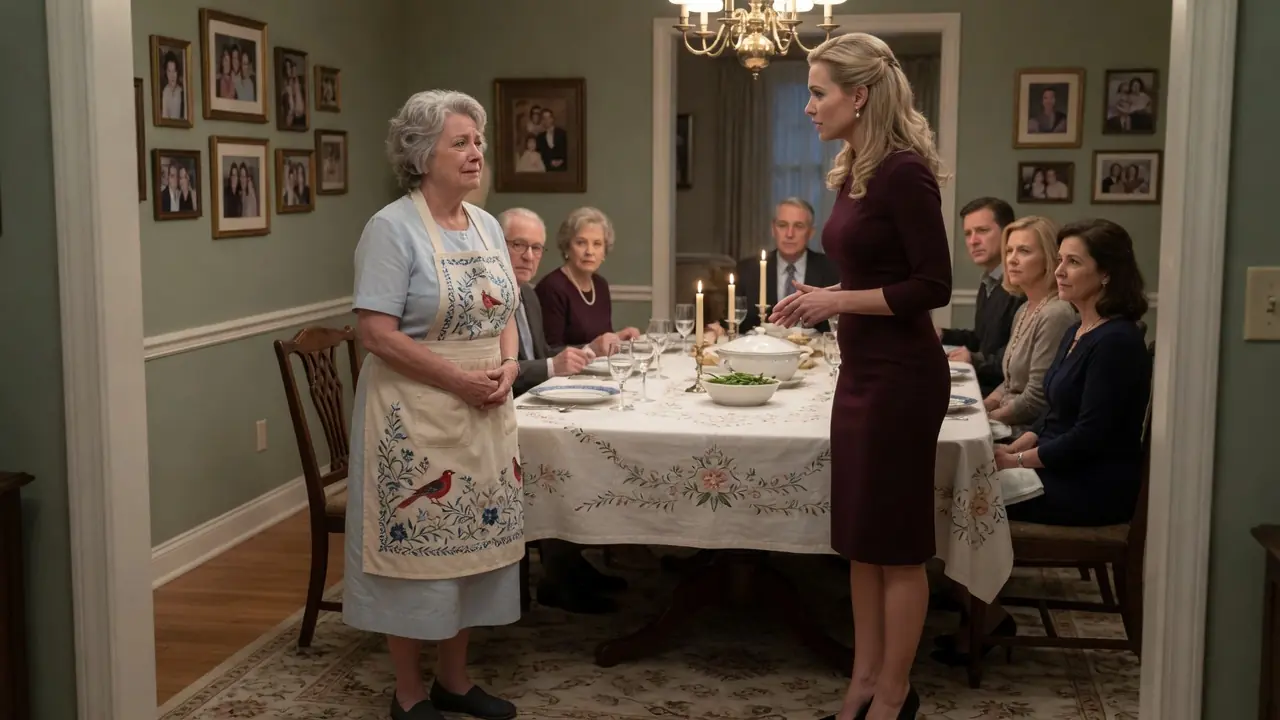
It all began one Sunday afternoon.
My daughter-in-law, Chelsea, organized a family dinner in my own house. Yes, in the house where I had lived with my son, Robert, since I was widowed five years earlier. Chelsea had been married to him for three years, and I had tried to be the perfect mother-in-law.
The one who did not offer opinions.
The one who did not get in the way.
The one who smiled even if something inside was breaking.
That afternoon, she walked into the kitchen while I was chopping parsley for the salad. She wore a wine-colored dress, high heels, and that look I knew well, the look that said, this is not your place.
“Mrs. Allen,” she said to me with a cold smile, “today I want this to be a special dinner. My parents are coming. My siblings too. It’s important to me, so you’d better not worry about a thing. I’ll take care of it.”
I nodded.
I always nodded.
I spent the afternoon in my room. I heard laughter, glasses clinking in a toast, and soft music.
No one called me.
At eight in the evening, when the smell of pot roast filled the entire house, I peeked out discreetly. The table was set with my embroidered tablecloths, my porcelain plates, and the candles I had bought years ago for special occasions.
But my chair was not there.
Chelsea saw me from the dining room. She approached slowly, like someone about to give an order to an employee.
“Mrs. Allen, it’s better if you eat in the kitchen. Today, I only want my family at the table.”
I stood motionless.
Then she said it louder so everyone could hear.
“Go eat in the kitchen, you shabby old woman. I only want my family at the table.”
The silence was so heavy that I felt the entire house stop.
I did not say anything.
I just clutched the embroidered apron my mother gave me forty years ago. The same one I used to make Robert’s breakfast when he was a little boy. The same one that smelled like strong black coffee and cinnamon rolls on cold mornings.
Then I turned around.
I walked toward the kitchen with my head held high.
But right then, I heard the front door open.
Robert had arrived.
Before I tell you what happened that night, I need you to understand what my life was like before Chelsea arrived, because you do not appreciate peace until you lose it.
Robert was born when I was twenty-five years old. His father, Harold, was a man of few words but hardworking hands. We had a simple life. Nothing was extra, but nothing was missing.
Every morning, I got up at five to prepare strong black coffee with cinnamon, the kind Harold liked to drink hot while reading the newspaper on the porch.
Robert would wake up to that smell. He would say it was the smell of home.
I remember when Robert was seven years old and helped me make pancakes. He would put on my apron, the same one I still used, and his little hands would be covered in batter.
He laughed.
I laughed.
Harold would watch us from the doorway and smile without saying anything.
Those moments did not need words.
When Robert turned eighteen, Harold died of a heart attack. It was a Tuesday afternoon. We were planting basil in the garden. He put his hand to his chest, looked at me, and was gone just like that.
So cruel.
Robert hugged me that night and said, “Mom, I’ll take care of things. You are not alone.”
And he kept his word.
He worked double shifts at the factory, studied at night, and graduated as an engineer. I never lacked for anything. He never let me feel like I was a burden.
On Sundays, we would have breakfast together. He would tell me about his projects, his dreams. I would serve his coffee the way he liked it, with little sugar and a lot of love.
The house smelled clean, like chicken noodle soup on Fridays, like freshly ironed laundry.
In the afternoons, I would water the plants while listening to the radio. My neighbor, Mrs. Peterson, would come over for tea. We talked about everything and nothing.
Life was simple.
Life was good.
Then Robert met Chelsea.
He arrived one Saturday with that silly smile men have when they fall in love. He introduced her to me in the living room.
She wore a tight dress, strong perfume, and long nails painted red. She shook my hand without looking me in the eyes.
“Nice to meet you, Mrs. Allen,” she said, with a smile that did not reach her eyes.
I made her coffee.
She did not touch it.
Robert was so happy that he did not see what I saw. That look that scanned my house as if she were calculating its value. That way she sat on Harold’s armchair, as if it were already hers.
But I kept quiet, because a mother wants to see her son happy.
Sometimes, for love, you close your eyes to what you already know is coming.
The following months were fast.
Courtship.
Wedding.
Honeymoon.
Chelsea moved into my house. Robert told me it was temporary while they saved up to buy their own place. I accepted. He was my son. It was my duty.
But from the first day, something changed.
The smell of strong black coffee was replaced by machine-made pods. My patio plants were moved because they were in the way. My radio was turned off because it made noise.
And my place at the table, my place at the table began to feel smaller and smaller.
I kept telling myself, it is just a phase. They will get used to it. Everything will be fine.
But things were not fine.
And that night of the dinner, that night everything exploded.
Cracks do not appear overnight. They grow slowly, like the roots of a tree breaking concrete without a sound.
At first, they were small things, so small that I thought, I am exaggerating. I am the one being difficult.
One morning, I went down for breakfast and found the kitchen locked. Chelsea came out of her room in a silk robe and said, “Mrs. Allen, you left everything messy last night. I’d better take care of the kitchen from now on. You rest.”
I had washed, dried, and put everything away.
But I did not say anything.
Robert had already left for work. He was leaving earlier and earlier. He was coming back later and later.
Another day, Mrs. Peterson came to visit me. She knocked on the door as she always did on Thursdays. I was in my room. I heard Chelsea open it.
“Mrs. Allen? No, she can’t see you. She’s busy. Maybe another day.”
Then she closed the door.
Mrs. Peterson never came back.
My plants, the ones I had cared for for years, were thrown in the trash one Saturday morning. Chelsea said they attracted mosquitoes.
Robert nodded without looking at me.
I picked up a pot of red geraniums from the trash and kept it in my room. I watered it with the tears I would not allow myself to cry in front of them.
I started cooking less.
Chelsea said my food was too greasy or too simple. She ordered takeout. Robert ate without saying anything.
I ate alone in my room, sitting on the edge of the bed with my apron on, even though I was not cooking anymore.
One night, I heard voices in the living room. I peeked out without making a sound.
“My love, your mom needs to understand that this house is ours now,” Chelsea was saying. “You can’t let her keep doing whatever she wants. It’s not her house anymore.”
Robert sighed.
“Give her time, Chels. She’s been through a lot.”
“And what about me? Don’t I have the right to feel comfortable in my own house?”
Silence.
Then Robert’s voice, tired.
“I’ll talk to her.”
But he never did.
I started leaving my room only when necessary. I walked through the house like a ghost. Sometimes Chelsea would look at me and smile.
But that smile was not kind.
It was a smile that said, I won.
On Sundays, we no longer had breakfast together. Robert slept late. Chelsea went out with her friends. I stayed in my room, looking out the window, caressing my apron, remembering when that house smelled like cinnamon and not expensive perfume.
One afternoon, I found a box in the hallway. Inside were my things, photographs of Harold, the books he gave me, my mother’s rosary, and my embroidered tablecloths.
I asked Chelsea about it.
“We just need some space, Mrs. Allen,” she said. “Don’t worry. Everything is there. We just put it away.”
They stored my life in a box.
I continued to keep quiet because I thought that if I made myself smaller, if I took up less space, if I stopped existing a little each day, maybe I could stay close to my son.
Maybe he would remember who I was.
Maybe he would see me again.
But things only got worse.
There is a difference between being patient and being a coward. It took me a long time to understand it.
During those months, I convinced myself that everything was my fault.
I am the one who cannot adapt, I would tell myself in front of the mirror. I am the one clinging to the past.
I saw my reflection and no longer recognized the woman I once was. My eyes were tired. My back was hunched.
My voice hardly existed.
I decided to make one last effort to be the mother-in-law Chelsea needed.
The one who did not get in the way.
The one who helped without being seen.
When I learned she was organizing the Sunday dinner, I offered, “Chelsea, if you want, I can make the homemade chili. It’s my grandmother’s recipe. Robert loves it.”
She did not even look up from her phone.
“No, Mrs. Allen. I already ordered everything from a caterer. Professional food, you know. I don’t want my parents to think we eat poorly.”
I swallowed.
“Can I help set the table, then?”
“Don’t worry. I’ll take care of it. You rest.”
Rest.
That word again.
As if I were an invalid old woman and not a sixty-two-year-old woman who could still make pancakes with her own hands.
On Saturday night, while they slept, I went down to the kitchen. I took out my apron, the embroidered one my mother made with her own hands, and I cleaned every corner.
I washed the dishes.
I arranged the flowers from the garden that were still left.
I polished the silver cutlery that belonged to my mother-in-law.
I wanted everything to be perfect. I wanted Chelsea to see that I could be useful, that I deserved a place in that house.
When I finished, it was four minutes past midnight. I sat in the kitchen with a cup of tea, looking at my work.
Everything was shining.
Everything smelled clean.
For a moment, I felt that I had recovered a small piece of my home.
On Sunday afternoon, Chelsea walked into the kitchen. She saw everything clean and frowned.
“You did this?”
I nodded, expecting a thank you.
“Mrs. Allen, I asked you to rest. I don’t need your help. Besides, you moved everything. Now I can’t find anything.”
Then she left.
I stood there with my apron on, feeling more invisible than ever.
At six in the evening, the guests began to arrive. Chelsea’s parents, her brothers, and her sister with her husband. They entered my house as if it were theirs.
No one greeted me.
No one asked about me.
I stayed in my room, listening to the laughter, the clinking of glasses, the noise of heels on the wooden floor.
Robert was late from work. Chelsea had called him three times. I knew because I heard her annoyed voice on the phone.
“Robert, everyone is waiting for you. Where are you?”
I peeked out my room window.
I saw the dining room lights on. I saw the table set with my tablecloths, my plates, my candles. I saw Chelsea laughing with her family, pointing at the house as if she had decorated it herself.
Then I saw it.
My chair was missing.
I counted the chairs around the table.
Nine.
They were all seated, but my place did not exist.
I felt something break inside me.
But I still told myself, maybe they forgot. Maybe I can sit somewhere else. Maybe.
I went down slowly with my apron on. I reached the dining room just as they were serving dinner.
Chelsea saw me.
Her face changed.
Then she said it with that cold voice I knew.
“Mrs. Allen, it’s better if you eat in the kitchen. Today, I only want my family at the table.”
The silence was so heavy that I felt the air solidify.
Then she spoke louder, so everyone could hear.
“Go eat in the kitchen, you shabby old woman. I only want my family at the table.”
The guests looked down.
No one said anything.
No one defended me.
I squeezed my apron. I felt my knees tremble.
But I did not cry.
I did not yell.
I just turned around.
And at that moment, the door opened.
Robert had arrived.
Sometimes you think you know your son, and then you discover that you knew him better than you thought.
Robert walked in the door with his briefcase in his hand. His tie was loose, his hair was messy, and he had that tired expression he had been wearing every night lately.
But when his eyes swept the scene, something changed in his face.
He saw me standing in the dining room doorway with my embroidered apron, my hands clenched, my back straight, and my eyes moist.
He saw Chelsea sitting at the head of the table in the place where his father used to sit, with that tense smile on her lips.
He saw the guests looking at their plates, uncomfortable.
And he saw my chair, which was missing.
He closed the door slowly.
No one said anything.
Chelsea quickly stood up, smoothing her dress.
“My love, you’re finally here. We were just starting dinner. Come, sit down. I saved your place.”
Robert did not move.
His eyes were still on me.
“What happened here?” he asked in a calm voice.
Too calm.
“Nothing, honey. You know your mother. She prefers to eat in the kitchen. She’s more comfortable there, right, Mrs. Allen?”
I did not say anything.
But I did not nod either.
Robert put his briefcase on the floor. He slowly took off his tie. Then he walked toward me.
“Mom, what happened?”
His voice was soft.
But there was something in his eyes I had not seen in months. Something that reminded me of the seven-year-old boy who defended the smaller kids in school. Something that reminded me of his father.
“Nothing, son. Don’t worry. I already ate.”
I lied.
“Mom,” he repeated, “what happened?”
Chelsea interrupted in a sharper voice.
“Robert, don’t make a drama. It’s just dinner. Your mother understands that today we needed space for my family.”
“Your family?” Robert said, turning toward her. “Your family?”
Chelsea laughed nervously.
“Yes, my love. My parents, my siblings. It’s a special dinner. Your mother understands.”
Robert looked at the table.
He counted the chairs.
Then he looked at Chelsea.
“Where is my mother’s chair?”
“Honey, it didn’t fit. There are too many people.”
“And where is my mother’s chair?” he repeated, louder.
The silence became heavy.
One of Chelsea’s brothers cleared his throat. Her mother adjusted her napkin, uncomfortable.
Chelsea tried to laugh.
“Robert, don’t overreact. It’s just dinner. We can talk about this later.”
“Chelsea,” Robert said, and his voice was ice. “Did you tell my mother to go eat in the kitchen?”
The silence was deafening.
“I just thought that—”
“Yes or no?”
Chelsea swallowed. Her eyes gleamed with contained rage.
“Yes, I told her. So what? This is my house too. I have the right to decide.”
Robert raised his hand, not to strike, just to ask for silence.
Then he said something I will never forget.
“If she doesn’t eat here, no one eats.”
Chelsea paled.
“What?”
“You heard me.”
Robert walked toward the head of the table where Chelsea was sitting. He pulled her chair back firmly.
“Get up.”
“Robert, you’re going too far.”
“Get up.”
Chelsea stood up, trembling with anger and humiliation.
Her parents looked at the floor. Her siblings did not dare to move.
Robert took the chair and brought it over to where I was. He placed it in front of me.
“Sit down, Mom.”
“Son, it’s not necessary.”
“Sit down.”
I sat down.
My hands trembled on my apron.
Robert led me to the head of the table. He made me sit in the place of honor, the place that had always been mine when his father was alive.
Then he did something that broke my heart and healed it at the same time.
He took a plate.
He served rice, homemade chili, and cornbread with his own hands, like when he was a child and I taught him to serve himself.
He put it in front of me.
“Eat, Mom. This is your house. This has always been your house.”
Tears began to fall down my cheeks, but this time they were not tears of pain.
Chelsea stood motionless with her fists clenched.
Then I saw something I had never seen before.
Her eyes filled with tears.
Tears of rage, humiliation, and something I could not decipher.
She ran toward the bedroom.
She slammed the door.
The guests started to get up, murmuring excuses.
“It’s late.”
“We have to go.”
“Thanks for dinner.”
No one looked at anyone.
In five minutes, everyone was gone.
Robert sat next to me. He took my hand.
“Forgive me, Mom. I should have opened my eyes sooner.”
I could not speak.
I just squeezed his hand.
There, at that table, in that house that had witnessed so much pain, we ate together like before.
Like it should have always been.
But I knew this was not over.
There are truths you do not want to see. And there are truths that, when you finally see them, change everything.
That night, after we ate, Robert washed the dishes. I tried to help him, but he told me, “Mom, you rest. I’ll take care of it.”
Rest.
But this time, the words sounded different.
Not like an order.
Like affection.
I sat in the living room with my apron still on, listening to the water running in the kitchen. The house was silent. Chelsea had not come out of the room.
I did not know what to feel.
On one hand, I felt a deep relief. My son had defended me. My son had seen me.
On the other hand, I felt fear.
Fear of what would come next.
Fear that this war was just beginning.
Robert came out of the kitchen drying his hands. He sat down next to me.
“Mom, I have to talk to you.”
I nodded.
“I hadn’t realized how bad a time you were having. I don’t know how I could have been so blind. Chels told me you preferred to be alone, that you didn’t want to socialize as much anymore, that it was a matter of age. And I believed her.”
His eyes were red.
“Forgive me.”
“You have nothing to forgive, my son. You work a lot. You—”
“No, Mom. I do have to forgive myself. You are my mother. You raised me alone after my father died. You worked cleaning houses so I could go to school. Do you think I don’t remember? I remember everything, and I repaid you by letting them humiliate you in your own home.”
His voice broke.
I put my hand over his.
“Robert, you love Chelsea. She’s your wife. I understand that.”
“But you are my mother.”
We fell silent.
A silence filled with everything we had not said for months.
Then we heard footsteps.
Chelsea came out of the room. Her eyes were swollen, her makeup smeared. She looked at us from the hallway.
“Are you done with your drama?”
Robert stood up.
“Chelsea, we need to talk.”
“No, you’ve talked enough. You embarrassed me in front of my family. Do you know the shame I went through?”
“The shame you went through?” Robert raised his voice. “And the shame you made my mother go through?”
Chelsea laughed, but it was not a happy laugh. It was a bitter laugh, full of venom.
“Your mother. Always your mother. Do you know what the problem is, Robert? You married me, but you never stopped being a mama’s boy.”
“That has nothing to do with—”
“It has everything to do with it!” Chelsea yelled. “I didn’t marry you to live with your mother. I didn’t marry you to be second in this house. I didn’t marry you to have a mother-in-law who watches me, judges me, and does everything better than me.”
“No one is judging you, Chelsea,” I said softly.
She looked at me with pure hatred.
“You’re always here with your apron and your victim face. Oh, I’m the poor little widow. Oh, nobody loves me. Oh, my son abandoned me. Do you think I don’t notice? Everything you do is so Robert feels pity. So he sees me as the bad guy. So he remains your little boy.”
“Chelsea, stop it,” Robert said.
“No. You know what? I’m sick of it. Sick of living in this old house. Sick of sleeping in the bed where your parents slept. Sick of using your grandmother’s dishes. Sick of everything. Absolutely everything here smelling like her.”
I felt as if I had been slapped.
Chelsea continued, and the words came out like daggers.
“When we got married, you promised me we would have our own home, that we would build something new. But no. Here we are in her house, with her rules, with her ghost in every corner.”
“This house is my mother’s,” Robert said. “It always has been.”
“Oh, yeah? And who pays the electricity? Who pays the water? Who pays for the food? You, Robert. You pay for everything. So whose house is it really?”
Robert paled.
I stood up slowly.
“Chelsea, if living here bothers you so much, I can leave. I can look for a small place.”
“No,” Robert yelled. “Mom, you’re not going anywhere. This is your house, and if someone has to go—”
But he did not finish the sentence.
Chelsea smiled, a cruel smile.
“Are you going to kick me out, Robert? Your wife? The woman you love? For her?”
Robert looked at the floor.
In that silence, I saw everything.
I saw my son divided between two loves. I saw his pain. I saw his guilt.
“I thought you loved me,” Chelsea whispered. Now her voice trembled. “I thought I was your priority.”
“You are, but—”
“There are no buts, Robert. You’re either with me or you’re with her. Decide.”
Then she left the house, slamming the door.
Robert collapsed onto the couch. He put his face in his hands.
I stood there clutching my apron, feeling that I had just seen something I should not have seen.
Something that broke me inside because I understood something in that moment.
Chelsea did not hate me for what I did.
She hated me for what I represented.
I was Robert’s past. I was his history, his roots, his memory. And she wanted to build a future where I did not exist.
A future where Robert was only hers.
Where nothing reminded him that before her, there had been a life, a home, a love that did not include her name.
Then I understood something else.
I had allowed everything.
Every humiliation.
Every scorn.
Every time I made myself small.
Every time I kept quiet.
Every time I accepted being invisible.
I had taught Chelsea that she could treat me that way.
I had taught her that my place was not worth anything.
I had taught her that I was not worth anything.
And worst of all, I had taught my son that it was okay.
I sat down next to Robert.
He still had his face in his hands.
“My son,” I said softly. “Lift your head.”
He did.
His eyes were full of tears.
“I don’t know what to do, Mom. I love her, but I can’t let her treat you like that.”
“I know.”
“What do I do?”
Right there, in that moment, I made a decision.
A decision I had been avoiding for months.
A decision that hurt but was necessary.
“Robert, I’m going to leave.”
“What? No, Mom. No.”
“Listen to me. Chelsea is right about something. This is your life. Your marriage. And as long as I am here, you won’t be able to build anything. There will always be this tension, this resentment.”
“But this is your house.”
“This was my house,” I said.
I felt something break in my chest.
“It was my house with your father. It was my house when you were a boy. But it’s not anymore. I can no longer live where I am not welcome.”
“I want you here.”
“I know, my son. But it is not enough.”
Robert cried.
My strong son, my engineer, my thirty-three-year-old man, cried like a child.
And I cried too, but in silence.
Because some tears are so deep they make no sound.
That night, I stayed awake until dawn. I looked at my room, the walls I knew by heart. The window from where I watched Robert grow up. The bed where Harold hugged me for the last time before he died.
The pot of red geraniums I had rescued from the trash.
And my apron.
My embroidered apron hanging on the back of the chair.
I took it in my hands. I ran my fingers over the embroidery my mother made, the blue flowers and red birds. An embroidery more than forty years old. An embroidery that had survived everything.
Then I understood.
I was not that apron.
The apron was just fabric, thread, memories.
But I was more than that.
I was Sarah Allen.
Sixty-two years old.
Widow.
Mother.
Woman.
And I was still alive.
I still had a voice. I still had dignity. And I was not going to keep begging for a place at any table.
The next day, Chelsea came back.
She walked in without greeting anyone. She went straight to the room with Robert.
I heard low voices.
Then silence.
Then Robert came out, looked at me, and left the house without saying anything.
Chelsea stayed.
She poured herself coffee, sat in the living room, and looked at me.
“Have you decided if you’re leaving yet?”
I looked her in the eyes.
“Yes. I’m leaving.”
She smiled, a smile of victory.
“Good. It’s for the best for everyone.”
But I did not lower my gaze.
In my silence, there was something she did not expect.
Peace.
Because I was not leaving defeated.
I was leaving with my head held high.
I was leaving because I decided to, not because she kicked me out. I was leaving because I chose my dignity over the crumbs of affection they threw at me.
In that moment, something changed.
I changed.
And Chelsea still did not know that life has a way of collecting debts, that the universe has a memory, and that no one, absolutely no one, gets away with things forever.
There is a difference between leaving and being expelled.
I learned that difference in the days that followed.
The morning after my decision, I woke up early. The house was still sleeping. I put on my apron, as I had always done for forty years, and went down to the kitchen.
I prepared strong black coffee, not because someone asked me to.
I did it for myself.
Because that smell of cinnamon, that steam that filled the kitchen, that ritual was mine, and no one could take it away from me.
I sat at the small kitchen table, the one that had always been my corner, and drank my coffee slowly.
I looked out the window.
The sun was just starting to rise. The patio, which had once been full of plants, was now just concrete and neglect.
But even so, something green was peeking through the cracks.
Wild mint surviving where no one cared for it.
Like me, I thought.
Chelsea came down an hour later. She saw me in the kitchen and frowned.
“What are you doing awake so early?”
“Drinking my coffee.”
“Did you make that smell again? I’ve told you a thousand times I don’t like it. It gives me a headache.”
I took another sip.
“It’s the last time.”
She fell silent.
Then she smiled.
“Do you have a date to leave yet? This week? Where are you going to go?”
“That doesn’t concern you.”
Her smile faded.
She was not used to me answering her like that.
“With that attitude, Mrs. Allen, I understand why no one wants you around.”
I stood up slowly.
I looked her in the eyes.
“Chelsea, for these three years, I made myself small so you could feel big. I kept quiet so you could speak. I disappeared so you could shine. But that is over. I am leaving, yes, but not because you kicked me out. I am leaving because I decided to. I am leaving because I deserve a place where my presence is not a nuisance. And someday, I hope it is not too late, you will understand that people are not furniture you put in the corner when you do not like them anymore.”
Chelsea paled.
“Are you threatening me?”
“No. I am just seeing you. Truly seeing you. And what I see is a woman who believes that love is won by destroying others. But love does not work like that, child. Love is not a territory you conquer. It is a garden you tend. And you only know how to uproot.”
I left the kitchen.
Chelsea remained motionless.
For the first time in three years, I had spoken, and my voice did not tremble.
The following days were strange.
Robert was barely home. He left early, came back late, and avoided my gaze.
I knew he was suffering. I knew my decision tore him apart, but I also knew it was necessary.
I started packing my things.
I did not have much.
A whole life fit into three cardboard boxes.
Clothes.
Some photographs.
My mother’s rosary.
The books Harold gave me.
And my apron.
I folded that one carefully and put it right on top, as if it were the most valuable thing.
One afternoon, while putting away my things, I found an old letter at the bottom of a drawer.
It was from Harold. He wrote it to me when Robert was five years old and I was sick with pneumonia.
The shaky handwriting said:
Sarah, my love, I don’t know how to write pretty things, but I want you to know that you are the strongest woman I know. If anything happens to me, take care of our son and take care of yourself, because you are worth more than you think. You always have been.
Harold.
I cried.
I cried like I had not cried in years.
I cried for Harold, for Robert, for myself. I cried for everything I had lost and for everything I was letting go of.
But when I finished crying, I wiped my tears, put the letter away, and continued packing.
On Wednesday evening, Robert knocked on my room door.
“Mom, can I come in?”
“Of course, son.”
He came in slowly. He saw the boxes, and his eyes filled with tears.
“I don’t want you to go.”
“I know.”
“Why can’t we fix this? The three of us, as a family?”
I sat on the bed. I motioned for him to sit next to me.
“Robert, do you remember when you were eight years old and you got into a fight at school?”
He nodded.
“It was a bigger kid. He was bothering you and your friends, and you stood up to him. You came home with a black eye and a torn shirt. And I told you, son, it is okay to defend yourself. It is okay to set boundaries. But it is also okay to walk away from fights that go nowhere.”
Robert listened in silence.
“This, what is happening here, is a fight that is going nowhere. Every day is a battleground. Every meal is tension. Every word is a wound. And I do not want to fight anymore. I do not have the strength for it anymore.”
“But I can change things. I can talk to Chelsea. I can—”
“No, son. You cannot change how Chelsea feels. You cannot force her to love me. Love cannot be forced. Respect cannot be begged for. And I am tired of being the inconvenience in my own home.”
Robert put his head on my shoulder like when he was a little boy.
“I’m going to miss you.”
“And I will miss you every day of my life.”
We stayed like that, hugging in silence, a silence that said everything we could not put into words.
“Where are you going to go?” he asked finally.
“Mrs. Peterson offered to let me stay with her temporarily. Her house is big. She lives alone since her husband died. I’m going to look for work, maybe caring for children or helping in someone’s home. Don’t worry about me. I know how to take care of myself.”
“Let me help you with money. Please, Mom. Please. It’s the least I can do.”
I nodded because I knew he needed to feel that he could help, that he could do something.
“But with one condition,” I said. “I don’t want Chelsea to know where I’m going. I don’t want pity visits. I don’t want you to come because you feel guilty. If you come to see me, let it be because you want to, because you miss me, not out of obligation.”
Robert nodded, although I knew it was difficult for him.
He stood up and kissed me on the forehead the way I used to kiss him when he was little.
“You will always be the strongest woman I know,” he said.
Then he left the room.
I stayed seated on my bed, looking at the boxes, feeling that I was saying goodbye to a whole life.
On Saturday morning, the time came for me to leave.
I dressed in my best clothes, a blue dress Harold had given me years ago. I carefully combed my hair. I put on a little lipstick because I was not going to leave that house like a beggar.
I was going to leave as what I had always been.
A dignified woman.
I put my apron over the dress one last time.
I took the boxes down one by one. Robert helped me load them into the taxi I had called.
Chelsea did not come out of her room.
She did not even say goodbye.
I did not expect her to.
Before getting into the taxi, I looked at the house.
The house where I got married.
The house where my son was born.
The house where Harold died.
The house where I was happy.
And the house where I became the most invisible woman in the world.
“Goodbye,” I whispered.
Robert hugged me tightly, as if he never wanted to let go.
“I love you, Mom.”
“I love you too, son. Always. No matter what.”
I released myself.
I got into the taxi.
Robert stood on the sidewalk watching me leave.
I did not look back, because I knew that if I did, I would not have the strength to move forward.
The taxi started. The streets passed before my eyes like a blurry movie.
I knew everything.
The bakery where I bought cinnamon rolls.
The church where I had Robert baptized.
The park where I took him to play when he was little.
The market where I bought vegetables.
My whole life was on those streets.
And now I was leaving them behind.
We arrived at Mrs. Peterson’s house. She was waiting for me at the door.
When she saw me, she did not say anything.
She just hugged me.
And in that embrace, I allowed myself to cry.
I allowed myself to be vulnerable.
I allowed myself to be weak.
“You’re home, Sarah,” she said in my ear. “You’re home.”
But it was not my home.
And I knew it.
The first few days were the hardest.
I would wake up at night and not recognize the bed. I heard strange noises. I missed my window, my bed, my routine.
I missed Robert.
I even missed the weight of the silence in my old house.
Mrs. Peterson was an angel. She made me tea. She kept me company. She let me cry when I needed to cry.
She did not ask questions.
She was just there.
One afternoon, while having coffee on her small patio, she said to me, “Sarah, do you know what the hardest thing about losing something is? You think you’ve lost the object, the house, the person, but what you’ve really lost is the version of yourself that existed in that place. And now you have to reinvent yourself. And that hurts.”
She was right.
I had not just lost my house.
I had lost my identity.
For years, I was Robert’s mom, Harold’s wife, the mother-in-law.
But now, who was I?
One night, I took out my apron.
The blue and red embroidery shone under the lamplight. I looked at it for a long time, and then I did something I never thought I would do.
I folded it.
I put it in the bottom of my suitcase.
And I did not use it again.
Because I understood something.
That apron represented everything I had been.
The wife.
The mother.
The one who served.
The one who cooked.
The one who sacrificed.
But I was no longer just that.
I was more.
And I needed to discover who Sarah was without that apron.
Sarah without a kitchen to care for.
Sarah without a family to feed.
Just Sarah.
And that woman still had a lot to discover.
Weeks passed.
Robert called me every third day. Brief, awkward conversations full of things we could not say to each other.
He asked how I was.
I asked about him.
Neither of us mentioned Chelsea.
It was as if she were a ghost between us.
I got a job helping a family. Nothing glamorous, cooking, cleaning, and looking after two small children. But the money was honest, and the lady, Mrs. Miller, was kind.
She treated me with respect.
And that was more than I had had in a long time.
One afternoon, while preparing dinner at Mrs. Miller’s house, one of the children, a six-year-old boy named Matthew, came up to me.
“Mrs. Sarah, do you have grandchildren?”
The question surprised me.
“No, my dear.”
“Why?”
“Because life is sometimes complicated.”
He kept thinking.
“My grandma lives far away,” he said. “But when she comes, she makes the best hot chocolate in the world. Do you know how to make hot chocolate?”
I smiled.
“Yes. I know how to make hot chocolate.”
“Will you teach me?”
And there, in that kitchen that was not mine, with that child who was not my grandson, I began to teach him how to make hot chocolate.
I taught him to stir the spoon in circles, to taste it to see if it needed more sugar, and to blow on it so he would not get burned.
As I did it, I felt something strange.
I felt I was healing.
Because I realized that my worth was not in being Robert’s mother. My worth was not in living in that house. My worth was not in being accepted by Chelsea.
My worth was in what I could give.
In my patience.
In my wisdom.
In my ability to love, even when I had been hurt.
That night, Mrs. Miller paid me and gave me a hug.
“Sarah, I don’t know what I would do without you. The children adore you, and I do too.”
I left that house feeling light, as if I had dropped a weight I had been carrying for years.
I walked the streets back to Mrs. Peterson’s house. The fresh air caressed my face. The sun was setting, painting the sky orange and pink.
I thought about Chelsea.
I thought about her victory.
I thought about how she had gotten what she wanted, getting me out of the house, keeping Robert, having her perfect family.
And I did not feel anger.
I felt pity.
Because life has a peculiar way of teaching, and the hardest lessons are for those who believe they can build their happiness on the pain of others.
I had lost my house. I had lost my place next to my son. I had apparently lost everything.
But in reality, I had gained something much more valuable.
I had gained my dignity.
I had gained my voice.
I had gained the ability to look at myself in the mirror and recognize myself.
And no one, absolutely no one, could take that away from me.
Life still had reserved for me the chance to see that outstanding debts are always collected and that the universe has a memory.
But that would come later.
There are moments in life when everything becomes clear, like when turbid water settles and you can finally see the bottom.
Three months passed since I left the house.
Three months in which I learned something fundamental.
Peace is not the absence of problems.
Peace is the absence of internal war.
I was no longer fighting with myself. I no longer woke up wondering what I had done wrong, why I was not enough, how I could have avoided everything that happened.
I simply existed.
And that was enough.
My routine was simple. I got up early, went to Mrs. Miller’s house, looked after Matthew and his sister Sophia, cooked, cleaned, and returned to Mrs. Peterson’s house.
In the afternoons, we sat on the patio to drink coffee and talk about life.
Sometimes we did not talk about anything.
We were just there, two older women who had survived so much, enjoying the comfortable silence.
Robert kept calling me.
At first, every third day.
Then every week.
Then every two weeks.
I understood that was how things were.
Life went on. He had his marriage, his work, his world, and I had mine.
In our calls, he never mentioned Chelsea, and I never asked.
I had decided something important.
I was not going to be the problem in his marriage. I was not going to be the bitter mother-in-law who spoke ill of her daughter-in-law. I was not going to be the reason for their fights.
Whether their marriage worked out or not, that was their story.
No longer mine.
One October afternoon, Robert called me with a strange voice.
“Mom, can I come see you?”
“Of course, son. When?”
“Is now okay?”
Something in his voice worried me.
“Yes. Come.”
He arrived an hour later. When I saw him get out of the car, I noticed he had lost weight. He had deep, dark circles under his eyes. His clothes, always impeccable, were wrinkled.
He hugged me hard, as if he were holding on to a life raft.
“What happened, Robert?”
We sat on Mrs. Peterson’s patio. She, with her wisdom as an older woman, left us alone.
Robert took a long time to speak. He looked at his hands, nervous.
“Mom, I think I made a mistake. Chelsea, she’s not the woman I thought she was. Or maybe she is, and I didn’t want to see it.”
“What happened?”
“After you left, I thought everything was going to be fine. That we were finally going to be happy. That we were going to build our life together without tensions, without problems. But…”
His voice broke.
“Everything got worse. Now I’m the problem. I don’t earn enough money. I don’t pay enough attention. I’m not romantic. I’m not this. I’m not that. Every day is a complaint. Every night is a fight.”
“I’m sorry, son.”
“The worst thing is that now I understand everything she did to you. Everything she said to you. And I’m ashamed. I’m ashamed that it took me so long to see it. I’m ashamed I left you alone.”
Tears ran down his face.
“Robert,” I said softly. “Look at me.”
He looked up.
“You are not responsible for what Chelsea did. But you are responsible for what you do now. Do you understand?”
He nodded.
“What should I do?”
And right there, in that moment, I had to make a decision.
I could tell him what he wanted to hear.
Leave her.
Come back to me.
She does not deserve you.
I could feed his pain, his confusion, his guilt.
Or I could do what a mother really does.
Help him find his own answer.
“Robert, I can’t tell you what to do with your marriage. That is your decision. The only thing I can tell you is this. Do not stay anywhere where you have to make yourself small so someone else can feel big. Do not accept crumbs of love when you deserve the full banquet. And do not confuse love with the fear of being alone.”
“Do you think she loves me?”
“I believe Chelsea loves the idea of what you represent. Security, status, a house. But loving a person is different. That involves respect, admiration, care. It involves wanting to see the other person grow, not clipping their wings.”
Robert was silent for a long time.
“Mom, do you forgive me?”
“For what?”
“For not defending you. For allowing her to treat you like that. For letting you go.”
I placed my hand over his.
“Robert, there is nothing to forgive. You are my son. I love you, and I know you did the best you could with the information you had at the time. We all make mistakes. The important thing is not to avoid making them. The important thing is to learn from them.”
“Did you learn anything from all this?”
I smiled.
“I learned that my worth does not depend on whether someone wants me at their table. I learned that I can survive without the house I loved so much. I learned that at sixty-two years old, I can still reinvent myself. And I learned that true love is not begged for. It is given freely, or it is not love.”
Robert hugged me again.
“I miss you, Mom.”
“I miss you too. But I’m fine.”
“Really?”
“I’m fine.”
He stayed a little longer. We drank coffee. I told him about Matthew and Sophia, about my job, about Mrs. Peterson. He told me about his work, about his projects.
We did not mention Chelsea.
When he left, I watched him walk away down the street.
I felt something strange.
I did not feel pity.
I did not feel anger.
I did not feel guilt.
I felt hope.
Hope that my son would find his way. Hope that he would learn what he needed to learn. Hope that someday, he would be free.
That night, I took my apron out of the bottom of my suitcase.
I spread it out on the bed. I ran my fingers over my mother’s embroidery, the blue flowers, the red birds, the threads that had survived so many years, so many washes, so much life.
Then I realized something.
That apron no longer hurt me.
It no longer represented everything I had lost.
Now it represented everything I had survived.
My mother embroidered it when she was young. She used it to cook for my father, for my siblings, for me.
Then I used it to cook for Harold, for Robert, for all the family Sundays, for all the holiday dinners.
Now that apron rested like me.
Like my need to serve.
Like my need to be loved.
Like my need to cook to be valued.
I did not throw it away. I was never going to throw it away.
But I was not going to use it again either.
I stored it carefully. I wrapped it in tissue paper. I put it in a box along with Harold’s photographs, the letter he wrote me, and my mother’s rosary.
They were memories.
Beautiful memories.
But they were no longer my identity.
I was Sarah Allen, and I was still writing my story.
In the following months, something curious began to happen.
Mrs. Miller asked me to teach her how to make my homemade chili. Then she asked me if I could make it for a party she was organizing. Then a friend of hers asked me to cook for her birthday.
Without planning it, without looking for it, I started cooking for events.
Small ones.
Nothing big.
But it was mine.
It was my decision, my time, my creativity.
For the first time in a long time, cooking did not feel like an obligation.
It felt like a gift I chose to give.
One afternoon, Mrs. Peterson said to me, “Sarah, do you realize what’s happening?”
“What?”
“You are blooming. Like those plants you had that Chelsea threw in the trash, you are blooming in new soil.”
She was right.
I had lost my house, but I had found my home.
And that home was not a place.
It was myself.
I did not know what was going to happen with Robert and Chelsea. I did not know if he was going to stay or leave. I did not know if she was going to change or get worse.
But I knew something with absolute certainty.
Life has a memory.
The universe collects its debts.
And no one who builds their happiness on the pain of others ends well.
I did not need to take revenge. I did not need to do anything.
I just needed to live.
To live well.
To live with dignity.
To live in peace.
And the rest would resolve itself, because that is how truth works.
It is not loud.
It is not violent.
It is not immediate.
It is silent.
It is patient.
It is inevitable.
And I could wait.
Life does not need our help to deliver justice.
It only needs time.
Six more months passed.
Almost a year since I left that house.
My life had found a quiet rhythm. I worked Monday to Friday with Mrs. Miller. On Saturdays, I cooked for small events. On Sundays, I went to church with Mrs. Peterson, and then we walked through the market.
My bank account had savings.
Modest, but mine.
I had started dreaming of renting a small apartment, something of my own, something no one could take away from me.
Robert visited me every two weeks. I never asked him directly about Chelsea, but I could see in his eyes that things were not going well.
He was thinner.
Quieter.
More subdued.
Until one day in March, he knocked on my door at ten in the evening.
Mrs. Peterson opened it.
He was standing there with a suitcase in his hand.
“Can I stay here tonight?”
I did not ask questions.
I let him in.
I made him chamomile tea.
We sat at the kitchen table.
“I left,” he said finally.
“For how long?”
“Forever.”
I felt something in my chest.
It was not joy.
It was not satisfaction.
It was sadness.
Sadness for my son, for his broken marriage, for his destroyed dreams.
“What happened?”
Robert took a deep breath.
“Mom, I gave her everything. Everything I could give. I worked double shifts to buy her the car she wanted. I changed jobs to earn more. I took her on trips. I gave her my whole salary. I stopped seeing my friends because she said I was spending too much time away from home. I stopped exercising because she said it took time away from her. I made myself small, smaller and smaller, until I no longer recognized myself in the mirror.”
His eyes were red.
“And it was never enough. There was always something more. There was always a complaint. There was always a reason why I was not enough. And today, she told me something that opened my eyes.”
“What did she tell you?”
“She told me, ‘I should have married someone with money, not you. I wasted my time.’”
Silence filled the kitchen.
“In that moment,” Robert continued, “I remembered something you told me months ago. That I shouldn’t stay anywhere where I had to make myself small so someone else could feel big. And I understood. I understood that I had been making myself small for years. And she was never going to feel big because her emptiness has no bottom.”
I put my hand over his.
“And how do you feel?”
“Sad. Scared. But also free.”
“That’s good, son. That is very good.”
He fell asleep on Mrs. Peterson’s sofa that night.
I stayed awake looking out the window, thinking about everything that had happened.
I did not feel triumph.
I did not feel like I had won.
I only felt a deep compassion for Chelsea because I understood something fundamental.
She had gotten what she wanted.
She had kept the house.
She had gotten rid of me.
She had Robert all to herself.
And yet, she had not been happy.
Because happiness is not built by destroying others.
Happiness is not found in control.
Happiness does not exist in the void left by mistreated love.
The following weeks were difficult for Robert.
He started the divorce. Chelsea did not accept it at first.
She called him crying, then yelling, then threatening, then begging.
But Robert held firm.
One afternoon, my son called me from work.
“Mom, can you believe Chelsea came to my office today? She made a scene in front of all my colleagues. She said I was abandoning her, that I was cruel to her, that she had given everything for me.”
“And what did you do?”
“I calmly took her outside, and I told her something I never thought I would say. ‘Chelsea, you didn’t give anything for me. You took. You took my time, my peace, my dignity, and now I need to recover.’”
“I’m proud of you.”
“She told me something strange, Mom.”
“What?”
“She said, ‘Your mother put ideas in your head. She destroyed our marriage.’ And I replied, ‘No, Chelsea. You destroyed our marriage the day you yelled at my mother to go eat in the kitchen. That day, I understood who I was married to. It just took me a while to have the courage to accept it.’”
I closed my eyes, not out of pain, but out of relief.
“Do you know what the saddest thing was, Mom?” Robert continued. “When I told her that, she didn’t apologize. She didn’t show remorse. She only said, ‘She deserved it. She was a nuisance.’ And that was when I realized there is no redemption there. There is no way to build anything with someone who cannot see the damage they cause.”
Two months later, Robert told me that Chelsea had to sell the house. She could not afford it alone.
Her family, the same family that had filled my dining room and said nothing when I was humiliated, did not help her either.
Everyone had their own problems.
She moved to a small apartment alone.
Robert started to heal slowly. He moved into his own apartment. He started exercising again. He started seeing his friends again.
He started smiling again.
And I continued with my life.
Quiet.
Serene.
At peace.
One day in November, almost two years after that dinner, I received an unexpected call.
It was Chelsea’s mother.
“Mrs. Allen?”
“Yes. Who is speaking?”
“It’s Amelia. Chelsea’s mother. I don’t know if you remember me.”
I remembered perfectly.
She was one of the people at that table. One of the ones who looked down when I was humiliated.
“What do you need?”
“I wanted to talk to you. Can we meet?”
Something in her voice sounded broken.
I accepted.
Not for her.
For me.
Because I had learned that facing things, looking them straight in the eye, was part of my healing.
We met at a coffee shop.
Amelia had aged. She had more gray hair, more wrinkles, more weight on her shoulders.
“Mrs. Allen, I don’t know how to start,” she said without looking me in the eyes.
“Start where you need to.”
“I want to apologize.”
I looked up, surprised.
“I apologize for not defending you that night. I apologize for staying silent. I apologize for raising a daughter who can be so cruel.”
Her eyes filled with tears.
“Chelsea is alone. Completely alone. She has no friends. The few she had moved away because it is very difficult to be near her. There is always something wrong. There is always a complaint. Always someone else to blame for her unhappiness. And I see an emptiness in her that scares me.”
“Why are you telling me this?”
“Because yesterday was her birthday. She turned thirty-three. And no one called her. Not her siblings, not her cousins, not her friends. Only me. And when I went to visit her at her apartment, I found her sitting on the floor crying. Do you know what she told me?”
I shook my head.
“She said, ‘Mom, why doesn’t anyone love me?’ And I did not know how to answer her.”
“Why?”
“Because she pushed everyone away herself. But she cannot see it. She cannot see that she is the cause of her own loneliness.”
Amelia wiped her tears.
“Then I thought of you. How she treated you. How we all treated you. And I felt shame. Deep shame. Because you were a good woman, a good mother-in-law, and we did not defend you. We let you go, and now I see the consequences.”
“Does Chelsea know you are here?”
“No. She still believes you are the problem, that you took Robert away from her.” She sighed. “It is no use. She will never understand.”
We fell silent.
“Mrs. Amelia,” I said finally, “I accept your apology. But not because I need to accept it to heal. I already healed. I accept your apology because I see that you need it to move forward.”
She nodded, crying.
“May I give you some advice?” I continued.
“Please.”
“You cannot save someone who does not want to be saved. Chelsea has to hit rock bottom. She has to face the consequences of her decisions. And only when she is there, alone with her own truth, can she decide whether she wants to change or not. But that is not your responsibility. You already did your job as a mother. Now it is her turn to do her job as an adult.”
Amelia took my hand.
“Thank you. Really, thank you.”
She left, and I stayed seated in that coffee shop, drinking my coffee, looking out the window.
I thought about Chelsea, alone in her apartment, without the house she wanted so much, without the husband she tried to mold, without friends, without family to support her.
I did not feel joy.
I did not feel satisfaction.
I felt sadness.
Because she had wanted to have everything so badly that she ended up with nothing.
She once yelled at me, “shabby old woman,” in front of everyone. She once told me I was not her family. She once made me feel that I had no worth.
Now, years later, she was experiencing that same emptiness, that same loneliness, that same rejection.
Life always collects its debts.
But it is not sweet.
It is not triumphant.
It is simply inevitable.
And I, who had lost so much, had gained the most important things.
My dignity.
My peace.
And the certainty that true love is never built on the pain of others.
Today, as I tell this story, three years have passed since that dinner.
Three years since my life changed forever.
I am sitting in my small apartment.
Yes, I finally managed to rent one.
It is modest. One bedroom, a kitchen, a bathroom.
But it is mine.
The walls are painted a soft yellow that I chose. The window curtain has embroidered flowers I made on the nights when I could not sleep. On the main wall hangs a photograph of Harold and Robert when my son was five years old.
Both smiling.
Both happy.
Next to me on the table is my apron.
That apron embroidered by my mother more than forty years ago. I took it out a few days ago, not to use it, just to look at it, to remember.
That apron saw my complete story.
It saw young Sarah, recently married, learning to make pancakes.
It saw Sarah, the mother, up all night preparing bottles.
It saw Sarah, the widow, crying while making coffee for one instead of two.
It saw humiliated Sarah clutching it with trembling hands while they yelled at her to go eat in the kitchen.
And now, that apron rests.
Like me.
Like my need to prove to someone that I am worthy.
My life is different now.
Quiet, simple, but profoundly mine.
I continue to work with Mrs. Miller. Matthew is nine years old now. Sophia is seven. They call me Grandma Sue, even though I am not their grandmother.
And when they call me that, I feel a warmth in my chest that I did not feel before.
Because before, I looked for love in places where it did not exist.
Now I find it in unexpected places.
In a child’s smile.
In Mrs. Peterson’s hug.
In the grocer’s good morning.
My small homemade food business grew. I no longer just cook for events. Now I sell food by order three times a week.
Enchiladas on Mondays.
Chili on Thursdays.
Pot roast on Saturdays.
I do not earn much, but I earn enough. And most importantly, I earn dignity.
Every dollar that goes into my account is mine.
No one gave it to me.
No one gave it to me out of pity.
I earned it.
Sometimes, when I am cooking in my own kitchen, with my music, at my own pace, without rush, without fear, without having to ask permission, I cry.
But they are different tears.
They are tears of gratitude.
Because I lost so much to gain this.
And it was worth it.
Robert and I see each other every week. He is still healing. He no longer has those deep, dark circles under his eyes. He no longer walks hunched over. He no longer apologizes for existing.
He tells me about his life, his work, and a girl he met a few months ago.
“We’re just friends, Mom,” he tells me with that shy smile.
But I see something in his eyes that I had not seen in years.
Hope.
“Do you know what I learned from all this, Mom?” he asked me last Sunday while we ate together in my apartment.
“What did you learn?”
“I learned that love shouldn’t hurt. That peace is not boring. It’s necessary. That being alone is better than being accompanied by someone who makes you feel alone. And I learned that you are the bravest woman I know.”
“I’m not brave, my son. I just survived.”
“No, Mom. Surviving is staying alive. You did more than that. You reinvented yourself. At sixty years old, you started over. Do you know how many people can do that? Very few.”
His words filled me with something I could not describe.
It was not pride.
It was recognition.
The recognition that my pain had a purpose, that my fall had meaning, that my rising meant something.
Sometimes I think about Chelsea, not with anger, not with resentment, just with a deep compassion.
According to Robert, because he still has some contact with her family, Chelsea is still alone. She changed jobs three times in two years. Not because she was fired, but because there was always something she did not like.
There was always an unfair boss.
A problematic colleague.
A toxic environment.
And I understand something I did not understand before.
Chelsea is not evil.
Chelsea is broken.
And she never learned to heal.
She learned to blame. She learned to demand. She learned to take.
But she never learned to give.
She never learned that love is cultivated.
It is not uprooted.
Do I feel sorry for her?
Yes.
Do I wish things were different?
Maybe.
Do I regret leaving?
No.
Never.
Because I understood something fundamental.
You cannot save yourself by sacrificing yourself. You cannot find peace by giving up yourself. You cannot be happy by being invisible.
And I was invisible for a long time.
Too long.
A few months ago, a lady came to buy enchiladas from me. It was her first time. She told me a friend had recommended them.
As I gave her order, she asked me, “Do you make them alone?”
“Yes, ma’am. Just me.”
“And what is your business called?”
I paused.
I had never named it. It was just Mrs. Sarah’s enchiladas.
But in that moment, something came to my mind.
“It’s called The Stored Apron,” I said.
She smiled without understanding.
But I understood.
The stored apron.
The symbol that I no longer needed to serve to be loved. I no longer needed to cook to be valued. I no longer needed to disappear so others could shine.
Now when I cook, it is because I want to, because I enjoy it, because it is my art, my therapy, my gift to the world.
But on my terms.
In my time.
In my space.
There is something I want to say to anyone who feels invisible in their own house, to anyone who has been made to feel they are in the way, not worthy, too much, or not enough.
You are worthy not for what you do, but for who you are.
Not for what you cook, what you clean, what you give, or what you sacrifice.
You are worthy simply because you exist, because you breathe, because you have a unique story that no one else can tell.
And if you are in a situation where your voice, your space, and your dignity have been taken away from you, you have two options.
Stay and make yourself smaller and smaller until you disappear.
Or leave.
Leave with fear.
With pain.
With uncertainty.
But with your dignity intact.
I left.
It was the hardest thing I ever did in my life.
But it was also the bravest.
Do I have everything figured out?
No.
There are still tough days. Days when I miss my house. Days when I wonder what would have happened if I had stayed, if I had endured a little longer.
But then I look around.
I look at my small apartment, full of peace. I look at my modest but honest business. I look at my relationship with Robert, no longer tinged with guilt, but with genuine love.
And I know I did the right thing.
Because life is not about having the biggest house or the most perfect family.
Life is about having peace.
And peace is not found outside.
It is found inside.
A few days ago, Mrs. Peterson told me something beautiful. We were having coffee on her patio as we always do on Sundays.
“Sarah,” she told me, “when you came to my house three years ago, you looked like a little bird without wings. Scared, hurt, lost. And now I look at you and I see an eagle.”
I laughed.
“An eagle? Oh, Peterson, you exaggerate.”
“I do not exaggerate. An eagle that had to learn to fly again. That had to heal. That had to remember it always had wings. It had just forgotten how to use them.”
She was right.
I forgot who I was.
I forgot that I am more than a mother, more than a wife, more than a mother-in-law.
I am Sarah.
Sarah Allen.
Sixty-five years old.
And I still have a lot of life ahead of me.
I did not tell this story to elicit pity.
I told it to give hope.
Hope that no matter what age you are, you can always start over.
Hope that loss, although it hurts, can be the beginning of something better.
Hope that dignity is never lost if you carry it within.
And most importantly, hope that life does deliver justice.
Maybe not when we want it.
Maybe not how we expect it.
But always, always, the truth comes to light.
People who love with cruelty end up with the loneliness they sow.
I did not need to take revenge. I did not need to do anything.
I just needed to leave, heal, and live well.
And that was the best revenge.
Although it was not revenge.
It was justice.
The silent justice of the universe that rewards those who maintain their dignity.
I end this story with a thought.
My apron is still stored away. I no longer use it, but I did not throw it away either because it represents my history.
And although that history had painful chapters, it also had beautiful chapters.
Someday, when I am gone, that apron will belong to Robert. I hope he gives it to his daughter if he ever has one. And I hope he tells her the story of her grandmother.
Not the story of the woman who was humiliated.
But the story of the woman who stood up.
Because that is what we are.
Stories.
Stories of falls and rises, of losses and encounters, of pain and healing.
And my story did not end that night at the dinner.
My story was just beginning.
Because sometimes, to find yourself, you first have to lose yourself.
And I got lost.
But I found myself.
And now I am more myself than ever.