I got back from the grocery store, and my clothes were on the floor.
My daughter-in-law smiled and said she was making room for her things.
I answered her, “Then I am going to make room too, in this house without you.”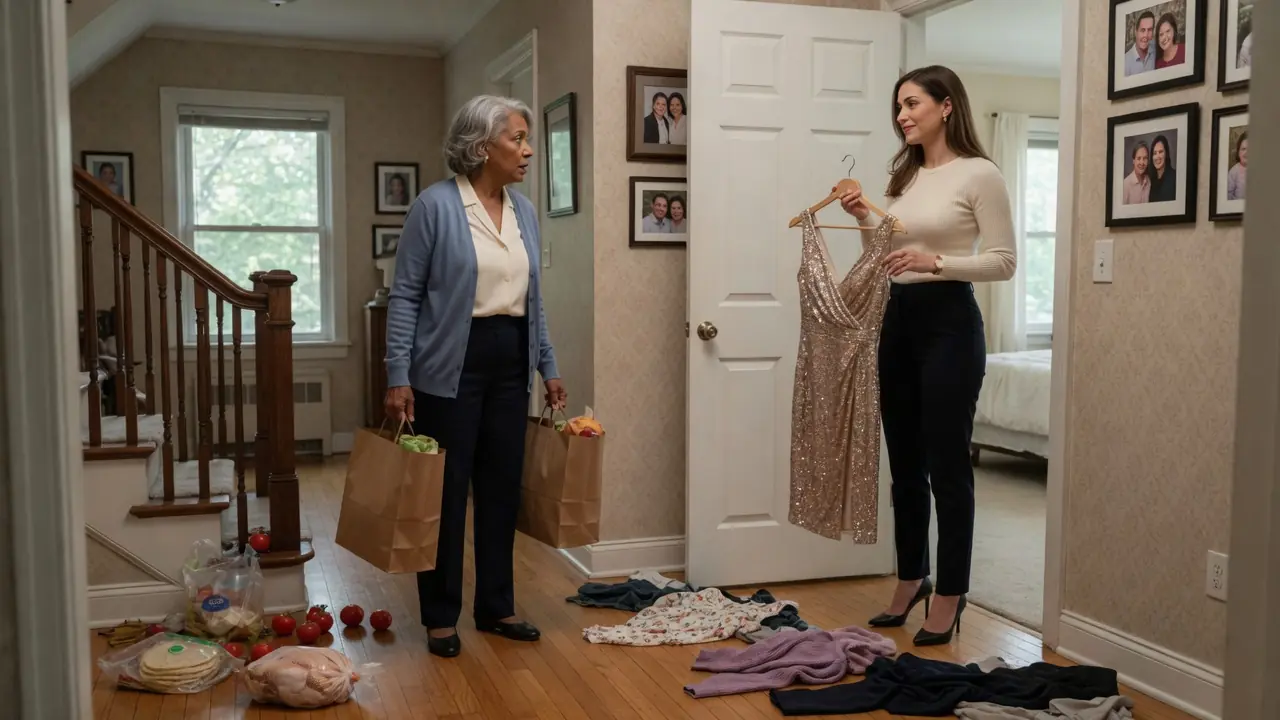
That smile vanished in seconds.
My hands were shaking as I held the grocery bags. Six and six-tenths pounds of tomatoes, a whole chicken, freshly made tortillas, everything I had bought to make the meal my son Robert had loved since he was a kid.
I walked up the stairs slowly because, at sixty-eight years old, my knees were not what they used to be.
When I got to the second floor, my heart stopped.
There, thrown in the hallway like old rags, was all my clothing. My blouses, my slacks, my Sunday dresses, the knitted cardigan my husband gave me before he passed away. All wrinkled, stepped on, piled against the wall as if it were trash.
And the door to my bedroom, the one that had been mine for forty years, was wide open.
Inside, my daughter-in-law Valerie was moving hangers back and forth with the nonchalance of someone in her own home. She was hanging her expensive dresses in my closet, arranging her high heels on my shelves, humming a song as if nothing was wrong.
The bags fell from my hands.
“What are you doing?”
My voice came out cracked, barely a whisper.
She turned around and smiled.
That smile, I will never forget.
Cold.
Calculating.
Victorious.
“Oh, Mary, you’re back,” she said. “I was just making room for my things. This bedroom has better light, you know, and the closet is much bigger. Robert and I need more space now that we’re thinking of having a baby.”
I felt as if a knife had been plunged into my chest.
My bedroom.
The bedroom where my husband and I slept for thirty-five years. Where he died holding my hand just three years ago. Where I still kept his watch on the nightstand because I could not bring myself to give it away.
“This is my house,” I said, and my voice started to regain its firmness. “My bedroom.”
Valerie let out a little laugh, a little laugh that made my blood boil.
“Oh, mother-in-law, don’t be like that. We all live together, don’t we? Besides, you’re getting older. The downstairs bedroom is more comfortable for you. No stairs. This is for your well-being.”
Something broke inside me at that moment.
It was not my heart.
It was something deeper.
It was my patience, my boundless kindness, my habit of bowing my head and smiling even as I was being trampled.
I walked toward her slowly, very slowly. When I stood face-to-face with her, looking into those green eyes that had so thoroughly deceived my son, I said with a voice I did not recognize as my own, “Then I am going to make room too, in this house without you.”
Her smile froze.
Then it disappeared like a candle suddenly blown out.
“What did you say?”
“What you heard, Valerie. You are going to take your things out of my closet. You are going to pick up my clothes from the floor. Then you and I are going to have a very long conversation about who is in charge of this house.”
For the first time in eight months since this woman came into my life, I saw fear in her eyes.
But I did not yet know what was coming.
I did not know that this moment, this return from the grocery store with full bags and a broken heart, was just the beginning of the worst battle of my life. A battle where I would discover that my own flesh and blood, my only son, was willing to betray me in ways I never imagined.
But first, I need to tell you how I got to that moment.
How I let things go that far.
And believe me when I tell you that every woman who hears me will recognize something of her own story in mine. Because all of us, at some point, have loved so much that we forgot to love ourselves.
I met Valerie on a Tuesday in April two years ago.
Robert came home earlier than usual with that nervous smile he had worn since he was a kid whenever he wanted to ask me for something important. He had a tall, thin woman on his arm with perfectly straight hair and long nails painted red.
“Mom, this is Valerie,” my son said with sparkling eyes. “She’s very special to me.”
I was preparing barbecue chicken, the kind I make well because I use the special smoky sauce from my family’s recipe. I wiped my hands on my apron and held out my hand to greet her.
Valerie gave me a light air kiss on both cheeks, one of those fake kisses that barely brush the skin, and smiled, showing very white teeth.
“Mrs. Mary, what a pleasure to finally meet you. Robert talks about you so much. And what a cozy house.”
The word cozy sounded as if she really meant outdated, but I ignored it.
I wanted my son to be happy.
He had been alone for three years after he broke up with Patricia, that sweet girl who was studying nursing and who I, foolish me, thought would be my daughter-in-law.
During that first meal, Valerie barely touched the barbecue chicken. She said she was watching what she ate for an event. She talked a lot about her job at a marketing agency, about the important clients she handled, about her trips to Miami and San Diego.
Robert looked at her as if she were an angel descended from heaven.
I wanted to believe her.
I really wanted to believe her.
The months passed. Robert started coming less often for Sunday dinners. When he did come, it was always with Valerie, and she always had an excuse not to stay long.
“We have a dinner with his bosses.”
“We need to look at some apartments.”
“We’re meeting my parents.”
Then one night in December, Robert showed up without warning. He knelt in front of me in the living room, where I was knitting a sweater while watching my soap opera, and told me, “Mom, I’m getting married. I proposed to Valerie, and she said yes.”
My heart skipped a beat.
Happiness mixed with something I could not identify then, something that tightened in my stomach.
“Son, that’s wonderful,” I said, and hugged him tight. “Your father would be so proud.”
“I want it to be a beautiful wedding, Mom, like the one you and Dad had. Valerie deserves the best.”
And that was where it all started.
The planning of that wedding cost me my savings.
Valerie wanted the ballroom at the Ritz-Carlton Hotel. She wanted three hundred guests. She wanted imported flowers and a dress from a boutique in Beverly Hills.
Her family, Robert explained with some embarrassment, was going through a difficult time and could not contribute much.
“How much do you need, son?” I asked one afternoon as we were having coffee in my kitchen.
Robert looked into his cup. He would not look me in the eye.
“About one hundred eighty thousand dollars, Mom. I have ninety thousand saved, but with the down payment on the apartment we’re looking at, I can’t afford everything.”
One hundred eighty thousand dollars.
Almost half of what my husband and I had saved over thirty years of working.
He had worked as an accountant. I had taught sewing classes at home. It was money we kept for emergencies, for my old age, to leave something for Robert when we were no longer around.
“It’s fine,” I said. “It’s your wedding. Your father would have wanted it to be special.”
I saw my son’s face light up.
He hugged me so tightly I could barely breathe.
“Thank you, Mom. I promise I’ll pay you back. When we get settled, I’ll return everything.”
I went to the bank the next day. I withdrew one hundred eighty thousand dollars from my savings account.
I gave the check to Robert, and he took it with trembling hands. He kissed me on the forehead. He told me I was the best mother in the world.
The wedding was in March, a sunny Saturday.
Valerie looked beautiful in her white beaded gown. Robert could not stop smiling.
I cried throughout the ceremony, sitting in the front row, holding my husband’s photograph in a silver frame on my lap because he should have been there.
At the reception, Valerie’s mother, a thin woman with too much makeup, approached me with a glass of champagne in her hand.
“Mary, thank you for making this beautiful wedding possible. We’re going through difficult times, you know, but Valerie deserves the best. She’s always been a girl with refined tastes.”
I smiled and nodded, although something in her words bothered me.
Refined tastes.
Was that code for expensive and spoiled?
After the honeymoon in Hawaii, a week that Robert also paid for with loans, the young couple returned. Two weeks later, my son appeared at my door with a proposition.
“Mom, can we talk?”
I made coffee. We sat at the kitchen table, the wooden table where he had done his homework as a child, where he had blown out the candles on all his birthday cakes.
“The apartment we wanted fell through,” Robert said, stirring sugar into his coffee without looking at me. “The owner sold it to someone else who offered more money. And rents are crazy expensive, Mom. Twelve thousand, fourteen thousand for a decent place.”
I waited.
I knew what was coming.
“So, how would you feel if Valerie and I stayed here with you? Just for a while. Six months. A year maximum. That way we can save up for the down payment on something better. This house is big. Three bedrooms. We have plenty of room.”
My house.
The house my husband bought in 1983 when Robert was a baby. The house where we grew up as a family. The house with the garden where we planted rose bushes together. The house full of memories in every corner.
I looked at my son, my only son, the child I breastfed, the child I cared for when he had chickenpox, the child I hugged when he failed math in high school, the child I encouraged when his first girlfriend left him.
How could I say no to him?
“It’s fine, son,” I said. “You can stay. It’s your house too.”
Robert jumped up and hugged me.
“Thank you, Mom. You don’t know how much this means. Valerie is going to be so happy.”
But when Valerie arrived that night to see her new temporary home, her expression was not exactly one of happiness.
It was more like an evaluation.
She walked through the rooms, touching the walls, looking at the furniture, analyzing every space like a real estate inspector.
“It’s cozy,” she said again, using that word I was beginning to hate. “Though we’ll need to modernize some things, right, honey?”
And Robert, my son, who had once defended this house from his friends’ teasing, saying it had history, only nodded.
“Yes, my love. We can make some changes.”
That night, after they left to sleep at a hotel while they brought their things over the next day, I sat in the dark living room. My husband’s photograph looked at me from the mantelpiece. In it, he was smiling with his trimmed mustache and his eyes full of life.
“I don’t know if I did the right thing, honey,” I whispered to him. “But he’s our son. What else could I do?”
If my husband had been alive, if he could have answered me, I know exactly what he would have said.
Mary, a mother’s love does not mean letting people walk all over you.
But I did not understand it yet.
I still believed that love and sacrifice were the same thing.
The first two months were tolerable.
That was the word.
Tolerable.
Like when a shoe pinches, but not so much that you have to take it off.
But the shoe would start to hurt very soon.
And I did not yet know that the deepest wounds would come from the people we love the most.
The first change was subtle. So subtle that I almost let it go.
One morning, I went down to make coffee and found my entire kitchen reorganized.
The plates that had always been in the top cabinet were now on the bottom. The mugs I kept next to the coffee maker had disappeared. The pots that had been hanging in their spot for twenty years were tucked away in a cabinet I could barely reach.
Valerie appeared in designer sweats and a workout top, her hair pulled back in a perfect ponytail.
“Oh, good morning, Mary. I reorganized a bit. The previous arrangement wasn’t functional at all. Now everything is more accessible. See, according to feng shui, the energy flows better this way.”
I opened my mouth to protest.
To say that I had cooked in that kitchen for forty years and knew exactly where everything was. That I did not need feng shui or modernity. That it was my kitchen.
But then I saw Robert walk in, kiss Valerie on the cheek, and tell her, “It’s great that you’re making the house more practical, my love.”
The words got stuck in my throat.
A week later, I came back from church one Sunday, and the living room curtains were gone.
Those burgundy curtains that I had custom made with fabric I chose at the shop near the market had been removed. In their place hung modern, minimalist gray curtains.
“Do you like them?” Valerie asked, admiring her work. “I bought them at Macy’s. The others were so dated, Mary. They made the living room look dark and sad. This is much fresher, don’t you think?”
No, I did not think so.
Those burgundy curtains had been chosen by my husband. He said they reminded him of the red wine we drank on our honeymoon in Napa Valley.
“How much did they cost?” was the only thing I could ask.
“Oh, not much. Three hundred fifty dollars, but they were on sale. Robert gave me permission to use the card.”
Three hundred fifty dollars on curtains without asking me, in my house.
I swallowed and did not say anything.
The changes continued like a silent avalanche.
The rug by the entrance disappeared because it collected dust. The painting of the Virgin Mary that hung in the dining room was moved to the hallway because it broke the aesthetic. The family photographs on the living room mantel were put in a box because there were too many and it looked cluttered.
Every time I wanted to say something, Valerie had a perfect explanation, a smile, a justification wrapped in words like practicality, modernity, better energy.
And Robert always agreed with her.
Always.
But what really started to hurt was something else.
One afternoon, Valerie invited three of her friends over to drink wine in the living room. She did not tell me. I was in my bedroom sewing, and suddenly I heard laughter and music.
I went downstairs and found four women with wine glasses, cheese, and ham appetizers I had bought for the week, laughing and talking about their jobs.
“Oh, Mary, come in,” Valerie said when she saw me at the door. “These are Andrea, Sophia, and Danielle. Girls, this is Robert’s mom.”
Robert’s mom.
Not the owner of the house.
Not her mother-in-law.
Just Robert’s mom.
As if I were just another piece of furniture.
“Nice to meet you,” I said, forcing a smile.
“Oh, what a lovely house you have, Valerie,” said one of them, a woman with designer glasses. “I love how you’ve decorated it.”
How she had decorated it.
As if it were hers.
As if I had not lived there for forty years.
“Do you want some wine, Mary?” Valerie offered.
It was my wine from my cellar, in my living room, but I felt like a guest asking for permission.
“No, thank you. I’m going upstairs.”
I went up the stairs, feeling the laughter resume downstairs.
I heard one of them say, “How lucky you are to live in such a big house without paying rent.”
Then Valerie laughed, clear and satisfied.
That night, I could not sleep.
But the worst was yet to come.
The worst arrived one Tuesday afternoon.
I went into my bedroom looking for my pearl necklace, the one my husband gave me on our twenty-fifth anniversary. I always kept it in the little blue velvet box in the first drawer of my dresser.
It was not there.
I looked in all the drawers.
Nothing.
My heart started beating fast.
That necklace was worth more than fifteen thousand dollars, but its sentimental value was incalculable.
I ran downstairs.
“Valerie, have you seen my pearl necklace?”
She was painting her nails at the dining room table with cotton balls and colorful little bottles spread all over.
“Which necklace?”
“The pearl one. My white pearl necklace. It’s always on my dresser.”
“Oh, yes,” she said with complete nonchalance. “I lent it out.”
My blood ran cold.
“You lent it out?”
“Yes, for my cousin’s wedding. She needed something elegant, and I remembered you had that beautiful necklace. Don’t worry. She’ll give it back next week.”
“Valerie,” my voice trembled, “my husband gave me that necklace. It is not for lending.”
She stopped painting her nails and looked at me as if I were an overly dramatic child.
“Oh, Mary, don’t be dramatic. It’s just a necklace. My cousin will take care of it. Besides, you never wear it. It was just sitting there collecting dust.”
“Because it’s a keepsake,” I exploded. “You can’t take my things without permission.”
Just then, Robert walked in from outside with his briefcase and a tired face.
“What’s going on here?”
Valerie immediately stood up, her eyes teary.
I did not even know she could cry that fast.
“Your mom is yelling at me for lending a necklace to my cousin. I just wanted to be nice and share something pretty, but she’s treating me like I’m a thief.”
My son looked at me.
In his eyes, I saw something that broke my heart.
Disappointment.
“Mom, it’s just a necklace. Valerie will give it back.”
“Robert, that necklace was your father’s. He gave it to me. It is not just a necklace.”
“I know, Mom, but Valerie didn’t know. It doesn’t have to be this serious. We all live together. We share things, right?”
Share.
That word burned me.
“No, son. We don’t share because this is my house and those are my things.”
The silence that followed was thick and uncomfortable.
Robert exchanged a look with Valerie, a look I could not decipher, but it made me feel like a stranger in my own home.
“Fine, Mom,” my son finally said, his voice tired. “Valerie will tell her cousin to return the necklace. Are you happy?”
I was not happy.
I was broken.
But I nodded.
Valerie stomped up the stairs, clearly offended. Robert looked at me once more, shook his head, and followed her.
I was left alone in the dining room, looking at the nail polish bottles scattered on my table.
That night, lying in the dark, I heard voices from the other side of the wall. Robert’s room was next to mine, and the walls of that old house were thin.
“Your mom is impossible,” Valerie was saying. “Everything bothers her. I can’t even breathe without her getting offended.”
“I know it’s hard, my love,” my son replied. “But give her time. She’ll get used to it.”
“Get used to what, Robert? To the fact that this is our house too? Because it seems like she still treats us like guests.”
There was silence.
“Sometimes I think,” Valerie continued, her voice sounding deliberately fragile, “that it would be better if we had our own space without having to ask permission for everything, without feeling like I’m invading.”
“We’ll have it, my love. We just need to save a little more.”
“And what if this house were ours completely? I mean, your mom is getting older, Robert. Someday, well, someday it will be yours anyway, and we could take better care of it. Do the renovations it needs.”
My heart stopped beating.
“Valerie, I can’t ask my mom for that.”
“I’m not saying you ask her. I’m just saying you think about the future. About our future. About our children when we have them. Are they going to grow up sharing a house with their grandma without their own space?”
I waited.
I waited for my son to defend my place, to say this was my house and that I had the right to live in it until my last day.
But what he said was, “You’re right. I’ll think of something.”
I closed my eyes tightly, tears rolling down my cheeks and wetting the pillow.
There, in the darkness, I understood something terrible.
I had opened my house, my space, my refuge, to people who did not see a temporary home. They saw a property, a prize, something to be taken.
And I had been too blind, too kind, too much of a mother to see it.
But the real pain, the kind that would completely destroy me, was still to come.
The following weeks were like living in a house I no longer recognized.
And the worst thing was that I started to feel like I was the intruder.
One Friday night, Valerie and Robert hosted a dinner party. They did not tell me until that very afternoon, when I had already prepared chicken soup for the three of us.
“Oh, Mom, don’t worry about cooking,” Robert said as he tied his tie in front of the hallway mirror. “Some of Valerie’s coworkers are coming over. She already ordered sushi.”
“How many people are coming?”
“About eight.”
Eight people in my dining room without anyone asking me.
“Robert, I already cooked. I made your favorite soup.”
My son sighed as if I were an annoying child.
“Mom, save it for tomorrow. Tonight is important. Valerie’s boss is coming, and we need to make a good impression.”
Make a good impression in my house, with food they ordered, while my soup cooled on the stove.
When the guests arrived, I retreated to my bedroom, but hunger forced me to go downstairs around nine in the evening. I needed a glass of water at least.
The scene I found in my dining room took my breath away.
Eight people were laughing and drinking wine around the table. Plates of sushi, sashimi, and rolls covered the tablecloth. Empty wine bottles were already on the kitchen counter.
At the head of the table, where my husband always sat, where I had set his place for a year after his death because I could not accept that he was gone, there sat a burly man in an expensive suit.
Valerie’s boss.
In my husband’s place.
No one noticed when I entered the kitchen. I grabbed a glass, filled it with water with trembling hands, and as I was about to leave, I heard Valerie’s voice.
“Oh, that’s Mary, Robert’s mom. She lives with us.”
She lives with us.
As if I were the one crashing.
As if this were not the house my husband bought with the sweat of thirty years of work.
One of the women smiled at me with pity.
“How sweet that you take care of your mom, Robert. Not all sons do that.”
That he takes care of me.
As if I were a burden, a helpless old woman who needed charity.
I went up the stairs, feeling like every step weighed a thousand pounds. I locked myself in my room with the glass of water untouched on the nightstand, and I cried myself to sleep.
But that was not the worst of it.
The worst arrived one Tuesday morning.
I went down early to make coffee and found the kitchen a disaster.
Dirty plates, glasses with leftover drinks, the sink full of dishes from the night before’s dinner. Another one of their gatherings that I no longer even bothered to attend.
I started washing up because it was my habit, because I could not stand to see my kitchen like that.
Because even if it hurt to admit it, it was still my house, and I needed to keep it dignified.
Valerie appeared at ten in silk pajamas, yawning.
“Morning, Mary. Oh, thanks for doing the dishes. You’re a doll.”
I did not answer.
I kept washing.
“By the way,” she continued, pouring herself a glass of orange juice I had squeezed, “some people are coming today to give us a quote for remodeling the kitchen. Robert and I thought it would be good to modernize it. These cabinets are so old.”
I dropped the plate I was washing.
Luckily, it did not break.
“Remodel my kitchen?”
“Well, we live here too, don’t we? And this kitchen is so dark, so old-fashioned. We want to put in white cabinets, a breakfast bar, and get rid of that old pantry.”
“My husband built that pantry with his own hands,” I said, and my voice sounded dangerously low.
“Yes, but its time has passed, Mary. Things aren’t eternal. We have to update.”
Update.
She wanted to update my memories of my husband.
She wanted to erase every trace of the life we had built.
“You are not touching this kitchen,” I said.
Valerie raised a perfectly drawn eyebrow.
“It’s not your decision. Robert already gave the okay. It’s his house too, remember?”
Then she walked out of the kitchen with her glass of juice, leaving me shaking with rage.
When Robert got home that night, I waited for him in the living room.
“Son, we need to talk.”
He dropped his briefcase with a tired sigh. He did not even ask me how I was anymore.
“What is it, Mom?”
“Valerie says you’re going to remodel the kitchen without consulting me.”
“Mom, we just want to improve the house, make it more functional.”
“It’s my house, Robert. The one your father and I bought. The one we took care of for forty years.”
My son rubbed his face with his hands.
“Yes, it’s your house, but Valerie and I live here too, and we need to feel comfortable. Can’t you give a little? Can’t you think about us too?”
Think about them.
I had paid for their wedding. I had opened my house to them. I cooked, cleaned, and did laundry while they went out and spent money at restaurants and on trips.
“Everything I do is thinking about you, Robert. Ever since you were born.”
“Well, it doesn’t look like it,” he said.
His words were like knives.
“Because every time Valerie tries to do something nice, you complain. Every time we want to improve something, you object. It’s like you want us to keep living in the eighties.”
I was speechless.
My son, my baby, was talking to me as if I were a nuisance.
“You know what, Mom? Sometimes Valerie is right. This house is too big for you alone, and we need our space. Maybe you should think about, I don’t know, moving to something smaller. An apartment. Something easier to maintain at your age.”
The world stopped.
“Are you asking me to leave my house?”
“No, Mom. It’s not that. I’m just saying that we would all be happier with our own spaces.”
Valerie appeared on the stairs at that moment, as if she had been waiting for her entrance.
“Robert is right, Mary. It’s not healthy for us to live like this with so much tension. You deserve your peace, and we need to start our married life for real. Build our home.”
“Our home? In my house?”
“Then leave,” I said. “If you need your space, go find it. But not in my house.”
“Mom, don’t be like this,” Robert raised his voice. “We’re trying to find a solution.”
“Find solutions that respect that this is my house. I decided to open the doors to help you, but you have turned my generosity into abuse.”
Valerie let out a sharp laugh.
“Abuse? Helping to clean and modernize this house is abuse? Bringing life to a place that looked like a museum is abuse?”
“That’s enough,” I yelled.
Even I was surprised by the strength of my voice.
“I want you out. Out of my house.”
The silence that followed was deafening.
Robert looked at me with an expression I had never seen before.
Coldness.
Contempt.
As if I were a stranger.
“Fine, Mom. If that’s what you want. But remember this when you’re alone in this enormous house. When you have no one. Remember that you threw us out.”
Then they went up the stairs together, leaving me trembling in the living room.
I did not sleep that night.
I sat by my bedroom window, looking at the empty street, wondering how I had gotten to this. How my son had become a stranger. How I had lost so much without realizing it.
At two in the morning, I heard their voices again, but this time they were speaking softly.
Conspiring.
I moved closer to the wall, my heart pounding.
“Don’t worry, my love,” Valerie whispered. “I already talked to my friend Richard, the lawyer. He says there are ways. We can get her to sign papers without giving up the house. Or if it gets too difficult, there are other options.”
“What options?”
“You know. Declare her incompetent. Say she’s senile, that she can’t take care of herself. With two medical testimonies and a certificate, we can get guardianship.”
My blood ran cold.
“And with guardianship, we can do whatever is necessary.”
“Are you talking about…”
“I’m talking about our future, Robert. About our children. About the life we deserve. Your mom has lived her life. It’s our turn.”
I waited.
I waited for my son to say no. That this was crazy. That he would never do such a thing.
But what he said was, “And how much would that process cost?”
Valerie smiled. I could not see her, but I could feel her smile through the wall.
“Richard owes me a favor. He’ll give us a special price. Three thousand dollars. Is the deed to the house in her name? Would it really work?”
“Richard says yes. Once we have guardianship, we can say she needs special care. A nursing home, for example. And to pay for that nursing home, we sell the house or transfer it to your name to protect it. There are several ways, all legal.”
My son was silent for a long moment.
A moment in which I prayed, begged, pleaded with heaven for him to say no.
“Fine,” he finally whispered. “Call Richard. Let’s see what can be done.”
Something inside me died at that moment.
It was not my heart, because it kept beating painfully loud.
It was something deeper.
My illusion.
My faith that blood was thicker than money.
My belief that I had raised a good man.
I moved away from the wall and sat on my bed trembling from head to toe.
My own son wanted to steal from me, take my house, declare me crazy, put me in a nursing home, and keep the only thing I had left of my life with his father.
I had been so foolish, so blind, so good of a mother that I did not see the betrayal coming.
But I was not going to be foolish anymore.
I was not going to be blind anymore.
And even if it hurt my soul, I was going to defend myself.
Because if my husband taught me anything before he died, it was this.
Mary, never let anyone, not even with the best intentions, take away your dignity.
The time had come to reclaim mine.
I woke up with swollen eyes, but with something new shining in my chest.
Determination.
I did not say anything to them during breakfast. Robert came down late, drank coffee standing up while checking his phone. He did not even look at me.
Valerie appeared perfectly made up, smelling of expensive perfume, and announced she was going shopping.
“I need a new dress for the dinner on Saturday,” she said, grabbing the car keys.
My car.
The one my husband left me.
The one she now used as if it were hers.
I watched them leave one after the other. The house fell silent, and then I allowed myself to cry, to really cry. Not those silent cries of the night, but deep sobs that shook my whole body.
I cried for my husband, who was not there to protect me. I cried for the son I had lost without realizing it. I cried for the fool I was for believing that love was enough.
But I did not cry for long because I had to be strong.
I had to think.
I wiped away my tears and went to the study, that small room where my husband kept his important documents.
The deed to the house should be in the safe. I opened it with trembling hands. The combination was our anniversary date, and I took out all the papers.
The deed to the house in my name.
Mary Harrison.
My husband’s will, everything to me and, after my death, to Robert.
Investment certificates.
The savings that remained.
Eight hundred ninety thousand dollars.
Then I found something that chilled my blood.
A loan application from National Bank for four hundred fifty thousand dollars, using my house as collateral.
My signature was there.
But I had never signed that.
My knees trembled. I had to sit in my husband’s desk chair, the chair where he had spent hours reviewing accounts and planning our future.
Robert had forged my signature.
My son.
The person I carried in my womb for nine months.
The child I breastfed.
The child I cared for when he had pneumonia at seven years old and the doctors said we might lose him.
That child had forged my signature to get a loan using my property as collateral.
And suddenly, everything made sense.
The new furniture they bought.
The trip to Cancun last month.
Valerie’s designer clothes.
The expensive restaurants.
All paid for with money they borrowed using my property as backing.
If they did not pay, the bank would take my house.
The phone rang, startling me.
It was my cousin Elena, the only family I had left on my husband’s side.
“Mary, how are you? I haven’t seen you in weeks. Are you still alive or did the earth swallow you up?”
Elena was a retired lawyer, direct, no beating around the bush, ten years older than me, a widow too. She lived alone in an apartment in Boston.
“Elena.”
My voice cracked.
“I need you to come over, please.”
She heard the crying in my voice.
“I’m on my way.”
She arrived in forty minutes.
When I opened the door, she saw my face and came in without asking anything. She hugged me tightly like my mother used to when I was a child.
“Tell me everything,” she said.
And I told her.
I told her about Valerie, about the changes to the house, about the humiliations, about the conversation I overheard in the early morning. I showed her the loan document.
Elena examined the paper with an eagle’s eye. She took out her reading glasses, the ones she always carried even though she said she did not need them anymore, and studied every line.
“This signature is fake,” she finally said. “I know your signature, Mary. This was done by someone who copied it, but it’s not you. Look here. The M is different, and the last name has a slant you never do.”
“What can I do?”
Elena took off her glasses and looked at me with that seriousness I had known since childhood.
“First, we are going to void that loan for fraud. Second, we are going to protect your assets before it’s too late. And third…”
She paused.
“Third, you’re going to have to decide how far you’re willing to go because if you report this, Robert could go to jail.”
The question hung in the air.
Could I send the child who once gave me flowers from the garden on Mother’s Day to jail? The young man who cried in my arms when he failed his final exam? The son who kissed my forehead and said, “Thank you for everything, Mom,” on his wedding day?
“I don’t know,” I whispered.
“Well, you have to know soon because, from what you’re telling me, they already have a plan, and you need a better one.”
Elena took out her phone and called someone.
“Russell, this is Elena Harrison. I need your help with an urgent case. Yes, a family fraud. No, I’d rather not discuss it over the phone. Tomorrow at ten? Perfect.”
She hung up and took my hands.
“Russell Martinez is the best lawyer I know. We’re going to see him tomorrow. But tonight, you and I are going to do something.”
“What?”
“We’re going to look for evidence. Everything you can find. Receipts, bank statements, messages, everything. Because if we’re going to fight, we’re going to fight with ammunition.”
We spent the afternoon searching.
We found things that turned my stomach.
Robert’s credit card statements.
Twenty-three thousand dollars in debt.
Expensive restaurants.
Luxury stores.
Spas.
Hotels.
Bills for furniture they bought for the house.
Eight thousand five hundred dollars.
A contract for a new car in Valerie’s name.
Twelve thousand dollars down payment.
Where did that money come from?
And the worst.
WhatsApp messages we found on an old tablet of Robert’s that was stored in a drawer.
Messages with Valerie.
Valerie: I already talked to Richard. He says the process takes about three months.
Robert: What if your mom resists?
Valerie: That’s why we need her to sign papers beforehand. We have to make her feel guilty. Make her think she’s doing us a favor.
Robert: I don’t know if I can. She’s my mom.
Valerie: And I’m your wife. To whom do you owe loyalty? Besides, we’re not taking anything away from her. It was going to be yours someday. We’re just speeding up the process.
Robert: You’re right. For our future.
Valerie: For our future.
Elena took a picture of every message with her phone.
“This is gold, Mary. Proof of conspiracy to commit fraud and deprive you of your property.”
But I could only see one thing.
My son choosing that woman over me.
My son calling me the obstacle.
My son planning to steal from me.
That night, when Robert and Valerie returned loaded with shopping bags from Nordstrom, I was sitting in the living room, calm and serene.
“Hi, Mom,” Robert said, almost surprised to see me there. “Are you okay?”
“Yes, son. Very well.”
Valerie looked at me with suspicion. She sensed something was different.
“Well, we’re going up. I’m tired,” she said, pulling Robert by the arm.
I watched them go upstairs.
When they were gone, I took out my phone and sent a message to Elena.
I’m ready. We’re going to fight.
The answer was immediate.
That’s my girl, cousin. Your comeback starts tomorrow.
I went to sleep that night with a strange peace.
I was no longer the victim.
I was no longer the naive mother who let herself be trampled.
I was a woman who was going to defend what was hers.
And Valerie and Robert had no idea of the storm that was about to hit them.
Because if I learned anything in sixty-eight years of life, it was this.
The still waters are the most dangerous.
I had been quiet, silent, and patient for too long.
But still waters, when stirred, turn into tsunamis.
And the tsunami was about to strike.
At nine the next morning, Elena arrived in her car, an old but impeccable Toyota, just like her. She carried a leather briefcase and that serious expression she wore when going to court.
“Ready?” she asked.
“Ready.”
I left a note for Robert in the kitchen.
Went out with Elena. Back this afternoon.
Short.
No explanations.
Let them wonder.
Russell Martinez’s office was in downtown Chicago, in an old building with a cage elevator. His office was small but full of books. A man about sixty years old with a graying mustache and intelligent eyes greeted us with coffee.
Elena gave him a brief summary as we sat across from him.
“But I need you to tell me everything, Mrs. Mary,” he said. “In detail.”
And I told him again.
But this time, I did not cry.
This time, I spoke clearly, with facts, with dates.
Mr. Martinez took notes on a yellow legal pad. Occasionally, he nodded. When I finished, he took off his glasses and looked at me with something close to admiration.
“Mrs. Mary, what they are doing to you has several legal names. Fraud, forgery of documents, dispossession, conspiracy. Your son could face up to twelve years in prison.”
I felt the floor move beneath my feet.
“Twelve years?”
“For forging your signature and using your property as collateral without your consent. Yes, it’s a serious felony. But there’s something else.”
He opened his briefcase and took out a laptop.
“With your permission, I’m going to do some research. Can you give me your daughter-in-law’s full name?”
“Valerie Rivas.”
His fingers flew over the keyboard.
Elena and I waited in silence. The wall clock ticked the seconds like heartbeats.
“Here it is,” he finally said. “Valerie Rivas, twenty-nine years old. And she has interesting…”
“What?”
“She has a rather problematic credit history. Three credit cards canceled for non-payment, a consolidated debt of thirty-two thousand dollars with a bank, and a pending civil lawsuit from a former landlord for damages to a rental property. Four thousand dollars.”
I was breathless.
“And her family?”
The lawyer kept researching.
“Her father, George Rivas, owned a wine distribution company. He went bankrupt two years ago. He currently faces three lawsuits from suppliers for unpaid bills. The mother, Sandra Rivas, has no registered employment activity. They live in a rented house in Brooklyn.”
It all clicked into place like pieces of a macabre puzzle.
Valerie was not the successful woman she pretended to be.
She was a woman with debts from a bankrupt family who saw an escape in my son and my house.
“There’s more,” the lawyer continued. “I found something curious. Valerie was engaged three years ago to a businessman from Dallas, Robert Sanders. The engagement was abruptly broken. According to a note in a social magazine, he accused her of stealing money from his account.”
Elena let out a low whistle.
“She’s a professional gold digger.”
“That’s what it looks like,” Mr. Martinez confirmed. “And your son, excuse my frankness, fell into the trap.”
My poor Robert.
My naive son, who always believed the best in people, who fell in love with his eyes closed, who had been manipulated by a woman who only saw dollar signs where there should have been love.
“What can I do?” I asked, and my voice sounded firmer than I expected.
The lawyer leaned back in his chair.
“You have several options. Option one, file a criminal complaint for fraud. The process would be long, painful, and your son would go to trial. If he is found guilty, jail. Option two, confront them with the evidence and negotiate. Force them to return the money, void the loan, and get them out of your house with an agreement signed before a notary public. No jail, but consequences.”
“And the house? Is it safe right now?”
“No. That loan is a time bomb. If it isn’t paid, the bank can start a foreclosure process. But we can void it by proving the signature is fake. We would need a handwriting expert, but I have a reliable one. Five hundred dollars, two weeks maximum.”
“Do it,” I said without thinking.
“Perfect. I also recommend that you transfer your savings to a new account, one they don’t know about, and change your will immediately. If something happened to you right now, everything would automatically go to your son, and consequently to her.”
Panic squeezed my chest.
“Change my will?”
“It’s a protective measure, Mrs. Mary. I’m not saying your son would harm you, but Valerie worries me. I have seen cases where things get ugly when money is involved.”
Elena took my hand.
“Listen to him, Mary. This isn’t a game.”
That same afternoon, Mr. Martinez took us to a notary public he trusted.
There, in an office smelling of old paper and coffee, I changed my will.
Now everything would go into a trust. Robert would receive the inheritance, but only after meeting certain conditions: proving financial stability, being divorced from Valerie, or presenting proof that he had paid all his debts.
If I died without him meeting those conditions, everything would go to charitable foundations.
I signed with a trembling hand.
Each signature felt like a betrayal.
But also an act of survival.
Then we went to the bank.
With Elena by my side and Mr. Martinez explaining everything to the executive, I opened a new account. I transferred the eight hundred ninety thousand dollars I had left. The new card would arrive in five days at Elena’s address.
“And the loan?” I asked the bank manager.
“We have to investigate, ma’am. If the signature is fake, the loan is voided, and your son would automatically face criminal charges. We need you to file the report.”
“Not yet,” I said. “First, I need to talk to him.”
The manager looked at me with pity. He had probably seen a thousand cases like mine. Mothers robbed by their sons. Elderly people dispossessed by family members.
The oldest story in the world.
When we returned home, it was almost six in the evening. Robert’s car was in the driveway. The living room lights were on.
“Do you want me to come in with you?” Elena asked.
“No. I need to do this alone.”
“Are you sure?”
“Yes.”
She hugged me tight.
“If you need me, call me anytime.”
I watched her drive away in her old car. Then I took a deep breath and entered my house.
Robert was in the living room watching television.
Valerie was not there.
“Hi, Mom. Where were you?”
His tone was casual, unconcerned, as if he were not planning to rob me.
“With Elena. Catching up.”
“Oh. Did you eat? Valerie went out with her friends. I was going to order a pizza.”
I sat across from him.
I really looked at him.
My thirty-four-year-old son with some gray hairs already at his temples, tired wrinkles around his eyes, and that three-day beard he now wore because Valerie said it made him look more masculine.
When had I lost my boy?
At what point did he become this stranger?
“Robert, I need to ask you something, and I want you to be honest.”
He turned off the television.
Something in my tone alerted him.
“What is it?”
“Did you take out a loan using my house as collateral?”
The color drained from his face.
His eyes widened.
His mouth opened, but no sound came out.
In that silence, I had my answer.
“Mom, I can explain.”
“Did you forge my signature, Robert? Yes or no?”
Tears began to roll down his cheeks.
My son crying like when he was five years old and broke my mother’s crystal vase.
“Mom, I’m sorry. I’m so sorry. We needed the money. Valerie had debts. Her family is in trouble. And I thought I could pay it back before you found out.”
“You thought you could steal from me without me finding out.”
“It’s not stealing. It’s my inheritance, Mom. It will be mine someday anyway. I just sped it up.”
I stood up.
I needed distance.
I needed air.
“It is not your inheritance while I am alive, Robert. And forging my signature is stealing. It is a crime. You could go to jail.”
“Jail? Mom? No, please. It was a mistake. I’ll fix it. I’ll pay back every cent. I swear.”
“With what money? You have twenty-three thousand dollars in credit card debt. You bought a new car, clothes, trips. Where are you going to get the money?”
He stayed silent because he had no answer.
“And there is something else,” I continued, my voice like ice. “I know that you and Valerie planned to declare me incompetent, that you wanted to put me in a nursing home to take the house. I heard your conversation. I have the proof.”
My son collapsed onto the sofa.
He covered his face with his hands.
“Mom, I would never. I would never have done that. It was just an idea. Something Valerie mentioned. I swear to you, I would never.”
“Never what? Never betray me? Because you already did, Robert. When you signed those papers with my name. When you let that woman disrespect me in my own house. When you chose her whims over my dignity.”
My son’s crying was heartbreaking.
But something in me had hardened.
Something had broken.
And I did not know if it could be repaired.
“Mom, please. I love you. You’re my mom. I made mistakes. Huge mistakes. But give me a chance. I’ll fix it. I’ll—”
The door opened.
Valerie walked in, laughing on the phone, carrying bags from Zara and Express.
“Yeah, girl. It was incredible. I’ll send you pictures later. Bye.”
She hung up and saw us.
Robert crying.
Me standing with my arms crossed.
“What happened here?” she asked, but her tone was cautious.
“What happened,” I said, and my voice cut the air like a knife, “is that the show is over. I know everything. The loan. The debts. The plans. Everything.”
The smile froze on her perfectly made-up face.
Then the mask of the sweet girl dropped.
Her eyes became hard.
Cold.
Calculating.
“Well,” she said, dropping the bags on the floor. “It was about time.”
What came next chilled me to the bone.
Valerie looked at me with a smile that was not sweet at all. It was the smile of someone who could finally take off the mask.
“You know what, Mary? I’m tired of pretending. Yes, we took out the loan. Yes, we did it without your permission. And you know why? Because this house is ridiculously big for one person. Because you have money saved up that you don’t use. Because your son is thirty-four years old and deserves to have his own life without begging you for every penny.”
“Valerie, shut up,” Robert whispered.
“No, honey. Why? She already knows everything. Let’s stop playing games.”
She took off her heels, poured herself a glass of wine from my bottle, and sat on my sofa as if she owned the place.
“The truth is simple. You’re old, Mary. You’re alone. You have no one but Robert, and we need this house. So yes, we did what we had to do. If you had been more understanding from the beginning, none of this would have been necessary.”
Every word was a slap.
But I was not going to cry.
Not in front of her.
“You’re right about one thing,” I said calmly. “I am old. I am sixty-eight years old. But I am not alone. And I am definitely not stupid.”
“Oh, really? Because you let us live here. You let us change your house. You let us use your things. That sounds pretty stupid.”
Robert got up from the sofa.
“Valerie, that’s enough. Mom, she doesn’t mean it. She’s angry.”
“Yes, I mean it,” Valerie interrupted him. “I’m sick of living in her shadow, of asking her permission for everything, of hearing her talk about your dad and the good old days as if the present doesn’t matter. This house needs new life, and we are going to bring it with her or without her.”
Something changed inside me at that moment.
It was not anger.
It was not pain.
It was something colder, more calculating.
It was clarity.
“You have a week,” I said.
“What?”
“A week to gather your things and get out of my house.”
Valerie let out a loud laugh.
“Or what? You’re going to kick us out? Robert is your son. He has rights. This house will be his someday.”
“Not if I don’t want it to be,” I replied. “I changed my will this afternoon. Everything is in a trust now. Robert will receive his inheritance only if he meets certain conditions. And while I am alive, this house is mine, and you are just guests. Guests who have overstayed their welcome.”
Valerie’s face turned red.
“You did what? You can’t do that.”
“I already did. And I also moved my savings to a new account, so don’t bother looking.”
Robert looked at me, his eyes wide.
“Mom, why? Why would you do that?”
“Because I heard your plan, son. The plan to declare me incompetent. To put me in a nursing home. To take my house while I die alone in some room smelling of disinfectant and stale food.”
“I would never, Mom. I would never.”
“But you thought about it. You considered it. And that is enough.”
Valerie stood up abruptly.
“This is war.”
“Then you should know something,” she said. “Richard can find medical witnesses to say you’re senile, that you’re not in your right mind. We can invalidate everything you signed today.”
“Try it,” I said, and my voice was steel. “But while you are doing that, I am going to report the loan fraud with handwriting experts, with the bank, with the police, and Robert will go to jail. Is that what you want for your husband?”
Silence fell like a tombstone.
Valerie looked at me with pure hatred.
Robert was pale, trembling.
“Seven days,” I repeated. “And if you don’t leave voluntarily, I’ll call the police and file the charges. You decide.”
I went up the stairs without looking back. My legs were shaking, but I did not stop until I reached my bedroom.
I locked the door.
Then, and only then, did I allow myself to tremble.
I sat on the bed, and the tears came.
But they were not tears of sadness.
They were tears of rage, of liberation, of a strength I did not know I had.
The next few days were strange.
Valerie and Robert barely spoke to me. They ate out. They came home late. I did not speak to them either.
But I was not idle.
Every morning after they left, I acted with precision, with intelligence.
I called Mr. Martinez. The handwriting expert had already analyzed the signature. He confirmed it was fake. The official report would be ready in three days.
I contacted the bank. We scheduled a meeting to present the evidence. If everything went well, the loan would be voided, and the bank would automatically file charges unless I objected.
That was my ace in the hole.
I could save Robert from jail, but he did not know it.
Elena came over every day. We drank coffee in the kitchen and went over the plan.
“Are you sure you want to go all the way?” she asked me one Wednesday.
“I’m not sure of anything, Elena. But I know I can’t keep being the victim.”
“Good,” she said, “because victims don’t win. Warriors do.”
On Thursday, while reviewing papers in the study, I found something that chilled my blood.
A real estate brochure with handwritten notes in Valerie’s handwriting.
House in Manhattan. Four bedrooms. $580,000. With the sale of Mary’s house, $420,000 approx. $160,000 loan. It works. Talk to Richard about how to force the sale.
I photographed the paper with my phone.
One more piece of evidence.
They did not just want my house.
They already had plans to sell it.
To force me to sell it so they could buy something better.
Friday, a package arrived for me at Elena’s address as we had agreed.
It was my new bank card.
I went to her house to pick it up.
“Everything is protected now,” she told me. “Your savings, your will, the evidence. Now all that’s left is the final blow.”
“What is it?”
“Confront them with everything in front of witnesses. Make them sign an agreement or face jail.”
“When?”
“Whenever you say.”
That night in my bedroom, I took out the rosary my mother gave me when I made my first communion. I had not prayed with it in years. The beads were cold between my fingers.
I prayed not for revenge.
Not for justice.
I prayed for strength, for clarity, for wisdom, to know what to do with my own son.
Because a part of me still loved him.
The part that remembered the five-year-old boy who brought me flowers. The teenager who hugged me after nightmares. The young man who cried on my shoulder when his father died.
But another part, the new part that was being born, knew that love did not mean letting yourself be destroyed.
On Saturday morning, I made a decision.
I went down to the kitchen, where Robert was drinking coffee alone.
Valerie was still asleep.
“Son, I need us to talk.”
He looked at me with swollen eyes. He had not slept well either.
“Mom, I—”
“Listen to me first. Next Wednesday, I am going to arrange a meeting. You, Valerie, my lawyer, a notary public. We’re going to sign an agreement.”
“What kind of agreement?”
“One where you waive all rights to this house, where you commit to paying me back in installments we can agree on, what you spent from the fraudulent loan, and where you leave this house. If you sign, I won’t file charges. If you don’t sign, the following Monday I go to the bank and the police, and you go to jail, Robert.”
My son dropped his mug.
Coffee spilled all over the table.
“Mom, you can’t.”
“Yes, I can, and I will. But I’m giving you a way out. A chance to fix this without completely destroying your life.”
“And what if Valerie doesn’t agree?”
“Then you’ll have to choose, son, between your wife and your freedom.”
I left him there, cleaning up the spilled coffee, his hands shaking. I went up to my bedroom and called Mr. Martinez.
“Lawyer, it’s time. Prepare everything for Wednesday.”
“Are you sure, Mrs. Mary?”
“Completely.”
I hung up and looked at myself in the mirror.
The woman looking back was not the same one from a month ago.
She had dark circles.
She had lost weight.
But her eyes shone with something I had not seen in years.
Determination.
Strength.
Dignity.
My husband had taught me to be strong. But I had forgotten that lesson somewhere along the way. At some point, I confused love with submission, generosity with weakness.
But not anymore.
On Sunday, Valerie came looking for me.
She knocked softly on my door.
“Mary, can we talk?”
I opened it.
She came in with a remorseful look.
Very well acted.
“I know things got out of hand,” she said in a soft voice. “And I’m sorry, really. Robert and I made mistakes, but we can fix it. We’re family.”
“Family?” I repeated. “Is that how you treat your family? By stealing? By planning to commit me?”
“I never wanted that. It was just… They were stupid ideas. The stress, the debts. I wasn’t thinking clearly.”
“We’ll resolve everything on Wednesday with lawyers, with papers, with signatures that will be real.”
Her mask of remorse dropped for a second. I saw the flash of hatred in her eyes.
“You’re tougher than I thought,” she said.
“I’m not tough. I’m a survivor, and you forced me to remember that.”
She left my room without saying anything more.
Monday and Tuesday passed in silent tension. Valerie and Robert whispered in their room. I heard them arguing. She was shouting. He was crying.
But I did not give in.
I did not go to comfort my son.
I did not soften my stance because I knew that if I did, I would lose.
And I had already lost too much.
On Tuesday night, I ate alone in the kitchen, a simple sandwich because I no longer cooked for them.
My phone rang.
It was Elena.
“Mary, everything is ready. Tomorrow at ten at Mr. Martinez’s office. The notary confirmed. Are you ready?”
I looked around my kitchen, the pantry my husband built, the table where we ate breakfast thousands of mornings, the walls that held forty years of memories.
“I’m ready,” I said.
For the first time in a long time, I truly believed it.
Wednesday dawned gray. Heavy clouds covered the city like a premonition.
I got up at six in the morning. I showered with hot water, letting the steam relax me. I put on my best dress, the navy blue one I wore to Robert’s wedding, and the silver necklace my husband gave me on our last anniversary together.
Not the pearl one.
That one still had not shown up.
Valerie never gave it back to me.
I went down to the kitchen.
Robert was already there, sitting at the table, his head in his hands.
“Good morning,” I said, pouring myself coffee.
“Mom, please don’t do this.”
“It’s already done, son. Now it’s up to you to decide which path to take.”
“Valerie says she won’t sign anything. She says it’s a trap.”
I took a sip of my coffee. It was bitter, but I liked it that way.
“It’s not a trap. It’s justice. But if she prefers a judge to resolve this, go ahead. Only then the judge will also decide about the years in jail.”
“She’s my wife, Mom. How can you ask me to choose?”
“I’m not asking you to choose, Robert. You already chose months ago when you signed my name on those papers. When you allowed me to be disrespected. When you planned to take the only thing I have left of your father.”
He broke.
He cried like a small child.
“Forgive me. Please forgive me.”
A part of me wanted to hug him. To tell him everything would be all right. That Mom always forgave.
But that part was tired, hurt, broken.
“I forgive you, son. But consequences are not erased with forgiveness. They are erased with actions.”
At nine-thirty, Elena picked me up. She was wearing a gray business suit and that intimidating lawyer look.
“How are you?” she asked.
“Scared, but firm.”
“That’s all you need.”
Robert followed us in his car. Valerie was in the passenger seat, wearing dark sunglasses and a face of contained fury.
Mr. Martinez’s office was set up like a hearing room, a long table, chairs on each side, the lawyer at the head. Beside him sat a notary public, an older gentleman with glasses and a briefcase, and another man I did not know.
“Mrs. Mary, this is Mr. Ramos from the bank,” Martinez introduced. “He is here as a witness for the institution.”
I nodded.
My heart was pounding so hard I thought everyone would hear it.
Robert and Valerie walked in. She was wearing high heels and a black dress that made her look like she was going to a funeral.
Perhaps it was appropriate.
Something was going to die today.
“Please have a seat,” Mr. Martinez instructed.
We sat down.
I was on one side with Elena. They were on the other.
The table between us felt like an abyss.
“All right,” Martinez began, opening his briefcase. “We are here to resolve a very delicate situation. Mrs. Mary Harrison, do you confirm that your son, Robert Harrison, forged your signature to obtain a loan of four hundred fifty thousand dollars using your property as collateral?”
“I confirm it.”
The lawyer took out documents and placed them on the table.
The loan.
The handwriting analysis.
Comparative photographs of the signatures.
“The certified expert confirms the signature is fake. The bank is prepared to void the loan and file criminal charges. This would involve imprisonment of six to twelve years for Mr. Harrison.”
Valerie clenched her fists.
Robert closed his eyes.
“However,” Martinez continued, “Mrs. Mary is willing not to file charges if an agreement is reached. This agreement includes three points. One, total waiver of rights to Mrs. Mary’s property. Two, commitment to pay the debt generated by the fraudulent loan in monthly payments of five hundred dollars for five years. Three, immediate vacating of the property with a maximum deadline of seven days.”
“This is ridiculous,” Valerie exploded. “We are not signing that. It’s extortion.”
“It is not extortion, ma’am,” the notary intervened, his voice tired. “It is a legal option. The alternative is the criminal process. And believe me, judges are not kind to fraud against seniors.”
“She’s not a helpless senior. Look at her. She’s setting a trap for us. This is revenge.”
“Revenge?”
My voice came out stronger than I expected.
“Revenge for wanting to protect what is mine? For not letting myself be robbed? Call it whatever you want, Valerie, but I am within my rights.”
“Robert, say something,” she pleaded with my son.
He was looking at the documents on the table.
The evidence of his betrayal, printed on official paper.
“How long do we have to decide?” he asked, his voice cracked.
“Today,” Martinez replied. “If you don’t sign, Mrs. Mary files the criminal complaint tomorrow, and once that process is started, there’s no turning back.”
Valerie stood up abruptly.
“I need to speak with my husband alone.”
The lawyer pointed to a small office next door.
They went in and closed the door.
Elena squeezed my hand under the table.
“You’re doing great,” she whispered.
But I did not feel great.
I felt like I was killing something.
I did not know if it was the past, the illusion, or the relationship with my son, but something was dying, and I was the executioner.
Ten minutes later, they came out.
Valerie’s eyes were red.
Robert was pale as a ghost.
They sat down again.
“I have a counterproposal,” Valerie said, her voice like ice. “We sign the agreement, we leave, but we also want you to give us twenty thousand dollars for a down payment on an apartment. Consider it compensation.”
“Compensation for what?”
“For raising him alone after his father died. For the sacrifices you made. For being a good mother. Consider it a gift, a final help for your son.”
It was brilliant.
I had to admit it.
She was turning her defeat into a final opportunity to get money out of me.
“No,” I said simply.
“Then we don’t sign,” Valerie countered. “Let the judge decide. Robert will go to jail, yes, but you will be without a son forever. Is that what you want? To be alone in that enormous house knowing you sent your only son to rot in prison?”
Her words were poison.
They hurt me.
They hurt so much that, for a second, I hesitated.
But then I remembered.
I remembered my clothes on the floor.
I remembered her friends’ laughter in my living room.
I remembered the words, “She lives with us,” as if I were the guest.
I remembered the plan to declare me incompetent.
I remembered forty years of effort, of love, of building something they wanted to destroy.
“No,” I repeated, firmer. “Not a dollar more. You sign the agreement, or I’ll see you in court.”
Valerie looked at Robert, looking for support, for him to beg me.
My son looked into my eyes, and in his eyes I saw everything.
The child he was.
The man he was.
The stranger he had become.
“Mom,” he whispered. “Would you really do this to me? Would you really send me to jail?”
“You sent yourself when you forged my signature. I am just defending myself.”
“Answer the question. Would you do it?”
The moment stretched.
Everyone waited for my answer.
Then I knew that this was the real question, the only one that mattered.
Would I love my son enough to save him from the consequences of his actions?
Or would I love myself enough not to let myself be destroyed?
“Yes,” I finally said. “I would do it. Because I am no longer the mother who forgives everything. Now I am a woman who defends herself. And if that means losing you, son, then so be it.”
Robert crumbled.
He literally folded over the table and cried.
He cried like I had not seen him cry since his father died.
Valerie looked at him with contempt.
And there I saw it.
I saw her calculating, measuring, deciding that a crying, homeless man was no use to her.
“Give me the pen,” she said angrily. “Let’s sign this and get it over with.”
The notary prepared the documents, three copies.
Mr. Martinez checked them line by line before handing them over.
“Read carefully before signing,” he warned. “Once signed, it is legal and binding.”
Robert read through tears.
Valerie barely glanced at the pages.
Then they signed, one after the other, their names in blue ink, waiving everything.
The house.
The immediate inheritance.
Committing to pay five hundred dollars monthly for five years.
The notary certified it. The bank representative took his copy. Elena took another.
“You have seven days to vacate,” Martinez said. “If you don’t, Mrs. Mary can request forcible eviction.”
Valerie stood up, grabbed her purse, and looked at Mr. Martinez.
“Can I ask a question?”
“Go ahead.”
“How much are they charging you for this? Because I’d love to sue her for extortion.”
Martinez smiled without humor.
“My services are pro bono in this case, and defending a sixty-eight-year-old woman from her own son’s fraud is not extortion. But try it. I have thirty years of experience fighting lost cases.”
Valerie slammed the door as she left.
Robert stayed a moment longer, looking at me.
“I lost my mom today,” he said.
“No, son. I lost my son months ago. I just hadn’t accepted it.”
He left without looking back.
When the door closed, I was left sitting there trembling.
Elena hugged me.
Mr. Martinez poured me a glass of water.
“You did well,” he said. “Very well.”
But I did not feel well.
I felt empty.
Victorious but destroyed.
Free but alone.
“Now what?” I asked.
“Now you go home,” Elena replied. “And you start getting your life back. Your space. Your peace.”
We left the office around noon. The sun had come out from behind the clouds. The city kept turning, unaware of my small personal drama.
In the car, Elena drove in silence until she said, “You know what the bravest thing you did today was?”
“What?”
“Loving yourself more than you loved your guilt.”
Those words broke me.
I cried all the way home.
I cried for my lost son, for the relationship we would never have again, for the innocence that had died.
But I also cried with relief because finally, after so much time, I had chosen not to be a victim.
I had chosen to survive.
The following seven days were the strangest of my life.
Robert and Valerie practically became invisible. They went out early, came back late. I heard them packing at night, boxes dragging, drawers opening and closing, the sound of a life dismantling a nest.
I did not speak to them either.
What was there to say?
Everything was already said, signed, sealed.
On Thursday, three days after the meeting, I came home from grocery shopping and found the house empty.
I thought they had just gone out, but when I went upstairs, I noticed their bedroom door was open.
I walked in.
The room was half packed.
Clothes everywhere.
Open suitcases.
And on the bed, thrown like trash, was a photograph.
I walked closer.
It was a picture of Robert as a child. He must have been about six years old. He was sitting on his father’s shoulders, smiling with that toothless grin.
I was next to them, pregnant, although it barely showed, with my second baby, the one I lost at four months.
That photo had been on his dresser forever.
It was his favorite picture.
He had told me a thousand times.
Mom, this is my best memory. Dad, you, me, complete.
And now it was there, discarded among dirty clothes and boxes.
I picked it up with trembling hands. The frame was broken. The glass was cracked as if it had been thrown in anger.
I sat on that bed that had been theirs for months, holding the photograph.
Something inside me changed again.
It was no longer pain.
It was understanding.
My son had chosen, and he had chosen poorly.
But that choice was his, not mine.
I could no longer save him.
I could only save myself.
On Saturday morning, the sixth day, the doorbell rang. I opened it and found a moving truck outside. Two burly men were waiting with dollies.
Robert came out of the house with a box.
“They’re going to take our things,” he said without looking me in the eye.
“Okay.”
For three hours, I watched them take everything out. The furniture they had bought, the new television, the boxes with their clothes.
Valerie’s car pulled out of the garage.
That garage where my husband had parked his car for thirty years.
Valerie supervised everything with dark sunglasses and a face of bitterness. She did not even say hello. She did not even look at me.
But when the truck was full and the men were waiting to leave, Robert approached me.
We were on the front porch, the same porch where I photographed him on his first day of school, where I waited for him a thousand nights when he went out with friends, where I hugged him when his dad died.
“Mom,” he said, and his voice was pure pain. “Is this really how it’s going to end?”
“You decided this, son.”
“I made mistakes, horrible mistakes. But I’m still your son. Doesn’t that count anymore?”
I looked at the man in front of me, tall, with his father’s features, but with something broken in his eyes.
“You will always be my son, Robert. But you can no longer be my responsibility, nor my vulnerability. You betrayed my trust. You forged my signature. You planned to take my home. How do you expect us to go back to the way we were?”
“By giving me a chance. Time. Forgiveness.”
“I forgave you when you signed the agreement and I didn’t press charges. You could be in jail right now. That was my forgiveness. But trust has to be earned. And it is going to take much more than words.”
“How much time? How many years until I can call you again, visit you, be your son again?”
“I don’t know, Robert. I really don’t know.”
Valerie honked the horn from the car.
“Your wife is waiting for you,” I said.
He looked back toward that woman who had led him down the wrong path.
Then he looked at me.
“I chose poorly, didn’t I?”
“Yes.”
“Is there a way to fix it?”
“There is always a way to fix things. But not today. Not tomorrow. Maybe in a long time, when you prove that you have truly changed, that you are not the man who signed my name on those papers.”
Valerie honked the horn again, more insistently.
Robert took a step toward me. For a moment, I thought he would hug me, but he just stopped, his arms half extended, not daring to.
“I love you, Mom.”
“I love you too, son. That’s why I had to do this.”
He got into the car.
Valerie drove off before he even closed the door properly.
The moving truck followed them.
I stood on the porch watching them drive away, watching them disappear around the corner, watching my son leave my life, perhaps forever.
Then, for the first time in months, I felt something strange.
Peace.
I went inside the house.
Our home.
Mine and my husband’s.
I walked through every room.
The kitchen no longer had those modern dishes or the expensive pots or the smell of Valerie’s expensive perfume.
The living room no longer had her clothes lying around or her fashion magazines or her friends laughing at my life.
My bedroom was still mine, without threats of it being taken away.
It was as if the house was breathing again.
As if the walls sighed with relief.
That afternoon, Elena called.
“How are you?”
“I don’t know. Fine, bad, empty, free. All of it together.”
“That’s normal. You just fought the hardest battle of your life, and you won.”
“It doesn’t feel like victory.”
“Because it isn’t victory. It’s survival. And that’s more important.”
“Now what do I do, Elena?”
“Now you live. You reclaim your house. You reclaim yourself. And you let time heal what needs to heal.”
Three weeks passed.
Total silence from Robert.
Not a call.
Not a text.
Nothing.
I rediscovered my house.
I put my burgundy curtains back up. I took all the family photographs out of the boxes and put them back on the mantelpiece. I hung my wedding portrait with my husband in the living room again.
Elena came over for Sunday dinner. She brought me lemon pound cake from the bakery near her house. We drank coffee and talked about everything and nothing.
“Have you heard anything from him?” she asked me one Sunday.
“Nothing. Have you?” I asked discreetly.
“They’re renting an apartment in Queens. Small. A one-bedroom. Robert is working at a mechanic’s shop. He lost his previous job because of, well, because of the loan scandal.”
It hurt to hear that.
To think of my son in a tough job, in a small apartment, paying for his mistakes.
“And Valerie?”
Elena took a sip of her coffee before answering.
“That’s the interesting part. It seems like they’re no longer together.”
My heart skipped a beat.
“What?”
“Valerie left him. Two weeks ago. A neighbor told me. You know how gossip is. Apparently, when she saw that Robert no longer had money or a house or a future, she left. She met another man, someone with money.”
I did not feel joy.
Only a deep sadness for my son.
“And Robert?”
“He’s alone. Working. Living. Surviving.”
I could not sleep that night.
I thought about my son in that small apartment, alone, abandoned by the woman for whom he had risked everything.
Was it punishment enough?
Was it too much?
When does the pain end and forgiveness begin?
The next morning, my phone rang.
Unknown number.
“Hello?”
“Mom.”
Robert’s voice was broken.
“Mom, it’s me. I know I don’t have the right to call you. I know I signed that I wouldn’t bother you, but I needed to hear your voice. I needed to tell you something.”
“I’m listening.”
“You were right about everything. Valerie, she left me. And I realized that she never loved me. She only loved what I could give her. And when I had nothing left, she left as if I never meant anything.”
He cried on the phone.
My adult son crying like a child.
“I lost everything, Mom. My job, my marriage, my dignity, my family. And the worst thing is that I deserved it. I deserved every blow, every consequence.”
“Robert, no.”
“Let me finish. I want you to know that I am not calling to ask you for money or to ask for your forgiveness. I just want you to know that I understood. I understood what I did. And I am going to spend the rest of my life trying to be the man Dad would have wanted me to be. The man you raised. I don’t know if you can ever forgive me, but I needed you to know.”
Tears rolled down my cheeks.
“Where are you, son?”
“In an apartment in Queens. I work at a repair shop. It’s hard work, but it’s honest. And every month, I am going to deposit the five hundred dollars from the agreement. I already made the first deposit. Check your account.”
“I don’t need that money, Robert.”
“But I need to pay it. I need to keep my word, even if it’s the only thing I can do to start fixing things.”
We were silent.
A silence filled with everything we could not say.
“Can I see you someday?” he asked, his voice small. “Not to ask you for anything. Just to have a coffee so you can see that I am trying to change.”
I closed my eyes.
In my mind, I saw two images.
My son forging my signature, planning to rob me.
And my six-year-old son on his father’s shoulders, smiling with that toothless grin.
“Call me in three months,” I finally said. “If by then you are still working, still paying, still being the man you say you want to be, then we’ll have that coffee.”
“Really?”
“Really. But it has to be on your terms, Robert, not mine. You have to prove yourself to me. And prove to yourself that you changed because you wanted to, not because I forced you.”
“I will, Mom. I swear it. I will.”
“Take care, son.”
“You too, Mom. And thank you for not giving up on me, even if you had to be tough.”
We hung up.
I stayed there with the phone in my hand, crying and smiling at the same time.
Elena was right.
It was not victory.
It was survival.
But it was also something more.
It was the possibility that something new could grow from the ashes.
I did not know if Robert would keep his word. I did not know if our relationship would ever be repaired.
But for the first time in a long time, I had hope.
Hope that my son would find his way.
And hope that I had finally found mine.
Three months passed.
Ninety days exactly since that call.
On the first of every month, without fail, a deposit appeared in my account.
Five hundred dollars.
With a reference that always said the same thing.
From Robert. Keeping my word.
I did not use that money. I left it there accumulating.
One thousand five hundred dollars that was more than money.
It was proof.
It was effort.
It was perhaps the beginning of redemption.
In those three months, my life changed in ways I did not expect.
I returned to my sewing classes. I had given them up when Robert and Valerie arrived because I no longer had the energy or the emotional space.
But now, three times a week, my living room was filled with women, young and old, learning to hem, to sew buttons, to create something with their own hands.
One of them, Lupita, a twenty-five-year-old girl with a baby a few months old, told me one day, “Mrs. Mary, you have a special light. It’s clear you’ve suffered, but also that you didn’t let the suffering extinguish you.”
Her words touched me deeply because she was right.
I had suffered.
But I had not been extinguished.
I had been ignited differently.
Elena and I started traveling. Small trips. To Seattle one weekend, to San Francisco another, to New Orleans to eat beignets and visit the churches.
Nothing luxurious.
Just two older women reclaiming lost time.
“You know what the best thing about getting older is?” Elena told me in Seattle while we were eating cheeseburgers at the market. “That you don’t have to ask anyone for permission to be happy anymore.”
And she was right.
I also started therapy.
Yes.
At sixty-eight years old, I sat in a psychologist’s office, Dr. Miriam, recommended by Elena, and I talked.
I talked about my husband, about my son, about the guilt, about misunderstood love, about all the years I confused sacrifice with love.
“Love isn’t disappearing so others can shine,” Dr. Miriam told me in one session. “Love is shining together. And when someone asks you to dim your light so they can shine, that’s not love. It’s abuse.”
I wrote those words in a notebook.
I read them every morning.
And in the midst of all this, my house became my house again.
I redecorated it calmly. I painted the guest bedroom light yellow. I bought new plants for the garden. I put up photos of my husband everywhere, not hidden, but celebrated.
One afternoon, while watering the roses, the ones my husband and I planted twenty years ago, I heard his voice in my head.
Not like madness.
Like memory.
Mary, I’m proud of you.
And I cried.
Not from sadness.
From peace.
On the ninetieth day, a Tuesday in September, my phone rang at nine in the morning.
It was Robert.
“Mom, three months have passed.”
“I know.”
“Do you still want that coffee?”
I looked out the window. The sky was blue. Birds were singing in the tree by the entrance. It was a beautiful day.
“Yes, son. I want that coffee.”
“Can I come pick you up? Or do you prefer we meet somewhere neutral?”
I thought about it.
My house was no longer a battleground. I no longer needed to protect it from him.
But I also knew I was not ready to have him there yet.
“Let’s meet at the coffee shop by the park. Eleven.”
“I’ll be there.”
I got dressed carefully, not to impress him, but out of self-respect.
Black pants.
A white blouse.
The necklace my husband gave me.
A little makeup.
I arrived at the coffee shop ten minutes early. I ordered an Americano and sat by the window.
At eleven sharp, I saw him arrive, walking from the bus stop.
He did not have a car anymore.
He was wearing jeans and a simple work shirt. He had lost weight. He had dark circles, but something in his posture was different.
He walked with his head held high, with the dignity of someone rebuilding his life from scratch.
He walked in.
Our eyes met, and I saw something in his eyes I had not seen in a long time.
Real humility.
Not acted.
Real.
He sat across from me and ordered a coffee.
We were silent for a few seconds.
“Thank you for coming,” he finally said.
“Thank you for keeping your word.”
“Did you receive the deposits?”
“Every one of them.”
“I’m going to keep paying down to the last dollar, even if it takes me years.”
“I know.”
He took a sip of his coffee. His hands were no longer those of an office worker. They were rough, calloused, hands of hard labor.
“Mom, I need you to know something. I didn’t look for you sooner because I needed… I needed to hit rock bottom. I needed to truly understand what I did. And I couldn’t do that while I was still justifying myself, blaming others, playing the victim.”
“And do you understand now?”
“Yes. I understand that I betrayed the person who loved me most in this world. That I put a woman who didn’t love me before my mother. That I signed your name on papers that could leave you on the street. That I was a bad son, a bad man, a bad person.”
His eyes filled with tears.
“And I also understand that you didn’t kick me out for revenge. You kicked me out for love. Because if you didn’t, I would have kept sinking. And you with me.”
I nodded.
I could not speak.
The lump in my throat was too big.
“Valerie left me a week after we moved,” he continued. “She met an accountant who has his own house and a new car. She left without looking back. And you know what the worst part was? That it didn’t even hurt that much, because deep down I knew. I always knew that she never loved me. And I clung to that illusion because I was afraid of being alone.”
“And now?”
“Now I’m alone, but I’m not afraid. Because I learned that being alone is better than being accompanied by the wrong people.”
I smiled through the tears.
“That’s a great lesson, son.”
“I work at a repair shop. It’s hard. I get tired. I come home with dirty hands and an aching back. But I like it. I like it because it’s honest. Because I earn every dollar with my effort. Not with lies. Not with tricks.”
“I’m proud of you.”
He broke.
He cried.
Right there in that coffee shop, with people watching, my son cried like he had not cried since he was a child.
“Really, Mom? Are you really proud?”
“Yes. Because you fell, but you got back up. And that is what matters.”
We talked for two hours. He told me about his life, about the small but clean apartment, about his coworkers at the shop, about how he had started going to therapy too.
“The therapist is helping me understand why I did what I did. The debts, the pressure, the fear of disappointing Valerie. But he is also teaching me that explanations are not justifications. That understanding why I did something doesn’t erase the harm I caused.”
“That’s very mature, Robert.”
When we finished our coffee, we walked in the park for a bit, slowly, without rushing.
“Mom, do you think someday we can be family again? Not like before, because that before was broken. But something new.”
I stopped.
I looked into his eyes.
Those eyes that were just like his father’s.
“Yes, son. I think so. But it is going to take time and effort and a lot, a lot of honesty.”
“I’m willing. Whatever it takes.”
“Then let’s start here today, with this coffee. And in a month, we’ll have another one. Step by step, we’ll rebuild what was broken.”
“Would you let me visit you at the house someday? Not to stay. Just to have dinner, to see you, for you to tell me about your life.”
I thought about it.
My house.
My refuge.
My sacred space.
“Not yet, Robert. But soon, when we are both ready.”
“I understand.”
We said goodbye with a hug.
A different kind of hug.
Not from the son who asks, but from the son who is grateful.
I watched him walk away, get on the bus, and leave.
Then I returned to my house with my heart full of something strange and wonderful.
Hope.
Three months later, it was December, the month of my husband’s death anniversary.
Robert called every week. Short but meaningful conversations. He told me about his progress. I told him about my sewing classes, about my trips with Elena, about how the garden was blooming.
The deposits kept coming punctually, without fail.
Then one day, I dared.
“Robert, would you like to come over for dinner this Sunday?”
Silence on the other end.
“At the house?”
“Yes. At home. I’m going to make your favorite soup.”
“Mom, are you sure?”
“I’m sure.”
On Sunday, I spent the morning cooking.
That chicken soup Robert had loved since he was a child. Homemade tortillas. Spanish rice. Beans. Lemon pound cake for coffee.
At two in the afternoon, the doorbell rang.
I opened the door.
There was my son with a bouquet of flowers, white daisies, my favorites, and an expression that was nervous yet hopeful.
“Hi, Mom.”
“Hello, son. Come in.”
He walked in slowly, looking at the house as if he were seeing it for the first time.
And in a way, he was.
Because this was no longer the house where he had lived with Valerie.
This was my house.
Recovered.
Redesigned.
Reborn.
“It looks beautiful,” he said. “It looks like before. Like when Dad was alive.”
“Because now he lives again.”
“Really?”
We ate in the dining room, the same table where thousands of family dinners had taken place. But this time, something was different.
There was no tension.
No lies.
No masks.
Only a mother and a son acknowledging each other, forgiving each other, starting over.
After eating, Robert took an envelope out of his backpack.
“This is for you.”
I opened it.
Inside, there was five hundred dollars in cash and a handwritten letter.
Mom,
This month I decided to give you the payment in person because I wanted you to see that it’s not just money. It’s my commitment. My promise that every day I’m trying to be better. I’ve saved a little extra. Not much, but something. And I want you to know that my goal is to pay you back everything I spent. Every dollar, down to the last cent. Your wedding money that you paid, the one hundred eighty thousand dollars, plus the loan, everything. I don’t know how many years it will take me, but I’m going to do it because that’s the only way I can prove to you that I’ve truly changed.
I love you, Mom, and I’m so sorry for the pain I caused you.
Your son,
Robert.
I cried reading that letter.
When I finished, I stood up and hugged my son tightly, like I had not hugged him in a long time.
“I don’t need you to pay me all that back, son.”
“But I need to do it. For my soul. For my peace.”
“Then I’ll accept it. Not because I need it, but because I know that you do.”
We spent the afternoon together looking at old photos, remembering his dad, laughing at anecdotes we had forgotten.
When the sun began to set, Robert got ready to leave.
“Thank you, Mom, for giving me another chance.”
“Thank you, son, for taking it.”
“Can I come back next Sunday?”
“You can come back whenever you want. As long as it is with honesty. As long as it is with respect.”
“It will be. I promise you.”
I watched him walk away down the street.
This time, not on the bus.
Walking with his head held high, with his shoulders straight.
I knew deep in my heart that my son was going to be okay.
That I was going to be okay.
That night, before sleeping, I sat on the bed with my husband’s photograph.
“We did it, honey,” I told him. “Our son got lost, but he found himself. And I got lost too, but I found myself.”
I could swear that in the silence of the night, I heard his voice.
I always knew you were stronger than you thought, Mary. I always knew it.
Robert no longer lives with me. He has his own life. His apartment is still small, but now it is better decorated. It has plants. It has books. It has hope.
He got a better job at an auto dealership. He earns a decent wage. He saves. He pays his debts.
We see each other every Sunday. Sometimes he comes to my house. Sometimes I go to his. We cook together. We talk. We laugh. We heal.
We have not talked about Valerie.
There is no need to.
That chapter closed.
And that is fine.
The sewing classes continue. My house is filled with life every week, with women learning, with shared stories, with coffee and laughter.
Elena and I are planning a big trip for next year, to Europe, to see the land of our grandparents.
And I, at sixty-nine years old, learned the most important lesson of my life.
That loving is not disappearing.
That being a mother does not mean being a martyr.
That defending your dignity does not make you a bad person.
That forgiving does not mean forgetting.
And that sometimes the greatest love you can give someone is letting them face the consequences of their actions.
My son betrayed me.
He hurt me.
He broke my heart.
But I did not break.
I rebuilt myself.
Stronger.
Wiser.
More myself.
And that is the biggest victory of all.
It is never too late to defend yourself.
It is never too late to reclaim your dignity.
It is never too late to say enough.
No matter how old you are, no matter who the person hurting you is, even if it is your own flesh and blood, your life is yours.
Your house is yours.
Your peace is yours.
And no one, absolutely no one, has the right to take it away from you.
I am Mary.
I am sixty-nine years old.
I lost my husband.
I almost lost my son.
I almost lost my house.
But I did not lose myself.
And that, in the end, is the only thing that really matters.
True love never asks you to disappear.
True love invites you to shine.