Carol Jensen knew something had changed the moment her suitcase struck the airport floor.
It did not fall accidentally or slip from anyone’s hand. Amber grabbed the small navy carry-on by its extended handle, pulled it away from Carol, and threw it beyond the velvet rope marking the first-class boarding line. The suitcase landed on its side with a hollow crack, slid several feet across the polished floor, and stopped beneath the gaze of twenty startled passengers.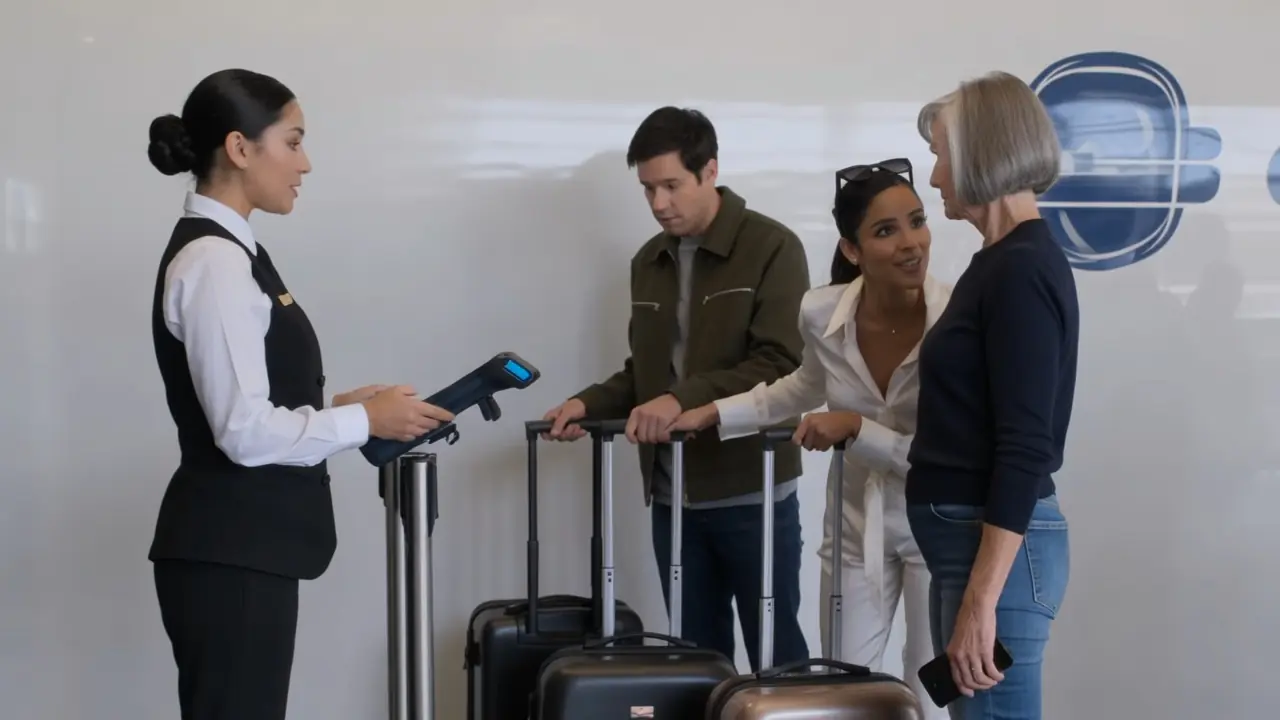
“Why are you blocking our first-class line when you didn’t pay a dime for this vacation?” Amber demanded.
The gate at Denver International Airport suddenly felt much quieter than an airport gate should. A little boy holding a stuffed bear stopped talking, and the gate agent lowered the scanner in her hand. Carol’s thirty-two-year-old son, Bradley, stood behind his wife with two large designer suitcases, but he did not immediately defend his mother.
That silence injured Carol more deeply than Amber’s accusation.
She looked at the son she had raised to return shopping carts, thank waitresses, and admit when he was wrong. Bradley’s eyes moved toward the floor, as though the pattern in the carpet had become more important than the woman who paid for every ticket, every room, and every luxury included in their trip. He knew exactly whose credit card had covered the twelve-thousand-dollar reservation.
Carol turned back toward Amber.
“I paid for every ticket, room, transfer, and suitcase,” she said coldly. “Including the one you just threw.”
Amber laughed, but the sound carried less confidence than before. She wore white linen trousers, a fitted tan jacket, and sunglasses resting above perfectly arranged blonde hair. Three expensive suitcases stood beside her, each packed for a week of carefully photographed relaxation.
“You offered to help,” Amber said. “That doesn’t mean you own our vacation.”
“I never said I did.”
“Then stop acting like we should arrange everything around you.”
Carol looked toward the two empty chairs she had saved for them earlier. Bradley and Amber had deliberately chosen seats across the gate rather than sit beside her. Inside the airport lounge, they had eaten breakfast at another table while Carol sat alone with coffee and fruit.
Every small rejection had prepared the ground for this larger one.
“Amber,” Bradley finally said, “maybe don’t do this here.”
It was not a defense.
It was a request that his wife humiliate Carol more privately.
Amber turned toward him.
“Why? Your mother keeps inserting herself into a trip meant for us.”
Bradley’s face tightened.
“She paid for it.”
Amber stared at him as though he had betrayed her.
Carol watched the conflict cross his expression. He wanted his mother’s money, his wife’s approval, and freedom from the discomfort of choosing between them. For years, he had tried to keep all three by offering quiet apologies without changing anything.
Sorry about Amber. She’s stressed.
Sorry about the holidays. She was overwhelmed.
Sorry you were seated at the end. It wasn’t intentional.
Carol had accepted every apology because she loved him.
Her late husband, Tom, had warned her about disappearing while helping others. He wrote those words inside the final letter he left before cancer took him six years earlier. Carol carried the folded letter in the inner pocket of her handbag whenever she traveled.
Live life, Carol. Help where your heart tells you. But don’t disappear while doing it.
She had mistaken generosity for love so many times that the difference had become difficult to see.
Amber stepped closer.
“We’re trying to board,” she said. “Pick up your bag and wait until we’re through.”
Carol looked at the gate agent.
“Are the tickets on one reservation?”
The woman checked her terminal.
“Yes, Mrs. Jensen. Three first-class tickets under confirmation Jensen-Cabo.”
“And the fare is fully flexible?”
The gate agent hesitated because she sensed the direction of the question.
“Yes.”
Carol picked up her suitcase and set it upright.
“Please separate my ticket from theirs.”
Bradley’s head rose.
“Mom?”
Carol removed her phone.
Amber folded her arms.
“You’re being ridiculous.”
Carol opened the airline application and selected the reservation. She had reviewed its terms two nights earlier after Amber suggested that Carol spend several evenings alone at the resort so the couple could have privacy. Something inside her had needed to know exactly what could still be changed.
The first-class fares were refundable until boarding.
The resort package could be divided because Carol was the cardholder and primary guest.
The private transfer, lounge access, and baggage fees were also connected to her payment authorization.
“Ma’am,” the gate agent said carefully, “boarding closes in six minutes.”
“I understand.”
Carol tapped the screen.
The application asked whether she wished to cancel two travelers while retaining the primary passenger. She selected Bradley Jensen and Amber Jensen. A second warning explained that seats would be released immediately and the refund returned to the original payment method.
Carol pressed confirm.
Amber’s phone vibrated.
Then Bradley’s did.
Amber glanced at the screen, and the color left her face.
“What did you do?”
Carol placed her phone inside her handbag.
“I let your statement become true.”
Amber stared at the cancellation notice.
“You canceled our flights?”
“Yes.”
“You can’t do that.”
“I purchased refundable tickets under my card and reservation.”
Bradley unlocked his phone with trembling fingers.
“Mom, why are our boarding passes gone?”
“Because Amber said I paid nothing.”
“That was just something she said.”
Carol looked at him.
“And you allowed her to say it.”
Bradley stepped closer.
“I was going to handle it.”
“When?”
“After we boarded.”
“After she threw my suitcase?”
“I didn’t know she was going to do that.”
“You knew she had been treating me like an unwanted guest for weeks.”
Amber grabbed the suitcase handle and shoved it back toward Carol. The bag rolled into Carol’s leg before tipping sideways again. Several passengers gasped, and the gate agent stepped away from her podium.
“Why did you cancel our entire vacation?” Amber demanded.
Carol lifted the suitcase calmly.
“Because you told everyone I hadn’t paid a dime.”
Bradley looked toward the departure screen.
“Mom, please. Boarding closes in three minutes.”
Carol turned toward the gate.
“Then use those three minutes to learn what my silence just cost you.”
Amber hurried to the counter.
“We’ll buy new tickets.”
The gate agent checked the flight.
“First class is sold out.”
“Then business.”
“This aircraft has only first class and economy. There are two economy seats available, but the current walk-up price is twenty-two hundred dollars each.”
Amber looked at Bradley.
He stared back.
Their joint checking account contained less than three thousand dollars. Carol knew because Bradley had asked her for help paying a property-tax bill only two months earlier. Amber’s designer luggage cost more than the money they had available for emergency travel.
“We can put it on a credit card,” Amber said.
Bradley lowered his voice.
“Which one?”
“Your platinum card.”
“It’s nearly maxed out.”
The gate agent made the final boarding announcement.
Carol handed over her passport and boarding pass. The scanner produced a clear green light. Before entering the jet bridge, she looked back once.
Bradley stood frozen beside his wife.
Amber’s anger had shifted into panic.
Neither apologized.
Carol boarded alone.
Her seat was 2A beside the window. She placed her suitcase in the overhead compartment, sat down, and buckled the belt with hands that began trembling only after nobody could see them. The aircraft door closed four minutes later.
Carol stared through the window at the runway.
She expected guilt to crush her.
Instead, relief arrived first.
That frightened her more.
When the plane began moving, Bradley called. Carol watched his name appear on the screen, then declined the call before switching the phone to airplane mode. She did not yet possess the strength to hear another soft apology offered in place of action.
A flight attendant brought orange juice.
“Would you prefer champagne, Mrs. Jensen?”
“Coffee, please.”
“Cream?”
“Black.”
Tom had taken his coffee black.
The thought brought him into the empty seat beside her more vividly than grief had in months. Carol imagined what he might say about the scene at the gate, and she knew he would not focus on Amber first.
He would ask why Bradley stood silent.
Tom had adored their son, but he never confused love with pretending a person’s failures did not matter. During Bradley’s childhood, Tom insisted consequences be connected to choices. If Bradley damaged a neighbor’s fence, he helped repair it.
Carol had softened those lessons after Tom died.
Whenever Bradley struggled, she reached for her checkbook before asking whether rescuing him would help. She paid part of his wedding, the deposit on his first home, and the medical deductible after Amber’s minor surgery. None of those gifts were wrong by themselves.
But slowly, gratitude had become expectation.
Expectation had become entitlement.
And Carol had kept giving because every payment purchased a little access to her son’s life.
The plane rose above Denver.
Clouds swallowed the city, and Carol finally cried.
She cried for the suitcase, the accusation, and the expensive vacation that had become evidence of how little she was valued. More than anything, she cried for the moment Bradley looked down instead of looking at her.
The woman across the aisle noticed but offered no intrusive questions. She simply placed a packet of tissues on the empty seat beside Carol.
Carol whispered thanks.
After the flight reached cruising altitude, she connected to the onboard internet. Twenty-seven messages waited.
The first twelve came from Bradley.
Mom, please call.
Amber didn’t mean it.
We can still fix this.
The resort says our reservation has changed.
They need the original cardholder.
Please don’t do this.
The next messages came from Amber.
This is financial abuse.
You invited us.
You cannot cancel gifts after giving them.
You embarrassed us publicly.
Carol read that sentence twice.
Amber had thrown her suitcase before a crowd, accused her of lying, and tried to remove her from a trip she funded. Yet in Amber’s mind, the embarrassment began only when consequences arrived.
Carol opened the resort application.
She had reserved a two-bedroom oceanfront suite because Amber insisted separate hotel rooms would make the family feel disconnected. The irony almost made Carol laugh. She separated her name from the package, canceled the couple’s occupancy, and requested a transfer to a smaller one-bedroom suite.
The resort confirmed the change.
Carol then canceled the private couple’s spa treatment, sunset cruise, and premium dinner reservations booked only for Bradley and Amber. She retained the airport transfer and added a note that she would arrive alone.
The revised cost dropped from nearly twelve thousand dollars to slightly over four thousand.
Carol considered canceling everything.
Then Tom’s letter returned to her.
Live life.
She had always dreamed of seeing Cabo with him. They discussed the trip during their final year together, but treatments and hospital visits consumed the time they believed remained. The thought of arriving without Bradley and Amber hurt.
The thought of going home hurt more.
Carol kept the reservation.
When the plane landed, her phone filled with new messages. Bradley and Amber had not purchased the remaining economy seats because they disappeared while the couple argued at the gate. The next available direct flight departed the following morning at a higher price.
They had returned home.
Carol walked through the Cabo airport with one small suitcase and no one rushing ahead of her. At the transfer desk, a representative greeted her by name and checked the new reservation.
“Only one passenger?”
“Yes.”
“Your previous booking listed three.”
“It changed.”
The representative smiled professionally.
“We will take good care of you.”
The words nearly broke her.
At the resort, the ocean appeared beyond a wide lobby of stone arches and flowering plants. The air smelled of salt, citrus, and sun-warmed wood. Carol stood before the view for several minutes without moving.
Her suite contained a balcony facing the water.
She unpacked slowly.
One navy dress.
Two linen shirts.
Comfortable sandals.
A book she had been saving.
No designer outfits, coordinated photographs, or demands that she remain out of the couple’s way.
That evening, Carol sat alone at the seafood restaurant Amber had described as too formal for her. She ordered grilled fish, one glass of white wine, and dessert because Tom always believed vacations required dessert.
A server offered to take her photograph.
Carol almost refused.
Then she agreed.
In the picture, she sat beside the ocean wearing the navy dress, her silver hair lifted slightly by the breeze. She expected to look lonely.
She looked peaceful.
The following morning, Bradley called again.
Carol answered from the balcony.
“Hi, Mom.”
His voice was quiet.
“Hello, Bradley.”
“Are you at the resort?”
“Yes.”
“So you really went without us.”
“You went through the gate without me first.”
Silence followed.
“That’s not the same.”
“No?”
“I thought you would board after us.”
“Amber told me to stay out of your way.”
“She was angry.”
“Anger does not invent character, Bradley. It reveals what someone believes they are permitted to do.”
He exhaled.
“I know she crossed a line.”
“You knew at the gate.”
“I froze.”
“You lowered your eyes.”
“I didn’t know what to say.”
“You could have said, ‘My mother paid for this trip. Do not throw her belongings.’”
He remained silent.
Carol listened to waves breaking below the balcony.
“Are you going to pay for another flight?” she asked.
“We can’t afford it.”
“That sounds like an answer.”
“Mom, please. We both took the week off.”
“You may spend it together.”
“At home?”
“You said it was a couple’s vacation.”
His voice tightened.
“That’s cruel.”
“No, Bradley. It is accurate.”
He became defensive.
“You’re punishing me for one mistake.”
Carol closed her eyes.
“No. I am allowing one choice to cost you something.”
“Amber says gifts cannot be taken back.”
“The vacation had not happened yet. Your tickets were refundable, your room was attached to my card, and you publicly said I contributed nothing.”
“That was Amber.”
“And your silence belonged to you.”
Bradley’s breathing changed.
Carol imagined him sitting at his kitchen table, looking for the version of his mother who would apologize for making him uncomfortable. She did not appear.
“What do you want me to do?” he asked.
“Stop asking me to define your adulthood.”
Then she ended the call.
Carol spent the week differently from any vacation she had taken before.
She joined a morning walking group along the beach. She read beneath an umbrella, took a cooking lesson, and sailed on a small sunset cruise with six strangers who included her in every conversation.
One afternoon, she met a retired teacher named Denise from Oregon.
They shared lunch and spoke about widowhood, adult children, and the strange guilt women carried whenever they chose themselves. Denise listened to the airport story without immediately praising Carol or condemning Amber.
“What hurt most?” she asked.
“My son looking down.”
“Then this is not really about twelve thousand dollars.”
“No.”
“It never is.”
Carol opened Tom’s letter that evening.
The paper had softened along the folds.
Help where your heart tells you. But don’t disappear while doing it.
For the first time, she understood that Tom had not warned her against generosity. He warned her against using generosity to make herself easier for other people to overlook.
Back in Denver, Bradley and Amber spent their vacation week arguing.
Amber believed Bradley should force Carol to restore the money or reimburse them for wasted leave. Bradley began by defending his wife, but the gate scene followed him through every conversation.
He remembered the suitcase striking the floor.
He remembered the passengers watching.
He remembered choosing silence.
Two days after Carol returned, Bradley came to her home alone.
She let him in but did not immediately offer coffee or food. That small absence unsettled him because Carol had spent his entire life filling every silence with care.
He sat at the kitchen table.
“Amber says you humiliated her.”
“Did she mention my suitcase?”
“She says she lost her temper.”
“Did she apologize?”
“No.”
“Then why are you here?”
Bradley rubbed both hands together.
“I need to know whether this means you’re done with us.”
Carol looked at him carefully.
“I am done paying to be tolerated.”
“That isn’t what I asked.”
“It is the answer.”
He lowered his head.
“I should have defended you.”
“Yes.”
“I was afraid she would cause a bigger scene.”
“She caused one anyway.”
“I thought if I stayed quiet, it would pass.”
“That has been your strategy for years.”
Bradley looked up.
Carol continued before fear softened her.
“Every time Amber insulted me, you apologized privately. You protected her comfort and asked me to absorb the damage.”
“I love her.”
“Love is not the same as helping someone avoid accountability.”
His eyes filled.
“Do you want me to leave her?”
“No.”
The answer surprised him.
“I want you to stop making me responsible for choices inside your marriage.”
Bradley stared at the table.
“What happens now?”
“You repay the extra baggage and lounge fees I covered that morning.”
He looked startled.
“That’s only a few hundred dollars.”
“It is not about the amount.”
“No,” he said slowly. “It isn’t.”
Carol placed a handwritten repayment schedule beside him. The monthly amount was modest, but the requirement mattered.
She also explained that there would be no more emergency credit-card payments, luxury gifts, or vacations funded without written limits. Her estate plan would remain private, and future family invitations would depend on respectful behavior rather than obligation.
Bradley read the page.
“You had this ready?”
“I had six years of avoiding it.”
He signed.
Amber did not speak to Carol for three months.
When she finally arrived, Bradley came with her but remained outside in the car. Amber stood on Carol’s porch wearing no sunglasses, no carefully staged smile, and no visible confidence.
“I came to apologize.”
Carol waited.
Amber looked toward the driveway.
“I was embarrassed that people might think we could not afford the trip.”
“You could not.”
“That is not the point.”
“It was part of the point.”
Amber swallowed.
“I made your payment sound like nothing because I wanted the trip to feel like ours.”
“So you erased me.”
“Yes.”
The honesty surprised Carol.
Amber continued.
“I threw the suitcase because you would not move, and I believed Bradley would support me no matter what I did.”
“Did he?”
“At first.”
“What changed?”
“He finally told me I had become cruel.”
Carol studied her.
“Do you believe him?”
Amber’s eyes filled.
“I believe I was cruel.”
The apology did not repair everything.
Carol did not hug her, restore access to her credit card, or pretend one conversation erased years of behavior. She invited Amber inside for coffee.
It was a beginning, not forgiveness completed on demand.
Over the next year, Bradley repaid every fee. He began correcting Amber in the moment rather than apologizing afterward. Sometimes that created arguments, but their marriage slowly became more honest because silence no longer protected every problem.
Carol changed too.
She joined Denise on another trip, this time to Santa Fe. She attended concerts alone, returned to painting, and stopped asking whether every enjoyable purchase should instead be saved for Bradley.
On the anniversary of the Cabo trip, Carol framed the photograph taken at the oceanfront restaurant.
She placed Tom’s letter behind it.
Bradley saw the picture during a visit.
“You looked happy.”
“I was learning how.”
“Were you lonely?”
“Sometimes.”
He nodded.
“I wish I had been there.”
Carol looked at him.
“I wished that too.”
Neither pretended the original trip could be recovered.
Some moments pass only once, and regret is the price of recognizing their value too late. But Bradley no longer looked away from that truth.
Years later, Amber joked once that Carol had canceled a twelve-thousand-dollar vacation over a suitcase. Bradley corrected her immediately.
“No,” he said. “Mom canceled it because we treated her like her love had no value once the payment cleared.”
Carol heard him from the next room.
She did not interrupt.
The quietest decision of her life had not been pressing the cancellation button at the Denver gate. It had been deciding that love would no longer require her disappearance.
Amber said Carol had paid nothing.
So Carol allowed that lie to become true.
The canceled tickets cost Bradley and Amber a vacation.
The boundary saved something far more valuable.
It returned Carol to herself.