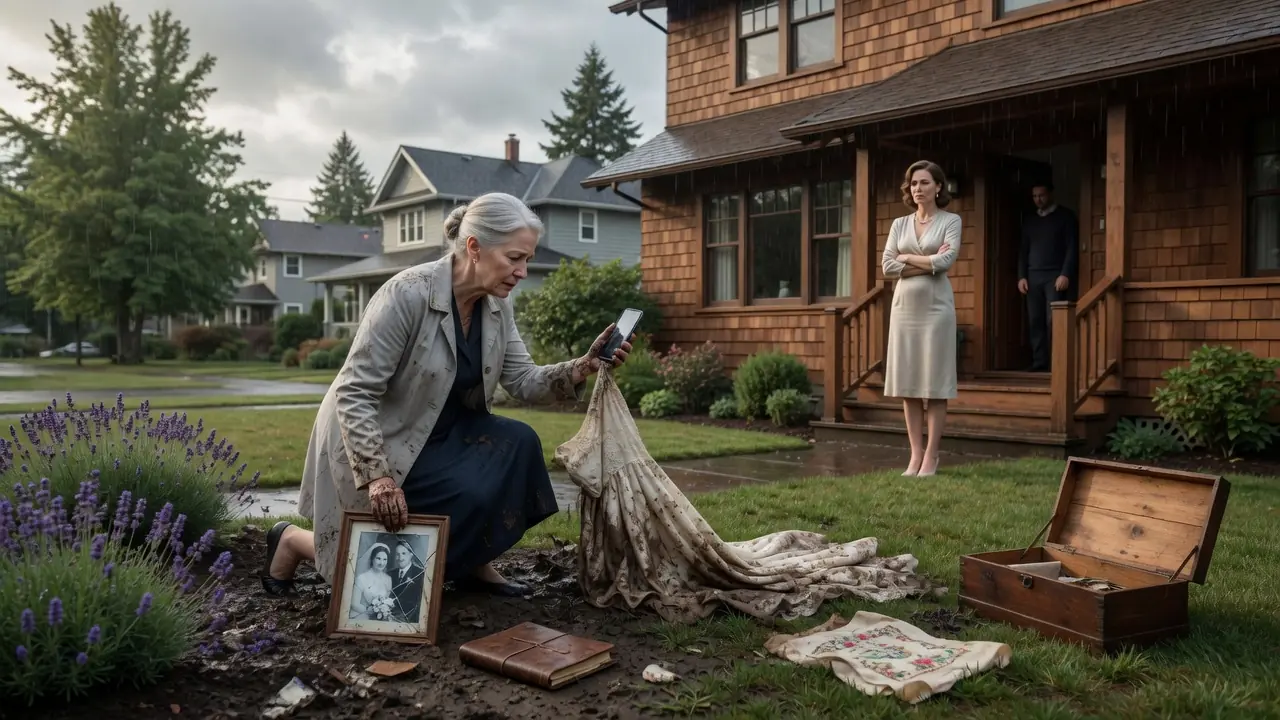
When Vivien Cole returned from her sister’s funeral, the first thing she saw was her mother’s wedding dress lying in the flower bed.
It was spread across the wet soil like a discarded rag, soaked through by the Portland rain and streaked with mud along the lace.
The hem, once carefully preserved in tissue paper for more than forty years, was twisted around a broken clay pot.
Beside it lay a cracked picture frame, a hand-stitched table runner, and the small leather notebook her mother used to carry in her apron pocket.
Vivien stood at the edge of the yard with her suitcase still in one hand.
For a moment, she forgot how to breathe.
She was sixty-five years old, tired from the flight back from Phoenix, and still carrying the grief of burying the last person who had ever called her little sister. Her body ached. Her eyes burned from two days of tears and airport lights. All she had wanted was to come home, take off her shoes, and sit quietly in the house she had spent thirty years building into a sanctuary.
Instead, her memories were scattered across the grass like trash.
The front door opened.
Sloan, her daughter-in-law, stood in the doorway wearing a silk dress and a cold expression.
“My child needs a private room,” Sloan said. “That pile of trash just needed to be thrown out.”
The sentence landed harder than grief.
Vivien looked past Sloan and saw her son, Andrew, standing in the hallway behind his wife. He was thirty-six now, tall like his father had been, with tired eyes and a face that still reminded Vivien of the boy who once ran through this very yard with a red bike and scraped knees.
He saw the wedding dress.
He saw the broken frame.
He saw his mother standing there with rain gathering on her coat.
And he said nothing.
Vivien bent down slowly and picked up the frame.
It held a photograph of her parents on their wedding day. Her mother in that same dress. Her father standing beside her, young and proud, one hand resting gently over hers.
Before Vivien could straighten, Sloan walked past her toward the driveway.
Her heel came down on the glass.
The frame cracked under her shoe.
A shard sliced Vivien’s palm.
She stared at the thin red line spreading across her skin and felt nothing.
Not pain.
Not yet.
Only humiliation, deep and breathless, rising inside her like floodwater.
Andrew shifted his weight.
“Mom,” he said weakly, “Sloan’s just stressed. You know, with the baby coming.”
Vivien looked at him.
“The baby?”
Sloan turned at the driveway.
“Yes,” she said. “And the upstairs room is going to be the nursery. You can use the back storage room. It’s quiet.”
Vivien gave a small laugh.
It had no warmth in it.
“The storage room?”
Sloan folded her arms.
“That’s where you can be.”
Vivien looked at her son again.
Andrew would not meet her eyes.
That hurt more than Sloan’s words.
This house was not Andrew’s. It was not Sloan’s. It was Vivien’s house, bought after her husband died, paid for through years of careful work as an accountant, repaired tile by tile, wall by wall, receipt by receipt. It held birthdays, school projects, grief, laughter, holidays, and every ordinary day that had somehow become sacred after everyone started leaving.
Vivien said nothing.
She took out her phone and photographed everything.
The dress in the mud.
The broken frame.
The open cedar chest.
The ruined embroidery.
The footprints across the hallway.
The damage was not only emotional.
It was evidence.
That word steadied her.
Evidence.
Vivien had spent nearly four decades balancing accounts. She knew better than most people that anger could be dismissed, but documents could not. Tears could be called exaggeration. A photograph could not. A memory could be mocked. A record could be presented.
That night, she carried what she could into the back storage room.
There was no table.
No chair.
No blanket.
Vivien sat on the mattress and looked around.
This was where Sloan believed she belonged.
In the back of her own house.
Out of sight.
Out of the way.
Like an old box no one had decided to throw away yet.
Vivien pressed a cloth against the cut in her palm.
Then she opened a notebook and wrote in blue ink:
March 14. Begin collecting evidence.
She sat very still after writing it.
Outside, rain tapped steadily against the glass.
Above her, she could hear Sloan laughing on the phone.
That laughter used to make Vivien uncomfortable. Now it made her focused.
She opened her banking app and logged into the secondary account she had once created for Andrew in case of emergencies.
At first, the numbers did not make sense.
Then they made too much sense.
Interior design: $12,800.
Baby room decoration: $3,400.
Spa retreat deposit: $2,500.
Napa Valley weekend: $7,900.
Luxury boutique: $4,300.
Designer resale purchase: $2,150.
One withdrawal after another.
Eight months of spending.
Eighty-six thousand four hundred dollars.
Vivien did not gasp.
She did not scream.
She simply stared at the screen until the figures arranged themselves into a truth.
Her emergency account had become Sloan’s private purse.
The next morning, Vivien walked through the house as if she were only looking around.
But she was not looking.
She was documenting.
The walnut cabinet her mother had saved a whole year to buy in 1962 was gone from the living room. In its place stood a sleek white console with gold handles and no soul.
Her father’s rocking chair was missing from the porch. The one with the scratch on the left armrest. The one he had sat in every Sunday after church.
Vivien opened a marketplace app and typed slowly.
Vintage walnut rocking chair Portland.
She scrolled.
Then stopped.
There it was.
The scratch on the arm.
The curve of the back.
The same faded cushion.
Sold.
$650.
Vivien placed the phone on the table and closed her eyes.
An object was just an object to some people.
To Vivien, that chair was the sound of her father humming in winter. It was her mother bringing tea to the porch. It was the shape of home before everyone learned how to leave.
She saved the image.
Then she created a folder on her laptop.
CASE SLOAN.
Into it went everything.
Photographs.
Bank statements.
Screenshots.
Receipts.
Listings.
Notes.
She labeled each file carefully.
01_FRONT_YARD_ITEMS.
02_STORAGE_ROOM_CONDITION.
03_BANK_STATEMENTS.
04_ROCKING_CHAIR_LISTING.
05_MISSING_WALNUT_CABINET.
Every file became another brick in the wall she was building around herself.
Later that morning, Vivien heard Sloan in the hallway.
The door was not fully closed.
Sloan’s voice came low and amused through the crack.
“Don’t worry. Everything is lined up. I told Andrew the house has to be redone for the baby. That old woman doesn’t know anything about paperwork.”
There was a pause.
Then Sloan laughed softly.
“If this works, we get the whole house.”
Vivien sat frozen.
Her first instinct was to open the door and confront her.
Instead, she slowly reached for the pocket recorder she had used years earlier in meetings.
The tiny red light blinked.
Recording.
Vivien did not move until Sloan’s footsteps faded.
Then she opened her notebook and wrote:
March 15. 8:27 a.m. Sloan phone call. Mentions plan to get house. Recording saved.
Her hand did not shake.
At nine the next morning, Vivien sat in a red brick office near the Willamette River across from Amit Patel, the attorney who had helped her years earlier with insurance paperwork after a storm damaged her roof.
Amit was in his early fifties, with half-rim glasses and calm eyes that missed very little. He looked through her folder without interrupting.
When he reached the house deed, he paused.
“This house is still entirely in your name?”
“Yes,” Vivien said.
“Andrew was never added to the title?”
“No.”
Amit set the paper down.
“Then the first thing you need to hear is this. You are the sole legal owner. Your son and daughter-in-law are living there by your permission. They do not own the house. They cannot force you into any room. They cannot alter or sell your property without permission. They cannot treat you as a guest in a home that belongs to you.”
Vivien felt something inside her loosen.
She had known it.
But hearing someone else say it made it real.
Amit turned to the bank statements.
“Now the money. You said the total unauthorized withdrawals are eighty-six thousand four hundred?”
“That is what I have confirmed so far.”
“And the heirlooms?”
“Estimated twelve thousand, not counting sentimental value.”
He nodded.
“We will prepare a formal notice. A lease if you want to allow them to remain. Repayment terms. Financial restrictions. And a demand for restitution regarding any sold property.”
Vivien looked down at her hands.
“I don’t want to destroy my son.”
Amit’s voice softened.
“Protecting yourself is not destroying him.”
“He’s weak right now.”
“Then consequences may be the first honest thing anyone has given him in a long time.”
Vivien swallowed.
She knew he was right.
Before she left, she signed the authorization for Amit to represent her. The pen moved smoothly across the line, her signature steadier than she expected.
As she stepped outside, the rain had stopped.
Sunlight broke through the clouds and struck the river, turning it silver.
For the first time since coming home from the funeral, Vivien did not feel helpless.
She felt prepared.
That evening, Andrew sent a text.
Mom, let’s have dinner as a family tonight. Sloan wants everyone to talk calmly and find a solution.
Vivien read it twice.
A solution.
That was what people called surrender when they wanted it to sound polite.
At 6:30, she showered, combed her hair, and put on the blue knit dress her sister once said made her look classy and steady. Then she slid Amit’s formal letter into her handbag.
The dining room smelled of roast meat and buttered bread.
Sloan had prepared an elaborate meal, the kind of meal people make when they are staging innocence. Her parents were there too. Gregory and Elise Mercer sat with wine glasses in hand, both wearing the composed expressions of people who believed money and tone could win any argument.
“Vivien,” Sloan said, smiling. “We just want peace.”
Vivien sat down.
“So do I.”
Dinner began with strained silence.
Then Elise spoke.
“There’s a wonderful senior living facility in Eugene,” she said, glancing at Vivien. “At a certain age, quiet care can be a gift.”
Gregory nodded.
“It would make life easier for everyone.”
Vivien placed her fork down.
“You are talking about me.”
Sloan sighed.
“Mom, nobody is attacking you. We’re just saying this house needs to change. The baby needs stability.”
Vivien reached into her handbag.
“In that case, let us make everything stable.”
She placed the envelope in the center of the table.
The room paused.
“This is a legal notice prepared by my attorney. Starting now, if Andrew and Sloan want to remain in my house, they will sign a lease for sixteen hundred fifty dollars per month. They will also repay the eighty-six thousand four hundred dollars withdrawn from my account over forty-eight months, with two percent interest.”
Gregory spilled wine over the rim of his glass.
Andrew went pale.
Sloan stared at Vivien, then gave a short laugh.
“You’re charging your own son interest?”
Vivien looked at her.
“I am charging the people who took my money.”
Sloan’s smile sharpened.
“You’re unbelievable. Turning family into spreadsheets.”
“I was an accountant for forty years,” Vivien said. “Spreadsheets are much kinder than courtrooms.”
Sloan’s face reddened.
Vivien opened her phone and turned the screen toward the table.
“This is my father’s rocking chair. Sold online for six hundred fifty dollars.”
Andrew leaned forward.
His expression changed.
Not defensiveness now.
Shock.
“Mom,” he whispered. “That was Grandpa’s chair.”
“Yes.”
He turned to Sloan.
“You said it was in storage.”
Sloan rolled her eyes.
“It was old.”
Vivien’s voice stayed calm.
“No. It was mine.”
Gregory stood.
“You are threatening my daughter in this house.”
Vivien looked up at him.
“No, Gregory. I am informing your daughter in my house.”
The wall clock ticked.
Sloan leaned back, one hand placed dramatically over her stomach.
“You would throw out a pregnant woman?”
Vivien held her gaze.
“When will you show us the prenatal records?”
The room went silent.
Sloan’s hand froze.
Andrew turned slowly toward his wife.
“Sloan?”
Her face hardened.
“I don’t have to prove anything to her.”
Vivien picked up the envelope and set it near Andrew’s plate.
“You have forty-eight hours.”
Then she stood.
“I am done begging for dignity under my own roof.”
She left the dining room while dishes clattered behind her.
That night, Andrew knocked on her storage room door close to midnight.
Three soft knocks.
“Mom?”
Vivien opened the door.
He stood there with red eyes and a collapsed expression, no longer a husband defending his wife, but a son terrified by the first glimpse of truth.
“I’m scared,” he said.
Vivien said nothing.
“If Sloan loses the house, she says she’ll leave me.”
Vivien looked at him carefully.
“Then she doesn’t want you, Andrew. She wants the house.”
His face twisted.
“I don’t know what to do.”
“You sign the agreement. You repay what was taken. You stop allowing your wife to hurt me and calling it stress.”
Andrew sat on the edge of the folding mattress and covered his face.
“I knew some of it was wrong,” he whispered. “The chair. The cabinet. The money. But she said you were controlling everything. She said we deserved a life of our own.”
Vivien felt both sorrow and anger.
“You have a life of your own. You just tried to build it with things that were not yours.”
Andrew began to cry.
Vivien watched him for a moment before placing a hand on his shoulder.
“I love you,” she said. “But I will not be robbed so you can avoid conflict.”
He nodded.
“I’ll sign.”
After he left, Vivien sat in the dim room and tried to breathe.
Then she heard Sloan upstairs.
A door clicked shut.
Her voice came through the old vent, low and clear.
“I told you, just a few more months. Once the old woman signs everything over, I’ll say I lost the baby. People will feel sorry for us. No one will question it.”
Vivien went still.
A man’s voice answered faintly on the other end of the call.
“You sure?”
Sloan laughed.
“This house is worth a little suffering.”
Vivien looked at the recorder on her shelf.
The red light blinked.
Steady.
For the first time, Vivien felt the cold sharpen into steel.
Two days later, Andrew and Sloan signed the lease and repayment agreement in Amit Patel’s office.
Sloan signed fast, angrily, as if speed could erase meaning.
Andrew signed slowly, with his shoulders bent and his hand shaking.
Amit notarized the documents.
“The lease is effective today,” he said. “The repayment schedule begins next month. Any further unauthorized use of Mrs. Cole’s accounts will be documented separately.”
Sloan stood.
“You win, Vivien.”
Vivien lifted her handbag.
“No. I protected myself. There is a difference.”
Sloan leaned close, her voice low enough that only Vivien could hear.
“You’ll regret humiliating me.”
Vivien met her eyes.
“I already survived being humiliated. Now I am documenting it.”
That night, Vivien changed the lock on the storage room.
It was a small act.
A new key.
A firm click.
A boundary in metal.
She moved the few remaining heirlooms to Mrs. Whitaker’s house next door. Mrs. Whitaker had been her neighbor for nearly twenty years, a small woman with silver hair and the kind of alert kindness that noticed what others missed.
“Leave them here,” Mrs. Whitaker said, taking the wrapped photographs and scarf. “I’ll keep them safe.”
“Thank you.”
Mrs. Whitaker squeezed her hand.
“You look exhausted, Vivien.”
“I am.”
“Then rest.”
Vivien tried.
But peace did not come.
Two nights later, she collapsed at the storage room door.
She remembered the keys slipping from her fingers. She remembered a sharp tightness in her chest. She remembered Mrs. Whitaker shouting her name from somewhere far away.
Then white.
When Vivien woke, she was in Providence Hospital with an IV in her arm and a doctor leaning over her.
“Mrs. Cole,” he said gently, “you had a stress-induced cardiac event. You were lucky your neighbor called emergency services when she did.”
Lucky.
Vivien closed her eyes.
She was tired of surviving things people created and then being told she was lucky.
By afternoon, Hannah and Lucas arrived.
Hannah, her daughter, flew in from New York. Lucas, her youngest, drove in from Seattle. Both looked frightened in a way that made Vivien’s heart ache more than the hospital monitors did.
Hannah hugged her carefully.
“Mom, why didn’t you tell us it was this bad?”
Vivien tried to smile.
“You both have your own lives.”
Lucas took her hand.
“You are part of our lives.”
The doctor recommended ninety days of rest, medication, therapy, and reduced stress.
Hannah immediately offered to take Vivien to Manhattan.
“You can stay with me. I have a spare room. You’ll be safe.”
Vivien shook her head.
“My home is in Portland.”
“Mom—”
“If I leave now, they will think I gave up.”
Lucas looked pained.
“Then we stand with you there.”
Andrew did not visit the hospital.
No call.
No text.
Vivien tried not to let that hurt.
It did anyway.
Three days later, she returned home with Hannah and Lucas beside her.
The front gate was open.
The yard was bare.
The bench was gone. The planters were gone. The wooden sign that read COLE HOME SINCE 1993 was gone. Even the fall mums she had planted before leaving for Phoenix had been pulled from the flower bed.
Vivien stood in the driveway, one hand pressed against her chest.
Hannah whispered, “Mom, where is everything?”
Lucas walked ahead and checked the storage room door.
The lock had been changed again.
Vivien stared at it.
The doctor had told her to avoid stress.
But how did a woman remain calm while being erased from her own home piece by piece?
Lucas turned.
“I’m calling Patel.”
“Not yet,” Vivien said.
Her voice surprised all three of them.
It was weak, but firm.
“First, take pictures.”
Hannah lifted her phone immediately.
The evidence grew.
A week later, Vivien received a call from Elise Mercer.
Sloan’s mother.
The woman who had once suggested a senior facility now sounded shaken.
“Vivien,” Elise said, “we need to meet. Alone.”
They met at a small café called Maple & Steam.
Elise arrived with no jewelry, no makeup, and a thick brown envelope clutched in both hands. She looked smaller than Vivien remembered.
“I don’t know how to start,” Elise said.
“Start with the truth.”
Elise pushed the envelope across the table.
Inside were fertility clinic records from California. Credit card statements. Screenshots of messages. Notes from failed treatments. One page bore the words:
Patient unable to conceive naturally.
Vivien looked up slowly.
Elise’s eyes filled.
“Sloan can’t have children,” she whispered. “We’ve known for years. She hid it from Andrew.”
Vivien’s hand tightened around the page.
Then she read the texts.
I’ll say I’m three months along.
Buy the fake test.
After a few months, I’ll say I lost it.
People will pity us.
Then we’ll have the house.
Vivien sat back.
For a long moment, she could hear nothing but the café spoon clinking against ceramic somewhere behind her.
Elise wiped her tears.
“I know you probably hate me.”
“No,” Vivien said quietly. “I don’t.”
“I helped her too many times. Paid her debts. Covered her lies. Told myself she was troubled, not cruel.” Elise’s voice broke. “But she is destroying everyone near her. Including my own conscience.”
Hannah arrived ten minutes later at Vivien’s request and photographed every document.
Elise watched silently.
“I don’t want to hurt my daughter,” she said.
Vivien looked at her.
“Then tell the truth before she becomes someone no one can reach.”
That night, Vivien called Andrew.
“Come alone,” she said.
He arrived in thick fog, looking hollow and unshaven.
Hannah and Lucas sat in the living room with Vivien.
The envelope lay on the table.
Andrew looked from face to face.
“What is this?”
Vivien slid the envelope toward him.
“Read.”
He did.
His expression shifted slowly from confusion to disbelief, then to devastation.
“No,” he whispered. “No, this can’t be right.”
Vivien said nothing.
He read the texts.
His hands began to shake.
“She said...” His voice broke. “She said we were having a baby.”
Vivien’s eyes stung.
“I know.”
Within fifteen minutes, Sloan arrived.
Vivien had asked her to come.
Sloan walked in wearing a long coat and a defensive smile.
“What is this? A family trial?”
Vivien pointed to the chair.
“Sit down.”
Sloan saw the envelope.
Her face changed before she could hide it.
Andrew stood.
“Is it true?”
Sloan’s mouth tightened.
“I didn’t want to lose you.”
“That’s not what I asked.”
She looked away.
Andrew stepped closer.
“Is it true?”
Sloan’s voice snapped.
“Yes. Fine. Yes. I can’t have children. Are you happy now?”
The room went still.
Andrew looked like the floor had vanished beneath him.
Sloan turned on Vivien.
“You did this. You poisoned everyone against me.”
Hannah stood.
“You faked a pregnancy.”
“I was trying to save my marriage.”
Lucas’s voice was cold.
“No. You were trying to steal a house.”
Sloan’s eyes flashed.
“Andrew promised me this house would be his someday. I only moved things forward.”
Vivien inhaled slowly.
“You sold my family’s memories. You drained my account. You lied about a child. And still, you think the crime is being caught.”
Sloan’s face twisted.
“You always looked down on me.”
“No,” Vivien said. “I trusted you. That was my mistake.”
Andrew sank to the floor and covered his face.
The sound that came from him was not anger.
It was grief.
Sloan stared at him for one second, then grabbed her bag and stormed out, slamming the door so hard the hallway picture tilted.
Vivien lowered herself beside Andrew.
He leaned into her like a child.
“I’m sorry,” he sobbed. “Mom, I’m so sorry.”
Vivien put one arm around him.
“Then make it mean something.”
The next month passed like winter weather, cold and necessary.
Andrew filed for divorce. Sloan countersued, accusing him of emotional abuse and demanding damages. Amit Patel responded with bank records, sale listings, signed agreements, text screenshots, and the audio recording of Sloan planning the fake pregnancy loss.
In court, Sloan tried to cry.
Then Elise testified.
Her own mother stood before the judge and confirmed everything.
The courtroom went silent as Elise said, “My daughter lied. I helped cover too much for too long, and I will not help her destroy another family.”
The judge rejected Sloan’s claim.
The lease and repayment agreement were upheld.
The court referred evidence of fraud and unauthorized financial use to investigators.
Vivien felt no joy.
Only exhaustion.
Justice did not feel like victory.
It felt like finally putting down a weight that had nearly crushed her.
Andrew moved into a small studio near his work.
Every month, he paid his rent obligation and debt repayment ahead of schedule. Each transfer came with a short note.
Month three. Still trying.
Month five. Therapy is helping.
Month eight. I said no today and meant it.
Month twelve. Thank you for making me face myself.
Vivien saved every message.
Not because of the money.
Because each one proved her son was slowly returning to himself.
Six months after the court ruling, the house began to feel like home again.
Hannah brought a new walnut rocking chair with a pale floral cushion.
“I couldn’t find Grandpa’s chair,” she said, “so maybe this one can become yours.”
Vivien sat in it, and the soft creak made her cry.
Lucas restored the shattered wedding photo frame. The cracks remained, sealed under clear protective resin.
“Sometimes broken things become more precious,” he said, placing it in her hands. “Because someone chose to hold them together.”
Vivien looked at her parents’ faces behind the repaired glass.
For the first time, the cracks did not look like damage.
They looked like proof of survival.
The flower bed was replanted with lavender and white daisies.
Her mother’s wedding dress could not be fully saved, but the lace was cleaned, pressed, and folded into a cedar box. Vivien placed it beside her mother’s ring and her sister’s last letter.
Then she rehung a new sign on the porch.
VIVIEN’S HOME.
Lucas drove the brass nails in firmly.
The final strike rang through the yard.
Clean.
Certain.
One year after Vivien came home from her sister’s funeral and found her memories in the mud, she stood before the same flower bed with a watering can in her hand.
The lavender had taken root.
The daisies had opened.
The Portland rain had softened the soil.
Andrew stood beside her, quieter now, but steadier. Hannah and Lucas were on the porch setting the table for Sunday dinner. Mrs. Whitaker was bringing tea from next door. Inside, chicken soup simmered, and the repaired photo frame sat on the mantel.
Andrew looked at the flowers.
“I should have protected you,” he said.
Vivien poured water slowly at the base of the lavender.
“Yes,” she said. “You should have.”
He closed his eyes.
“I’m sorry.”
“I know.”
“Can you forgive me?”
Vivien set down the watering can.
“I can love you while still remembering what happened. Forgiveness does not mean pretending.”
Andrew nodded.
“That’s fair.”
Vivien looked at him.
“And boundaries do not mean I stopped being your mother.”
His eyes filled.
“I’m learning that.”
She touched his cheek.
“Good.”
That evening, the whole family sat around the dining table.
Not the same as before.
Never the same.
But honest.
Hannah read one of her aunt’s poems, the sister Vivien had buried right before the storm began.
Home is not the place where nothing breaks.
Home is the place where truth is allowed to return.
No one spoke for a while after that.
Vivien looked around the table.
At her children.
At the repaired frame.
At the flowers beyond the window.
At the house she had nearly been pushed out of by lies, greed, and silence.
Then she understood something she wished she had learned earlier.
A home is not protected by walls.
It is protected by truth.
By records.
By boundaries.
By the courage to stop calling cruelty family just because it happens under the same roof.
Later that night, Vivien sat in her walnut chair with tea in her hands while rain tapped lightly against the window.
There were no footsteps outside her door.
No cold voice from the hallway.
No fear of what had been sold, moved, taken, or broken.
Only the soft rhythm of rain, the scent of lavender, and the steady beat of her own heart.
She had not won by becoming cruel.
She had won by becoming clear.
And sometimes clarity is the strongest weapon a gentle woman can hold.
Vivien turned off the lamp and looked once more toward the repaired photograph on the mantel.
Her parents seemed almost to smile through the fine lines of broken glass.
She whispered into the quiet room, “It’s done.”
Then, for the first time in years, Vivien Cole slept peacefully in her own home.