The applause for my son’s promotion had not even faded when my daughter-in-law decided to remind everyone exactly where she believed I belonged.
Not beside my own family.
Not at their table.
Not even in the same room.
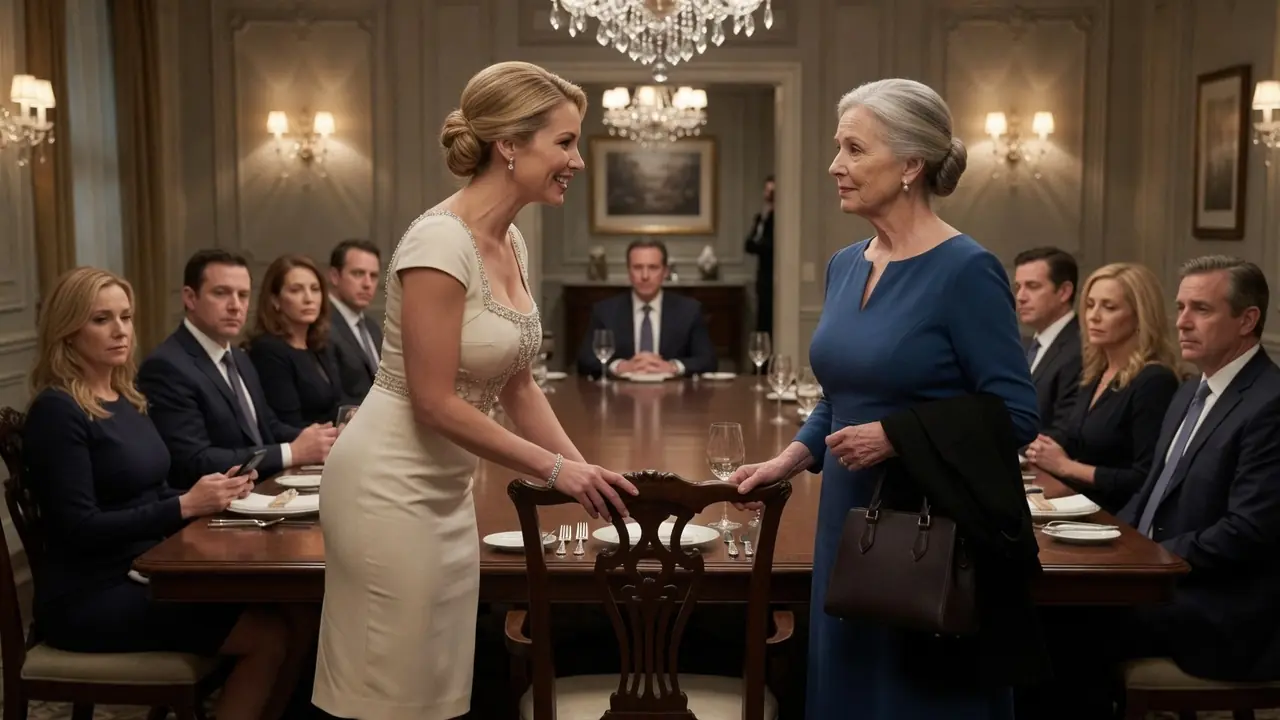
Twenty-four guests sat beneath warm golden chandeliers inside the private dining room of Bellmont House, one of the most expensive restaurants in downtown Charlotte. Crystal glasses sparkled beneath soft light. Polished silverware rested beside folded ivory napkins. White roses filled the center of the long table, arranged so perfectly that they looked almost unreal.
It was the kind of room where cruelty did not have to shout.
It could smile.
It could wear pearls.
It could sound like a joke and still cut down to the bone.
Every chair around the private dining table was occupied, except one.
The final seat.
My seat.
I had arrived five minutes late because the elevator in the parking garage had stopped working, and at seventy-one years old, stairs did not negotiate with my knees. I came in quietly with my coat folded over one arm and a small gift bag in my hand. Inside was a watch I had bought for my son, Reid, to celebrate his promotion to executive vice president at Hawthorne Capital.
It was not the most expensive gift I could have purchased.
But it was the one I thought he would understand.
His father, Calvin, had worn a watch every day of his life, even when he was driving trucks through rain at two in the morning and had no one to impress but himself. Calvin used to say a watch was not about wealth. It was about honoring time, because time was the one thing a man could spend and never earn back.
Reid had loved that saying when he was young.
I wanted to remind him of it.
But before I could reach the empty chair, Tessa rested one manicured hand across its back.
She smiled with the confidence of someone who had never been told no often enough to become decent.
“There’s no chair for you, Wilma,” she said sweetly enough for every guest to hear. “Go eat in the restroom. You’re used to it.”
The room changed.
Not loudly.
Not honestly.
Just enough.
A fork paused halfway to someone’s mouth. A woman in a navy dress blinked and looked down at her plate. Reid’s boss shifted uncomfortably in his chair. Someone near the far end gave a nervous laugh, the kind people use when they are too cowardly to object and too embarrassed to stay silent.
Tessa did not lower her voice.
She wanted an audience.
She wanted the table to understand that I was tolerated, not welcomed. She wanted every polished guest in that room to know that the old woman standing by the doorway was an inconvenience dressed in a department store coat.
A few more nervous laughs drifted through the room.
Others suddenly became fascinated with their wine glasses or the glowing screens of their phones, pretending not to notice what had just happened.
No one spoke.
No one offered me a chair.
No one challenged her.
I stood there with my coat folded over one arm and the gift bag hanging from my fingers, feeling dozens of eyes studying me as though humiliation were simply another course being served that evening.
But I searched for only one face.
Reid.
My son.
The little boy I had carried through childhood fevers. The boy I had cheered for at Little League games even when he struck out four times in one afternoon. The boy who once cried in my lap because his father missed his sixth-grade award ceremony after a truck broke down in Tennessee. The boy I comforted after every disappointment, celebrated after every small victory, and loved through every season of his life.
He was sitting beside Tessa in a charcoal suit that probably cost more than my first truck.
He never looked up.
Not once.
His hands were folded near his plate. His jaw was tight. His eyes stayed fixed on the tablecloth, as if the pattern in the linen had suddenly become the most important thing in the world.
That silence hurt far more than Tessa’s words ever could.
For one suspended moment, the entire dining room seemed to wait.
They expected tears.
They expected anger.
Maybe even pleading.
Instead, I simply nodded.
“I hope you all enjoy your dinner,” I said quietly.
Then I turned and walked away before anyone could see the price those seven words had cost me.
Outside, the cool evening air washed over me like freedom.
The restaurant glowed behind me with expensive elegance, all brass handles, tall windows, velvet curtains, and soft music drifting through the entrance whenever the door opened. Inside, my son was probably still pretending nothing unusual had happened. Inside, Tessa was probably lifting her wine glass and accepting everyone’s silence as proof that she had won.
But every step away from that restaurant made breathing easier.
I had lived long enough to know that humiliation is only powerful when you remain where it is being served.
So I left.
I walked slowly down Tryon Street, my knees aching, my coat pulled tight around my shoulders. Rain had fallen earlier, leaving the sidewalks glossy beneath streetlights. The city looked beautiful in the way cities often do when they are indifferent to private heartbreak.
A few blocks later, I found an empty bench beneath a lonely streetlamp overlooking rain-soaked streets reflecting the city lights.
I sat down carefully.
For a moment, I expected heartbreak.
Instead, I found clarity.
Sometimes people spend decades hiding who they really are.
Sometimes they reveal everything with a single sentence.
Tessa had revealed herself.
Reid had revealed himself too.
That was the part I had not wanted to face.
A daughter-in-law can dislike you. She can be cold, competitive, vain, insecure, cruel, or jealous. Those things hurt, but they do not always surprise you. But a son’s silence can tear through places no stranger could ever reach.
I opened the gift bag and looked at the watch inside.
Silver face.
Brown leather strap.
Classic.
Simple.
The kind of thing Reid’s father would have worn proudly.
My hand trembled as I closed the box again.
Calvin had been dead for eleven years. Sometimes I was grateful he had not lived to see what wealth, status, and a beautiful wife with expensive taste had done to our son. Other times, I wished he were beside me, because Calvin had always been better at anger than I was.
He would have walked into that dining room, pulled out the empty chair, and said, “My wife sits before anyone eats.”
But Calvin was gone.
So I had to be the one to decide what happened next.
I reached into my handbag and took out my phone.
The first call went to my attorney.
Her name was Elaine Mercer, and for almost a year, she had been helping me negotiate the sale of the freight company I had built from a single aging truck and three unpaid invoices.
Tate Freight Solutions had not always been a company people wanted to buy.
At the beginning, it was just me, Calvin, one rusted blue cab, and a folding table in our garage. Calvin drove. I handled invoices, dispatch calls, repairs, angry clients, unpaid bills, payroll when there was eventually someone to pay, and coffee strong enough to keep men awake through storms.
The first winter nearly broke us.
One engine failure. Two late payments. A client who disappeared owing us eleven thousand dollars. I remember sitting on the garage floor at three in the morning, surrounded by receipts, crying because I did not know how to tell Calvin we might lose the house.
He sat beside me, put one arm around my shoulders, and said, “Then we get up tomorrow and make one more call.”
So we did.
One call became one contract.
One contract became three trucks.
Three trucks became a small warehouse.
The small warehouse became regional routes.
And decades later, that lonely truck had become a transportation network stretching across four states. Warehouses. Distribution centers. Long-term contracts. Hundreds of employees who knew me long before they ever knew my title.
People liked to call me lucky.
Luck did not wake up at 4:00 a.m. to argue fuel prices.
Luck did not take calls from drivers stranded in ice.
Luck did not sit across from bankers who looked past me to ask whether my husband would be joining the meeting.
Luck did not sign payroll checks with shaking hands during recessions and pray every employee’s family would make it to Friday.
I built that company with grit, grief, and stubborn love.
After Calvin died, people assumed I would sell.
I did not.
I ran it for another eleven years.
And now, the final offer had been waiting on my desk for weeks.
One hundred sixty-five million dollars.
Elaine answered on the second ring.
“Wilma?”
“Accept it,” I said.
There was a long pause.
“Mrs. Tate, are you absolutely certain?”
I glanced back toward the restaurant where my son was probably still pretending nothing unusual had happened.
“Yes,” I replied. “I’ve never been more certain.”
Elaine’s voice softened.
“Did something happen?”
“Yes.”
“Do you need me to call you tomorrow morning?”
“No. I need you to send the acceptance tonight. And Elaine?”
“Yes?”
“Prepare the trust revisions we discussed.”
Another pause.
This one was heavier.
“All of them?”
“All of them.”
“Understood.”
When I ended the call, I sat very still.
For almost a year, I had hesitated to accept the offer because I kept thinking about Reid.
Not because he worked for my company.
He never had.
He had interned there one summer in college, then told me logistics was “not the world he saw himself in.” I was not offended. A mother does not need her child to inherit her work in order to be proud of him.
But some part of me had hoped that after the sale, I could give him something meaningful. Not control. Not power. But security. A foundation. Maybe seed money for the investment firm he dreamed of starting someday. Maybe help with the mansion Tessa kept hinting they deserved. Maybe a place for future grandchildren to grow up without worrying about money the way Reid had watched us worry when he was little.
For months, Elaine had warned me.
“Be careful, Wilma. Generosity without structure can become a weapon in someone else’s hand.”
I had told her Reid was my son.
Elaine had said gently, “That does not make him immune to influence.”
I hated her for saying it.
Now I knew she had been kind to warn me before I had proof.
My second call went directly to the restaurant manager.
Bellmont House had my number because I had booked the room myself.
Tessa had wanted the dinner there, of course. She said it would reflect Reid’s new position. She chose the private room, the wine package, the tasting menu, the custom dessert plates with Congratulations Reid written in chocolate script.
Then she forwarded the deposit request to me with a little message.
Would you mind handling this, Wilma? It would mean so much to Reid.
I paid it.
Of course I did.
That was the disease of motherhood.
Sometimes we keep paying for love long after the bill has become disrespect.
The manager answered professionally.
“Bellmont House, this is Aaron.”
“This is Mrs. Tate.”
His tone changed immediately.
“Good evening, Mrs. Tate.”
“I need you to remove my card from tonight’s reservation.”
Another careful pause.
“Would you like me to notify the party immediately?”
For the first time that evening, I smiled.
“No.”
“Wait until they ask for the check.”
Aaron was too well-trained to react openly.
But I heard the breath he took.
“Of course, Mrs. Tate.”
“And Aaron?”
“Yes, ma’am?”
“If anyone claims there was a mistake, there was not.”
“Understood.”
I ended the call and sat on the bench for another minute, listening to cars whisper over wet pavement.
Then I drove home.
Not to the elegant house Reid and Tessa proudly displayed across social media.
I returned to my small apartment on Sycamore Street.
Simple.
Quiet.
Honest.
There were no marble floors. No luxury decorations. No carefully staged photographs pretending everything was perfect. No imported rugs selected by Tessa. No kitchen island large enough for people to gather around while secretly judging whoever paid for it.
Only a modest living room, a worn armchair, a bookshelf full of mysteries, a framed photograph of Calvin leaning against our first truck, and a kettle that whistled too loudly.
People never understood why I lived there.
Reid certainly did not.
“Mom, you can afford better,” he used to say.
“I know.”
“Then why stay in that little apartment?”
“Because no one performs in it.”
He never understood that answer.
The apartment was mine. Not impressive. Not curated. Mine.
For the first time all night, I finally felt at home.
I removed my shoes, hung my coat, and placed Reid’s unopened watch box on the small table by the door. Then I made tea, though my hands were still shaking. I sat in Calvin’s old chair and watched rain slide down the window glass.
Several hours later, my phone began vibrating.
Once.
Twice.
Three times.
I ignored every call.
When it rang a fourth time, I answered.
“Mom?”
Reid’s voice sounded smaller than I remembered.
Not executive vice president.
Not successful son.
Not the man in the charcoal suit who had stared at his plate while his wife humiliated me.
Just my boy, calling because something had gone wrong.
“There’s a problem,” he said.
I remained silent.
“The restaurant says the payment method was removed. The bill is almost four thousand dollars, and everyone’s still here.”
“How unfortunate.”
He swallowed.
“Can you… can you please fix this?”
I closed my eyes for a moment before asking the only question that mattered.
“Do you remember what your wife said to me tonight?”
Silence.
“And do you remember what you did after she said it?”
His breathing changed.
“Mom, I was caught off guard.”
“No,” I said softly. “You were seated.”
“That’s not fair.”
“Fair would have been you standing up before I had to walk out.”
He did not answer.
In the background, I heard Tessa’s voice, sharp and low.
“Is she paying or not?”
There it was.
Not, Is she all right?
Not, I went too far.
Not, Tell her I am sorry.
Is she paying or not?
Reid covered the phone, but not well enough.
“Tessa, give me a second.”
Then he came back.
“Mom, please. This is embarrassing.”
I looked around my quiet apartment.
The old chair.
The rain.
The photograph of Calvin.
“Yes,” I said. “It is.”
“We have guests.”
“You had a mother.”
The line went silent again.
Then he said, quieter, “I know she shouldn’t have said that.”
“And yet she did.”
“I’ll talk to her.”
“No, Reid. You will pay the bill.”
“I don’t have that kind of available balance tonight.”
That surprised me more than it should have.
For years, Reid and Tessa lived as though money was a fragrance they wanted everyone to smell on them. Designer clothes. Weekend trips. Rooftop dinners. A leased luxury SUV. Photographs from private clubs. A house with white stone counters and a curved staircase that appeared in almost every picture Tessa posted.
But available balance was a phrase that cuts through illusion quickly.
“Then ask your guests to contribute,” I said.
“Mom, you know how that would look.”
“I know exactly how it will look.”
He exhaled sharply.
“Are you punishing me?”
“No. I am letting you pay for the room where you allowed me to be humiliated.”
“Mom.”
“I hope you enjoyed your dinner, Reid.”
Then I ended the call.
My hands trembled afterward.
Not because I regretted it.
Because sometimes standing up for yourself still hurts when the person you are standing against is someone you raised.
The phone rang again.
Then again.
Then Tessa called.
I declined.
She sent a text.
This is unbelievably petty. You embarrassed Reid in front of everyone.
I stared at the message for a long time.
Then I wrote back:
No, Tessa. You embarrassed him. I only stopped funding the performance.
I placed the phone face down.
That night, I slept poorly but honestly.
The next morning, sunlight came through my apartment window, pale and clean. I made coffee, toasted one slice of bread, and sat at my small kitchen table while the city woke up outside.
At 8:17, Elaine called.
“The acceptance has been sent,” she said. “The buyers are thrilled. They want to close as quickly as possible.”
“Good.”
“And the trust revisions?”
“Proceed.”
“Wilma,” she said gently, “this is a significant change.”
“I know.”
“Reid was originally named as primary beneficiary of nearly everything outside the charitable allocations.”
“I remember.”
“You now want the majority placed into employee pensions, scholarships, driver assistance funds, and the Calvin Tate Foundation?”
“Yes.”
“And Reid?”
“He will receive enough to know I loved him. Not enough to let his wife mistake my life’s work for a prize she earned.”
Elaine was quiet for a moment.
Then she said, “I will draft it exactly that way, though perhaps in more legal language.”
Despite myself, I laughed.
“Please do.”
The Calvin Tate Foundation had been Calvin’s dream long before we had money.
He used to say truck drivers were the backbone of America until their backs gave out, and then everyone forgot them. He wanted a fund for injured drivers, scholarships for their children, emergency grants for families after accidents, and mental health support for men and women who spent too much of life alone on highways trying to make delivery windows that did not care about human bodies.
I had planned to start the foundation after the sale anyway.
But I had also planned to give Reid control of a family investment trust.
Not anymore.
Control requires character.
Blood alone was not enough.
By ten o’clock, news of the sale had reached Reid.
I know because he showed up at my apartment at 10:26.
He knocked three times, then called through the door.
“Mom, please. I know you’re in there.”
I looked through the peephole.
He stood in the hallway wearing yesterday’s exhaustion. No suit jacket. No tie. Just a white shirt, wrinkled at the sleeves, and a face that looked like he had not slept.
I opened the door.
“Good morning.”
His eyes searched my face.
“Can I come in?”
I stepped aside.
He entered slowly, looking around the apartment as though seeing it for the first time. He had visited before, of course, but never with humility. Before, he looked at my modest furniture and old photographs as if they were problems I refused to solve.
Now he looked at them like evidence.
Evidence that I had never needed his approval.
He stood near the bookshelf.
“Tessa isn’t here,” he said.
“I noticed.”
“She wanted to come.”
“I doubt that.”
He looked down.
“She wanted to explain.”
“She had an audience last night. She used it.”
He flinched.
I walked to the kitchen.
“Coffee?”
He looked surprised by the offer.
“Yes, please.”
I poured him a cup because I was still his mother, not because he deserved comfort.
He sat across from me at the small table.
For a moment, neither of us spoke.
Then he said, “You sold the company.”
“I accepted the offer.”
“Without telling me?”
I raised an eyebrow.
“Should I have asked permission?”
“No. I didn’t mean…” He rubbed his forehead. “I just thought you were still deciding.”
“I was.”
“What changed?”
I looked at him.
“You did.”
The words landed.
His face tightened.
“Mom, last night was awful. I know that.”
“Do you?”
“Yes.”
“Then tell me what happened.”
He looked confused.
“What do you mean?”
“I want to hear you say it. Not Tessa’s version. Not the polite version. Yours.”
He stared into his coffee.
“Tessa told you there was no chair for you.”
“And?”
His jaw worked.
“She told you to eat in the restroom.”
“And?”
“I didn’t stop her.”
There.
The first honest thing.
I waited.
He continued, voice rougher.
“I looked down because I was embarrassed and because I didn’t want a scene in front of my boss. I told myself I would talk to her later. I told myself you would understand because you always understand.”
That sentence almost broke me.
Because it was true.
I had understood too much for too long.
I had understood when he missed birthdays because work was demanding. I understood when he forgot to call because life was busy. I understood when Tessa made sharp remarks because she was “adjusting to the family.” I understood until understanding became the blanket they used to cover disrespect.
“I am tired of being expected to understand my own mistreatment,” I said.
His eyes filled.
“I’m sorry.”
“I know you are.”
“Do you?”
“Yes. But sorry does not put you back at that table standing up for me.”
He covered his face with both hands.
“I hate myself for it.”
I softened, but only a little.
“Do not make your regret my responsibility, Reid.”
He lowered his hands.
“What does that mean?”
“It means I am not going to comfort you for hurting me.”
He nodded slowly.
“I deserve that.”
“No one deserves pain. But everyone deserves consequences.”
He looked toward the photograph of Calvin by the window.
“Dad would be ashamed of me.”
“Yes,” I said.
His face crumpled.
I let the truth sit there.
Then I added, “But he would still love you.”
Reid wiped his eyes.
“I don’t know how I became this man.”
I studied him.
“You did not become him in one night. Last night simply showed him to you.”
That hurt him too.
Good.
Some pain is useful if it wakes the right part of a person.
He took a breath.
“Tessa said you were trying to make her look bad.”
I laughed once.
“Tessa needed no assistance.”
His mouth twitched, but the almost-smile vanished quickly.
“The bill was a disaster,” he admitted.
“I assumed.”
“My boss paid part of it. Two of my coworkers covered some. I put the rest on a credit card. Tessa cried in the car and said you ruined the most important night of my career.”
“What did you say?”
He looked ashamed.
“Nothing.”
I closed my eyes briefly.
Still.
He saw my reaction and leaned forward.
“No. Mom, listen. At first I said nothing. Then when we got home, she kept going. She said you were vindictive. She said you never accepted her. She said you wanted to make me choose.”
“And?”
“I said maybe she made the choice for me when she told my mother to eat in a restroom.”
I looked at him.
For the first time since the dinner, I saw my son clearly.
Not restored.
Not forgiven fully.
But awake.
“What did she say?”
“She said I was weak.”
“Of course she did.”
“She said men who let their mothers control them never build anything.”
I smiled sadly.
“Did you remind her what my company just sold for?”
Reid looked down, embarrassed by his own small laugh.
“No.”
“You should have.”
He looked at me then.
“Is it true? One hundred sixty-five million?”
“Yes.”
He absorbed it slowly.
I had never hidden that the company was valuable, but I had never lived like a woman carrying that number either. Reid knew I had money. He did not know the final amount, and Tessa certainly had not.
“She knows,” he said quietly.
“I imagine.”
“She saw an alert online.”
“And now she wants to explain.”
He nodded.
I sipped my coffee.
“No.”
“Mom.”
“No, Reid. Not today.”
“She said she’ll apologize.”
“I’m sure she will.”
“Doesn’t that matter?”
“It would have mattered before the bill. Before the sale. Before she knew consequences existed.”
He had no answer.
I reached into my drawer and pulled out an envelope.
Inside was the watch.
I pushed it across the table.
“I brought this for you last night.”
He stared at it.
“What is it?”
“Open it.”
He did.
His hands stilled when he saw the watch.
“Dad’s style,” he whispered.
“Yes.”
His eyes filled again.
“I don’t deserve this.”
“No. You don’t.”
He looked up.
I continued.
“But I bought it before you disappointed me. I am giving it to you because I want you to remember the man your father tried to raise, not the man your wife applauded last night.”
He held the watch like it was heavier than metal.
“I don’t know how to fix this.”
“You begin by no longer asking the people you hurt to pretend it is fixed.”
He nodded.
“And Tessa?”
“That is your marriage.”
“She’s my wife.”
“Yes.”
“You don’t like her.”
“No.”
His eyes widened slightly at my honesty.
I said, “I tried. For your sake, I tried. But I will not lie anymore. She is cruel when cruelty benefits her. She is charming when charm benefits her. Last night, she believed humiliating me would raise her position in that room. That tells me everything I need to know.”
Reid looked at the watch.
“I think she married the version of me she wanted to create.”
“And did you let her?”
“For a while.”
“Then stop.”
He left an hour later, still holding the watch box.
He hugged me at the door.
I allowed it.
But I did not hold on as long as he wanted.
That afternoon, Tessa arrived.
I saw her through the peephole. Cream coat. Perfect hair. Diamond earrings. Lips pressed into the expression of a woman prepared to perform remorse like a well-rehearsed speech.
I did not open the door.
She knocked again.
“Wilma, I know you’re home.”
I remained silent.
She knocked a third time.
“I came to apologize.”
I waited.
Her voice sharpened slightly.
“Reid told me I should come.”
There it was.
Not I needed to come.
Reid told me.
I opened the door but kept the chain on.
Tessa blinked at the barrier.
“Hello, Wilma.”
“Mrs. Tate.”
Her smile faltered.
“What?”
“You may call me Mrs. Tate.”
Color rose in her cheeks.
“Mrs. Tate,” she said carefully, “I wanted to apologize for last night.”
I waited.
“What I said was inappropriate.”
“That is a word for wearing white to someone else’s wedding. Try again.”
Her jaw tightened.
“It was hurtful.”
“Yes.”
“And disrespectful.”
“Yes.”
“I was under stress.”
I almost closed the door.
She rushed on.
“I know that doesn’t excuse it. Reid’s promotion was important, and I wanted everything to be perfect. When there was confusion with the seating, I handled it badly.”
“Confusion?”
“The room was full.”
“The reservation was for twenty-five.”
She blinked.
“I paid the deposit, Tessa. I know how many chairs were ordered.”
Her face hardened for half a second before she smoothed it over.
“I made a terrible comment. I am sorry.”
“No, you made an intentional comment. In front of twenty-four guests. Loudly. Then you watched me leave and stayed for dinner.”
“I was embarrassed.”
“So was I.”
She looked past me into the apartment, as if trying to understand how a woman with a $165 million sale could live in such a small place.
I saw calculation move behind her eyes.
“Wilma, we are family.”
“No,” I said. “We are related by your marriage to my son. Family requires more than proximity to money.”
Her lips parted.
“That is unfair.”
“Is it?”
“I came here to make peace.”
“No. You came here because you learned I can remove more than a credit card.”
For the first time, she looked genuinely caught.
I stepped closer to the door.
“Tessa, I am going to say this once. You are not welcome in my home. You are not welcome to call me by my first name. You are not welcome to ask me for money, favors, introductions, investments, or forgiveness performed on your schedule.”
Her face went pale with anger.
“You are going to make Reid choose.”
“No. Reid will reveal himself by what he chooses. That is different.”
She stared at me.
Then the mask slipped.
“You think money makes you powerful now?”
I smiled.
“No, dear. I was powerful when I was poor. Money just means people like you finally notice.”
Her eyes flashed.
For a second, I thought she might say something even uglier.
Instead, she stepped back.
“You’re going to regret turning me into an enemy.”
I looked at her through the narrow opening.
“You were never important enough to be my enemy.”
Then I closed the door.
My hands shook afterward, but not from fear.
From release.
Over the next several weeks, the sale of Tate Freight Solutions became public. Business papers wrote about it. Local news called me a “transportation pioneer.” Former employees sent messages that made me cry harder than the articles did. Drivers I had not seen in years called to tell me Calvin would have been proud.
The closing happened on a Thursday morning.
I wore my navy suit, the one Calvin always said made me look like I was about to buy the bank instead of ask it for a loan. Elaine sat on my left. The buyers sat across from us. Papers moved. Pens signed. Hands shook.
When it was done, one hundred sixty-five million dollars had changed legal direction.
People expected me to celebrate with champagne.
Instead, I went to the old yard where our first warehouse still stood, though we had not used it in years. The blue truck was there too, restored and parked beneath a covered bay. Calvin had refused to sell it. After he died, I kept it because some machines become family.
I climbed into the cab slowly.
The seat smelled faintly of leather, dust, and memory.
For the first time that day, I cried.
Not because I had sold a company.
Because I had ended a chapter that began with me and Calvin frightened in a garage, wondering if we could make one more call.
My phone buzzed while I sat there.
Reid.
I answered.
“Hi, Mom.”
“Hello.”
“I just saw the news. Congratulations.”
“Thank you.”
He paused.
“I’m proud of you.”
The words were simple.
Late.
But real.
I closed my eyes.
“Thank you, Reid.”
“I should have said that more.”
“Yes.”
“I know.”
He cleared his throat.
“Tessa and I are separated.”
I opened my eyes.
“I’m sorry you are hurting.”
“She said I chose you over her.”
“And did you?”
“No,” he said slowly. “I think I chose myself for the first time in a long time.”
That answer gave me hope.
Not joy.
Hope.
A cautious thing.
“We’re selling the house,” he said.
“The social media house?”
He laughed softly.
“Yes. That one.”
“Good.”
“I can’t afford it alone.”
“I know.”
He hesitated.
“I’m not asking for money.”
“I know.”
“I just wanted you to hear it from me.”
“I appreciate that.”
Another pause.
“Can I come see the old truck sometime?”
I looked around the cab.
“You remember it?”
“Of course I remember it. Dad let me sit in the driver’s seat when I was six. I thought it was a spaceship.”
“It was less comfortable than a spaceship.”
He laughed again, and for a moment, he sounded like my son before ambition and fear and Tessa’s voice had crowded him.
“Come Saturday,” I said.
“I’d like that.”
Saturday came clear and cool.
Reid arrived in jeans, not a suit. He looked tired, thinner somehow, but more honest. He brought coffee in paper cups and a box of doughnuts from the bakery Calvin loved.
We sat in the old truck together.
For a while, neither of us spoke.
Then Reid touched the steering wheel.
“I forgot how big it felt.”
“You were small.”
“I think I stayed small in some ways.”
I looked at him.
He continued.
“I liked being seen as successful. I liked the rooms Tessa got me into. I liked people thinking I had become someone important.” He swallowed. “But I think I stopped asking whether I was becoming someone good.”
I let that sit.
The old version of me would have rushed to reassure him.
This version did not.
Reid looked at me.
“I let her treat you like you were beneath us because part of me wanted to believe I had risen above where I came from.”
That sentence was the closest he had come to the center of it.
I looked out through the windshield at the quiet yard.
“Do you know what your father would say?”
Reid gave a sad smile.
“He’d say a man who forgets where he came from better hope the road ahead has no mirrors.”
I laughed.
“That sounds like him.”
Then Reid cried.
Not loudly.
He turned his face away at first, but I reached for his hand.
He held on like he had when he was a boy.
“I’m sorry, Mom.”
“I know.”
“I should have stood up.”
“Yes.”
“I’ll spend the rest of my life wishing I had.”
“Do not spend your life wishing. Spend it becoming the kind of man who stands up next time.”
He nodded.
That was how we began again.
Not quickly.
Not neatly.
Reid moved into a smaller apartment. He changed jobs six months later, leaving Hawthorne Capital for a smaller firm where he said people actually went home for dinner. He began volunteering with the Calvin Tate Foundation after I made it very clear he would not be running it.
“You can carry boxes,” I told him.
He did.
The first foundation event provided emergency grants to twenty-seven families of injured truck drivers. Reid stood beside me as one woman cried over a check that would keep her mortgage current while her husband recovered from a highway accident. He did not speak much that day. He mostly listened.
Afterward, he said, “I understand why Dad wanted this.”
“Yes,” I said. “This is what money is for when it remembers people.”
Tessa disappeared from my life, though not from gossip.
Their divorce was finalized the following year. I heard she remarried a developer in Atlanta and posted photographs from a vineyard wedding with captions about new beginnings. I wished her no harm. I also wished her no access to me.
Some people are lessons, not relationships.
As for the dinner guests from Bellmont House, several sent polite messages after the sale became public.
One of Reid’s coworkers wrote that he regretted not saying anything.
I replied:
Then say something next time.
That was all.
Because regret without change is just manners arriving late.
Two years after that night, the Calvin Tate Foundation held its first scholarship dinner.
Not at Bellmont House.
I chose a restored community hall near the old warehouse. There were wooden floors, bright windows, simple flowers, and enough chairs for everyone. Drivers came with their families. Scholarship students came with parents who looked proud and overwhelmed. Former employees hugged me until my ribs hurt.
Reid came too.
He arrived early to help set up tables.
At the front of the hall, there was one empty chair beside mine.
When the program began, Reid walked to the podium to introduce me. He looked nervous, but steady.
“My mother built more than a company,” he said. “She built a place where people were seen. I forgot that once. I forgot it badly. But she reminded me that success without character is just expensive emptiness.”
His voice wavered.
“She is the strongest person I know. And I am grateful she loved me enough not to protect me from consequences.”
The room applauded.
This time, I did not search his face and find silence.
I found my son standing.
After the dinner, he pulled out my chair before I sat down.
A small gesture.
Almost nothing.
Everything.
I looked up at him.
He smiled sadly.
“I should have done that before.”
“Yes,” I said.
Then I sat.
The evening was warm, full of laughter, children running between tables, drivers telling stories too loudly, and families eating without checking whether the silverware was polished enough to impress anyone. There were no crystal chandeliers. No velvet curtains. No four-thousand-dollar bill waiting like a trap.
Only people.
Real ones.
The kind Calvin and I had spent our lives working beside.
Later, after everyone left, Reid and I stood outside under the hall lights. Rain had fallen again, leaving the pavement shining just as it had the night I walked away from Bellmont House.
Reid glanced at me.
“Do you ever think about that night?”
“Yes.”
“Do you still hate me for it?”
“I never hated you.”
“But you were angry.”
“I still am sometimes.”
He nodded.
“I understand.”
“No,” I said gently. “You are learning to.”
He accepted that.
Progress, I had discovered, often sounds like someone no longer defending themselves.
We walked to my car together.
Before I got in, Reid said, “Mom?”
“Yes?”
“Thank you for not paying that bill.”
I looked at him in surprise.
He gave a small, painful smile.
“If you had paid it, I might have kept pretending.”
I thought of Tessa’s hand on the chair.
The nervous laughter.
My son’s lowered eyes.
The bench under the streetlamp.
The phone call to Elaine.
The card removed from the reservation.
The bill arriving like truth printed on paper.
“You are welcome,” I said.
He laughed softly.
So did I.
People often think dignity is loud.
They imagine it as a grand speech, a slammed door, a courtroom victory, a public downfall. Sometimes dignity is those things. But sometimes dignity is quieter. Sometimes it is an old woman standing in a private dining room while everyone waits for her to beg, and choosing instead to leave with her head high.
Sometimes it is removing your credit card from a table where you were not given a seat.
Sometimes it is accepting that the people you love may need consequences more than comfort.
And sometimes it is understanding that wealth means nothing if it only buys admission into rooms where cruelty wears perfume and calls itself elegance.
That night at Bellmont House, Tessa thought she had shown everyone where I belonged.
She was right, in a way.
She showed me exactly where I did not belong.
I did not belong at a table where my dignity depended on my silence.
I did not belong funding humiliation disguised as celebration.
I did not belong shrinking myself so my son could avoid an uncomfortable moment.
I belonged in the company I built.
In the foundation that carried Calvin’s name.
In the small apartment that gave me peace.
In any room where every person had a chair.
Most of all, I belonged to myself.
And once I remembered that, no one could send me to the restroom again.