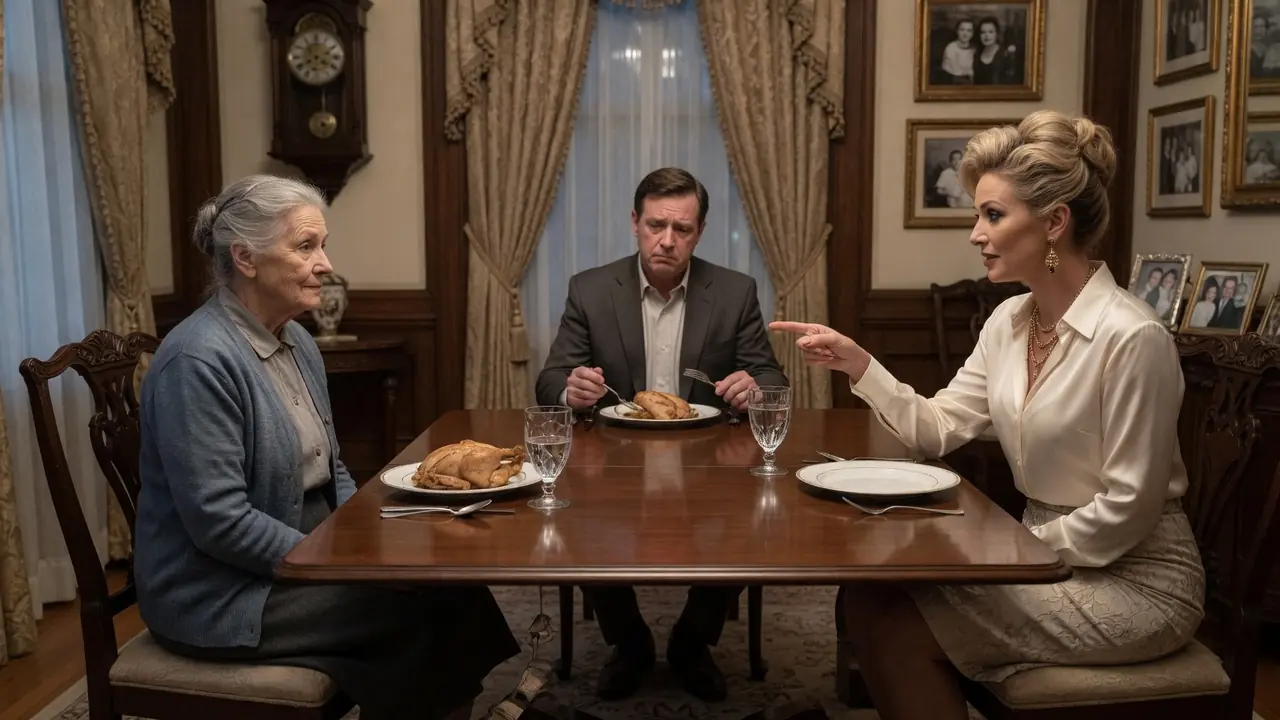
“Get a job and stop living off everyone.”
My daughter-in-law screamed those words across Sunday dinner as if she had been carrying them behind her teeth for years.
The room went still.
Not quiet.
Still.
There is a difference.
Quiet is peaceful. Still is what happens when every person in the room realizes something has been broken and nobody knows who will pick up the first piece.
My son Wesley froze with his fork halfway to his mouth. Bianca sat at the head of her polished dining table, cheeks flushed, eyes bright with the kind of satisfaction people only show when they have been waiting a long time to be cruel. Behind her perfect curtains, the old wall clock kept ticking.
Tick.
Tick.
Tick.
It was the only sound left in the dining room.
She thought she had finally cornered me.
A broke widow. A burden. A lonely old woman clinging to her only son because grief had emptied my life and poverty had finished the job.
So I smiled.
Not softly.
Not sadly.
It was the kind of smile that comes when someone finally says the one sentence that gives you permission to stop protecting them from the truth.
Bianca’s expression tightened.
“What’s funny?” she asked.
I looked at the dry chicken on my plate, the crystal glasses gleaming in front of everyone else, and the polished silverware arranged like a magazine photograph. Then I looked down at my own place setting.
A chipped plate.
A cracked glass.
A bent spoon.
Tiny humiliations, carefully chosen and quietly placed.
I lifted my eyes to Bianca.
“Honey,” I said, my voice calm enough to make Wesley flinch, “you might want to start packing your bags tonight.”
Bianca blinked once.
Wesley finally lowered his fork.
“Mom,” he whispered.
But I did not look at him.
Not yet.
My name is Patricia Maddox, though most people call me Pat. I am sixty-six years old, and for four years I allowed my son and his wife to believe I was barely surviving in a tiny rental cottage on the edge of Hastings, Nebraska.
They thought my faded cardigans meant I had no money.
They thought my scuffed shoes meant I had no pride.
They thought I walked through town because I could not afford a car.
They thought every quiet smile, every humble nod, every time I declined an expensive restaurant or wore the same coat twice in one month meant life had finally beaten me after my husband Hal died.
They were wrong.
I owned that cottage outright.
I owned pieces of businesses all over our town through trusts and holding companies most people never bothered to read closely. I owned part of the building where Bianca had her favorite boutique account. I owned the parking lot behind the salon where she got her hair highlighted every six weeks. I owned three small warehouses, two restaurants, a storage company, and minority shares in a medical supply business that had grown more than even Hal expected before he passed.
And quietly, without a diamond bracelet or luxury car to announce it, I had ten million dollars sitting behind my name.
But money had never been the test.
Love was.
And for four long years, I had been learning exactly who loved me when they believed I had nothing left to offer.
The dinner invitation had come the Monday before.
“Mom,” Wesley said over the phone, his voice low and careful, “want to come for dinner Sunday? Bianca’s making her special chicken.”
Then came the pause.
I knew that pause.
I had raised the boy who made it.
“And maybe wear something nicer this time,” he added. “You know how Bianca likes things to look proper.”
Proper.
That word stayed with me all week.
It followed me while I watered the geraniums Hal had planted before he got sick. It sat beside me while I drank coffee alone at the small kitchen table. It echoed in my bedroom while I buttoned the same faded blue cardigan Bianca hated so much.
Proper.
The word was funny, coming from people living inside a house they did not even know I had purchased for them.
Their house looked beautiful when I arrived Sunday evening.
It should have.
I had bought it nine years earlier as a wedding gift.
Not directly, of course. Wesley was too proud, and Bianca was too hungry for appearances. So I had done it through a lawyer, with instructions that my name never be mentioned.
To them, it was a miracle financing arrangement.
To me, it was a mother trying to give her son a safe beginning.
The house sat on a quiet street lined with maple trees, with a wide front porch, black shutters, a brick walkway, and flower boxes Bianca changed every season for photographs. In spring, tulips. In summer, white hydrangeas. In autumn, orange mums and pumpkins arranged with such careful casualness that nothing about them looked casual at all.
Inside, every room had been curated.
Not decorated.
Curated.
Bianca liked that word.
The walls were soft beige. The lamps were expensive. The kitchen counters gleamed. There were framed family photographs everywhere, though somehow I appeared in only one, and in that one, I was half hidden behind Wesley’s shoulder.
I noticed things like that.
Old women notice when they begin disappearing from their own family’s walls.
Wesley hugged me at the door, but his arms barely held on.
He smelled like aftershave and worry.
“Hi, Mom,” he said.
“Hi, sweetheart.”
For one second, I saw the little boy who used to run barefoot across my kitchen floor, holding up broken toys for Hal to fix. He had been a sweet boy once, tender in a way he tried to hide from other children. When his first dog died, he slept on the kitchen floor beside the empty dog bed for three nights.
Then Bianca appeared in the kitchen doorway.
Her eyes slid over me slowly.
The cardigan.
The shoes.
The plain purse.
She did not even try to hide the judgment.
“Pat,” she said, like my name was something she had found under the sink.
“Bianca,” I replied.
She air-kissed near my cheek without touching me.
“We’re in the dining room.”
“I can see that.”
Her smile tightened.
Wesley gave me a pleading look, the sort of look he had perfected over the years. Please don’t make this difficult. Please don’t notice what she just did. Please keep the peace so I don’t have to choose courage.
I followed them inside.
Dinner was already arranged when I entered the dining room.
Matching plates for everyone.
Except me.
Crystal glasses for everyone.
Except me.
Straight silverware for everyone.
Except me.
My place setting had been arranged at the far end of the table, not the guest seat near Wesley, not beside anyone, but slightly apart. The plate in front of my chair had a chip along the rim. The glass had a thin crack running down one side. The spoon beside my napkin was bent, not enough to be unusable, just enough to be noticed by anyone meant to notice.
I noticed.
His eyes flicked to my setting and then away so quickly it felt practiced.
That hurt more than Bianca’s cruelty.
Cruel people are predictable.
Cowards surprise you every time.
I sat down anyway.
I thanked Bianca for inviting me.
I said the chicken looked lovely.
Bianca smiled.
“It’s herb roasted. I used a recipe from a chef in Omaha.”
It tasted like cardboard and resentment.
Still, I took a polite bite.
Hal would have laughed if he had been there. He never liked dry chicken, but he respected good manners. He used to say a person’s table revealed more truth than their front door. People could polish an entrance for strangers, but the table showed how they treated those expected to stay.
At that table, I had been given the plate they would never offer a stranger.
That told me enough.
Bianca talked through the meal. She talked about yoga, shopping, a charity luncheon, and replacing the kitchen cabinets she had once called perfect. She spoke as if every object in the room existed to prove she had climbed higher than the people around her.
Wesley stared at his food.
His shoulders were tight.
His jaw moved before any words came out.
Finally, he cleared his throat.
“Mom, we need to talk.”
There it was.
Bianca leaned forward, folding her hands with fake concern.
“Pat, we’re worried about you,” she said. “You’re alone. You’re struggling. It’s been four years since Hal passed, and honestly, you don’t seem to be doing well.”
“I’m doing fine,” I said.
Bianca tilted her head.
“Are you?”
Her voice had gone silky.
That was when the real Bianca always came out.
“You can barely make rent,” she continued. “You don’t own a car. You dress like you’re digging through donation bins.”
Wesley said nothing.
Nothing.
The boy I had carried through fevers.
The young man whose college tuition Hal and I paid without complaint.
The husband sitting in a house I had secretly bought for him.
He sat there and let his wife strip me down in my own silence.
Bianca mistook my quiet for weakness.
She lifted her chin.
“You’re only sixty-six,” she said. “The grocery store is always hiring baggers. A job would give you purpose. Independence. Self-worth.”
Self-worth.
The word landed in my chest like a slap.
After twenty-five years building restaurants with Hal.
After buying properties no one knew I owned.
After saving businesses during bad seasons.
After paying payrolls for families who never knew how close they had come to losing everything.
After funding scholarships for children whose parents still sent me Christmas cards without knowing why their lives had changed.
After quietly making sure Wesley never knew how close he had come to losing everything himself.
I set the bent spoon down beside the chipped plate.
The sound was small.
But Wesley heard it.
His face changed.
Maybe some part of him remembered the way I went still before making a decision. Maybe he remembered being twelve years old and watching me negotiate with a banker who thought he could intimidate me. Maybe he remembered his father saying, “Your mother is kind, Wes. Don’t ever mistake that for soft.”
Bianca did not notice.
She was too busy enjoying herself.
“Funny you should bring up worth, Bianca,” I said.
Her smile twitched.
“Excuse me?”
I reached into my purse.
Wesley’s eyes dropped to my hand.
Slowly, I pulled out a folded document and placed it on the table between the dry chicken and the cracked glass.
The paper looked harmless.
That was the beauty of it.
Bianca stared at it, then at me.
“What is that?” she asked.
I unfolded it carefully, smoothing the crease with fingers that did not tremble.
Wesley finally looked up.
For the first time all evening, he looked afraid.
I turned the document so both of them could see the first line.
“Let’s start,” I said quietly, “with who actually owns the chair you’re sitting in.”
Bianca let out a short laugh.
It was not a real laugh.
It was the kind people use when their minds reject the first sign that reality has changed.
“What are you talking about?”
I tapped the page once.
“That house. This dining room. Those curtains you like so much. The kitchen cabinets you want to replace. The porch where you posed for your anniversary photos. It all belongs to the Maddox Family Trust.”
Wesley closed his eyes.
Bianca looked at him sharply.
“What is she saying?”
I continued before he could answer.
“The trust owns the property. I am the controlling trustee. You and Wesley have lived here under a family occupancy agreement since your wedding.”
Bianca stared at the document.
“That’s impossible.”
“No, honey. It is inconvenient. That is different.”
She grabbed the paper and scanned it quickly, though I doubted she understood half the legal language. Bianca was good at reading room arrangements and social cues. She was less good at reading documents that did not flatter her.
Wesley spoke at last.
“Mom, please.”
I turned to him.
“Please what?”
He swallowed.
“Let’s talk privately.”
“We were talking publicly when your wife told me to get a job.”
His face reddened.
Bianca slammed the paper down.
“This is fake.”
“No.”
“You’re lying.”
“No.”
“This is our house.”
“It is your home,” I said. “Or it was. Ownership is another matter.”
Her mouth opened.
Closed.
Opened again.
She looked at Wesley.
“Did you know?”
Wesley’s silence answered before his words did.
“I suspected,” he said quietly.
Bianca stood so abruptly her chair scraped the floor.
“You suspected?”
“When we first got the house, the terms were strange. The lawyer never gave me a normal closing packet. Dad handled most of it.”
“Your father?”
“And Mom.”
I watched him carefully.
He had known enough to wonder.
Not enough to be certain.
But enough to ask me years ago.
He never had.
Maybe because not knowing let him pretend the house was his achievement.
Bianca pointed at me.
“You let us think it was ours.”
“I let you live here. There is a difference.”
“You manipulated us.”
That made me smile again.
A smaller smile this time.
“Bianca, I gave my son a home and asked for nothing in return but basic respect.”
“You hid it.”
“Yes.”
“Why?”
I looked at Wesley.
“Because your husband had pride, and I had enough love to protect it.”
Wesley’s face twisted.
I almost softened.
Almost.
Then I looked down at the chipped plate.
No.
Not yet.
Bianca crossed her arms.
“So what? You think you can wave some old paper and throw us out because I hurt your feelings?”
“My feelings have survived worse than you.”
Her eyes flashed.
“Then why are you doing this?”
“Because you stopped at cruelty only when you believed I had no power to answer.”
That silenced her for a moment.
The old wall clock continued.
Tick.
Tick.
Tick.
I reached into my purse again.
Wesley whispered, “Mom.”
I placed a second document on the table.
“This is notice of termination of occupancy.”
Bianca’s face changed.
“What?”
“You will have thirty days. Not because you deserve thirty. Because I am still me.”
Wesley pushed back from the table.
“Mom, wait.”
I finally turned fully toward him.
“Did you think there would never be a consequence?”
He looked stricken.
“I didn’t know she was going to say that.”
“But you knew where I would sit.”
He flinched.
“You knew about the chipped plate.”
His eyes filled.
“Mom.”
“You knew the glass was cracked.”
“I didn’t choose it.”
“No. You just allowed it.”
He lowered his head.
That was the difference between Bianca and Wesley.
Bianca wanted to humiliate me.
Wesley wanted to avoid discomfort so badly that he let humiliation happen and called it peace.
I had spent years forgiving his silence because he was my son.
That night, the forgiveness ran out.
Not love.
Love is harder to kill.
But forgiveness, in the form they had been spending carelessly, ended.
Bianca looked from him to me, panic beginning to sharpen her voice.
“You can’t just evict family.”
“Family,” I said, “does not serve a widow dinner on a chipped plate and tell her to bag groceries for self-worth.”
“I was trying to help.”
“You were trying to feel taller.”
Her face went red.
“You are unbelievable.”
“No. I am finished.”
She turned to Wesley.
“Say something.”
He looked at me.
Then at her.
Then back at the table.
“I don’t know what to say.”
For once, that was honest.
I gathered my purse.
Bianca stepped around the table.
“This is insane. You’re going to ruin us over one argument?”
I paused near the doorway and looked back at her.
“No, Bianca. I am going to stop financing people who believe kindness is weakness. If that ruins you, then my money was holding up more of your life than your pride admitted.”
She had no answer for that.
I walked toward the front door.
Wesley followed me.
“Mom, wait.”
I stopped in the foyer beneath a framed wedding photograph of him and Bianca. She looked radiant in the picture. He looked terrified and happy, the way young men often do when they think they have found both love and a future.
He stood in front of me now, no longer young, no longer sure.
“Please don’t leave like this,” he said.
“How should I leave?”
He looked helpless.
“I’m sorry.”
“For what?”
He opened his mouth.
Closed it.
I waited.
This mattered.
An apology without shape is just a plea for consequences to stop.
Finally, he whispered, “For not stopping her.”
“And?”
“For letting you be treated like you didn’t matter.”
“And?”
His eyes shone.
“For being ashamed of how you looked when I should have been ashamed of how we acted.”
There he was.
My boy.
Buried, but not gone.
I touched his cheek once.
He leaned into it for half a second before remembering he was a grown man.
“I love you, Wesley,” I said.
His breath hitched.
“But love is not a permission slip for cowardice.”
He nodded, crying silently.
I opened the door and stepped onto the porch.
Behind him, Bianca shouted something I did not bother to understand.
The night air was cool.
I walked down the brick path I had paid for and climbed into the town car waiting at the curb.
Yes.
The town car.
Not my car.
I had stopped driving years earlier because I preferred walking, and because walking told me more about people than arriving in leather seats ever could. But I kept a driver for evenings and longer trips. Most people in town did not know that. They saw what they expected to see.
A lonely old widow walking because she had to.
Not a wealthy woman walking because she liked knowing which neighbors waved when they thought she had nothing.
My driver, Alan, opened the door.
“Home, Mrs. Maddox?”
“Yes, Alan.”
He glanced toward the house, where Bianca’s silhouette moved sharply behind the curtains.
“Everything all right?”
I settled into the back seat.
“It is now.”
The next morning, Bianca called seven times before breakfast.
I did not answer.
Wesley called twice.
I let those ring too.
Then came the messages.
Mom, please call me.
Mom, we need to talk.
Mom, Bianca is freaking out.
Then Bianca.
Pat, you are being irrational.
Pat, this is elder manipulation and I will get a lawyer.
Pat, you cannot throw us out of our home.
By noon, my attorney, Mr. Calvin Price, called me.
“She has contacted a lawyer,” he said.
“Of course she has.”
“He will have a difficult morning once he reads the documents.”
“Try not to enjoy that too much, Calvin.”
“I make no promises.”
Calvin had been Hal’s lawyer before he became mine. He was seventy-two, dry as toast, and had helped build every trust structure Bianca was now about to discover. He had warned me years ago not to give Wesley full ownership too soon.
“Children may be good people,” he said then, “but marriage introduces weather.”
I had laughed.
I was not laughing now.
That afternoon, Wesley came to my cottage alone.
I saw him through the lace curtain before he knocked. He stood on my porch with his hands in his coat pockets, shoulders hunched, eyes red. For a moment, he looked eighteen again, standing outside my bedroom after a fight with his father, unsure how to apologize.
I opened the door.
“Hello, Wesley.”
“Hi, Mom.”
He looked past me into the cottage.
It was small, yes.
But not poor.
The furniture was simple because I liked it. The rugs were old because they had belonged to my mother. The curtains were handmade by Hal’s sister. Nothing in the room existed to impress anyone, which was why Bianca never understood it.
“May I come in?” he asked.
I stepped aside.
He entered carefully.
I made tea, not because he deserved hospitality, but because I remained myself. We sat at the kitchen table, the same table where Hal and I had planned acquisitions, payroll decisions, donations, and Wesley’s college move-in weekend.
Wesley wrapped both hands around his mug.
“Bianca didn’t know,” he said.
“That is not a defense.”
“I know.”
“Do you?”
He nodded slowly.
“She thought you were…” He stopped.
“Say it.”
He looked ashamed.
“She thought you were poor.”
“Yes.”
“And I let her.”
“Yes.”
He swallowed.
“I don’t know when I became like that.”
I studied him.
“Like what?”
“A coward.”
The word hurt him.
Good.
Some words should.
“You became one choice at a time,” I said. “That is how most people become things they never meant to be.”
He stared into his tea.
“At first, it was little comments. She’d say your coat looked sad or your purse looked cheap. I told myself it didn’t matter because you didn’t care about that stuff.”
“I did not care about the coat.”
“But you cared about being mocked.”
“Yes.”
“I should have stopped it.”
“Yes.”
He pressed his fingers to his eyes.
“Then she started saying you were embarrassing when we went places. I told myself she was just insecure.”
“She was.”
“But that doesn’t make it okay.”
“No.”
He let out a shaky breath.
“Last night, when I saw the plate, I knew. I knew what she was doing. And I still sat down.”
I said nothing.
He needed to hear himself.
“I thought if I ignored it, dinner would pass. I thought if I kept quiet, nobody would explode. I thought peace meant silence.”
He looked at me.
“But it wasn’t peace, was it?”
“No, Wesley. It was permission.”
He closed his eyes.
A tear slipped down his cheek.
“I’m sorry, Mom.”
This apology had shape.
It had bones.
It did not fix everything, but it could stand.
“I believe you,” I said.
His face crumpled with relief.
“But belief is not restoration.”
He nodded.
“What happens now?”
“You and Bianca move out.”
He looked down.
“Thirty days?”
“Yes.”
“Is there any way…”
“No.”
He nodded again, more slowly.
“I figured.”
“Good.”
“Bianca wants to fight.”
“I expected that.”
“She says you tricked us.”
“No, Wesley. I protected you. The problem is that you began to believe protection was proof you had earned the view.”
He looked around my kitchen.
“Why didn’t you ever tell me how much you had?”
I smiled sadly.
“Because money changes rooms before people enter them.”
He frowned.
“What does that mean?”
“It means if you had known, every visit, every birthday, every phone call would have passed through the question of inheritance. Maybe not for you at first. But eventually. Money sits in a family like another person at the table. It speaks even when nobody mentions it.”
He was quiet.
“I wanted to know who came to see me when they thought there was nothing to gain.”
His face tightened.
“And I failed.”
“You faltered.”
“Is that better?”
“It gives you room to stand up.”
He looked at me.
“Do I still have room?”
I reached across the table and covered his hand with mine.
“Yes. But not inside that house.”
Bianca did fight.
For three days.
Then her lawyer called Calvin Price.
After that, she fought differently.
Less publicly.
Less confidently.
She discovered that the house was not hers. The furniture she had assumed came with it had been purchased through a family furnishing account controlled by the trust. Even the art pieces she bragged about at brunches had been lent, not gifted.
She discovered the SUV she drove was leased through a company owned by one of my holding firms because Wesley’s credit had been strained in the first year of their marriage.
She discovered the country club membership had been paid annually by a “family lifestyle fund” created by Hal, administered by me, and revocable at my discretion.
That phrase became important.
At my discretion.
Bianca had built a life on things she believed made her superior.
None of them belonged to her.
Not truly.
The day she realized that, she came to my cottage.
Unlike Wesley, she did not knock gently.
She rang the bell twice, then knocked hard enough to rattle the frame.
I opened the door wearing my faded blue cardigan.
Her eyes dropped to it.
This time, she did not dare comment.
“Pat,” she said.
“Bianca.”
“May I come in?”
“No.”
Her mouth tightened.
“I think we should talk.”
“We are talking.”
“In private.”
“I am alone. You are alone. That seems private enough.”
She glanced toward the street, embarrassed to be standing on the porch of the cottage she had mocked.
“My lawyer says the documents are difficult.”
“I imagine that is one word for it.”
“This is vindictive.”
“No.”
“You’re taking everything.”
“I am taking back what was mine.”
Her face reddened.
“That house was our life.”
“No, Bianca. That house was a gift you mistook for an achievement.”
She inhaled sharply.
“I loved that home.”
“I know.”
“I made it beautiful.”
“Yes.”
Her eyes flashed.
“Doesn’t that count?”
“It counts as care for the house. It does not erase contempt for the woman who gave it to you.”
For a moment, she looked away.
Then she said something quieter.
“You could have told me.”
“That I had money?”
“Yes.”
“Would it have made you kinder?”
She did not answer.
I nodded.
“That is why I didn’t.”
Her lips pressed together.
“I was wrong to say what I said.”
“Yes.”
“I was angry.”
“No,” I said. “You were confident.”
That struck harder.
She looked at me.
“Confident?”
“You thought I had no power. Your cruelty came from certainty, not anger.”
Her eyes filled, but her pride held the tears in place.
“I don’t know where we’re supposed to go.”
“That is something you and Wesley will need to decide.”
“We can’t afford anything comparable.”
“Then do not compare.”
She laughed bitterly.
“That is easy for you to say from behind your secret millions.”
I looked at her for a long moment.
“Do you know what I did the first year after Hal and I opened our first restaurant?”
She frowned, thrown by the question.
“What?”
“I worked from four in the morning until midnight six days a week. On Sundays, I did books. I wore the same two dresses until one split at the seam behind the register. We slept in the office twice because payroll mattered more than rent that month.”
Bianca said nothing.
“I have eaten beans from a pot standing over a sink. I have told suppliers I would pay Friday and then stayed awake until Friday praying enough customers came through the door. I have carried debt in my chest like a stone. Do not speak to me as if money arrived one morning with manners and a bow.”
Her face shifted.
For the first time, she looked uncertain.
“I didn’t know.”
“You never asked.”
Silence passed between us.
Then she whispered, “I thought you looked down on me.”
That surprised me.
“Why?”
“Because you never seemed impressed.”
I almost laughed, but the sadness of it stopped me.
“Bianca, I lived long enough to learn that performance is expensive and peace is quiet. I was not unimpressed with you. I was waiting to meet the person under the performance.”
Her eyes filled again.
“And did you?”
“Not often.”
She looked down.
“I don’t know how to be poor.”
The sentence was honest enough that I softened by one degree.
“Then learn how to be humble first. It will help.”
She let out a shaky breath.
“I’m sorry.”
I heard the words.
I did not yet hear enough truth beneath them.
“I hope someday you mean that for my sake, not yours.”
She nodded once.
Then she turned and walked back to her car.
The move happened within three weeks.
Bianca posted nothing online.
For once, there was no staged photograph, no caption about new beginnings, no smiling picture beside boxes and a coffee cup. The silence was revealing.
Wesley found a modest rental townhouse across town. Two bedrooms, small yard, no grand staircase, no dining room built for performance. The first time he told me about it, he sounded ashamed.
I stopped him.
“Is it safe?”
“Yes.”
“Clean?”
“Yes.”
“Can you afford it without my help?”
A pause.
“Yes.”
“Then it is a good home.”
He went quiet.
“I forgot how to think like that.”
“I know.”
Bianca hated the townhouse at first.
I know because Ruth Bell, my friend who owned the bakery two streets over, heard it from her niece who did hair at the salon Bianca no longer visited every six weeks. Small towns have many sins, but poor information flow is not one of them.
The first month was hard for them.
No country club.
No SUV.
No housekeeper twice a month.
No credit card quietly covered through a family account.
No trust-funded illusion.
Wesley had to confront his finances. Bianca had to confront her taste. Both were overdue.
I did not rescue them.
That was harder than people think.
It is one thing to cut off an ungrateful daughter-in-law. It is another to watch your son sit in the consequences beside her. But rescue had become the language through which I kept him from growing a spine.
So I stayed out.
I took walks.
Watered geraniums.
Met Calvin twice about restructuring my estate.
And, for the first time in four years, I changed my will.
Not to punish Wesley.
To protect what Hal and I built from being swallowed by whoever shouted loudest at a dining table.
The Maddox Family Trust would now divide future assets into charitable funds, community investments, and carefully managed inheritance structures. Wesley would receive support, but not control. Any future grandchildren would be provided for educationally and medically. No spouse could access principal funds without trustee approval.
Calvin read the new structure and looked over his glasses.
“Very sensible.”
“That means very expensive.”
“Yes.”
“Do it.”
He smiled faintly.
“Hal would approve.”
My throat tightened.
“Hal would have acted sooner.”
“Perhaps,” Calvin said. “But he loved Wesley too.”
That was true.
Love delays decisions sometimes.
Then life makes them for you.
Two months after the dinner, Wesley invited me for coffee.
Not dinner.
Not at Bianca’s table.
Coffee at a small café downtown.
He arrived early and stood when I approached.
That small courtesy nearly undid me.
“Hi, Mom.”
“Hello, sweetheart.”
He looked better.
Tired, but clearer.
We ordered coffee and sat near the window.
“I’m seeing a counselor,” he said after a few minutes.
I kept my face calm.
“I’m glad.”
“I needed to understand why I freeze.”
“That is worth understanding.”
He nodded.
“Bianca and I are also seeing someone.”
I lifted my eyebrows slightly.
“That surprises me.”
“Me too.”
“How is it?”
“Terrible.”
I almost smiled.
“Good therapy often is.”
He laughed softly.
Then he grew serious.
“She’s different right now. I don’t know if it will last. But she’s trying. She got a job.”
That did surprise me.
“Where?”
“Event coordinator at the community center.”
“Honest work.”
“Less glamorous than she likes.”
“Most honest work is.”
He looked down at his cup.
“I got a second job too. Consulting for a small accounting firm on weekends.”
“You always were good with numbers.”
“Not as good as Dad.”
“No one was as good as your father, according to your father.”
Wesley laughed again.
This time, it sounded like my boy.
After a pause, he said, “I told Bianca about the scholarship fund.”
I stilled.
“What scholarship fund?”
“The one you and Dad started under the Maddox Foundation. She found out when she was looking through old town articles.”
I sighed.
“The town articles are getting nosy.”
“She cried.”
That made me look up.
“She did?”
“She said she had spent years thinking you were pathetic because you didn’t show anything off, and then found out half the things she respected in town existed because you didn’t show off.”
I said nothing.
Wesley continued.
“I don’t know if that changes who she is. But it cracked something.”
“Cracks are useful if light gets through.”
He nodded.
Then he reached into his jacket and pulled out something wrapped in tissue.
He set it on the table.
“What is that?”
“Open it.”
Inside was a spoon.
Polished silver.
Straight.
Old.
Familiar.
My breath caught.
It belonged to the silverware set Hal bought me on our twenty-fifth anniversary. I had given it to Wesley years ago because I thought family heirlooms should live with the next generation.
“Bianca found the box in storage,” Wesley said. “She said she didn’t know where it came from.”
“She never asked.”
“I know.”
He pushed the spoon gently toward me.
“She wanted you to have it back.”
I touched the handle.
“Why?”
He swallowed.
“She said she had no right to serve you with anything bent while your own silver sat in her closet.”
For a moment, the café blurred.
I placed the spoon back in the tissue.
“Tell her I received it.”
“Do you forgive her?”
I looked at my son.
“I am less angry than I was.”
“That isn’t yes.”
“No.”
He nodded.
“I understand.”
“Do you?”
“I’m trying.”
“Good.”
The seasons moved.
Spring came slowly to Nebraska that year. Snow melted into brown grass. Geraniums bloomed. The maple trees outside Bianca and Wesley’s former house filled with leaves, though I no longer drove past often.
I had the house cleaned, repaired, and then made a decision that surprised even Calvin.
I did not sell it.
I donated its use to the Maddox Foundation’s new family transition program.
Women leaving unsafe marriages. Families recovering from financial loss. Single parents rebuilding after hardship. People who needed one year in a good home while they found their footing.
Bianca heard before Wesley told her.
She called me herself.
I almost did not answer.
Then I did.
“Pat,” she said.
“Bianca.”
“I heard what you’re doing with the house.”
“Yes.”
“That’s…” She paused. “That’s good.”
“It is.”
Another pause.
“I’m sorry I made that house smaller than it was.”
I understood what she meant.
For years, she had turned a gift into a stage for her own insecurity.
Now it would become shelter.
“Thank you,” I said.
Her voice trembled.
“I started volunteering at the community center on Saturdays. Not for appearances. Wesley doesn’t even come. I just…”
She stopped.
“You just what?”
“I just realized I don’t know how to be useful when nobody is admiring me.”
There it was.
The first honest sentence she had ever given me.
“Then you are learning something important.”
“I’m trying.”
“Keep trying.”
“I will.”
Months later, she asked if I would meet her for lunch.
I chose the place.
A small diner Hal and I used to love, where the plates did not match because nobody cared and the pie was better than anything Bianca used to serve on crystal stands.
Bianca arrived in plain trousers and a sweater.
No performance.
Or less performance, at least.
She looked nervous.
I let her be.
We sat across from each other.
For a while, we spoke about neutral things. Weather. Wesley. The community center. A family moving into the old house through the foundation.
Then Bianca placed both hands around her coffee mug and looked at me.
“I hated you,” she said.
It was not the apology I expected.
So I waited.
“I hated that Wesley loved you in a way I couldn’t control. I hated that you didn’t seem impressed by me. I hated that you could sit quietly in a room and somehow make me feel like I was trying too hard.”
I took a slow breath.
“I was not trying to make you feel that way.”
“I know that now.”
She looked down.
“I grew up with a mother who made everything a competition. House, clothes, weight, parties, husbands, children. If you looked poor, you were failing. If someone had more, they were winning. I thought that was life.”
“It is a terrible way to live.”
“Yes.”
She wiped beneath one eye quickly.
“When I saw you in those cardigans, I thought you had lost. And if you had lost, I thought I could look down on you without consequence.”
I said nothing.
She continued.
“But you hadn’t lost. You had stopped playing.”
The words were sharp with truth.
I nodded once.
“That is closer.”
“I am ashamed,” she whispered.
“You should be.”
She flinched, but accepted it.
That mattered.
“I don’t expect you to love me,” she said.
“No?”
“No. But I would like to earn the chance for you not to dread seeing me.”
It was the first request she had made of me that did not involve money, status, or my silence.
“That is possible,” I said.
Her eyes filled.
“Thank you.”
“Do not thank me too quickly. It will take time.”
“I know.”
“Good.”
By Christmas, the family transition house welcomed its first residents.
A mother named Sharon and her two children moved in after losing their apartment when her hours were cut. Wesley helped carry boxes. Bianca organized the pantry, quietly, without taking photos. I stood in the living room watching a little boy run up the staircase Bianca once used for posed holiday pictures.
The house felt different.
Lighter.
As if it had been waiting to become useful.
Sharon tried to thank me three times.
I told her she did not owe me gratitude every time we made eye contact.
She laughed through tears.
Her daughter, a shy eight-year-old named Lucy, asked if the house was really theirs for a while.
“For a while,” I said. “Long enough to breathe.”
Lucy nodded seriously.
“That’s good. My mom needs breathing.”
Yes, I thought.
Many people do.
On Christmas Eve, Wesley and Bianca came to my cottage.
They brought food.
Not dry chicken.
A simple stew Wesley had made himself and bread Bianca had picked up from Ruth’s bakery. Bianca wore no expensive coat. Wesley carried a small box wrapped in brown paper.
I opened it after dinner.
Inside was a new place setting.
A plate, a glass, a spoon, a fork, and a knife.
Not crystal.
Not silver.
Beautiful stoneware, handmade by a local potter.
The plate had one small intentional line of gold through the glaze, like the Japanese repair art I had once told Wesley about when he was young. Broken places made visible, not hidden.
Wesley cleared his throat.
“We wanted you to have a place at our table,” he said.
Bianca added quietly, “A real one.”
I touched the plate.
For once, I had no quick words.
Bianca looked down.
“I know it doesn’t fix what I did.”
“No,” I said.
Her face tightened.
“But it begins a different sentence.”
She looked up.
Wesley blinked hard.
I stood and placed the plate in my cabinet.
Not with the old chipped things.
With the dishes I used when people I loved came to eat.
It was not full forgiveness.
It was not forgetting.
It was a place to begin.
Two years passed.
Wesley and Bianca stayed in the townhouse longer than planned. They could have moved somewhere bigger eventually, but they did not rush. Wesley became more confident in ways that had nothing to do with money. Bianca became quieter in ways that suited her better than polish ever had.
She still liked nice things.
There was nothing wrong with that.
But she no longer confused nice things with worth.
One afternoon, she arrived at my cottage with dirt on her hands and no makeup. I had never seen such a thing.
“Are you ill?” I asked.
She laughed.
“I was planting flowers at the transition house.”
“Voluntarily?”
“Yes.”
“Should I call a doctor?”
She rolled her eyes.
That was when I knew we were improving.
The transition program grew.
One house became three.
Then five.
The Maddox Foundation funded job training, childcare stipends, emergency rent support, and small business grants. I finally allowed my name to be attached publicly after Calvin convinced me anonymity had limits and legacy required clarity.
The newspaper ran a profile.
They used a photograph of me in my faded blue cardigan because I insisted.
The headline read:
LOCAL WIDOW BEHIND MILLIONS IN QUIET COMMUNITY SUPPORT
Bianca read the article three times, Wesley told me later.
Then she framed it and hung it in the community center office.
Not in her house.
Not as proof she was connected to money.
In the place where people needed to see what quiet generosity could build.
The old house where she once served me dinner on a chipped plate became known in town as the Maddox House.
Families stayed there for one year at a time.
The dining room table remained.
But every place setting matched.
Bianca made sure of that herself.
She became almost fierce about it.
Once, during a volunteer dinner, someone accidentally placed a chipped mug at the end of the table. Bianca removed it so quickly Ruth told me later she nearly caused a breeze.
“Not at that table,” Bianca said.
When Ruth told me, I sat very still.
Then I smiled.
People can change.
Not always.
Not easily.
Not because consequences frightened them for one night.
But sometimes, when shame becomes honesty and honesty becomes action, a person can turn.
I never again allowed my wealth to be used as a silent cushion for disrespect.
Wesley knew that.
Bianca knew it too.
My will remained structured, careful, and protected. The trust remained firm. Help came with accountability. Love came freely, but money came through wisdom.
That balance brought me peace.
One Sunday, nearly three years after the dinner that changed everything, Wesley invited me over.
Not to the old house.
To the townhouse.
It was smaller, lived-in, and warm. Bianca opened the door herself. She wore an apron with flour on it and looked nervous.
“Pat,” she said, then corrected herself. “Mom Pat, if that is still all right?”
I looked at her.
It had been a long road from the chipped plate.
“Yes,” I said. “That is all right.”
Her eyes shone.
Dinner was roast chicken.
Not dry.
In fact, it was quite good.
At the table, my place was beside Wesley.
My plate matched everyone else’s.
My glass was whole.
My spoon was straight.
Nobody mentioned it.
Nobody needed to.
During dessert, Bianca stood.
“I want to say something,” she said.
Wesley looked surprised.
I looked wary.
She smiled faintly.
“Don’t worry. I practiced being brief.”
I raised an eyebrow.
“A miracle.”
She laughed softly, then grew serious.
“I once thought worth was something people displayed. Houses, clothes, cars, furniture, who admired you, who envied you. And because I believed that, I mistreated someone who had more worth sitting quietly in a faded cardigan than I had ever managed to fake in my whole polished life.”
Wesley reached for her hand.
She looked at me.
“I’m sorry for the plate. I’m sorry for the glass. I’m sorry for the spoon. I’m sorry for every little humiliation I thought was small enough to hide behind manners.”
My throat tightened.
“I have apologized before,” she continued. “But I wanted to say it at a table. A real table. With a real place for you.”
The room was quiet.
The old kind of stillness did not return.
This stillness was different.
It was full.
I looked at Wesley.
Then Bianca.
Then the plate in front of me.
“I receive that,” I said.
Bianca pressed her lips together and nodded.
After dinner, Wesley walked me to the door.
“Mom,” he said.
“Yes?”
“I’m proud of you.”
I smiled.
“For what?”
“For making us face it.”
I looked at my son, the boy I had loved, the man I had nearly spoiled into permanent weakness, the husband learning courage one late lesson at a time.
“I wish I had done it sooner,” I said.
“Maybe. But you did it.”
He hugged me then.
Not lightly.
Not briefly.
He held on the way he used to when he was small and frightened and knew I was safe.
This time, though, I was not the only safe one.
He was becoming safer too.
When I stepped outside, the evening air was cool. The streetlights glowed. The town was quiet in the way small towns become quiet after supper.
Alan was not waiting.
I had walked.
Not because I had to.
Because I wanted to.
My shoes were still scuffed. My cardigan was still faded. My purse was still plain.
But anyone who saw only those things had failed the test before speaking.
I walked home slowly beneath the Nebraska sky, thinking of Hal.
He would have been angry about that dinner.
Furious, actually.
But later, once the anger passed, he would have been proud of what came after. Not the documents. Not the trust. Not the eviction notice. Those were tools.
He would have been proud that I finally stopped using kindness to hide from conflict.
He would have been proud that Wesley learned accountability.
He would have been cautiously hopeful about Bianca.
And he would have laughed, loud and long, at the idea of me being told to get a job.
Because I had been working all along.
Working when no one noticed.
Working when no one thanked me.
Working when my name was hidden behind trusts, foundations, payrolls, and quiet checks.
Working to build a life large enough to help people.
But that night at Sunday dinner, I learned something important.
Work is not only what earns money.
Sometimes the hardest work is ending the version of yourself other people learned to use.
Bianca had screamed, “Get a job and stop living off everyone.”
She did not know the chipped plate in front of me was the last insult I planned to forgive.
She did not know the chair beneath her belonged to me.
She did not know the house around her stood because of my love.
She did not know that my silence was not poverty.
It was patience.
And when patience ended, truth did not need to shout.
It only needed one folded document on a dining room table.
One calm voice.
One sentence.
“Let’s start with who actually owns the chair you’re sitting in.”
That was the moment everything began to unravel.
But sometimes, unraveling is mercy.
Because only after the false things come apart can a family learn what is strong enough to remain.