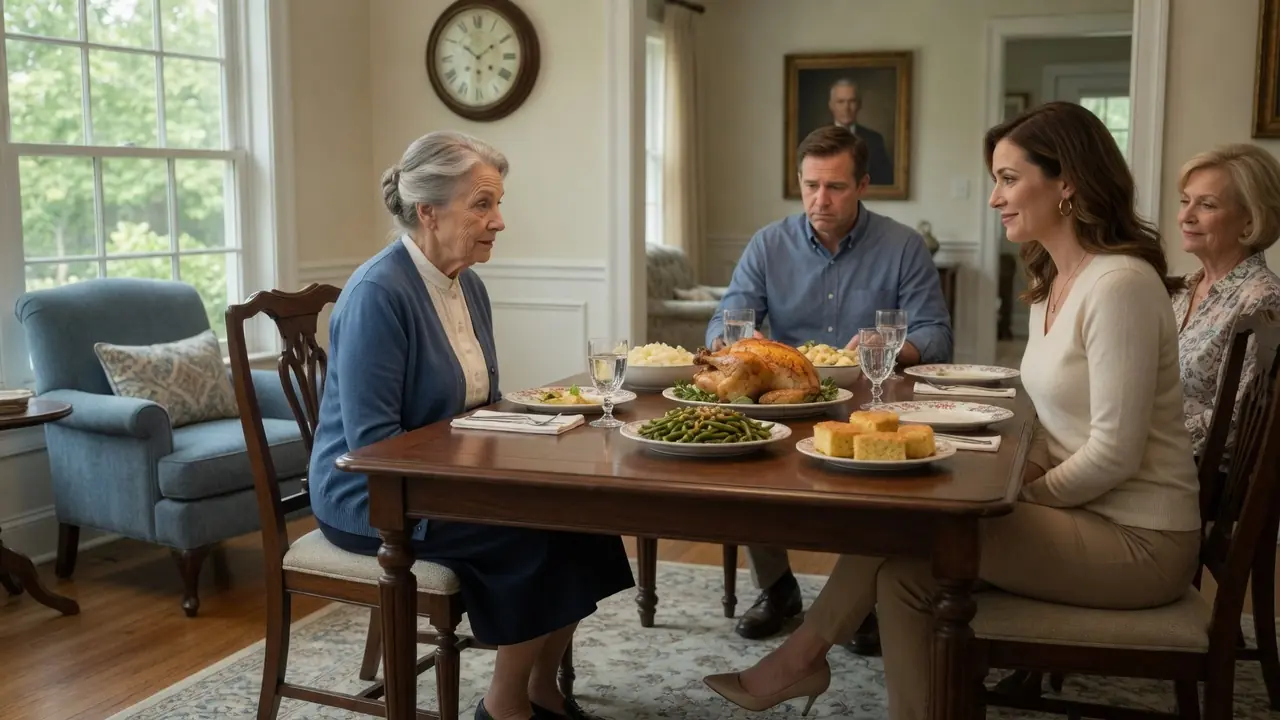
My daughter-in-law sat at my Sunday table and suggested I move into senior living so “she’d be more comfortable,” and my son looked down at his plate like my home had already stopped belonging to me.
For a moment, the dining room went so quiet I could hear the old wall clock ticking beside Frank’s portrait in the foyer.
Tick.
Tick.
Tick.
That clock had hung in our house for thirty-one years. Frank bought it from an estate sale the summer Mark turned five. He said every house needed one thing that sounded older than everyone in it, something steady enough to remind people time was a guest and not an owner.
That afternoon, time felt like it was holding its breath.
Lauren’s mother, Denise, nodded slowly, her lips pressed together in that careful, satisfied way she had, as if she had just watched a door unlock.
My son, Mark, did not defend me.
He did not even look surprised.
He simply set down his fork beside the roast chicken I had cooked with my own hands and said, “Mom… maybe it is a good option.”
That was the moment I stopped hearing concern.
I started hearing the plan.
My name is Helen Walker. I am seventy years old, and I have lived in that house outside Nashville for thirty-four years.
I raised my son beneath that roof.
I buried my husband from that front porch.
I paid the mortgage, the taxes, the roof repairs, the plumbing bills, the insurance premiums, and every quiet cost that comes with keeping a home alive after the man you built it with is gone.
So when Lauren first called it “too much house for one woman,” I did not miss what she meant.
When she started calling it “family space,” I heard the second warning.
And when her mother, Denise, arrived after the wedding with three suitcases and somehow never left, I understood exactly where the road was going.
They did not take over loudly.
That would have been too easy to name.
They did it with smiles.
With helpful hands.
With little suggestions spoken in soft voices.
At first, Lauren only “rearranged” small things.
The vase on the mantel.
The lace runner on the sideboard.
The framed picture of Mark in his Little League uniform, moved from the living room to the upstairs hallway because, according to her, “family photos feel cleaner when they’re grouped together.”
Cleaner.
That word came up often.
Cleaner.
Brighter.
Lighter.
Modern.
Never mine.
Never Helen’s.
Never the house Frank and I built one payment, one repair, one hard year at a time.
Frank’s portrait disappeared from the entry wall first.
One morning, I came downstairs and found a gold-framed mirror hanging where his face had watched over the foyer for almost twenty years. It was a large mirror with a thin decorative border, the sort of thing Lauren found online and called “timeless,” though it looked like every hotel lobby I had ever walked through.
I stood in the entryway for a long time with my hand on the banister.
There was no trace of Frank there anymore.
No brown eyes.
No crooked smile.
No blue tie he hated wearing, but wore anyway because I said it made him look handsome.
Lauren came in from the kitchen carrying a mug of coffee.
“Oh good, you saw it,” she said brightly. “Doesn’t it make the space feel bigger?”
I looked at the mirror.
It reflected an old woman in a house that suddenly seemed less sure of her.
“Where is Frank’s portrait?”
Lauren blinked as if the question itself were unpleasant.
“I put it in the study for now. The mirror opens up the entryway. Denise said the old portrait made the foyer feel heavy.”
Heavy.
My husband had become heavy.
Denise came down the stairs behind her wearing one of her silk robes, though she had been “visiting” for almost six weeks by then.
“It really does brighten things,” Denise said. “Sometimes grief becomes clutter before we realize it.”
I looked at her.
She smiled softly.
That was Denise’s talent.
She could say something cruel in the voice of a woman offering tea.
Mark walked in a few minutes later, still buttoning his work shirt. I looked at him, waiting. Surely he would say something. Surely he would remember his father standing in that hallway every Christmas morning, pretending not to cry while Mark tore through wrapping paper. Surely he would remember Frank touching that banister the day the doctor told us the cancer had spread, standing there with one hand on the wood because his knees had almost given out.
Mark glanced at the mirror.
Then at me.
Then at Lauren.
“Mom,” he said, “it’s just a picture.”
Just a picture.
As if grief became decoration once someone younger wanted cleaner walls.
That was the first time I understood my son had learned to survive his marriage by letting me disappear one room at a time.
The reading chair went next.
It was blue, faded on one arm, and ugly to anyone who did not know its history. Frank bought it for me the winter after Mark was born, when I was exhausted and crying over laundry because the baby never slept and my body felt like it belonged to someone else. Frank carried the chair into the living room himself, grinning like he had brought home a Cadillac.
“For the queen,” he said.
I had nursed Mark in that chair.
Read library books in that chair.
Sat beside Frank’s hospital bed in that chair after we moved it downstairs during his final months.
After he passed, I spent entire nights there because my bedroom felt too big without the sound of his breathing.
Lauren moved it into a corner because it “blocked the flow.”
My plant table by the front window was moved to the garage.
My old pots, the ones I had used for thirty years of Sunday dinners, were stacked in a cardboard box marked donate.
Lauren called it modernizing.
Denise called it helping.
Mark called it keeping peace.
But peace should not require a mother to vanish inside her own home.
The worst part was not the furniture.
It was the way they began speaking around me, as if age had made me easier to outvote.
Lauren started leaving senior living brochures near my coffee maker.
Glossy pages.
Smiling gray-haired people.
Words like comfort, care, community, safety.
Denise would tap one with her fingernail and say, “Helen, elevators really are wonderful at your age.”
At your age.
She said it like a locked door.
At your age, stairs were dangerous.
At your age, a large kitchen was impractical.
At your age, the garden was too much.
At your age, driving at night was unwise.
At your age, decisions should be made with family input.
Family input, in Denise’s mouth, meant Denise’s preference with my signature underneath.
Mark avoided my eyes every time the subject came up.
He would pour coffee.
Clear his throat.
Check his phone.
Anything but look at the woman who had once worked double shifts so he could graduate without debt.
I had raised Mark to be kind, but I had also raised him to be comfortable. Maybe that was where I failed. I had protected him too well from worry, from money troubles, from the ugly math of keeping a roof overhead after Frank got sick. I wanted him to have a soft childhood because mine had not been soft.
But softness, if not strengthened by gratitude, can become entitlement.
And my son had begun to believe the house was waiting for him simply because I had grown old inside it.
Lauren and Mark had moved in six months earlier.
They said it was temporary.
Their rent had gone up. Mark’s construction management job had slowed during winter. Lauren said it made no sense to waste money when I had “all this space.” She smiled when she said it, touching my hand across the kitchen table like she was doing me a favor by needing my house.
“Just until we get back on our feet,” she said.
Then Denise came to stay after “a stressful dental procedure,” which somehow required three suitcases, a full makeup case, two boxes of shoes, and no return date.
Frank would have seen through it by the second week.
I saw through it by the third.
But seeing through something and stopping it are not the same.
At first, I told myself I was being generous.
Then I told myself Mark needed help.
Then I told myself a mother should not make her son feel unwelcome in the house where he grew up.
By the time I realized they were making me feel unwelcome instead, they had already learned which floorboards did not creak.
Then came the Thursday evening that changed everything.
I had gone upstairs to fold towels because laundry was one of the few things Lauren still let me do without acting like I might injure myself. The towels were warm from the dryer, soft against my arms. I carried the basket toward the linen closet and stopped halfway down the hallway when I heard voices from the living room below.
Low.
Careful.
Not sweet anymore.
Lauren said, “Older people hate conflict. If we make the house uncomfortable enough, she’ll leave on her own.”
My fingers tightened around the towels.
Denise answered, “Don’t wait too long. Once she gets stubborn, everything becomes harder.”
There was a pause.
A long one.
I waited for Mark.
I waited for my son to say no.
To say that was his mother.
To say this was still my home.
To say the word home like it belonged to me too.
Instead, he sighed.
“Well,” he said, “that house is going to be mine someday anyway.”
The towels cooled against my chest.
Something inside me went very still.
Not broken.
Awake.
I went back upstairs without making a sound.
That night, I sat on the edge of my bed in the dark and looked at Frank’s empty side.
For the first time in months, I did not cry.
I thought of my husband’s hands.
Large.
Callused.
Patient.
Hands that fixed porch steps, braided Mark’s fishing line, rubbed my back after long shifts, and held mine the night before he passed.
“Helen,” he had whispered, voice thin but clear, “promise me you’ll keep living in the house as long as it brings you peace.”
“I promise,” I told him.
“And if it stops bringing peace?”
I had cried then.
He squeezed my hand.
“Then choose yourself. Not the house. Not Mark. Not old guilt. Yourself.”
At the time, I thought he was talking about grief.
I did not understand he might also be warning me about the living.
From that moment on, I paid attention.
People leave behind proof when they think an older woman is too tired to notice.
I took photos of every moved piece of furniture.
Frank’s portrait leaning face-in against a stack of storage bins in the study.
My blue reading chair shoved into a corner.
My plant table in the garage beside a bag of charcoal.
The box marked donate with my old pots inside.
I saved screenshots of messages Lauren accidentally left open on the family tablet.
One said, She’s sentimental about everything. It’s exhausting.
Another said, Mark will fold if we keep pressure steady.
A third, sent to Denise, made me sit down before I could keep reading.
Once Helen is settled somewhere, we can start the remodel before baby planning. No point bringing a child into a house that still looks like his dead father lives there.
No baby existed yet.
Only a plan.
I photographed contractor estimates for rooms they did not own.
A nursery plan.
A remodeling draft with my address typed neatly at the top.
Paint samples for my bedroom.
Cabinet designs for my kitchen.
A note in Denise’s handwriting that read, Primary suite should be Lauren and Mark’s. Helen’s current room best for nursery.
My current room.
The room where Frank died holding my hand.
The room where I still said goodnight to his side of the bed when loneliness got too large.
Reduced to square footage.
I also found a folder in Mark’s laptop bag one morning when he left it open in the dining room. I did not dig. I did not need to. The papers were on top, visible beneath a grocery receipt.
Comparative senior living costs.
Projected sale value of my house.
Estimated renovation budget.
Possible refinance after title transfer.
Title transfer.
That was when I stopped thinking of it as pressure and started thinking of it as theft with better manners.
The next day, I made three phone calls.
The first was to my attorney, Calvin Price.
He had handled Frank’s will, our mortgage closing years before, and the property transfer after Frank died. He was older now, but still sharp enough to make younger men nervous. When I told him I needed to review my estate documents and occupancy rights immediately, he did not ask why.
He only said, “Come tomorrow morning.”
The second call was to my friend Ruth Bell, who ran the bakery near the church.
Ruth had been widowed eight years before me, and if there was a woman in Tennessee less impressed by manipulation than Ruth, I had never met her.
“Do you need a place to stay?” she asked after I explained.
“Not yet.”
“Do you need me to come over and scare them?”
“Not yet.”
“Do you need banana bread?”
That made me laugh for the first time in days.
“Yes.”
“Good. That one I can do immediately.”
The third call was to my nephew, David.
He was Frank’s sister’s boy, a former accountant turned financial investigator who now worked with elder fraud cases. I asked if he could visit for coffee that week.
He did not laugh when I showed him the screenshots.
He did not tell me I was overreacting.
He said, “Aunt Helen, this is coercion.”
The word settled over the kitchen table like a hard truth finally given a name.
Coercion.
Not helping.
Not concern.
Not family planning.
Coercion.
David took copies of everything.
He helped me check my accounts, my deed, my insurance policies, my tax records, my will, and my power of attorney documents. Then he looked at me in a way that reminded me of Frank.
“Do not sign anything they give you.”
“I have no intention of it.”
“And do not be alone with Denise if she pushes papers.”
“I am old, David. Not foolish.”
He smiled sadly.
“I know. But people count on polite women staying polite.”
That was true.
I had been polite my entire life.
Polite through grief.
Polite through inconvenience.
Polite through people touching my things without asking.
Polite while my husband’s portrait was removed from its wall.
Politeness is a good thing until someone starts using it as a leash.
Calvin Price and I met two days later.
His office smelled of paper, coffee, and lemon furniture polish. He listened while I told him everything. He looked through the photographs, the screenshots, the remodeling plans, and the brochures. His expression did not change much, but by the time he finished reading, the muscle in his jaw was working.
“Helen,” he said, “do Mark and Lauren pay rent?”
“No.”
“Utilities?”
“Sometimes groceries. Not consistently.”
“Any written lease?”
“No.”
“Any written permission for Denise to live there?”
“No.”
“Have you signed any document suggesting transfer, shared ownership, or future rights?”
“Absolutely not.”
“Good.”
He leaned back.
“They are licensees at best. Guests, legally. Guests whose permission to remain can be revoked.”
I felt something inside me loosen.
Guests.
Not owners.
Not heirs in waiting.
Guests.
Calvin continued.
“We will update your estate plan immediately. I recommend placing the house into a revocable trust with you as sole trustee and naming a neutral successor trustee, not Mark.”
I stared at him.
“Not Mark.”
“No.”
The words hurt.
I had known they were coming.
They hurt anyway.
“He may still inherit under conditions if you choose,” Calvin said gently. “But he should not have control over the house or your finances without significant safeguards.”
I looked down at my hands.
“I never thought I would have to protect myself from my own son.”
“I know.”
Calvin’s voice softened.
“But protecting yourself is not the same as hating him.”
That became the sentence I held onto.
We prepared everything.
The Walker Family Home Trust.
Updated will.
Revoked old power of attorney.
New medical directive naming Ruth and David as decision-makers if I could not speak for myself.
A written notice terminating permission for Denise to live in the house.
A separate notice for Lauren and Mark, giving them thirty days to leave unless they entered a formal written rental agreement on terms I controlled.
Calvin asked if I wanted the documents delivered quietly.
I said no.
“Sunday lunch,” I told him.
He looked at me over his glasses.
“I beg your pardon?”
“They invited themselves to push me out over roast chicken. They can receive the answer at the same table.”
For the first time that morning, Calvin smiled.
“Frank would have enjoyed that.”
“He would have asked for extra gravy.”
That Sunday lunch was supposed to be their final push.
I knew it before Lauren even arrived downstairs.
She walked into my kitchen wearing the soft cream sweater she saved for conversations where she wanted to sound gentle and look harmless. Denise followed behind her with a bottle of wine and a smile too smooth to trust. Mark came last, shoulders tense, eyes already tired.
I had cooked roast chicken because Frank loved it.
Mashed potatoes.
Green beans.
Cornbread in one of the old pots Lauren had tried to throw away.
Before they sat down, I put Frank’s portrait back in the foyer.
Then I moved my blue reading chair back to the window, exactly where it had always belonged.
Lauren noticed immediately.
Her mouth tightened.
Denise noticed too.
Her eyes flicked toward the chair, then toward Lauren.
Mark noticed nothing until Lauren kicked him lightly under the table.
Lunch began with ordinary lies.
“The chicken is delicious,” Lauren said.
“The weather has been strange,” Denise added.
“We’re only trying to help,” Mark murmured, though no one had asked him anything.
I watched them eat the food cooked in the kitchen they had already redesigned in their minds.
I watched Lauren glance toward the foyer.
I watched Denise look at the hallway, probably imagining which wall would come down first.
I watched my son avoid the empty chair where his father used to sit.
Then Lauren folded her hands beside her plate and gave me that soft, careful smile.
“Helen,” she said, “we’ve all been thinking.”
That phrase should be illegal at family meals.
She talked about safety.
Stability.
Comfort.
What was “best for everyone.”
Denise leaned in with practiced sympathy and said I had “done my part” and deserved rest.
Rest.
As if I were a finished chore.
As if the life I had built could be packed, labeled, and removed.
Then Mark finally looked at me.
Only for a second.
“I think it could be a good option too,” he said.
I looked at my son’s face and searched for the little boy who used to run through that hallway with scraped knees and grass-stained shoes.
For a moment, I almost found him.
Then he looked away.
I folded my napkin slowly.
Set it beside my plate.
And stood up.
Lauren’s eyes brightened before she could hide it.
She thought I was going upstairs to cry.
Denise leaned back slightly, already victorious.
Mark stared at his hands.
I looked at all three of them.
Then I said, “Someone’s here.”
The doorbell rang.
Lauren’s smile disappeared.
Denise turned toward the foyer.
Mark finally lifted his head.
I walked past Frank’s portrait, opened the front door, and saw Calvin Price standing on my porch holding three white envelopes.
Beside him stood David.
Behind them, Ruth Bell held a foil-wrapped loaf of banana bread against her chest like she had come to witness a baptism and a trial at the same time.
“Good afternoon, Helen,” Calvin said.
“Right on time.”
“I do try.”
I stepped aside.
Lauren stood quickly when Calvin entered the dining room.
“Who is this?”
“My attorney,” I said.
Denise’s eyes narrowed.
“Your attorney?”
“Yes.”
Mark pushed back from the table.
“Mom, what’s going on?”
I looked at him.
“The plan, Mark. Only not yours.”
Calvin placed the three white envelopes on the dining table, one in front of each of them.
Lauren stared at hers.
Denise did not touch hers.
Mark looked at me as if I had become someone he did not recognize.
Maybe I had.
Or maybe he was finally meeting the woman who had been paying attention all along.
Calvin spoke calmly.
“These are formal written notices. Mrs. Denise Hart, your permission to reside in Mrs. Walker’s home is revoked effective immediately, with a courtesy period for removal of personal belongings. Mr. Mark Walker and Mrs. Lauren Walker, your permission to reside in the property is terminated. You have thirty days to vacate unless you enter a written rental arrangement acceptable to Mrs. Walker.”
Lauren’s mouth fell open.
“You can’t do that.”
Calvin looked at her.
“She can.”
“This is family.”
“No,” I said. “This is my home.”
Mark stood.
“Mom, this is insane.”
“Is it?”
“You’re throwing us out?”
I picked up my water glass and took one slow sip.
“No. I am ending your assumption that love comes with automatic ownership.”
Lauren’s face flushed.
“We were trying to help you.”
Ruth made a small sound near the doorway.
I gave her a look.
She pressed her lips together, though I could tell she was enjoying herself.
I turned back to Lauren.
“Help does not require moving my husband’s portrait into the study. Help does not require putting my pots in a donate box. Help does not require senior living brochures beside my coffee maker. Help does not require contractor estimates for my bedroom.”
Lauren’s eyes widened.
Denise went still.
Mark looked from me to Lauren.
“What contractor estimates?”
“Oh,” I said softly. “Now you’re interested.”
Lauren’s voice sharpened.
“You went through our things?”
“No. You left your plan on the family tablet. You left remodeling folders on my kitchen counter. You left paint samples in my laundry room. You left proof everywhere because you thought an old woman would not notice.”
Denise finally spoke.
“Helen, this is an emotional overreaction.”
I turned to her.
“Denise, you have been living here rent-free for months while helping your daughter push me out of the house my husband and I built. Do not use the word emotional as if my dignity is a symptom.”
Her face hardened.
“You are making a terrible mistake.”
“No,” I said. “I made the mistake when I let guests behave like owners.”
Mark’s voice broke slightly.
“Mom, I didn’t know they had contractor plans.”
I looked at him for a long moment.
“But you knew about making the house uncomfortable enough for me to leave.”
His face drained of color.
Lauren turned sharply toward him.
“What?”
I continued.
“You knew because I heard you. Thursday evening. I was standing in the hallway with warm towels in my arms while your wife said older people hate conflict, and your mother-in-law told her not to wait too long.”
Mark stepped back as if the table had moved.
“Mom…”
“And then you said, ‘That house is going to be mine someday anyway.’”
The room went silent.
That sentence had sounded ugly in the living room.
It sounded worse at the Sunday table.
Mark’s eyes filled.
“I didn’t mean…”
“Yes,” I said. “You did.”
He lowered his head.
“That is the part you will have to live with.”
Lauren suddenly stood, chair scraping.
“This is ridiculous. Mark, say something.”
He looked at her.
For the first time, really looked.
“What did you do?”
Lauren’s face shifted.
“I did what we had to do.”
“No,” he said slowly. “What did you do?”
Denise stood too.
“Mark, don’t let your mother manipulate you.”
David stepped forward then.
His voice was calm, but I knew that tone. He used it when someone was about to lose an argument they had not prepared for.
“Mrs. Hart, I reviewed the documents and messages. There is enough here to support claims of undue influence, coercion, and attempted financial exploitation. Aunt Helen has chosen a civil solution today. I would be careful about accusing her of manipulation.”
Denise looked at him sharply.
“And who are you?”
“Her nephew. Also the person who helped secure her accounts, revise her estate structure, and preserve the evidence you left behind.”
Lauren grabbed the envelope and tore it open.
Her eyes moved quickly over the page.
“This says we have thirty days.”
“That is correct,” Calvin said.
“We have nowhere to go.”
I looked at Mark.
“You both have jobs.”
Lauren looked at me with hatred.
“This was supposed to be a family home.”
“It was,” I said. “Until you tried to remove the only person who made it one.”
That sentence landed in the room and stayed there.
Denise snatched up her envelope.
“I’ll be out tonight.”
“Good,” Ruth muttered.
This time, I did not stop her.
Lauren turned on Mark.
“Are you going to let her do this to us?”
Mark looked down at his hands.
The son I had raised was somewhere inside him, buried under comfort, conflict avoidance, and the easy habit of letting stronger people make his choices. For years, I had stepped in before life forced him to become brave. Now life had arrived without asking me first.
He looked at Lauren.
Then at Denise.
Then at Frank’s portrait in the foyer.
“I think,” he said slowly, “we should leave.”
Lauren stared at him.
“What?”
He swallowed.
“Mom’s right.”
The words cost him.
I could hear it.
“She is?”
“Yes.”
Denise made a disgusted sound.
“Typical.”
Lauren turned red.
“You’re choosing her?”
Mark looked at me.
For the first time that afternoon, he did not look away.
“I should have chosen right sooner.”
My heart tightened.
I did not forgive him in that moment.
But something small and living moved under the ash.
The rest of that day was ugly in a quiet way.
Denise packed first, slamming drawers and muttering about betrayal. Ruth followed her room to room with a notepad, documenting what she removed, which infuriated Denise but delighted Ruth.
Lauren cried, shouted, accused, threatened, then called three friends who were suddenly unavailable. By evening, she had packed two suitcases and left with Denise to stay at an extended-stay hotel near the interstate.
Mark remained in the living room after they left.
The house felt larger than it had in months.
Frank’s portrait was back in the foyer.
My reading chair was by the window.
The old pots were on the kitchen counter, waiting to be washed and put back where they belonged.
Mark sat on the couch, elbows on knees, face in his hands.
I stood near the doorway.
He looked up.
“Mom, I am so sorry.”
I had imagined that sentence for days.
I had wondered whether it would soften me.
It did not.
Not right away.
“For what?” I asked.
He blinked.
“For… all of it.”
“That is too easy.”
He nodded, tears gathering.
“For letting Lauren and Denise move your things. For not stopping them when they talked about senior living. For knowing the house was yours and still thinking of it like mine. For saying it was going to be mine someday.”
His voice broke.
“For making you feel like you had to defend yourself in the home you gave me.”
That apology had shape.
It had bones.
I sat slowly in my blue chair.
Mark looked at the chair, then at me.
“I remember Dad carrying that in,” he said.
“So do I.”
“I forgot.”
“No,” I said. “You didn’t forget. You let someone convince you remembering was inconvenient.”
He cried then.
Quietly.
Like a boy who had finally found the place where the injury began.
I wanted to comfort him.
I also wanted him to feel the full weight of what he had allowed.
A mother’s love often reaches too quickly for a bandage. That night, I made mine sit still.
“You may stay tonight,” I said.
His head lifted.
“Mom…”
“Tonight. Tomorrow, you find somewhere else for the next thirty days.”
His face fell, but he nodded.
“You need to understand what it means to stand on your own without assuming I will make every landing soft.”
“I do.”
“No,” I said. “You are about to.”
The next month was difficult.
Lauren did not go quietly.
She sent messages.
Long ones.
Angry ones.
Apologetic ones that somehow blamed me by the third paragraph.
She told Mark I was controlling.
That I had humiliated her.
That I had poisoned him against his wife.
That my grief had made me unstable.
She demanded he fight me for “his future.”
Mark moved into a small apartment near his work. Not fancy. Not terrible. Two rooms, thin walls, one noisy neighbor, and rent he could afford if he stopped eating takeout three nights a week.
For the first time in years, he had to make his own coffee, wash his own towels, and sit alone with his choices.
Lauren hated the apartment.
She stayed there two nights before returning to the extended-stay hotel with Denise.
Two weeks later, Mark told me they were separating.
He said it at my kitchen table, sitting across from me like a man confessing something late.
“She says I abandoned her.”
“Did you?”
“No.”
“Then why do you look unsure?”
“Because for a long time I thought keeping peace meant doing whatever made the loudest person quiet.”
“That is not peace.”
“I know that now.”
He looked toward the foyer.
“Dad would be ashamed of me.”
I followed his gaze to Frank’s portrait.
“Yes,” I said.
Mark flinched.
Then I added, “But he would not stop loving you.”
His eyes filled.
That was the truth.
Frank had been a gentle man, but not a weak one. He would have been furious with Mark. He would have said hard things. Then he would have offered him a way back, because Frank believed correction without a road forward was only punishment.
I believed that too.
But roads forward still require walking.
Lauren filed for divorce four months later.
By then, Mark had begun counseling. He called me every Sunday, not to ask for things, not to update me on Lauren, but to ask whether I needed anything and to tell me something honest about his week.
At first, I kept him at a distance.
He deserved that.
Trust, once cracked by entitlement, needs time and proof.
He did not push.
That helped.
One Sunday, he arrived with a box in his arms.
“What is that?” I asked.
He opened it.
Inside were my old pots, cleaned, polished, and carefully stacked.
“I found two more in the garage,” he said. “Lauren had put them behind some boxes. I cleaned them.”
I touched the handle of the large soup pot.
Frank had fixed that handle twice.
“Thank you.”
“I also rehung the plant table.”
“I saw.”
“And I moved the mirror to the guest room.”
I looked at him.
“Where is your father’s portrait?”
“In the foyer,” he said quietly. “Where it belongs.”
That was one brick.
Not the whole bridge.
One brick.
Life returned slowly to my house.
Not the old life.
Nothing returns exactly.
But something better than silence filled the rooms.
Ruth came over on Tuesdays with bread and opinions. David helped install better locks and updated my security system. I joined a widows’ lunch group at church, where women spoke with the kind of honesty that only comes after grief has stripped away interest in pretending.
I also did something I had put off for years.
I opened my home on the first Sunday of every month for what I called Frank’s Table.
It began small.
Ruth.
David.
Two widows from church.
Mrs. Alvarez from down the road, whose children lived out of state and only called when they needed tax documents.
Then it grew.
An elderly widower who ate too much cornbread and cried when I packed leftovers for him.
A retired teacher whose daughter kept hinting she should “downsize.”
A woman named Marjorie whose son had taken over her finances and suddenly become very interested in her signature.
We ate roast chicken, soup, casseroles, green beans, biscuits, whatever I felt like cooking in the old pots Lauren had tried to throw away.
Before dessert, we talked about practical things.
Wills.
Power of attorney.
Home ownership.
Bank access.
Red flags.
Adult children who meant well.
Adult children who did not.
Denise would have called it inappropriate.
Frank would have called it necessary.
I worked with Calvin and David to create a small community workshop through the church called Still My Home. It helped older homeowners understand their rights, prepare documents, protect themselves from pressure, and separate help from control.
The first workshop had twelve people.
The second had thirty.
By the third, Calvin had to bring extra chairs.
One woman stood up after a session and said her daughter had moved in “temporarily” two years ago and now referred to the master bedroom as “eventually ours.” Another man admitted his grandson had convinced him to sign checks he did not understand. A retired nurse said she had been afraid to seem ungrateful when her son started calling her house “family property.”
I listened.
I understood every word.
At the end, I always said the same thing.
“Love your family. Help them if you choose. But do not confuse love with surrender. Your life is still yours.”
That sentence traveled farther than I expected.
People wrote it down.
Repeated it.
One woman put it on her refrigerator.
Another said it to her son and then called me crying because he apologized instead of yelling.
The house outside Nashville, the house Lauren had planned to remodel before I was gone, became something else.
Not a museum for Frank.
Not a battlefield.
A place where older people remembered they were not furniture to be moved when younger lives needed space.
Mark came to one of the workshops six months after his separation.
He sat in the back.
I saw him, but did not acknowledge him publicly.
Afterward, he helped stack chairs.
When everyone else left, he stood beside Frank’s portrait.
“I didn’t understand how common it was,” he said.
“No one does until it happens close enough to hear.”
He nodded.
“I used to think inheritance was love arriving later.”
I looked at him.
“And now?”
“Now I think it can become poison if people start drinking it early.”
That sounded like something a counselor had helped him phrase.
Still true.
I smiled faintly.
“Your father would have liked that.”
Mark’s eyes shone.
“I miss him.”
“So do I.”
“I used to think missing him meant I deserved pieces of what he left.”
I waited.
“But what he left was you too. And I almost treated you like an obstacle.”
That sentence reached me.
Not because it erased the hurt.
Because it named it accurately.
I walked to him and touched his cheek, the way I had when he was a boy with fever.
“You lost your way badly.”
“I know.”
“You may find it again.”
He closed his eyes.
“I’m trying.”
“I see that.”
That was the first time I said it.
His face crumpled.
I hugged him then.
Not because everything was fixed.
Because some things were healing, and healing deserves recognition before it is finished.
A year after the Sunday lunch, Lauren came to see me.
I was in the garden cutting rosemary when her car pulled into the driveway. For a second, old anger rose in me like heat. She stepped out wearing a navy dress and no makeup except lipstick. She looked thinner, older, less certain.
“Helen,” she said from the edge of the garden.
“Lauren.”
“May I speak with you?”
I considered saying no.
I had earned no.
Then Frank’s voice in my memory said, Hear first. Decide after.
I pointed toward the porch.
“Five minutes.”
She sat on the edge of the porch chair as if the house itself might reject her.
“I’m not here to ask for anything,” she said.
“That is wise.”
She accepted that.
“I came to apologize.”
I waited.
Her hands twisted together.
“What I did was wrong. Not confused. Not poorly communicated. Wrong. I wanted the house. I wanted the life I thought it could give me. I told myself you would be happier somewhere easier, but that was just the story that made greed sound kind.”
That was the first honest thing she had ever said to me.
“Your mother?”
Lauren looked down.
“She still thinks you were selfish.”
“I assumed.”
“I don’t.”
I said nothing.
She continued.
“I lost Mark. I lost the marriage. I lost the future I was trying to force into your rooms. And it took me too long to admit I did not lose those things because of you.”
A breeze moved through the porch.
The wind chime Frank had hung years ago sounded once.
“I appreciate the apology,” I said.
Her eyes filled.
“Do you forgive me?”
I looked at her for a long time.
“I am not carrying you every day anymore. If that is forgiveness, then perhaps.”
She nodded through tears.
“That’s more than I deserve.”
“Yes.”
She almost smiled.
Then she stood.
“Thank you for hearing me.”
I watched her leave.
I did not invite her in.
Some doors can remain closed without bitterness.
That is another thing I learned.
Boundaries do not need hatred to stand.
Mark eventually divorced Lauren.
It was sad, as divorces are, even when necessary. He grieved not only the marriage, but the version of himself who had let it become a place where his mother could be treated like an inconvenience.
He continued counseling.
He stayed in his apartment.
He visited on Sundays, but he never again used his key without calling first. One day, he handed it back to me.
“I shouldn’t have this unless you want me to,” he said.
I looked at the key in his palm.
So small.
So heavy.
“Keep it,” I said after a moment.
His eyes widened.
“Are you sure?”
“Yes. But understand what it is.”
“A responsibility.”
“Not a right.”
He closed his hand around it.
“I understand.”
And I believed he did.
The second year of Frank’s Table, Mark began arriving early to set up chairs and peel potatoes. Ruth told him he was terrible at peeling and took over, which made him laugh. David teased him about folding napkins wrong. Mrs. Alvarez told him he looked like Frank when he concentrated.
He began becoming part of the house again.
Not as an owner-in-waiting.
As a son.
There is a difference.
One Sunday, after everyone left, Mark and I stood in the foyer beneath Frank’s portrait.
The old wall clock ticked beside us.
Tick.
Tick.
Tick.
Mark looked at the portrait.
“Do you think Dad knows?”
“I think your father knows everything worth knowing and ignores the rest.”
He smiled.
“That sounds like him.”
Then he looked at me.
“Mom, when the time comes, I don’t want the house if it means losing what it really was.”
I studied him.
“What do you mean?”
“I mean, do whatever you want with it. Leave it to the trust. The church program. Sell it. Live here forever. I don’t want to sit around waiting for walls.”
My throat tightened.
“Good.”
He laughed softly.
“That’s all?”
“That is plenty.”
In my updated will, the house remained in the Walker Family Home Trust. Mark would not inherit it outright. After my death, it would become a residence and resource center for older adults facing family pressure, housing insecurity, or financial coercion, unless I changed my mind before then.
Mark knew.
He did not object.
That was how I knew he had changed.
Not because he said sorry.
Because he stopped measuring love in future property.
Years later, people would ask me when everything changed.
Some thought it was the day Calvin arrived with the white envelopes.
Some thought it was when Denise left dragging her suitcases across my porch.
Some thought it was when Mark apologized in the living room.
But I knew better.
It changed on the stairs, with warm towels cooling in my arms, when I heard my son say, “That house is going to be mine someday anyway.”
That was the moment the old version of me stepped aside.
The version that absorbed.
Explained.
Excused.
Waited.
The version that believed a mother should give until there was nothing left but gratitude owed and never paid.
In her place stood a woman Frank had always known was there.
A woman who could love her son and still protect herself.
A woman who could forgive eventually without handing back control.
A woman who understood that a house is not just walls, but memory, labor, grief, dignity, and choice.
My daughter-in-law sat at my Sunday table and suggested I move into senior living so she would be more comfortable.
My son looked down at his plate like my home had already stopped belonging to me.
But the house had not stopped belonging to me.
I had only stopped saying it out loud.
So I said it.
With documents.
With witnesses.
With Frank’s portrait back in the foyer.
With my blue chair by the window.
With my old pots on the stove.
With the doorbell ringing at exactly the right moment.
That was the day everything began to unravel.
And sometimes unraveling is mercy.
Because when the false things came apart, what remained was mine.
My home.
My name.
My peace.
My life.
Still mine.