My own daughter slammed the bills in front of me and told me to pay rent or get out of the house I bought 20 years ago. In that moment, I felt something inside me break, but I stayed silent. She had no idea the deed was still in my name, or that one decision could turn her world upside down. My name is Frank, and this is the story of how betrayal in my own kitchen led me to sell the very house my daughter was living in.
I looked up at her, the little girl I once carried on my shoulders through the Ozark trails, the one who used to beg me to buy her ice cream after Sunday church. Now her face was tight and impatient, like I was nothing more than a burden she had been forced to drag along. Patrick shifted uncomfortably in his chair but didn't say a word. He never did when it came to this. "I pay you every month," I said quietly.
My voice sounded foreign to me, thin and worn. "Not enough," she snapped back. "Taxes are going up. Insurance is higher. You sit here all day watching TV while we work to keep this place afloat."
"It's not fair." I wanted to tell her the truth right then. I wanted to tell her that the house on Maplewood Lane in Springfield, Missouri—the very roof over her head—was mine. I had signed the deed back in 2004 after winning $2 million on a lottery ticket I never told anyone about. Every check I handed her for rent was just money moving from one account to another, a charade I kept alive to keep the peace.
But the words stuck in my throat like ash. Instead, I nodded slowly as if I agreed, as if she was right to treat me like a tenant in my own home. My hands trembled slightly as I folded the bill and tucked it into my shirt pocket. Karen's eyes narrowed. "So, what's it going to be, Dad? Can you pay, or do I need to start looking for a new place for you?"
The air in the kitchen felt heavy. Patrick cleared his throat and glanced at the clock, mumbling something about needing to get to the office. He kissed her on the cheek and slipped out, leaving the two of us staring at each other across the table like strangers. We were bound by blood, but nothing else.
I forced myself to stand. My legs felt weak, but they were steady enough to carry me down the hall to my room on the first floor. I shut the door behind me and leaned against it, the echo of her words circling inside my head: "Pay the rent or get out." On the desk by the window lay the old photograph of Margaret, my late wife, smiling in the sunlight of a long-gone summer.
I picked it up and whispered so quietly I could barely hear myself, "I don't know where we went wrong, Maggie." "Maybe I gave too much." "Maybe I failed to teach them what respect means." Through the thin walls, I could hear Karen moving around the kitchen, the slam of cabinets, and the sound of her heels against the floor.
I sat down in the chair by the window and stared out at the quiet street lined with maples just beginning to turn for fall. A man can take only so much before something inside him breaks. I opened the drawer and pulled out a plain white envelope with a business card tucked inside. It was Thomas Grant from the Ozark Realty Group.
His words from last week echoed in my ears. "That house could easily go for 720, maybe 760," he had said. "The market is hot right now." I held the card between my fingers, rubbing the edges like it was a lifeline.
My daughter thought she had cornered me and that I was powerless—an old man with nothing but a pension and a shrinking place at the table. But she had no idea the ground she stood on was mine. I slipped the card back into the envelope, closed the drawer, and drew a long breath. I would not answer her ultimatum today, not with words.
When the time came, my answer would echo louder than anything she could imagine. The morning passed with a dull weight pressing on my chest, the kind that makes the hours stretch longer than they should. I moved through the house like a shadow, each step heavy with thoughts I could not shake. The smell of coffee still lingered in the air, mixed with the faint scent of bleach from the floors.
Karen insisted on mopping every Saturday. She kept the house spotless, as if the shine of the counters and the polished wood floors could cover the cracks spreading through the family that lived inside. Emily came down the stairs with her backpack slung over one shoulder, her long brown hair pulled into a messy ponytail. Her voice was soft when she said good morning to me.
She was the only one who still greeted me as if I mattered. She poured herself a bowl of cereal and sat across from me at the table, her eyes curious but careful, like she knew something had happened. "Are you all right, Grandpa?" she asked between bites. Her voice carried that mix of concern and caution young people use when they know the truth might be heavier than they can handle.
I gave her the same smile I always did, the kind that tried to hide more than it revealed. "I'm fine, Emily, just a little tired." She tilted her head, studying me for a moment longer, then nodded as if deciding not to press further. She talked about her classes at Missouri State, about the project she was working on with her roommates, and about a professor who seemed determined to make her semester miserable.
I listened, nodding and offering small words of encouragement. All the while, my thoughts were elsewhere, circling around the ultimatum her mother had given me. When she finished her cereal and rose to leave, she kissed me on the cheek. "Don't let Mom stress you out too much," she whispered before hurrying out the door.
Her words stung, not because they were cruel, but because they revealed how much she saw and how much she understood about the tension in this house. The front door closed, and the silence returned, heavy and suffocating. I sat at the table for a long while, staring at the folded bills in my pocket, until I heard Brian's car pull up in the driveway. The sound of his boots on the steps filled me with dread.
Brian was not like his sister; he was less sharp and less organized, but just as hungry. The door opened without a knock, and he strode into the kitchen, his broad frame filling the doorway. His wife, Melissa, trailed behind him, quiet as always, her eyes darting nervously from me to the floor. "Dad," Brian said, clapping his hands together like he was about to strike a deal, "we need to talk."
I braced myself. His tone was far too casual. He sat down across from me and leaned forward, elbows on the table. "You know, things are rough at work," he began. "Midwest Freight isn't doing well, and the contracts are drying up."
"I just need a little help to get through the month." He paused, waiting for my reaction. I gave him nothing—just silence and a steady gaze. He frowned, then pressed on, "Five thousand should cover it, just until the next shipment comes in."
"You've always helped before." Melissa shifted uncomfortably, her hands twisting the strap of her purse. She looked like she wanted to speak to soften his request, but she stayed quiet. "Brian," I said slowly, my voice low and even, "you're a grown man with a family of your own."
"You need to figure this out without leaning on me every time." His jaw tightened. "I thought family was supposed to help each other," he countered. "Or do you only care about Emily now?"
The jab cut deep, but I didn't let it show. I pushed back my chair and stood up. "I've given you more than enough over the years," I stated. "It's time you learned how to stand on your own two feet."
Brian's face flushed red. He opened his mouth to argue, but Melissa touched his arm and shook her head. He gritted his teeth, then stood abruptly. "Fine, don't help me," he snapped, "don't be surprised when everything falls apart."
He stormed out the door, slamming it behind him. Melissa lingered a moment, her eyes meeting mine with a mixture of pity and apology, then followed him out. The house trembled with the slam of the door, and I sank back into my chair. My hands trembled as I rubbed my temples.
First Karen with her demands, now Brian with his pleas. Both of them were circling me like vultures, each trying to take what they could. I rose slowly and walked to my room again. The photograph of Margaret seemed to stare at me from the desk, her smile frozen in time.
"I don't know what happened to them, Maggie," I whispered. "I don't know how we raised children who see me as a wallet instead of a father." That afternoon, Karen returned from work, her heels clicking sharply against the tile. As she entered the kitchen, she glanced at me sitting at the table, her expression unreadable.
"Brian was here, wasn't he?" she asked flatly. I nodded. She sighed, shaking her head. "He can't keep a job, can't manage money, and then he runs to you."
"And you probably told him no, which means he'll be calling me next, begging for help." "You see why I need you to pay more now?" "You're not the only one draining this family." Her words were sharp, but there was a sliver of truth buried in them.
Still, I refused to be her scapegoat. "I already pay what you ask," I said, "and I keep quiet about everything else." "That should be enough." Karen's eyes hardened.
"It's not enough, not anymore." "You're going to have to step up, Dad, or I'll make arrangements for you." Her threat hung in the air, heavy and unmistakable. She left me alone in the kitchen, her perfume lingering like smoke after a fire.
That evening, Emily returned home. She found me sitting on the porch, staring at the fading light over the neighborhood. She sat beside me, her backpack still on her shoulders. "You look tired," she said softly. I smiled faintly.
"It's been a long day." She rested her head against my arm just like she used to when she was a little girl. "I hate the way they talk to you," she whispered, "it's not right." I wrapped my arm around her shoulders, holding her close.
"Don't worry about me, Emily. Focus on your studies." "That's what matters." She tilted her head to look at me. "Promise me you'll take care of yourself."
"I promise," I said, though the words tasted bitter on my tongue. The days blurred together after that, each one marked by small confrontations and quiet moments of reflection. Karen's demands grew sharper, Brian's pleas more desperate, and Emily's concern more visible. Through it all, I kept my secret locked tight—the deed to the house, hidden in a folder at the back of my drawer, waiting for the day I would need it.
One night, after Karen had gone to bed and the house was quiet, I sat alone in my room with the folder open on my lap. The papers inside were crisp, the ink clear, and my name was printed boldly at the bottom: Franklin Miller, owner. I traced the letters with my finger, the weight of the truth pressing down on me. I thought about Margaret, about the promise I made to her before she passed.
I told her I would take care of the children, and that I would make sure they had everything they needed. I had kept that promise, maybe too well. I had given them so much that they no longer saw me as a father, only as a resource to be tapped until I ran dry. A knock at the door startled me.
I closed the folder quickly and slid it under the bed. Karen's voice came through the wood. "Dad, can we talk?" I hesitated, then told her to come in.
She entered, her arms folded across her chest, her expression tense. "I've been looking at apartments," she said without preamble. "If you can't handle the new arrangement, maybe it's best if you find somewhere else to live." "There are senior facilities in town that could take you."
The words hit me like a blow. She was not just demanding more money now; she was pushing me out completely. I forced myself to stay calm. "I've lived in this house longer than you've had children," I countered, "I'm not leaving."
She stared at me, her jaw set. "We'll see." She turned and left, closing the door softly behind her. I sat there in the darkness, my heart pounding, with the folder hidden beneath my bed like a loaded weapon.
I knew then that the time was coming when I would have to use it. The following morning, Doug, my neighbor from across the street, waved at me as I stepped outside to collect the newspaper. He walked over, his easy smile a stark contrast to the tension inside my house. "Morning, Frank," he said cheerfully.
"You ever think about selling this place? Market's crazy right now." "Houses are going for way above asking, so you'd make a killing." I forced a chuckle. "This house isn't on the market."
Doug shrugged. "Just saying. If it were, you'd be looking at 750 easy, maybe more." "People are desperate to move into this neighborhood." I nodded, thanking him, but my mind was racing. His words echoed what Tom Grant had told me.
The opportunity was real, and the power was mine, hidden in plain sight. While my children treated me like a squatter in my own home, I watched Doug walk away. His words replayed over and over in my mind. For the first time in years, I felt a spark of control flicker inside me.
They thought they held the power, but they had no idea the truth was sitting in my drawer, waiting to change everything. That night, as the house settled into silence, I sat by the window and looked out at the streetlights casting long shadows across the lawn. My fingers drummed against the armrest of the chair, the weight of the decision pressing down on me. I knew the storm was coming, and this time I would not be the one caught in the rain.
I woke before the sun rose, the weight of the night still heavy on my chest. Sleep had not come easy, and when it did, it was filled with restless dreams of Margaret standing in the doorway. Her face was full of sorrow, her lips moving, but no words reached me. I lay in the dim light for a long while, staring at the ceiling, listening to the faint creaks of the old house until the smell of coffee drifted up from the kitchen.
When I came down the stairs, Karen was already there, her back to me as she pulled dishes from the cabinet. The clatter was sharp and impatient, like everything she did now. Patrick sat at the table, scrolling on his phone, his face blank and his tie already loosened, though the day had barely begun. He looked up when I entered, gave a half-nod, then returned to his screen.
Karen set a mug of coffee in front of me without looking at me. "You need to let me know by the end of the week," she said flatly. "If you're going to pay the increase or if we have to make other arrangements." I wrapped my hands around the mug, the heat burning into my palms, grounding me.
"I told you I'd handle it," I said softly. She finally turned her eyes, looking hard. "That doesn't mean anything, Dad; you say a lot of things." "What I need is an answer I can trust."
I sipped the coffee, bitter and strong, and said nothing more. She shook her head, muttering under her breath, and returned to stacking plates. Emily came bounding down the stairs a few minutes later, her hair tied back, her backpack slung over one shoulder. She greeted me with a smile that was like a patch of sunlight in a room full of shadows.
She kissed my cheek and sat beside me, chatting about a test she had at Missouri State, about her friends, and about how she might apply for an internship in Kansas City next summer. I nodded, listening, grateful for her voice cutting through the heaviness. Karen interrupted, her tone sharp. "Emily, grab your jacket; you'll be late if you keep talking."
Emily rolled her eyes but gave me another smile before hurrying out the door. I watched her go, the warmth of her presence fading with each step. The house fell silent again once Karen left for work, and Patrick disappeared into his office upstairs. I sat at the table long after the coffee had gone cold, staring at the bills folded in my pocket.
My thoughts circled back to the folder hidden under the bed, to the papers that held the truth. No one else knew. In the afternoon, Brian showed up unannounced again. His boots clumped heavily against the hardwood, his voice loud before he even reached the kitchen.
Melissa trailed behind him, her eyes downcast and her hands clutching her purse strap. "Dad," Brian said, dropping into the chair across from me, "I need you to listen this time." "This isn't just about me." "If I don't get this money, Melissa and the kids are going to suffer."
"We'll lose the car, maybe even the house." I looked at him steadily, saying nothing. "Five thousand," he pressed, his voice rising, "that's all I need." "Just until the next load comes through, and you know I'll pay you back."
Melissa flinched slightly at the word pay, as if even she didn't believe it. I shook my head slowly. "Brian, I can't do this for you anymore." "You've asked too many times." "It's never just five thousand, it's never just until next time, and it's always something new."
His face turned red and his fists clenched. "So that's it? You're just going to let me drown?" "What kind of father does that?" "A father who already gave more than he should have," I said quietly.
He slammed his fist on the table, making the coffee cups rattle. "You think you're teaching me a lesson?" "You think this makes you some kind of hero?" "You're just a bitter old man who doesn't care about his own son."
Melissa tugged at his sleeve, her voice trembling. "Brian, please, let's go." But he shook her off, glaring at me with a fury that seemed to burn straight through me. Then, without another word, he stormed out the door, slamming it so hard the walls shook. Melissa lingered a moment, her eyes meeting mine with a mixture of pity and apology, then followed him out.
The house trembled with the slam of the door, and I sank back into my chair. My hands trembled as I rubbed my temples. First Karen with her demands, now Brian with his pleas. Both of them were circling me like vultures, each trying to take what they could.
I rose slowly and walked to my room again. The photograph of Margaret seemed to stare at me from the desk, her smile frozen in time. "I don't know what happened to them, Maggie," I whispered. "I don't know how we raised children who see me as a wallet instead of a father."
That afternoon, Karen returned from work, her heels clicking sharply against the tile. As she entered the kitchen, she glanced at me sitting at the table, her expression unreadable. "Brian was here, wasn't he?" she asked flatly. I nodded.
She sighed, shaking her head. "He can't keep a job, can't manage money, and then he runs to you." "And you probably told him no, which means he'll be calling me next, begging for help." "You see why I need you to pay more now? You're not the only one draining this family."
Her words were sharp, but there was a sliver of truth buried in them. Still, I refused to be her scapegoat. "I already pay what you ask," I said, "and I keep quiet about everything else." "That should be enough."
Karen's eyes hardened. "It's not enough, not anymore." "You're going to have to step up, Dad, or I'll make arrangements for you." Her threat hung in the air, heavy and unmistakable.
She left me alone in the kitchen, her perfume lingering like smoke after a fire. That evening, Emily returned home. She found me sitting on the porch, staring at the fading light over the neighborhood. She sat beside me, her backpack still on her shoulders.
"You look tired," she said softly. I smiled faintly. "It's been a long day." She rested her head against my arm just like she used to when she was a little girl.
"I hate the way they talk to you," she whispered, "it's not right." I wrapped my arm around her shoulders, holding her close. "Don't worry about me, Emily; focus on your studies." "That's what matters."
She tilted her head to look at me. "Promise me you'll take care of yourself." "I promise," I said, though the words tasted bitter on my tongue. The days blurred together after that, each one marked by small confrontations and quiet moments of reflection.
Karen's demands grew sharper, Brian's pleas more desperate, and Emily's concern more visible. Through it all, I kept my secret locked tight—the deed to the house, hidden in a folder at the back of my drawer, waiting for the day I would need it. One night, after Karen had gone to bed and the house was quiet, I sat alone in my room with the folder open on my lap. The papers inside were crisp, the ink clear, and my name was printed boldly at the bottom: Franklin Miller, owner.
I traced the letters with my finger, the weight of the truth pressing down on me. I thought about Margaret, about the promise I made to her before she passed. I told her I would take care of the children, and that I would make sure they had everything they needed. I had kept that promise, maybe too well.
I had given them so much that they no longer saw me as a father, only as a resource to be tapped until I ran dry. A knock at the door startled me. I closed the folder quickly and slid it under the bed. Karen's voice came through the wood.
"Dad, can we talk?" I hesitated, then told her to come in. She entered, her arms folded across her chest, her expression tense. "I've been looking at apartments," she said without preamble.
"If you can't handle the new arrangement, maybe it's best if you find somewhere else to live." "There are senior facilities in town that could take you." The words hit me like a blow. She was not just demanding more money now; she was pushing me out completely.
I forced myself to stay calm. "I've lived in this house longer than you've had children, so I'm not leaving." She stared at me, her jaw set. "We'll see."
She turned and left, closing the door softly behind her. I sat there in the darkness, my heart pounding, with the folder hidden beneath my bed like a loaded weapon. I knew then that the time was coming when I would have to use it. The following morning, Doug, my neighbor from across the street, waved at me as I stepped outside to collect the newspaper.
He walked over, his easy smile a stark contrast to the tension inside my house. "Morning, Frank," he said cheerfully. "You ever think about selling this place? Market's crazy right now." "Houses are going for way above asking, so you'd make a killing."
I forced a chuckle. "This house isn't on the market." Doug shrugged. "Just saying. If it were, you'd be looking at 750 easy, maybe more." "People are desperate to move into this neighborhood."
I nodded, thanking him, but my mind was racing. His words echoed what Tom Grant had told me. The opportunity was real, and the power was mine, hidden in plain sight. While my children treated me like a squatter in my own home, I watched Doug walk away.
His words replaying over and over in my mind. For the first time in years, I felt a spark of control flicker inside me. They thought they held the power, but they had no idea the truth was sitting in my drawer, waiting to change everything. That night, as the house settled into silence, I sat by the window and looked out at the streetlights casting long shadows across the lawn.
My fingers drummed against the armrest of the chair, the weight of the decision pressing down on me. I knew the storm was coming, and this time I would not be the one caught in the rain. I woke before the sun rose, the weight of the night still heavy on my chest. Sleep had not come easy, and when it did, it was filled with restless dreams of Margaret standing in the doorway.
Her face was full of sorrow, her lips moving, but no words reached me. I lay in the dim light for a long while, staring at the ceiling, listening to the faint creaks of the old house until the smell of coffee drifted up from the kitchen. When I came down the stairs, Karen was already there, her back to me as she pulled dishes from the cabinet. The clatter was sharp and impatient, like everything she did now.
Patrick sat at the table, scrolling on his phone, his face blank and his tie already loosened, though the day had barely begun. He looked up when I entered, gave a half-nod, then returned to his screen. Karen set a mug of coffee in front of me without looking at me. "You need to let me know by the end of the week," she said flatly.
"If you're going to pay the increase or if we have to make other arrangements." I wrapped my hands around the mug, the heat burning into my palms, grounding me. "I told you I'd handle it," I said softly. She finally turned her eyes, looking hard.
"That doesn't mean anything, Dad; you say a lot of things." "What I need is an answer I can trust." I sipped the coffee, bitter and strong, and said nothing more. She shook her head, muttering under her breath, and returned to stacking plates.
Emily came bounding down the stairs a few minutes later, her hair tied back, her backpack slung over one shoulder. She greeted me with a smile that was like a patch of sunlight in a room full of shadows. She kissed my cheek and sat beside me, chatting about a test she had at Missouri State, about her friends, and about how she might apply for an internship in Kansas City next summer. I nodded, listening, grateful for her voice cutting through the heaviness.
Karen interrupted, her tone sharp. "Emily, grab your jacket; you'll be late if you keep talking." Emily rolled her eyes but gave me another smile before hurrying out the door. I watched her go, the warmth of her presence fading with each step.
The house fell silent again once Karen left for work, and Patrick disappeared into his office upstairs. I sat at the table long after the coffee had gone cold, staring at the bills folded in my pocket. My thoughts circled back to the folder hidden under the bed, to the papers that held the truth. No one else knew.
In the afternoon, Brian showed up unannounced again. His boots clumped heavily against the hardwood, his voice loud before he even reached the kitchen. Melissa trailed behind him, her eyes downcast and her hands clutching her purse strap. "Dad," Brian said, dropping into the chair across from me, "I need you to listen this time."
"This isn't just about me." "If I don't get this money, Melissa and the kids are going to suffer." "We'll lose the car, maybe even the house." I looked at him steadily, saying nothing.
"Five thousand," he pressed, his voice rising, "that's all I need." "Just until the next load comes through, and you know I'll pay you back." Melissa fluxed slightly at the word pay, as if even she didn't believe it. I shook my head slowly.
"Brian, I can't do this for you anymore." "You've asked too many times." "It's never just five thousand, it's never just until next time, and it's always something new." His face turned red and his fists clenched.
"So that's it? You're just going to let me drown?" "What kind of father does that?" "A father who already gave more than he should have," I said quietly. He slammed his fist on the table, making the coffee cups rattle.
"You think you're teaching me a lesson?" "You think this makes you some kind of hero?" "You're just a bitter old man who doesn't care about his own son." Melissa tugged at his sleeve, her voice trembling.
"Brian, please, let's go." But he shook her off, glaring at me with a fury that seemed to burn straight through me. Then, without another word, he stormed out the door, slamming it so hard the walls shook. Melissa lingered a moment, her eyes meeting mine with a mixture of pity and apology, then followed him out.
The house trembled with the slam of the door, and I sank back into my chair. My hands trembled as I rubbed my temples. Every confrontation only strengthened my resolve. Every insult, every demand, and every slammed door was another brick in the wall of determination I was building.
Emily found me in the backyard later that night, sitting in the old lawn chair with my head in my hands. She pulled up a chair beside me, her eyes soft with concern. "They don't understand," she said quietly. "They don't see you the way I do."
I smiled faintly, though my eyes burned. "You're young, Emily. You see what's good in people. That's a gift. Don't lose it." She shook her head. "It's not just that. I see you. I see how much you've given. You're not a burden. You never were."
Her words wrapped around me like a blanket, soothing but painful all the same. I wished she was wrong, that I was more than what they thought, but deep down I knew the truth. To them, I was a bill to be paid, an obligation to be managed. When the sun set and the yard fell into shadow, I excused myself and went inside.
In my room, I pulled the folder from its hiding place and spread the papers across the desk. The deed with my name on it, the bank statements showing the payments I had made, and the lottery stub from 2004, yellowed but still legible, were proof of everything. I traced my name with my finger, whispering to Margaret's photograph, "They think I'm powerless. They think I'm nothing, but they have no idea."
The next day, I called Tom Grant, the realtor. His voice was brisk but warm, carrying the easy confidence of a man who had sold a thousand homes. "Frank, you picked the right time," he said. "The market in Springfield is hotter than ever. We can get you top dollar for that place. 740, maybe more. You ready to move forward?"
I closed my eyes, the weight of the moment pressing down on me. "Yes," I said finally, "let's do it." "Good," he replied, "I'll stop by this week to take some photos. We'll list it fast, and you'll have offers before you know it."
When I hung up the phone, my hands were trembling, but not from fear. It was relief, a release, a fire burning through years of quiet humiliation. I sat back in the chair, staring at the papers, knowing the storm was coming. And for the first time in years, I felt ready.
That evening, Karen cornered me in the hallway, her eyes sharp. "So, did you decide? Are you paying or not?" I looked at her calmly, the faintest hint of a smile tugging at my lips. "Don't worry, Karen. Everything will be taken care of soon."
She took it as surrender, her shoulders relaxing, her lips curling into a satisfied smirk. She turned and walked away, never realizing that the ground beneath her feet was already shifting. I returned to my room, closed the door, and stared at the contract, waiting to be signed. The pen lay beside it, gleaming in the lamplight.
I picked it up, my heart pounding, and pressed the tip to the paper: Franklin Miller, owner. Franklin Miller, seller. Each letter was a victory, each stroke a declaration. When I finished, I leaned back in the chair, the weight of years lifting from my shoulders. For the first time in a long time, I breathed freely.
The storm was coming, and I was the one who had called it forth. The days that followed were filled with a strange kind of silence, the calm before thunder. I went through the routines as I always had—eating meals at the table, walking slowly through the backyard in the evenings, and reading the paper on the porch while the neighborhood dogs barked and kids played in the street.
From the outside, nothing had changed, but inside me, something had shifted. I carried the secret of my decision like a flame cupped carefully in my hands. Karen was busy with her job at the bank and her endless lists of chores. Patrick buried himself in paperwork for his clients.
Brian kept calling at all hours, his messages angrier each time, demanding I return his calls, demanding I give him money, and demanding I remember he was my son. Melissa's voice would sometimes slip into the messages, trying to soften his anger, but the words were always the same. I let the phone ring, let the messages pile up, and for the first time in years, I did not feel guilty.
One afternoon, Emily found me in the garage sorting through boxes that had not been touched in decades. Dust hung in the air, and the faint smell of oil and wood filled the space. She leaned against the doorframe, her expression curious. "What are you doing, Grandpa?"
"Just cleaning up," I said, brushing the dust from an old fishing rod Margaret and I had used on summer trips to Table Rock Lake, "making sure I don't leave a mess behind." She frowned, stepping closer. "What do you mean? You're not... you're not leaving, are you?"
I met her worried eyes and forced a small smile. "Not the way you think. I'm just making sure things are in order." She studied me for a moment, then nodded slowly, as if she understood more than I wanted her to. She helped me lift boxes, her laughter light when we uncovered old photo albums and knickknacks from her mother's childhood.
For a while, it felt almost normal, almost like the family we used to be. That night, after she went upstairs to her room, I sat at my desk with the contract in front of me. Tom had called again earlier, telling me we already had interest. A young couple with two kids, eager to move into a quiet neighborhood with good schools, had offered above asking.
He said there would be more offers and that I could take my pick, but his voice carried the excitement of a man who knew a deal was already in the bag. I picked up the pen again, tracing my name on the paper, feeling the weight of every decision I had made since Margaret died. She had been the heart of this family, the glue that held us together.
Without her, the cracks had spread quickly, widening until nothing felt whole. I wondered what she would think if she could see us now, and if she would forgive me for what I was about to do. The next morning, Karen came to me with another demand. "Dad, the electric bill is overdue again. If you can't pay your share, I don't know what else to say. We can't keep carrying you."
Her words were sharp, but I only nodded, slipping my hand into my pocket where the folded contract rested. "It's taken care of," I said calmly. She looked at me with suspicion, narrowing her eyes. "What does that mean?"
"It means you won't have to worry about me much longer," I answered, keeping my voice steady. She shook her head, muttering something under her breath, and walked away. She thought I was admitting defeat, thinking I was finally going to do what she wanted and leave quietly.
The truth was so far beyond her imagination that she could not see it, even when it was standing right in front of her. Later that afternoon, Doug from across the street waved me over while he trimmed his hedges. "Frank, did you talk to that realtor yet? I wasn't kidding when I said you could make a killing. Houses like yours don't stay on the market more than a week."
I smiled faintly, careful not to give too much away. "I might have, Doug. We'll see how it goes." He grinned, wiping sweat from his forehead. "Well, if you do, let me know. I've got friends looking, and wouldn't mind having some good neighbors around here."
As I walked back across the street, I felt a strange lightness in my chest. The decision was no longer just an idea; it was in motion, rolling forward like a train on a track no one could stop. That evening, Brian showed up again. He didn't bother knocking, just barged into the kitchen with Melissa trailing behind.
His face was red, his voice already raised. "Why haven't you answered my calls? I need that money, Dad. Do you even understand what's happening to me?" I stayed seated at the table, folding the newspaper neatly before setting it aside. "I heard your messages. I chose not to respond."
His eyes widened, then narrowed with fury. "Chose not to? You think you can ignore me? I'm your son. You owe me." "I don't owe you anything," I said evenly. The silence that followed was thick, broken only by Melissa's soft gasp.
Brian's face twisted with rage, his fists clenched so tight his knuckles turned white. "You ungrateful old man," he spat. "After everything I've done for this family, you treat me like some stranger begging on the street." I stood slowly, meeting his eyes without flinching.
"You are begging, and that's not what family is supposed to be." For a moment, I thought he might strike me, his chest heaving, his face inches from mine. Then Melissa touched his arm, whispering his name, and the fire in his eyes dimmed just enough for him to storm out instead. The door slammed again, rattling the windows.
Melissa lingered, her eyes full of tears. "I'm sorry," she whispered, "he's just... he's under so much pressure." I nodded but said nothing, and she followed him out. I sat back down, my heart pounding, but beneath the pounding was a steady calm.
Every confrontation only strengthened my resolve. Every insult, every demand, and every slammed door was another brick in the wall of determination I was building. Emily came to me later that night, her eyes wide with worry. "I heard them yelling. Are you all right?"
I smiled faintly, patting her hand. "I'm fine. Don't worry about me." She leaned closer, her voice barely above a whisper. "I don't like the way they treat you. It's not right." I looked at her, my chest tightening with both pride and sorrow. "You're the only one who sees me, Emily. Don't ever lose that."
She hugged me tightly, and for a moment, I let myself believe that maybe the cycle could be broken, that maybe one day she would carry forward something better. But when she went upstairs and the house fell silent again, I sat alone with the papers spread across my desk. The contract was signed, the decision sealed. The storm was coming, and I would be ready when it broke.
The next day, Tom came by with the official documents. He walked through the house with his camera, snapping photos of the rooms, the yard, and the porch. Karen asked about him, suspicion in her eyes, but I told her he was a friend helping me with insurance paperwork. She accepted the lie, too caught up in her own world to question it further.
As Tom left, he shook my hand firmly. "You'll have offers by the end of the week. I promise you that." I watched him drive away, my heart steady, my mind clear. This was no longer just a secret I carried; it was a truth that would soon crash down on all of them, undeniable and irreversible.
That night, alone in my room, I whispered to Margaret's photograph once more, "It's almost over, Maggie. They'll finally understand." I slid the papers back into the envelope and tucked it safely away, my pulse strong and my resolve unshaken. The storm was coming, and this time I was the one holding the lightning.
The morning sunlight poured through the blinds, cutting across the floor in thin stripes of gold. I sat at the kitchen table with a cup of coffee growing cold in my hands, listening to the house breathe. Karen's heels clicked overhead as she moved through her room, preparing for work. Patrick's muffled voice carried from his office as he argued with a client over the phone.
I could almost pretend it was a normal household, except every sound reminded me that I was not a father here, not even a guest. I was a tenant waiting for eviction. When Karen came down, she barely looked at me. She set her purse on the counter and sifted through a pile of envelopes, sighing loudly.
"Bills are getting worse, Dad. I don't think you realize how much this house costs." I looked up at her calmly. "I realize more than you know." She snorted and stuffed the envelopes into her purse.
"You need to make a decision by Friday. Either you pay more or I start looking at facilities." I nodded slowly, watching the determination harden on her face. She really believed she had the power to push me out, to uproot me from the place I had built with my own hands.
She left without another word, her perfume hanging in the air long after the door closed. Emily came into the kitchen a few minutes later, her backpack slung over her shoulder. She poured herself orange juice and sat down across from me. "She's not going to let up, Grandpa," she said quietly. "I know," I replied.
She leaned closer, her voice urgent. "What are you going to do?" I studied her, the innocence still clinging to her, even as she tried to shoulder burdens too heavy for her age. "Don't worry about me, Emily. Focus on your classes."
But she didn't look convinced. She reached out and squeezed my hand, her eyes shining. "You don't deserve this." Her words warmed me even as they cut deep. After she left for school, I sat there for a long time, staring at the wall, listening to the silence settle back into the house.
That afternoon, Tom called again. "Frank, you've got another offer even higher than the first. This market is wild." I agreed to meet him the next day. The sound of his voice steadied me; this was happening. The house would be gone soon, and with it the illusion of their control.
When Brian showed up later that evening, the anger in his face was sharper than before. He slammed the door behind him and stormed into the kitchen. "Dad, why aren't you answering my calls? You think ignoring me makes you right?" I folded the newspaper and set it down. "I don't owe you answers anymore, Brian."
His jaw clenched. "You're my father. You're supposed to help me. What kind of man lets his own son go under?" "A man who already gave more than he should have," I said evenly. Melissa stood behind him, wringing her hands, her face pale. "Brian, maybe we should..."
"Shut up, Melissa!" he snapped. I stood, meeting his glare head-on. "Don't talk to her like that. Your failures are not her fault." His face twisted with rage.
He stepped closer, his chest heaving. "You think you're better than me? Sitting here with nothing, acting like you're some wise old man. You're pathetic." For a moment, the air felt charged, like he might strike me. Then Emily walked in from the porch, her eyes widening at the scene.
"What's going on?" she demanded. Brian's fury faltered. He muttered something under his breath and stormed out, Melissa trailing behind with tears in her eyes. Emily rushed to me, her voice trembling. "Are you okay?"
I nodded, though my hands shook slightly. "I'm fine." But inside, something shifted. Their cruelty had reached its peak. It was no longer just words or demands; it was violence waiting to happen.
That night, I sat in my room with the folder open, the papers spread across the desk like a map of everything I had endured. The deed, the contract, the proof. I stared at Margaret's photograph, her eyes calm, her smile soft. "It's almost time, Maggie," I whispered. "They'll see the truth soon."
The next day, Tom arrived with final documents. We sat at the kitchen table while he laid them out neatly. Karen wasn't home, Patrick was upstairs, and Emily lingered nearby, watching quietly. Tom tapped the papers with his pen. "Once you sign these, it's official. The buyers are ready. Closing will be quick."
I picked up the pen, my hand steady now, and signed my name: Franklin Miller, owner, seller. Each stroke was a release, each letter a declaration. When I was done, Tom shook my hand firmly. "Congratulations, Frank. You made the right choice."
As he left, Emily hugged me tightly, her voice filled with awe. "You really did it, Grandpa." I smiled faintly. "It's not over yet, but soon." That evening, Karen noticed the boxes stacked in my room.
She narrowed her eyes. "What are you doing with all this?" I looked at her calmly. "Preparing." "For what?" "For change."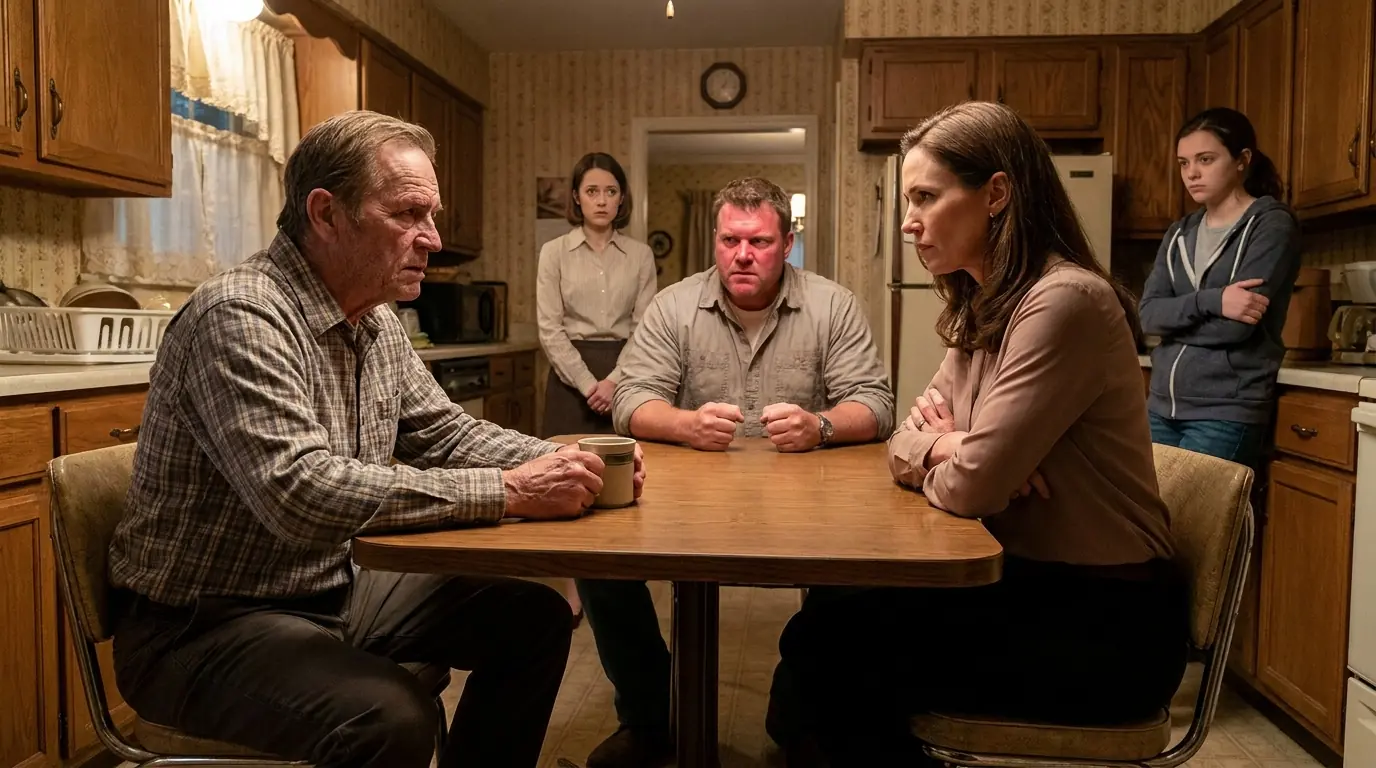
She stared at me, suspicion flickering across her face, but she said nothing. She turned sharply and walked away, her heels clicking against the floor like gunshots. That night, I sat by the window, watching the streetlights flicker across the quiet neighborhood. My heart was steady, my mind clear. The storm was coming, and this time I was ready to stand in it.
The following day, Brian returned again, this time calmer, his tone almost pleading. He sat at the table, his shoulders slumped. "Dad, I can't do this anymore. I'm drowning. Please, just this once." I looked at him for a long moment.
"I've already given you more than you know. But I can't keep saving you from yourself." Tears filled his eyes, anger mixing with desperation. "So, you're just going to watch me lose everything?" "I'm going to watch you stand on your own," I said quietly.
He pushed back his chair roughly and left without another word. Melissa lingered again, her eyes full of shame before following him out. I sat there alone, the silence pressing down, but beneath it all was a strength I hadn't felt in years. The papers were signed, the wheels already turning.
They thought they could push me out, but soon they would realize it was never theirs to begin with. That night, Emily came to me, her voice soft. "Grandpa, when they find out, it's going to be ugly." "I know," I said. "Are you ready for that?"
I looked at her, my chest tightening with both pride and sorrow. "I've been ready for years." She hugged me, her arms tight around me, and I held her close. The storm was gathering, the clouds thickening. Soon the rain would fall, and when it did, it would wash everything clean.
I closed my eyes and whispered to Margaret one more time, "Hold on, Maggie. Justice is coming." The day the offer was accepted, the air felt different, as if even the house knew its fate had been sealed. I walked through each room slowly, letting my hand brush across the walls, the furniture, the familiar corners worn down by years of footsteps.
Every creak in the floorboard seemed louder, every patch of sunlight spilling across the rug more precious. This was my home, the place I had poured my life into, and soon it would no longer belong to me. But more than that, it would no longer belong to them either. Tom called to confirm everything.
"Closing is set in three weeks, Frank. The buyers are solid. You'll be free of all this soon." His voice carried a finality that steadied me. I thanked him, then hung up and sat in the quiet living room. The clock ticked steadily on the wall, each second a drumbeat counting down.
That evening, Karen confronted me again, her patience worn thin. She stormed into the kitchen where I sat with my tea, her eyes blazing. "I asked you weeks ago, Dad. You've been dodging me ever since. Are you paying more rent or not?" I looked at her calmly, the faintest smile on my lips.
"You'll know soon enough." Her hands slammed against the table. "This isn't a game. You're not in charge here. Patrick and I make the rules in this house." I met her eyes without flinching.
"Do you really believe that?" Her face twisted with confusion and anger. "What's that supposed to mean?" I stood slowly, gathering my cup and saucer, and walked past her without another word.
She shouted after me, her voice rising, but I kept going down the hall to my room. Behind the door, I leaned against the wood, my heart pounding, my breath heavy. Soon, the truth would break free, and the storm would drown every illusion she clung to. The next morning, Emily slipped into my room as I packed another box.
She watched me quietly before asking, "Does she know?" "Not yet," I said. Her eyes filled with worry. "When she does, it's going to explode." "I know," I said softly, closing the box and sealing it with tape, "but it has to."
Over the next days, Karen's suspicion grew. She noticed the missing books on the shelves, the photos gone from the hallway, the boxes stacked neatly in my closet. She demanded answers, but I gave her none. Each time, I told her not to worry, that everything would be taken care of soon.
Her anger sharpened, her threats grew louder, but I stayed calm. Patrick kept his distance, watching quietly but saying nothing. He was always more cautious, less confrontational than Karen, but I could see the questions in his eyes when he passed me in the hallway. Brian's calls became frantic.
His voice cracked with desperation in the voicemails he left, sometimes pleading, sometimes screaming. He showed up twice more, pounding on the door until Karen shouted at him to leave. I stayed in my room, listening to the chaos, my resolve hardening with every slam of his fists against the wood. One night, Emily sat with me by the window, the cicadas buzzing outside, the warm summer air drifting in.
She rested her head against my arm. "I don't want to lose this house," she whispered. I kissed the top of her head. "You're not losing anything. You're gaining the truth." "But where will you go?"
"I'll be fine," I told her. "I'll find a place of my own, somewhere peaceful." She was silent for a while, then nodded, though I could feel the sadness in her shoulders. A few days later, Tom called again. "We're moving fast, Frank. Closing may happen even sooner. Get ready."
I felt a surge of energy, a fire rising in me. The time was almost here. That evening, Karen cornered me in the living room. Her voice was sharp, her eyes narrowed. "What's going on? Why are there boxes in your room? Why are strangers calling here and asking for you?"
I looked at her, calm and steady. "You'll know soon." She threw her hands in the air. "Enough of your riddles, Dad. If you don't give me an answer tonight, I'll start making arrangements myself." I leaned back in the chair, folding my hands in my lap.
"Make whatever arrangements you want. It won't matter." Her face flushed with fury. She opened her mouth to lash out again, but Patrick entered the room, his voice cautious. "Karen, maybe you should let it go for now."
She turned on him, her words sharp, but he raised his hands, unwilling to be caught in the middle. She stormed off, her heels pounding against the floor, the slam of her bedroom door echoing through the house. Patrick lingered a moment, his eyes meeting mine. He gave a small nod, then followed her upstairs.
I sat there in the quiet, the tension still vibrating in the air, and smiled faintly. The storm was almost here. The next morning, Doug waved to me from across the street as I collected the newspaper. He walked over, wiping sweat from his brow.
"Heard you might be selling, Frank. Is it true?" I raised an eyebrow. "Where'd you hear that?" He chuckled. "News travels fast around here. Someone saw the realtor's sign in his car. Folks are curious."
I smiled faintly. "Maybe, maybe not. Time will tell." Doug grinned, clapping me on the shoulder. "If you are, you'll do well. That place is worth a fortune." I nodded, but inside my chest burned with both satisfaction and anticipation.
Soon, the whispers would be reality. That evening, Emily helped me carry boxes to the garage. She asked me again if I was sure, if this was what I wanted. I told her yes, that it was the only way left. She hugged me tightly, tears slipping down her cheeks.
"You don't deserve this, Grandpa," she whispered. "No one does," I replied. The night stretched long and heavy. I sat in my room with the papers spread out once more—the contract signed, the closing date set.
I traced my name on the deed, whispering to Margaret's photograph, "It's almost time, Maggie. They'll finally understand who I am. Not a tenant, not a burden. Their father, the man who built this house." The storm was gathering. The clouds were black and full, pressing against the horizon, and I could feel the thunder waiting in my chest, ready to shake the earth beneath their feet.
The week before closing, the air inside the house grew heavy, like everyone could sense something shifting, even if they could not name it. Karen grew sharper, her tone cutting with every word, and she moved through the rooms as if she owned every inch of space. Patrick kept his distance, quiet and cautious, always slipping away when tension rose. Emily stayed close to me whenever she could, her eyes filled with questions she was too kind to ask.
One evening, I sat at the table after dinner, the clock ticking loudly on the wall. Karen stacked plates roughly in the sink, the water running harder than it needed to. She turned suddenly, her voice raised. "Dad, I need an answer tonight. I can't keep waiting. Are you paying more rent or not?"
I looked at her calmly. "It's already taken care of." She frowned. "What does that mean? Did you finally agree to my terms?" "It means you won't have to worry about me much longer," I said softly.
Her face twisted with frustration. "You can't keep talking in circles. This is my house, my rules, and you will respect that." I set down my fork and stood, meeting her glare without flinching. "Do you really believe this is your house?" Her eyes narrowed, her lips curling into a bitter smile.
"Of course it is. Patrick and I pay for everything. You're just here because we let you be here." I felt a strange calm settle over me. "Then soon you'll find out just how wrong you are." She stared at me, confusion flickering across her face, but I walked past her without another word.
My heart was pounding, but not from fear; it was the steady drumbeat of justice approaching. The next morning, Tom called with final confirmation. "Frank, we're set. Closing in five days. Funds will be transferred directly. All you need to do now is pack." I thanked him and hung up, the words echoing in my chest: Five days.
That was all that remained between illusion and truth. That afternoon, Brian showed up again, his face pale, his eyes sunken. He looked less like a man and more like a boy who had lost his way. He sat hunched at my table, his voice trembling. "Dad, I don't have anywhere else to turn. Please just help me this one last time."
I studied him—the son I had once carried on my shoulders, the boy who used to run across the yard with scraped knees and a wild grin. "I can't, Brian," I said softly. He slammed his fist on the table, but the sound lacked the fury it once had. "You don't understand. I'll lose everything."
"Then maybe it's time you learned what everything really means," I replied. He stared at me, his eyes wet, then stood abruptly and stormed out. Melissa lingered again. Her lips parted as if she wanted to speak, but no words came.
She followed him out the door, closing it softly behind her. That night, Emily came to me in my room. She sat on the edge of the bed, her voice barely a whisper. "I'm scared, Grandpa. When they find out, they're going to be furious." I placed my hand over hers.
"Sometimes the truth has to burn before it heals." She leaned against me, her tears dampening my shirt. "I just don't want to lose you." "You won't," I told her, holding her close, "no matter what happens, you'll never lose me." The days passed quickly after that.
I packed quietly in the night, sealing boxes of photographs, books, and memories. Karen grew more suspicious with each passing day, but I kept my answers short, giving her nothing. The storm was almost here, and soon the thunder would shake her world apart. On the morning before closing, Karen confronted me one last time.
She stood in the doorway of my room, her arms crossed, her eyes sharp. "Dad, I know something is going on. You're hiding something from me." I looked up from the box I was sealing. "You'll know tomorrow." Her face flushed with anger. "Stop playing games with me. I'm not a child."
"No," I said quietly, "but sometimes you act like one." Her mouth opened in shock, but before she could respond, Emily appeared behind her. "Mom, just leave him alone." Karen turned, furious. "Stay out of this, Emily."
Emily's eyes blazed. "No, you treat him like he's nothing, and I'm done watching it." The silence that followed was electric. Karen glared at her daughter, then spun on her heel and stormed away. Emily slipped into the room and hugged me tightly, her body shaking.
"I don't care what happens tomorrow," she whispered, "I'm with you." I held her close, my chest tightening with both pride and sorrow. "That's all I need." That night, I barely slept.
I sat by the window, staring at the moonlight spilling across the lawn, listening to the house creak around me. Each sound felt like a farewell. I whispered to Margaret's photograph one more time, "Tomorrow, Maggie. Tomorrow they'll see." The morning of closing day dawned bright and clear.
I rose early, dressed again in my best shirt, and carried the envelope with the final documents tucked safely inside my jacket. Karen eyed me suspiciously as I poured my coffee. "Where are you going?" she asked. "Out," I replied simply. She frowned. "Out where?"
"You'll know soon," I said, meeting her gaze steadily. Her mouth opened to demand more, but I walked past her, the sound of my footsteps echoing down the hall. Outside, the air was crisp, the sky wide and endless. I climbed into the cab waiting at the curb, Tom's car following close behind.
At the office, the papers were signed quickly, the funds transferred, and the keys handed over. It was done. Just like that, the house on Maplewood Lane no longer belonged to me, and it no longer belonged to them. When I returned that afternoon, Karen was waiting in the driveway, her arms crossed and her face a storm. "Where have you been?"
I looked at her calmly, the envelope still in my hand. "Taking care of business." Her eyes narrowed. "What business?" I handed her the envelope. She snatched it from my hand, tearing it open.
As her eyes scanned the papers, the color drained from her face. Patrick came out behind her, his brow furrowed as he took the papers from her trembling hands. Emily stood nearby, her eyes wide but steady, already knowing what the papers contained. The silence stretched heavy and unbearable until Karen finally spoke, her voice a whisper of disbelief: "You sold the house."
"Yes," I said evenly, "because it was mine to sell." Her eyes shot up to mine, wide with shock. "Yours?" I nodded.
"I bought it 20 years ago. Every bill you thought you covered, every payment you thought you made, was already mine. You treated me like a tenant in my own home, but now you'll learn what it feels like to lose control." Her mouth opened, but no sound came. Patrick's face turned pale as he realized the truth.
Emily stepped closer to me, slipping her hand into mine, her grip strong and steady. Karen finally found her voice, a broken cry tearing from her throat: "Where will we go? What have you done?" I met her gaze calmly, my voice steady. "I've done what you forced me to do. I've taken back my dignity."
The storm had broken at last. The thunder roared in their silence, and the truth hung heavy in the air like rain. Karen's cry echoed across the driveway, sharp enough to draw Doug from across the street. He looked over curiously, his hedge clippers frozen in mid-air, but I ignored him.
My daughter's face was pale with shock, her lips trembling, her body shaking with the realization that the ground beneath her had shifted forever. Patrick kept scanning the papers, his hands unsteady, as if hoping the words would change if he read them enough times. Emily stayed beside me, her grip on my hand strong, her chin lifted defiantly. Karen finally managed words, though her voice was hoarse.
"You can't do this. You can't just sell the house without telling us." I looked at her calmly. "I already did. It was never yours to begin with." She shook her head violently, tears springing to her eyes. "You're lying! You've been paying rent. You've been giving me checks every month. If this was your house, why would you do that?"
"Because I wanted peace," I said softly. "Because I thought maybe if I gave you what you wanted, you would let me stay with some dignity. But you pushed. You kept pushing until you left me no choice." Her tears turned to fury, her voice rising.
"You betrayed us! You ruined everything! Where are we supposed to go now?" Patrick lowered the papers slowly, his face grim. "Karen, it's real. The deed, the signatures—it's all here." She spun on him, her voice sharp. "Don't you side with him! He's destroyed us!"
Patrick held up his hands, backing away. "I'm just saying what it is. He owns it. He always did." Emily spoke then, her voice cutting through the chaos. "No, Mom. He didn't destroy us. You did. You treated him like he was nothing, like he was a burden. And now you're facing the truth. You can't blame him for that."
Karen turned to her daughter, stunned, her mouth open in disbelief. "You're defending him after what he's done?" Emily's eyes filled with tears, but her voice was steady. "I'm defending what's right. You never saw him for who he is, but I did, and now everyone does." The silence that followed was heavy, broken only by the distant sound of Doug's hedge clippers resuming their steady snip.
Karen covered her face with her hands, sobbing, while Patrick walked slowly back into the house. Emily squeezed my hand, her eyes fixed on her mother. That evening, the house was filled with a suffocating quiet. Karen locked herself in her room, and Patrick paced the living room, muttering about what they would do next.
Emily stayed close to me, sitting at the kitchen table with her books spread out, but I knew she was not really studying. She was standing guard, ready to shield me from their anger. Brian showed up just after dark, his car screeching into the driveway. He burst through the door without knocking, his face wild, his voice already shouting, "What the hell is going on? I just heard from Karen. You sold the house?"
I sat calmly at the table, my hands folded. "Yes." His face turned crimson, his body shaking with rage. "How could you do this? You're insane! You've ruined us all!" "I saved myself," I said evenly.
He slammed his fist on the table so hard the wood groaned. "You think this is some kind of victory? You think this makes you a man? You're nothing but a selfish old fool who just burned his own family to the ground!" Emily shot to her feet, her voice fierce. "Don't you talk to him like that!"
Brian turned on her, his fury spilling over. "Stay out of this, Emily. You don't understand what he's done." She stepped in front of me, her hands clenched into fists. "I understand perfectly. He finally stood up for himself after years of being treated like trash. You should be ashamed of yourself."
The room crackled with tension. For a moment, I thought Brian might lurch out, but Melissa appeared in the doorway, her face pale and her eyes red. She tugged at his arm, her voice trembling. "Brian, stop. Just stop."
He shook her off but backed away, his chest heaving. He glared at me, his eyes full of venom. "You'll regret this," he spat before storming out the door, it rattling in its frame. Melissa lingered, her eyes meeting mine. There was no hatred there, only sorrow.
She nodded slightly, then followed him out. The silence returned, thick and heavy. Emily sat back down beside me, her shoulders tense, her eyes glistening with unshed tears. "They'll never forgive you," she whispered. I placed my hand gently on hers.
"I don't need their forgiveness. I just need my dignity." That night, I could not sleep. I sat by the window, watching the moonlight stretch across the lawn, listening to the distant hum of traffic on the highway. Every creak of the house felt like a farewell.
My mind replayed Karen's cries, Brian's fury, and Emily's defiance. The storm had broken and the rain was pouring, but inside I felt a strange calm. The truth was out. The weight I had carried for years was gone.
In the early hours of the morning, I rose and walked through the house one last time. I touched the banister I had polished a thousand times, the kitchen counter where Margaret once baked pies, and the living room rug where Emily had built castles of blocks when she was little. Each memory clung to me like a thread pulling at my heart, but I knew it was time to let go. When the sun rose, I brewed a pot of coffee and sat at the table waiting.
Karen emerged eventually, her eyes swollen from crying, her expression hard. She sat across from me, her voice cold. "You've destroyed this family." I met her gaze steadily. "No, I revealed it."
She clenched her jaw, her hands tightening into fists. "I don't know where we'll go. I don't know what we'll do, but I hope you're happy." I sipped my coffee, the bitter taste grounding me. "I'm not happy, Karen, but I'm free." She stared at me for a long moment, then rose and walked away.
Emily joined me a few minutes later, sliding into the chair beside me. She leaned her head against my shoulder, her voice soft. "I'm proud of you, Grandpa." I smiled faintly, wrapping my arm around her. "That's all I need."
The storm had raged and left wreckage behind, but as I sat there with Emily beside me, I knew I had done what had to be done. The house was gone, the illusion shattered, but my dignity was intact. And for the first time in a long time, I felt peace. The morning after the storm broke, the house felt like a battlefield.
Every corner carried the weight of what had been said—the truth hanging in the air like smoke that refused to clear. Karen barely looked at me as she stormed through the kitchen, slamming cabinet doors, her eyes red and swollen from another sleepless night. Patrick sat silently in the living room, staring at the television without really seeing it, his hands twisting nervously in his lap. Emily lingered close to me, her presence steady and warm—the only anchor in a house that felt ready to collapse.
The closing was only days away now, and Tom had called to confirm the final details. "Everything's lined up, Frank. You just show up and it's done. The buyers are ready. The money's ready. The papers are ready. There's no turning back now." "No turning back." The words settled into me with both weight and relief.
I had spent years shrinking, letting myself be diminished in my own home. And now I was standing taller than I had in decades, but I knew the hardest part was still ahead. That evening, as the sun dipped behind the maples lining the street, Brian returned. His truck roared into the driveway, gravel spitting under the tires, and he leapt out before it had fully stopped.
Melissa followed more slowly, her face drawn, her eyes already brimming with tears. Brian burst through the front door, his voice booming. "You think you're clever, old man? You think selling this house makes you powerful?" He pointed a shaking finger at me where I sat at the kitchen table.
"All you've done is destroy your own blood." "I reclaimed what was mine," I said. His face turned crimson. "You're nothing without us. You need us. You always did." Emily stepped between us, her small frame trembling, but her voice fierce.
"No, Uncle Brian. He doesn't need you. He never did. You needed him." Brian's eyes snapped to her, his rage spilling over. "Stay out of this, Emily. You don't understand." She didn't back down.
"I understand perfectly. You used him. You all did. And now you're angry because he finally stopped letting you." The silence that followed was electric. Melissa stood in the doorway, her lips trembling as if she wanted to speak but couldn't find the words. Patrick lingered near the hall, his face pale, his eyes darting nervously between us.
Karen appeared at the top of the stairs, her arms crossed, her face a mask of fury. Brian stepped closer, his chest heaving, his voice a low growl. "You think this is over, Dad? You think selling this house solves everything? You've only made enemies out of your own family." I rose slowly, my chair scraping across the floor.
For a moment, the years seemed to fall away, my back straight, my eyes steady. "If telling the truth makes me your enemy, then so be it." His fist clenched, his body trembling with rage, but Melissa grabbed his arm desperately. "Please, Brian, don't."
He shook her off, his voice breaking. "We'll be out on the street because of him. Do you get that? We'll have nothing." Karen's voice rang out from the stairs, sharp and bitter: "Good. Maybe now he'll see what it feels like to be abandoned." Emily gasped. "Mom, stop!"
But Karen's words only fueled the fire in Brian's eyes. He lunged forward, but I didn't flinch. Emily's scream split the air, and Melissa threw herself between us, her hands pressing against his chest. "Stop it, please!" The room crackled with tension, every breath heavy, every movement sharp.
Finally, Brian staggered back, his chest heaving, his eyes wild. He spat on the floor, his voice shaking with rage. "You'll regret this. Every last one of you." He stormed out, Melissa following with tears streaming down her face.
The door slammed, rattling the windows, leaving the house trembling in silence. Karen descended the stairs slowly, her eyes locked on me, her voice low and venomous. "You've torn this family apart, Dad. And for what—pride, money? You'll die alone in some apartment, and no one will care."
I met her gaze steadily, my voice calm. "Better to die with dignity than to live as someone else's burden." She stared at me, her face twisted with fury, then turned and stormed into the kitchen. The slam of cabinet doors echoed like gunfire.
Emily touched my arm gently, her eyes filled with tears. "Grandpa, I'm scared." I pulled her close, holding her tightly. "Don't be. Sometimes the storm has to rage before the sky clears."
That night, the house was filled with silence again, but it was a different silence now. Not the silence of fear or submission, but the silence of endings. The truth had been spoken, the lines drawn, and there was no going back. As I lay in bed, staring at the ceiling, I whispered to Margaret's photograph one more time, "It's almost over, Maggie. Tomorrow, they'll know it's real."
The next morning, Karen cornered me in the kitchen, her voice sharp and her eyes blazing. "You think you've won, but you haven't. You'll regret this, Dad. You'll regret it when you're old and sick, and no one's there to take care of you." I sipped my coffee, calm as ever. "I already am old, Karen, and I've been sick with your disrespect for years. But that ends now."
She glared at me, her hands trembling, then spun on her heel and stormed out. Emily came in a few minutes later, her eyes wide with worry. "She's losing it," she whispered. I nodded slowly. "Based on her expressions, the ground beneath her feet is gone."
That day, Tom called again. "Frank, the buyers want to meet you tomorrow. They'd like to see the house one last time before closing. Are you comfortable with that?" I thought about it, then smiled faintly. "Yes, let them come."
When I hung up, I felt a strange mixture of nerves and peace. Tomorrow, the truth would not just be on paper; it would stand in the open, undeniable and unchangeable. That evening, as the sun set and the shadows stretched across the lawn, I walked through the house one last time. Each room whispered memories, and each corner carried echoes of laughter and sorrow.
I paused in the living room where Margaret used to sit with her sewing, in the kitchen where Karen once baked cookies as a child, and in the hallway where Brian had hung his football jersey with pride. All of it would soon belong to someone else, but the memories would remain mine. Emily found me standing in the doorway of her mother's room, staring at the framed photos on the dresser. She slipped her arm through mine and leaned against me.
"Are you ready?" she asked softly. I nodded. "I've been ready for years." We stood there together as the last light faded, the house falling into shadow. Tomorrow would bring the final reckoning.
The next day dawned with a sharp clarity, the kind of morning where the sky seemed scrubbed clean by the night—every color sharper, every sound louder. I woke early, the weight of the moment pressing heavy on my chest, but beneath it all was a calm resolve. Today the buyers would come, and with them the final truth. I dressed carefully, choosing the same plaid shirt Margaret had always said made me look strong, the fabric worn soft from years of use.
I stood in front of the mirror, staring at the lines etched deep into my face, and I whispered softly, "This is for you, Maggie." Downstairs, the house was restless. Karen clattered dishes in the sink, the noise loud and angry. Patrick sat silently in the living room, his eyes fixed on the television, but not watching.
Emily hovered near me, her backpack slung loosely on her shoulder, as if she couldn't decide whether to go to class or stay. Around ten, the doorbell rang. The sound was sharp, cutting through the silence. Karen glanced toward it with irritation, wiping her hands on a dish towel.
I moved past her calmly and opened the door. Tom stood there, professional as always, his briefcase in hand, and beside him a young couple with two children. The boy clutched a toy truck, the girl a doll with tangled hair. Their eyes were wide as they looked past me into the house.
"Frank," Tom said warmly, "these are the Harrisons. They'll be the new owners once everything is finalized." I stepped aside, gesturing them in. Karen's face went pale as she watched them enter. "New owners?" she repeated, her voice tight.
Tom nodded politely. "Yes, ma'am. We're closing tomorrow. Just one last walkthrough." Karen's eyes turned to me, wide with disbelief. "You did it. You actually did it."
I met her gaze steadily. "Yes." Patrick rose slowly from the couch, his face drained of color. "This can't be real." "It's real," Tom said matter-of-factly, flipping open his folder to show the papers, "everything signed, sealed, and ready. Just the final transfer tomorrow."
Karen let out a choked sound, half-sob, half-scream. "How could you? How could you sell our home?" I turned to her, my voice calm but firm. "Because it was never yours. It was mine from the day I bought it."
"Every year, every payment, and every brick of this place was mine, and I finally chose to stop pretending otherwise." The Harrisons stood awkwardly in the doorway, their children clinging to their legs. Tom gestured politely. "Perhaps we should look around." I nodded, leading them through the house.
Their voices were soft and respectful, but each comment about the spacious kitchen, the sunny backyard, or the quiet street was like another nail in the coffin of Karen's illusions. She followed us, her face flushed, her words tumbling out. "You can't just walk through here like you own it. This is my home."
Emily's voice rang out suddenly, sharp and clear: "No, Mom, it's his. It always was." Karen froze, staring at her daughter as if she had been slapped. "You're taking his side?" "I'm taking the truth's side," Emily said firmly.
The Harrisons finished their walkthrough quickly, sensing the tension. Tom shook my hand and assured me everything would be finalized tomorrow. "Congratulations again, Frank," he said warmly before leaving with the family. As the door closed, Karen rounded on me, her voice shrill: "You've ruined everything! Do you know what you've done? We have nowhere to go!"
"You had years to build something of your own," I said softly, "instead, you built it on me." "And now that foundation is gone." Her face twisted with rage. She lunged forward, her hands trembling.
"You betrayed me, Dad! You betrayed your own daughter!" I stood firm, my voice steady. "No, Karen. I betrayed myself when I let you treat me like a stranger in my own home. Today, I took that back."
She stumbled back as if struck, tears streaming down her cheeks. Patrick moved to steady her, his own face pale and shaken. Emily slipped her arm through mine, her voice trembling but proud: "You don't owe them anything, Grandpa. Not anymore." The house felt different after they left, as if the air itself had shifted.
The walls seemed lighter, the weight lifted. Tomorrow, the keys would be handed over, the papers signed, and the chapter closed. That night, the silence was thick. Karen stayed in her room, her sobs muffled through the walls.
Patrick paced the hallway, his footsteps heavy. Emily sat with me by the window, her head resting against my shoulder, the quiet between us filled with unspoken words. "Are you scared?" she asked softly. I thought about it for a moment, then shook my head.
"No, I'm free." She nodded, her eyes glistening. "I'm glad." When she went to bed, I stayed by the window, watching the moonlight spill across the lawn, listening to the night sounds.
I thought of Margaret again—her laughter, her warmth, and her steady hand guiding me through the years. "It's almost done, Maggie," I whispered, "tomorrow we walk away with our dignity." The morning of closing day arrived bright and sharp. I rose early, dressed again in my best shirt, and tucked the final envelope into my jacket.
Tom was waiting outside with his car, ready to take me to the office. Karen confronted me one last time in the kitchen, her eyes hollow and her face drawn. "If you do this, I'll never forgive you," she said quietly. I looked at her steadily.
"Forgiveness was never what I needed. Respect was, and you never gave it." She turned away, her shoulders shaking, and I walked past her without another word. Emily met me at the door, her eyes wide and her lips trembling. "I'll come with you," she said.
I smiled faintly, brushing a hand against her cheek. "Stay here. You have a life to live. This is mine to finish." Her arms wrapped tightly around me, her tears hot against my neck. "I love you, Grandpa."
"I love you, too," I whispered. Then I stepped outside into the sunlight, warm on my face, and climbed into Tom's car. As we drove away, I looked back at the house one last time. The windows glinted in the morning light, and the maples swayed gently in the breeze.
I felt the weight of years lift from my shoulders. At the office, the closing was quick, the signatures smooth, and the funds transferred. Tom shook my hand firmly. "It's done, Frank. You're free."
I walked out into the bright morning air, my chest swelling with a mixture of sorrow and triumph. I had lost a house, but I had reclaimed myself, and that was worth more than any brick or beam. When I stepped out of Tom's car that afternoon, the weight in my chest felt different—lighter and freer, but heavy in another way, like carrying a flag through a battlefield after the fight was done. The house stood before me on Maplewood Lane, its windows shining in the bright sun, the lawn trimmed, and the porch swept.
It looked the same as it always had, but it no longer belonged to me, and it no longer belonged to them. Karen stood on the porch, her arms crossed, her face pale and hollow. Patrick sat on the steps, staring down at the driveway as if it might open and swallow him whole. Emily leaned against the railing, her arms folded tightly across her chest, her eyes locked on me.
I walked slowly up the path, my footsteps steady and my head high. Karen's voice trembled when she spoke. "So, it's done." "It's done," I said simply. Her lips quivered, her eyes red.
"You didn't even give us a chance." I looked at her steadily. "I gave you years, Karen. I gave you everything, and all you gave me was disrespect." "You've left us with nothing."
I sighed, the sorrow pressing heavy on my chest. "You had the chance to build something of your own. You chose not to. That's not my failure. That's yours." Patrick rose slowly, his face weary.
"Where will you go, Dad?" I looked at him calmly. "Somewhere peaceful—somewhere I can live without being treated like a stranger." Emily stepped closer, her eyes wide. "You're not leaving me, are you?"
I reached out and touched her cheek gently. "Never. Wherever I go, you'll always have a place with me. You're the only one who saw me for who I really am." Karen let out a bitter laugh through her tears.
"You're destroying this family." "No," I said softly, "I'm saving myself from it." The silence that followed was thick, broken only by the sound of a car driving by, its tires crunching against the pavement. Finally, I turned, walking down the steps, past the lawn I had mowed a thousand times, and past the flowers Margaret once planted in the garden bed.
I did not look back. Emily followed me down the path, her voice trembling. "Grandpa, please let me come with you." I shook my head, smiling faintly. "No, sweetheart. You have your whole life ahead of you. This is my road to walk."
She clung to me, her tears dampening my shirt. "I don't want to lose you." "You won't," I whispered, "you carry me with you always." I kissed the top of her head, then pulled away gently. She stood there on the sidewalk, her eyes shining with grief and pride as I walked toward the cab waiting at the curb.
The ride was quiet, the streets of Springfield rolling past in a blur of houses, trees, and memories. I thought of Margaret again, her laughter echoing in my ears, her smile bright in the sunlight. I whispered softly, "We did it, Maggie. We took it back." The apartment I rented was small—just two rooms in a quiet building near the edge of town.
The walls were plain and the furniture modest, but when I stepped inside, I felt something I hadn't felt in years: peace. No one was shouting, no one was demanding, and no one was treating me like a burden. There was just silence, clean and steady. I unpacked slowly, placing Margaret's photograph on the dresser, stacking my books neatly on the shelf, and hanging my clothes in the small closet.
Each item found its place, and each memory settled gently. When I finished, I sat by the window with a cup of coffee and watched the sun sink low over the rooftops. For the first time in a long time, I breathed deeply and freely. Days passed quietly.
I walked to the market in the mornings, greeting neighbors who nodded kindly. I sat on the porch in the evenings, listening to the cicadas hum. I wrote letters to Emily—long letters filled with advice, memories, and love. She visited often, her smile lighting up the small apartment and her laughter filling the rooms with warmth.
Karen never came. Patrick never called. Brian left a single voicemail, his voice thick with anger and bitterness, but I deleted it without listening to the end. They had made their choices, and now they lived with them. One afternoon, Emily brought me a box of photographs she had saved from the house before the buyers moved in.
We spread them across the table, laughing at the old memories and crying at the faces we missed. Margaret's smile shone from every frame, her presence filling the room. "She would be proud of you," Emily whispered, her eyes glistening. I nodded, my throat tight. "I hope so."
We sat together in the quiet, the photographs spread out before us like a map of our lives, each image a thread tying us to something bigger. In the weeks that followed, I settled into a rhythm. The mornings were bright and peaceful, the afternoons filled with small tasks, and the evenings calm. The storm had passed, and though the wreckage remained, I had walked out of it whole.
Sometimes I thought of Karen, of Patrick, and of Brian. I wondered if they regretted their choices, if they lay awake at night thinking of what they had lost, and if they blamed me or if deep down they knew the truth. But I no longer carried the weight of their judgments. I carried only my own dignity, and that was enough.
One evening, as the sun set in streaks of gold and crimson, Emily sat beside me on the porch. She leaned against my shoulder, her voice soft. "Do you ever miss the house?" I thought about it for a long moment. "I miss the memories. But the house itself? No. It was never about the walls or the roof; it was about the life we built inside it, and those memories can't be sold."
She smiled faintly, her eyes glistening. "I'm glad you finally stood up for yourself." "So am I," I said quietly. The cicadas buzzed, the night settled in, and I felt a deep calm wash over me. The story was over, the chapter closed, but the lessons remained.
I had been betrayed, diminished, and treated like nothing, but I had taken it back. I had shown them who I was, and in the end, that was all that mattered. As I looked out at the fading light, I whispered one last time to Margaret, "We're free, Maggie. We're finally free."