My daughter didn't yell. She didn't have to. She just stood in that doorway, arms folded, and looked at me the way you look at something that's been taking up space for too long. "Mom, I need you to find somewhere else to go. This is my house now."
I remember the light coming through the window behind her. I remember the dust floating in the air between us. I remember thinking, "I painted these walls. I planted that garden outside. I brought your father home to die in this house." I didn't say any of that.
I just looked at her and nodded. She thought that nod meant I was giving in. She had no idea what she had just started. My name is Ruth Elaine Harmon.
I'm 64 years old and I spent most of my life loving a daughter who made that very, very hard. Her name is Diane, born on a Wednesday morning in September of 1982, three weeks early, already impatient. Thomas used to say she came into the world fighting. He meant it with love; I always heard it as a warning.
She wasn't a cruel child, but she was the kind of person who needed to be the center of every room she walked into. And when she wasn't, when things didn't go her way, she had this way of making the air in the house feel heavy. You know that feeling, when someone doesn't say anything, but the whole room changes? That was Diane.
I remember her at 7 years old, standing in the kitchen doorway after I'd given the last piece of birthday cake to her cousin. She didn't cry. She didn't yell. She just looked at me with those dark, flat eyes and walked away. And somehow that silence was worse than any tantrum would have been.
I remember her at 15, the night of her school play. She had the second lead; her friend Keisha had the first. Diane performed beautifully, but on the drive home, she didn't say a single word. Not one.
She stared out the window the entire forty minutes, and when we pulled into the driveway, she got out of the car and went straight to her room. Thomas knocked on her door that night, stayed in there for an hour. When he came out, he said she just needed time. She always just needed time, but the time never seemed to change anything.
Thomas loved her without limits. He was patient the way I sometimes wasn't. He believed she'd settle down, that if we gave her enough room, she'd figure things out. He gave her room, he gave her grace, he gave her everything he had, and she took it, the way she took most things, like it was simply owed to her.
Thomas and I had been married for 38 years when he died. We met in the summer of 1983 at a church picnic in Birmingham. He was 28 years old, tall, quiet, and wore a green shirt that day that I still remember. He brought me a plate of food without being asked, just noticed I hadn't made it to the table yet and came back with a plate.
That was Thomas. We married the following spring, moved into the house on Delaney Street in 1985, the year after Diane was born. That house was everything. It wasn't big—three bedrooms, one and a half baths, and a back porch that got the evening light just right.
Thomas built the garden shed himself the summer of 1991. He planted the magnolia tree in the front yard the year we paid off the mortgage, 2003, as a quiet celebration that nobody but us understood. We built a life inside those walls. We argued in that kitchen, made up in that hallway, raised a daughter who took everything we gave her and still somehow felt shortchanged, but we had each other.
For 38 years, we had each other, and then we didn't. The first real shift in Diane came in the spring of 2009. She had been living in Atlanta for 3 years by then, calling on birthdays, visiting at Christmas, sometimes Thanksgiving, never both—always busy, always almost coming, then not quite. That spring, Thomas was diagnosed with heart disease—not critical, manageable, the doctor said, with medication and lifestyle changes—but it was enough to slow him down.
It was enough to make him quiet in a new way, not the peaceful quiet I loved, but a thoughtful one, like he was doing math in his head that he hadn't shared with me yet. I remember one evening in May of that year. We were on the back porch, the light going orange over the neighbor's oak tree, the fireflies just starting to come out over the yard. Thomas sat with his hands around his coffee cup for a long time without speaking.
Then he said, very carefully, "Ruth, I want to make sure you're protected, whatever happens." I told him not to talk like that. He smiled, said he wasn't being morbid, said he was being practical. I told him we had time.
He looked at me for a moment, then he nodded and he let it go. But I should have asked what he meant. I should have asked because what I didn't know, what I wouldn't find out until 2 years after he was gone, was that he had already made an appointment with an attorney that same week. While I was telling him we had time, he was already making sure that time wouldn't matter.
Diane came home that Christmas, distracted, the way she usually was when she was between things—between jobs, between relationships, between versions of the life she was always almost living. She and Thomas spent a Sunday afternoon together, just the two of them, while I was at church. When I came home, they were sitting at the kitchen table, two cups of coffee between them and some papers I didn't recognize. The conversation stopped when I walked in.
I asked what they were talking about. Thomas said nothing important; Diane looked out the window. I put the groceries away, made dinner, didn't press, but I noticed things after that—small things. Diane started calling Thomas more often, once a week, then twice.
She started asking questions about the house: how much we'd put into renovations, whether we'd considered updating the kitchen, what we thought the neighborhood was doing in terms of property value. Thomas answered her honestly, without suspicion. He saw a daughter finally showing interest in her family's life; I saw something else. One afternoon, I came home from the pharmacy and found Diane standing in the doorway of Thomas's study.
She wasn't doing anything, just looking, taking stock of something. She didn't hear me come in. When she noticed me, she smiled and said she was looking for a pen. There were no pens in Thomas's study.
I didn't say anything, but I started remembering small things after that: the way she had photographed the living room furniture with her phone during Christmas, the way she had asked, twice, whether the deed to the house was in both our names or just Thomas's. I filed those moments away, the way you file things you're not ready to understand yet. But I told myself I was imagining things. I watched, I said nothing.
I was not imagining things. Thomas died in March of 2022, a heart attack, early morning, a Tuesday. 67 years old, gone before the ambulance arrived. The grief that came after didn't arrive with drama.
It moved in quiet, the way weather changes while you're sleeping. You go to bed in one season and wake up in another, and you don't even know when the shift happened. Some mornings I'd wake up and forget, just for a moment, that he wasn't there, and then I'd remember, and the remembering was like learning it for the first time, every single morning for months. Diane came home for the funeral.
She organized everything efficiently—the flowers, the catering, the program, the phone calls. She cried at the graveside, held my hand during the service. I believe those tears were real, but grief does something strange to people; it reveals them. Two weeks after we buried Thomas, Diane sat down across from me at the kitchen table, the same table where those papers had been sitting the Christmas of 2009, and said she had been thinking.
She said the house was too big for me alone, said she was worried about my safety, my health, the maintenance. She said she had already spoken to a friend who was in real estate and that the market in Birmingham was strong right now, and she could help me find something smaller, something easier, something closer to her in Atlanta. She had already spoken to the agent before she even asked me. She said all of this gently, carefully, the way you say something you have been rehearsing for a long time.
I told her I would think about it. I did not think about it, not the way she wanted. What I thought about was Thomas, about that evening on the back porch in May of 2009, about the appointment I never asked about, about the way he always, always prepared for the things that mattered, quietly, without announcement, without needing anyone to notice. And I thought about an envelope, a small white envelope he had pressed into my hand on our anniversary in June of 2021, nine months before he died.
We had eaten dinner at home that evening, just the two of us—candles on the table, the good dishes, the wine we saved for occasions. Afterward, he reached into the drawer of the sideboard and placed that envelope in my hands. He had that half smile, the one he got when he knew something I didn't. He said, "Don't open this now. Put it somewhere safe. If you ever need it, you'll know when."
I asked him what it was. He just smiled and said, "Insurance." I put it in the back of my Bible, between the Old and New Testament, the way my mother used to keep things that mattered, and I left it there. Through the summer, through the fall, through the morning in March when I stood in our bedroom doorway and watched the paramedics work and knew before they told me that Thomas was already gone.
Through the funeral, through all of Diane's gentle, rehearsed words about the house being too big. That night, after Diane had gone to bed in the spare room, I sat in the living room for a long time in the dark. Then I got up, walked to the shelf, and took down my Bible. The envelope was still there, thin, white, my name on the front in Thomas's handwriting—his careful, deliberate letters.
The same handwriting that had signed our mortgage, our daughter's school forms, every card he ever gave me. I sat down in the chair by the window. I held it for a moment. The whole house was quiet, and I opened it.
Thomas had been gone for months. The grief was still living in every corner of that house. And yet, sitting there in the dark, holding that thin, white envelope with my name on the front, I felt something I hadn't felt since the morning he died. I felt like he was still in the room.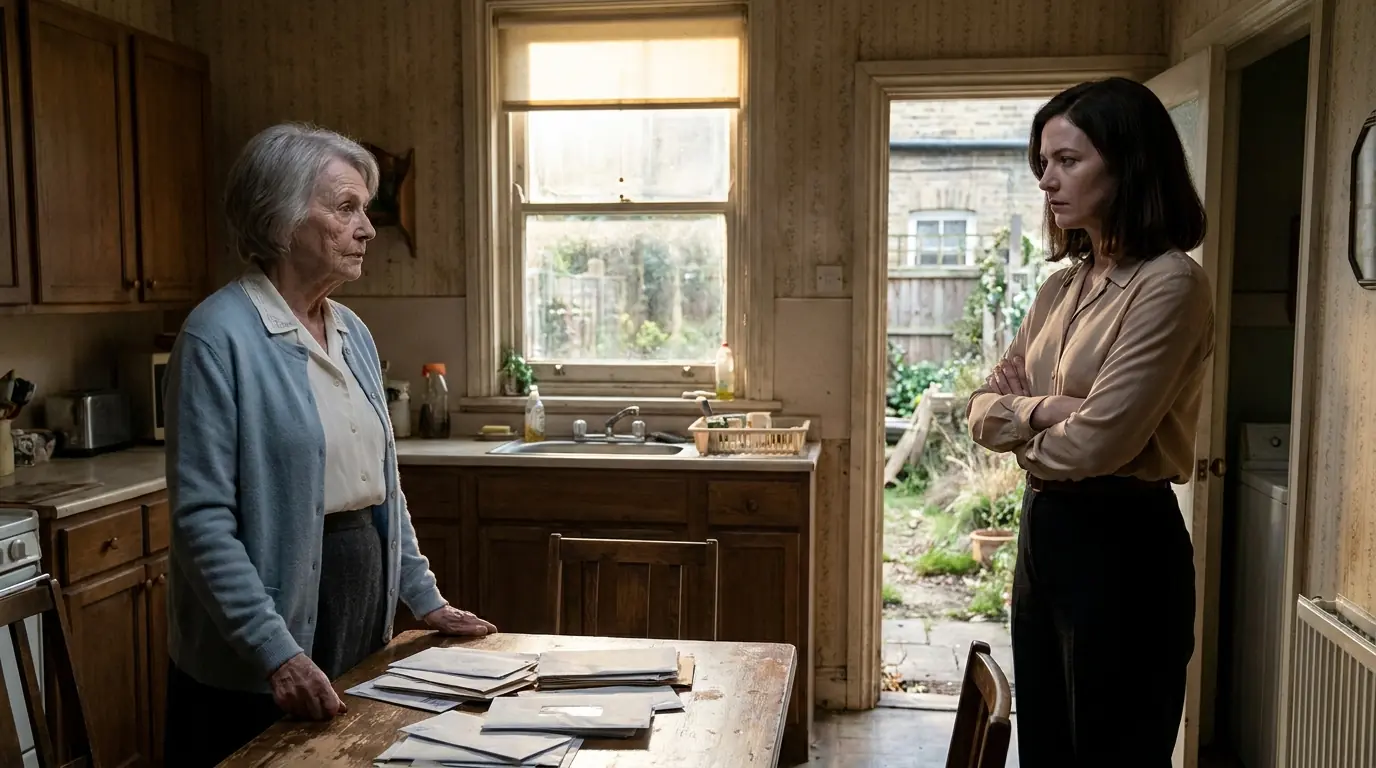
Inside was a single folded card and a business card paper-clipped to it. The card was in Thomas's handwriting. It said, "Ruth, if anything ever happens, call Walter. He has everything. He'll know what to do. I love you. T."
The business card read, "Walter R. Okafor, estate attorney, Birmingham, Alabama." I read it twice. Then I set it on the table beside me, and I went to bed. And for the first time since Thomas died, I slept straight through the night without waking once.
I called Walter Okafor the next morning while Diane was still upstairs. He answered on the second ring. When I said my name, there was a pause—not a confused pause, a recognizing one. He said, "Mrs. Harmon, Thomas told me you might call someday.
I'm very glad you did." He asked me to come in at my earliest convenience, said there were documents I needed to see, said Thomas had been very thorough. I drove to his office that Thursday morning, told Diane I had a doctor's appointment. She barely looked up from her phone.
Walter Okafor's office was on the third floor of a building on Fifth Avenue North. It was a quiet office with heavy wooden furniture and afternoon light coming through tall windows. He was a tall, calm man, late 50s, with silver at his temples—the kind of stillness that comes from spending years sitting across from people, carrying the weight of everything they stood to lose. He shook my hand, offered me water, sat down across from me with a folder, and opened it without rushing.
He told me Thomas had first come to see him in September of 2009, right after that evening on the back porch, right after I told him we had time. He told me Thomas had updated the documents twice after that—once in 2015 and again in May of 2021, one month before he handed me that envelope. And then Walter slid a document across the desk and turned it so I could read it clearly. The house on Delaney Street was placed in a revocable living trust—not in both our names, not divided between family members, but in mine solely, specifically, irrevocably mine.
It had legal protections that would hold regardless of what anyone said or asked or pressured me to sign in a moment of grief or confusion or loneliness. I looked at the date on that document: September 14th, 2009, three months after that quiet evening on the back porch. He heard every word I didn't say, and he answered every question I didn't know how to ask. I sat in that office for a long time without speaking.
Walter didn't rush me; he just let me sit. I found out through Walter, through the documents that came to light in the weeks that followed, that Diane had made her first call to the real estate agent in February of 2022, four weeks before Thomas died. The agent told Walter later that she had described herself as the future owner of the property—not the heir, not the daughter of the owner, but the future owner. She had also requested a preliminary market valuation.
The house appraised at $430,000. She had known that number for months before she sat across from me at that kitchen table with her gentle voice and her rehearsed concern. She had been doing math on a house she didn't own, using a death that hadn't happened yet, and she had never once doubted it would go her way. That was the part I couldn't stop thinking about—not the greed, the certainty.
She had believed the house would come to her for years, and she had never once thought to ask, because she had never once considered that I might have anything worth protecting. That was her fatal mistake. And it was the same mistake people had been making about me for my entire life. I didn't say a word when I got home from Walter's office.
I made dinner, set the table, and called Diane down from upstairs. We ate together, the two of us, in the kitchen where I had cooked 10,000 meals—birthday dinners, holiday spreads, quiet Tuesday suppers when it was just me and Thomas and the evening news. She talked about Atlanta, about a project at work, about a restaurant opening near her apartment. I listened, I nodded.
I poured her more water when her glass was empty, and I thought about Thomas, about how he used to say that the most powerful thing a person can do is know something and choose the exact right moment to say it. Not yet. Not yet. Three weeks passed. Diane grew impatient the way she always had, quietly at first, then less quietly.
She started bringing up the house at every meal, reframing it each time: my health, my safety, the burden of upkeep for a woman living alone, the opportunity the market was offering right now. Did I really want to miss it? Each conversation was a little more pointed than the last, each one a little less gentle. One Saturday morning in April, she came downstairs, sat across from me at the kitchen table, and placed a piece of paper in front of me—a listing agreement, already filled out, my name at the top, a line at the bottom waiting for my signature.
"All you need to do is sign, Mom." I looked at the paper. I looked at her. Then I stood up, walked to the shelf in the hallway, took down my Bible, and removed the card Thomas had left me, still in its white envelope, my name still visible in his careful handwriting.
I walked back to the kitchen table, and I placed it in front of her. I said, "Call that number before you say another word." She looked at the card. She looked at me. Something shifted in her face, something she tried to control and couldn't quite.
I said, "Your father took care of this a long time ago. This house is mine, Diane. It was always mine, and it will stay mine for as long as I choose to live in it." The room went very quiet. She picked up the card, read it, and set it down.
And for the first time in as long as I could remember, my daughter had absolutely nothing to say. There is something Thomas understood about me that I didn't always understand about myself. He knew I was stronger than I looked. He knew I had spent years absorbing other people's certainty about what I deserved and what I was capable of.
He watched me do it, and he never said a word about it to anyone. He just went quietly about making sure that no matter what, the ground would not be pulled out from under me. He did that without drama, without telling me, without ever asking for credit. And standing in that kitchen with the listing agreement still on the table, and my daughter's face finally saying what her words had been hiding for years, I understood something I hadn't understood before.
Being protected doesn't mean being fragile. It means someone loved you enough to think ahead. Diane and I are not close; I don't know if we will ever be, but I wake up every morning in the house on Delaney Street. I drink my coffee on the back porch where Thomas and I used to watch the light go orange over the oak tree.
I tend the garden he started our second summer here. I sit sometimes in the chair by the window where I opened that envelope, and I talk to him the way I always did, out loud, like he's still just in the other room. I am not angry. I am not broken.
I am exactly where I am supposed to be. And the woman who tried to take that from me, my own daughter, has not walked through that door since the morning I put that card on the table. The magnolia Thomas planted the year we paid off the mortgage is still in the front yard. It blooms every spring without being asked, without being noticed, without needing anyone to know it's there.
That tree is the most Thomas thing in the world. And every April, when it blooms, I understand exactly why he planted it.