At my daughter's birthday party, she said, Thank you, Dad, for the new car. But the only way you can make me happy is when you leave me alone. Everyone laughed and cheered on. I smiled and immediately moved out. Then I vanished. What happened next was rather unexpected. I will tell you everything.
I'd always believed that love, when poured long and steady, could eventually fill any crack. That was my parenting philosophy. Or maybe just a coping mechanism dressed up as wisdom. Either way, it's what I clung to over the years.
I was a single father by necessity, not choice. My daughter, Maya, came into this world screaming her lungs out and never quite stopped. Her mother left when she was nine. Said she couldn't handle the weight of motherhood like it was some seasonal gig she'd been tricked into.
So, I picked up the slack, braided hair with trembling fingers, packed school lunches with handwritten notes, showed up to every recital, even when my body begged for sleep. I built a life around her needs, convinced that if I worked hard enough, gave enough, she'd always know I had her back.
Now I owned a modest construction firm, built it from scratch. It took me years to move out of debt, then into stability and eventually into quiet affluence. I never broadcasted my success. I wasn't flashy.
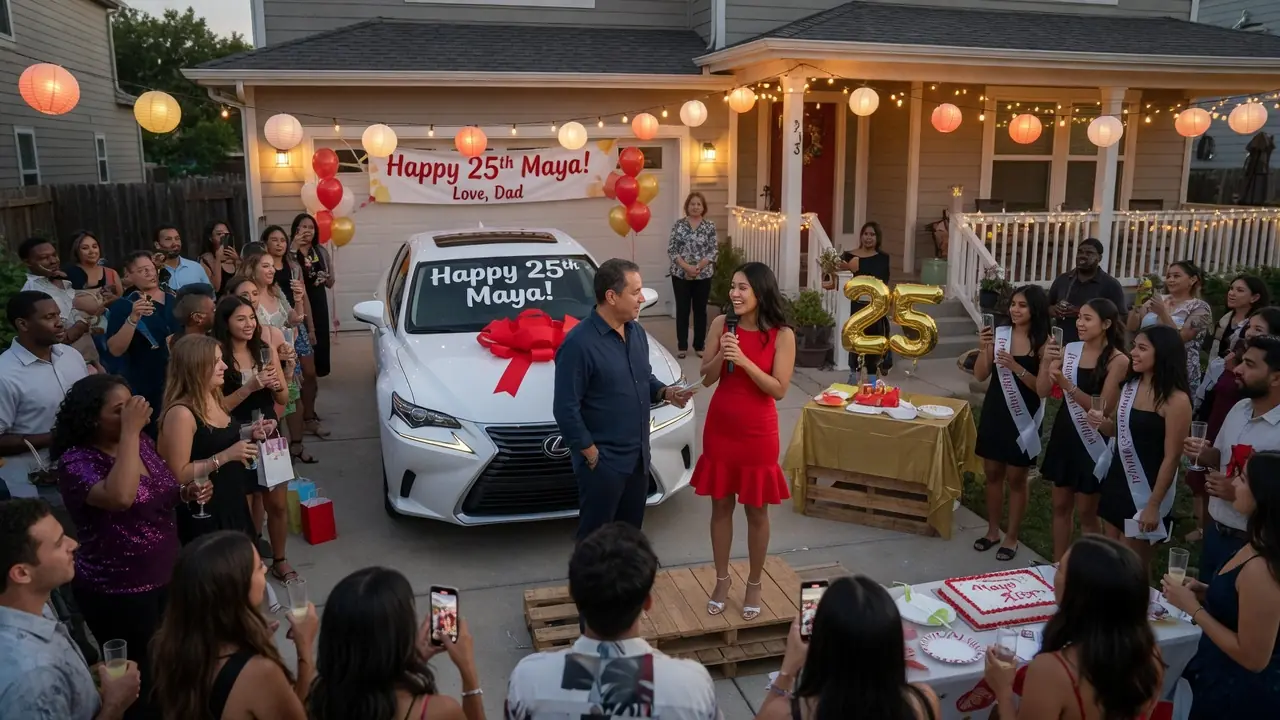
But for Maya's 25th birthday, I decided to splurge. I bought her a brand new Lexus, pearl white, leather interior, all the bells and whistles. It was more than just a gift. It was my way of saying, I see you. I'm proud. I'll always be here.
I didn't realize it would become the last thing I ever gave her.
She'd grown into a woman I didn't entirely recognize. She was beautiful, smart, confident, yes, but also cold in a way that felt new. She barely returned my calls these days, and when she did, it was surface level. We hadn't had a real conversation in over a year.
But I told myself that was just how young people were. Detached, independent. I was the relic father she didn't know how to relate to anymore. That didn't stop me from trying.
The party was at her mother's house. That was my first mistake. I should have known better. But Maya insisted it was easier to host there. Said it was neutral ground. Funny how the person who walked out on us got to be considered neutral.
I arrived early as always, helped set up the tables, carried in the cake she didn't know I paid for, and parked the new Lexus right in front with a big red bow on top. It was corny, sure, but I imagined the look on her face. I imagined tears or maybe just a hug that lasted longer than usual.
Instead, I got a show.
There were about fifty people there, friends, cousins, co-workers, some folks I didn't even recognize. She looked stunning in a red dress, drink in hand, laughing like the world owed her nothing but joy.
When she saw the car, her eyes widened for a second and I caught a flicker of the girl I used to know. Then it vanished.
Dad, you didn't, she squealed, running over, phone already filming. This is insane. Like, who needs a Lexus? You're crazy. Crazy.
Not thoughtful, not loving, not appreciated, just crazy.
I smiled through it because that's what I trained myself to do. I stood beside her as she showed off the car to her friends, nodded along as they gushed. The attention she gave me was fleeting, performative. I was just a prop in her Instagram story.
Then came the toast.
Someone clinked a glass and suddenly Maya was on the makeshift stage, mic in hand, smiling that same dazzling smile she inherited from her mother.
I just want to say thank you to everyone for coming, she began, swaying a little from champagne. And special thanks to my dad who bought me this insane car. Like, who does that? Only my dad, right?
People laughed. I smiled, still hopeful.
But honestly, she continued, pausing for effect. The only way you can really make me happy is when you leave me alone.
The crowd erupted. Laughter, cheers. Someone even whistled. She beamed, proud of her little punchline.
I stood frozen. My smile held, but inside something twisted. She didn't look at me, didn't add a wink or a just kidding. Just took another sip of champagne and passed the mic to her friend.
Nobody noticed me walk out, not even her.
I didn't slam the door. I didn't shout or make a scene. I just walked one slow, calculated step after another, past the buffet table, the chattering guests, the DJ booth, and out into the parking lot.
I climbed into my old pickup truck, the one I drove when I wasn't pretending to be the generous father with money to spare, and sat there with my hands on the wheel, unmoving.
Her voice still echoed in my head. Leave me alone. It was a joke to her, a punchline. But to me, it sounded like permission or maybe a dare.
I didn't cry, not that night. But I did stare straight ahead until the sky turned black and the party lights dimmed inside the house. No one came looking for me. Not her, not her mother, not one of those people who laughed like my humiliation was entertainment.
That's when I made the decision. It wasn't bitter. It wasn't even emotional. It was just clear. The clearest thing I'd felt in years.
I was done.
She wanted space, she could have it. She wanted freedom, I'd hand it to her. Stripped of all the luxuries I gave without question. I would not bankroll my own disrespect.
By the time I pulled into my driveway, the wheels in my head were already turning.
The Lexus was still registered under my name. I had the spare key and the tracking device was still active. She hadn't even transferred the insurance yet.
I opened my laptop and made the first call to the dealership. They said they could dispatch a tow truck by morning.
Next, I logged into the online banking portal. Two accounts were frozen in under ten minutes. The shared one I opened when she started college and the card I gave her for emergencies that had somehow paid for two trips to Miami and an obscene amount of Uber Eats. I left the balances untouched. I wasn't stealing, just closing the gates.
Then came the house. That one stung.
I bought it two years ago when she said she wanted to move out but couldn't afford rent in a decent neighborhood. I didn't put it in her name. Something told me to hold that boundary and I was grateful now that I did.
I called the property manager and gave notice. Renters would be in by the end of the month. I'd pay for her storage and moving costs. One final courtesy, but she would need to vacate. I wasn't going to leave her homeless. Just accountable.
I didn't sleep that night. I sat on the couch with the lights off, replaying every missed sign, every eye roll, every unanswered call, every sarcastic love you too, Dad.
I thought of her sixth grade talent show where she forgot the words and ran off stage crying. I thought of the night she turned eighteen and I surprised her with a scrapbook of every note, drawing, and school certificate I'd ever saved. She rolled her eyes then, too. Said I was doing too much.
Maybe I always had been.
The next day was quiet. No calls, no texts, just silence.
I imagine she was still recovering from the hangover, maybe showing off the car again to her followers. But by evening, she must have noticed.
The Lexus was gone by noon, towed clean from the driveway. Her card was declined at some boutique cafe. I know because the bank app pinged a fraud alert.
And by ten p.m., the first text came.
Maya, hey, are you messing with my account? My card isn't working.
I didn't reply.
Then another. Maya, Dad, seriously. I can't get into the house. What's going on?
Still, I said nothing. She'd asked for silence. I was just giving her what she wanted.
The next morning, the calls started. I didn't block her. That would have been petty, but I let each one ring out.
By the third voicemail, her tone had shifted from confused to angry.
Voicemail number three. Okay, what the hell is this? You can't just take back everything. This is insane. You're acting crazy.
That word again. Crazy. As if I'd lost touch with reality instead of finally seeing it clearly.
But it was the fourth message that cut deep.
Voicemail number four. Dad, please. I didn't mean it. I was just trying to be funny. Everyone was watching. Please call me back. Please.
I almost did. I hovered over her contact, thumbs shaking.
But then I remembered her laugh. That cruel little moment on stage, the way she weaponized her wit against me to earn cheap claps. I had smiled while my soul buckled in front of fifty people.
No, this wasn't just a misunderstanding. It was a pattern, a culmination of years of quiet disrespect, and I finally had the courage to name it.
By the third day, she was begging. The tone had turned. Her texts came in floods, frantic, apologetic, scared.
Maya, I didn't think you'd actually do this. Please don't cut me off. I don't know what to do. Please, Dad. I'm sorry.
I stared at the screen, heart tight. The part of me that raised her, the part that loved her in spite of everything, ached. But the part of me that had been humiliated and drained felt resolute.
I finally called her back. She picked up on the first ring.
Dad. Her voice was cracked, hoarse, like she hadn't slept.
I exhaled. You told me the only way I could make you happy was to leave you alone.
I was joking, she choked. It was stupid. I didn't mean it.
I know you didn't mean it, but you said it in front of everyone. You made a fool of me.
I was nervous. I didn't know what to say. I I'm not doing this anymore, Maya. My voice didn't rise. It was steady. I gave you more than I should have. And you took it like it was owed to you. Maybe that's my fault. But I won't keep bleeding for someone who laughs while I do.
She went silent.
I ended the call with one final sentence. Forget about my existence. Move on. That's what you wanted, right?
Click.
I didn't check my phone the rest of that day. I left it face down on the kitchen table, screen dark, vibrating now and then like a distant dying heartbeat.
I didn't want to hear her cry. I didn't want to read another apology laced with manipulation. I wanted to sit with the silence. Let it spread through the house like steam, fill every corner that used to echo with her voice.
That place had once been a home we shared, even after she moved out. Now it felt like a museum. Quiet, hollow, haunted by the ghosts of every version of us that never made it.
And for the first time in a long time, I didn't feel like I owed anyone an explanation.
I spent the day cleaning, not for guests, not out of habit, just to move, to do something with my hands. I scrubbed the kitchen counters until the tiles shone, vacuumed under the couch where old popcorn kernels and forgotten receipts had gathered.
I boxed up the framed photos of Maya. Birthdays, graduation, that one from the beach when she was nine and had no front teeth. I didn't throw them away. I just packed them out of sight like setting a boundary in glass and cardboard.
I wasn't erasing her, just stepping back.
The house was too quiet. So, I turned on the radio, classic rock, low volume, and sat at the kitchen table with a cup of black coffee that tasted like burnt regrets.
That's when the first real call came. Not from Maya, from her mother.
Are you insane? she barked, skipping any pretense of civility. You really took the car? Froze her accounts? What the hell is wrong with you?
I gave her what she asked for, I said calmly.
Oh, cut the crap. She was joking. It was a damn joke.
No one was laughing with me, I replied. Only at me.
There was a beat of silence on her end. I could almost hear her flipping through her mental script for a comeback.
You're just trying to control her.
I laughed then. Not loudly, not cruelly. Just a quiet, tired exhale that tasted like the truth.
I haven't controlled Maya in years. That's the problem.
You're being dramatic and you're still enabling her.
I said, standing now, my coffee cold in my hand. You always have.
She's our daughter.
She's a grown woman. And if this is who she's become, then I'm done funding it.
She hung up without another word.
I stared at the receiver like it owed me closure, but none came.
The days passed in a blur. I stopped checking social media. I knew what I'd find. The pity posts, the passive aggressive captions, probably a selfie with tears and a caption like, Some people show you who they really are. Believe them.
I didn't need to see it to know. The pattern was predictable. Public shame, private chaos, performative grief. She had a flare for dramatics, just like her mother.
But beneath the performance, I wondered if she was really beginning to feel the weight of her own decisions.
By day five, the calls stopped, just silence. A full day without a missed call or message. It should have felt peaceful, but it didn't. It felt like standing on the edge of a cliff after an avalanche. Quiet but unstable.
I didn't second guess what I'd done, but that didn't mean it didn't hurt.
That evening, I went to visit my brother Marcus. He lived on the other side of town in a modest ranch house with a porch swing and a yard full of wild flowers his wife planted every spring. He'd always been the balanced one, less sentimental, more honest.
You look like you've been dragged behind a truck, he said when he opened the door.
I smiled faintly. Feel about the same.
We sat on his porch, beers in hand, dusk settling like a soft blanket over the neighborhood.
She really said that in front of everyone, he asked after I told him the story.
I nodded. Smiled while she said it, too.
Marcus took a long swig, then leaned back in his chair. Damn, that's cold.
Yeah.
You did the right thing, he said finally. Took you long enough.
I raised an eyebrow. What do you mean?
He gave me a look that cut deep. You've been chasing her love for years, man. Throwing money at a wound that needed honesty. You finally got honest. Good for you.
I didn't know what to say to that. Part of me wanted to argue, to defend every gift and gesture, but I couldn't because he was right.
Doesn't feel good, I said quietly.
No, he agreed. It never does. But sometimes peace looks like loss. You just got to be brave enough to sit in it.
We didn't talk much after that. Just sat in the dark, the cicadas humming in the distance. Two brothers who had grown up with different kinds of heartbreak.
I left his house feeling no lighter, but more certain.
When I got home, the message light on my landline blinked red. One new voicemail.
I almost didn't play it, but something told me to listen.
Voicemail number six. Dad, if you never want to talk to me again, I get it, but I just need you to know I wasn't trying to hurt you. I was trying to be funny. I thought I don't know what I thought. I messed up. I get it now. Everything you did. I didn't say thank you enough. I didn't act like I cared, but I did. I do. I just I didn't know how to show it. Please, just don't give up on me completely.
The line went dead.
I didn't replay it. Didn't save it. Just deleted it. My thumb pressing the button like it weighed ten pounds.
Then I stood there for a long time staring at the silent phone.
She wanted me to believe she'd changed. That this moment was clarity, not strategy.
But I'd been burned too many times to reach back so quickly. Growth takes more than tears. It takes time. And she would have to take that journey on her own.
The backlash came quietly at first. A few side eyes at church. A couple of cold shoulders from people who used to ask me about Maya every Sunday.
I caught wind of a few conversations that stopped mid-sentence when I entered the room, their pity hanging in the air like cigarette smoke.
They didn't know the full story, of course. They never do. All they heard was that I'd taken my daughter's car, shut off her accounts, and evicted her without notice. That I'd abandoned her.
And I could see it on their faces. The unspoken question. What kind of father does that?
I didn't bother to explain myself. I'd learned that some people aren't looking for clarity. They just want to feel superior.
Let them have it. I had nothing left to defend.
But the phone calls, that was where the real war started.
My sister Janice was first.
You need to fix this, she said the moment I answered.
No hello. No how are you?
There's nothing to fix, I replied.
She's your daughter, Darren. You don't just cut off your own flesh and blood like that.
She cut me off first. Just did it with a smile and a microphone. You're being petty.
No, I said, voice flat. I'm being done.
Janice didn't understand. Most of them didn't. They still believed in the myth of unconditional fatherhood. That no matter how many times you're disrespected, you stay, you give, you absorb it all because that's what love looks like.
But I was beginning to see that real love had boundaries. Real love sometimes meant stepping back instead of stepping in.
Then came Serena, my niece, Janice's daughter. She showed up at my house one afternoon unannounced like she used to when she was a kid before college took her out of state and adulthood made us strangers.
She was twenty-eight now, sharp-eyed, the kind of woman who could smell bullshit from a mile away.
I brought Thai, she said, holding up a brown bag. And no, I'm not here to guilt you.
I stepped aside and let her in.
She dumped the food on the kitchen counter and started unpacking cartons like she owned the place.
I know everyone's been coming at you, she said between bites. And I know you're probably sick of defending yourself.
Not really defending, I said. Just ignoring.
She nodded. Good, because you're not wrong.
I raised an eyebrow. You sure about that? Thought you were team Maya?
I was, she said, chewing slowly. Until I saw her crying on TikTok talking about how you blindsided her out of nowhere. I asked her straight up, What did you say at the party? and she told me word for word.
I waited.
Serena shook her head. She thought it was funny. Still does, I think. Even now, she doesn't fully get why it hurt.
She humiliated me, I said. I would have taken it in private. I would have even forgiven it if she pulled me aside afterward, but she never did.
Serena looked at me for a long time. You didn't deserve that. But I got to ask, why now? Why not earlier? Why give so much for so long if she never really earned it?
That question sat heavy in the air.
I leaned back in my chair, eyes on the ceiling. Guilt, maybe. Her mother leaving. Me working all the time. I thought if I gave her enough, she'd feel whole or she'd love me again like she used to when she was little before life got complicated.
She's not a kid anymore.
I know. But part of me still sees her that way. That little girl who used to climb into my bed when it thundered, who used to squeeze my hand so tight when she was nervous.
Serena reached across the table, placed her hand on mine. Maybe it's time you stop chasing that version of her. Let her catch up to who you are now.
We sat there in silence, the air thick with grief and understanding.
The next day, I ran into my old friend Lionel at the hardware store. He owned a plumbing business we'd collaborated on a few jobs years back. Solid guy. We hadn't talked in months, but he spotted me near the lighting aisle.
Darren, he said, nodding. Heard about what happened.
Yeah, I replied cautiously. I braced for judgment.
He surprised me.
I just want to say I get it, he said. My son stopped talking to me after I stopped paying for his apartment. Called me a traitor. Ain't spoken in a year.
I'm sorry, I said genuinely.
He shrugged. Sometimes being a father means being the villain in their story. At least for a while.
That stuck with me for days.
I began journaling in the evenings. Nothing elaborate, just notes, thoughts, trying to untangle the guilt from the growth.
One night, I wrote, It's not that I stopped loving her. It's that I started loving myself, too.
And that's what it felt like. Like I was finally giving myself the kindness I kept handing to everyone else.
By the end of that week, Maya's social media quieted. No more vague quotes, no new photos. Either she'd accepted the silence or was simply regrouping. I didn't know which. I didn't care.
The damage was done. And for the first time in years, I didn't feel the urge to fix it.
I sat on my porch with a whiskey in hand and watched the sun go down. No phone in sight, no emails to check, just me, the breeze, and the slow, deliberate realization that peace isn't always warm or easy.
Sometimes it's cold. Sometimes it's lonely. But it's always honest.
It came on a Tuesday afternoon, tucked in among the bills and supermarket flyers in my mailbox. A white envelope, my name scrolled across the front, and handwriting I hadn't seen in years. The kind she used before text messages replaced thank you notes.
I stood on the porch for a long moment, just staring at it, my thumb tracing the edge of the paper, feeling like the air had thickened around me.
It wasn't a text. It wasn't a voicemail. It wasn't a post written for the world's sympathy.
It was just a letter from my daughter.
I didn't open it right away. I laid it on the kitchen counter next to the fruit bowl and walked away. Made coffee, folded laundry, pretended like my hands weren't itching to tear it open.
But eventually, as the house settled into its usual afternoon stillness, I sat at the kitchen table, turned on the little desk lamp, and unfolded the single page inside.
Her writing was messy, rushed, not performative, not polished. It felt raw.
Dad, I don't know how to start this except to say I'm sorry. Not in the way I said it on the phone. Not in the way people say it when they want something. I mean it this time. I was cruel. I thought I was being funny and I wasn't. I knew it the second I saw your face. But I was too proud to say anything. And I hate that about myself.
You've always been there for me. You gave me everything. Things I didn't earn. Things I didn't thank you for. I got used to you fixing everything. To you showing up. To you forgiving me without asking me to grow. And when you finally didn't, it broke something in me. I deserve that break, but it still hurt.
I'm not asking for the car back or the house or the money. I just want to know if one day maybe we can talk again when you're ready. I love you, even if I never showed it right. And I'm sorry. I really am.
Love, Maya.
My eyes read it twice, then a third time. My hands trembled. Not from anger, but from the weight of it, the honesty, the humility.
It wasn't a perfect apology, but it was real.
And for the first time in weeks, I didn't feel rage pressing at my ribs. Just grief. That old slow-burning ache of watching someone you love finally see themselves clearly after all the damage is done.
I set the letter down, leaned back in my chair, and stared out the window.
My mind flickered with memories. Her little hand in mine on the first day of kindergarten. Her screaming at thirteen that I didn't get it. Her quiet, grateful hug when I paid off her student loans.
The roller coaster of raising her, beautiful, exhausting, filled with sharp turns I never saw coming.
I didn't call her. I didn't write back. Not because I was still angry, but because change, real change, needs time, and letters are only words until actions show up to match them.
I wasn't going to open my doors again just because she opened her heart once. But I could honor the gesture without reopening the wound.
Later that week, I stopped by the DMV. I signed over the title to her old 2011 Honda Civic, the car she drove back in college. I had it in storage for years. Needed new tires and a fresh battery, but it still ran well, reliable, unflashy.
It felt fitting, a symbol of responsibility, of earning one's keep.
I didn't include a note, no message, no guilt, just the keys and paperwork left in a padded envelope and mailed to the address her mother gave me when I called to confirm where she was staying.
It wasn't forgiveness, but it was something. A small door, cracked, not open.
I expected her to text when she got it, to say thank you, maybe even ask why, but days passed. Then a week and nothing came. No message, no call, just silence.
And weirdly, that silence didn't hurt. It felt mature, like maybe she understood that this wasn't her moment to speak again, but mine to breathe.
I spent more time outdoors after that. Started walking in the mornings, joined a local chess club. Nothing fancy, just old men in ball caps talking trash over worn boards.
One of them, Gary, I think, asked if I had kids.
I paused for a second before answering. I do, I said. One daughter.
Close? he asked.
I thought about it. We used to be. Then we weren't. And now maybe we're figuring it out.
He nodded like that made perfect sense.
One night, I stood in my garage organizing old tools and found the birthday card I never gave her, the one I bought before the party. It was still in the glove box of my truck, sealed, written, forgotten.
I opened it. Inside was a simple message. No matter how far we drift, you'll always be my daughter. Love, Dad.
I stared at those words and realized I still meant them.
But meaning something doesn't mean surrendering your peace. It means holding space, creating distance with dignity, letting love exist without letting it bleed you dry.
I slid the card back into the envelope and filed it away in a drawer. Not to give, just to keep. A reminder that love doesn't always come with reunions. Sometimes it just comes with clarity.
The silence stopped feeling sharp after a while. It softened into something almost comfortable, like an old sweater you wear around the house. Not stylish, not warm enough for the coldest days, but familiar.
I didn't know if Maya would ever write again. I didn't know if I'd ever open another letter if she did.
But I knew this. I didn't need to hear from her to have closure. I didn't need a reunion or a tearful embrace or some movie scene redemption to know I had made the right call.
Sometimes all a man needs is his own damn peace.
I had spent so many years reacting, fixing, funding, forgiving that it took real effort to just be, to sit in my own skin without needing someone else to reflect my worth back to me.
That was the hardest part really, how much of my identity I had tied to being her provider, her protector, her plan B.
I had trained myself to live for her needs. Without that role, I had to figure out who I was when no one was watching, when no one needed saving.
Mornings became a ritual. Coffee at six a.m., the paper in hand, radio low in the background.
I started cooking again. Simple stuff like skillet eggs, bacon, sourdough toast with real butter. I'd forgotten how much joy there was in feeding myself. Not for anyone else, just me.
I even took up woodworking in the garage. Built a small bench, a planter box, a coat rack. It didn't matter if the corners weren't perfect. It was mine, my hands, my effort, my life.
One afternoon, I walked past Maya's old bedroom, still mostly untouched, and paused at the door. The posters on the wall had faded. Her bookshelf stood half empty, like someone pressed pause on her teenage years and never hit play again.
I thought about taking everything down, painting it fresh, turning it into an office, but I didn't. Not because I was waiting for her to come back, but because that space reminded me of where we started, before everything got messy, before money became love's substitute, and silence became our default language.
It reminded me that we had once been close, that it wasn't all bad. She'd made her choices, and I'd made mine, but the love hadn't vanished. It had just changed shape.
Serena came by a few weeks later with a batch of muffins and her usual side eye.
You look stable, she said with a smirk.
Don't sound too surprised.
She sat on the porch swing and kicked her feet like she used to as a kid.
She's working part-time at a nonprofit now, living with a friend. Said she's trying to get her feet under her.
That's good, I said, keeping my voice neutral.
She still hasn't reached out, huh?
I shook my head.
Would you want her to?
I sipped my coffee and thought about it. Thought about what I'd say if Maya showed up tomorrow with a suitcase full of humility and hope.
I don't know, I said finally. I think I'd need her to show up different. Not polished, not perfect, just honest and willing to do the work.
Serena nodded. She said she's trying to become the kind of daughter she should have been.
I didn't respond because hope is a quiet thing. You don't speak it too loudly or it disappears.
Later that night, I walked out to the back porch, lit a small fire in the pit, and watched the flames eat through the dry wood. The stars were out, clear, sharp, uncaring.
I reached into my pocket and pulled out the old birthday photo I kept folded in my wallet. Maya, age five, frosting on her cheek, laughing with wild abandon. Before she learned the art of sarcasm. Before I learned that love couldn't buy loyalty.
I whispered, I still love you, kid.
Not to her, to the memory of her, to the version I raised, not the one I lost, and maybe, just maybe, to the one she was still trying to become.
But I didn't pick up the phone. I didn't write another letter. I didn't tell Serena to pass on a message.
Because part of being a parent, maybe the hardest part, is knowing when to let go. Not out of punishment, but out of respect for her journey, for mine, for the space we both needed to finally grow.
If Maya ever came back, I'd listen. But I wouldn't beg.
And if she didn't, I'd be okay.
I had found peace in the quiet. Not because I stopped loving her, but because I finally started loving myself.
Sometimes walking away is the bravest kind of love.