Every morning, I wake up at exactly 6:00.
Old habits, especially when you have lived seventy-seven years and spent most of them obeying clocks, schedules, and responsibility.
My body still remembers the old rhythm from my years at the power plant. Up before sunrise. Coffee before seven. Work boots by the door. Lunch packed in a metal box. Hands washed until the grease and copper smell finally faded from my skin.
Now there is no power plant waiting for me.
No supervisor checking the board.
No crew depending on me to keep the city lights running.
But still, every morning at 6:00, my eyes open.
I lie still for a few minutes, staring at the pale ceiling of the first-floor bedroom that Gina calls “my room,” as if she gave it to me out of charity. The curtains are thin, and a little gray light slips in from the backyard. The house is always cold in the morning because Gina keeps the thermostat low to save money, even though Noah makes a good living and she wastes more on candles than I ever used in electricity.
At 6:07, the refrigerator door slams in the kitchen.
That is Gina.
She is packing breakfast for her husband, Noah. Not because she enjoys caring for him, but because she likes the order of it. Gina has always liked controlling what other people eat, spend, wear, say, and need. A boiled egg in a container. A folded napkin. Coffee in a stainless-steel cup. Everything measured and efficient.
Forty minutes later, she knocks on my door.
Not softly.
Not politely.
Three hard knocks.
She does it every morning, not to say hello, not to ask whether I slept well, but to make sure I did not die in my sleep and create an inconvenience before breakfast.
“Earl,” she calls through the door. “You’re not dead?”
Her voice sounds more annoyed than concerned.
“Not yet,” I answer, as I do every morning.
There is a pause.
Then she says, “Breakfast is in twenty minutes. Don’t be late.”
I hear her walk away without waiting for my reply.
My name is Earl Cunningham. I am seventy-seven years old. I am a widower. I have thinning gray hair, stiff knees, scarred hands, and a secret so large it has lived inside this house longer than anyone understands.
Gina is my youngest daughter. She is forty-two now, though sometimes when she speaks to me, I still hear the sharp little girl who used to throw her shoes across the room if they did not match her dress. Her mother, my late wife, Vivien, died when Gina was only fifteen. Maybe that is why Gina became so cold. Maybe some part of her blamed me for staying alive when Vivien did not.
Or maybe that is just the sort of woman Gina grew up to be.
I stopped looking for explanations a long time ago.
I sit up slowly, gripping the edge of the mattress while my knees complain. Arthritis has a way of making every morning feel like a negotiation. First the knees. Then the back. Then the hands. If I move too quickly, pain shoots up my leg, so I have learned patience, not because I am peaceful, but because my body demands it.
The room around me is small but neat.
A single bed. A wooden dresser. A desk. A chair near the window. A narrow bookshelf filled with detective novels I have read so many times I could probably solve the murders before the authors introduce them. On the desk sits an old radio receiver I restored myself, one of the few things in this house that still feels honestly mine.
Gina calls this room the old guest bedroom.
She says it was remodeled for me when I “moved in” five years ago.
Moved in is a funny phrase.
The truth is, I have always lived in this house.
It is just that no one knows it.
I dress slowly, choosing a clean long-sleeve shirt and the dark sweater Avery gave me for Christmas. The sweater is soft, practical, and warmer than anything Gina buys. I smooth it over my chest, then look in the mirror above the dresser.
An old man looks back at me.
Thin face. Deep wrinkles around the eyes. Shoulders not as broad as they once were. Hands scarred from forty-five years of electrical work, from wire, tools, heat, pressure, and the sort of small burns a man stops mentioning after the first hundred.
I worked as an electrical engineer at the city power plant for most of my adult life. Honest work. Steady pay. A modest pension. That is what everyone believes. Earl Cunningham, careful old man, living on retirement checks and whatever kindness his daughter allows him.
It is a useful lie.
Not a noble one.
But useful.
Because twenty years ago, in 2005, I won the lottery.
One million eight hundred thousand dollars.
Not enough to buy a private island or live like a movie star, but enough to change the direction of an ordinary man’s life. Enough to free me from worry if I handled it carefully. Enough to destroy my family if I did not.
So I told no one.
Not Vivien.
Not because I did not trust her, but because she was already sick then. The doctors were using softer words, but I understood machines, numbers, and patterns. I knew what was coming before anyone wanted to say it aloud. Vivien had enough fear in her life. I did not want to place a fortune on top of it and watch our children circle like birds over fresh bread.
And I certainly did not tell Gina or Weston.
My two children had been expensive since the day they learned the word want.
Weston, my oldest, always needed money for some new plan. A business idea. A truck. Equipment. Payroll. Taxes. A temporary problem that would become a great opportunity if only I could help this one time. Gina was no better. She wanted help with rent, then furniture, then a wedding, then a better car because reliable transportation mattered, Dad.
Vivien and I helped when we could.
Too much, probably.
And each time we gave, they returned not humbled, but trained.
They learned that asking worked.
When the lottery money came, I looked at the check and thought of their faces.
Not joy.
Calculation.
I could see Weston leaning across a table, explaining how my winnings could save his business. I could see Gina crying that I did not love her if I refused to help. I could see the money bleeding out in chunks until nothing remained except resentment.
So I did the only sensible thing I could think of.
I kept quiet.
I placed the money with a cautious financial advisor, put most of it into conservative investments, and lived as if nothing had changed. A year later, after Vivien was gone, I bought this house in Slidell for six hundred thousand dollars.
Three stories.
A wide front porch.
A backyard overlooking a small pond.
Magnolias along the fence.
Good bones, good wiring, and enough room for a family that I foolishly hoped might still come together after grief had finished tearing us apart.
But I did not tell my children I bought it.
Instead, I told them I had found a good rental. A long-term arrangement with a private landlord. They believed it because they wanted to believe I was small, dependent, and ordinary. People rarely investigate a story that lets them feel superior.
For twenty years, this house has belonged to me.
For five years, Gina and Noah have believed it belongs to someone else.
And for five years, my own daughter has charged me rent to live in my own home.
“Earl, you’re late!” Gina shouts from downstairs.
I take one last look in the mirror.
Then I leave my room and make my way slowly toward the kitchen.
Noah is already at the table, scrolling through something on his tablet with a clipboard beside him. Noah works as a financial analyst, and he has the personality of a spreadsheet. Not cruel in the obvious way. Not warm either. He has always treated me like an expense category that refuses to disappear.
“Morning,” I say.
He gives me a small nod without lifting his eyes.
Gina places a bowl in front of me.
Oatmeal.
Watered down.
No butter.
Half a banana sliced thinly on top like decoration.
“For your health,” she says.
We both know it is for the budget.
I pick up the spoon and stir the gray mass in the bowl.
“You haven’t forgotten Weston and the kids are coming today, have you?” Gina asks, pouring coffee for herself.
“I remember.”
“I hope you don’t stay in your room all day like you did last time.”
“I’m not hiding from my own son.”
“Then why did you barely speak to him at Christmas?” Gina crosses her arms. “He thinks you don’t love him.”
I look up from my oatmeal.
“When was the last time Weston called me just to talk, not to ask for money?”
Noah snorts softly without looking away from the tablet.
Gina shoots him a warning glance.
“He’s a busy man,” she says. “He has a logistics company, two children, responsibilities.”
“And yet he always has time to call when he needs money for a new truck or a warehouse expansion,” I reply. “An amazing coincidence.”
Gina’s face stiffens.
“You’re being unfair. We all care about you. Who took you in when you couldn’t live alone anymore? Who cooks your meals, does your laundry, takes you to the doctor?”
There it is.
The speech.
The one she gives whenever I forget to look sufficiently grateful.
I live in my own house, I want to say.
You did not take me in. I allowed you to live here.
But I only nod, as I have done hundreds of times before.
“I’m grateful for the roof over my head.”
Gina’s expression softens with satisfaction.
“Exactly.”
At that moment, Avery enters the kitchen.
My granddaughter is nineteen, a freshman at the local college, and the only person in this house who sometimes sees me as more than a burden with a pension check. She has tired eyes from working too many shifts at the coffee shop, but when she sees me, she smiles.
“Good morning, Grandpa.”
She comes over and kisses my cheek.
“How did you sleep?”
“The usual, dear. Half the night counting sheep, the other half counting my sore feet.”
Avery laughs.
Gina rolls her eyes.
She has never understood my humor. Vivien did. Vivien would have laughed first, then told me I was ridiculous, then kissed the top of my head while pretending not to find me charming.
“Are you going to class today?” I ask Avery.
“Yeah, until three. Then work until eight.” She grabs an apple from the bowl on the counter. “I can pick you up tomorrow if you still want to walk in the park.”
“Avery,” Gina interrupts, “Grandpa has more important things to do. The plumber is coming tomorrow to check his bathroom. It keeps leaking.”
“I can do both,” I say. “Plumbers usually come in the morning.”
“We don’t know the exact time,” Gina says. “You’d better stay home all day.”
I do not argue.
There is no use.
Gina always has a reason why I should stay home. I think she is afraid I might fall somewhere public and make the family look careless. Or worse, that I might talk to someone and accidentally reveal that I still have a mind of my own.
Avery gives her mother a look but says nothing.
She has learned to pick her battles.
“Okay, I’ve got to go,” Avery says, finishing her coffee quickly. “I’ll see you tonight, Grandpa.”
She kisses me again and hurries out.
The front door closes behind her, and the house feels colder.
Noah gets up from the table, gathering his papers.
“Don’t forget to check the electric bill,” he tells Gina. “It was suspiciously high last month.”
His eyes drift toward me for one brief second.
The old man sits at home all day burning electricity.
That is what he does not say.
“I hardly ever turn on the lights,” I say. “And I only watch television in the evenings.”
“No one is blaming you, Earl.” Noah gives me a thin smile. “It’s just that bills are mounting, and your pension isn’t exactly elastic.”
I nod.
In my head, I see my bank account.
More than a million dollars still sitting quietly beneath layers of careful planning and old discipline.
Sometimes I wonder why I still keep the secret.
Then Gina says something like this, and I remember.
After breakfast, I return to my room and sit in the chair by the window. The backyard is damp with morning light. Spring in Slidell has always been beautiful. Magnolias blooming. Fresh green on the trees. Birds returning to the pond like they have made a promise and remembered to keep it.
Vivien loved this time of year.
Before she got sick, we used to sit on the back porch of our old house drinking tea. She taught school for thirty-three years and still had the patience to tell me the names of birds I would forget by supper.
“That one is a finch, Earl.”
“Looks like a small bird to me.”
“They are all small birds to you.”
“That is because I am not a bird accountant.”
She would swat my arm with a newspaper and laugh.
I miss that laugh more than I miss being young.
Sometimes I think Vivien would not have approved of my lies. She was honest to the point of brutality. If a dress looked bad, she said so. If a child behaved selfishly, she named it. If I avoided a hard conversation, she would stand in the doorway with one eyebrow raised until I confessed.
“Earl Cunningham,” she would say, “you have turned into a secretive old fox.”
Maybe she would be right.
But then I remember the way she cried when Weston asked us for money while she was waiting for test results. I remember Gina showing up at the hospital for fifteen minutes and spending ten of them complaining about parking. I remember Vivien whispering one night, “We raised selfish people, Earl.”
And I think maybe she would understand after all.
The sound of a car pulling into the driveway interrupts my thoughts.
I look out the window.
Weston’s black SUV.
Of course it is black. Of course it is shiny. Of course it looks expensive enough to make any lender nervous.
Weston gets out first, heavy around the middle now, balding, fifty years old but somehow older from years of chasing success without ever catching peace. His wife, Lauren, steps out beside him, elegant and distracted. Their two teenagers, Ethan and Kora, climb out with phones already in hand.
They live twenty minutes away.
They visit as if they crossed a continent.
I make my way to the front of the house as Gina opens the door.
“Weston!” she cries, her voice rising into a warmth she never spends on me. “I’m so glad you’re here.”
She hugs him tightly.
Then Lauren.
Then the children, who mumble greetings without looking away from their screens.
Weston sees me over Gina’s shoulder.
“Hi, Dad.”
He comes over and hugs me awkwardly.
“How’s your health?”
“Still alive,” I say. “It’s good to see you, son.”
He pats my back twice, then releases me.
We all move into the living room. Ethan and Kora drop onto the couch, their thumbs moving. Gina and Lauren disappear into the kitchen, already talking about some diet plan involving fewer carbs and more judgment.
Weston and I are left alone.
For one brief moment, I let myself hope.
Maybe he will ask about my old radio.
Maybe he will mention Vivien.
Maybe he will say, “Dad, I know I don’t come by enough.”
Instead, he lowers his voice.
“How’s your pension holding up?”
There it is.
I almost smile.
“About the same.”
He nods, glancing toward the kitchen.
“Business has been tough,” he says. “Competition is rough. Customers want more for the same money. Fuel costs are up. Insurance is killing me.”
“I’m sorry to hear that.”
He leans closer.
“I was thinking. Do you have any spare cash? Just temporary. I need to upgrade two trucks, or I might lose the Blue Ridge shipping contract.”
Not even five minutes.
Not one full cup of coffee.
“Weston,” I say, “you know my situation. I live on my pension. I pay Gina for the room and utilities.”
“I know, I know.” He nods quickly. “But maybe you have something set aside. Rainy day money. I’ll pay it back with interest once the contract starts producing.”
I look at my son, and I see the boy who once demanded a new bicycle because the old one was not cool enough. Same expression. Same urgency. Same belief that my refusal is a personal betrayal rather than a limit.
“No,” I say. “I don’t have money to lend.”
His face darkens.
“I see.”
And just like that, the visit is over before lunch begins.
He still sits at the table. He still eats Gina’s dry chicken and compliments Lauren’s new haircut. But with me, he is finished. His eyes pass over me like furniture. The children do not speak to me at all except when Kora asks whether the Wi-Fi password changed.
When they leave after lunch, claiming urgent business, Gina shuts the door and turns to me.
“What did you say to him?”
“The truth.”
“He looked upset.”
“He asked for money. I told him I didn’t have it.”
Gina shakes her head.
“Do you have to be so callous? He’s your son. He is trying to keep a business alive.”
“And I’m trying to make it to the end of the month on a pension,” I reply, “part of which I give to you.”
Her lips press into a thin line.
“You live in my house. You use my food, my electricity, my water. It would be strange if you didn’t contribute.”
My house, she says.
So easily.
So confidently.
I look around the living room. At the crown molding I paid to repair. At the hardwood floor I chose. At the windows overlooking the pond. At the fireplace mantle where Gina has placed framed pictures of herself, Noah, and Avery, but none of Vivien.
“In your house,” I repeat quietly.
“What?”
“Nothing,” I say. “Of course. All is fair.”
That evening, I sit in my room listening to old jazz on the radio, low enough that Gina cannot complain. Through the wall, I hear her and Noah talking.
“He must have something,” Gina says.
“Old people hide money,” Noah replies. “Cash, bonds, accounts. They always say they’re broke, then you find out they were sitting on a fortune.”
“Then why won’t he help Weston?”
“Control.”
I stare at my reflection in the dark window.
An old man with a bitter smile.
Twenty years of keeping a secret.
Twenty years of being treated like a burden by people who would become very loving if they knew what I owned.
Avery comes home around nine.
I hear her footsteps first, lighter than Gina’s, then a gentle knock.
“Grandpa? Are you awake?”
“Come in, sweetheart.”
She slips into the room, tired but smiling. Her coffee shop apron is folded over one arm, and her hair is pulled into a messy knot.
“How was your day?” she asks, sitting on the edge of my bed.
“Your uncle came by.”
She makes a face.
“He asked for money?”
“Trucks this time.”
Avery rolls her eyes.
“He never just visits, does he?”
I shrug.
“He has problems.”
“That doesn’t give him the right to use you.” She looks toward the door, lowering her voice. “Mom does it too. They all think you owe them something.”
Sometimes it amazes me how clearly Avery sees what everyone else refuses to admit.
“Your mother takes care of me,” I say.
Avery gives me a look.
“She takes your rent, Grandpa.”
The words land softly because she says them with sorrow, not cruelty.
“I’m sorry,” she adds. “I shouldn’t talk about Mom that way.”
“You remind me of your grandmother,” I say. “She told the truth even when it made the room uncomfortable.”
Avery smiles faintly.
“I wish I remembered her better. I was only four when she died.”
“She would have been proud of you.”
Avery looks down at her hands.
“I don’t want to be like them.”
“You are not.”
She stays for almost an hour. We talk about college, her job, a professor she likes, a book she is reading about investigative journalism. She wants to write about people who are ignored by systems, people whose voices get buried under money and power.
The irony almost makes me laugh.
Before she leaves, she kisses my cheek.
“Good night, Grandpa. Don’t let them hurt you.”
After she goes, I sit in the dark for a long time.
For the first time in years, I consider telling someone the truth.
Not Gina.
Not Weston.
Avery.
She deserves to know that one day her poor grandfather intends to leave her enough money to finish college, start her career, and never beg anyone for permission to become herself.
But then she would have to keep my secret from her parents.
That is too heavy a thing to put on a nineteen-year-old.
So I remain silent.
I have become very good at silence.
The next morning is Sunday.
I wake with a headache and the sound of a lawn mower outside my window. The neighbor across the street mows at exactly 8:00 every Sunday, regardless of weather, season, or mercy.
By the time I reach the kitchen, Gina and Noah are already surrounded by papers.
Bills.
Receipts.
Bank statements.
Noah stands by the window with his arms crossed, while Gina sits at the table with a calculator.
The conversation stops when I enter.
“Good morning,” I say, heading for the coffee maker.
“Earl,” Noah says in his business tone, “we were just talking about you.”
“That’s rarely good news.”
He does not smile.
“Your rent is due tomorrow.”
“I know. I’ll transfer it today.”
“And the electric rate went up again,” he adds. “Your share this month will be four hundred.”
I pause with my hand on the coffee pot.
“Four hundred? Last month it was three hundred fifty.”
“Inflation,” Noah says, as if explaining weather to a child. “Everything costs more.”
“I hardly use anything.”
“The meter doesn’t lie,” Gina says.
“No,” I reply quietly. “But people interpreting it sometimes do.”
Her eyes narrow.
“What does that mean?”
“It means I know what I use.”
Noah steps in before Gina can snap.
“We all have to tighten our belts, Earl.”
I look at his pressed shirt, his smartwatch, the expensive coffee beans on the counter that I am not allowed to touch.
“Of course.”
After breakfast, I take a slow walk through the neighborhood.
The houses here are large, well-kept, and proud of themselves. Perfect lawns. Clean driveways. Flowerbeds like small acts of competition. My house is one of the largest on the street, though Gina speaks about it as if it were a burden she nobly carries.
“Mr. Cunningham!”
I turn and see Harper Dwight, our neighbor on the right. He is in his fifties, friendly, curious, and always in possession of news.
“Good morning, Harper.”
“Beautiful day,” he says, walking closer. “Have you heard? The Browns are selling.”
“Are they?”
“Almost a million asking price.”
I raise my eyebrows.
“For the Browns’ house?”
“Market is crazy,” Harper says. “This neighborhood is hot right now. Houses are getting attention before they’re even listed.”
I glance down the street toward the Browns’ place. It is smaller than mine, with less land and no pond view.
“Interesting.”
“Have you folks ever thought of selling?” Harper asks. “That house of yours would do very well.”
I smile with the old lie ready on my tongue.
“It isn’t mine. I rent a room from my daughter.”
“Oh, right. Sorry. I forgot.” He shrugs. “Well, tell her if she ever wants to sell, my brother-in-law knows a great realtor.”
“I’ll keep that in mind.”
But as I walk away, the idea follows me.
Sell the house.
The thought should feel impossible.
Instead, it feels like a window opening.
For twenty years, I have kept the secret to protect my money from my children. But lately, I have begun to wonder whether I have become a prisoner of my own lie. Paying rent to live in my own home. Asking no one for kindness because I already know the price. Letting Gina speak to me as if I survive on her mercy.
Why?
What exactly am I preserving?
A family?
Or the appearance of one?
That afternoon, the boiler breaks.
Again.
Gina storms through the kitchen, slamming cabinet doors and muttering about repairs.
“This house eats money,” she says.
I sit at the table, watching her search for a warranty folder she never keeps in the proper place.
“Maybe you should call a different repairman,” I suggest. “The last one didn’t seem very confident.”
She turns on me.
“You’re an expert on boilers now?”
“I spent forty-five years working with electrical systems. I know when a man is guessing.”
“Unless you have spare money for a better repairman, I don’t need criticism.”
I go quiet.
But silence does not save me.
“You have no idea what it costs to run this house,” Gina continues. “Repairs, insurance, taxes, maintenance. You sit in that room and think two thousand dollars covers everything.”
“It covers a small bedroom.”
“It covers being part of this household.”
“No,” I say. “It covers your patience.”
Her face hardens.
Noah comes in from a run, still breathing heavily.
“What’s going on?”
“The boiler is broken,” Gina says. “And Earl has opinions.”
Noah looks at me.
“The cost of this place keeps rising. Your contribution needs to rise too.”
“My contribution?”
“An extra five hundred a month,” he says.
I stare at him.
“That would make my total twenty-nine hundred a month.”
“For room, utilities, meals, laundry, transportation, support,” he says. “That is fair.”
I feel something inside me tighten.
“I need time to think.”
“Think fast,” Noah says. “Bills don’t wait.”
Gina looks at me with something like pity.
“We’re not going to throw you out on the street,” she says. “But nothing comes free, Dad. This is adult life.”
Adult life.
I am seventy-seven years old.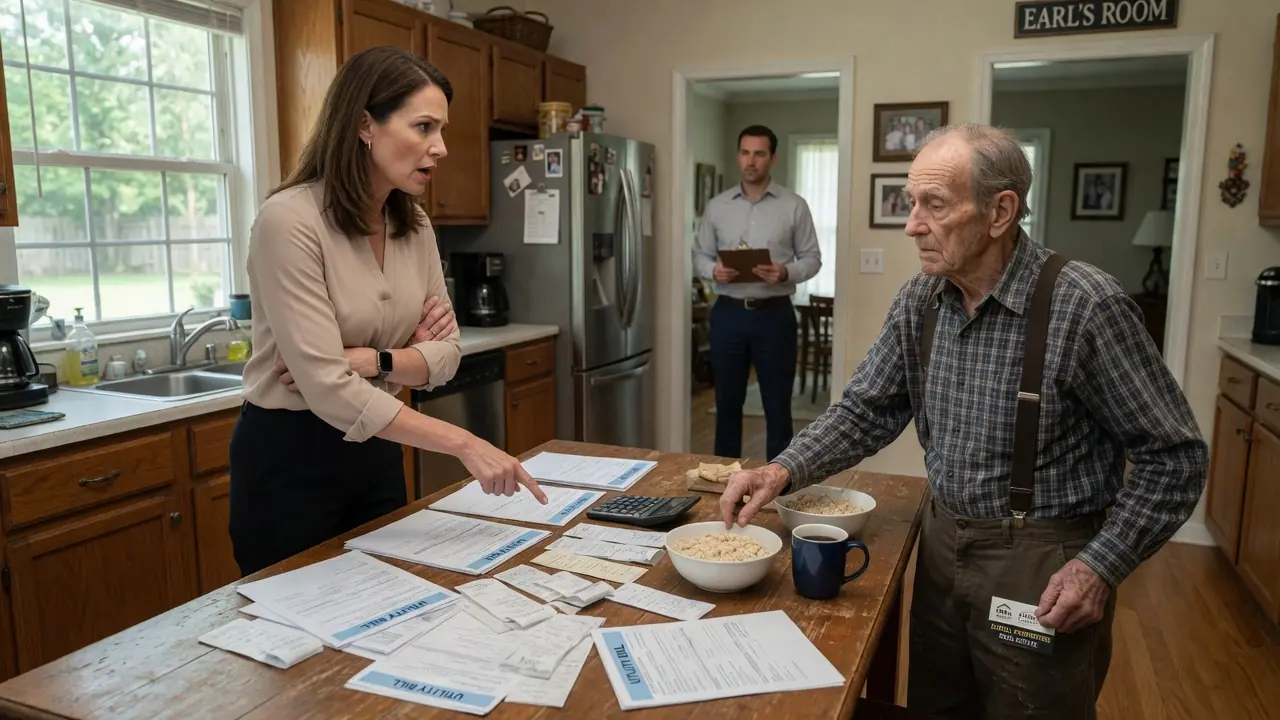
I have buried my wife, raised two children, worked since I was eighteen, saved every dollar I could, and hidden a fortune from people who would have mistaken it for an invitation.
And my daughter is explaining adult life to me.
Two nights later, the final blow comes.
Gina arrives home angry and tired. I am at the kitchen table, reading the paper and drinking tea.
“Did you transfer the rent?” she asks without greeting me.
“Yes.”
“And the extra?”
I lower the newspaper.
“I told you I needed time.”
“You’ve had time.”
“I can’t afford another five hundred.”
Her face flushes.
“So you expect us to subsidize you.”
“I pay two thousand dollars for one room. That is not being subsidized.”
“You use the kitchen, the laundry, the garden, the living room.”
“I barely leave my room because every step I take apparently costs someone money.”
Her eyes flash.
“Don’t be dramatic.”
“I’m being accurate.”
She comes closer, palms on the table.
“Either you increase your share by five hundred a month, or you look for somewhere else to live.”
The house goes silent.
Even the refrigerator hum seems to fade.
I look at my youngest daughter.
The baby I once carried through a thunderstorm because she was afraid of lightning. The little girl Vivien sang to when she had a fever. The teenager who cried at her mother’s funeral while clutching my sleeve so tightly I thought she would never let go.
Now she stands before me like a landlord.
“Are you kicking me out?” I ask.
“I’m setting fair terms.”
“Fair terms.”
“This is business, Earl. Nothing personal.”
Nothing personal.
My own daughter tells me that removing her father from his home is business.
I stand slowly.
“My mistake,” I say.
“What?”
“I thought this was still family.”
I leave the kitchen before my voice can betray me.
In my room, I close the door and sit at the desk. My hands shake as I open the drawer and pull out a business card I picked up the day before from a realtor outside the Browns’ house.
Raymond Prescott.
Slidell Luxury Real Estate.
I stare at the card for a long time.
Then I take out my phone and dial.
“Mr. Prescott,” I say when he answers. “This is Earl Cunningham. We spoke outside the Browns’ house. I’d like to discuss selling my property.”
The next morning, I begin packing.
There is not much.
Clothes. Books. My radio. Vivien’s photograph. Her old recipe box. Personal documents. Bank papers. A few tools. Robert Frost poems she loved. The chipped blue mug she bought me at a school fundraiser, though the handle has been repaired twice.
My life fits into two suitcases and a cardboard box.
A sad summary of seventy-seven years.
Gina is at work. Noah is gone. I planned it that way.
But Avery comes home early between class and work, and when she sees the suitcases, she freezes in the doorway.
“Grandpa?”
I turn.
Her face crumples before I can speak.
“What’s going on?”
“I’m moving out, sweetheart.”
“No.”
The word comes out small.
I force myself to smile.
“It’s all right.”
“No, it isn’t.” She steps into the room. “Mom actually did it? She made you leave?”
“She gave me terms I could not accept.”
Avery sits on the bed, tears in her eyes.
“She can’t do this to you. You’re her father.”
“In some families,” I say quietly, “that matters less than money.”
“Where will you go?”
“I found a small apartment downtown. Clean, modest, affordable.”
“You should have told me. I could have helped.”
“You already help more than you know.”
She looks at the boxes.
“I hate this.”
I sit beside her and take her hand.
“You are not responsible for your mother’s choices.”
“She’ll be furious when she finds out.”
“She already wanted me gone.”
Avery shakes her head.
“No. She wanted you paying.”
The honesty of it hurts because it is true.
The cab arrives at noon. Avery helps me carry my things outside. Before I get in, she hugs me tightly.
“I’ll call you tomorrow,” she whispers.
“I’ll be waiting.”
As the cab pulls away, I look back at the house.
My house.
The house Gina believes she allowed me to live in.
The house she is about to lose.
Raymond Prescott meets me the next day at a café near my apartment. He is tall, polished, and professional, with the careful expression of a man who has seen enough family conflict to stop being surprised by it.
He is surprised, however, when I tell him the truth.
“So the house belongs to you,” he says.
“Yes.”
“But your daughter believes it belongs to a landlord.”
“Yes.”
“And she has been collecting rent from you.”
“Yes.”
He leans back slightly.
“Well,” he says after a moment, “that is delicate.”
“That is one word for it.”
I explain what I want. A quick sale. Quiet handling. No unnecessary drama until the legal requirements make silence impossible. Gina and Noah must be informed as tenants when the time comes, but not before.
Raymond listens, takes notes, and nods.
“Given the market, I would list at eight hundred ninety thousand,” he says. “But I suspect we could receive strong offers quickly. Your property is one of the better ones in that neighborhood.”
“What is the minimum you recommend?”
“Eight hundred forty thousand.”
“Then anything above that, I accept.”
He studies me.
“Are you certain, Mr. Cunningham?”
I think of Gina’s voice.
Pay the rent or get out.
“Yes,” I say. “I am certain.”
The apartment I rent temporarily is small, but the first night there, I sleep better than I have in years.
No one knocks to check if I am dead.
No one counts how much coffee I drink.
No one complains about the light on beside my chair.
I make toast at midnight simply because I want toast at midnight.
Freedom can look very small from the outside.
Inside, it feels enormous.
Gina calls the next evening.
I let it ring once, twice, three times before answering.
“Where are you?” she demands.
“Somewhere safe.”
“You left without even saying goodbye. Avery said you took a cab.”
“You told me to pay more or leave.”
“I did not kick you out.”
“That is exactly what you did.”
She exhales sharply.
“Look, maybe I was too harsh. You shouldn’t be living alone at your age. It’s dangerous.”
There it is.
Not love.
Concern wrapped around lost income.
“I’m managing fine.”
“Earl, don’t be stubborn. We can work something out. Maybe two hundred extra instead of five.”
“I signed a lease.”
“You what?”
“I signed a lease. I have no intention of coming back.”
Silence.
Then her voice cools.
“Fine. But when you realize you can’t manage alone, don’t expect me to fix it.”
“I won’t.”
Three days later, Raymond begins showing the house while Gina and Noah are at work.
He moves quickly. Photographs. Virtual tour. Private showings. Interested buyers. Slidell’s market is hot, and my house is exactly the kind of property people fight over.
One week after listing, he calls me.
“Mr. Cunningham, we have a cash offer.”
“How much?”
“Eight hundred sixty thousand. Quick closing. Retired couple from New York. They love the pond view.”
I sit very still.
Eight hundred sixty thousand dollars.
For a moment, I see Vivien on the porch, smiling at the magnolias.
Then I hear Gina again.
Nothing comes free.
“This is business, Earl.”
I close my eyes.
“I accept.”
The following days pass in paperwork. Documents. Signatures. Calls with attorneys. Escrow. Inspection. Confirmation. Raymond handles everything with smooth precision.
Then comes the notification.
Raymond visits the house in person to inform Gina and Noah that the property has been sold and that they will need to vacate within the legal time frame after closing.
I am in my small apartment when Gina calls.
Exactly 11:30.
I look at the screen.
My daughter.
I answer.
“Hello?”
“What the hell is going on?” she screams.
I close my eyes.
“What are you talking about?”
“Some realtor was here. He said the house is sold. Sold. He said we have thirty days after closing to move out. There’s been a mistake.”
“No mistake.”
“What do you mean no mistake? We live here. You paid rent. I handled everything. How can the landlord just sell it?”
“The landlord can sell his property.”
“Then we need to contact him. Noah and I could maybe buy it. We have good credit. We could explain the situation.”
“Gina.”
“What?”
“There is no landlord.”
Silence.
“What are you talking about?”
“I never paid a landlord,” I say. “I paid you.”
“Of course you paid me. I paid the landlord.”
“No. You didn’t. Because there was no landlord.”
The silence deepens.
“The house has always belonged to me,” I say.
For several seconds, I hear nothing but her breathing.
Then she whispers, “What?”
“I bought it twenty years ago after your mother died. I used lottery winnings. One point eight million dollars. I kept it quiet because I knew exactly what would happen if you and Weston found out.”
“No,” she says. “No, that’s impossible.”
“It is true.”
“You lied to us?”
“Yes.”
“For twenty years?”
“Yes.”
“And you let me think we were helping you?”
“You were not helping me,” I say. “You were charging me rent to live in my own house.”
Her voice returns sharper than before.
“You are unbelievable.”
“No, Gina. What is unbelievable is that you threatened to throw me out of a house I owned because I would not pay you more money.”
“You set me up.”
“I gave you five years to treat me like a father.”
“That is not fair.”
“No. It wasn’t.”
She begins crying then, but there is anger inside it.
“What are we supposed to do?”
“Find a place to live.”
“In thirty days?”
“You told a seventy-seven-year-old man to do it in one week.”
She has no answer for that.
Then she says the thing people say when truth leaves them with nothing else.
“You’re cruel.”
I think about the cold room. The oatmeal. The utility charges. The morning knocks. The way she called care a transaction and business nothing personal.
“No,” I say quietly. “I am finished.”
Weston calls fifteen minutes later.
Gina must have called him immediately.
“What the hell are you doing?” he says.
“Hello, Weston.”
“You sold the house? You’re throwing Gina out?”
“I sold my property.”
“Why didn’t you tell us you owned it?”
“Because the first thing you asked after hearing the sale price would be what I planned to do with the money.”
He goes quiet.
I almost laugh.
Then he says, “How much did you sell it for?”
There it is.
Even in outrage, Weston cannot resist counting.
“Enough.”
“Dad, that was a family house.”
“No. It was my house. Family was what should have happened inside it.”
He accuses me of betrayal. I remind him of the calls, the loans, the birthday he missed, the visits that lasted only long enough to ask for help. We go in circles until we are both tired.
Finally, he says, “Don’t come to us when you’re alone.”
“I have been alone for years, Weston. You are only noticing now because money is involved.”
I end the call before he can answer.
Avery calls next.
That is the one that hurts.
“Grandpa,” she says, voice trembling, “Mom told me everything. Is it true?”
“Yes.”
“The house was yours?”
“Yes.”
“And the lottery money?”
“Yes.”
She is silent a long time.
“Why didn’t you tell me?”
“Because I did not want to make you carry my secret.”
“Mom says you did it for revenge.”
I look around the tiny apartment. At the boxes. The old chair. Vivien’s picture on the table.
“Partly,” I admit. “I won’t lie to you. Part of me wanted her to feel what she made me feel. But mostly, I was tired. Tired of pretending. Tired of paying for the right to be insulted. Tired of being treated like a burden in a house I bought.”
Avery exhales shakily.
“I don’t know what to think.”
“You don’t have to decide tonight.”
“I still love you.”
The words loosen something in my chest.
“I love you too, sweetheart.”
Three weeks later, the sale closes.
After fees and taxes, the money arrives in my account. I do not celebrate. There is no champagne. No victory dance. No grand announcement.
I sit in the apartment with a cup of coffee and stare at the bank balance.
The number looks unreal.
Not because I have never seen money before, but because freedom, once reduced to a number, can look almost too simple.
The first thing I do is buy a new home.
Not a mansion.
Not another three-story house full of rooms where resentment can grow in corners.
A practical one-story house on the south side of Slidell. Three bedrooms. Wide doorways. A veranda overlooking a garden. No stairs. Good light. Quiet neighbors. A kitchen with enough room for Avery to sit and talk while I cook.
I pay in full.
The realtor, Helen Marrow, looks surprised.
“Not many buyers do that anymore, Mr. Cunningham.”
“I am too old for mortgages,” I tell her. “I prefer to own what I have.”
The second thing I do is see a good doctor.
Not the rushed clinic Gina drove me to while sighing about parking. A real specialist. Dr. Phelps, a gerontologist with kind eyes and no habit of speaking to me like a child. He examines me properly, changes my arthritis medication, sends me to physical therapy, and tells me something I have not heard in years.
“For seventy-seven, you are doing well. With better care, you can stay active for a long time.”
I almost cry in the parking lot.
Not because the news is miraculous.
Because no one has spoken to me as if my future mattered in a very long time.
I buy furniture next.
A real armchair with an adjustable back. A firm mattress. A television large enough to watch old movies without squinting. Shelves for my books. A proper workbench in the garage for repairing radios. Fresh coffee. Good bread. Butter without someone measuring it like a crime.
Avery visits on a Saturday.
When she sees the house, her eyes widen.
“Grandpa.”
“Too much?”
“No,” she says, stepping inside. “It feels like you.”
That is the best compliment she could have given me.
We cook dinner together. Real food. Roast chicken. Potatoes. Green beans with garlic. A pie from the bakery because I can afford to buy pie and still sleep at night.
After dinner, we sit on the veranda while the garden settles into evening.
“There is something I want to tell you,” I say.
Avery looks nervous.
“I set up a trust for you.”
“What?”
“For college. For your future. You will not have full access until you graduate, but your tuition, books, and basic living expenses can be covered.”
Her eyes fill with tears.
“Grandpa, no. I can’t take that.”
“You can. And you will.”
“What about Mom?”
“This has nothing to do with your mother.”
“She’ll be furious if she finds out.”
“Then we will let her be furious with no access to the account.”
Avery laughs through tears.
“I don’t know what to say.”
“Say you’ll finish school. Say you’ll become the kind of journalist who tells the truth even when powerful people prefer silence.”
She hugs me so tightly my ribs complain.
“I promise.”
For the first time in years, I feel that my money has done something good.
Not fed greed.
Not rewarded neglect.
Not purchased peace.
Opened a door.
Gina does not contact me for almost two months.
Weston calls three times, each time beginning with guilt and ending near money. His business is struggling. The market is brutal. Family should help family. I listen politely and decline.
Eventually, he calls less.
That tells me everything.
Then one afternoon, while I am trimming roses in the front garden, Gina’s car pulls into the driveway.
I straighten slowly, leaning on the rake.
She gets out and looks at the house.
Her face reveals more than she intends.
Surprise.
Irritation.
Calculation.
“Earl,” she says.
“Gina.”
“Nice place.”
“Thank you.”
She studies me.
“You look healthier.”
“A good doctor, decent food, and less stress can do wonders.”
Her jaw tightens, but she does not snap back.
“Avery told me you bought this house.”
“She should not have had to keep secrets from you. But yes, I bought it.”
“With the sale money.”
“With my money.”
She looks toward the veranda, the new chairs, the garden, the clean windows.
“You really landed on your feet.”
“I was never as helpless as you wanted to believe.”
That hits her.
She looks down.
“I came because I thought maybe we should talk.”
“About what?”
“About family.”
The word hangs between us.
Family.
How cheaply people use it when they need something.
“You did not come for family when I was living in that little apartment,” I say. “You came after learning I was comfortable.”
“That is not fair.”
“I gave you five years of chances to be fair.”
Her eyes flash.
“You lied to me for twenty years.”
“Yes.”
“You made me look like a fool.”
“No, Gina. Your behavior did that.”
She takes a step back as if I slapped her.
“I was caring for you.”
“You were charging me.”
“I cooked for you. I washed your clothes. I took you to appointments.”
“And reminded me every day what a burden I was.”
She looks away.
For the first time, she has no sharp answer ready.
“I was tired,” she says quietly. “I was under pressure. Noah worried about money. The house was expensive.”
“The house was mine.”
“I didn’t know that.”
“You didn’t need to know that to treat me with kindness.”
Her eyes redden, but no tears fall.
Maybe she is too proud.
Maybe she has forgotten how to cry honestly.
“I thought you would be lonely,” she says. “I thought after a while, you would understand that we were doing our best.”
“No,” I answer. “I understood something else. I understood I had mistaken being tolerated for being loved.”
She flinches.
For a moment, I see the girl she was at fifteen, standing beside Vivien’s coffin, angry at the whole world because grief had no one proper to punish.
Then she is gone again.
The grown woman returns.
“I suppose you are happy now.”
I look at my garden.
At the veranda.
At the house I own outright.
At the quiet I paid for with truth.
“I am peaceful,” I say. “That is better.”
Gina leaves without asking to come inside.
I let her go.
Months pass.
Avery continues visiting. Sometimes she studies at my kitchen table. Sometimes she brings coffee shop pastries that were not sold by closing time. Sometimes we watch old movies and she complains that the pacing is too slow, then gets invested anyway.
She becomes my family not because she is the only one left, but because she chose me before she knew I had anything to give.
Weston fades into occasional holiday messages.
Gina sends a birthday card with no return address.
Noah never contacts me.
I hear through Avery that Gina and Noah bought a smaller house. Nice enough, but not grand. Noah still complains about money. Gina complains that everything has become harder. Perhaps it has. Perhaps that is what happens when a person loses access to something they never respected.
One spring morning, almost a year after I left Gina’s house, I sit on my veranda with a cup of real coffee.
Freshly ground.
Strong.
No one watered it down.
The garden is blooming. Tulips. Daffodils. Early roses. Birds move through the hedges with the confidence of creatures who understand ownership better than some families do. My old radio plays jazz from the kitchen window while sunlight warms the floorboards beneath my feet.
My phone rings.
Gina.
I look at the screen for a long time.
Once, I would have answered immediately.
Because she was my daughter.
Because I was afraid of losing what little connection remained.
Because an old father can be trained to accept crumbs if he has been hungry long enough.
But I am not hungry now.
Not for that kind of love.
If it is important, she can leave a message. If she is ready to speak honestly, she can learn patience. If she wants money, silence is already the answer.
I turn the phone face down.
The ringing stops.
I take another sip of coffee.
For years, I thought the secret was the lottery money.
It was not.
The real secret was how much disrespect a lonely parent can endure while calling it love.
The real secret was how long a man can sit inside his own house and be treated like a guest who overstayed.
The real secret was that I had the key to my freedom the whole time, but I was too afraid of breaking the illusion of family to use it.
I think of Vivien then.
Not sick. Not tired. Not fading.
I think of her young, laughing at a dance in 1968, brown hair loose around her shoulders, looking at me as if I were the only man in the room worth noticing.
She would have scolded me for the lies.
She would have told me secrets poison a house.
But she also would have looked at what our children became and said the truth in that fearless voice of hers.
“Earl, enough is enough.”
I smile at the garden.
“I know, Viv,” I whisper. “I finally heard you.”
The day opens slowly around me.
No knocks on the door.
No cold oatmeal.
No utility bill accusations.
No daughter asking whether I am dead with annoyance in her voice.
Just birds, coffee, sunlight, and my own name on my own deed.
Not a poor old man living on someone else’s mercy.
Not a burden.
Not a wallet.
Not a secret.
Just Earl Cunningham.
Seventy-seven years old.
Still alive.
And finally, completely, at home.