My daughter forgot to hang up the phone.
That was how I heard the sentence that changed everything.
“It’s time for him to go to a nursing home. He’s becoming a burden.”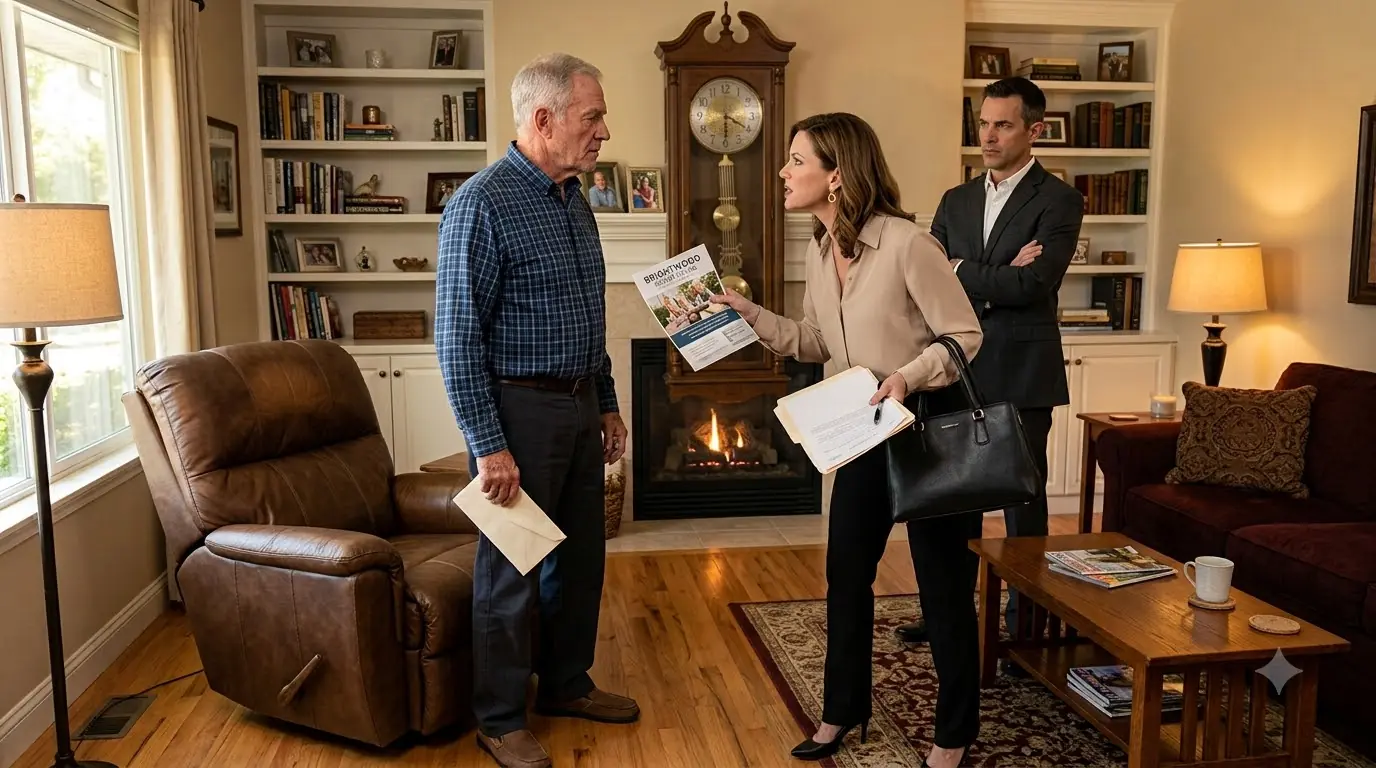
I didn’t say anything.
I simply sat there in the house I had built with my own hands and listened to my daughter and her husband discuss what they planned to do with the rest of my life.
A little more than a week later, that house was sold for $890,000.
When Caitlyn and Jeremy returned from their business trip smiling and carrying suitcases, their keys no longer opened the front door.
And waiting for them was a note.
The phone had rung just as I was scraping the last of the meatloaf from my plate.
Ellen’s recipe.
Mine had never tasted quite right without her.
I glanced at the caller ID and smiled despite myself.
Caitlyn.
“Dad, how are you holding up?”
Her voice carried the familiar warmth that had always made my chest tighten with equal parts love and loneliness.
I settled deeper into Ellen’s old leather recliner. The armrests had been worn smooth from years of her sitting there with mystery novels open across her lap.
“Oh, you know me, sweetheart. Just finished dinner. I was about to watch the news.”
I didn’t mention that the meatloaf was three days old.
I didn’t mention that I had spent nearly an hour staring at Ellen’s photograph on the mantel before Caitlyn called.
“Are you eating enough? You know you can order groceries online now, right? I showed you the app.”
“I’m eating plenty.”
Then, trying to make light conversation, I added, “I had a little scare yesterday. Forgot to turn off the burner under the coffee pot. Good thing I smelled it from the living room.”
There was a pause.
I could picture Caitlyn frowning.
She had inherited the exact little crease between the eyebrows that Ellen used to get when she was worried.
“Dad, maybe we should talk about having someone check on you more regularly. Jeremy thinks—”
“I’m fine, Caitlyn. Really.”
I changed the subject.
“How’s the business trip? You’re still in Phoenix?”
“Yes. The conference ends tomorrow. Jeremy’s been handling most of the client meetings while I sit through endless presentations about digital marketing trends.”
She laughed.
It sounded slightly forced.
“Listen, Dad, I should probably get going. Jeremy and I have dinner plans with some potential investors.”
“Of course, sweetheart.”
I smiled even though she couldn’t see me.
“I love you.”
“Love you too, Dad. Take care of yourself, okay?”
I heard a click.
Then rustling.
At first I assumed she had ended the call and dropped the phone into her purse.
I reached toward my own phone.
Then I heard her voice again.
Muffled.
But clear enough.
“Jeremy, you see how he’s deteriorating?”
My hand froze.
“He forgot to turn off the stove yesterday. What if he burns the house down?”
Something cold spread through my chest.
Then Jeremy answered.
“It’s time for a nursing home, Caitlyn. He’s becoming a burden, and you know it.”
I stopped breathing.
“Your dad’s a good man,” Jeremy continued, “but he can’t live alone forever.”
Then came the sentence that told me what the conversation was really about.
“The house is worth almost a million dollars now.”
Caitlyn answered immediately.
“With Denver’s market, probably nine hundred thousand. Maybe more.”
“Exactly.”
Jeremy sounded pleased.
“We sell it, put him somewhere decent but not too expensive, and finally buy the Boulder place we’ve been looking at.”
“The one with the mountain view?”
“That one.”
And then my daughter laughed.
Actually laughed.
“God, Jeremy, you should have seen him tonight. So grateful just to hear from me. He has no idea we’re planning any of this.”
“The longer we wait, the harder it gets.”
Jeremy paused.
“We should do it while he still trusts us completely.”
The phone slipped from my fingers.
It struck the hardwood floor Ellen and I had installed together twenty-three years earlier.
Every board.
Every nail.
Every measurement.
I had laid those floors thinking about the family who would walk across them after I was gone.
I sat in the sudden silence of the living room staring at Ellen’s photograph.
Her eyes seemed to look straight through me.
I couldn’t tell whether I imagined disappointment there.
Or warning.
Or perhaps the terrible understanding of someone who had already left the world and knew what the people still living were capable of doing to one another.
The grandfather clock in the hallway ticked steadily.
Ellen had bought it for our anniversary fifteen years earlier.
Outside, the first spring crickets were beginning their evening chorus in the garden she had planted and I still tended.
Something inside me changed.
My hands, weathered from decades of construction work, slowly tightened.
They thought I was a burden.
They thought I was confused.
Helpless.
An old man ready to be managed.
They were already spending my money.
Already imagining themselves inside their new Boulder house while deciding how inexpensive my remaining years should be.
But I wasn’t dead yet.
And I wasn’t nearly as confused as they believed.
I don’t know how long I remained there.
Eventually I stood and switched on the lamp.
Warm light spread across the living room.
The burgundy sofa where Caitlyn once curled up doing homework.
The coffee table I had built in the garage while she played on the floor near my feet.
The bookcase Ellen had filled slowly over twenty-five years.
Suddenly, I saw everything differently.
I walked into the kitchen.
In the bottom drawer was a folder filled with old financial records.
Ellen had always kept everything.
“You never know when you might need it,” she used to say.
That night, I needed it.
University of Colorado tuition receipts.
Almost $48,000 across four years.
I remembered working double shifts.
Coming through the door with concrete dust in my hair and plaster under my fingernails.
Ellen would have coffee waiting.
Sometimes she stood behind my chair massaging my shoulders while I calculated how much we needed for Caitlyn’s next semester.
One night, Ellen had watched me staring at those numbers.
“Roy, you’re working yourself to death.”
“She deserves better than we had,” I told her.
Ellen kissed the top of my head.
“Just don’t give her so much that she forgets how to be grateful.”
I should have listened.
The wedding receipts were there too.
More than $30,000 for one day.
I originally told Caitlyn we could afford five thousand.
Maybe eight if I stretched.
She cried.
Her dream wedding, she called it.
So I spent six months working weekends installing hardwood floors for a contractor friend.
During our father-daughter dance, she rested her head on my shoulder.
“Daddy, you’re the best father in the world.”
“I’ll never forget this.”
But she had forgotten.
She had forgotten who co-signed her first car loan when her credit wasn’t strong enough.
Who made calls to help her find work after graduation.
Who paid bills when she struggled.
Then I found the bank records from two years earlier.
That was when Jeremy lost his financial-adviser position for reasons neither of them had ever explained clearly.
They moved into my house “temporarily.”
Just until Jeremy found something else.
I never charged rent.
I paid the higher utilities.
Bought groceries for three adults instead of one widower.
Jeremy used to pat my shoulder.
“Roy, you’re like a father to me.”
At a barbecue, I heard him tell friends, “I’m lucky I married into this family.”
Caitlyn promised they would repay me when they got back on their feet.
They had been on their feet for more than a year.
Both working.
Both earning far more than I had at their age.
They never mentioned repayment.
They barely mentioned moving out.
Then came the anniversary dinner I paid for the previous month.
Two hundred dollars at a downtown steakhouse because Jeremy said they deserved to celebrate.
Then the repair bill for Jeremy’s BMW.
Nearly three thousand dollars.
It emptied most of my emergency fund.
And I had paid it without complaint.
I had been proud of being generous.
Proud of being the father and father-in-law who took care of his family.
That night, generosity felt different.
It felt like evidence.
I walked upstairs.
Ellen’s side of our bedroom remained almost exactly as she had left it two years earlier.
Her jewelry box sat on the dresser.
Her reading glasses remained folded near the lamp.
I opened the lower drawer where I kept our most important papers.
The house deed was there.
Roy and Ellen Hayes.
Purchased 1999.
After Ellen died, ownership had transferred fully to me.
No liens.
No co-signers.
No Caitlyn.
No Jeremy.
My house.
Standing inside the room where Ellen had spent her final days, I felt something underneath the pain begin to harden.
They wanted to put me away.
They wanted to sell what Ellen and I had built.
They believed age had made me weak.
I looked toward Ellen’s photograph on the nightstand.
Her warning returned.
Don’t give her so much that she forgets to be grateful.
“Well, Ellen,” I whispered, “our daughter definitely forgot.”
Then I walked into my home office.
Inside a desk drawer was a business card I had kept for three years.
Todd Fischer.
Real estate attorney.
Ellen had insisted we meet with him after her cancer diagnosis to make sure our affairs were organized.
I picked up the card.
It was time for another consultation.
The following morning, I walked through the house like a stranger.
Instead of seeing home, I tried to see what Caitlyn and Jeremy had seen.
Square footage.
Market value.
Liquid assets.
In the kitchen, I ran my hand over the granite countertop I had installed myself.
Ellen chose the pattern.
Speckled gray with narrow veins of gold.
She said the gold looked like sunlight trapped inside stone.
She made coffee on that counter every morning for sixteen years.
Until cancer took away the strength to stand there.
I remembered three-year-old Caitlyn taking her first steps in that kitchen.
From the refrigerator toward Ellen’s open arms.
Our daughter staggered across the floor, and Ellen scooped her up laughing and crying at the same time.
“Our baby is walking in our house,” Ellen whispered.
“In the house we built for her.”
The living room held twenty-five Christmas mornings.
I could still picture seven-year-old Caitlyn discovering the dollhouse I had built secretly in the garage.
Three months of work.
Ellen sewed curtains for miniature windows.
Made tiny furniture from fabric scraps and cardboard.
“Daddy, it’s just like our house!”
It was.
I had copied everything.
Even the bay window from Caitlyn’s bedroom.
That real bay window had cost six months of overtime.
Ellen had seen one in a magazine and imagined herself reading there in the afternoon.
I learned angles I had never cut before.
Measured again and again until my knees and back hurt from crawling around the framing.
“Roy, we can’t afford this,” Ellen had said.
“You want it?”
“Yes.”
“Then you’ll have it.”
I had always found a way.
Upstairs, Caitlyn’s old bedroom was still painted the soft yellow she chose for her sixteenth birthday.
Photographs from high school remained along one wall.
The little white desk I built still fit perfectly beneath the window.
That room had once held sleepless nights with a colicky baby.
Algebra homework.
Teenage arguments.
College applications.
Everything.
The master bedroom was harder.
Ellen’s water glass still sat beside her side of the bed.
Her bookmark remained at page 247 of the novel she never finished.
Her clothes still hung inside the closet I custom-built to suit her height.
Some still carried the faintest trace of her perfume.
This was where we planned our future.
Where we whispered about Caitlyn.
Where Ellen eventually died with my hand around hers.
Near the end, she made me promise something.
“Don’t let people take advantage of you, Roy.”
Her voice had barely been more than air.
“You’re too generous.”
I leaned closer.
“Promise me you’ll take care of yourself.”
I promised.
Standing there, I realized I had not kept that promise.
Not really.
In my office I found the construction-photo album.
Me in 1999.
Twenty-five years younger.
Fifty pounds stronger.
Pouring the foundation.
Framing walls with my crew.
Ellen wearing a hard hat, bringing lemonade during the summer.
Her pregnancy with Caitlyn just beginning to show.
The financial documents told the parts the photographs didn’t.
Loans.
Money borrowed from my brother.
Ellen taking part-time work with the school district to pay for materials.
Months of rice and beans.
Cars held together by maintenance, patience, and whatever we could afford.
We had built the house through sacrifice.
And now the child we had built it for wanted to turn everything into a real-estate transaction before I was even gone.
I took Todd Fischer’s card from my desk.
Then I called.
His office occupied the second floor of a modest brick building on Colfax Avenue.
It was the kind of firm that represented ordinary families rather than decorating downtown towers with its logo.
I wore my best charcoal suit.
The one Ellen had selected for her funeral.
I arrived fifteen minutes early.
Todd Fischer looked to be in his mid-fifties.
Gray at the temples.
Patient eyes.
His office shelves held law books and family photographs.
Wife.
Two teenagers.
Golden retriever.
A normal life.
The kind Ellen and I had tried to build.
“Mr. Hayes. Good to see you again.”
He poured coffee from a machine in the corner.
“I remember you and Ellen. I was very sorry to hear about her passing.”
“Thank you.”
I accepted the cup.
“I need to talk to you about my daughter and son-in-law.”
Todd sat down.
“I’m listening.”
I told him everything.
The forgotten phone connection.
The nursing home.
The word burden.
The plan to sell the house.
Their dream of using the money for a Boulder property.
Todd did not interrupt.
When I finished, he set down his pen.
“Unfortunately, Mr. Hayes, situations involving aging parents and valuable assets can become complicated very quickly.”
“But legally, can they do any of it?”
“Let’s begin with ownership. The house is titled only in your name?”
“Yes.”
“No power of attorney giving Caitlyn property authority?”
“No.”
“No guardianship order?”
“Absolutely not.”
“Then your daughter and son-in-law cannot simply sell your property. They cannot decide where you live merely because they prefer another arrangement.”
Todd leaned forward.
“The house belongs to you.”
Relief washed through me.
Then came another thought.
“So if I wanted to sell it myself?”
“You could.”
“Tomorrow?”
“If the proper transaction could be arranged, yes.”
Todd studied my face.
“Why are you considering that?”
I thought of Caitlyn laughing.
Jeremy talking about putting me somewhere inexpensive.
“They think I’m helpless.”
I tightened my grip on the coffee cup.
“Maybe I need to remind them I’m not.”
Todd remained quiet for a moment.
“Denver’s market is strong. Especially for a well-maintained house in your area.”
“How quickly could a cash sale happen?”
“With the right buyer and clean title, very quickly. But I need you to understand something.”
“I do.”
“This is not a symbolic gesture. Once a sale closes, the house is no longer yours.”
“I built that house, Mr. Fischer.”
He waited.
“I know exactly what I would be giving up.”
We spent another hour discussing the practical issues.
Title.
Closing.
Taxes.
Possession.
Cash buyers.
Legal documentation.
Todd made it clear the decision had to be mine.
Nobody else’s.
When the meeting ended, he told me the consultation fee.
I paid in cash.
Outside, spring sunlight covered the parking lot.
My phone began vibrating.
Caitlyn.
For the first time since I overheard her conversation, I smiled.
I let it ring.
Once.
Twice.
Three times.
I imagined her standing in some Phoenix hotel wondering why her grateful old father was not answering immediately.
Let her wonder.
The phone eventually stopped.
It rang again as I reached home.
I left it on the kitchen counter long enough to pour myself water.
Then answered on the sixth ring.
“Dad, there you are.”
Her voice practically sparkled.
“I was starting to worry.”
“Sorry, sweetheart. Running errands.”
I kept my voice gentle.
“How’s Phoenix?”
“You know how conferences are.”
Then her tone changed.
“But listen. I have wonderful news.”
“Oh?”
“Jeremy and I have been planning something special for you.”
My knuckles tightened around the phone.
“We want to send you on a little vacation.”
“A vacation?”
“You deserve rest after everything you’ve been through since Mom died.”
That practiced sympathy.
I heard it differently now.
“There’s a beautiful place we found. Almost like a resort, but with medical staff if you ever need anything.”
A resort with medical staff.
I looked across the kitchen Ellen and I had built.
“That sounds lovely.”
“You really don’t have to make a fuss over me.”
“Nonsense. You’re family.”
Jeremy’s voice came faintly through the background.
They had me on speaker.
“We’ve already looked into everything,” Caitlyn continued.
“When were you thinking?”
“We’ll be home next Friday. We thought you could be ready around then.”
“Ready?”
“Just clothes and personal items. The essentials.”
The essentials.
Not Ellen’s photo albums.
Not the furniture I had built.
Not her china.
Not the house.
Just enough belongings for an old man being transferred out of the way.
I smiled.
“Actually, Caitlyn, I have a surprise for you too.”
There was genuine excitement in her voice.
“Oh, Dad. What kind of surprise?”
I walked toward Ellen’s bay window.
“It’s something I’ve been working on since we last talked.”
I stared at her garden.
“I think you’ll be very surprised.”
“You’re so sweet.”
That word almost made me laugh.
“We’ll talk about everything when we get home. Get some rest. We’ll take care of everything else.”
“I will.”
“I love you, Dad.”
“Love you too, sweetheart.”
The call ended.
I opened my laptop.
Then typed:
Denver real estate agents.
I had spent twenty-five years as a construction engineer.
Research was second nature.
I compared agents the way I once compared steel suppliers.
Sales records.
Client feedback.
Average closing times.
Experience with cash buyers.
One name kept appearing.
Brian Connor.
Forty-three.
Fifteen years in residential real estate.
Known for quick sales in established Denver neighborhoods.
Testimonials caught my attention.
House sold in six days.
Cash investor found within forty-eight hours.
Smooth transaction.
Fast closing.
I called.
“Brian Connor, Connor Real Estate.”
“Mr. Connor, my name is Roy Hayes. I’m interested in selling my house quickly.”
“How quickly?”
“As quickly as reasonably possible.”
“That depends on the property.”
“Two-story. About thirty-four hundred square feet. Built in 1999. Three bedrooms, two and a half baths. Established Denver neighborhood. Original owner.”
Brian’s tone sharpened.
“Condition?”
“Excellent. I built much of it myself.”
“You’re a contractor?”
“Retired construction engineer.”
There was a short pause.
“That gets my attention.”
He explained that strong cash buyers could sometimes close much faster than conventional buyers, particularly when title was clean and inspections revealed few issues.
“When can you evaluate the property?”
“I can come this afternoon.”
“What time?”
“Three?”
“Three works.”
After the call, I sat in the kitchen.
In three hours, a stranger would walk through my home assigning dollar values to memories.
I spent the next two hours cleaning.
Old habit.
Ellen never allowed visitors into a dusty house.
I wiped the bay window.
Straightened pillows.
Polished countertops.
Vacuumed floors.
It felt less like preparing for company than preparing for the ending of something.
At exactly three, the doorbell rang.
Brian Connor looked almost exactly like his website photograph.
Professional.
Approachable.
Leather portfolio.
Tablet in hand.
The moment he entered, he stopped.
“Wow.”
His gaze moved toward the crown molding.
Then the hardwood.
Then the staircase.
“Mr. Hayes, this is better than I expected.”
He studied everything.
The way the afternoon light passed through Ellen’s bay window.
The built-in shelves.
The open layout.
“You really did this yourself?”
“A lot of it.”
“These floors?”
“Installed them in 2001. Three-quarter-inch solid oak.”
Brian crouched briefly to look at the finish.
“Beautiful.”
“Ellen wanted something that would last.”
We entered the kitchen.
Brian ran his hand near the granite edge.
“Custom?”
“Every inch.”
I nodded toward the surface.
“My wife picked that pattern. She said the gold looked like sunlight.”
My voice caught.
“I spent three weekends making sure it fit perfectly.”
Brian photographed cabinets.
Checked fixtures.
Made notes.
Then he stood back.
“Mr. Hayes, I rarely see twenty-five-year-old homes maintained like this.”
“I believe in building things correctly the first time.”
“It shows.”
He walked into the living room.
“Built-ins?”
“Mine.”
“The bay window?”
“Mine too.”
Brian finally stopped working.
“May I show you some comparable properties?”
I sat in Ellen’s reading chair.
He opened recent sales.
Similar houses had sold from the mid-eight hundreds into the nine hundreds.
“Because of the condition and custom work, I would position yours around eight hundred ninety thousand.”
I stared at him.
“Eight ninety?”
“Yes.”
That was almost exactly what Caitlyn believed the house was worth.
Except she had imagined spending it.
Brian continued.
“I already know an investment group looking for well-maintained houses in established neighborhoods.”
“What kind?”
“Long-term residential investors. Cash. Minimal financing risk. They still inspect everything, of course, but properties like yours interest them.”
“How quickly?”
“If they like it as much as I think they will, they’ll move fast.”
I looked around.
The Christmas room.
The homework room.
The room where Ellen and I read newspapers on Sunday mornings.
“When would I have to leave?”
“That can be negotiated. You could retain temporary occupancy after closing if necessary.”
I thought about my daughter calling me a burden.
“Call them.”
Brian blinked.
“You’re sure?”
“Call them.”
The professional expression broke into genuine excitement.
He dialed.
I listened while he described the house.
Original owner.
Excellent condition.
Custom craftsmanship.
Established location.
When he finished, he smiled.
“They want the information immediately.”
The sun was dropping behind Ellen’s bay window.
Warm light stretched across the hardwood.
Twenty-five years of my life suddenly had a price attached to them.
And for the first time since hearing that phone conversation, I felt something stronger than betrayal.
Control.
Brian returned the following morning with paperwork and a notary.
He also brought coffee.
I read every page.
Every paragraph.
Every number.
Engineers do not sign things they have not inspected.
The proposed sale price was $890,000.
Cash transaction.
Title search.
Final inspection.
Accelerated closing subject to clean documents.
Temporary possession rights long enough for me to move properly.
The notary watched me carefully.
“Take your time, Mr. Hayes.”
“I intend to.”
When I finished reading, I signed.
The following days became a blur.
Title searches.
Inspections.
Buyer representatives.
The inspection team found little to criticize.
One of them ran his hand along the staircase rail.
“Whoever built this house knew what he was doing.”
“That was me.”
He smiled.
“Then you knew what you were doing.”
In between inspections, I began searching for somewhere else to live.
Not another large house.
I did not need one.
I wanted something small.
Quiet.
Comfortable.
A place where nobody treated me like an inconvenient guest in my own life.
I found Sunset Manor Apartments in the Highlands area.
Despite the name, it wasn’t an institution.
It was an independent senior community.
Private apartments.
Community room.
Gardens.
Walking paths.
People living their own lives without needing permission from their children.
I liked it immediately.
I also began deciding what to keep.
Ellen’s jewelry box.
Absolutely.
Wedding photographs.
Photo albums.
Her favorite cookbook filled with handwritten notes.
The novel she never finished.
My engineering certificates.
Family documents.
Small objects mattered more than furniture now.
Mrs. Patterson from next door noticed inspectors coming and going.
“Everything okay, Roy?”
“Just having some work evaluated.”
Not exactly a lie.
Not the whole truth either.
I hated keeping it from her.
But I knew neighborhood gossip moved faster than any closing company.
Then Brian called.
“Everything cleared. The buyers are prepared to close on the accelerated schedule.”
My pulse increased.
“When?”
“Friday.”
Caitlyn and Jeremy were still away.
Perfect.
Thursday evening, I packed a suitcase.
Ellen’s photograph rested on the dresser.
I picked it up.
“I hope you understand.”
Friday morning dawned bright and clear.
Denver spring at its best.
I wore the navy suit Ellen had bought for Caitlyn’s college graduation.
The title office was calm, efficient, almost anticlimactic.
The buyer’s attorney reviewed the documents.
Brian handled the sequence.
“Sign here.”
“Initial here.”
“Date here.”
The deed transferred.
The settlement statement finalized.
1247 Maple Street was no longer Roy Hayes’s house.
Then Brian placed the wire confirmation in front of me.
“Eight hundred ninety thousand dollars, less approved closing costs, has been transferred.”
I looked at the amount.
More money than I had ever controlled at once.
More money than Caitlyn and Jeremy had already spent in their imaginations.
Everyone shook hands.
Outside, Brian walked with me toward my truck.
“You sure you’re okay?”
I looked back toward the building.
“Yes.”
“You made a big decision.”
“I know.”
“Sometimes starting over is exactly what people need.”
I drove home slowly.
Past Caitlyn’s elementary school.
Past the park where Ellen and I used to walk on Sundays.
Past streets I had known for twenty-five years.
I expected grief.
Instead I felt strangely light.
When I reached Maple Street, I remained inside the truck for several minutes.
The house was no longer mine.
But under the temporary possession arrangement, I still had enough time to collect my things and complete the move.
I had one more job to do before Caitlyn and Jeremy returned.
Access had to change.
I arranged for the exterior locks to be rekeyed during my remaining occupancy period.
The locksmith arrived later that day.
As he removed the old brass hardware, he paused.
“These were good locks.”
“I installed them.”
He looked at me.
“Thought so.”
“The new hardware’s different.”
“Yes, sir.”
“That’s all right.”
Different was the point.
When he tested the new locks, the click sounded sharper.
Less familiar.
Final.
Afterward, I began packing the things that mattered.
Ellen’s jewelry.
Wedding pictures.
Important papers.
Her cookbook.
The unfinished novel with its bookmark still at page 247.
I could not take everything.
That was the hardest part.
Furniture could remain.
Some photographs could be copied.
Ellen’s clothes were harder.
For two years, opening that closet had made me feel she might still walk through the door.
I touched one of her dresses.
Then closed the closet.
Some things had to stay with the house.
That afternoon, I called Sunset Manor.
Mrs. Chen answered.
“We do have a furnished one-bedroom available.”
“Month to month?”
“If you want flexibility.”
“I do.”
“When would you like to move?”
“Tonight.”
There was a pause.
“All right, Mr. Hayes.”
I signed the lease.
Paid the deposit and first month.
By evening, my car held what remained of twenty-five years.
Mrs. Patterson watched from next door.
She waved.
I waved back.
Then I walked through the house one final time.
The kitchen where Ellen taught Caitlyn to bake Christmas cookies.
The living room where our daughter opened presents.
The staircase I had measured three times because Ellen worried the railing was too low.
Our bedroom.
I stood there longest.
“I’m sorry, honey.”
My voice sounded strange inside the almost-empty room.
“But you told me to take care of myself.”
I locked the door.
Then drove away.
Sunset Manor felt like a hotel that first night.
Clean.
Functional.
Generic furniture.
Industrial carpet smell.
No history.
I placed Ellen’s photograph on the nightstand.
Immediately the room felt less empty.
The next priority was money.
I no longer wanted my finances tangled with the routines Caitlyn knew.
I contacted Colorado Community Bank and asked about private banking for a substantial deposit.
David Morrison met with me Monday morning.
He was about forty-five.
Professional without being stiff.
“What brings you to us, Mr. Hayes?”
“I sold my house.”
“Congratulations.”
“I need a fresh start.”
He waited.
“With a bank that treats me like the owner of my own money.”
David nodded.
“That we can do.”
I explained only what was necessary.
Widower.
House sold.
Large liquid balance.
Wanted independent accounts and better security.
No shared access.
No family authority.
He explained the options carefully.
I signed the paperwork.
The sale proceeds were transferred into accounts under my sole control.
When the money cleared, David called.
“Mr. Hayes, everything is complete.”
I looked around my small apartment.
Ellen’s photograph.
My awards.
My suitcase.
My own key on the table.
“Thank you.”
That week I began building a routine.
Morning coffee at a little shop called Brews and Views.
The barista was named Sarah.
Purple streaks in her hair.
Coffee strong enough to make my eyes water.
“You new around here?” she asked.
“Just moved.”
“What did you do before retirement?”
“Engineer.”
“Building things?”
“Mostly.”
She handed me my cup.
“Sounds useful.”
I smiled.
“It was.”
I walked in the afternoons.
Found a nearby park.
Met retirees reading newspapers.
Watched people walking dogs and pushing grandchildren in strollers.
Normal life.
The kind Ellen and I once imagined when we talked about getting older.
For the first time since her death, the future did not feel like something happening to me.
It felt like something I still owned.
There remained one final confrontation.
Caitlyn and Jeremy were returning Friday.
I knew what they expected.
They believed I would be waiting at Maple Street.
Bags packed.
Emotionally softened.
Ready to accept whatever “resort” they had chosen.
Instead, I wrote them a letter.
The first version was too angry.
The second sounded like a legal notice.
The third sounded like me.
I wrote it by hand.
Dear Caitlyn and Jeremy,
If you are reading this, then you have discovered that things changed while you were away.
I heard the conversation you thought had ended.
I heard the discussion about putting me in a nursing home because I had become a burden.
I heard you calculate what my house might sell for.
I heard you discuss using the money for your own future.
The house has been sold for $890,000.
The proceeds belong to me and are secured in accounts under my sole control.
I have moved somewhere I chose for myself.
I am not in a nursing home.
I am not helpless.
And I am not confused.
Your belongings have been separated from mine and arrangements have been made so you can retrieve them properly.
For forty-two years, I tried to give my family everything I could.
I paid for education.
A wedding.
Housing.
Emergencies.
Cars.
Food.
I never kept score because I believed helping family was what a father did.
What hurt was not that you worried about me living alone.
What hurt was hearing you discuss my life as an obstacle between you and my property.
You were planning my future without asking me.
So I made my own plans.
I hope someday you understand the difference.
Love,
Dad
I read the letter twice.
Then folded it.
To avoid any later argument about what happened when Caitlyn and Jeremy returned, I arranged a simple temporary entryway camera aimed only at the front-door area during the final transition.
No elaborate setup.
I only wanted a record.
Thursday afternoon, I returned to Maple Street.
The house still smelled faintly like Ellen.
Lavender.
Wood polish.
Old dinners.
Twenty-five years.
Caitlyn and Jeremy still had personal things inside from before their trip.
I made sure everything was organized for collection.
Then I placed the envelope where they could not miss it.
I stood in the living room.
Touched the mantel.
Ellen’s photograph was gone now.
With me.
The empty spot looked strange.
“It’s done,” I whispered.
Then I locked the door and left.
Friday morning, I woke before sunrise.
I made coffee.
The little apartment no longer seemed as foreign.
At four-thirty that afternoon, I checked my phone.
Nothing.
Five o’clock.
Nothing.
Then at 5:15, the entry camera detected motion.
Jeremy’s black SUV pulled into the driveway.
My heartbeat changed instantly.
Caitlyn climbed from the passenger side.
Jeremy opened the rear hatch and pulled out luggage.
They looked relaxed.
Confident.
Like people arriving home.
Caitlyn approached the door while searching through her purse.
She found the key.
Inserted it.
Nothing.
She frowned.
Tried again.
“That’s weird.”
Jeremy looked up.
“What?”
“My key isn’t working.”
“Wrong key?”
“No.”
She tried again.
The lock did not turn.
Jeremy left the luggage beside the porch.
“I’ll check the other entrance.”
He disappeared from view.
Caitlyn kept twisting the key.
When Jeremy returned, he looked different.
“Other access is changed too.”
“What?”
“These locks are new.”
Caitlyn stared at the door.
“That’s impossible.”
Jeremy studied the hardware.
“No. Somebody changed them.”
“Dad wouldn’t know how to arrange this.”
I almost laughed at that.
They had apparently forgotten I had built half the house.
Caitlyn pulled out her phone.
“I’m calling him.”
She tried the old house number.
Disconnected.
Her expression shifted.
“It’s not working.”
“Try him another way.”
“I don’t know where he is.”
For the first time, panic appeared.
Eventually they contacted the appropriate property representative and were allowed to enter briefly to deal with their belongings.
That was when they saw the envelope.
Caitlyn recognized my handwriting.
Her hand trembled as she opened it.
Jeremy read over her shoulder.
I watched their expressions change.
Confusion.
Then shock.
Then disbelief.
Caitlyn reached the line about the sale.
“He sold the house.”
Jeremy took the letter.
“What?”
“He sold it.”
Her voice rose.
“For eight hundred ninety thousand dollars.”
Jeremy read faster.
Then again.
“He kept all of it.”
Caitlyn stared at him.
“That money was supposed to be our future.”
There it was.
Not Dad’s future.
Not Roy’s retirement.
Our future.
Jeremy’s expression hardened.
“This is your father, Caitlyn. You should have handled this better.”
She turned.
“My fault?”
“You’re the one who was supposed to keep him comfortable with the plan.”
“You’re the one who said he was becoming a burden.”
“And he was!”
Jeremy gestured around the house.
“Look what he’s done.”
Caitlyn stared at him.
“We don’t even have somewhere permanent to go.”
Their existing lease was ending.
They had assumed they would stay with me while organizing my move and then transition into whatever they purchased with the proceeds.
That plan no longer existed.
“Call a lawyer,” Caitlyn said.
“There has to be something we can do.”
Jeremy looked at her.
“About what?”
“He can’t sell the house without telling us.”
“Yes, he can.”
“How do you know?”
“Because it was his.”
The silence after that sentence was remarkable.
Jeremy looked down at my letter.
“He was smarter than both of us.”
Caitlyn began crying.
“How could he do this?”
Jeremy gave a bitter laugh.
“The same way we were going to make decisions for him without asking.”
She stared at him.
“You wanted the nursing home.”
“You agreed.”
“You pushed it.”
“You laughed about the Boulder house.”
Their partnership began collapsing under the weight of the truth neither wanted to own.
Then another truth slipped out.
Jeremy had not been as financially stable as Caitlyn had allowed me to believe.
His career trouble was worse than they admitted.
Employment problems.
Debt.
Questionable decisions at the previous firm.
Their confidence had depended heavily on the expectation that my house would eventually solve their problems.
I watched long enough.
Then I closed the camera feed.
There was no satisfaction left in watching them fight.
I had already learned what I needed to know.
I walked into my little kitchen.
From a box I had brought from Maple Street, I removed a bottle of Bordeaux Ellen and I had been saving for a special occasion.
The occasion never came while she was alive.
I opened it.
Poured one glass.
Then lifted it toward her photograph.
“To you, my love.”
I took a sip.
It did not taste like victory exactly.
Victory was too simple a word.
It tasted like the end of being afraid to choose myself.
My phone buzzed later.
An unfamiliar number.
Then another.
I assumed Caitlyn was trying different ways to contact me.
I did not answer.
Not that night.
I needed silence.
Real silence.
Not the lonely silence I had lived with after Ellen died.
Silence that belonged to me.
I stood by the apartment window.
Denver glowed beneath the evening sky.
Somewhere across the city, Caitlyn and Jeremy were learning something I wished I had never needed to teach them.
I had not sold the house because I hated my daughter.
That would have been easier.
I sold it because I finally understood that love without boundaries had turned into permission.
For decades, every time Caitlyn needed something, I solved it.
Tuition.
Wedding.
Housing.
Jobs.
Car trouble.
Food.
Bills.
I had mistaken endless giving for good parenting.
Ellen had seen the danger long before I did.
“Don’t give her so much that she forgets to be grateful.”
I finally understood.
Gratitude cannot survive when generosity becomes an expectation.
Weeks passed.
Sunset Manor began feeling less temporary.
Sarah at Brews and Views stopped asking what I wanted.
She saw me enter and started the coffee automatically.
I joined a small morning walking group.
A retired electrician named Frank discovered I had been a construction engineer and began arguing with me about bridges every Tuesday.
Mrs. Chen convinced me to attend a community dinner.
I resisted.
Then went.
I met widows.
Widowers.
Divorced people.
People whose children lived across the country.
People whose children called every day.
People whose children barely called at all.
Nobody there treated independent living as abandonment.
We were simply adults getting older.
One afternoon, I realized something.
I had spent so much time assuming a smaller apartment meant my life had become smaller.
It hadn’t.
The house was smaller.
That was all.
My bank account remained mine.
My schedule was mine.
My meals were mine.
If I wanted leftover meatloaf three nights in a row, nobody could stop me.
If I wanted to spend two hundred dollars on a ridiculous fishing rod, I could.
If I wanted to sit in the park until sunset, I did.
And if I eventually needed help someday, that decision would be made with me.
Not around me.
Caitlyn eventually reached me through Todd Fischer.
She wanted to talk.
For several days, I refused.
Not permanently.
I simply wasn’t ready.
Todd never pressured me.
“Your decision,” he said.
Those words had become important.
Eventually, I agreed to receive a letter from Caitlyn.
Not a phone call.
Not a surprise visit.
A letter.
She wrote several pages.
Some of it was apology.
Some explanation.
Some blame.
She claimed they genuinely worried about my safety.
I believed that part.
The forgotten burner had scared her.
But concern had become opportunity.
That was the part she could not erase.
She admitted that once Jeremy started discussing the house, she allowed herself to imagine what the money could do for them.
Then she stopped thinking about what it represented to me.
She wrote:
Dad, I convinced myself that because I would inherit someday, it was almost ours already. Reading those words now makes me ashamed.
That sentence mattered more than the rest.
Not enough to restore trust.
But enough to tell me perhaps she had finally understood something.
I did not invite her over.
I did not give her access to my money.
I did not rewrite my estate documents in anger either.
Instead, Todd helped me create a new plan.
My future care would be funded properly.
My finances would remain under my control while I was competent.
Independent professionals would be involved if that ever changed.
No one person would control everything.
Especially not someone who benefited financially from declaring me incapable.
The remaining estate would eventually be distributed according to terms I chose.
Not assumed.
Not promised.
Chosen.
That mattered.
Months after the sale, I drove past Maple Street.
I had not planned to.
I simply found myself nearby after an appointment.
The new owners had planted flowers beside the porch.
Children’s bicycles were lying near the garage.
The bay window curtains had changed.
For one painful second, I felt as though somebody else had stepped inside my memories.
Then a little girl ran through the living room.
Someone inside chased her.
I saw laughter through the glass.
And something loosened inside me.
The house was doing what Ellen and I had built it to do.
Holding a family.
It didn’t need our last name to keep doing that.
I pulled over a block away.
Sat inside the truck.
And cried.
Not because I regretted selling.
Because I finally understood I had not sold Ellen.
I had not sold our marriage.
I had not sold Caitlyn’s first steps.
Those things did not belong to the deed.
They belonged to me.
I carried them wherever I went.
When I returned to Sunset Manor, I took Ellen’s unfinished novel from the shelf.
Page 247.
The bookmark had remained there since she died.
For two years, I could not move it.
That evening, I sat beside the window.
I opened the book.
Read page 247.
Then page 248.
Then another.
I smiled.
“You never did tell me how this thing ends,” I said toward her photograph.
So I kept reading.
That may have been the moment I finally understood what I had done.
Selling the house was not really revenge.
Changing the locks was not the victory.
Neither was keeping the $890,000.
The real victory was that I had stopped allowing other people to decide when my life was finished.
Caitlyn and Jeremy had looked at an aging widower and seen a burden.
An asset.
A problem that needed management.
I looked at myself again and saw Roy Hayes.
Construction engineer.
Husband.
Father.
Widower.
Homebuilder.
A man who had made mistakes.
A man who had given too much.
A man who had lost the woman he loved and nearly disappeared inside the loneliness she left behind.
But still a man.
Still capable.
Still allowed to choose.
Ellen had asked me to take care of myself.
It took me two years after her death to understand that sometimes taking care of yourself means saying no to the people you love.
Sometimes it means leaving the house you built.
Sometimes it means letting your grown child experience consequences you spent a lifetime protecting her from.
And sometimes it means sitting alone in a small apartment, opening the book your wife never finished, and discovering that turning the page is not betrayal.
It is what the living are supposed to do.