"Oops, I forgot my card again.”
My daughter-in-law Brenda laughed as she slid a two-thousand-dollar luxury mall bill toward me, and her mother smiled like I was their personal ATM.
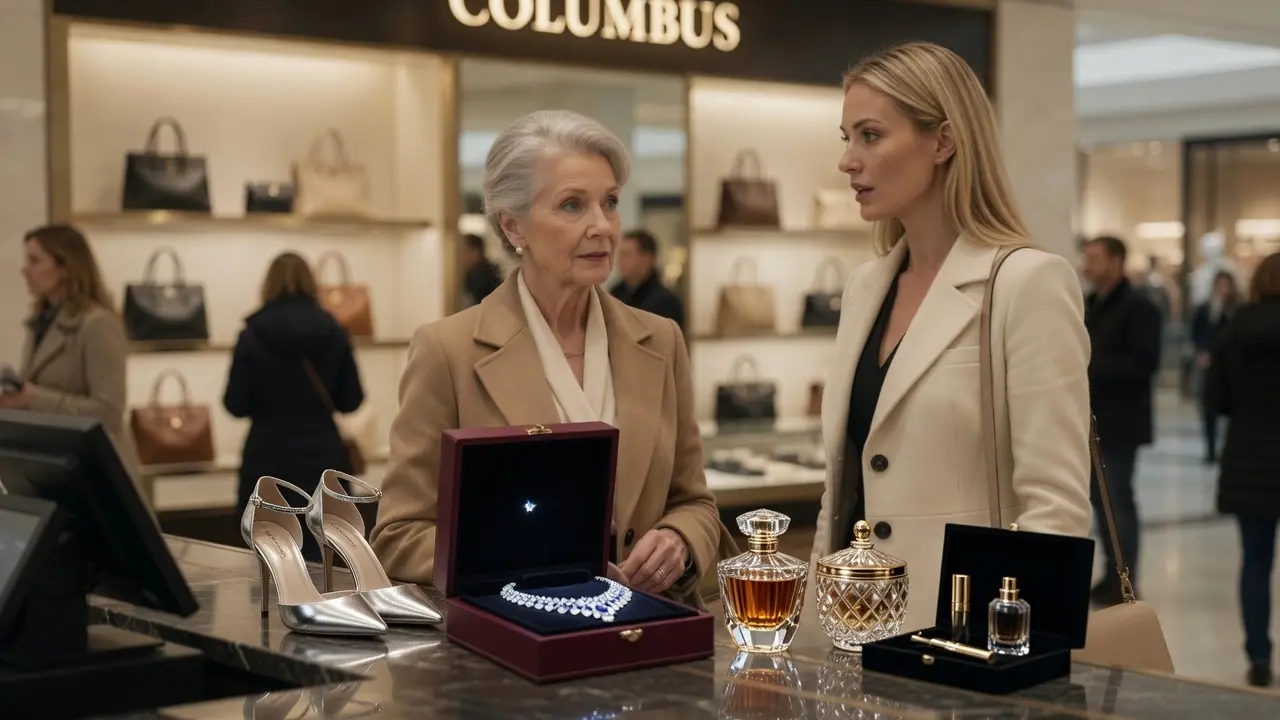
The cashier at the upscale boutique had already wrapped two silk scarves, three bottles of imported perfume, a pair of cream leather heels, and a designer handbag that cost more than my first car.
For six months, I had kept paying to keep the peace.
But this time, I smiled back and said five words that wiped the smile right off her face.
“Funny. I forgot mine too.”
The boutique went so quiet I could hear the soft hum of the air conditioning above the display shelves. Brenda’s polished smile froze in place, then cracked around the edges. Her mother, Janice, stopped stroking the sleeve of a cashmere coat and slowly turned toward me as if I had spoken in a foreign language.
The cashier stood behind the marble counter, one hand hovering over the payment terminal, trying very hard to pretend she was not listening. She was young, maybe twenty-five, with neat blond hair and a name tag that read Melissa. I felt sorry for her. No retail worker deserved to be trapped inside another family’s bad manners.
Brenda’s eyes narrowed slightly. “What do you mean, Mom?”
I had never liked that she called me Mom only when she wanted something. In casual conversation, I was Evelyn. In front of her friends, I was Kevin’s mother. When the bill arrived, I became Mom, drawn out sweetly, like the word itself had a credit limit.
“I mean exactly what I said,” I replied, adjusting the collar of my winter coat. “I do not have my card with me today.”
Brenda gave a little laugh that sounded more like a cough. “That is impossible. You always carry your card.”
“Usually,” I said. “Not today.”
Janice stepped closer, her perfume arriving before the rest of her. She was sixty-three, though she dressed as if aging were a personal insult she intended to challenge in court. Her silver hair was styled into a perfect bob, her lipstick was a hard coral pink, and her smile had the practiced sympathy of a woman who could ask for your last dollar while acting wounded that you hesitated.
“Oh dear,” Janice said. “I just realized I left my entire purse in the car too. What a silly pair we are today, Brenda.”
They both looked at me with wide eyes and absolute expectation.
This was not a new routine.
Over the past six months, Brenda had repeatedly invited me out under the guise of bonding time. Coffee dates became expensive brunches. Brunches became spa visits. Spa visits became shopping trips. Every single time, her wallet mysteriously vanished at the cash register or her card failed at the exact moment payment was due.
At first, I believed the excuses.
Then I tolerated them.
Then I began counting.
A family dinner at a steakhouse: six hundred and forty dollars.
A luxury spa afternoon Brenda said would “bring us closer”: nine hundred and fifteen dollars.
Three weeks of organic groceries from a boutique market because Brenda claimed Kevin was “too stressed to shop”: one thousand and three dollars.
A baby shower gift for one of Brenda’s friends whom I had never met: four hundred and eighty dollars.
A charity gala dress she said she would “pay me back for immediately”: seven hundred and twenty dollars.
No repayment ever came.
Each time, I paid because I wanted peace for my son, Kevin. He was thirty-two, my only child, and had always been passive in the presence of louder people. As a boy, he had been gentle, dreamy, and kind, the sort of child who apologized to furniture after bumping into it. As a man, that softness had curdled into avoidance. He hated conflict so much that he often handed victory to whoever shouted first.
Lately, that person was Brenda.
Today was supposed to be a special ladies’ day outing. Brenda had called me the week before, her voice honeyed with false warmth, saying she wanted to spend “quality time” together. Then, that morning, she casually mentioned that her mother was joining us. By noon, I understood why.
They had not invited me to bond.
They had invited a wallet with gray hair.
The total on the digital screen glowed in clean white numbers.
$1,986.42
I looked at the piles of silk, leather, perfume, and shoes, none of which I had chosen. I looked at Brenda’s confident waiting smile. I looked at Janice, who had already begun pretending embarrassment on behalf of all of us.
Then I gave them their own performance back.
“Well,” I said pleasantly, “since your purse is just out in the car, Janice, you can easily run out and grab it.”
Janice blinked.
Brenda’s lips parted.
I turned and walked away without waiting for permission.
Behind me, Brenda hissed, “Evelyn.”
Not Mom now.
Interesting.
I kept walking.
The polished floor of the luxury mall reflected the ceiling lights in long white ribbons. Around me, women carrying expensive bags drifted past designer windows. The air smelled of perfume, coffee, new leather, and quiet financial danger. For the first time in months, I felt no need to fix what someone else had broken.
Walking out of that mall felt significantly lighter than I expected.
For years since my husband, Martin, passed away, I had maintained my quiet, orderly life in the suburban home we built together. I was not wealthy beyond measure, but I was secure because I had managed our finances carefully. Martin used to say that money was not meant to be worshiped or wasted. It was meant to provide shelter, dignity, and choices.
I had a pension from my years as a school administrator. I had Martin’s life insurance carefully invested. I had no mortgage, no credit card debt, and a small travel fund I rarely touched because I preferred my garden, my book club, and my kitchen table to cruise ships and crowded tours.
I was comfortable because I had been disciplined.
Brenda mistook that discipline for endless availability.
By the time I reached my car, my phone had already buzzed four times. I placed it facedown in the passenger seat and drove home in silence. Snow had begun falling lightly, soft white flakes melting against the windshield before the wipers swept them away. I remember thinking how peaceful the world looked when I finally stopped rushing to rescue people from consequences.
An hour after I arrived home, my phone began buzzing again.
First came Brenda’s texts.
How could you leave us like that?
That was humiliating.
You made me look poor in front of the staff.
My mother is shaking.
Kevin needs to know what you did.
Then Janice.
I have never been treated so rudely in my life.
You embarrassed your own family over money.
A woman your age should know better.
Then Kevin’s voicemail.
“Mom, call me back. Brenda is really upset. I do not know what happened, but she says you caused a huge scene at the mall. Please just call me.”
I did not answer any of them.
Instead, I made myself a cup of chamomile tea in the blue mug Martin bought me in Vermont fifteen years earlier. I sat on the back porch beneath the heated awning, wrapped my hands around the mug, and watched cardinals hop along the fence. The yard was quiet except for the soft scrape of bare branches against the winter sky.
I knew exactly what was happening at that boutique counter.
Without my card, Brenda and Janice had been forced to face the ultimate humiliation for people of their vanity: standing at a luxury register and admitting they could not afford what they had chosen. They would not call it that, of course. They would call it mistreatment. They would call it abandonment. They would call it a misunderstanding.
But I had been a school administrator for thirty-four years.
I knew the difference between a mistake and a pattern.
When Kevin finally called a third time, I decided to pick up.
His voice was visibly stressed, the familiar tone of a man trying to fix a problem he did not create and had no courage to name.
“Mom, what on earth happened at the mall?”
“I went shopping with Brenda and Janice.”
“That is not what Brenda said.”
“I am sure it is not.”
He sighed heavily. “She said you abandoned her and her mother at the register and made a huge public scene.”
“There was no scene, Kevin. I simply did not have my credit card with me, and I had to leave for my scheduled meeting. Janice had her purse in the car, so I naturally assumed they figured it out.”
Kevin was quiet.
That silence told me he knew more than he wanted to admit.
“They had to put almost everything back, Mom,” he said at last. “Brenda said she has never been so embarrassed in her entire life.”
“I imagine not.”
“Mom.”
“Kevin.”
He lowered his voice, trying to sound reasonable. “They are coming over to talk to you right now.”
“They are welcome to visit my home,” I said.
Then I hung up.
I knew a major storm was coming, but for the first time in months, I felt completely prepared to meet it.
The front door did not just open later that afternoon. It practically rattled on its hinges. Brenda marched into my living room without knocking, her face flushed with deep anger, her hair still perfectly curled despite the drama she was carrying. Janice followed closely behind her, looking deeply offended. Kevin hovered near the entryway like a reluctant bodyguard who had misplaced his shield.
“How could you do that to us?” Brenda demanded.
I remained seated comfortably in my armchair, holding my warm tea. My living room was one of my favorite places in the house. Pale curtains, a navy rug, shelves of books, framed photographs of Martin and Kevin, a small fireplace, and the quiet sense of order that comes from years of choosing only what belongs.
Brenda’s anger looked strangely out of place there.
“You utterly humiliated me in front of the store staff,” she continued. “We had to return almost everything because you decided to play some passive-aggressive game.”
I looked at the small plastic shopping bag in her hand.
A single expensive designer lipstick.
I feigned mild surprise.
“Oh,” I said. “You returned most of the items, but clearly not all. So you did have a way to pay after all.”
Brenda stuttered, caught completely off guard.
“I found enough cash in my wallet for the lipstick. That is completely beside the point.”
“Actually,” I said, setting my teacup down on the saucer with a soft click, “it is the entire point. If you had enough money for a luxury lipstick, you were not completely stranded.”
Brenda’s eyes flashed.
“That was cash. My card was not with me.”
“Where was it?”
“I forgot it.”
“Again.”
She stiffened.
Janice stepped forward, one hand pressed dramatically to her chest.
“That is incredibly rude, Evelyn. Brenda is your family. We invited you out to spend quality time with us.”
I turned my steady gaze to Janice.
“And I spent time with you. But spending time does not mean funding your lifestyle. Tell me, Janice, didn’t your mother ever teach you that adults are supposed to pay for their own needs?”
The living room went dead silent.
Kevin shifted uncomfortably from foot to foot, looking anywhere but at his furious wife.
Brenda’s jaw dropped, completely unaccustomed to me speaking with such direct, unyielding clarity. They had expected me to apologize. They had expected me to explain myself. They had expected me to feel guilty enough to restore the old arrangement.
Instead, I sat there and watched them realize that their tears and anger had no power over me anymore.
Brenda recovered first.
“How dare you talk to my mother that way?”
“The same way she dared to stand beside you while you pushed a two-thousand-dollar bill toward me.”
“It was not like that.”
“It was exactly like that.”
Kevin finally spoke.
“Mom, come on. Let’s just calm down. This is getting out of hand.”
I looked at my son.
“No, Kevin. It got out of hand six months ago. Today, I put it back in hand.”
His face reddened.
Brenda threw up both arms. “Do you hear how she talks to us? Like we are criminals.”
“You are not criminals,” I said. “You are adults with expensive taste and poor boundaries.”
Janice gasped as if I had thrown wine at her.
Before Brenda could launch into another loud tirade, I stood.
I am not a loud woman, but I know how to hold a room. Years of managing angry parents, frightened teachers, school board egos, and children in crisis had taught me that authority does not always need volume. Sometimes stillness does the work.
“This conversation is over,” I said quietly. “Kevin, please take your wife and your mother-in-law home.”
“Mom,” Kevin pleaded, stepping forward with his hands raised, “let’s just talk about this rationally.”
“There is nothing to talk about, Kevin. My home is a place of peace. If people cannot respect that, they cannot be here.”
I walked to the front door and held it open.
Brenda stared at me.
Her eyes narrowed into cold slits.
“Fine,” she said. “If this is how you treat your own family, do not expect us to keep helping you around here. Do not expect visits. Do not expect to see your future grandchildren either.”
It was a classic threat.
She thought the word grandchildren would pierce whatever armor I had put on.
But a threat built on imaginary children is still a threat.
“I manage my home just fine on my own, Brenda,” I replied smoothly. “Safe drive home.”
After they left, the silence of my house settled back in.
But it did not feel lonely anymore.
It felt protective.
I walked slowly through the rooms, noticing small things I had been pretending not to see. Brenda had slowly been leaving her personal items around the house, an expensive scented candle on my hallway table, a designer throw pillow on the guest room chair, a framed engagement photo on my piano, a silk robe in the upstairs closet. It was as if she had been marking territory, one tasteful object at a time.
She had also been dropping hints for months.
This house is so big for one person.
You must get lonely here.
Kevin and I could help you age in place.
Our townhouse is so cramped.
It would be smart to rent our place out and consolidate.
Consolidate.
That was the word she used when she meant occupy.
I went to the guest room, picked up the decorative items she had placed on the dresser, and put them into a plain cardboard box. I added the throw pillow, the candle, the robe, and the framed photo. I was not angry. I was simply auditing my life.
The financial drain was stopping today.
But I knew the emotional manipulation would intensify from here.
I needed to ensure my physical space remained entirely my own, free from their quiet invasion. I taped the box shut and placed it neatly by the front door. On top, I wrote Brenda’s name with a black marker.
Then I made a list.
When Martin was alive, he used to tease me about my lists.
“Evelyn,” he would say, leaning in the kitchen doorway with a cup of coffee, “you could organize a thunderstorm into folders.”
Maybe I could.
That night, I organized the thunderstorm that had entered my family.
The next morning, I sat at my kitchen table with bank statements, a yellow legal pad, and a black marker. I went back through the last year of expenses. It was a quiet revelation, one transaction at a time.
Beyond the shopping trips, I noticed small recurring drains.
Kevin was still on my family phone plan, a remnant from his college days that I had never bothered to change. He also had a spare credit card linked to my account for emergencies. Emergencies, lately, appeared to include premium car washes, high-end coffee subscriptions, golf course lunches, streaming upgrades, and an expensive monthly grooming service for Brenda’s little white dog.
I stared at the dog grooming charge for a long time.
Then I laughed.
Not because it was funny.
Because sometimes disrespect becomes so ridiculous that laughter is the only sound left.
I called the bank first.
Within ten minutes, Kevin’s emergency card was permanently deactivated. Next, I logged into my cellular account and removed his line, sending him an automated notification that he had thirty days to transfer his number to his own plan. Then I changed the passwords on my banking apps, household accounts, streaming services, delivery memberships, and online shopping profiles.
I was not doing this to be cruel or vindictive.
I was doing this because passive dependency breeds disrespect.
If Kevin was going to allow his wife to treat me like an ATM, he could no longer enjoy the perks of my financial oversight while pretending neutrality.
Around noon, my phone rang.
Kevin.
“Mom, I just got a notification about my phone plan,” he said. “And my emergency card declined at the gas station. Is everything okay with your accounts? Did you get hacked?”
I adjusted the blinds to let the winter sun into my kitchen.
“My accounts are perfectly secure, Kevin. I am simply cleaning up my finances.”
“Cleaning up?”
“You are a thirty-two-year-old married man. It is time your phone and gas are solely your responsibility.”
He was quiet for a moment.
“Is this because of yesterday?”
“It is because of the last six months.”
“Brenda is still furious, Mom. She says you are ruining our relationship over a simple misunderstanding.”
“It was not a misunderstanding, Kevin. It was a pattern. And the pattern is finished.”
He exhaled.
“Mom, things are tight for us right now.”
“Then you and Brenda need a budget, not my credit card.”
“That is harsh.”
“No. It is adult.”
Another silence.
I softened my voice, but not my boundary.
“I love you, Kevin. I will always love you. But I am no longer funding your household.”
He murmured goodbye and hung up.
I crossed the item off my list.
A week passed in beautiful, undisturbed quiet.
I tended to my garden, though winter had left little to tend except the small greenhouse Martin built for me years earlier. I met my friends for book club, where I said nothing about Brenda but listened with new appreciation when Carol complained about her nephew borrowing money. I cleaned the linen closet, baked lemon bread, and rediscovered the pleasure of moving through my house without waiting for my phone to buzz with someone else’s emergency.
I did not reach out to Kevin.
He did not reach out to me.
I knew he was likely caught in the middle of Brenda’s storm, but I refused to provide the shelter anymore.
On Sunday afternoon, I heard a car pull into the driveway.
I looked out the window and saw Kevin’s sedan.
Both he and Brenda got out.
Brenda did not look angry today.
She looked determined.
She was holding a large leather binder.
I opened the door before they could knock.
“Hello, Kevin. Brenda.”
“Hi, Mom,” Kevin said, looking tired. “Can we come in? We really want to smooth things over. We brought lunch.”
He held up a bag from a local deli.
Not the expensive bistro Brenda preferred.
A very affordable deli.
Progress, perhaps, though I did not trust it yet.
“You can come in for lunch,” I said, stepping aside. “But if the binder is for a sales pitch, leave it in the car.”
Brenda smiled, though it did not reach her eyes.
“It is not a pitch, Mom. It is just some family planning. We really think it is time we talk about the future.”
We sat at the kitchen table.
As soon as Kevin finished unpacking the sandwiches, Brenda opened the binder anyway.
It was filled with printed listings of townhouses in their area, a detailed spreadsheet, highlighted expense categories, property tax estimates, and a monthly cash flow projection that appeared to rely heavily on my assets becoming theirs.
“We have been thinking,” Brenda began, her voice dripping with manufactured sweetness. “With inflation and the cost of maintaining this big house, it does not make sense for you to live here alone.”
I took a slow sip of water.
“We want to move in here to take care of you,” she continued. “We can rent our place out and use that money to pay down our debts. It is a win-win.”
I looked at the spreadsheet.
It was detailed.
Too detailed.
They had been planning this for weeks, perhaps months.
Brenda had already designated which rooms would be theirs. The master bedroom, my bedroom, the room I had shared with Martin for thirty years, was labeled Kevin and Brenda. My sewing room was labeled nursery. My study was labeled office and content room. The guest room at the back of the house, the one with poor heating and a view of the neighbor’s fence, had my name typed into it.
Evelyn’s room.
Not Mom’s room.
Not current bedroom.
Evelyn’s room.
I stared at those two words until they became almost amusing.
“You have been very busy, Brenda,” I said, turning the binder around so it faced her again. “But you forgot to ask the most important question.”
“What is that?” Brenda asked, leaning forward.
“Whether I want to live with you.”
Her face tightened.
“Mom, we are trying to help you. You are getting older. What happens if you fall? Plus, Kevin tells me the property taxes here are going up next year. It is just practical.”
“I am sixty-five, not infirm,” I replied calmly. “And my property taxes are fully covered by my retirement budget. I do not need your rent money, and I certainly do not need to be relegated to my own guest room so you can live in my master suite debt-free.”
Kevin looked down at his sandwich.
Completely silent.
That silence hurt, but it no longer surprised me.
Brenda slammed the binder shut.
“Kevin, say something. We talked about this. Your mother is being completely unreasonable and selfish. We are trying to build a stable family here.”
“Kevin does not have a say in the ownership of this house, Brenda,” I said before my son could speak. “His name is not on the deed. Mine is. And as long as I am breathing, this house remains exactly as it is.”
Brenda stood up so fast her chair scraped loudly against the floor.
“You will regret being this stubborn when you are lonely,” she snapped.
I did not blink.
I simply pointed toward the door.
Kevin stood slowly, holding the deli bag as if lunch had become evidence. He looked at me once, and for a second, I saw shame move across his face. Not enough to make him brave, but enough to prove he knew.
After they left, with Brenda stomping out and Kevin offering a muted apologetic shrug, I did not sit down to cry.
I walked straight to my junk drawer and pulled out the business card of a local locksmith my neighbor had highly recommended.
Kevin had a key to my house. He had held it since he moved out. Under normal circumstances, I trusted him completely.
But Kevin was weak when it came to his wife.
If Brenda pressured him enough, if she convinced him that they needed to surprise me, help me, protect me, or simply bring their things over gradually, he would give in. I could not risk waking up to find boxes in my garage or Brenda measuring curtains in my bedroom.
The locksmith arrived two hours later.
He was an older man named Mr. Alvarez, with a gray mustache and a calm, efficient manner. He worked quickly, removing the old deadbolts and replacing them with new reinforced locks. As he worked, I gathered every spare key from the kitchen drawer, the flowerpot by the back porch, the garage hook, and the small ceramic dish near the laundry room.
When he finished, he handed me three shiny new brass keys.
“Do you need a spare for your son, ma’am?” he asked politely.
“No, thank you,” I said with a polite smile. “Just these three for me will be perfect.”
As his truck pulled away, I felt a profound sense of security.
My house was truly my castle now.
I was not locking my son out of my life.
I was locking out unauthorized access to my peace.
Later that evening, I sent Kevin a simple text message.
I have updated the home security and changed the deadbolts today. If you ever need to visit, just let me know in advance so I can ensure I am home to let you in.
The reply took three hours.
A single word.
Okay.
He did not argue.
He did not ask why.
Deep down, I think he knew exactly why I had done it.
I went to bed that night sleeping soundly, listening to the rain tap against my window. For the first time in months, I did not wake at 2:00 a.m. worrying about what Brenda might demand next. Peace, once restored, has a sound. It sounds like a house that answers only to you.
Two weeks passed.
The true test of my new boundaries arrived on a rainy Tuesday afternoon.
I received a sudden notification on my tablet from my front porch camera.
Brenda was standing at my front door holding a large plastic storage bin.
She wore a beige trench coat, oversized sunglasses despite the cloudy weather, and an expression of irritated entitlement. Rain dotted her hair and shoulders. She set the bin down, dug into her purse, and pulled out a key.
I watched the screen as she tried it in the lock.
Left.
Right.
Nothing.
She removed it, examined it, and tried again.
This time harder.
Then she used both hands, forcing it with visible aggression.
When it was entirely clear the lock would not budge, she knocked loudly on the wood.
I walked to the door and opened it, keeping the heavy security chain engaged.
“Hello, Brenda. Can I help you?”
She looked furious, soaking wet under the porch awning.
“My key does not work. What on earth did you do to these locks?”
“I told Kevin I updated the security.”
“You changed the locks without telling me?”
“This is my house.”
“I am family.”
“You are also on my porch with a storage bin after trying to enter without permission.”
Her mouth tightened.
“What is in the bin?” I asked.
“It is some winter clothes I wanted to store in your attic. Our townhouse closets are overflowing right now.”
“I am sorry, Brenda, but my attic is no longer available for family storage. I am downsizing my own belongings this month and need every bit of the space.”
Her voice cracked with anger.
“You are locking out your own daughter-in-law over a mall bill. You are incredibly vindictive.”
“No, Brenda,” I said, my voice steady and completely devoid of anger. “I am just an adult who pays for her own things and manages her own space. I expect you to do the same.”
She stared at me through the crack in the door.
For the first time, I think she understood that I was not bluffing.
“Have a safe drive back,” I said.
Then I closed the door firmly and turned the new deadbolt into place.
She stood on the porch for another minute before stomping back to her car with her bin.
The boundary had been tested.
It held.
But Brenda was not finished.
Two days later, Janice called.
I let it go to voicemail.
Her voice came through later, dripping with wounded dignity.
“Evelyn, I hope you are proud of yourself. You are creating division in your family. Brenda has been crying for days. Kevin is under tremendous stress. A mother should want to help her child, not punish him.”
I saved the voicemail in a folder labeled Records.
Not because I planned to sue anyone.
Because clarity has value.
The next week, Kevin came alone.
He stood on my porch at six in the evening holding a grocery bag and looking like a man who had finally slept badly enough to become honest. I let him in. He placed the bag on the kitchen counter.
“I brought soup,” he said.
“That is thoughtful.”
“It is from the grocery store.”
“I did not expect you to make soup from scratch.”
He smiled weakly.
We sat at the kitchen table without Brenda’s binder, without Janice’s perfume, without a bill waiting between us.
For a long time, Kevin said nothing.
Then he looked at me and asked, “How long were you angry before the mall?”
I appreciated the question.
Not because it was perfect.
Because it was finally his.
“I was not angry at first,” I said. “I was embarrassed for you. Then worried. Then tired. The anger came later.”
He nodded slowly.
“I knew Brenda was doing it,” he admitted.
I said nothing.
He looked down at his hands.
“I told myself it was small stuff. That you could afford it. That it made things easier.”
“For whom?”
His face twisted.
“For me.”
That truth sat between us.
Painful.
Useful.
“I did not want fights at home,” he whispered.
“So you let the fights come to me.”
He closed his eyes.
“Yes.”
I looked at my son, and for the first time in months, I saw not only weakness, but the beginning of recognition. That did not erase what he had done. It did not restore trust. But it mattered.
“I love you, Kevin,” I said. “But I will not be used as the pressure valve for your marriage.”
“I know.”
“Do you?”
“I am starting to.”
He stayed for one hour. We ate grocery store soup and talked about his job, his bills, and the reality that he and Brenda were in more debt than he had admitted. I did not offer money. He did not ask. That was the first peaceful conversation we had shared in nearly a year.
When he left, he paused at the door.
“Can I come next Thursday?”
“Alone?”
He swallowed.
“Yes.”
“Then yes.”
Three months have passed since that rainy Tuesday.
Brenda has not come back to my house.
Janice has stopped leaving voicemails.
Kevin still comes over occasionally, always alone, usually on Thursday evenings. We sit on the porch when the weather allows, drink coffee, and talk about his job. Sometimes he tells me about his budgeting class. Sometimes he says very little. I let silence do its work.
He and Brenda are still married.
That is his choice.
But he has moved his phone to his own plan. He canceled three subscriptions. He sold the second car they did not need. He has begun paying down debt without my help. He seems more grounded now, perhaps because he is finally carrying his own financial weight.
As for Brenda, she no longer calls me Mom.
That is fine.
The title was never the point.
Looking back, I realized my biggest mistake was not walking away at the luxury mall. It was letting matters reach that point in the first place. I had allowed my desire to be a good mother to blind me to the fact that I was being used. I had confused peace with silence, and silence with love.
They are not the same.
True family love does not demand your financial submission. It does not require you to shrink yourself in your own home so others can expand without limits. It does not use guilt as a receipt or inheritance as a bargaining chip. And it certainly does not label your bedroom before you have agreed to move out of it.
I sit in my living room tonight surrounded by the things I chose, funded by the life Martin and I built together through patience, labor, and careful decisions. My life is not grand or filled with dramatic victories. It is quiet, orderly, and entirely mine.
There is a fire in the fireplace.
There is tea beside my chair.
There are three new brass keys in the small ceramic dish by the door.
Only I decide where they go.
I learned that boundaries are not walls built to keep people out forever. They are gates with secure locks. The right people can still come through, but they must knock, wait, and respect the person who opens the door.
As the sole owner of this house and my life, I am the only one who decides who gets a key.
And who has to stand on the porch with a storage bin, finally learning that my peace is not available for purchase.
That peace is worth more than any designer handbag in the world.