“My father said you needed a wife.”
Clara Dutton’s voice barely rose above the wind moving through the golden aspens beyond Callum Hargrove’s porch. She stood before him in a faded beige prairie dress and a dark-brown wool shawl, clutching her father’s final letter against her chest as though the paper were the last solid thing left in her life. Her boots were coated with red dust from the long walk east of Boise City, and grief had left dark circles beneath her hazel eyes. Callum studied her without speaking, his storm-gray gaze steady beneath tousled dark hair.
“Maybe,” he said at last. “You.”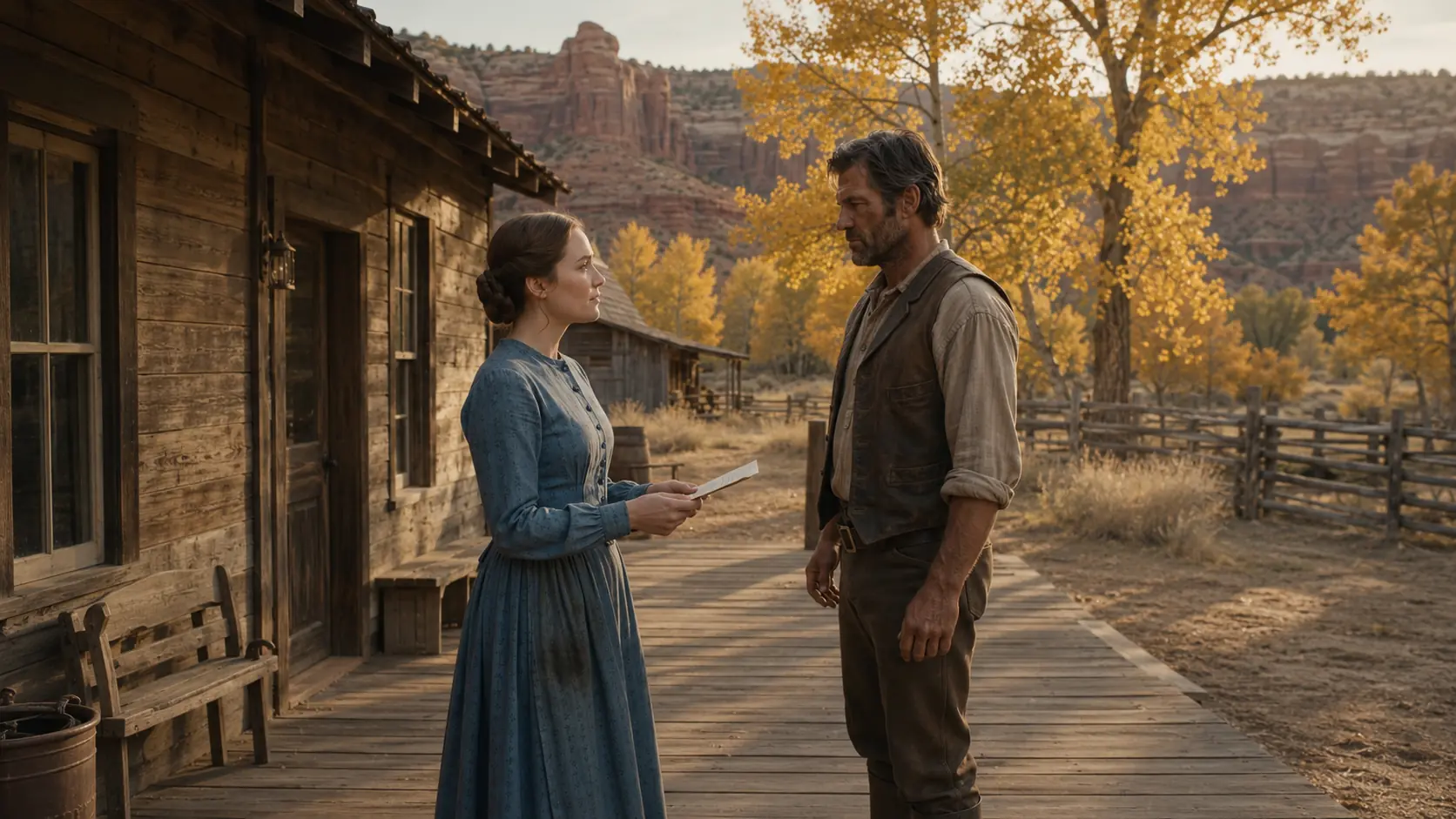
Clara’s head lifted sharply, and the shawl slipped from one shoulder before she caught it. She had prepared herself for suspicion, rejection, or the cold charity people offered when they wanted gratitude more than they wanted to help. She had not prepared for two quiet words spoken without mockery. Callum looked toward the folded letter in her hands, but his expression revealed nothing.
“You don’t understand,” she said. “My father’s debts took our house, I owe three months at the boardinghouse, and by Friday my trunk will be in the street.”
Callum extended one scarred hand. Clara hesitated before giving him the letter, watching as he unfolded the paper with surprising care. He recognized Edmund Dutton’s cramped handwriting immediately, the same writing that once filled field maps and small notes left beside campfires. Edmund asked him to look after Clara, not because she was helpless, but because the world had left her nowhere safe to stand. Callum folded the letter along its original creases and returned it.
“Your father carried me eight miles through hostile country with an arrow in my shoulder,” Callum said. “He stayed beside me for two nights while fever tried to kill me, then never asked for payment.”
“I’m not my father’s debt.”
“No,” Callum replied. “You’re his daughter.”
Clara lowered her eyes, ashamed of the relief trying to rise inside her. Since Edmund’s death, every conversation had become a negotiation over money, property, or what respectable work a young unmarried woman could obtain before winter. Mrs. Opal Greer had suggested employment at a saloon in Silver Junction, where the owner liked hiring women with no relatives nearby. Clara had understood the warning concealed inside the offer and packed her few belongings that night.
“I can cook,” she said quickly. “I can mend, tend a garden, preserve vegetables, keep accounts, and handle a horse if it isn’t mean.”
Callum’s mouth moved slightly, almost becoming a smile. “One of mine bites.”
“Then I’ll begin with the other.”
He opened the cabin door. Warmth from a small iron stove drifted onto the porch, carrying the scent of coffee, leather, and split cedar. The single room contained a narrow bed, a rough table, two chairs, shelves of tools, and a stone fireplace that had been repaired more often than decorated. Everything was clean, practical, and built for one person.
Clara remained outside. “What exactly are you offering?”
“A roof until the winter passes.”
“And after?”
“We’ll decide after.”
She tightened her shawl around her shoulders. “People in town will say I traded myself for shelter.”
“People in town say I killed twelve men with one bullet.”
“Did you?”
“Not on the same day.”
The answer startled a laugh from her before grief caught it and turned it into something fragile. Callum stepped aside, giving her room to enter without touching her. He did not speak of marriage again that afternoon, nor did he demand a promise in exchange for the shelter he offered. He simply placed another piece of wood in the stove and told her the left chair did not wobble as badly as the right.
Clara’s trunk arrived two days later in the back of a freight wagon driven by a boy Mrs. Greer had paid to remove it. The boardinghouse owner included a final demand for thirty-seven dollars and a threat to sell Clara’s mother’s silver hairbrush if the balance was not paid before December. Callum read the note once, climbed onto his horse, and rode toward town without explaining himself. He returned at dusk with the hairbrush wrapped in cloth and Mrs. Greer’s receipt folded in his pocket.
“You paid her,” Clara said.
“I settled the account.”
“I told you I wasn’t asking for charity.”
Callum set the wrapped hairbrush on the table. “Then work it off.”
Her pride eased enough for her to breathe. “At what wage?”
“Whatever is fair.”
“Who decides what is fair?”
“You keep the accounts. You do.”
That arrangement gave Clara something shelter alone could not provide: a place she had earned. She began by repairing the torn curtains and clearing spoiled jars from the pantry shelves. She discovered that Callum survived mainly on beans, coffee, dried venison, and bread hard enough to be used as a building material. Within a week, the cabin smelled of rabbit stew, fresh biscuits, and apples simmering with cinnamon.
Callum worked from before sunrise until the canyon turned purple in the evening. He repaired fences, cut firewood, checked traps, and prepared the stable roof for heavy snow. Clara often watched him from the doorway, noticing how carefully he moved despite the gun at his hip and the stories attached to his name. He treated animals gently, spoke to his horses as if they were stubborn relatives, and carried injured birds away from the barn so the barn cat could not reach them.
One afternoon, Clara found him beside the garden fence with blood soaking through his sleeve. A rusted nail had torn his forearm while he was reinforcing a post. He tried to hide the injury, but she caught his wrist and pulled him toward the cabin. Callum followed with the expression of a man more uncomfortable with concern than pain.
“Sit,” Clara ordered.
“I’ve had worse.”
“That explains the scars, not the foolishness.”
She cleaned the wound with boiled water and whiskey, then wrapped it with a strip torn from an old linen sheet. Callum watched her bent head and careful hands, remembering Edmund doing the same after the ambush years earlier. Clara looked like her father when she concentrated, carrying the same stubborn crease between her brows. When she finished, her fingers remained around his wrist for one quiet second longer than necessary.
“You don’t have to keep proving you can survive alone,” she whispered.
Callum met her eyes. “Neither do you.”
The first snow came early, covering the red earth beneath a hard white sheet. By then, Clara had moved the narrow bed behind a curtain near the fireplace while Callum slept on a pallet beside the door. Neither discussed the arrangement, though she occasionally woke to find another blanket placed over her during the night. He always denied doing it, and she always pretended to believe him.
Life settled into a rhythm that surprised them both. Clara prepared breakfast while Callum carried water from the well, and each evening they sat across from one another with Edmund’s old letter stored safely in a wooden box. Callum began telling her stories about her father: how Edmund once talked a drunken miner out of shooting his own shadow, how he could find water in country where even coyotes gave up, and how he sang hymns badly enough to frighten horses. Clara laughed more often, though sometimes laughter ended with tears.
Callum never told her to stop grieving. He simply remained at the table until the tears passed, offering silence without making her feel abandoned inside it. Clara had known men who filled every quiet moment with promises, explanations, and claims of understanding. Callum’s silence was different. It did not close a door; it waited beside one.
The trouble began when Silas Rourke arrived from Larksburg with two armed men and a document bearing Edmund Dutton’s signature. Rourke owned a freight company, half the gambling tables in Silver Junction, and enough local officials to make legal threats dangerous. He claimed Edmund had borrowed four hundred dollars the year before his death and pledged Clara’s mother’s remaining property as security. Since the property had already been sold, Rourke announced that Clara herself would work in one of his establishments until the debt was cleared.
Callum stood between Rourke and the cabin door. “She isn’t property.”
“She inherited the debt.”
“Not that kind.”
Rourke smiled beneath a waxed black mustache. “You planning to marry her, Hargrove?”
Clara came onto the porch before Callum could answer. She wore her shawl pinned firmly at her throat and held Edmund’s account ledger against her side. “My father recorded every debt he owed, and your name isn’t in this book.”
“Then he forgot.”
“My father forgot meals, birthdays, and where he left his hat. He never forgot money he owed.”
Rourke’s smile disappeared. He handed her the document and told her a territorial judge would recognize it within the month. Callum read the signature carefully and noticed that the final stroke curved upward, unlike Edmund’s usual downward line. He said nothing while Rourke’s men remained within hearing, but his hand rested near the holster at his hip until their horses vanished along the canyon trail.
“The signature is false,” Callum said.
Clara nodded. “I know.”
“Can you prove it?”
“Father kept copies of contracts, but Rourke’s men emptied the house after the funeral.”
Callum looked toward the snow-covered ridge. “Then we find where they put them.”
Clara expected him to order her to remain behind while he rode into danger. Instead, he asked whether she could shoot. She admitted Edmund had taught her with a small revolver, though she disliked the noise. Callum gave her a weapon from the shelf, checked the cylinder, and fastened a leather holster around her waist.
“I don’t want you using it,” he said.
“Then why give it to me?”
“Because what I want and what keeps you alive may not be the same thing.”
They rode toward Larksburg before dawn, reaching the abandoned Dutton house by midday. Snow had drifted against the porch, and the front door hung from one hinge. Inside, drawers had been overturned, floorboards broken, and every paper removed from Edmund’s writing desk. Clara stood in the room where her father died and fought the urge to collapse beneath the weight of all that had been taken.
Callum found boot marks leading toward the old smokehouse. Beneath a loose plank inside, Clara discovered a metal box containing correspondence, receipts, and a sealed statement written two months before Edmund’s death. The statement described Rourke’s attempt to pressure Edmund into falsifying freight permits for weapons being transported across territorial lines. Edmund refused and recorded the names of two deputies and a magistrate who had accepted payment.
Rourke’s forged debt was not about money. He wanted Clara under his control because he feared Edmund had told her where the evidence was hidden. The box contained enough to destroy his freight operation and place several influential men before a federal judge. Clara held the papers with both hands, understanding that her father had died believing danger would come after him.
A floorboard creaked outside.
Callum pushed Clara behind the stone chimney as a bullet tore through the smokehouse wall. Rourke’s men had followed their tracks and taken positions near the ruined barn. Callum fired once through a gap in the logs, forcing one man behind a wagon. Clara’s hands shook around her revolver, but she remembered her father telling her that fear was not an instruction; it was only information.
One of Rourke’s men circled toward the rear door. Clara saw his shadow pass across the snow and fired into the wooden post beside his face. The man stopped, startled by the splinters. She aimed again, steadier this time.
“Take another step,” she called, “and the next one won’t miss.”
Callum glanced at her, pride briefly overcoming concern. The gunman retreated toward the barn, but the second man continued firing until hoofbeats sounded along the road. A United States marshal and three riders appeared through the snow, responding to a message Callum had secretly sent before leaving the homestead. Faced with federal authority and Edmund’s evidence, Rourke’s men surrendered.
Silas Rourke was arrested three days later at the Silver Junction hotel. The documents revealed fraud, illegal weapons shipments, bribery, and the use of false debts to force vulnerable families into labor. Mrs. Greer admitted Rourke had paid her to send Clara toward his saloon once she lost her room. The magistrate who validated the forged agreement attempted to flee the territory but was caught before reaching Oregon.
Clara’s name was cleared, and the court returned part of the money taken from Edmund’s estate. It was enough for her to leave Callum’s cabin, purchase a small house near town, and begin again without depending on anyone. When the federal clerk handed her the payment, Clara felt freedom in the weight of the coins. She also felt an unexpected fear.
Callum had offered shelter because he owed Edmund a life. That debt had now been honored many times over. Clara no longer required protection, and he no longer had a reason to ask her to remain. During the ride home, neither mentioned the money or what it meant.
The cabin seemed smaller that evening. Clara folded her dresses into the trunk and placed her mother’s silver brush on top. Callum sat at the table repairing a saddle strap, though he had worked on the same buckle for nearly an hour. The silence between them no longer felt patient; it felt like a road dividing in two directions.
“I can buy the Weaver house near Larksburg,” Clara said.
“I heard it’s sound.”
“There’s a garden.”
“You grow things well.”
“And a room where I could sew for people in town.”
Callum nodded. “You’d do fine.”
His calm answer hurt more than rejection would have. Clara closed the trunk and fastened the latch, refusing to let him see her eyes fill. She had mistaken safety for affection and gratitude for the beginning of something neither of them had named. Her father sent her to a man who would protect her, not necessarily to one who could love her.
“I’ll leave in the morning,” she said.
Callum’s hands stopped. “The trail may ice overnight.”
“Then I’ll wait until noon.”
“That wasn’t what I meant.”
Clara turned toward him. “Then say what you mean.”
Callum rose slowly. He had faced armed men with steadier breath than he possessed standing before her now. His gaze moved toward the bed curtain she had sewn, the jars lined neatly on the shelf, and the second cup she placed beside his every morning. Before Clara arrived, he had believed a home was land no one could take from him; now he understood it was a person whose leaving could make the land empty again.
“Your father sent you because he believed I would keep you safe,” Callum said. “I let myself hide behind that promise.”
“Hide from what?”
“Wanting you here for reasons that belong to me.”
Clara’s fingers tightened against the trunk. “You never asked me to stay.”
“I didn’t want your fear deciding for you.”
“My fear brought me to this cabin. It didn’t make me laugh at your terrible jokes, wait for your horse on the ridge, or wake at night listening for your breathing.”
Callum moved closer, stopping before touching her. “You have money now. Choices.”
“Yes.”
“If you stay, it must be because you choose this place. Not Edmund, not gratitude, not winter.”
Clara looked into the storm-gray eyes the territory had mistaken for emptiness. She had watched those eyes soften over injured animals, brighten at the sound of her laughter, and remain beside her grief without demanding that it end. Callum had not rescued her by making her smaller. He had protected her long enough for her to stand beside him as an equal.
“My father said you needed a wife,” she whispered.
Callum’s hand rose, hesitating near her cheek until she leaned into his palm. “He was wrong about one thing.”
“What?”
“I needed you.”
The confession carried no performance and no practiced romance. It came from the deepest place inside a man who had survived by speaking only what he could defend. Clara covered his hand with hers, feeling the roughness of his fingers against her skin.
“Ask me properly,” she said.
Callum swallowed. “Clara Dutton, will you stay on this hard, stubborn land with a man who doesn’t know how to say half of what he feels?”
She smiled through tears. “That depends.”
“On what?”
“Whether that man is willing to learn.”
Callum lowered his forehead against hers. “Then stay—and let me become your home.”
They married in early spring beneath the cottonwoods beside the Boise River. The United States marshal served as witness, while Mrs. Brooks from the general store brought a cake that leaned to one side but tasted better than anything Clara had eaten in months. Callum wore a dark coat borrowed from a rancher twice his width, and Clara carried wildflowers tied with a strip from Edmund’s old neckcloth.
No grand crowd attended, and no newspaper recorded the ceremony. Callum spoke his vows quietly, promising not to keep Clara from hardship but never to let her face it alone. Clara promised to remain honest when silence became easier and tender when the territory tried to make them hard. When they kissed, wind moved through the cottonwoods like a blessing too large for words.
They used part of Clara’s inheritance to rebuild the stable and add two rooms to the cabin. One became a sewing room overlooking the garden, while the other remained empty until Clara discovered she was carrying their first child. Callum stood in the doorway after she told him, one scarred hand gripping the frame as if the earth had shifted beneath his boots. Then he knelt before her and pressed his face against her dress, overcome by a joy he had no language to contain.
Years later, travelers no longer spoke first of the outlaws Callum shot at Dry Creek Crossing. They spoke of the Hargrove homestead, where no stranded rider was turned away during winter and no hungry child left without food. Clara kept Edmund’s letter framed above the fireplace beside a newer note written in Callum’s uneven hand.
It contained only one sentence.
Your father believed I would save you, but you were the one who taught me how to live.
On cold October evenings, Clara sometimes stood on the porch overlooking the red canyon and remembered the frightened young woman who had walked up that road with debts, one trunk, and nowhere else to go. Callum would come behind her, wrap his arms around her waist, and rest his chin against her hair. Neither needed to speak about the day her father’s final request brought her to the loneliest man in the territory.
The cabin still stood low against the wind, and the land remained hard. Winter still demanded preparation, fences still broke, and nothing in that country came easily. But two cups now rested on the table, children’s laughter moved through the rooms, and Clara’s flowers grew beside the porch where she once waited for rejection.
Callum had believed the land became his because he built on it with scarred hands.
Only after Clara arrived did he understand that a place became home when someone chose to stay.