The first time Adrian Vail heard the words, he almost dropped the lunchbox in his hand.
It was just after nine in the morning, sunlight pouring through the towering glass walls of the executive floor, painting the polished marble in gold.
Adrian stood near the office doorway in his worn navy shirt, his daughter’s pink lunchbox still tucked under his arm because he had rushed from school drop-off straight to work.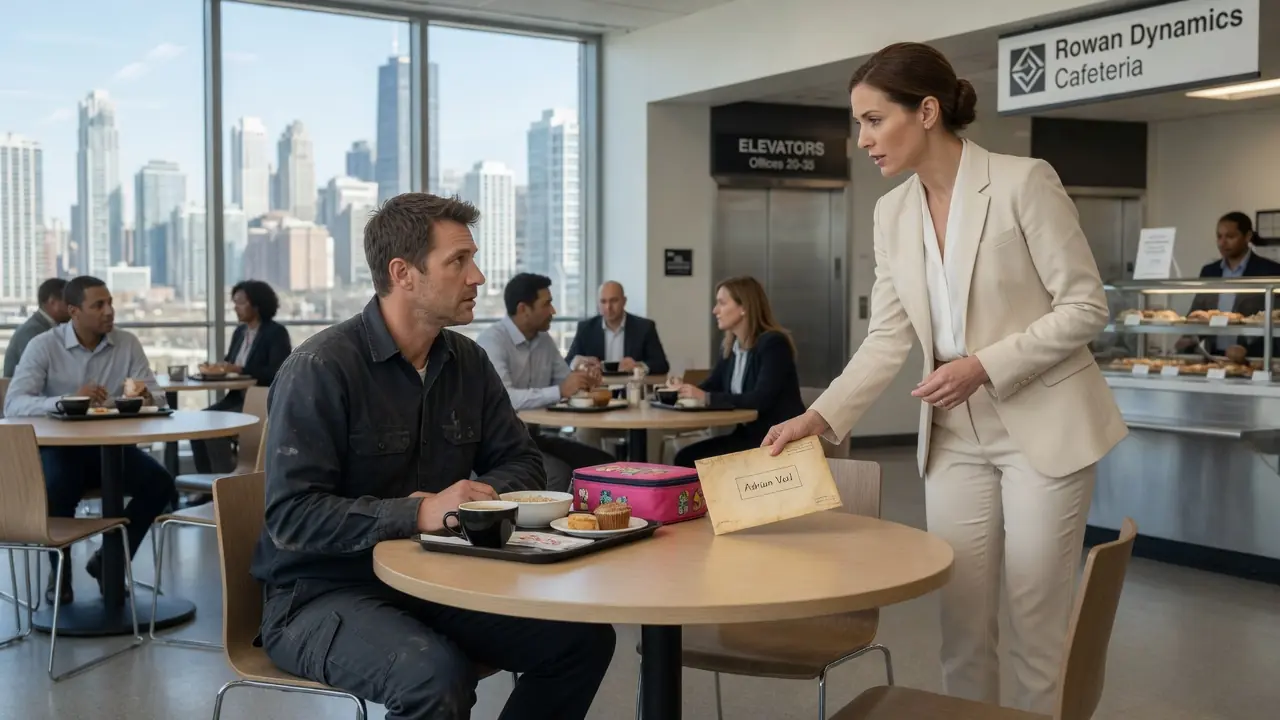
He was a single father, a maintenance supervisor in one of the city’s biggest tech firms, and a man who had long ago stopped expecting life to surprise him in any good way.
But then the CEO, Celeste Rowan, stepped out of her office in a cream-colored suit, looked directly at him in front of a silent hallway full of employees, and said in a calm voice that somehow shook the entire floor, “My father said you needed a wife.”
For one heartbeat, the entire building seemed to stop breathing.
Adrian had faced many humiliations in his thirty-four years, but none quite like that one.
He had learned to endure whispers when he brought his daughter to work on school holidays. He had learned to ignore the pitying looks from parents at parent-teacher meetings when they realized there was no mother beside him.
He had learned to smile through the exhaustion of night fevers, unpaid bills, and washing tiny socks at midnight after finishing a ten-hour shift.
Still, this was different.
This was the CEO of Rowan Dynamics, one of the youngest and most intimidating women in the business world, standing before him as if she had casually announced the weather.
Around them, assistants froze with tablets in hand. Two junior managers looked like they had forgotten how to blink.
It was confusion.
Celeste Rowan was not known for jokes.
She was known for making billion-dollar decisions before lunch and reducing arrogant board members to silence with a single look. She was elegant, disciplined, and so private that even gossip about her never lasted long because no one really knew anything.
Her late father, the founder of the company, had built Rowan Dynamics from a cramped warehouse office into an empire.
He had also been one of the only executives who ever treated Adrian like a human being.
Years ago, when Adrian’s wife, Mara, had died only three weeks after giving birth to their daughter Ivy, it was the older Mr. Rowan who quietly arranged extra paid leave and sent groceries to Adrian’s apartment without ever taking credit for it.
Adrian had never forgotten that kindness.
But he had no idea why the man’s daughter was now repeating something so bizarre in the middle of a workday.
Celeste studied him with a strange softness in her eyes, one that did not match the steel in her public reputation.
She asked him to step into her office, and Adrian followed because refusing the CEO in front of half the company was not really an option.
Inside, the room was bright with daylight and city views. Everything about it was sleek and expensive, from the oak shelves to the glass desk, but there was one detail that did not fit the image.
On the corner of her desk sat a small old-fashioned tin toy airplane, its chipped blue paint fading from its wings.
Adrian recognized it instantly.
Ivy had dropped that toy in the lobby two weeks earlier when he brought her in after her babysitter canceled.
Celeste had been the one to pick it up.
Adrian had assumed she had forgotten about it.
She did not begin with business.
She opened a drawer and placed an envelope in front of him.
It was yellowed at the edges, the handwriting old and familiar.
Adrian’s chest tightened before he even touched it.
It was addressed in Mr. Rowan’s hand.
Celeste told him she had found a stack of personal letters in her father’s private study after his death, each one marked with a name and instructions for when to deliver them.
Adrian’s was the last one.
She said her father had written that if anything ever happened to him, she was to make sure Adrian read the letter in person.
Adrian’s hands trembled as he opened it.
The letter was brief, but every line landed like a stone in his heart.
Mr. Rowan wrote that he had watched Adrian carry grief with more grace than most people carried success.
He wrote that the company had survived because of brilliant people in suits, yes, but also because of decent men in work boots who fixed what everyone else ignored.
He wrote that Adrian had been trying to be two parents, one provider, and an entire shelter for his daughter, and that no man should have to carry so much alone.
Then came the line that explained everything.
If my daughter ever has enough sense to slow down and notice the people worth admiring, tell Adrian I think he needs a wife, and tell her she needs a man who understands what loyalty looks like when no one is watching.
Adrian read that sentence three times.
When he finally looked up, Celeste was no longer the cold CEO from magazine covers.
She looked like a daughter still trying to understand a father she had loved but never fully known.
She admitted that at first she had been offended by the letter.
It sounded old-fashioned, intrusive, ridiculous.
But then she had started paying attention to the man her father had described.
She noticed Adrian arriving before sunrise to repair a broken elevator so employees would not be late.
She noticed him skipping lunch to answer a school call from Ivy’s teacher.
She noticed the way he fixed a receptionist’s space heater without being asked, and how he once spent his own money replacing a janitor’s worn-out toolbox because the man’s son was sick and the family needed every cent.
Celeste said her father had not been trying to arrange a marriage.
He had been trying to point her toward a kind of strength she had spent her whole life overlooking.
Adrian should have been flattered, maybe even amused.
Instead, he felt something deeper and more dangerous rise in him, anger born from exhaustion.
Not at Celeste. Not even at her father.
But at the cruel ease with which people spoke about his life as if loneliness could be solved like a staffing issue.
He thought of the nights Ivy cried for a mother she had never really known.
He thought of sitting on the bathroom floor after putting her to sleep, too tired to cry, staring at overdue bills while the apartment leaked rainwater through the ceiling.
He thought of all the well-meaning people who had told him he was still young and needed someone.
As if a new woman could simply be inserted into the empty shape grief had carved out of his life.
That was when Adrian gave the answer that left Celeste speechless.
He folded the letter carefully, placed it back into the envelope, and said in a voice so steady it startled even him, “I don’t need a wife. My daughter needs a world that won’t teach her a woman’s value is to complete a broken man. And I need people to stop looking at a widower like he’s a half-finished life.”
The silence that followed was so complete Adrian could hear the hum of the air conditioning.
Celeste stared at him, not offended, not defensive, just stunned, as if his words had reached some place in her that no boardroom argument ever had.
Adrian kept going because once years of swallowed pain finally found a crack, it refused to stay contained.
He told her he had loved his wife enough to know grief was not disloyalty to the future, but neither was it a vacancy sign hanging over his heart.
He said he was not against love.
He was against pity disguised as romance.
He was against the idea that being a single father automatically made him incomplete.
Some days he was exhausted, yes.
Some days he wanted to collapse.
But every morning Ivy smiled at him over cereal with milk on her chin, and somehow that was enough to get up and try again.
He did not need rescuing.
He needed respect.
Celeste’s eyes shimmered, and for the first time Adrian realized the conversation was not just about him.
She admitted quietly that her father had spent years pushing her toward relationships she did not want because he feared her ambition would leave her alone.
She had built an empire, but she was still haunted by the feeling that she had failed some invisible test of womanhood by not choosing marriage over work.
Adrian’s words, blunt and aching and honest, had shattered something in her, some old belief that everyone needed saving in the same way.
For a long moment, they simply stood there, two people from different worlds suddenly meeting in the same wound.
After that day, something changed between them, though not in the way the office gossip expected.
Celeste did not flirt.
She did not turn Adrian into some secret romance.
Instead, she started asking real questions.
She asked about Ivy’s school schedule and why the company daycare had such limited hours.
She asked why hourly staff had no emergency family support program.
She asked why a man who kept half the building running had to use vacation days when his daughter got sick.
Within a month, Rowan Dynamics launched flexible child care assistance, paid family emergency leave for all staff, and scholarship support for employees’ children.
Nobody knew that those sweeping changes had begun with one widower’s quiet refusal to be pitied.
Adrian noticed changes in Celeste too.
She began leaving the office before dark once a week to visit the community reading center her father used to fund.
She started speaking to janitors by name.
She smiled more, though only when she thought no one was looking.
And one bright Saturday afternoon, when Adrian was in the park helping Ivy learn to ride her bicycle without training wheels, he looked up to find Celeste standing by the fence holding the old blue toy airplane.
She had come not as a CEO, but as a woman trying to return something precious.
Ivy, with the fearless honesty only children possess, asked if Celeste was the lady who made Daddy look confused all the time.
Adrian nearly choked.
Celeste laughed so hard she had to wipe tears from her eyes, and that laugh transformed her more than any expensive dress or title ever could.
For the next hour, she jogged beside Ivy’s bike while Adrian adjusted the seat and pretended not to notice how sunlight kept catching in Celeste’s hair.
It was not love.
Not yet.
It was something rarer and perhaps more beautiful at the start.
Understanding.
The kind that arrives after two people have seen each other at their most guarded and most wounded, and choose gentleness anyway.
As the afternoon softened and Ivy finally pedaled three full seconds on her own before toppling into the grass with delighted squeals, Adrian felt something inside him loosen.
Not the grief.
Mara would always be part of him.
Not the exhaustion either.
Life was still hard, and tomorrow would still bring bills, lunches to pack, uniforms to wash.
But for the first time in years, hope no longer felt like betrayal.
It felt like sunlight warming a room that had been cold for too long.
Months later, at the company’s family day event, Adrian watched Ivy race across the lawn with her face painted like a butterfly while Celeste stood beside him under a white tent, both of them laughing at how fiercely a six-year-old could negotiate for extra ice cream.
Neither of them rushed what was growing between them.
There were no dramatic confessions, no impossible fairy-tale shortcuts.
There was just patience, trust, and the steady healing that happens when two people stop trying to rescue each other and simply begin showing up.
Celeste no longer looked at Adrian like a man who needed fixing.
She looked at him like a man whose strength had taught her how to soften without breaking.
And Adrian, for the first time since losing Mara, looked at the future without feeling guilty for wanting it.
Because in the end, Celeste’s father had been wrong in the most beautiful possible way.
Adrian had not needed a wife.
He had needed to be seen.
And once someone finally did, it changed not just his life, but the lives of everyone around him.