The knock came before sunrise.
Not on Ethan Carter’s door, but on the iron gate beyond the yard.
Out on the dry New Mexico edge, visitors did not come before daylight unless trouble rode with them.
Ethan stood beside the well with a water bucket in his hand and listened.
One horse.
One rider.
No wagon.
No shouting.
No hurry.
That was the part that made him pause. Trouble usually came fast. This sounded different, slower, almost careful, as if whoever had arrived was afraid of being turned away but too tired to run from it.
The eastern sky had only begun to pale behind the red hills. The house behind Ethan sat quiet and gray, its windows still dark. The cottonwood near the well shifted in the morning wind, dry leaves whispering against one another like old women trading warnings.
Ethan set the bucket down.
He had lived alone long enough to know the difference between silence and waiting.
That morning, the whole ranch seemed to be waiting.
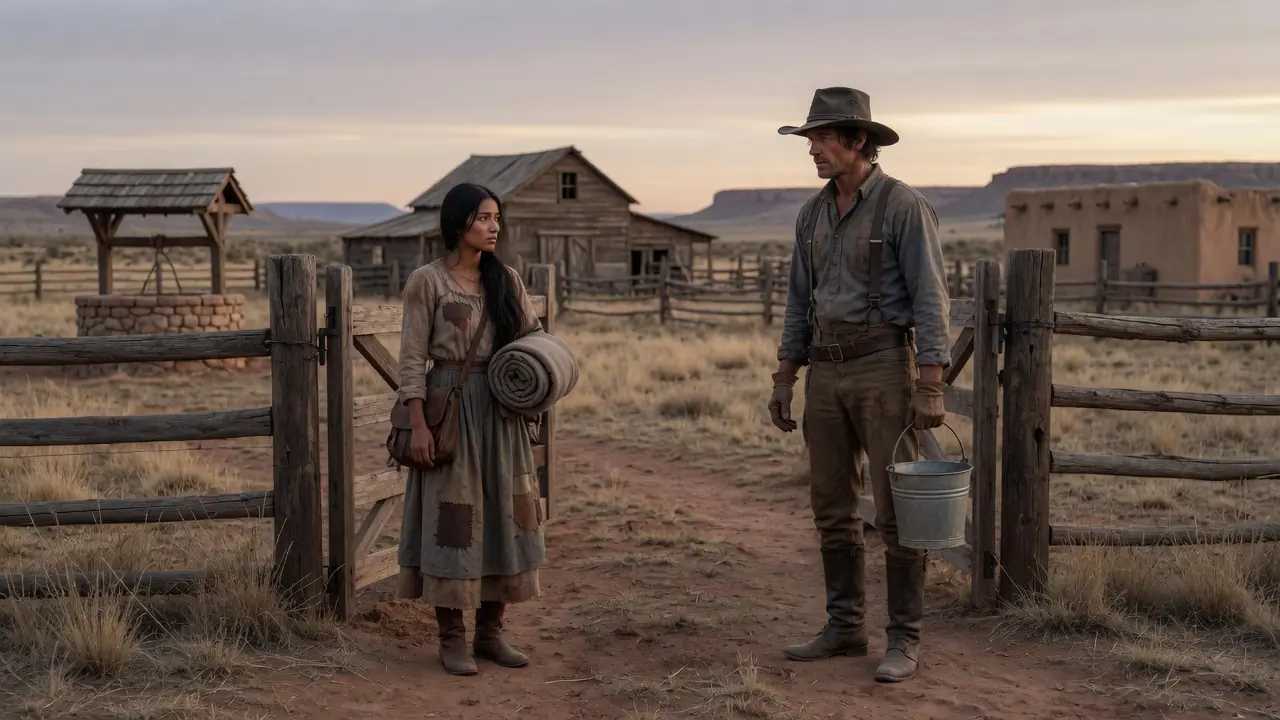
He crossed the yard, boots grinding against the dust, and stopped several feet from the gate.
A young woman stood outside it.
She looked no older than twenty-four. Black hair fell down her back in a long braid tied with a strip of faded cloth. Her cotton dress had been patched by hands that knew patience. Dust covered the hem and clung to her boots. A rolled blanket rested beneath one arm, and a leather satchel hung against her hip.
Beside her stood a bay mare with tired legs and a lowered head.
The young woman did not beg. She did not smile. She simply looked at Ethan through the gate as if she had come too far to be frightened by one more hard face.
Ethan did not open it.
“Who are you?”
She swallowed.
“My name is Ayana.”
“That doesn’t tell me why you’re standing at my gate before sunup.”
She lowered her eyes for a moment, then raised them again.
“My father said you wanted children.”
The words landed with such force that Ethan forgot the wind, the cold, and the gate between them.
For a moment, the past opened like a wound.
A cradle never built.
A small shirt Margaret had sewn by hand and folded away before fever took her.
A house that had once been meant to hold more than one set of footsteps.
Ethan’s jaw tightened.
“Who’s your father?”
“Was,” the young woman said softly. “His name was Kele Running Horse. You knew him as Charlie.”
The name stopped him.
Twelve years earlier, Ethan Carter and Charlie Running Horse had ridden cattle across hard country beneath the same pitiless stars. They had shared coffee boiled black in a dented pot, slept through storms under one canvas, and gone silent together for miles when words had nothing useful to offer.
Charlie had been a quiet man with sharp eyes and a laugh that came rarely, but honestly. He could read weather in the smell of the air and judge a horse’s mood from the twitch of an ear. Ethan had trusted him more than most men he had known.
He had not heard the name in years.
“Charlie’s gone?”
Ayana’s face did not break, but something in her eyes folded inward.
“Three months now.”
Ethan looked away toward the ridge, where sunrise had begun laying a thin gold line along the earth.
The world kept changing, even when a man stopped paying attention.
“He sent you here?”
“He asked me to come.”
She opened the satchel and took out a folded letter. The paper was worn soft at the edges, as if it had been read many times on the road. She pushed it between the bars of the gate.
Ethan took it.
For a long moment, he only stared at the handwriting.
Charlie’s hand had always leaned hard to the right, as if every word were moving toward some destination.
Ethan opened the letter.
Ethan,
If Ayana reaches you, give her one season.
Honest work. Honest pay. Let her choose where to go afterward.
I know what I ask is heavy.
You once told me you wished for a family, and that the chance had passed you by.
I disagreed then.
I disagree now.
Ayana is my daughter in every way that matters. She has my stubbornness, her mother’s quiet fire, and more talent than this world knows how to honor.
She needs a safe place to stand while she decides what kind of life belongs to her.
Do not pity her.
Give her work.
Give her room.
And if your empty house has forgotten how to welcome footsteps, let hers remind it.
Your friend,
Charlie
Ethan read the letter twice.
He lowered the paper slowly.
Ayana remained still.
Behind her, the mare shifted, tack creaking faintly in the morning cold.
“I’m not looking for charity,” Ayana said before he could speak. “I can mend fences, cook, ride, clean harness, patch clothing, and work from dawn until dark.”
“You don’t know this ranch.”
“I’ll learn.”
“You don’t know me.”
“My father did.”
Ethan looked at her sharply.
There was no challenge in her voice. Only truth.
That made it harder to answer.
He looked back at the house.
Seven years had passed since Margaret died.
Seven years since fever swept through the valley like smoke, leaving doors marked with grief and rooms emptied of voices.
Margaret had been thirty-one. She had laughed easily, worked hard, and believed the ranch would one day be filled with children, chickens, noise, and trouble.
Ethan had buried her in spring, when the ground had finally softened enough to receive her.
After that, he had stopped speaking of children.
Stopped thinking of them, too, or tried to.
He folded Charlie’s letter and placed it in his shirt pocket.
“There’s a cot in the back room,” he said.
Ayana blinked once, as if she had expected refusal even after coming all that way.
“Supper comes at sundown,” Ethan added. “Breakfast before first light. Work starts when there’s enough sun to see by.”
Ayana nodded.
“I understand.”
Ethan opened the gate.
The first day passed without softness.
Ayana put her blanket on the cot in the back room, washed her face at the basin, tied her sleeves, and went to work as if she had been born with dust under her nails.
Ethan gave her the tasks he would have given any hired hand he did not yet trust.
Check the south fence.
Haul feed.
Clean the tack room.
Bring in the storm blankets.
She did not complain.
By noon, she had found three weak spots in the fence Ethan had meant to repair for weeks.
By late afternoon, the old well rope no longer caught against the pulley.
By supper, two broken harness straps lay mended on the kitchen table with stitches neat enough to shame a shopkeeper.
Ethan noticed.
He said nothing.
At the table, they traded facts instead of stories.
“North pasture needs checking tomorrow.”
“I checked it after the tack room.”
“Gate holding?”
“For now. The bottom hinge is loose.”
“I know.”
“I can fix it.”
“I’ll fix it.”
She looked at him across the table.
“I can fix it,” she repeated.
Ethan took a drink of coffee and decided not to argue.
The next morning, the hinge was repaired before he finished milking the cow.
That was Ayana’s way.
Quiet.
Steady.
Never asking for praise, never waiting for permission when work needed doing.
She moved through the ranch like someone trying not to claim space she had not yet been offered. She cleaned only what was necessary. Sat only after Ethan sat. Spoke only when spoken to, unless the matter was practical.
But slowly, the house changed around her.
A cracked bowl was mended with wire.
Fresh cloth appeared over the bread.
The kitchen window, long filmed with dust, became clear enough to catch sunrise.
Margaret’s old rocking chair, which Ethan had not touched in years, was wiped clean and moved closer to the hearth.
When Ethan saw it, he stopped in the doorway.
Ayana looked up from kneading dough.
“I can move it back.”
“No.”
He stared at the chair.
“I just forgot it could be used.”
Ayana said nothing, but her hands slowed in the dough.
The silence after that did not feel as empty as the silences before.
On the fifteenth day, the barn ladder slipped.
Ethan had climbed to the loft to shift hay before the weather turned. One rung gave beneath his boot. He reached for the beam, missed, and hit the ground hard enough to knock the breath from his lungs.
The sky spun overhead.
Dust filled his mouth.
For a moment, he could not move.
Then Ayana was beside him.
“Move your fingers.”
Ethan blinked up at her.
“What?”
“Your fingers. Move them.”
He did.
“Now your feet.”
He shifted both boots.
“Good,” she said. “You’re not made of glass.”
He tried to sit up and winced.
“You always talk this sweet to injured men?”
“Only stubborn ones.”
She offered her hand.
Ethan stared at it.
It had been a long time since he had accepted help before he had no choice.
Finally, he took it.
Ayana braced her boots and pulled with surprising strength. Ethan got upright, one hand pressed to his ribs.
“You should rest,” she said.
“I have work.”
“You have bruises. The work will wait.”
“It usually doesn’t.”
“Then today it learns.”
Ethan almost smiled.
Almost.
That evening, the silence around the supper table changed shape.
Not warmer exactly.
But less guarded.
After supper, Ethan carried a chair outside and sat near a small fire. The night spread wide above the ranch, deep and black, covered in stars bright enough to make a man believe the dead had not gone far.
He heard footsteps behind him.
Ayana lowered herself onto the opposite side of the flames.
For several minutes, neither spoke.
Then she looked up at the sky.
“My father said the stars are campfires left burning by the people who walked ahead of us.”
Ethan followed her gaze.
For years, he had looked at the night sky the way he looked at fence posts and weather signs. Something to read. Something to measure.
Tonight, he saw campfires.
“Charlie always talked like that when the coffee was strong,” Ethan said.
Ayana smiled faintly.
“He talked about you often.”
Ethan looked across the fire.
“What did he say?”
“That you were steady.”
The fire cracked between them.
“That you never pretended hard things were easy.”
Ethan lowered his gaze.
“That all?”
“No.”
She drew a small circle in the dirt with a stick.
“He said losing your wife made you quiet in a way even he could not reach.”
Ethan’s fingers tightened on his cup.
Ayana seemed to notice, but she did not apologize.
Charlie would not have.
“Where will you go after this season?” Ethan asked.
Ayana kept drawing circles.
“I don’t know anymore.”
“You knew before?”
“I thought I did.”
“What changed?”
She looked out past the firelight.
“I’m tired of going places where I have to become someone else before they let me stay.”
That answer stayed with him.
Long after Ayana went inside.
Long after the fire sank into coals.
Long after the coyotes called across the flats.
Ethan remained outside, Charlie’s letter heavy in his shirt pocket, staring toward the dark edge of the land where the fences disappeared.
He did not notice the rider on the distant ridge.
The rider stayed just long enough to watch the house.
Then he turned his horse and vanished beyond the rise.
The first time Ethan noticed the drawings, the house had gone quiet after lunch.
Ayana’s satchel rested open on the kitchen table beside folded cloth. He had come in for a hammer and a strip of leather. He had not meant to look.
Then his hand stopped.
Sheets of paper covered the table.
Horses running through canyon dust.
A hawk circling above red cliffs.
The cottonwood beside the well.
The crooked barn.
A coffee cup held in an old man’s hand.
Charlie’s hand.
Ethan picked up the drawing carefully.
The lines were simple but alive. Somehow, with charcoal and patience, Ayana had captured not only the shape of Charlie’s fingers, but the weight they had carried.
Another page showed Ethan’s ranch as seen from the south pasture. The house stood small beneath the wide sky. The barn leaned slightly, just as it did in life. The fence line ran crooked where the ground dipped. She had drawn every flaw and made none of them ugly.
“You weren’t supposed to see those.”
Ethan turned.
Ayana stood in the doorway.
There was no panic in her face. Only quiet acceptance, as if she had been found out and would not waste breath denying what was true.
“You drew these?”
“My father taught me.”
She stepped closer.
“He said if you learn to draw something, you learn to notice it.”
Ethan looked back at the papers.
“You notice things I stopped seeing.”
“That happens when people live beside something too long.”
He set the drawing down with more care than he intended.
“You’re wasting your talent fixing fences.”
“A ranch needs fences.”
“A person needs more than fences.”
For the first time, Ayana looked directly at him with something almost sharp in her eyes.
“A person needs both,” she said. “The fence keeps cattle. The drawing keeps me.”
Ethan had no answer.
That evening passed without another mention of the drawings.
But three days later, Ayana handed him a folded sheet.
“For you.”
Ethan unfolded it.
The well stood in the center. Morning light caught the water spilling from a bucket. His own hands gripped the rope, every weathered line drawn from memory.
Near the water’s reflection, almost hidden beneath careful shading, stood two small figures side by side.
Ethan stared at it.
“You remembered my hands.”
“You use them every day.”
He touched the edge of the paper.
There were men who could carve wood, men who could break horses, men who could shoot bottles off fence posts from fifty yards.
But this was different.
Ayana had taken something ordinary and made it impossible to ignore.
Ethan’s hands had always been tools to him.
In her drawing, they looked like proof that he had survived.
After supper, he found her beside the well.
The sunset had washed the distant hills in copper and rose. Ayana sat with her knees drawn to her chest, her braid over one shoulder, the wind lifting loose strands of hair around her face.
“Ayana.”
She wiped beneath one eye before looking up.
“I need to tell you something.”
Ethan sat beside her without asking.
She stared toward the hills.
“My father left something out of the letter.”
Ethan waited.
“A man named Aldous Rowe controls several land claims east of here. He has papers, influence, and friends in the county office.”
Her hands tightened around the fabric of her skirt.
“He says women like me need documented work attached to established property, or a lawful household willing to claim responsibility.”
Ethan’s jaw tightened.
“What happens if you don’t have it?”
“They send me north.”
“How far?”
“Nearly two hundred miles.”
The answer settled heavily between them.
It was not only distance.
It was exile.
“Why didn’t Charlie tell me?”
Ayana gave a tired smile.
“He wanted you to choose freely.”
Ethan looked at her.
“He didn’t want pity making the decision,” she said.
The well rope creaked softly in the evening wind.
Ethan stared at the drawing still folded in his hand.
He understood Charlie’s final request differently now.
Give her one season.
Honest work.
Honest pay.
Let her choose.
But Charlie had known the world did not always let people choose.
That night, Ethan could not sleep.
Moonlight stretched across the bedroom floor.
Margaret’s memory waited where it always waited, patient and unaccusing.
He thought of the empty rooms.
The supper table with two cups now instead of one.
Ayana’s footsteps before sunrise.
Her quiet voice beneath the stars.
Her drawings spread across the kitchen table, proving the ranch still had lines worth seeing.
Without meaning to, Ethan had begun listening for her.
Without admitting it, he had begun making room.
The realization frightened him.
Not because he did not want it.
Because he did.
Wanting was dangerous after loss.
A man could survive emptiness if he accepted it as the weather of his life. But hope was different. Hope opened doors. Hope asked what might still come. Hope made a man vulnerable to losing again.
Before sunrise, Ethan saddled his horse and rode into Rio Blanco.
Dust rose beneath the hooves as he crossed the flats.
The county office sat beside the mercantile, a square wooden building with a faded flag and two cracked windows. Inside, a clerk named Willis looked up from a ledger.
“Carter.”
“Need to see records tied to Aldous Rowe.”
Willis hesitated.
“That so?”
“That is so.”
The clerk pulled several papers from a shelf.
Ethan read slowly.
Rowe was not lying.
That angered him more than if the man had been. A clean lie could be knocked down. A cruel truth needed harder work.
“What changes it?” Ethan asked.
Willis shifted uneasily.
“Formal employment papers help. Signed contract. Witnesses. Wages recorded.”
“That enough?”
“Maybe.”
Ethan heard what was not said.
“What else?”
The clerk lowered his voice.
“Marriage.”
The word hung in the room.
Ethan walked outside.
He stood in the street for a long moment while wagons passed, horses stamped, and somebody laughed outside the saloon as if the world had not just shifted.
Marriage.
It was not a small word to a widower.
It carried Margaret’s face. Her voice. Her hand in his. The grave beneath the cottonwood ridge.
But it also carried Ayana standing at his gate before sunrise with dust on her boots and Charlie’s last letter in her satchel.
Ethan mounted slowly.
The ride home felt shorter than the ride out.
He found Ayana repairing fence posts near the south pasture. Her sleeves were rolled up. Sweat dampened the hair near her temples. She looked up as his horse approached.
“You’ve been gone all day.”
Ethan climbed down.
“I went into town.”
Ayana rested both hands on the fence rail.
“And?”
“I found out about Rowe.”
Her face became still.
“And?”
Ethan looked toward the house, then back at her.
“I don’t want you to go.”
The hammer slipped from her fingers and landed in the dirt.
Neither moved.
“What does that mean?” she asked quietly.
Ethan removed his hat.
“It means the ranch feels different with you here.”
The wind moved through the dry grass.
“It means I sleep easier hearing another person moving through the house. It means you’ve reminded me this place is still alive.”
He swallowed hard.
“And maybe I am, too.”
Ayana searched his face.
“I came for one season.”
“I know.”
“I don’t know what I am to you.”
Ethan looked at the fence between them.
“Neither do I.”
She looked down.
“But maybe some answers only come after people choose to stay,” he said.
For a long moment, she said nothing.
Then she picked up the hammer.
“I’ll think about it.”
The fence remained unfinished between them.
Far beyond the pasture line, three riders appeared briefly atop a distant ridge before disappearing behind rolling hills.
This time Ethan saw the dust.
He said nothing to Ayana.
But that evening, he cleaned his rifle and set it behind the kitchen door.
Rowe arrived on Thursday.
He brought two men with him, hard-faced riders who sat their horses like they enjoyed being mistaken for law.
Dust rolled behind them as they entered the yard.
Ethan was repairing the barn door.
Ayana stood beside the well.
Aldous Rowe dismounted first. He was tall and narrow, dressed too finely for the dust he rode through. His beard was trimmed close, his gloves clean, and his eyes went straight past Ethan toward Ayana.
That alone told Ethan everything.
“The season ends tomorrow,” Rowe said.
Ayana’s shoulders stiffened.
“The arrangement here isn’t official.”
Rowe unfolded a paper.
“County records won’t recognize it.”
Ethan stepped away from the barn door.
Ayana lifted her chin.
“I understand.”
“You’ll come with us.”
“No.”
The word came from Ethan.
Flat.
Certain.
Rowe turned his head.
“This doesn’t concern you.”
Ethan wiped dust from his palms.
“She’s staying.”
“You don’t decide that.”
“Actually,” Ethan said, “I do.”
The two men beside Rowe shifted uneasily.
Rowe studied him.
“Under what authority?”
Ethan felt his heartbeat hammer once against his ribs.
He had rehearsed nothing.
No speech.
No explanation.
No graceful way to cross the distance between what he feared and what he knew.
He looked toward Ayana, then back at Rowe.
“Because she’s my intended.”
Silence followed.
Even the horses seemed to still.
Ayana stared at him.
Rowe blinked once.
“You’ll need proof.”
“You’ll have it.”
Rowe’s mouth tightened.
“That kind of claim should not be made lightly.”
“I don’t make light claims.”
For a moment, Ethan thought Rowe might push further.
Then the man folded the papers.
“You have until week’s end.”
He climbed back onto his horse.
The three riders turned and disappeared down the trail.
Only when they were gone did Ethan breathe.
He turned.
Ayana remained beside the well, her face unreadable.
“You should have asked first.”
“I know.”
“You announced an engagement before discussing it.”
“I know that, too.”
A long pause stretched between them.
Then quietly, she said, “Ask me now.”
Ethan looked around the ranch.
The repaired fence.
The weathered barn.
The house that had begun to hold light again.
Nothing about the moment resembled the proposals sung about in town. No polished words. No flowers. No kneeling before a crowd.
Only truth.
“I’m not easy,” Ethan said.
Ayana did not interrupt.
“I’ve spent years alone. I don’t always know what to say. I still speak to Margaret in my thoughts sometimes.”
He looked down at his rough hands.
“I don’t know how to promise grand things.”
His voice lowered.
“But I can promise this. I’ll notice when you’re tired. I’ll remember how you take your coffee. I’ll listen when you speak. I’ll see you every day.”
He lifted his eyes.
“And I don’t want to stop.”
Ayana watched him quietly.
Wind brushed strands of dark hair across her cheek.
“My father said you were stubborn.”
“He wasn’t wrong.”
“He also said you were good.”
“He exaggerated.”
The corner of her mouth lifted, barely.
“No,” she said. “I don’t think he did.”
Ethan waited.
“I came here for one season.”
“I know.”
“I expected work.”
“I know.”
“I didn’t expect this.”
“Neither did I.”
Ayana looked toward the hills beyond the ranch.
“My father believed people deserved second beginnings.”
“He did.”
“He also believed children should grow where they’re wanted.”
Ethan’s throat tightened.
For years, that thought had remained locked away, untouched and hidden.
“My father told me something before he died,” Ayana said softly. “He said wanting something again doesn’t erase what came before.”
Ethan closed his eyes briefly.
“It honors it,” she finished.
When he opened his eyes, Ayana still stood there waiting.
“I think,” she said carefully, “my answer is yes.”
For a moment, neither moved.
Then Ethan reached for her hand.
She let him.
They married six days later at the Rio Blanco courthouse.
Mrs. Galvin, who ran the boarding rooms, dabbed at her eyes with a handkerchief and pretended the dust had caused it. Judge Bell smiled through the entire ceremony. Willis the clerk signed as witness. Doyle, the blacksmith, stood in the doorway and nodded once with solemn approval, as if he had personally inspected the union and found it structurally sound.
Ayana wore a simple blue dress Mrs. Galvin had insisted on lending her.
Ethan wore the black coat he had not taken from the cedar chest since Margaret’s burial.
Before leaving the ranch that morning, he had stood alone by Margaret’s grave beneath the ridge.
He had not asked permission.
Margaret had never belonged to him in that way.
Instead, he spoke honestly.
“I am not forgetting you,” he said into the morning quiet. “I am trying to live the life you wanted for me.”
The wind moved softly through the grass.
That was answer enough.
After the wedding, life did not turn suddenly easy.
Nothing honest ever did.
Ayana had to learn what it meant to live in a house with a man who sometimes went quiet without warning.
Ethan had to learn that another person’s presence was not an invasion.
There were awkward mornings and uncertain evenings. There were moments when Ayana reached for help and Ethan offered solutions instead of listening. There were moments when Ethan withdrew into memory and Ayana mistook it for regret.
But they kept choosing.
That was the difference.
One choice did not make a marriage.
A hundred small ones did.
He learned that she liked coffee with a little milk when the morning was cold.
She learned that he checked the south fence whenever he was troubled.
He learned not to touch her drawings unless she handed them to him.
She learned that Margaret’s chair could remain near the hearth without haunting the room.
The ranch changed slowly.
A garden appeared east of the house, with beans, squash, onions, and desert flowers Ayana insisted would survive if Ethan stopped doubting them.
The barn roof finally stood repaired.
Fresh curtains hung in the kitchen windows.
A shelf near the hearth began filling with drawings: the well, the mare, Ethan repairing a gate, the cottonwood in winter, the courthouse, Charlie’s hands.
One day, Ethan found a new drawing on the table.
It showed the ranch house at dusk.
Light glowed in every window.
Two figures stood on the porch.
A third shadow, smaller and not yet formed, seemed to wait behind them in the doorway.
Ethan stared at it for a long time.
When Ayana came in, he did not ask.
He only looked at her.
She looked back, and something unspoken passed between them.
Spring came early that year.
The desert did not become soft, exactly, but it became less severe. Wildflowers appeared in small brave patches along the fence line. The air warmed. The mare gained weight. The garden took root.
One morning, Ethan stood at the well pulling water.
The rope moved smooth through the pulley now, repaired by Ayana’s hands months before.
Footsteps approached behind him.
Ayana rested a hand lightly against his arm.
“There will be another pair of footsteps soon.”
Ethan frowned slightly.
“What do you mean?”
She guided his rough hand to her stomach.
The bucket slipped from his fingers.
Water splashed over stone and spread into the thirsty earth.
Ethan stood perfectly still.
He had thought the doors in that part of his life had closed forever. He had built walls around the empty rooms and buried the keys beneath work, silence, and habit.
Now life stood before him beneath the New Mexico sky, asking to enter again.
Ayana watched his face with tears in her eyes.
“If you’re afraid,” she whispered, “say so.”
Ethan looked at his hand against her.
“I am.”
“Me, too.”
He crossed the small distance between them and wrapped his arms around her carefully.
Not because he feared breaking her.
Because he understood the weight of what they carried now.
Ayana leaned into him, fingers closing around his shirt.
For a long while, neither spoke.
Nearby, the old cottonwood stirred beneath a warm breeze.
Overhead, a hawk circled patiently above the open land.
The ranch no longer sounded empty.
The wind carried different music now.
A porch swing creaking at sunset.
A woman humming in the kitchen.
A man laughing before he could stop himself.
A child not yet born, already changing the shape of every tomorrow.
Months passed.
Ayana’s belly rounded beneath her dresses.
Ethan became careful in a way that made her laugh and sometimes roll her eyes. He tried to carry every bucket, lift every basket, and prevent her from climbing anything taller than a step. She reminded him often that she was expecting a child, not turning into porcelain.
He apologized.
Then tried to do the same thing again the next day.
In late autumn, when the nights sharpened and the stars seemed closer than ever, their daughter was born in the back room where Ayana had first placed her rolled blanket.
Mrs. Galvin came from town with hot water, clean cloth, and the commanding tone of a woman who had delivered enough babies to outrank every man in the county.
Ethan waited outside on the porch, hat crushed between his hands, listening to every sound from inside the house with his heart in his throat.
Then, just before dawn, he heard the cry.
Small.
Fierce.
Alive.
Mrs. Galvin opened the door.
“You can come in now, Carter.”
Ethan entered as if stepping into church.
Ayana lay against the pillows, exhausted and radiant, holding a tiny bundle against her chest.
“She has your frown,” Ayana whispered.
Ethan looked down.
The baby’s eyes were squeezed shut. Her mouth trembled. One small fist waved angrily against the blanket.
His knees almost gave.
“What’s her name?” Mrs. Galvin asked.
Ayana looked at Ethan.
He understood.
“Margaret,” he said softly.
Ayana smiled.
“Margaret Rose Carter.”
Ethan bent his head.
For the first time in years, Margaret’s name did not feel like grief alone.
It felt like blessing.
Three months later, a letter arrived from Rio Blanco.
Ethan opened it while Ayana sat at the kitchen table feeding the baby.
Inside was an official notice.
Aldous Rowe’s land claim authority had been challenged. Three families had come forward with complaints. Willis the clerk had quietly copied records. Judge Bell had reviewed them. Rowe’s influence was collapsing.
Ayana read the notice after Ethan handed it to her.
Her expression remained calm, but her fingers tightened on the paper.
“It’s over?” she asked.
“For us, it already was.”
She looked up.
“For others?”
Ethan nodded toward the baby.
“Maybe it’s beginning.”
Ayana folded the notice carefully.
That winter, the Carter ranch became a place travelers knew they could stop.
Not loudly.
Not officially.
But word traveled.
A widow needing work stayed two weeks and left with wages and a horse blanket.
A boy from a distant settlement slept in the barn after losing his way and left with bread, directions, and a sketch Ayana made of his mule.
Two sisters heading west spent a night in the back room and cried at breakfast because no one had asked them to pay before letting them eat.
Ethan never said they were building something.
Ayana knew they were.
One evening, when Margaret Rose was nearly walking, Ayana sat by the fire with charcoal in hand. Ethan sat across from her, mending a bridle.
The child slept in Margaret’s old rocking chair, bundled beneath a quilt.
Ayana looked up.
“Do you remember what I said the first morning?”
Ethan’s mouth twitched.
“You said your father told you I wanted children.”
“And you looked like I had shot at you.”
“You nearly did.”
She smiled.
“I thought you would send me away.”
“I almost did.”
“Why didn’t you?”
Ethan looked toward the sleeping child, then at the drawings on the shelf, then at Ayana’s face in the firelight.
“Because Charlie knew me better than I knew myself.”
Ayana’s eyes softened.
“And because you opened the gate.”
Ethan set the bridle aside.
“Yes,” he said. “Because I opened the gate.”
Years later, people in Rio Blanco would tell the story differently depending on who was speaking.
Some said Ethan Carter married out of duty and found love afterward.
Some said Ayana Running Horse arrived with nothing but a satchel and saved a dying ranch.
Some said Charlie’s ghost had guided her there.
Some said old grief finally got tired of guarding the door.
Ethan never corrected any version.
He knew the truth was simpler and deeper.
A dying friend had written a letter.
A young woman had ridden through dust before sunrise.
A lonely man had opened a gate.
And from those small acts, a family had grown where silence once lived.
On quiet mornings, Ethan still stood by the well before first light.
Sometimes Ayana joined him with Margaret Rose on her hip, the child pointing at birds and asking questions neither parent could answer quickly enough.
Sometimes Ethan would glance toward the gate and remember the girl who had stood outside it with dust on her boots and courage in her eyes.
Ayana would catch him looking.
“What are you thinking?”
He would smile faintly.
“That life can change between one breath and the next.”
She would shift their daughter higher on her hip.
“And?”
“And sometimes trouble does ride in before daylight.”
Ayana laughed softly.
“Was I trouble?”
Ethan looked at his wife, his child, the house full of light behind them, the fences repaired, the garden waking, the future no longer feared.
“The best kind,” he said.
The sun rose over the New Mexico hills.
Water spilled into the bucket.
The cottonwood leaves moved in the morning wind.
And the ranch that had once been empty listened to the sound of footsteps, laughter, and a child calling for her father across the yard.
Ethan Carter had believed his chance for a family was buried with the woman he lost.
But love, like desert rain, sometimes returns after long drought.
Not always the way a man expects.
Not always the way he planned.
But when it comes, it asks the same question every time.
Will you open the gate?