His weathered hands hung at his sides, his tools forgotten, while his eyes traced the lines of our John Deere Model B as if he were seeing it for the first time, or maybe seeing a ghost. The machine looked different because it was different, and I had made sure of that.
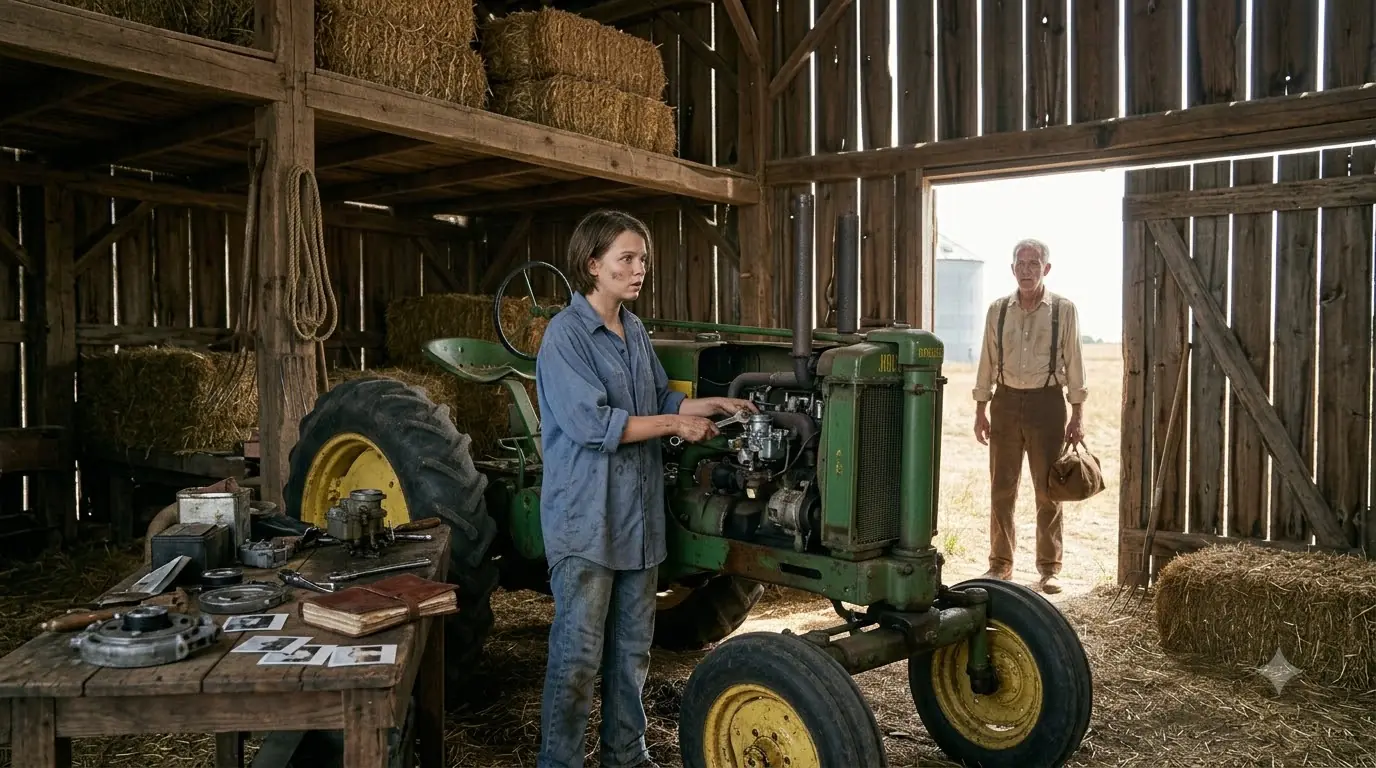 Three weeks earlier, I was nobody. I was just Marigold Hartwell, fifteen years old, too tall and too clumsy, the girl who wore her dead father's work shirts because the pockets were deep enough for wrenches.
I was the girl whose hands always carried the smell of machine oil, no matter how hard Grandma Lorelei made me scrub before supper. I was the girl the other students at Oak Ridge High whispered about when they thought I could not hear. But I am getting ahead of myself. To understand why Grandpa stood there as if the ground had opened beneath him, you need to know about that Sunday in late July when everything started to crack.
The Hartwell farm sat on sixty acres of Kansas flatland, where the horizon stretched so far that you could watch tomorrow coming at you across the wheat fields. Our house wore white paint that had given up fighting the sun years ago, turning gray and peeling in long strips that curled like wood shavings. The barn held its red color better, though rust ate at the tin roof in one corner where Grandpa kept meaning to patch it. We had lived through worse than peeling paint.
The drought of 1966 had killed forty percent of our crop and left the soil cracked and mean. We owed $3,800 to First National Bank of Oak Ridge, due September 15, only six weeks away. Grandma kept a ledger in the kitchen drawer, her careful handwriting tracking every penny we had left. The total was $127.50, nowhere near enough. But the real heart of everything, the machine that kept us alive or would kill us trying, was the John Deere Model B sitting in the barn. Its green and yellow paint had faded into ghosts of the original colors. Grandpa had bought it used in 1946 when he came back from the war. It had given us twenty-one years of plowing, planting, and harvesting, twenty-one years of keeping us fed.
Grandpa Augustus "Gus" Hartwell did not talk much about the war, or about anything else. He was sixty-eight years old, tall and lean as a fence post, with skin darkened by decades beneath the Kansas sun. He moved through the world as if he were trying not to disturb it, as if staying quiet enough might keep bad things from noticing him. The only thing he ever said about fighting in Europe was, "Equipment you can trust saves lives. Learned that at Normandy."
Then his jaw would set, and the conversation was over. Every evening at six, he walked to the barn and spent an hour with the tractor. He checked the oil, greased the fittings, and ran his hands over the belts and hoses. It was like watching someone perform a religious ritual. Maybe it was one. Maybe that machine was the only God he still believed in after whatever he had seen in France. The tractor meant even more after 1960, after we lost my father. Jasper Hartwell was twenty-five when he died, and I was eight. The details lived in the spaces between what people would tell me, in the way adults edited their sentences when I walked into rooms. "An accident," they said. "The tractor," they said. "Quick," they said, as if that made it better. Grandpa never talked about it at all. He only became quieter, spent longer hours in the barn, and held his tools as if they might slip away if he loosened his grip.
Grandma Lorelei was the spine that held our crooked house upright. She was sixty-six, with silver hair always pinned in a neat bun and aprons patterned with tiny flowers that she had sewn herself. She managed every dollar like a general deploying troops. Her ledger was thick as a Bible and twice as sacred. She knew exactly where we stood: $3,847.23 in debt, $127.50 in the bank, and $43 a month for insulin. Diabetes had caught up with her five years earlier. The doctor had called it Type 2 and handed over prescriptions we could barely afford. Sometimes Grandma skipped meals to save money and thought I did not notice. I saw how she portioned out smaller servings for herself, claiming she was not hungry while Grandpa and I ate. I saw everything. She was the one who taught me to think before acting, to measure twice and cut once, all those old sayings that sounded simple until you stood in the middle of a decision that could wreck everything.
"Goldie," she would say while sitting across from me at the kitchen table as I did homework, "being smart is not knowing what to do. It is knowing when not to do something." I should have listened better. My full name was Marigold Hartwell, after the flowers my mother loved. Most people called me Goldie. I was fifteen that summer, five feet four, skinny in a way that made me look breakable even though I could carry feed sacks that made grown men grunt. My hair was brown with blond streaks from the sun, cut short because long hair got caught in machinery. Grandma hated the haircut and said I looked like a boy. Maybe I did, but I did not care much about looking like the other girls at Oak Ridge High. They wore patterned dresses and shoes with small heels, and they talked about Beatles albums and which boys had the nicest cars. I wore oil-stained jeans, my father's old work boots, and read Popular Mechanics the way other girls read romance novels. The other girls thought I was strange, and they were not wrong. While they learned to curl their hair, I took apart alarm clocks to see how the gears meshed. While they practiced walking in heels, I learned to read engine compression by sound alone. I did not have friends at school, only Iris, my sister, and she was barely around anymore. Iris Hartwell was everything I was not. She was twenty, beautiful in the effortless way some people are, with blond hair that actually stayed where she put it. She had graduated from nursing school two years earlier and worked at Mercy Hospital, forty miles away in Junction City. She made eighty dollars a week and sent home whatever she could spare after rent and gas. We were opposites, but she never treated me as if I were defective for being different. "You do not need to be like everyone else," she told me during her weekend visits. "You only need to be yourself." It was easy for her to say. She fit in everywhere. My father had taught me to hold a wrench and to feel the exact pressure needed to tighten a bolt without stripping the threads. He explained that engines were only metal put together in the right order, nothing to fear. "Goldie," he had said more than once, "it does not matter whether you are a girl or a boy when it comes to mechanics. Metal does not care. It only needs someone who understands it, so do not let anybody tell you different." After he died, I kept learning on my own. I spent seven years reading library books and magazine subscriptions paid for with birthday money, and taking apart anything people allowed me to touch. I fixed bicycles for neighbors, lawn mowers, and small engines. They paid me a dollar or two, or sometimes gave me a pie or a jar of preserves. There was one machine I had never been allowed to touch. The John Deere was Grandpa's territory, sacred ground. I could watch him work on it and hand him tools, but my hands never went near the important parts. That boundary had never been stated because it did not need to be. Mrs. Dorothea "Dottie" Finch lived alone in a small house on the edge of Oak Ridge, surrounded by welding equipment and metal stock. She was fifty-eight and had been widowed since 1963, when her husband's heart gave out. Dottie was the only welder within fifty miles, and she was a woman. The men in town did not like that. They made comments about women doing men's work and said it was not natural. When their equipment broke, however, they came to her because she was better than any man they could find. She fixed their problems, charged fair rates, and watched them pay while looking at their feet. I started helping her when I was thirteen. I cleaned her house, cooked meals, and did laundry. In exchange, she taught me to weld. She taught me not only how to strike an arc and run a bead, but how to understand what the metal was doing, how heat changed its structure, and where strength lived in a joint. "Welding is not about melting metal together," she would say with her face shield raised. "It is about understanding what the metal needs. Listen to it, feel it, and respect it." She had been teaching me for two years. I became good enough that she sometimes allowed me to handle small jobs while she supervised. But she warned me early, "Never practice on something you cannot afford to lose. Do you understand me? Never." I nodded, agreed, and meant it at the time. Sunday, July 23, 1967, started like most Sundays. We went to church in the morning, ate Grandma's pot roast for lunch, and let the afternoon stretch lazy and hot. Then Iris drove up in her Ford Falcon, dust trailing behind her on the gravel road. She came inside carrying worry in her shoulders, the kind of tension that meant bad news was coming. "The hospital raised the price of insulin," she said as she sat at the kitchen table and Grandma poured iced tea. "They need another two hundred dollars this month." Grandma did not say anything. She sat down, opened her ledger, and ran her finger down the columns of numbers. Her face stayed neutral, but I saw her hand shake before she closed the book. Two hundred dollars was money we did not have and would not have. The math was simple and cruel. Around three that afternoon, another engine came up the driveway. It was not the familiar rattle of a neighbor's truck, but something newer and smoother. I looked out the window and saw Weston Caldwell's red Jeep. West was sixteen, one year older than me. His father, Nathaniel Caldwell, owned four hundred acres on the other side of Oak Ridge, the biggest farm in the county. They had five new tractors, a white two-story house that looked as if it belonged in a magazine, and a black Mercedes sedan Nathaniel drove to church on Sundays. West climbed out of his Jeep wearing clean jeans and a polo shirt, looking as if he had never touched dirt in his life. He wandered over to where Grandpa was checking fence posts. "Saw your old Model B in the barn," he said loudly enough for me to hear from the porch. "My dad says tractors that old belong in museums. Says it is a wonder yours still runs." Grandpa did not answer and kept working. West looked over, saw me standing there, and his grin widened. "Oh, right, you are a girl. You probably do not understand much about machinery anyway, do you?" My hands curled into fists, but I stayed quiet. I watched him climb back into his Jeep and drive away, dust rising behind him like an insult. That night I could not sleep. I lay in bed listening to the house settle and to crickets outside my window. Around eleven, I heard voices from the kitchen. Grandpa and Grandma were talking quietly. I crept to my bedroom door and opened it just enough to hear. "Lorelei, we do not have the money," Grandpa said. "I know, Gus. The bank note is due in six weeks. We cannot make it." Silence followed, long enough that I thought the conversation might be over. Then Grandma spoke so quietly I almost missed it. "Maybe we should consider selling the farm." More silence followed. Then I heard something I had never heard before, Grandma Lorelei crying. Not loudly or dramatically, just small, broken sounds that made my chest hurt. I closed my door, sat on my bed, and stared at the wall. Something had to change. We needed money. We needed the farm to produce more, faster and better. We needed that old tractor to work as if it were worth something. Maybe I needed to prove something, too. I wanted to prove West Caldwell wrong. I wanted to prove that being a girl did not make me useless. I wanted to prove that my father had been right when he said I could do this work. The idea started forming then, though I did not fully recognize it yet, only a whisper in the back of my mind asking, What if? The next morning, I went into the attic. We kept most of my father's belongings there, boxes and trunks nobody had the heart to sort through. I dug through them until I found an old leather journal, its cover worn soft with age. Inside was my father's neat, careful handwriting, the letters slanting slightly to the right. I flipped through pages of notes about crops, weather, and expenses. Then I found an entry dated June 15, 1960. "Today I tried to modify the carburetor on the John Deere. I thought I could increase horsepower by twenty percent if I changed the fuel mixture and airflow. I was wrong. I failed completely and nearly destroyed the engine. Dad was furious and said I was reckless." "Maybe he was right, but someday someone will figure out how to make these old machines work better. Maybe it will be Goldie, my smart girl. She will be better than I was." The page was dated three weeks before he died. I sat in the dusty attic holding my father's journal and cried, not only because he was gone, but because he had believed in me. He had written it down and left it there like a message he knew I would eventually find. He thought I could do this. That was when the idea stopped being a whisper and became a plan. For the next six weeks, I prepared. Every day after my chores, I rode my bicycle three miles into town to the library and checked out books on internal combustion engines, carburetor design, and exhaust systems. The librarian, Mrs. Patterson, started setting aside books she thought I would like. I filled notebooks with diagrams and calculated airflow rates, fuel ratios, and compression changes. I drew forty-seven versions of a possible carburetor modification that could increase the tractor's power without sacrificing reliability. Before touching the John Deere, I needed to test my ideas. Dottie had an old engine in her workshop, pulled from her late husband's truck, dead and useless and perfect for experimentation. I worked on it three times. On the first attempt, I forgot to torque a bolt properly, and the whole assembly rattled apart when I tried to run it. On the second, I welded a bracket at the wrong angle, and the metal cracked under stress. The third time, everything held together. The modified carburetor pulled more air, mixed the fuel more efficiently, and ran more smoothly than the original design. Dottie found me in her workshop that afternoon, grinning at a greasy engine that actually worked. "What exactly are you planning to do with all this knowledge?" she asked. Her voice was not angry, only curious and perhaps concerned. "Just learning," I said. She looked at me for a long moment, her eyes sharp behind her safety glasses. She knew I was lying, but she did not press. The opportunity came in late August. Grandpa's cousin Temperance, who lived in Kansas City, fell and broke her leg. Grandpa needed to drive there and help make sure she had everything she needed. "Four days," he said. Iris volunteered to travel with him and assist with the nursing care. Grandma Lorelei had to drive to Springfield, two hours away, to buy insulin and meet with a bank about extending our loan. The local bank had turned us down, and Springfield was our last chance. She would be gone for two days. That meant I would have the farm to myself for forty-eight hours. The night before they left, I lay in bed reviewing my plan. Every step was memorized, every tool accounted for, and every possible problem anticipated. I thought about what my father had written. I also thought about Dottie's warning never to practice on something I could not afford to lose, and Grandma's lesson that being smart meant knowing when not to do something. Then I thought about Grandma crying in the kitchen. I thought about money we could not pay, West Caldwell's smug face, and my father's belief that I could do this. If we did not try something different, we would lose the farm anyway. At least this way, if I succeeded, we would have a chance. I got out of bed, went to my desk, wrote a list of everything I would need, checked it three times, and put it in my pocket. I would start the next morning, Tuesday, August 29. They left before sunrise, Grandpa's truck heading north toward Kansas City and Grandma's car heading east toward Springfield. Iris rode with Grandpa. I waited until both vehicles disappeared from sight, then walked to the barn. The John Deere sat in its usual place, morning light slanting through gaps in the walls and dust floating in the beams. It looked smaller than I remembered, or maybe I had grown. My heart hammered against my ribs, and my hands shook. This was the moment. Start or walk away. Change everything or leave it alone. I pulled out Iris's Polaroid camera, which she had left on the kitchen counter, and photographed the carburetor from every angle, every hose connection, every wire, and every bolt. I took twenty-three photographs. Then I opened my notebook and began sketching, adding measurements and notes in the margins. Documentation mattered. If something went wrong, I needed to know exactly how to put the tractor back the way I had found it. The carburetor came off more easily than I expected. I had watched Grandpa remove it dozens of times for cleaning, and my hands knew the movements even while my mind screamed that this was wrong, forbidden, and a violation of the family's sacred machine. The bolts turned, the fuel line disconnected, and the whole assembly lifted free. I placed it carefully on the workbench. That piece of metal had been mixing air and fuel for twenty-one years, keeping my family fed, housed, and alive. The new carburetor I had ordered from a catalog waited in my toolbox. It had a larger venturi, better atomization, more precise fuel metering, and a modern design that would allow the engine to breathe properly. When I tried to install it, however, I found a problem. One mounting bolt had rusted solidly into the engine block. I spent two hours trying every tool in the barn, but it would not move. I needed help and equipment I did not have. That meant going to Dottie Finch. I rode the three miles to her house under the hot August sun, my shirt sticking to my back. She was in her workshop, torch in hand, working on something for a customer. "I need to borrow a heavy-duty impact wrench," I said. She raised her face shield and looked at me. "What are you working on, Goldie?" I did not answer because I could not make myself say it aloud. Her eyes narrowed. "You are touching the John Deere, are you not?" My silence was confession enough. "That is the stupidest thing you have ever tried to do." "I know," I said, and my voice came out stronger than I felt. "But I have to try. I have to prove I can." Dottie set down her torch and pulled off her gloves. Her face hardened. "Prove it to whom? That Caldwell boy, your grandfather, or yourself?" "All of them." She shook her head. "You understand what happens if you ruin this. That tractor is all your family has. You break it, and they lose everything." "I know." "And you are still going to do it." "Yes." She stared at me, and I stared back. Neither of us blinked. Finally, she sighed. "If you are determined to do something this insane, at least do it properly. I am coming with you." We worked together for the rest of Tuesday and all of Wednesday. The impact wrench freed the rusted bolt, and the new carburetor installed cleanly. Dottie checked every connection I made and caught two mistakes before they became problems. The exhaust modification was more difficult. I had designed a new manifold that would reduce back pressure and allow the engine to expel waste gases more efficiently. Welding it required precision I had not yet mastered. My first attempt cracked. Dottie made me grind it down and start over. "Wrong angle. The heat is not distributing evenly. Try again." The second attempt cracked as well. "Too much heat this time. You are burning through. Control your torch." The third attempt took four hours. My hands ached, my back hurt from bending over the work, and sweat ran into my eyes. The weld held. It formed a perfect bead with even heat distribution and a strong joint. Dottie inspected it with a critical eye, running her fingers along the metal. "That will do." Wednesday evening, we finished installing the air intake system. Every part was in place, and every connection was tight. "Rest tonight," Dottie said. "Tomorrow we test it." I could not rest. After she left, I returned to the barn and checked every bolt, wire, and hose connection again, looking for any missed mistake waiting to destroy everything. At 10:15, the telephone rang inside the house. I ran to answer it. "Goldie, it is Iris. I am calling to let you know Grandma is coming home early. Tomorrow afternoon, around four." My stomach dropped. "Early? Why?" "The bank in Springfield is closed tomorrow for a holiday. She got her business done today, so she is driving back." I looked at the clock. It was 10:16. Grandma would be home in less than eighteen hours. The tractor had not been tested or proven. I needed at least a day to run it, make sure everything worked, and adjust whatever needed adjusting. "Goldie, are you there?" "Yes. Thank you for telling me." I hung up and sat on the kitchen floor, staring at nothing. Dottie was still outside loading tools into her truck, so I went to tell her. "We will have to work through the night," she said. She stayed with me and kept me going when exhaustion made my hands clumsy. We drank coffee she made on Grandma's stove, bitter and strong enough to strip paint. Around three in the morning, while waiting for the engine to cool before making final adjustments, Dottie told me a story. "My husband did something like this once. He fixed my father's truck without asking permission because he was trying to prove he was worthy of me." "Did it work?" "The truck? No. He made a mess of it, but I married him anyway. We had twenty-eight years together before his heart gave out." She smiled, looking at something I could not see. "Sometimes the bravest thing is not succeeding. Sometimes it is trying at all." By five Thursday morning, the modifications were complete. Everything had been checked twice and was ready. It was time to learn whether any of it worked. I climbed onto the John Deere's seat. The metal felt cold despite the August heat. My hands found the key, and I took a deep breath. I pressed the starter button. The engine turned over once, then twice, and nothing happened. Panic flooded through me. I had broken it and killed the only machine keeping my family alive. Dottie leaned in and checked the connections. She found a loose wire I had somehow missed. "Here. Try again." I turned the key and pressed the starter. The engine turned three times, then four. It roared to life with a sound I had never heard from it before, deeper and stronger, as if something sleeping had finally awakened. I sat there feeling the vibrations through the seat and listening to the engine sing in a voice that was familiar but transformed. "Now we test it," Dottie said. I drove the tractor out of the barn into the Thursday morning sunlight. The engine pulled smoothly and responded to the throttle as if it had waited all these years to run properly. This was going to work. It had to. For the next hour, I ran the tractor through every test I could imagine. I drove it around the property boundaries, up the slight incline behind the barn, and through the soft dirt near the irrigation ditch. The engine never faltered, coughed, sputtered, or showed weakness. Dottie watched from the fence line, arms crossed and face unreadable. Around noon, I heard another engine with a lighter pitch. My heart seized when I recognized Iris's Ford Falcon coming up the driveway. She was not supposed to return until the following day. None of them were. I killed the tractor and climbed down. Iris parked near the house and got out slowly, her nurse's uniform wrinkled from the long drive. She looked tired, then looked at me, and then at the barn. Her eyes widened. She walked toward me with steps that became faster and angrier until she was almost running. She pushed past me into the barn and stopped when she saw the tools scattered across the workbench, the old carburetor in pieces, and oil stains on the concrete floor. "What did you do?" Her voice came out small and tight, as if she feared the answer. "I improved it. I made it stronger." Iris spun around, her face pale. "You took apart the tractor. Our tractor, the only machine keeping this farm alive." "I can explain." "Explain what? That you experimented on the one piece of equipment we cannot afford to lose?" Dottie stepped into the barn. "Iris, listen to her." But Iris was not listening. She looked between me and Dottie as understanding dawned. "You helped her. You knew what she was doing, and you helped." "The girl needed supervision. I was not going to let her kill herself alone." Iris covered her face with both hands. When she lowered them, her eyes were wet. "Do you have any idea what Grandpa will do when he finds out? Do you understand what this will do to him?" The words hit harder than I expected. I had not considered Grandpa's reaction beyond hoping he would be impressed. I had not thought that seeing his precious tractor changed might hurt him in ways I could not predict. "It works, Iris. It works better than before. Let me show you." Iris wiped her eyes with the back of her hand. "One day. You have one day to prove it. If there is any problem, anything at all, you tell Grandpa the second he gets home. Promise me." "I promise." She looked at me for a long moment, nodded, and walked back toward the house. Her shoulders shook as if she might be crying. Dottie touched my arm. "Show me what it can do. For real this time." The south field behind the house covered forty acres. It was mostly flat except for a gentle rise at the far end. We had kept it fallow that year to let the soil rest, but it made good testing ground. I hitched up our heaviest plow, the five-blade monster that always made the old tractor struggle. It used to take Grandpa most of a day to work through half the field with that implement. I started the engine, engaged the transmission, and felt the tractor dig in and pull. The plow cut through the earth like soft butter. The engine maintained steady revolutions without bogging down or straining. I could shift into a higher gear than we had ever used with that load. Dottie stood at the field's edge, watching. After twenty minutes, she waved me over. "Take a break. You are grinning like an idiot." I shut down the engine and climbed off. My hands shook from adrenaline rather than fatigue. "It is working. It is actually working." "So far," Dottie said. "Working for twenty minutes and working for twenty years are different things." Iris came from the house carrying two glasses of lemonade and handed one to me and one to Dottie. She had stopped crying, but her eyes were still red. "How much have you done? About two acres?" She studied the clean furrows and the tractor sitting there as if resting instead of exhausted. "That would have taken Grandpa all morning." "I know." She took a long drink of lemonade. "Be careful. Please." I returned to work and plowed for another hour. The sun climbed higher, and the heat built until sweat soaked through my shirt, but the tractor kept pulling and proving that everything I had done was right. At the far end of the field, I needed to turn around. It was a wide arc with plenty of room, nothing complicated. I had made that turn a hundred times on smaller equipment, but I forgot something crucial. This was no longer the old tractor. It was stronger, faster, and more responsive than my muscle memory expected. I gave it too much throttle coming out of the turn. The rear wheels, already stressed from pulling the heavy plow through resistant soil, lost traction. The machine lurched sideways. I yanked the steering wheel to correct, but momentum had other ideas. The tractor slewed toward the irrigation ditch and picked up speed. I hit the brakes too late. We went over the edge, not flipping, thank God, but sliding hard down the embankment. The tractor tilted at a forty-five-degree angle and threatened to roll, but somehow remained upright. Metal screamed, and something underneath struck the rocks. Then we stopped, wedged in the ditch at an angle that made my stomach hurt to see. I killed the engine with shaking hands and climbed out carefully, trying not to shift the tractor's weight. My legs barely held me when I reached solid ground. Iris was running across the field with Dottie close behind. I heard Iris screaming my name, her voice breaking with panic. She reached me, grabbed my shoulders, and checked me for injuries with a nurse's efficiency. "Are you hurt? Goldie, are you hurt?" "I am fine." "You are not fine. You almost died." "I did not. The tractor is stable." It was not stable, and it was not fine. The exhaust pipe I had welded so carefully had caught a boulder on the way down and cracked clean through. Oil dripped from somewhere underneath, forming a dark puddle across the ditch bottom. Long scrapes gouged the tractor's side where it had dragged against dirt and rock. Dottie slid down the embankment and assessed the damage with the cold eye of someone who had seen many mechanical disasters. "The exhaust is broken. You have a loose oil line, perhaps worse. We will need a winch to get it out." She looked at Iris. "When is your grandmother due back?" Iris checked her watch. "Three hours, perhaps less." Dottie looked at me. "Then we had better work fast." She climbed back up the embankment, drove her truck across the field, and positioned it at the top of the ditch. Her son Everett arrived thirty minutes later with a commercial-grade winch and enough chain to pull a house from its foundation. Everett was twenty-eight, built like his father had been, and quiet like his mother. He looked at the John Deere, then at me, and shook his head. "Let us get it out first and talk later." Hooking up the winch took fifteen minutes, and getting the angle right required another ten. Everett started pulling, the winch motor whining and the chain drawing tight. The tractor shifted and groaned but did not move. He added power. The truck's engine revved higher, and the tractor lurched upward six inches, then a foot, then two. Metal squealed. Something underneath tore loose and clattered down the ditch. "Keep going." The tractor climbed another foot and then another. It crested the embankment, tilted back toward level, and finally sat on solid ground. We had recovered it, but the damage was obvious even from a distance. Oil continued leaking from the disconnected line, leaving a trail across the field. The exhaust pipe hung at an angle, and the weld I had been proud of was split apart. Mud and scratches covered the faded green paint. Iris checked her watch again. "Two hours and ten minutes." We worked like a surgical team in an emergency room. Dottie and I tackled the exhaust pipe and rewelded the break while Everett and Iris traced the oil leak to its source. A mounting bracket had come loose, nothing catastrophic, but it needed immediate attention. The welding went faster this time. My hands knew what to do even while my mind screamed that time was running out. The new weld held, functional but not beautiful. Everett tightened the oil line and topped the reservoir with fresh oil from Grandpa's supply in the barn. Iris found touch-up paint and covered the worst scratches, though nothing could hide them completely from someone looking closely. By 4:15, we were out of time. "Start it," Dottie said. "Let us see if it runs." I turned the key. The engine fired, but the sound I had been proud of that morning was different. A small tick, tick, tick disturbed the rhythm. Something was not right. "What is that noise?" I asked. Dottie listened with a grim expression. "It could be nothing, or it could be something working loose. We will not know without taking it apart again." "We do not have time." "No, we do not." "What do I do?" She looked at me hard. "You pray your grandmother does not notice. Tomorrow, you tell your grandfather everything." Iris drove the tractor back to the barn while I cleaned up the tools and tried to hide every sign of what had happened. We had barely closed the barn doors when Grandma Lorelei's car appeared in the driveway. I walked out to meet her, forcing my breathing steady and keeping my hands from shaking. "You are home. How did it go?" Grandma got out slowly, moving like someone who had spent too many hours in a car seat. She looked at me, really looked, and I felt as if she could see through everything I had done. "The bank agreed to extend the loan. We have until December now." "That is great." "Is it? We owe the same amount. We only have more time to fail." She walked past me toward the house, then stopped and turned. "What did you do to the tractor?" My heart stopped. "Nothing. Why?" She pointed at the ground. "There is fresh oil on the driveway, and I can see it on your shirt." I looked down. She was right. Dark oil stains marked the fabric in places I had missed. The truth caught in my throat. I wanted to lie, deny it, and buy more time, but Grandma's eyes held mine. "I modified it while you were gone. I am sorry." She did not yell or look particularly angry. She only looked tired, so tired. "Does it still work?" "Yes. Better than before." "For now." Her voice carried a weight I did not yet understand. "Come inside. We will talk about this after supper." We never talked after supper. Grandma went to her room early and claimed exhaustion from the drive. I lay awake most of the night, waiting for consequences that did not come. Around midnight, I heard footsteps in the hallway. My door opened a crack, and Grandma's silhouette stood there, backlit by the hall. "Tomorrow morning your grandfather will see what you have done, and you will tell him everything. The whole truth. No lies and no excuses. Do you understand?" "Yes, ma'am." "What you did was dishonest, Goldie. Not because you modified the tractor, but because you hid it from us. Trust matters more than machinery." She closed the door. I stared at the ceiling while her words echoed. I had not considered that the real betrayal was not touching the John Deere, but doing it in secret. I had made decisions that affected everyone while pretending I was acting alone. Friday morning arrived too quickly. I barely slept and kept jolting awake, thinking I had heard Grandpa's truck. Finally, around five, I gave up and went downstairs. Grandma was already awake, making coffee and moving through the kitchen with her usual precise efficiency. "He will be home around six-thirty. I suggest you be in the barn when he arrives." I drank coffee I did not want, ate toast that tasted like cardboard, and watched the clock move toward judgment. At 6:20, I walked to the barn. The John Deere sat in its usual place and looked almost normal in the dim light. Almost nothing had changed, yet everything had changed. I had broken an invisible rule I did not fully understand until it was too late. Six-thirty came and went, then 6:45 and 7:00. Finally, I heard Grandpa's truck, the distinctive rattle that meant he needed a new muffler but would probably keep driving until it fell off completely. The truck pulled up beside the house. The engine died, a door opened and closed, and footsteps approached the barn. I stood beside the tractor with my hands at my sides, trying to decide where to look when he entered. The barn door opened. Grandpa Gus stepped inside carrying his overnight bag, looking road-worn and tired. His eyes went to the John Deere, and he froze. He stopped moving, stopped breathing, and became nothing but a man staring at something impossible. I counted the seconds in my head. Ten, twenty, thirty. His face passed through expressions I had never seen. Confusion came first as his eyes tracked the modified carburetor, the new air intake, and the altered exhaust configuration. Then came recognition as he understood what he was seeing, followed by something that looked like horror. The overnight bag slipped from his hand and landed with a soft thump. Grandpa took three steps toward the tractor and touched the new carburetor as if checking whether it was real. His other hand went into his shirt pocket, but then his gaze dropped to the workbench. My father's journal lay there, the one I had left in the barn by accident while rushing to clean up. Grandpa picked it up. When he looked at me, his eyes were wet. "You knew Jasper tried this." His voice was barely above a whisper, rough as gravel. "Yes, sir. I found his journal. I read what happened." "And you did it anyway?" "I learned from his mistakes. I did it differently." Grandpa walked slowly around the tractor, inspecting every change I had made. His hands trembled when he touched the welds, traced the fuel lines, and examined the modified mounting brackets. "This tractor is all we have. Do you understand that? Without it, we lose everything." "I know." "Then why would you risk it?" "Because we are losing everything anyway." The words burst from me louder than intended. "We owe money we cannot pay. Grandma needs medicine we can barely afford. If we keep doing what we have always done, we fail. At least this way, there is a chance." Grandpa turned away, placed both hands on the tractor's hood, and leaned his weight against it. His shoulders shook. I realized with shock that he was crying. I had never seen Grandpa Gus cry, not when Grandma received her diabetes diagnosis, not at any funeral I remembered, not ever. He was crying now, and I did not know what to do except stand there and feel like the worst person in Kansas. "I lost your father to this machine." The words came out broken, separated by gasps for air. "My father?" "He was so confident, so sure he could improve it. I told him to leave it alone, but he did not listen." Grandpa straightened and wiped his face with his sleeve, though the tears kept coming. "The accident was not random, Goldie. Jasper was working on the tractor while it was running, trying to adjust something. He thought he could do it live. I told him it was dangerous, and he said he knew what he was doing. The engine caught his shirt and pulled him in. By the time I reached him..." He stopped and could not finish. I stood there with my own eyes burning, understanding for the first time the weight of what I had done. I had not only modified a tractor. I had reopened a wound that had never healed. "I did not know. I am so sorry. I did not know that was how it happened." "Now you do," Grandpa said. "Now you know why I cannot lose you, too." The barn door opened, and Grandma Lorelei stepped inside. Her presence made the space feel less crushing. "Gus, that is enough," she said gently but firmly. "Goldie is not Jasper. She did not work on a running engine. She spent six weeks preparing. She learned proper welding from Dottie Finch, and she had a plan." "But she lied to us." "Yes, she did, and that was wrong." Grandma turned toward me. "Very wrong. Trust is sacred in this family, and you broke it." Then she looked back at Grandpa. "But lying about the project does not mean the project itself was foolish. Our granddaughter is not reckless. She is desperate, and perhaps we should have listened when that desperation started showing." "I was not desperate. I only wanted to help." "By putting yourself at risk and gambling with our livelihood without asking." The words stung because they were true. I had gambled with equipment we could not afford to lose, trust I had not earned, and consequences I had not fully considered. Grandma moved closer and stood between Grandpa and me like a referee. "What is done is done. The tractor has been modified. Now we need to know whether it works. Gus, you need to test it." Grandpa looked at her as if she had suggested jumping from a cliff. "Test it," Grandma repeated. "Unless you want Goldie's work to be meaningless, test it. See what she has built, then decide." He stared at the John Deere for a long moment and nodded once, short and sharp. "All right. We will test it, but if anything is wrong, anything at all, we stop immediately." He looked at me. "Get in. We are going to North Ridge Field." My stomach dropped. North Ridge was the field with the heaviest clay soil in the county, the field where my father had died. It seemed intentional, a test with layers I was not ready to face. We crossed the property in silence. Grandpa drove while I sat on the fender. Grandma and Iris followed in Grandma's car. Dottie must have seen us heading out because her truck appeared as well, parking near the field's edge. The whole family gathered to watch me either save us or destroy us. Grandpa engaged the transmission and started pulling the same five-blade plow I had used the previous day. The tractor dug in, its muscles of steel and combustion coming alive. For ten minutes, everything was perfect. The engine pulled smoothly through soil that normally made it labor. The increase in power was undeniable, even to someone as skeptical as Grandpa. I saw his grip on the steering wheel loosen. Something like hope began to show in his face. Then the ticking sound returned. It was louder now and more insistent. Grandpa heard it instantly, killed the engine, and climbed down. "What is that noise?" "I do not know. It started after the accident yesterday." "What accident?" I told him everything, the test run, the lost traction, the slide into the ditch, the damage, and the rushed repairs. I gave him every detail I had hoped to hide. Grandpa's face turned red, then white, then red again. "You crashed it. You crashed it and did not tell me." "I was going to tell you. I promised Iris I would." "But you did not tell me when I first walked into the barn. You let me discover it like this." He knelt beside the tractor and examined the undercarriage. I knelt with him, watching him trace fuel lines, inspect mounting points, and feel for anything loose. His hand stopped on something I could not see and stayed there. "Goldie, look at this." I crawled farther underneath. He pointed to an old, cracked gasket that was barely holding together. "This has been failing for weeks, perhaps months. It is not from your modifications." "How can you tell?" "Because this is original equipment, and it has rotted through." He continued examining the tractor with increasing focus. He found the oil line that had come loose in the crash and traced it to the connection point. "This was not loose because of the accident. The mount was already failing. The crash only finished what had already begun to break." He slid out from beneath the tractor, stained with oil and deep in thought. "If you had not taken this machine apart, I might never have found these problems. Another two or three weeks, and the engine could have seized completely during harvest." "So I saved it by accident." "The exhaust work you did is sloppy. You rushed the welds after the accident, and it shows. But the core modifications, the carburetor, the intake system, and the design work are solid." He stood and looked directly at me. "You had no right to do this without permission. You broke our trust and put yourself in danger, but you may also have saved this farm from disaster." I did not know what to say. Sorry felt too small, and thank you felt wrong. "We are going to repair this properly, you and me together. Then we will establish rules about what you may and may not touch without asking." "Yes, sir." Dottie walked over from where she had been watching. Everett stood beside her truck, probably resisting the urge to say he had warned us. "The girl did good work, Gus, with supervision." "With supervision being the important phrase," Grandpa replied. He looked at Dottie with something that might have been gratitude. "Thank you for keeping her alive." "Someone had to. She is too stubborn to stop once she begins something." "I wonder where she gets that," Grandma Lorelei said, looking pointedly at Grandpa. For the first time since he had walked into the barn, the tension eased enough for someone to almost smile. The crisis was not over, but the family was still standing. That mattered. The following week passed in a blur of work. Grandpa and I rebuilt the engine mounts properly, replaced the failing gasket, and redid my exhaust welds with professional precision. Dottie supervised and pointed out every mistake, demanding that we do things correctly rather than quickly. Iris brought lunch to the barn each day and watched us with relief in her eyes. By the next Friday, the John Deere ran perfectly. There was no ticking, no leaking, only smooth power that made Grandpa shake his head in what might have been admiration. News spread through Oak Ridge the way news always spread in small towns. People came by to see the modified tractor. Some were impressed, while others thought we were crazy. Virgil Brennan arrived on a Saturday morning with his hat in his hands. "I heard your granddaughter has a gift for machinery," he told Grandpa. "I have an International Harvester that has been giving me trouble. Do you think she could take a look?" Grandpa glanced at me, then back at Virgil. "She could, but there are conditions. First, I supervise the entire job. Second, you pay a fair rate for both our time. Third, you understand that we are learning as we go." Virgil nodded. "Fair enough. Does fifty dollars sound reasonable?" Fifty dollars was more money than I had ever earned. That evening, Grandpa called me into the barn. He looked serious, which was not unusual, but he also looked uncertain, which was. "If you are going to work on other people's equipment, we need rules." "I am listening." "First rule, complete honesty. You tell me everything you are planning, every step of the way. No secrets." "I promise." "Second, no rushing. We work carefully and methodically. Quality over speed." "All right." "Third, we work together. You do not accept jobs without me or Dottie present, not until you have at least two more years of experience." "That is fair." He pulled a small box wrapped in brown paper from his workbench drawer. "This is for you. An early birthday present." I opened it carefully. Inside was a set of precision measuring tools: micrometers, calipers, gauges, professional equipment that must have cost him a month of crop money. "You are talented, Goldie. Your father would be proud, but talent without discipline is dangerous. These tools will help you learn precision. Use them well." I could not speak. I only nodded and held the box as if it were made from something more precious than steel. The Virgil Brennan job began the following Monday. His 1958 International Harvester had a completely different engine architecture from our John Deere, with a different fuel system, cooling system, and nearly everything else. Grandpa warned me at the beginning. "Every machine is unique. What worked on ours will not necessarily work on his." I thought I understood, but understanding and truly knowing were different things. We spent three days diagnosing Virgil's problem and traced it to a carburetor issue similar to the one on our John Deere. I felt confident that I knew the solution because I had done it before. When Grandpa recommended a Type A gasket for the rebuild, I disagreed. "Type B would be better. It is newer and can handle higher temperatures." "Are you certain this engine runs hotter than ours?" "I am certain." Grandpa watched me for a long moment and nodded. "Your decision, but you own the result." We installed everything carefully and precisely. I was completely certain I was right. Three days later, Virgil called. His voice was tight with anger. "The tractor is completely dead. The engine seized. I need you out here now." We drove to his farm immediately. One look beneath the hood told the story. The Type B gasket had failed because it was wrong for that engine's operating conditions, causing a breakdown that spread through multiple systems. Virgil stood with his arms crossed and his face red. "This is not a simple repair. This requires a total rebuild. Do you have any idea what you have done?" "Harvest begins in two weeks. Without this tractor, I lose my entire crop." "Mr. Brennan, I am so sorry. I will repair it and make it right." "Repair it with what? I need a complete replacement engine. That is five hundred dollars. Where is a fifteen-year-old farm girl going to find five hundred dollars?" The number struck like a physical blow. Five hundred dollars was more than our family had saved and more than I could earn in years. Grandpa pulled Virgil aside and spoke quietly enough that I could not hear. Virgil shook his head and walked to his truck without looking back. Grandpa did not speak during the drive home. He did not need to. The silence was louder than any lecture. That night, our family held a council around the kitchen table. Grandma had her ledger open and ran figures that refused to add up. "We have one hundred forty-seven dollars in savings. It is not enough." Iris spoke. "I have two hundred eighty dollars in my account, savings for nursing school. I can use that." "Absolutely not," Grandma said. "That is your future." "I will quit school, get a job, and pay it back," I said. "No," Grandpa said firmly. "You made the mistake, but we will not sacrifice your education for it." I sat there feeling as if the weight of everyone's disappointment might crush me into the floor. Saturday morning, Dottie's truck pulled into our driveway. She came inside carrying an envelope and placed it on the kitchen table. It contained five hundred dollars. "Dottie, we cannot accept this," Grandpa said. "Yes, you can. This is money Goldie earned while working for me over the past two years. I have been saving it for her. Consider it an advance on her future wages." "But that is your money," I said. "No, it is yours. You worked for it. Now you are paying for your education." She looked directly at me. "There is a condition. If you take this money, you commit to learning properly. No more shortcuts and no more assumptions. You study, practice, and listen to people with more experience. Do you understand?" "Yes, ma'am." "You will pay me back, not in dollars, but by becoming the best mechanic in this county." I took the envelope with shaking hands. It felt heavier than paper should. We paid Virgil Brennan that afternoon. He accepted the money without comment, but his eyes held something that was not yet forgiveness. Over the next three months, I learned more from failure than I ever had from success. Grandpa and Dottie taught me properly and slowly. Every machine was treated as unique. Every assumption was questioned, and every shortcut was challenged. I repaired Virgil's tractor correctly and refused payment. He gradually softened and eventually sent another customer to me with the grudging recommendation that I was careful now, thorough, and could be trusted. Word spread slowly. I was not the miracle girl mechanic. I was the girl who had made a terrible mistake and learned from it. That was better because it was honest. Our John Deere continued running strongly. The modifications held through harvest, winter, and another planting cycle. The extra power allowed us to finish our work faster and accept custom jobs for neighbors, earning money that slowly drew us away from financial collapse. By late November, we had saved enough to make the first major payment on the extended bank loan. The farm was still standing. For the moment, that had to be enough. Christmas 1968 arrived with snow that turned the Kansas fields into blank pages. The farmhouse smelled of Grandma's gingerbread and the pine tree Grandpa and I had cut from the back forty. Iris came home for three days. Her nursing uniform had been replaced by a red sweater that made her look younger than twenty. After dinner, we gathered in the living room beneath tree lights that cast colored shadows across the walls. Grandpa handed me a package wrapped in brown paper and twine, heavier than it appeared. "Open it." Inside was a toolbox, but not an ordinary one. It was a machinist's chest made from oak and brass, the kind professionals used, with drawers gliding on ball bearings and compartments lined with felt. It must have cost more than we had earned from two months of custom work. "Grandpa, this is too much." "No, it is exactly right. You have earned it, but remember what it represents." His voice carried a weight unrelated to the gift itself. "I trust you now, but trust must be maintained every day. One lie, one hidden mistake, and we return to where we began." "I will not let you down." "I know. That is why I am giving it to you." Grandma handed me something smaller, a framed photograph I had never seen. My father was perhaps twenty, standing beside the John Deere with grease on his hands and a smile on his face. "He would have been proud of the person you are becoming," she said. "He would be even prouder that you learned from his mistakes instead of repeating them." Her fingers touched the frame gently, as if the glass might break. "You do not have to prove anything to anyone, Goldie. Not to that Caldwell boy, not to the town, and not even to yourself. You are already enough." The words settled somewhere deep. I had spent so long trying to prove I could do things that I had forgotten to ask whether anything needed proving. That night, while snow fell beyond my window, I wrote a list of things I wanted to learn, not to impress anyone, but simply to know. Electrical systems, hydraulics, metallurgy, and diesel engines filled two pages before I fell asleep. Spring 1969 brought more customers. A farmer from three counties away had heard about the girl who could resurrect old equipment. A widow brought the tractor her late husband had left unused for five years. An elderly man wanted to keep his father's 1940 Farmall running just a little longer. Every job was different, and every one taught me something. I worked with Grandpa or Dottie watching, checking, and making certain I did not rush, assume, or take shortcuts. Virgil Brennan came by in April carrying a case of motor oil and an apology. "I was hard on you last fall, harder than I should have been." "You made a mistake, but you accepted responsibility. That counts for something." He set the oil on our porch. "I have been telling people you are reliable now. Slow, but reliable. I hope that is all right." Slow was fine. Slow meant careful. Slow meant learning to value precision over speed and thoroughness over display. That summer, Nathaniel Caldwell's newest International Harvester developed a problem. The dealership could not diagnose it and left the machine in its shop for three weeks without answers. Nathaniel did not want to ask us for help because his pride resisted it. Desperation eventually won. He arrived one Tuesday afternoon in his black Mercedes, parking as if he feared Kansas dirt might contaminate the paint. "I hear you have developed some skill with engines," he said. "Some," I replied. "My tractor has been at the dealership for a month. They are incompetent. I need someone who understands machinery." I felt Grandpa tense beside me, ready to turn him away. I touched his arm gently. "We can examine it, but we work methodically. Diagnosis may take a week or longer." "I do not pay for time. I pay for results." "Then you may want to stay with the dealership. We charge for both time and results, and we do not rush." Nathaniel's face reddened. He was not accustomed to being told no, especially by a teenage girl in oil-stained coveralls. "Fine, but I expect an update every day. If you cannot repair it, you are not paid." "Agreed." After he left, Grandpa looked at me with something between admiration and concern. "You know his son humiliated you. He called you stupid for being a girl interested in machines." "I know." "And you are still going to help his father." "The tractor does not care whose farm it is on. It only needs to be repaired." Grandpa nodded slowly. "That is more mature than I would have been at your age." We spent three days at the Caldwell farm, which was everything ours was not. Its buildings were new, the paint fresh, and the equipment looked as if it belonged in showrooms. Their collection of John Deere tractors made our single Model B appear like a museum piece. West avoided me on the first day and stayed inside, probably embarrassed. Curiosity overcame him on the second day. He wandered to where Grandpa and I worked on Nathaniel's International Harvester, his hands in his pockets, trying to look casual. "Have you figured out what is wrong?" "We are still diagnosing it. There is a complex electrical fault in the fuel injection system." He watched us work in silence for about ten minutes. "I am sorry about what I said last year, about girls not understanding machines." "All right." "That is all? Just all right?" "What do you want me to say, West? That it hurt? It did. That you were wrong? You were. But holding grudges requires energy, and I would rather use mine to learn things." He sat on a hay bale and suddenly looked younger than sixteen. "My father expects me to take over the farm. Four hundred acres, all the newest equipment, everything. But I do not understand any of it. I can drive a tractor, but I could not repair one if my life depended on it." "Then learn." "From whom? My father has no time to teach. The dealership men only want to sell us new parts." "Dottie teaches welding on Saturday mornings. The library has books on engine mechanics. Or you could admit you are interested and find someone willing to mentor you." West looked at me as if I had suggested something revolutionary. The idea that he could simply ask for help seemed foreign to him. "Would you teach me? Not for free. I would pay." Before I could answer, Grandpa spoke. "You would start at the beginning. Basic tools and principles. No shortcuts because you are impatient or think you are above manual labor." "I am not above anything. I want to understand what I am doing instead of pretending I know." "All right, then. Saturdays. You come to our place and help with whatever needs doing. We will teach you while we work." We repaired Nathaniel Caldwell's tractor on the fourth day. The fault was subtle and buried deep in the electrical system, where most mechanics would not think to look. Grandpa had encountered similar problems, and between his experience and my systematic approach, we traced it. When the engine came to life perfectly, Nathaniel's expression passed through several stages before settling on something that might have been respect. "How much do I owe you?" "$300. Four days at our standard rate." He wrote the check without arguing. While we packed our tools, he cleared his throat. "My son tells me he has been bothering you about learning mechanics." "He asked if we would teach him, and we agreed." Nathaniel's jaw worked as though the words were fighting to get out. "I would appreciate it if you did. The boy needs to understand the equipment he will inherit, and apparently I do not have the patience to teach him." It was not exactly a thank-you, but it was close enough. One week later, West appeared at our barn door on Saturday morning at seven sharp. He wore clothes he clearly did not mind ruining. He said little at first and watched while Grandpa and I serviced a neighbor's grain auger. After an hour of silent observation, he asked, "Can I help?" Grandpa handed him a wrench. "Begin by learning which end does what." Over the following weeks, something unexpected happened. West kept returning. He arrived at seven every Saturday and stayed until we sent him home at dusk. He worked hard, asked intelligent questions, and recorded notes in a small leather journal like those engineers used. He was no longer the arrogant boy who had sneered at our old tractor, or perhaps the arrogance remained but had redirected itself toward learning rather than showing off. We did not become friends exactly, but developed mutual respect as two people learning the same lessons from different starting points. The high school counselor called me into her office in October. "Have you considered college, Goldie? Your grades are excellent, especially in mathematics and science." I had not considered it. College belonged to people with money and plans, and neither seemed to apply to me. "The farm needs me. I cannot leave Grandma and Grandpa." "There are scholarships and programs specifically for girls interested in engineering. You could commute to Kansas State or apply to schools farther away." "I will think about it." I did not think about it, at least not seriously. The idea felt too large and too far removed from the life I knew. Two weeks later, Dottie raised the subject while we repaired the frame of a neighbor's trailer. "That counselor spoke to you about college." "How did you know?" "Oak Ridge is a small town. Everyone knows everything." She raised her welding shield and examined her work critically. "My husband wanted to be an engineer. He studied for two years before the money ran out and he had to return to the farm. He never regretted the choice, but he never stopped wondering what might have happened." "Do you think I should go?" "I think you should have options, and options require preparation. Applications, test scores, and a portfolio of your work." "I barely know what I want to do next month. How am I supposed to plan four years ahead?" "You do not plan the entire journey. You take the next step, then the step after that." She pulled out a welding rod and handed it to me. "Make this bead perfect, not merely good enough. Perfect. That is how you build a future, one careful step at a time." November brought early snow and a letter from a school I had barely heard of, the Massachusetts Institute of Technology. Someone had sent them my name, probably the counselor, and they invited me to apply to the engineering program. The letter sat on my dresser for a week. I took it out, read it, and put it away repeatedly. MIT was for geniuses, rich students with preparatory school educations, and people who belonged in places like that. It was not for farm girls from Kansas who smelled of tractor grease. Grandma found me staring at the letter one evening. "What is holding you back?" "I do not belong there. Look at me and where I come from." She sat on my bed and patted the place beside her. "When I was your age, women were not supposed to manage money. That was men's work. I taught myself bookkeeping from library books and practiced on my father's farm accounts when he was not looking. People said I was being uppity and rising above my station." "What did you do?" "I continued anyway. I became so good that eventually people had to admit I was right. I changed what was possible for women in this town." Her hand found mine. "You believe you do not belong there because nobody like you has gone before. Someone has to be first. Why not you?" "Because I am afraid." "Good. Fear means it matters." I completed the MIT application on a Saturday in December. I took the required examinations at a high school in Junction City. I wrote essays about modifying tractors, learning from failure, and discovering that bravery did not mean succeeding on the first attempt. I sent everything in January and tried not to think about it. The John Deere Model B continued running through another winter and spring. We used it for our farm and hired it out for custom jobs. The extra income slowly raised our savings to figures that would have seemed impossible two years earlier. Iris married in June in a small ceremony at the Methodist church, followed by cake and punch in the parish hall. She looked radiant in a simple white dress. Marcus looked terrified, and everyone cried during the vows. I stood beside Iris as maid of honor, wearing a dress that felt foreign after years of coveralls and work boots. At the reception, she pulled me outside into the warm evening. "I am scared, Goldie." "Scared of moving away, scared of being a wife, and scared of everything that might go wrong." "You are the bravest person I know." "No, you are. You took apart the tractor that kept us alive. That is the most frightening thing anyone in this family has ever done." She smoothed her dress and looked back through the parish hall windows, where Marcus was dancing with Grandma. "Being scared does not mean you should not do something. It means the thing matters enough to be worth the fear." In May 1970, my acceptance letter from MIT arrived. It included a full scholarship covering tuition, room, board, and every expense. They wanted me to begin that fall. I sat at the kitchen table with the letter in my hands, unable to understand what it meant. Grandma saw it first, and her face lit more brightly than I had seen in years. "Goldie, this is extraordinary." "I cannot go. The farm needs me." "The farm needs you to become everything you are capable of becoming, not to remain small because you are afraid of becoming large." "Who will help Grandpa with the custom work? Who will repair things when they break?" "West has been training for eight months. He is competent now, and there are other mechanics. The farm survived before you, and it will survive while you are in school." Grandpa entered from the barn and read the letter over Grandma's shoulder. I waited for him to say I could not leave and that they needed me too much. "When do you leave?" he asked. "August, but I am not going." "Yes, you are." His voice carried the firm tone that made argument pointless. "Your father would have given anything for an opportunity like this. You will take it, and you will make us proud. Not because you owe us anything, but because it is what you are meant to do." The summer passed in a blur of preparation and goodbyes. I trained West on the more complicated repairs and made certain he understood not only how to perform them, but why. He proved to be a quick student when his pride did not obstruct him. Dr. Patricia Hartwell from MIT visited in July during a recruitment trip through the Midwest. We sat on the front porch drinking iced tea while she asked about my work. "You made significant mistakes with that first customer's tractor." "Yes, ma'am." "And you learned from them." "I tried." "That is more valuable than never making mistakes at all." She told me MIT would be harder than anything I had done. Most classmates would come from preparatory schools with resources I had never possessed, but I understood practical applications they had only read about. "That is worth more than any advantage," she said. Her words did not erase my fear, but they gave it a shape I could work with. The night before I left, the entire family gathered for dinner. Grandma served pot roast, mashed potatoes, and green beans from the garden, the same meal we had eaten hundreds of times. That night it tasted like memory rather than sustenance. After dessert, Grandpa asked me to walk with him to the barn. The John Deere stood in its usual place, twenty-four years old and still running strongly. Grandpa rested a hand on the hood. "This machine taught you something important. Do you want to know what I think it is?" "That sometimes you must risk what you have to protect what you love." "You risked our livelihood because you loved this family. It was both the bravest and the most foolish thing I had ever seen." He turned to face me. "MIT is another risk. You will leave everything familiar and go somewhere you may fail. But if you do not go, you will always wonder what might have happened, and wondering is worse than trying." "What if I fail?" "Then you come home. We will still be here. The farm will still be here. Failure is not final unless you allow it to be." Grandpa pulled an envelope from his jacket pocket. "This is from your father's journal, the page after the one you read. I cut it out years ago and kept it separate. You should have it now." Inside was one page in my father's handwriting. "If you are reading this, Goldie, it means I am gone, and it means you found my notes about the tractor modifications. I know I failed and know I was reckless, but I also know you will want to try." "Here is what I learned from my failure. Do not work alone. Do not hide what you are doing. Do not let pride convince you that asking for help is weakness." "If you succeed where I failed, do not stop there. Take what you learn and build something larger, because that is progress. Each generation stands on the shoulders of the one before and reaches a little higher. I love you. I am proud of you. I always will be." I read it three times through tears that blurred the words. Grandpa waited quietly. "He knew you would do great things," he said. "Now go prove him right." Boston felt like another world. MIT's campus spread along the Charles River, old brick buildings mixed with modern concrete and glass. Students moved with purpose, carrying books, laptops, and conversations about subjects I had never heard discussed aloud. My roommate Jennifer came from a wealthy Connecticut family. Her father taught at Yale. She had spent summers in Europe, spoke three languages, and could not understand why I had never visited an art museum. Yet she was kind, patient with my ignorance about things she took for granted, and completely baffled when I repaired our dorm room's broken radiator using a paper clip and determination. "How did you know how to do that?" she asked. "It is the same principle as adjusting a carburetor linkage, only smaller." Classes began, and I discovered Dr. Hartwell had been right. I was behind in several ways. Most students had already taken calculus, advanced physics, and chemistry courses my high school never offered. I understood applications, however. When Engineering 101 asked us to design a simple machine, other students struggled to translate theory into function. I built a lever-based lifting system in an afternoon because I had built dozens of similar mechanisms on the farm. Calculus nearly defeated me at first. The abstract mathematics felt disconnected from anything real. Professor Chen suggested that I create physical models of the concepts. I built small machines from metal and wood to demonstrate derivatives and integrals. It looked absurd, but it worked. The hardest part was not the academics. It was believing I deserved to be there. In every classroom, I saw students who seemed confident, prepared, and certain of their place. I felt like the farm girl who smelled of motor oil no matter how many times she showered. "Impostor syndrome," Dr. Hartwell called it when I finally broke down in her office that October. "Everyone feels it. Women feel it more, and women from backgrounds like yours often feel it most of all." "How do I make it stop?" "You do not. You continue working despite it. Eventually the evidence becomes too strong to ignore." During Thanksgiving break, I flew home. The farm looked smaller than I remembered, or perhaps I had adjusted to Boston's scale. The smell of Grandma's turkey and the sound of Grandpa's quiet movements in the barn brought everything important rushing back. "You look different," Grandpa said over dinner. "How?" "Harder, as if you have been fighting something." "I am only learning. It is intense." "Good intense or bad intense?" "Both." On Friday, we performed the John Deere's annual maintenance. My hands remembered every movement, bolt, and adjustment. This was home in a way Boston might never be. "You are going to make it," Grandpa said quietly as we checked the valve clearances. "How do you know?" "Because you are Lorelei's granddaughter, and Hartwell women do not quit." The spring semester brought engineering design. My team was assigned to improve efficiency in agricultural equipment, finally a subject I understood intimately. We designed a modified fuel-injection system for small tractors. The mathematics was sound, and the design was elegant. When we attempted to build the prototype, nothing worked. My teammates wanted to abandon it and begin again. I insisted the design was sound and that we only needed to find the implementation errors. It reminded me exactly of the John Deere. We spent three weeks troubleshooting. Slowly the prototype began to function, then to function well, and eventually to exceed our projections. Our professor entered it in a regional competition. We won third place and scholarship money. A local newspaper ran a story under the headline, "Kansas Farm Girl Brings Practical Knowledge to MIT Innovation." Grandma framed the article. During the summer of 1971, I returned home and worked full-time on the farm, but I approached it differently. Every problem became an opportunity to apply what I was learning. I redesigned the irrigation system using fluid dynamics equations and improved the grain-storage ventilation using thermodynamic principles. The farm became my laboratory. Virgil Brennan hired me for two weeks to overhaul his equipment fleet. The work was difficult but satisfying because I could see theory becoming results. Virgil told everyone. By August, I had more offers than I could accept. The money was useful, but more important was the proof that education had value beyond knowledge alone. My second year at MIT began with a confidence I had not possessed before. I knew the campus, the expectations, and the workload. I began tutoring first-year students who were struggling and shared the methods that had helped me connect abstract concepts with practical understanding. One student, Rachel from rural Maine, reminded me of myself. She was intelligent but underprepared, capable but doubtful. "You belong here," I told her. "I promise that you belong here." "How do you know?" "Because a few years ago, someone told me the same thing, and she was right." In the spring of 1972, I received a letter from Engineering Monthly. The magazine was preparing a feature on women in engineering and wanted to interview me. A photographer came to campus in April and took pictures while I worked in the laboratory. "What made you interested in engineering?" the reporter asked. "My father. He taught me that metal does not care whether you are a boy or a girl. It only needs someone who understands it." "What is the hardest part of being a woman in this field?" "People assume I am less capable before I have done anything. But that is changing, slowly." The magazine appeared in June. My photograph was on page forty-seven beside the agricultural prototype. The headline read, "Female Engineer Revolutionizes Small-Scale Farm Equipment." Grandpa bought ten copies. That summer, I knew it would be my last full season on the farm. The following year would bring internships, research projects, and opportunities away from Kansas. The knowledge carried melancholy because a chapter was ending. In early July, Grandpa asked me to drive with him to North Ridge Field. It was the place where my father had died and where I had tested the modified tractor four years earlier. We stood at the edge and looked across soil that had witnessed both tragedy and redemption. "Your father would be proud of who you have become," Grandpa said. "I wish I could tell him." "You can. Live in a way that honors what he taught you." Grandpa brought out my father's journal. "This is yours now, all of it. Keep it and remember where you came from." That evening, I read the entire journal. Every page held my father's thoughts, struggles, hopes, and his belief that I would be better than he had been. In late August, I stood in the barn one final time before returning to Boston. The John Deere remained in its place, twenty-six years old and running strongly. I put my hand on the hood. "Thank you." I did not know whether I was speaking to the machine, my father's memory, Grandpa for teaching me, or myself for having the courage to try. Perhaps I meant all of them. Grandpa drove me to the airport. At security, he handed me a small wooden box. "Open it when you reach Boston." The flight gave me time to think about the frightened fifteen-year-old who had taken apart a tractor, the failing sixteen-year-old who had learned through disaster, and the young woman who had discovered she was stronger than fear. In my dormitory room, I opened the box. Inside was a photograph of Grandpa standing beside the John Deere in 1946, young and hopeful. Beneath it was a note. "You have already done the hard part. Everything from here is only details." Classes began the following week: advanced dynamics, thermal systems, and design optimization. Junior year was when everything became serious, but I was ready. I was ready to prove that sometimes the greatest risks lead to the greatest rewards. I was ready to prove that trust, once broken and rebuilt, can become stronger than if it had never been tested. Each generation stands on the shoulders of the one before and reaches a little higher. I was ready to be exactly who I was meant to be.I stood in the barn doorway that Friday morning, watching Grandpa Gus freeze as if somebody had unplugged him from the world. Thirty seconds passed, maybe longer. His weathered hands hung at his sides, his tools forgotten, while his eyes traced the lines of our John Deere Model B as if he were seeing it for the first time, or maybe seeing a ghost. The machine looked different because it was different, and I had made sure of that.
Three weeks earlier, I was nobody. I was just Marigold Hartwell, fifteen years old, too tall and too clumsy, the girl who wore her dead father's work shirts because the pockets were deep enough for wrenches. I was the girl whose hands always carried the smell of machine oil, no matter how hard Grandma Lorelei made me scrub before supper. I was the girl the other students at Oak Ridge High whispered about when they thought I could not hear.
But I am getting ahead of myself. To understand why Grandpa stood there as if the ground had opened beneath him, you need to know about that Sunday in late July when everything started to crack. The Hartwell farm sat on sixty acres of Kansas flatland, where the horizon stretched so far that you could watch tomorrow coming at you across the wheat fields. Our house wore white paint that had given up fighting the sun years ago, turning gray and peeling in long strips that curled like wood shavings.
The barn held its red color better, though rust ate at the tin roof in one corner where Grandpa kept meaning to patch it. We had lived through worse than peeling paint. The drought of 1966 had killed forty percent of our crop and left the soil cracked and mean. We owed $3,800 to First National Bank of Oak Ridge, due September 15, only six weeks away.
Grandma kept a ledger in the kitchen drawer, her careful handwriting tracking every penny we had left. The total was $127.50, nowhere near enough. But the real heart of everything, the machine that kept us alive or would kill us trying, was the John Deere Model B sitting in the barn. Its green and yellow paint had faded into ghosts of the original colors.
Grandpa had bought it used in 1946 when he came back from the war. It had given us twenty-one years of plowing, planting, and harvesting, twenty-one years of keeping us fed. Grandpa Augustus "Gus" Hartwell did not talk much about the war, or about anything else. He was sixty-eight years old, tall and lean as a fence post, with skin darkened by decades beneath the Kansas sun.
He moved through the world as if he were trying not to disturb it, as if staying quiet enough might keep bad things from noticing him. The only thing he ever said about fighting in Europe was, "Equipment you can trust saves lives. Learned that at Normandy." Then his jaw would set, and the conversation was over. Every evening at six, he walked to the barn and spent an hour with the tractor.
He checked the oil, greased the fittings, and ran his hands over the belts and hoses. It was like watching someone perform a religious ritual. Maybe it was one. Maybe that machine was the only God he still believed in after whatever he had seen in France.
The tractor meant even more after 1960, after we lost my father. Jasper Hartwell was twenty-five when he died, and I was eight. The details lived in the spaces between what people would tell me, in the way adults edited their sentences when I walked into rooms. "An accident," they said. "The tractor," they said. "Quick," they said, as if that made it better.
Grandpa never talked about it at all. He only became quieter, spent longer hours in the barn, and held his tools as if they might slip away if he loosened his grip. Grandma Lorelei was the spine that held our crooked house upright. She was sixty-six, with silver hair always pinned in a neat bun and aprons patterned with tiny flowers that she had sewn herself.
She managed every dollar like a general deploying troops. Her ledger was thick as a Bible and twice as sacred. She knew exactly where we stood: $3,847.23 in debt, $127.50 in the bank, and $43 a month for insulin. Diabetes had caught up with her five years earlier.
The doctor had called it Type 2 and handed over prescriptions we could barely afford. Sometimes Grandma skipped meals to save money and thought I did not notice. I saw how she portioned out smaller servings for herself, claiming she was not hungry while Grandpa and I ate. I saw everything.
She was the one who taught me to think before acting, to measure twice and cut once, all those old sayings that sounded simple until you stood in the middle of a decision that could wreck everything. "Goldie," she would say while sitting across from me at the kitchen table as I did homework, "being smart is not knowing what to do. It is knowing when not to do something." I should have listened better.
My full name was Marigold Hartwell, after the flowers my mother loved. Most people called me Goldie. I was fifteen that summer, five feet four, skinny in a way that made me look breakable even though I could carry feed sacks that made grown men grunt. My hair was brown with blond streaks from the sun, cut short because long hair got caught in machinery.
Grandma hated the haircut and said I looked like a boy. Maybe I did, but I did not care much about looking like the other girls at Oak Ridge High. They wore patterned dresses and shoes with small heels, and they talked about Beatles albums and which boys had the nicest cars. I wore oil-stained jeans, my father's old work boots, and read Popular Mechanics the way other girls read romance novels.
The other girls thought I was strange, and they were not wrong. While they learned to curl their hair, I took apart alarm clocks to see how the gears meshed. While they practiced walking in heels, I learned to read engine compression by sound alone. I did not have friends at school, only Iris, my sister, and she was barely around anymore.
Iris Hartwell was everything I was not. She was twenty, beautiful in the effortless way some people are, with blond hair that actually stayed where she put it. She had graduated from nursing school two years earlier and worked at Mercy Hospital, forty miles away in Junction City. She made eighty dollars a week and sent home whatever she could spare after rent and gas.
We were opposites, but she never treated me as if I were defective for being different. "You do not need to be like everyone else," she told me during her weekend visits. "You only need to be yourself." It was easy for her to say. She fit in everywhere.
My father had taught me to hold a wrench and to feel the exact pressure needed to tighten a bolt without stripping the threads. He explained that engines were only metal put together in the right order, nothing to fear. "Goldie," he had said more than once, "it does not matter whether you are a girl or a boy when it comes to mechanics. Metal does not care. It only needs someone who understands it, so do not let anybody tell you different."
After he died, I kept learning on my own. I spent seven years reading library books and magazine subscriptions paid for with birthday money, and taking apart anything people allowed me to touch. I fixed bicycles for neighbors, lawn mowers, and small engines. They paid me a dollar or two, or sometimes gave me a pie or a jar of preserves.
There was one machine I had never been allowed to touch. The John Deere was Grandpa's territory, sacred ground. I could watch him work on it and hand him tools, but my hands never went near the important parts. That boundary had never been stated because it did not need to be.
Mrs. Dorothea "Dottie" Finch lived alone in a small house on the edge of Oak Ridge, surrounded by welding equipment and metal stock. She was fifty-eight and had been widowed since 1963, when her husband's heart gave out. Dottie was the only welder within fifty miles, and she was a woman. The men in town did not like that.
They made comments about women doing men's work and said it was not natural. When their equipment broke, however, they came to her because she was better than any man they could find. She fixed their problems, charged fair rates, and watched them pay while looking at their feet. I started helping her when I was thirteen.
I cleaned her house, cooked meals, and did laundry. In exchange, she taught me to weld. She taught me not only how to strike an arc and run a bead, but how to understand what the metal was doing, how heat changed its structure, and where strength lived in a joint. "Welding is not about melting metal together," she would say with her face shield raised. "It is about understanding what the metal needs. Listen to it, feel it, and respect it."
She had been teaching me for two years. I became good enough that she sometimes allowed me to handle small jobs while she supervised. But she warned me early, "Never practice on something you cannot afford to lose. Do you understand me? Never." I nodded, agreed, and meant it at the time.
Sunday, July 23, 1967, started like most Sundays. We went to church in the morning, ate Grandma's pot roast for lunch, and let the afternoon stretch lazy and hot. Then Iris drove up in her Ford Falcon, dust trailing behind her on the gravel road. She came inside carrying worry in her shoulders, the kind of tension that meant bad news was coming.
"The hospital raised the price of insulin," she said as she sat at the kitchen table and Grandma poured iced tea. "They need another two hundred dollars this month." Grandma did not say anything. She sat down, opened her ledger, and ran her finger down the columns of numbers.
Her face stayed neutral, but I saw her hand shake before she closed the book. Two hundred dollars was money we did not have and would not have. The math was simple and cruel. Around three that afternoon, another engine came up the driveway.
It was not the familiar rattle of a neighbor's truck, but something newer and smoother. I looked out the window and saw Weston Caldwell's red Jeep. West was sixteen, one year older than me. His father, Nathaniel Caldwell, owned four hundred acres on the other side of Oak Ridge, the biggest farm in the county.
They had five new tractors, a white two-story house that looked as if it belonged in a magazine, and a black Mercedes sedan Nathaniel drove to church on Sundays. West climbed out of his Jeep wearing clean jeans and a polo shirt, looking as if he had never touched dirt in his life. He wandered over to where Grandpa was checking fence posts. "Saw your old Model B in the barn," he said loudly enough for me to hear from the porch.
"My dad says tractors that old belong in museums. Says it is a wonder yours still runs." Grandpa did not answer and kept working. West looked over, saw me standing there, and his grin widened. "Oh, right, you are a girl. You probably do not understand much about machinery anyway, do you?"
My hands curled into fists, but I stayed quiet. I watched him climb back into his Jeep and drive away, dust rising behind him like an insult. That night I could not sleep. I lay in bed listening to the house settle and to crickets outside my window.
Around eleven, I heard voices from the kitchen. Grandpa and Grandma were talking quietly. I crept to my bedroom door and opened it just enough to hear. "Lorelei, we do not have the money," Grandpa said.
"I know, Gus. The bank note is due in six weeks. We cannot make it." Silence followed, long enough that I thought the conversation might be over. Then Grandma spoke so quietly I almost missed it. "Maybe we should consider selling the farm."
More silence followed. Then I heard something I had never heard before, Grandma Lorelei crying. Not loudly or dramatically, just small, broken sounds that made my chest hurt. I closed my door, sat on my bed, and stared at the wall. Something had to change.
We needed money. We needed the farm to produce more, faster and better. We needed that old tractor to work as if it were worth something. Maybe I needed to prove something, too.
I wanted to prove West Caldwell wrong. I wanted to prove that being a girl did not make me useless. I wanted to prove that my father had been right when he said I could do this work. The idea started forming then, though I did not fully recognize it yet, only a whisper in the back of my mind asking, What if?
The next morning, I went into the attic. We kept most of my father's belongings there, boxes and trunks nobody had the heart to sort through. I dug through them until I found an old leather journal, its cover worn soft with age. Inside was my father's neat, careful handwriting, the letters slanting slightly to the right.
I flipped through pages of notes about crops, weather, and expenses. Then I found an entry dated June 15, 1960.
"Today I tried to modify the carburetor on the John Deere. I thought I could increase horsepower by twenty percent if I changed the fuel mixture and airflow. I was wrong. I failed completely and nearly destroyed the engine. Dad was furious and said I was reckless."
"Maybe he was right, but someday someone will figure out how to make these old machines work better. Maybe it will be Goldie, my smart girl. She will be better than I was."
The page was dated three weeks before he died. I sat in the dusty attic holding my father's journal and cried, not only because he was gone, but because he had believed in me. He had written it down and left it there like a message he knew I would eventually find. He thought I could do this.
That was when the idea stopped being a whisper and became a plan. For the next six weeks, I prepared. Every day after my chores, I rode my bicycle three miles into town to the library and checked out books on internal combustion engines, carburetor design, and exhaust systems. The librarian, Mrs. Patterson, started setting aside books she thought I would like.
I filled notebooks with diagrams and calculated airflow rates, fuel ratios, and compression changes. I drew forty-seven versions of a possible carburetor modification that could increase the tractor's power without sacrificing reliability. Before touching the John Deere, I needed to test my ideas. Dottie had an old engine in her workshop, pulled from her late husband's truck, dead and useless and perfect for experimentation.
I worked on it three times. On the first attempt, I forgot to torque a bolt properly, and the whole assembly rattled apart when I tried to run it. On the second, I welded a bracket at the wrong angle, and the metal cracked under stress. The third time, everything held together.
The modified carburetor pulled more air, mixed the fuel more efficiently, and ran more smoothly than the original design. Dottie found me in her workshop that afternoon, grinning at a greasy engine that actually worked. "What exactly are you planning to do with all this knowledge?" she asked. Her voice was not angry, only curious and perhaps concerned.
"Just learning," I said. She looked at me for a long moment, her eyes sharp behind her safety glasses. She knew I was lying, but she did not press. The opportunity came in late August.
Grandpa's cousin Temperance, who lived in Kansas City, fell and broke her leg. Grandpa needed to drive there and help make sure she had everything she needed. "Four days," he said. Iris volunteered to travel with him and assist with the nursing care.
Grandma Lorelei had to drive to Springfield, two hours away, to buy insulin and meet with a bank about extending our loan. The local bank had turned us down, and Springfield was our last chance. She would be gone for two days. That meant I would have the farm to myself for forty-eight hours.
The night before they left, I lay in bed reviewing my plan. Every step was memorized, every tool accounted for, and every possible problem anticipated. I thought about what my father had written. I also thought about Dottie's warning never to practice on something I could not afford to lose, and Grandma's lesson that being smart meant knowing when not to do something.
Then I thought about Grandma crying in the kitchen. I thought about money we could not pay, West Caldwell's smug face, and my father's belief that I could do this. If we did not try something different, we would lose the farm anyway. At least this way, if I succeeded, we would have a chance.
I got out of bed, went to my desk, wrote a list of everything I would need, checked it three times, and put it in my pocket. I would start the next morning, Tuesday, August 29. They left before sunrise, Grandpa's truck heading north toward Kansas City and Grandma's car heading east toward Springfield. Iris rode with Grandpa.
I waited until both vehicles disappeared from sight, then walked to the barn. The John Deere sat in its usual place, morning light slanting through gaps in the walls and dust floating in the beams. It looked smaller than I remembered, or maybe I had grown. My heart hammered against my ribs, and my hands shook.
This was the moment. Start or walk away. Change everything or leave it alone. I pulled out Iris's Polaroid camera, which she had left on the kitchen counter, and photographed the carburetor from every angle, every hose connection, every wire, and every bolt.
I took twenty-three photographs. Then I opened my notebook and began sketching, adding measurements and notes in the margins. Documentation mattered. If something went wrong, I needed to know exactly how to put the tractor back the way I had found it.
The carburetor came off more easily than I expected. I had watched Grandpa remove it dozens of times for cleaning, and my hands knew the movements even while my mind screamed that this was wrong, forbidden, and a violation of the family's sacred machine. The bolts turned, the fuel line disconnected, and the whole assembly lifted free. I placed it carefully on the workbench.
That piece of metal had been mixing air and fuel for twenty-one years, keeping my family fed, housed, and alive. The new carburetor I had ordered from a catalog waited in my toolbox. It had a larger venturi, better atomization, more precise fuel metering, and a modern design that would allow the engine to breathe properly. When I tried to install it, however, I found a problem.
One mounting bolt had rusted solidly into the engine block. I spent two hours trying every tool in the barn, but it would not move. I needed help and equipment I did not have. That meant going to Dottie Finch.
I rode the three miles to her house under the hot August sun, my shirt sticking to my back. She was in her workshop, torch in hand, working on something for a customer. "I need to borrow a heavy-duty impact wrench," I said. She raised her face shield and looked at me.
"What are you working on, Goldie?" I did not answer because I could not make myself say it aloud. Her eyes narrowed. "You are touching the John Deere, are you not?"
My silence was confession enough. "That is the stupidest thing you have ever tried to do." "I know," I said, and my voice came out stronger than I felt. "But I have to try. I have to prove I can."
Dottie set down her torch and pulled off her gloves. Her face hardened. "Prove it to whom? That Caldwell boy, your grandfather, or yourself?" "All of them."
She shook her head. "You understand what happens if you ruin this. That tractor is all your family has. You break it, and they lose everything." "I know."
"And you are still going to do it." "Yes." She stared at me, and I stared back. Neither of us blinked.
Finally, she sighed. "If you are determined to do something this insane, at least do it properly. I am coming with you." We worked together for the rest of Tuesday and all of Wednesday. The impact wrench freed the rusted bolt, and the new carburetor installed cleanly.
Dottie checked every connection I made and caught two mistakes before they became problems. The exhaust modification was more difficult. I had designed a new manifold that would reduce back pressure and allow the engine to expel waste gases more efficiently. Welding it required precision I had not yet mastered.
My first attempt cracked. Dottie made me grind it down and start over. "Wrong angle. The heat is not distributing evenly. Try again." The second attempt cracked as well.
"Too much heat this time. You are burning through. Control your torch." The third attempt took four hours. My hands ached, my back hurt from bending over the work, and sweat ran into my eyes.
The weld held. It formed a perfect bead with even heat distribution and a strong joint. Dottie inspected it with a critical eye, running her fingers along the metal. "That will do."
Wednesday evening, we finished installing the air intake system. Every part was in place, and every connection was tight. "Rest tonight," Dottie said. "Tomorrow we test it."
I could not rest. After she left, I returned to the barn and checked every bolt, wire, and hose connection again, looking for any missed mistake waiting to destroy everything. At 10:15, the telephone rang inside the house. I ran to answer it.
"Goldie, it is Iris. I am calling to let you know Grandma is coming home early. Tomorrow afternoon, around four." My stomach dropped. "Early? Why?"
"The bank in Springfield is closed tomorrow for a holiday. She got her business done today, so she is driving back." I looked at the clock. It was 10:16. Grandma would be home in less than eighteen hours.
The tractor had not been tested or proven. I needed at least a day to run it, make sure everything worked, and adjust whatever needed adjusting. "Goldie, are you there?" "Yes. Thank you for telling me."
I hung up and sat on the kitchen floor, staring at nothing. Dottie was still outside loading tools into her truck, so I went to tell her. "We will have to work through the night," she said. She stayed with me and kept me going when exhaustion made my hands clumsy.
We drank coffee she made on Grandma's stove, bitter and strong enough to strip paint. Around three in the morning, while waiting for the engine to cool before making final adjustments, Dottie told me a story. "My husband did something like this once. He fixed my father's truck without asking permission because he was trying to prove he was worthy of me."
"Did it work?" "The truck? No. He made a mess of it, but I married him anyway. We had twenty-eight years together before his heart gave out."
She smiled, looking at something I could not see. "Sometimes the bravest thing is not succeeding. Sometimes it is trying at all." By five Thursday morning, the modifications were complete. Everything had been checked twice and was ready.
It was time to learn whether any of it worked. I climbed onto the John Deere's seat. The metal felt cold despite the August heat. My hands found the key, and I took a deep breath.
I pressed the starter button. The engine turned over once, then twice, and nothing happened. Panic flooded through me. I had broken it and killed the only machine keeping my family alive.
Dottie leaned in and checked the connections. She found a loose wire I had somehow missed. "Here. Try again." I turned the key and pressed the starter.
The engine turned three times, then four. It roared to life with a sound I had never heard from it before, deeper and stronger, as if something sleeping had finally awakened. I sat there feeling the vibrations through the seat and listening to the engine sing in a voice that was familiar but transformed. "Now we test it," Dottie said.
I drove the tractor out of the barn into the Thursday morning sunlight. The engine pulled smoothly and responded to the throttle as if it had waited all these years to run properly. This was going to work. It had to.
For the next hour, I ran the tractor through every test I could imagine. I drove it around the property boundaries, up the slight incline behind the barn, and through the soft dirt near the irrigation ditch. The engine never faltered, coughed, sputtered, or showed weakness. Dottie watched from the fence line, arms crossed and face unreadable.
Around noon, I heard another engine with a lighter pitch. My heart seized when I recognized Iris's Ford Falcon coming up the driveway. She was not supposed to return until the following day. None of them were.
I killed the tractor and climbed down. Iris parked near the house and got out slowly, her nurse's uniform wrinkled from the long drive. She looked tired, then looked at me, and then at the barn. Her eyes widened.
She walked toward me with steps that became faster and angrier until she was almost running. She pushed past me into the barn and stopped when she saw the tools scattered across the workbench, the old carburetor in pieces, and oil stains on the concrete floor. "What did you do?" Her voice came out small and tight, as if she feared the answer.
"I improved it. I made it stronger." Iris spun around, her face pale. "You took apart the tractor. Our tractor, the only machine keeping this farm alive."
"I can explain." "Explain what? That you experimented on the one piece of equipment we cannot afford to lose?" Dottie stepped into the barn.
"Iris, listen to her." But Iris was not listening. She looked between me and Dottie as understanding dawned. "You helped her. You knew what she was doing, and you helped."
"The girl needed supervision. I was not going to let her kill herself alone." Iris covered her face with both hands. When she lowered them, her eyes were wet. "Do you have any idea what Grandpa will do when he finds out? Do you understand what this will do to him?"
The words hit harder than I expected. I had not considered Grandpa's reaction beyond hoping he would be impressed. I had not thought that seeing his precious tractor changed might hurt him in ways I could not predict. "It works, Iris. It works better than before. Let me show you."
Iris wiped her eyes with the back of her hand. "One day. You have one day to prove it. If there is any problem, anything at all, you tell Grandpa the second he gets home. Promise me." "I promise."
She looked at me for a long moment, nodded, and walked back toward the house. Her shoulders shook as if she might be crying. Dottie touched my arm. "Show me what it can do. For real this time."
The south field behind the house covered forty acres. It was mostly flat except for a gentle rise at the far end. We had kept it fallow that year to let the soil rest, but it made good testing ground. I hitched up our heaviest plow, the five-blade monster that always made the old tractor struggle.
It used to take Grandpa most of a day to work through half the field with that implement. I started the engine, engaged the transmission, and felt the tractor dig in and pull. The plow cut through the earth like soft butter. The engine maintained steady revolutions without bogging down or straining.
I could shift into a higher gear than we had ever used with that load. Dottie stood at the field's edge, watching. After twenty minutes, she waved me over. "Take a break. You are grinning like an idiot."
I shut down the engine and climbed off. My hands shook from adrenaline rather than fatigue. "It is working. It is actually working." "So far," Dottie said. "Working for twenty minutes and working for twenty years are different things."
Iris came from the house carrying two glasses of lemonade and handed one to me and one to Dottie. She had stopped crying, but her eyes were still red. "How much have you done? About two acres?" She studied the clean furrows and the tractor sitting there as if resting instead of exhausted.
"That would have taken Grandpa all morning." "I know." She took a long drink of lemonade. "Be careful. Please."
I returned to work and plowed for another hour. The sun climbed higher, and the heat built until sweat soaked through my shirt, but the tractor kept pulling and proving that everything I had done was right. At the far end of the field, I needed to turn around. It was a wide arc with plenty of room, nothing complicated.
I had made that turn a hundred times on smaller equipment, but I forgot something crucial. This was no longer the old tractor. It was stronger, faster, and more responsive than my muscle memory expected. I gave it too much throttle coming out of the turn.
The rear wheels, already stressed from pulling the heavy plow through resistant soil, lost traction. The machine lurched sideways. I yanked the steering wheel to correct, but momentum had other ideas. The tractor slewed toward the irrigation ditch and picked up speed.
I hit the brakes too late. We went over the edge, not flipping, thank God, but sliding hard down the embankment. The tractor tilted at a forty-five-degree angle and threatened to roll, but somehow remained upright. Metal screamed, and something underneath struck the rocks.
Then we stopped, wedged in the ditch at an angle that made my stomach hurt to see. I killed the engine with shaking hands and climbed out carefully, trying not to shift the tractor's weight. My legs barely held me when I reached solid ground. Iris was running across the field with Dottie close behind.
I heard Iris screaming my name, her voice breaking with panic. She reached me, grabbed my shoulders, and checked me for injuries with a nurse's efficiency. "Are you hurt? Goldie, are you hurt?" "I am fine."
"You are not fine. You almost died." "I did not. The tractor is stable." It was not stable, and it was not fine.
The exhaust pipe I had welded so carefully had caught a boulder on the way down and cracked clean through. Oil dripped from somewhere underneath, forming a dark puddle across the ditch bottom. Long scrapes gouged the tractor's side where it had dragged against dirt and rock. Dottie slid down the embankment and assessed the damage with the cold eye of someone who had seen many mechanical disasters.
"The exhaust is broken. You have a loose oil line, perhaps worse. We will need a winch to get it out." She looked at Iris. "When is your grandmother due back?"
Iris checked her watch. "Three hours, perhaps less." Dottie looked at me. "Then we had better work fast."
She climbed back up the embankment, drove her truck across the field, and positioned it at the top of the ditch. Her son Everett arrived thirty minutes later with a commercial-grade winch and enough chain to pull a house from its foundation. Everett was twenty-eight, built like his father had been, and quiet like his mother. He looked at the John Deere, then at me, and shook his head.
"Let us get it out first and talk later." Hooking up the winch took fifteen minutes, and getting the angle right required another ten. Everett started pulling, the winch motor whining and the chain drawing tight. The tractor shifted and groaned but did not move.
He added power. The truck's engine revved higher, and the tractor lurched upward six inches, then a foot, then two. Metal squealed. Something underneath tore loose and clattered down the ditch.
"Keep going." The tractor climbed another foot and then another. It crested the embankment, tilted back toward level, and finally sat on solid ground. We had recovered it, but the damage was obvious even from a distance.
Oil continued leaking from the disconnected line, leaving a trail across the field. The exhaust pipe hung at an angle, and the weld I had been proud of was split apart. Mud and scratches covered the faded green paint. Iris checked her watch again.
"Two hours and ten minutes." We worked like a surgical team in an emergency room. Dottie and I tackled the exhaust pipe and rewelded the break while Everett and Iris traced the oil leak to its source. A mounting bracket had come loose, nothing catastrophic, but it needed immediate attention.
The welding went faster this time. My hands knew what to do even while my mind screamed that time was running out. The new weld held, functional but not beautiful. Everett tightened the oil line and topped the reservoir with fresh oil from Grandpa's supply in the barn.
Iris found touch-up paint and covered the worst scratches, though nothing could hide them completely from someone looking closely. By 4:15, we were out of time. "Start it," Dottie said. "Let us see if it runs."
I turned the key. The engine fired, but the sound I had been proud of that morning was different. A small tick, tick, tick disturbed the rhythm. Something was not right.
"What is that noise?" I asked. Dottie listened with a grim expression. "It could be nothing, or it could be something working loose. We will not know without taking it apart again."
"We do not have time." "No, we do not." "What do I do?"
She looked at me hard. "You pray your grandmother does not notice. Tomorrow, you tell your grandfather everything." Iris drove the tractor back to the barn while I cleaned up the tools and tried to hide every sign of what had happened.
We had barely closed the barn doors when Grandma Lorelei's car appeared in the driveway. I walked out to meet her, forcing my breathing steady and keeping my hands from shaking. "You are home. How did it go?"
Grandma got out slowly, moving like someone who had spent too many hours in a car seat. She looked at me, really looked, and I felt as if she could see through everything I had done. "The bank agreed to extend the loan. We have until December now."
"That is great." "Is it? We owe the same amount. We only have more time to fail." She walked past me toward the house, then stopped and turned.
"What did you do to the tractor?" My heart stopped. "Nothing. Why?"
She pointed at the ground. "There is fresh oil on the driveway, and I can see it on your shirt." I looked down. She was right.
Dark oil stains marked the fabric in places I had missed. The truth caught in my throat. I wanted to lie, deny it, and buy more time, but Grandma's eyes held mine. "I modified it while you were gone. I am sorry."
She did not yell or look particularly angry. She only looked tired, so tired. "Does it still work?" "Yes. Better than before."
"For now." Her voice carried a weight I did not yet understand. "Come inside. We will talk about this after supper." We never talked after supper.
Grandma went to her room early and claimed exhaustion from the drive. I lay awake most of the night, waiting for consequences that did not come. Around midnight, I heard footsteps in the hallway. My door opened a crack, and Grandma's silhouette stood there, backlit by the hall.
"Tomorrow morning your grandfather will see what you have done, and you will tell him everything. The whole truth. No lies and no excuses. Do you understand?" "Yes, ma'am."
"What you did was dishonest, Goldie. Not because you modified the tractor, but because you hid it from us. Trust matters more than machinery." She closed the door.
I stared at the ceiling while her words echoed. I had not considered that the real betrayal was not touching the John Deere, but doing it in secret. I had made decisions that affected everyone while pretending I was acting alone. Friday morning arrived too quickly.
I barely slept and kept jolting awake, thinking I had heard Grandpa's truck. Finally, around five, I gave up and went downstairs. Grandma was already awake, making coffee and moving through the kitchen with her usual precise efficiency. "He will be home around six-thirty. I suggest you be in the barn when he arrives."
I drank coffee I did not want, ate toast that tasted like cardboard, and watched the clock move toward judgment. At 6:20, I walked to the barn. The John Deere sat in its usual place and looked almost normal in the dim light. Almost nothing had changed, yet everything had changed.
I had broken an invisible rule I did not fully understand until it was too late. Six-thirty came and went, then 6:45 and 7:00. Finally, I heard Grandpa's truck, the distinctive rattle that meant he needed a new muffler but would probably keep driving until it fell off completely. The truck pulled up beside the house.
The engine died, a door opened and closed, and footsteps approached the barn. I stood beside the tractor with my hands at my sides, trying to decide where to look when he entered. The barn door opened. Grandpa Gus stepped inside carrying his overnight bag, looking road-worn and tired.
His eyes went to the John Deere, and he froze. He stopped moving, stopped breathing, and became nothing but a man staring at something impossible. I counted the seconds in my head. Ten, twenty, thirty.
His face passed through expressions I had never seen. Confusion came first as his eyes tracked the modified carburetor, the new air intake, and the altered exhaust configuration. Then came recognition as he understood what he was seeing, followed by something that looked like horror. The overnight bag slipped from his hand and landed with a soft thump.
Grandpa took three steps toward the tractor and touched the new carburetor as if checking whether it was real. His other hand went into his shirt pocket, but then his gaze dropped to the workbench. My father's journal lay there, the one I had left in the barn by accident while rushing to clean up. Grandpa picked it up.
When he looked at me, his eyes were wet. "You knew Jasper tried this." His voice was barely above a whisper, rough as gravel. "Yes, sir. I found his journal. I read what happened."
"And you did it anyway?" "I learned from his mistakes. I did it differently." Grandpa walked slowly around the tractor, inspecting every change I had made.
His hands trembled when he touched the welds, traced the fuel lines, and examined the modified mounting brackets. "This tractor is all we have. Do you understand that? Without it, we lose everything." "I know."
"Then why would you risk it?" "Because we are losing everything anyway." The words burst from me louder than intended.
"We owe money we cannot pay. Grandma needs medicine we can barely afford. If we keep doing what we have always done, we fail. At least this way, there is a chance."
Grandpa turned away, placed both hands on the tractor's hood, and leaned his weight against it. His shoulders shook. I realized with shock that he was crying. I had never seen Grandpa Gus cry, not when Grandma received her diabetes diagnosis, not at any funeral I remembered, not ever.
He was crying now, and I did not know what to do except stand there and feel like the worst person in Kansas. "I lost your father to this machine." The words came out broken, separated by gasps for air.
"My father?" "He was so confident, so sure he could improve it. I told him to leave it alone, but he did not listen." Grandpa straightened and wiped his face with his sleeve, though the tears kept coming.
"The accident was not random, Goldie. Jasper was working on the tractor while it was running, trying to adjust something. He thought he could do it live. I told him it was dangerous, and he said he knew what he was doing. The engine caught his shirt and pulled him in. By the time I reached him..."
He stopped and could not finish. I stood there with my own eyes burning, understanding for the first time the weight of what I had done. I had not only modified a tractor. I had reopened a wound that had never healed.
"I did not know. I am so sorry. I did not know that was how it happened." "Now you do," Grandpa said. "Now you know why I cannot lose you, too."
The barn door opened, and Grandma Lorelei stepped inside. Her presence made the space feel less crushing. "Gus, that is enough," she said gently but firmly.
"Goldie is not Jasper. She did not work on a running engine. She spent six weeks preparing. She learned proper welding from Dottie Finch, and she had a plan."
"But she lied to us." "Yes, she did, and that was wrong." Grandma turned toward me. "Very wrong. Trust is sacred in this family, and you broke it."
Then she looked back at Grandpa. "But lying about the project does not mean the project itself was foolish. Our granddaughter is not reckless. She is desperate, and perhaps we should have listened when that desperation started showing." "I was not desperate. I only wanted to help."
"By putting yourself at risk and gambling with our livelihood without asking." The words stung because they were true. I had gambled with equipment we could not afford to lose, trust I had not earned, and consequences I had not fully considered.
Grandma moved closer and stood between Grandpa and me like a referee. "What is done is done. The tractor has been modified. Now we need to know whether it works. Gus, you need to test it."
Grandpa looked at her as if she had suggested jumping from a cliff. "Test it," Grandma repeated. "Unless you want Goldie's work to be meaningless, test it. See what she has built, then decide."
He stared at the John Deere for a long moment and nodded once, short and sharp. "All right. We will test it, but if anything is wrong, anything at all, we stop immediately." He looked at me. "Get in. We are going to North Ridge Field."
My stomach dropped. North Ridge was the field with the heaviest clay soil in the county, the field where my father had died. It seemed intentional, a test with layers I was not ready to face. We crossed the property in silence.
Grandpa drove while I sat on the fender. Grandma and Iris followed in Grandma's car. Dottie must have seen us heading out because her truck appeared as well, parking near the field's edge. The whole family gathered to watch me either save us or destroy us.
Grandpa engaged the transmission and started pulling the same five-blade plow I had used the previous day. The tractor dug in, its muscles of steel and combustion coming alive. For ten minutes, everything was perfect. The engine pulled smoothly through soil that normally made it labor.
The increase in power was undeniable, even to someone as skeptical as Grandpa. I saw his grip on the steering wheel loosen. Something like hope began to show in his face. Then the ticking sound returned.
It was louder now and more insistent. Grandpa heard it instantly, killed the engine, and climbed down. "What is that noise?" "I do not know. It started after the accident yesterday."
"What accident?" I told him everything, the test run, the lost traction, the slide into the ditch, the damage, and the rushed repairs. I gave him every detail I had hoped to hide. Grandpa's face turned red, then white, then red again.
"You crashed it. You crashed it and did not tell me." "I was going to tell you. I promised Iris I would." "But you did not tell me when I first walked into the barn. You let me discover it like this."
He knelt beside the tractor and examined the undercarriage. I knelt with him, watching him trace fuel lines, inspect mounting points, and feel for anything loose. His hand stopped on something I could not see and stayed there. "Goldie, look at this."
I crawled farther underneath. He pointed to an old, cracked gasket that was barely holding together. "This has been failing for weeks, perhaps months. It is not from your modifications."
"How can you tell?" "Because this is original equipment, and it has rotted through." He continued examining the tractor with increasing focus.
He found the oil line that had come loose in the crash and traced it to the connection point. "This was not loose because of the accident. The mount was already failing. The crash only finished what had already begun to break."
He slid out from beneath the tractor, stained with oil and deep in thought. "If you had not taken this machine apart, I might never have found these problems. Another two or three weeks, and the engine could have seized completely during harvest." "So I saved it by accident."
"The exhaust work you did is sloppy. You rushed the welds after the accident, and it shows. But the core modifications, the carburetor, the intake system, and the design work are solid." He stood and looked directly at me.
"You had no right to do this without permission. You broke our trust and put yourself in danger, but you may also have saved this farm from disaster." I did not know what to say. Sorry felt too small, and thank you felt wrong.
"We are going to repair this properly, you and me together. Then we will establish rules about what you may and may not touch without asking." "Yes, sir."
Dottie walked over from where she had been watching. Everett stood beside her truck, probably resisting the urge to say he had warned us. "The girl did good work, Gus, with supervision." "With supervision being the important phrase," Grandpa replied.
He looked at Dottie with something that might have been gratitude. "Thank you for keeping her alive." "Someone had to. She is too stubborn to stop once she begins something."
"I wonder where she gets that," Grandma Lorelei said, looking pointedly at Grandpa. For the first time since he had walked into the barn, the tension eased enough for someone to almost smile. The crisis was not over, but the family was still standing. That mattered.
The following week passed in a blur of work. Grandpa and I rebuilt the engine mounts properly, replaced the failing gasket, and redid my exhaust welds with professional precision. Dottie supervised and pointed out every mistake, demanding that we do things correctly rather than quickly. Iris brought lunch to the barn each day and watched us with relief in her eyes.
By the next Friday, the John Deere ran perfectly. There was no ticking, no leaking, only smooth power that made Grandpa shake his head in what might have been admiration. News spread through Oak Ridge the way news always spread in small towns. People came by to see the modified tractor.
Some were impressed, while others thought we were crazy. Virgil Brennan arrived on a Saturday morning with his hat in his hands. "I heard your granddaughter has a gift for machinery," he told Grandpa. "I have an International Harvester that has been giving me trouble. Do you think she could take a look?"
Grandpa glanced at me, then back at Virgil. "She could, but there are conditions. First, I supervise the entire job. Second, you pay a fair rate for both our time. Third, you understand that we are learning as we go."
Virgil nodded. "Fair enough. Does fifty dollars sound reasonable?" Fifty dollars was more money than I had ever earned. That evening, Grandpa called me into the barn.
He looked serious, which was not unusual, but he also looked uncertain, which was. "If you are going to work on other people's equipment, we need rules." "I am listening."
"First rule, complete honesty. You tell me everything you are planning, every step of the way. No secrets." "I promise."
"Second, no rushing. We work carefully and methodically. Quality over speed." "All right."
"Third, we work together. You do not accept jobs without me or Dottie present, not until you have at least two more years of experience." "That is fair."
He pulled a small box wrapped in brown paper from his workbench drawer. "This is for you. An early birthday present." I opened it carefully.
Inside was a set of precision measuring tools: micrometers, calipers, gauges, professional equipment that must have cost him a month of crop money. "You are talented, Goldie. Your father would be proud, but talent without discipline is dangerous. These tools will help you learn precision. Use them well."
I could not speak. I only nodded and held the box as if it were made from something more precious than steel. The Virgil Brennan job began the following Monday. His 1958 International Harvester had a completely different engine architecture from our John Deere, with a different fuel system, cooling system, and nearly everything else.
Grandpa warned me at the beginning. "Every machine is unique. What worked on ours will not necessarily work on his." I thought I understood, but understanding and truly knowing were different things. We spent three days diagnosing Virgil's problem and traced it to a carburetor issue similar to the one on our John Deere.
I felt confident that I knew the solution because I had done it before. When Grandpa recommended a Type A gasket for the rebuild, I disagreed. "Type B would be better. It is newer and can handle higher temperatures."
"Are you certain this engine runs hotter than ours?" "I am certain." Grandpa watched me for a long moment and nodded.
"Your decision, but you own the result." We installed everything carefully and precisely. I was completely certain I was right. Three days later, Virgil called.
His voice was tight with anger. "The tractor is completely dead. The engine seized. I need you out here now." We drove to his farm immediately.
One look beneath the hood told the story. The Type B gasket had failed because it was wrong for that engine's operating conditions, causing a breakdown that spread through multiple systems. Virgil stood with his arms crossed and his face red. "This is not a simple repair. This requires a total rebuild. Do you have any idea what you have done?"
"Harvest begins in two weeks. Without this tractor, I lose my entire crop." "Mr. Brennan, I am so sorry. I will repair it and make it right."
"Repair it with what? I need a complete replacement engine. That is five hundred dollars. Where is a fifteen-year-old farm girl going to find five hundred dollars?" The number struck like a physical blow.
Five hundred dollars was more than our family had saved and more than I could earn in years. Grandpa pulled Virgil aside and spoke quietly enough that I could not hear. Virgil shook his head and walked to his truck without looking back. Grandpa did not speak during the drive home.
He did not need to. The silence was louder than any lecture. That night, our family held a council around the kitchen table. Grandma had her ledger open and ran figures that refused to add up.
"We have one hundred forty-seven dollars in savings. It is not enough." Iris spoke. "I have two hundred eighty dollars in my account, savings for nursing school. I can use that."
"Absolutely not," Grandma said. "That is your future." "I will quit school, get a job, and pay it back," I said.
"No," Grandpa said firmly. "You made the mistake, but we will not sacrifice your education for it." I sat there feeling as if the weight of everyone's disappointment might crush me into the floor. Saturday morning, Dottie's truck pulled into our driveway.
She came inside carrying an envelope and placed it on the kitchen table. It contained five hundred dollars. "Dottie, we cannot accept this," Grandpa said.
"Yes, you can. This is money Goldie earned while working for me over the past two years. I have been saving it for her. Consider it an advance on her future wages."
"But that is your money," I said. "No, it is yours. You worked for it. Now you are paying for your education."
She looked directly at me. "There is a condition. If you take this money, you commit to learning properly. No more shortcuts and no more assumptions. You study, practice, and listen to people with more experience. Do you understand?"
"Yes, ma'am." "You will pay me back, not in dollars, but by becoming the best mechanic in this county." I took the envelope with shaking hands. It felt heavier than paper should.
We paid Virgil Brennan that afternoon. He accepted the money without comment, but his eyes held something that was not yet forgiveness. Over the next three months, I learned more from failure than I ever had from success. Grandpa and Dottie taught me properly and slowly.
Every machine was treated as unique. Every assumption was questioned, and every shortcut was challenged. I repaired Virgil's tractor correctly and refused payment. He gradually softened and eventually sent another customer to me with the grudging recommendation that I was careful now, thorough, and could be trusted.
Word spread slowly. I was not the miracle girl mechanic. I was the girl who had made a terrible mistake and learned from it. That was better because it was honest.
Our John Deere continued running strongly. The modifications held through harvest, winter, and another planting cycle. The extra power allowed us to finish our work faster and accept custom jobs for neighbors, earning money that slowly drew us away from financial collapse. By late November, we had saved enough to make the first major payment on the extended bank loan.
The farm was still standing. For the moment, that had to be enough. Christmas 1968 arrived with snow that turned the Kansas fields into blank pages. The farmhouse smelled of Grandma's gingerbread and the pine tree Grandpa and I had cut from the back forty.
Iris came home for three days. Her nursing uniform had been replaced by a red sweater that made her look younger than twenty. After dinner, we gathered in the living room beneath tree lights that cast colored shadows across the walls. Grandpa handed me a package wrapped in brown paper and twine, heavier than it appeared.
"Open it." Inside was a toolbox, but not an ordinary one. It was a machinist's chest made from oak and brass, the kind professionals used, with drawers gliding on ball bearings and compartments lined with felt. It must have cost more than we had earned from two months of custom work.
"Grandpa, this is too much." "No, it is exactly right. You have earned it, but remember what it represents." His voice carried a weight unrelated to the gift itself.
"I trust you now, but trust must be maintained every day. One lie, one hidden mistake, and we return to where we began." "I will not let you down." "I know. That is why I am giving it to you."
Grandma handed me something smaller, a framed photograph I had never seen. My father was perhaps twenty, standing beside the John Deere with grease on his hands and a smile on his face. "He would have been proud of the person you are becoming," she said. "He would be even prouder that you learned from his mistakes instead of repeating them."
Her fingers touched the frame gently, as if the glass might break. "You do not have to prove anything to anyone, Goldie. Not to that Caldwell boy, not to the town, and not even to yourself. You are already enough."
The words settled somewhere deep. I had spent so long trying to prove I could do things that I had forgotten to ask whether anything needed proving. That night, while snow fell beyond my window, I wrote a list of things I wanted to learn, not to impress anyone, but simply to know. Electrical systems, hydraulics, metallurgy, and diesel engines filled two pages before I fell asleep.
Spring 1969 brought more customers. A farmer from three counties away had heard about the girl who could resurrect old equipment. A widow brought the tractor her late husband had left unused for five years. An elderly man wanted to keep his father's 1940 Farmall running just a little longer.
Every job was different, and every one taught me something. I worked with Grandpa or Dottie watching, checking, and making certain I did not rush, assume, or take shortcuts. Virgil Brennan came by in April carrying a case of motor oil and an apology. "I was hard on you last fall, harder than I should have been."
"You made a mistake, but you accepted responsibility. That counts for something." He set the oil on our porch. "I have been telling people you are reliable now. Slow, but reliable. I hope that is all right."
Slow was fine. Slow meant careful. Slow meant learning to value precision over speed and thoroughness over display. That summer, Nathaniel Caldwell's newest International Harvester developed a problem.
The dealership could not diagnose it and left the machine in its shop for three weeks without answers. Nathaniel did not want to ask us for help because his pride resisted it. Desperation eventually won. He arrived one Tuesday afternoon in his black Mercedes, parking as if he feared Kansas dirt might contaminate the paint.
"I hear you have developed some skill with engines," he said. "Some," I replied.
"My tractor has been at the dealership for a month. They are incompetent. I need someone who understands machinery." I felt Grandpa tense beside me, ready to turn him away. I touched his arm gently.
"We can examine it, but we work methodically. Diagnosis may take a week or longer." "I do not pay for time. I pay for results."
"Then you may want to stay with the dealership. We charge for both time and results, and we do not rush." Nathaniel's face reddened. He was not accustomed to being told no, especially by a teenage girl in oil-stained coveralls.
"Fine, but I expect an update every day. If you cannot repair it, you are not paid." "Agreed." After he left, Grandpa looked at me with something between admiration and concern.
"You know his son humiliated you. He called you stupid for being a girl interested in machines." "I know." "And you are still going to help his father."
"The tractor does not care whose farm it is on. It only needs to be repaired." Grandpa nodded slowly. "That is more mature than I would have been at your age."
We spent three days at the Caldwell farm, which was everything ours was not. Its buildings were new, the paint fresh, and the equipment looked as if it belonged in showrooms. Their collection of John Deere tractors made our single Model B appear like a museum piece. West avoided me on the first day and stayed inside, probably embarrassed.
Curiosity overcame him on the second day. He wandered to where Grandpa and I worked on Nathaniel's International Harvester, his hands in his pockets, trying to look casual. "Have you figured out what is wrong?" "We are still diagnosing it. There is a complex electrical fault in the fuel injection system."
He watched us work in silence for about ten minutes. "I am sorry about what I said last year, about girls not understanding machines." "All right."
"That is all? Just all right?"
"What do you want me to say, West? That it hurt? It did. That you were wrong? You were. But holding grudges requires energy, and I would rather use mine to learn things."
He sat on a hay bale and suddenly looked younger than sixteen. "My father expects me to take over the farm. Four hundred acres, all the newest equipment, everything. But I do not understand any of it. I can drive a tractor, but I could not repair one if my life depended on it."
"Then learn." "From whom? My father has no time to teach. The dealership men only want to sell us new parts."
"Dottie teaches welding on Saturday mornings. The library has books on engine mechanics. Or you could admit you are interested and find someone willing to mentor you." West looked at me as if I had suggested something revolutionary.
The idea that he could simply ask for help seemed foreign to him. "Would you teach me? Not for free. I would pay." Before I could answer, Grandpa spoke.
"You would start at the beginning. Basic tools and principles. No shortcuts because you are impatient or think you are above manual labor." "I am not above anything. I want to understand what I am doing instead of pretending I know."
"All right, then. Saturdays. You come to our place and help with whatever needs doing. We will teach you while we work."
We repaired Nathaniel Caldwell's tractor on the fourth day. The fault was subtle and buried deep in the electrical system, where most mechanics would not think to look. Grandpa had encountered similar problems, and between his experience and my systematic approach, we traced it. When the engine came to life perfectly, Nathaniel's expression passed through several stages before settling on something that might have been respect.
"How much do I owe you?" "$300. Four days at our standard rate." He wrote the check without arguing.
While we packed our tools, he cleared his throat. "My son tells me he has been bothering you about learning mechanics." "He asked if we would teach him, and we agreed."
Nathaniel's jaw worked as though the words were fighting to get out. "I would appreciate it if you did. The boy needs to understand the equipment he will inherit, and apparently I do not have the patience to teach him." It was not exactly a thank-you, but it was close enough.
One week later, West appeared at our barn door on Saturday morning at seven sharp. He wore clothes he clearly did not mind ruining. He said little at first and watched while Grandpa and I serviced a neighbor's grain auger. After an hour of silent observation, he asked, "Can I help?"
Grandpa handed him a wrench. "Begin by learning which end does what." Over the following weeks, something unexpected happened. West kept returning.
He arrived at seven every Saturday and stayed until we sent him home at dusk. He worked hard, asked intelligent questions, and recorded notes in a small leather journal like those engineers used. He was no longer the arrogant boy who had sneered at our old tractor, or perhaps the arrogance remained but had redirected itself toward learning rather than showing off. We did not become friends exactly, but developed mutual respect as two people learning the same lessons from different starting points.
The high school counselor called me into her office in October. "Have you considered college, Goldie? Your grades are excellent, especially in mathematics and science." I had not considered it. College belonged to people with money and plans, and neither seemed to apply to me.
"The farm needs me. I cannot leave Grandma and Grandpa." "There are scholarships and programs specifically for girls interested in engineering. You could commute to Kansas State or apply to schools farther away."
"I will think about it." I did not think about it, at least not seriously. The idea felt too large and too far removed from the life I knew. Two weeks later, Dottie raised the subject while we repaired the frame of a neighbor's trailer.
"That counselor spoke to you about college." "How did you know?" "Oak Ridge is a small town. Everyone knows everything."
She raised her welding shield and examined her work critically. "My husband wanted to be an engineer. He studied for two years before the money ran out and he had to return to the farm. He never regretted the choice, but he never stopped wondering what might have happened."
"Do you think I should go?" "I think you should have options, and options require preparation. Applications, test scores, and a portfolio of your work."
"I barely know what I want to do next month. How am I supposed to plan four years ahead?" "You do not plan the entire journey. You take the next step, then the step after that."
She pulled out a welding rod and handed it to me. "Make this bead perfect, not merely good enough. Perfect. That is how you build a future, one careful step at a time."
November brought early snow and a letter from a school I had barely heard of, the Massachusetts Institute of Technology. Someone had sent them my name, probably the counselor, and they invited me to apply to the engineering program. The letter sat on my dresser for a week. I took it out, read it, and put it away repeatedly.
MIT was for geniuses, rich students with preparatory school educations, and people who belonged in places like that. It was not for farm girls from Kansas who smelled of tractor grease. Grandma found me staring at the letter one evening. "What is holding you back?"
"I do not belong there. Look at me and where I come from." She sat on my bed and patted the place beside her.
"When I was your age, women were not supposed to manage money. That was men's work. I taught myself bookkeeping from library books and practiced on my father's farm accounts when he was not looking. People said I was being uppity and rising above my station."
"What did you do?" "I continued anyway. I became so good that eventually people had to admit I was right. I changed what was possible for women in this town."
Her hand found mine. "You believe you do not belong there because nobody like you has gone before. Someone has to be first. Why not you?"
"Because I am afraid." "Good. Fear means it matters." I completed the MIT application on a Saturday in December.
I took the required examinations at a high school in Junction City. I wrote essays about modifying tractors, learning from failure, and discovering that bravery did not mean succeeding on the first attempt. I sent everything in January and tried not to think about it. The John Deere Model B continued running through another winter and spring.
We used it for our farm and hired it out for custom jobs. The extra income slowly raised our savings to figures that would have seemed impossible two years earlier. Iris married in June in a small ceremony at the Methodist church, followed by cake and punch in the parish hall. She looked radiant in a simple white dress.
Marcus looked terrified, and everyone cried during the vows. I stood beside Iris as maid of honor, wearing a dress that felt foreign after years of coveralls and work boots. At the reception, she pulled me outside into the warm evening. "I am scared, Goldie."
"Scared of moving away, scared of being a wife, and scared of everything that might go wrong." "You are the bravest person I know."
"No, you are. You took apart the tractor that kept us alive. That is the most frightening thing anyone in this family has ever done." She smoothed her dress and looked back through the parish hall windows, where Marcus was dancing with Grandma.
"Being scared does not mean you should not do something. It means the thing matters enough to be worth the fear." In May 1970, my acceptance letter from MIT arrived. It included a full scholarship covering tuition, room, board, and every expense.
They wanted me to begin that fall. I sat at the kitchen table with the letter in my hands, unable to understand what it meant. Grandma saw it first, and her face lit more brightly than I had seen in years. "Goldie, this is extraordinary."
"I cannot go. The farm needs me." "The farm needs you to become everything you are capable of becoming, not to remain small because you are afraid of becoming large."
"Who will help Grandpa with the custom work? Who will repair things when they break?" "West has been training for eight months. He is competent now, and there are other mechanics. The farm survived before you, and it will survive while you are in school."
Grandpa entered from the barn and read the letter over Grandma's shoulder. I waited for him to say I could not leave and that they needed me too much. "When do you leave?" he asked.
"August, but I am not going." "Yes, you are." His voice carried the firm tone that made argument pointless.
"Your father would have given anything for an opportunity like this. You will take it, and you will make us proud. Not because you owe us anything, but because it is what you are meant to do."
The summer passed in a blur of preparation and goodbyes. I trained West on the more complicated repairs and made certain he understood not only how to perform them, but why. He proved to be a quick student when his pride did not obstruct him. Dr. Patricia Hartwell from MIT visited in July during a recruitment trip through the Midwest.
We sat on the front porch drinking iced tea while she asked about my work. "You made significant mistakes with that first customer's tractor." "Yes, ma'am."
"And you learned from them." "I tried." "That is more valuable than never making mistakes at all."
She told me MIT would be harder than anything I had done. Most classmates would come from preparatory schools with resources I had never possessed, but I understood practical applications they had only read about. "That is worth more than any advantage," she said. Her words did not erase my fear, but they gave it a shape I could work with.
The night before I left, the entire family gathered for dinner. Grandma served pot roast, mashed potatoes, and green beans from the garden, the same meal we had eaten hundreds of times. That night it tasted like memory rather than sustenance. After dessert, Grandpa asked me to walk with him to the barn.
The John Deere stood in its usual place, twenty-four years old and still running strongly. Grandpa rested a hand on the hood. "This machine taught you something important. Do you want to know what I think it is?"
"That sometimes you must risk what you have to protect what you love." "You risked our livelihood because you loved this family. It was both the bravest and the most foolish thing I had ever seen."
He turned to face me. "MIT is another risk. You will leave everything familiar and go somewhere you may fail. But if you do not go, you will always wonder what might have happened, and wondering is worse than trying."
"What if I fail?" "Then you come home. We will still be here. The farm will still be here. Failure is not final unless you allow it to be."
Grandpa pulled an envelope from his jacket pocket. "This is from your father's journal, the page after the one you read. I cut it out years ago and kept it separate. You should have it now."
Inside was one page in my father's handwriting. "If you are reading this, Goldie, it means I am gone, and it means you found my notes about the tractor modifications. I know I failed and know I was reckless, but I also know you will want to try."
"Here is what I learned from my failure. Do not work alone. Do not hide what you are doing. Do not let pride convince you that asking for help is weakness."
"If you succeed where I failed, do not stop there. Take what you learn and build something larger, because that is progress. Each generation stands on the shoulders of the one before and reaches a little higher. I love you. I am proud of you. I always will be."
I read it three times through tears that blurred the words. Grandpa waited quietly. "He knew you would do great things," he said. "Now go prove him right."
Boston felt like another world. MIT's campus spread along the Charles River, old brick buildings mixed with modern concrete and glass. Students moved with purpose, carrying books, laptops, and conversations about subjects I had never heard discussed aloud. My roommate Jennifer came from a wealthy Connecticut family.
Her father taught at Yale. She had spent summers in Europe, spoke three languages, and could not understand why I had never visited an art museum. Yet she was kind, patient with my ignorance about things she took for granted, and completely baffled when I repaired our dorm room's broken radiator using a paper clip and determination. "How did you know how to do that?" she asked.
"It is the same principle as adjusting a carburetor linkage, only smaller." Classes began, and I discovered Dr. Hartwell had been right. I was behind in several ways. Most students had already taken calculus, advanced physics, and chemistry courses my high school never offered.
I understood applications, however. When Engineering 101 asked us to design a simple machine, other students struggled to translate theory into function. I built a lever-based lifting system in an afternoon because I had built dozens of similar mechanisms on the farm. Calculus nearly defeated me at first.
The abstract mathematics felt disconnected from anything real. Professor Chen suggested that I create physical models of the concepts. I built small machines from metal and wood to demonstrate derivatives and integrals. It looked absurd, but it worked.
The hardest part was not the academics. It was believing I deserved to be there. In every classroom, I saw students who seemed confident, prepared, and certain of their place. I felt like the farm girl who smelled of motor oil no matter how many times she showered.
"Impostor syndrome," Dr. Hartwell called it when I finally broke down in her office that October. "Everyone feels it. Women feel it more, and women from backgrounds like yours often feel it most of all." "How do I make it stop?"
"You do not. You continue working despite it. Eventually the evidence becomes too strong to ignore." During Thanksgiving break, I flew home. The farm looked smaller than I remembered, or perhaps I had adjusted to Boston's scale.
The smell of Grandma's turkey and the sound of Grandpa's quiet movements in the barn brought everything important rushing back. "You look different," Grandpa said over dinner. "How?"
"Harder, as if you have been fighting something." "I am only learning. It is intense." "Good intense or bad intense?"
"Both." On Friday, we performed the John Deere's annual maintenance. My hands remembered every movement, bolt, and adjustment. This was home in a way Boston might never be.
"You are going to make it," Grandpa said quietly as we checked the valve clearances. "How do you know?" "Because you are Lorelei's granddaughter, and Hartwell women do not quit."
The spring semester brought engineering design. My team was assigned to improve efficiency in agricultural equipment, finally a subject I understood intimately. We designed a modified fuel-injection system for small tractors. The mathematics was sound, and the design was elegant.
When we attempted to build the prototype, nothing worked. My teammates wanted to abandon it and begin again. I insisted the design was sound and that we only needed to find the implementation errors. It reminded me exactly of the John Deere.
We spent three weeks troubleshooting. Slowly the prototype began to function, then to function well, and eventually to exceed our projections. Our professor entered it in a regional competition. We won third place and scholarship money.
A local newspaper ran a story under the headline, "Kansas Farm Girl Brings Practical Knowledge to MIT Innovation." Grandma framed the article. During the summer of 1971, I returned home and worked full-time on the farm, but I approached it differently. Every problem became an opportunity to apply what I was learning.
I redesigned the irrigation system using fluid dynamics equations and improved the grain-storage ventilation using thermodynamic principles. The farm became my laboratory. Virgil Brennan hired me for two weeks to overhaul his equipment fleet. The work was difficult but satisfying because I could see theory becoming results.
Virgil told everyone. By August, I had more offers than I could accept. The money was useful, but more important was the proof that education had value beyond knowledge alone. My second year at MIT began with a confidence I had not possessed before.
I knew the campus, the expectations, and the workload. I began tutoring first-year students who were struggling and shared the methods that had helped me connect abstract concepts with practical understanding. One student, Rachel from rural Maine, reminded me of myself. She was intelligent but underprepared, capable but doubtful.
"You belong here," I told her. "I promise that you belong here." "How do you know?"
"Because a few years ago, someone told me the same thing, and she was right." In the spring of 1972, I received a letter from Engineering Monthly. The magazine was preparing a feature on women in engineering and wanted to interview me.
A photographer came to campus in April and took pictures while I worked in the laboratory. "What made you interested in engineering?" the reporter asked. "My father. He taught me that metal does not care whether you are a boy or a girl. It only needs someone who understands it."
"What is the hardest part of being a woman in this field?" "People assume I am less capable before I have done anything. But that is changing, slowly."
The magazine appeared in June. My photograph was on page forty-seven beside the agricultural prototype. The headline read, "Female Engineer Revolutionizes Small-Scale Farm Equipment." Grandpa bought ten copies.
That summer, I knew it would be my last full season on the farm. The following year would bring internships, research projects, and opportunities away from Kansas. The knowledge carried melancholy because a chapter was ending. In early July, Grandpa asked me to drive with him to North Ridge Field.
It was the place where my father had died and where I had tested the modified tractor four years earlier. We stood at the edge and looked across soil that had witnessed both tragedy and redemption. "Your father would be proud of who you have become," Grandpa said. "I wish I could tell him."
"You can. Live in a way that honors what he taught you." Grandpa brought out my father's journal. "This is yours now, all of it. Keep it and remember where you came from."
That evening, I read the entire journal. Every page held my father's thoughts, struggles, hopes, and his belief that I would be better than he had been. In late August, I stood in the barn one final time before returning to Boston. The John Deere remained in its place, twenty-six years old and running strongly.
I put my hand on the hood. "Thank you." I did not know whether I was speaking to the machine, my father's memory, Grandpa for teaching me, or myself for having the courage to try. Perhaps I meant all of them.
Grandpa drove me to the airport. At security, he handed me a small wooden box. "Open it when you reach Boston." The flight gave me time to think about the frightened fifteen-year-old who had taken apart a tractor, the failing sixteen-year-old who had learned through disaster, and the young woman who had discovered she was stronger than fear.
In my dormitory room, I opened the box. Inside was a photograph of Grandpa standing beside the John Deere in 1946, young and hopeful. Beneath it was a note. "You have already done the hard part. Everything from here is only details."
Classes began the following week: advanced dynamics, thermal systems, and design optimization. Junior year was when everything became serious, but I was ready. I was ready to prove that sometimes the greatest risks lead to the greatest rewards. I was ready to prove that trust, once broken and rebuilt, can become stronger than if it had never been tested.
Each generation stands on the shoulders of the one before and reaches a little higher. I was ready to be exactly who I was meant to be.