My name is Dulce Witford. I'm 28 years old. For 20 years, my parents called me the slow one, while my sister Miranda collected Harvard degrees and inheritance promises.
They mocked my dyslexia at dinner tables, excluded me from family decisions, and paid me a fraction of what they paid her.
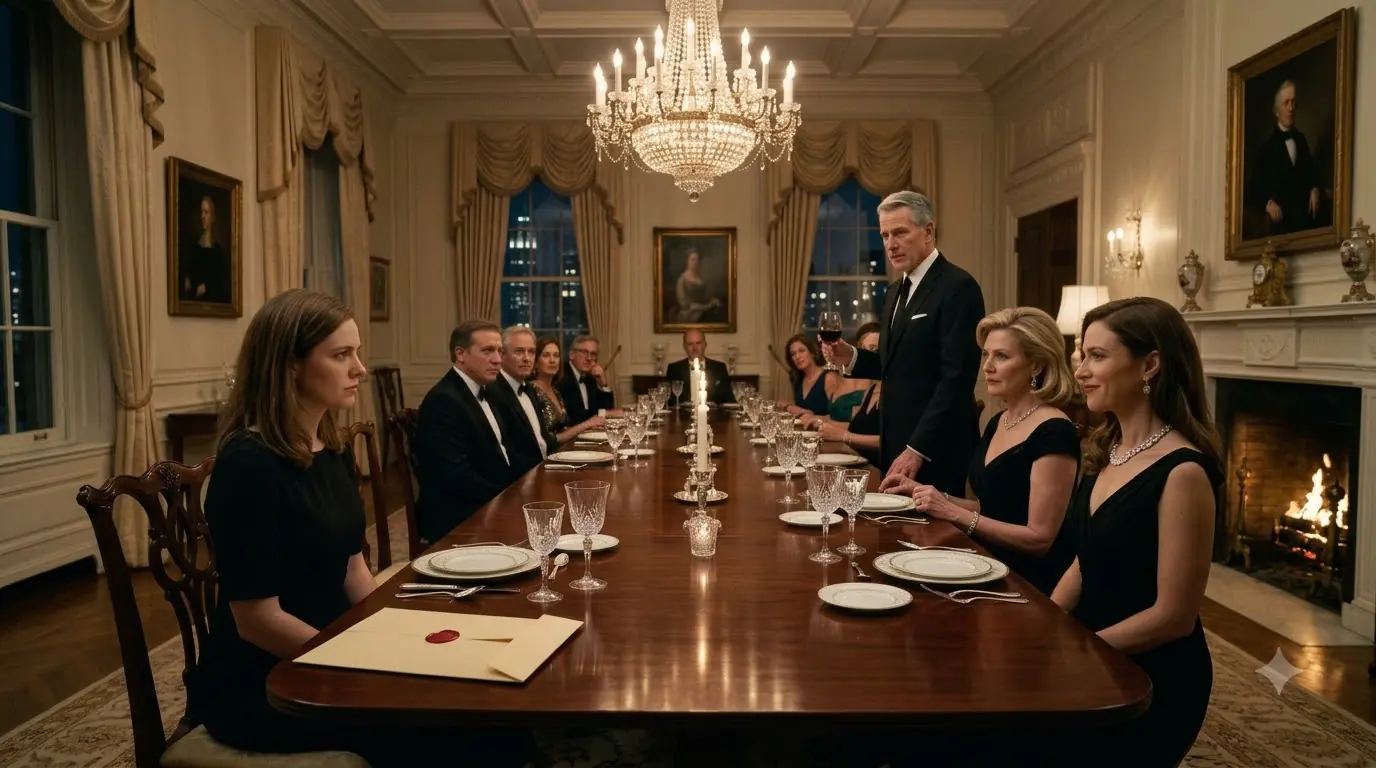
But on Miranda's graduation day at the Plaza Hotel, in front of 350 guests, a stranger handed me an envelope that would expose every lie my parents ever told about me.
What they didn't know, Grandma had been watching. She saw everything. And she left me something that would flip the entire Witford Empire upside down. The Witfords were old money Manhattan, the kind of family whose name appeared on hospital wings and museum plaques. My father, Gerald Witford, ran Witford Properties, a commercial real estate empire my grandmother, Eleanor, had built from a single Brooklyn office in 1965.
By 2024, the company was valued at $92 million. I was born with dyslexia, diagnosed at seven. The letters on pages would swim and rearrange themselves, turning simple sentences into puzzles that took me three times longer to solve than other kids.
My parents' response wasn't support, it was shame. When I was 12, they hired tutors for Miranda's violin lessons at Juilliard, French immersion classes, SAT prep with a Princeton graduate who charged $400 an hour.
When I asked about getting help for my reading, my mother Priscilla just sighed. “Dulce, we've already spent so much on specialists. At some point, we have to accept that some children just aren't academic.” I was 12. I believed her.
So, I learned to adapt on my own. Audiobooks became my lifeline. I developed a system of visual notes, diagrams, and flowcharts that helped me process information in ways traditional reading couldn't.
And every Sunday afternoon, I'd take the train to my grandmother Eleanor's apartment on the Upper West Side, where she'd sit with me for hours, explaining concepts through stories instead of textbooks. “Dulce,” she told me once, her weathered hand covering mine.
“You read slower than most, but you see things others miss. That's not a disability, sweetheart. That's a different kind of vision.” I didn't fully understand what she meant. I would understand eventually, but first I had to survive years of being the Witford family's embarrassing secret.
Christmas 2018, 20 relatives gathered around the mahogany table in my parents' Upper East Side townhouse. Crystal chandeliers, catered dinner, the annual performance of Witford Family Perfection. My father stood at the head of the table, wine glass raised. “I'd like to make an announcement,” he said, his voice carrying that boardroom authority he wore like a second skin. “Miranda has been accepted to Harvard Law School on a full scholarship.”
Applause. Cheers. Miranda blushed with practiced modesty. “My eldest daughter,” Gerald continued, beaming, “will be the first Witford to attend Harvard in three generations. She's going to take this family and this company to extraordinary heights.”
More applause. Uncle Richard clapped Miranda on the shoulder. Aunt Catherine dabbed her eyes with a napkin. Then my father's gaze drifted down the table. To me. “And Dulce...” he paused.
The warmth in his voice evaporated. “Well, Dulce is also here.” A few relatives chuckled. Soft, uncomfortable laughs. The kind people make when they don't know what else to do. Miranda didn't defend me.
She laughed along with them. I stared at my plate. The roasted lamb blurred through the tears I refused to let fall. Under the table, a hand found mine. Thin fingers, papery skin.
Grandma Eleanor, seated across from me, squeezed gently. When I looked up, her eyes held something fierce, something that looked almost like fury directed at her own son. She didn't say anything. Not then. But 3 months later, she called me to her apartment, said she needed to show me something important.
I didn't know it at the time, but that Christmas dinner, that moment of casual cruelty in front of 20 witnesses, had set something in motion, something that would take 5 years to detonate. After graduating from a state university in 2022, not an Ivy, never an Ivy, I applied for a position at Witford Properties, I wanted to prove I could contribute, that the family business could be my path, too. My father agreed to hire me as an administrative assistant. Salary: $42,000 a year. That same month, Miranda joined as chief legal counsel.
Her salary: $280,000 plus bonuses. My job consisted of photocopying documents, booking conference rooms, and fetching coffee for executives who never learned my name. I wasn't invited to a single meeting, never shown a single contract. But I watched and I listened. I discovered something about myself during those long hours in the copy room.
I could spot patterns others missed. When executives discussed deals in the hallway, I'd sketch diagrams of the relationships between parties, the flow of money, the potential conflicts. A skill I developed to compensate for my reading difficulties had become something else entirely. Grandma Eleanor had taught me this. During those Sunday afternoons at her apartment, she'd spread out old contracts from the company's early days and show me how to read them, not word by word, but as systems, as structures.
“Your father reads contracts like a lawyer,” she told me once in 2019, just before her health started declining. “He looks for what he can exploit. You read them like an architect. You see how all the pieces connect.” That same day, she'd handed me a small wooden box, mahogany, with brass hinges.
“Keep this safe,” she'd said. “Don't open it yet. When you need it, you'll know.” I'd taken the box home, tucked it in my closet, and tried to forget the strange weight of her words. March 2019, Grandma Eleanor's apartment.
She was 82 then, her once vigorous frame grown thin, her silver hair wispy against the pillow of her armchair, but her eyes, those sharp knowing eyes, hadn't dimmed at all. “Sit down, Dulce.” I sat across from her in the living room where I'd spent so many Sunday afternoons. The walls were covered with photographs. Eleanor breaking ground on her first Brooklyn property in 1965.
Eleanor shaking hands with Mayor Koch. Eleanor accepting a Women in Business award in 1987. Not a single photo of my father at the helm. “I built Witford Properties from nothing,” she said, her voice carrying decades of steel. “One office, one secretary, decades of work.”
“Your father...” She paused, and something bitter flickered across her face. “Your father inherited it. He didn't build it. He doesn't understand what it means to create something.”
“Grandma, he judges people by their credentials, their degrees, their ability to perform in boardrooms.” She leaned forward. “I judge people by how they treat those who can't fight back. And you, Dulce, you're the only one in this family who knows how to be kind.” She pressed the wooden box into my hands.
“There's something inside that might help you someday, but not yet. You're not ready yet. And neither is Gerald.” Her grip tightened. “When the time comes, when he shows you exactly who he is, you'll know what to do.”
I wanted to ask what she meant, what was inside, why she'd chosen me, but she changed the subject, started talking about the weather, her garden, the book she was reading. Later, she was gone. Pancreatic cancer. I held her hand in the hospice. The only family member at her bedside. The box remained unopened in my closet.
April 2024. The email arrived on a Tuesday afternoon. Subject line: Position Restructuring, Confidential. Dear Ms. Witford, as part of our ongoing organizational optimization, your current position will be eliminated.
Effective July 1st, 2024. HR will contact you regarding severance options. I read it three times. The letters swam, rearranged themselves, then settled back into the same devastating message. They were firing me.
That evening, I stayed late organizing files no one would ever look at. Through the thin wall separating my cubicle from my father's corner office, I heard Gerald and Priscilla talking. “We can't have her here when Miranda takes over,” my father was saying. “It looks bad. The CEO's sister working as a secretary. People will ask questions.”
“What kind of questions?” my mother asked. “Why she's not in leadership? Why we haven't promoted her?” My father paused. “Why she's the way she is?”
My mother's response came soft, almost gentle. “We've done everything we could for her, Gerald. Some children just don't have what it takes.” “Exactly,” he said. “So she needs to go.”
“We'll give her a generous severance. She can find something else, something more suited to her abilities.” I pressed my palm against the wall. I was earning $42,000 a year.
My studio apartment in Queens, shared with two roommates, cost $1,800 a month. No savings, no safety net. If I lost this job, I'd be homeless within two months. But the money wasn't what made my chest tight. It was the realization settling into my bones like frost.
If I let them do this, if I accepted their version of who I was, I would spend the rest of my life as the family failure. Not because I'd actually failed, but because I'd never been given the chance to succeed. Miranda's graduation party was tomorrow. I wondered what other announcements my father had planned. May 15th, 2024, the Plaza Hotel, Grand Ballroom.
350 guests filled the gilded room. Business partners, investors, lawyers from white-shoe firms, extended family members I barely recognized. Crystal chandeliers cast prismatic light across silk tablecloths. A 12-piece orchestra played Gershwin in the corner. This was Gerald Witford's kingdom, his stage, the place where he performed his role as patriarch, as mogul, as the man who had everything.
I stood in the entrance, tugging at the hem of my dress, black, simple, $79 from Zara, the most I could afford on my salary. Everyone else glittered in designer gowns and tailored tuxedos. My mother intercepted me before I could find a seat. “Dulce.” Priscilla's gaze traveled from my drugstore makeup to my scuffed heels, her lips pressed into a thin line. “You couldn't find anything nicer?”
“This is what I have.”
“Well.” She adjusted her Cartier bracelet. “You'll be at table 27 near the service entrance. Try not to draw attention to yourself.”
“Of course.”
“And, Dulce.” She leaned closer, her Chanel No. 5 overwhelming. “Tonight is Miranda's night. Whatever you're feeling, whatever resentment you think you're entitled to, keep it to yourself. Don't embarrass us.”
She walked away before I could respond. Table 27 was at the back of the ballroom, partially hidden behind a pillar. My tablemates were distant cousins I'd met maybe twice. From my seat, I could see the main stage, the massive portrait of Miranda in her Harvard regalia, and the banner reading, “Congratulations, Miranda Witford, Harvard Law Class of 2024.”
And near the entrance, standing alone by the door, a silver-haired man in a gray suit. He wasn't mingling, wasn't eating, just watching. His eyes found mine across the crowded room. Something cold prickled down my spine. At 8:30 p.m., the orchestra stopped.