The first thing Rachel Bennett remembered was not the scream. It was the smell of butter burning at the edge of the stove, coffee turning bitter in the pot, and pancakes cooling on plates no one bothered to move. Her parents’ kitchen in suburban Michigan had carried that Saturday-morning smell throughout her childhood, and she had once mistaken it for safety. By the end of that morning, it became a scent she could not remember without feeling her chest tighten.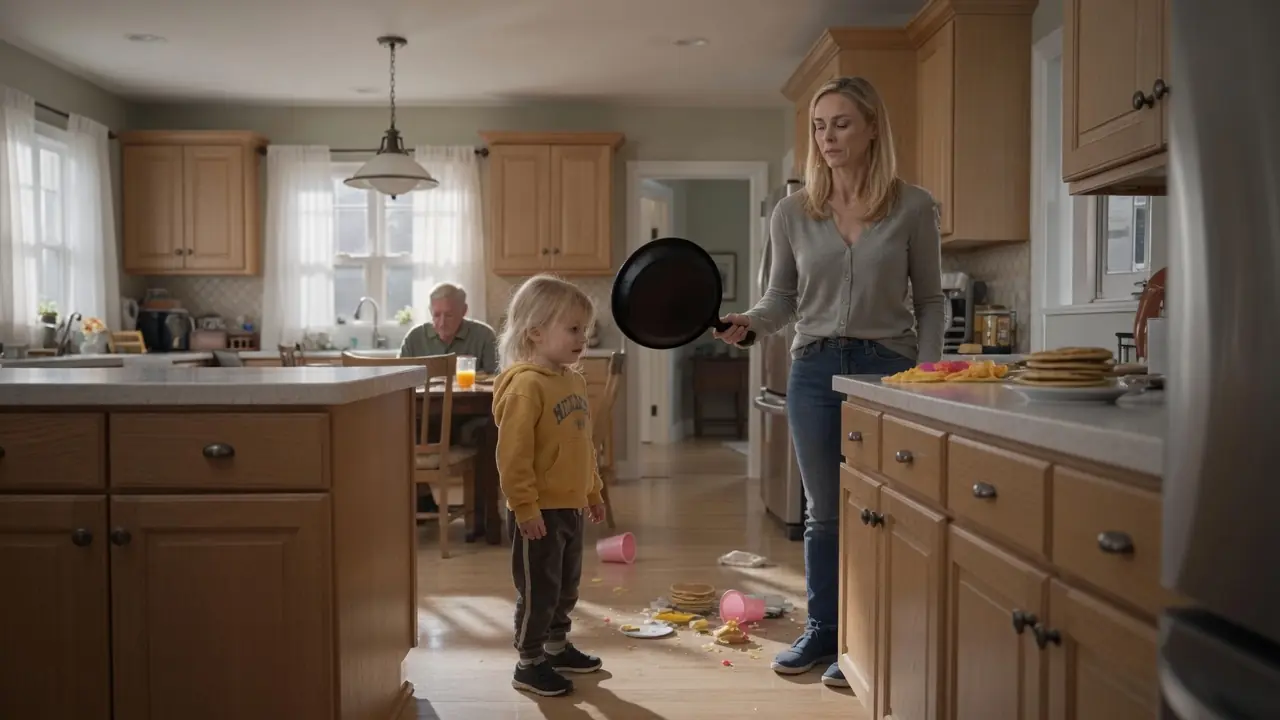
Rachel had been upstairs removing the makeup she wore to a late shift the previous night. Emma had gone downstairs less than ten minutes earlier, still dressed in the oversized yellow sweatshirt she used as pajamas. At four years old, she was small enough to lose one sock while walking and curious enough to ask three times where Grandma kept the syrup. Rachel had told her to stay near Grandpa until she came down.
Then something struck the floor.
The noise was hard and metallic, followed by a chair scraping across wood. Rachel heard one quick gasp and then a silence so complete that her hand stopped moving beside her face. The house was never silent during family breakfast because her sister Vanessa filled every room she entered with instructions, complaints, and corrections. That silence told Rachel something had happened before her mind could name it.
She ran.
Her palm struck the hallway wall near the family photographs as she took the stairs two at a time. One frame tilted beneath her shoulder, leaving a picture of Rachel and Vanessa as children hanging crooked behind her. By the time Rachel reached the kitchen doorway, every adult in the room was standing perfectly still.
Emma lay beside the breakfast table.
A black skillet rested near her, its handle turned toward the stove. Scrambled eggs had spread across the floor, and orange juice flowed beneath the chair legs from Lily’s overturned pink cup. Emma’s blonde hair covered part of her face, while one small hand remained curled near her cheek.
Vanessa stood beside the stove with her arms crossed.
She was not crying or kneeling near the child. She did not appear shocked by what had happened. Her expression carried only irritation, as though Emma had spilled something expensive and forced everyone to wait while it was cleaned.
Rachel’s father, Martin, still held his coffee mug. Her mother, Diane, stood in her bathrobe near the counter, lips pressed into a narrow line. Vanessa’s six-year-old daughter Lily sat frozen in her chair, staring down at her plate as though looking at Emma would somehow make her responsible.
Rachel dropped to her knees.
“Emma, baby, open your eyes.”
There was no answer.
Rachel touched her daughter’s shoulder, terrified of moving her incorrectly. Emma made one faint sound through her nose, so quiet and wrong that it cut through the rage rising inside Rachel. For one terrible second, Rachel imagined standing and putting her hands on Vanessa.
Then she saw Emma’s fingers twitch.
Rachel became her mother again.
She lifted Emma carefully, supporting her head and shoulders. The child’s skin felt too hot, and her hair smelled like grease, syrup, and smoke from the pan. Rachel pressed Emma against her chest and turned toward her sister.
“What kind of monster—”
“Stop shouting,” Diane snapped. “Take her somewhere. She’s disturbing everyone’s mood.”
Rachel stared at her mother.
The room did not gasp.
Nobody corrected Diane or moved toward Emma. Martin set down his mug with a soft click, while Vanessa remained beside the stove as if the person being unreasonable had finally arrived.
“What did you say?” Rachel whispered.
Diane tightened the belt of her robe. “You heard me. Screaming will not help anything.”
“My daughter is unconscious.”
“She is breathing.”
“That does not make this acceptable.”
Vanessa pointed toward Lily’s chair. “She sat where Lily was sitting and started eating her breakfast.”
Rachel looked at the plate near Emma’s empty place. A child-sized fork rested beside half a pancake covered in syrup. Emma had apparently mistaken Lily’s seat for her own and taken two bites before Vanessa reacted.
“She is four,” Rachel said.
“Then she should learn,” Vanessa answered.
Rachel’s arms tightened around Emma.
“Learn what?”
“That she cannot take whatever she wants.”
“She took a bite of pancake.”
“It was not hers.”
Rachel looked toward the skillet on the floor. “You threw that at her?”
Vanessa’s face remained flat. “I put a stop to her behavior.”
“You knocked her unconscious.”
“She fell because she panicked.”
Lily began crying silently.
Vanessa turned toward her daughter. “Stop that.”
The child immediately lowered her face.
Rachel saw the pattern in that single movement. Lily knew the same silence Emma had been expected to learn. Her own fear was simply hidden more carefully because Vanessa lived with her every day.
Martin finally spoke.
“Rachel, do not turn this into a scene.”
The word felt older than the kitchen.
Scene.
If Rachel cried as a child, she was creating a scene. If she complained about Vanessa taking her belongings, she was jealous and dramatic. If she objected when her parents dismissed another cruel remark, Rachel became the person ruining the day.
But Emma was not one of their old habits.
She was not a spilled drink, an inconvenient argument, or something to carry out of sight while the adults finished breakfast. She was four years old and limp in her mother’s arms.
Rachel looked at each person in the room.
“You watched this happen.”
Diane glanced away. “It happened quickly.”
“And then you stood there.”
“We were shocked.”
“No. You were deciding how to blame me.”
Vanessa laughed quietly. “You always make yourself the victim.”
Rachel stared at her. “You hurt my child.”
“She stole from Lily.”
“Food from a breakfast table is not worth hurting a child.”
“You raise her without discipline. Someone had to teach her.”
Rachel’s voice became cold. “You will never teach my daughter anything again.”
She carried Emma toward the front door.
Behind her, Diane muttered that Rachel was always dramatic, while Martin said they could discuss the incident after everyone calmed down. Vanessa called after her that hospitals would ask uncomfortable questions and Rachel should be careful before exaggerating.
Rachel stopped with one hand on the door.
She looked back.
“You should have thought of that before attacking a four-year-old.”
Outside, the February air cut through Emma’s thin sweatshirt. Rachel wrapped her own coat around the child and hurried toward the SUV. Her hands shook so badly that she missed the buckle twice before securing Emma in the car seat.
Emma’s head leaned to one side.
The SUV smelled like crayons, apple slices, and the strawberry shampoo Rachel used in her daughter’s hair. Ordinary evidence of a life that had still been safe an hour earlier surrounded them. Rachel started the engine and called emergency services before pulling out of the driveway.
The dispatcher instructed her to drive directly to the nearest pediatric emergency department because Emma was breathing but unresponsive. An ambulance met them halfway and transferred Emma onto a stretcher. Rachel climbed inside without her handbag, coat, or anything except the phone still clutched in her hand.
At the hospital, the intake nurse looked at Emma once and stopped asking routine questions.
Another nurse appeared with a pediatric trauma team. Someone guided Rachel toward a chair, but she refused to release Emma until a woman in blue scrubs placed a hand on her shoulder.
“Mom, we have her.”
Rachel’s arms opened reluctantly.
The double doors closed behind Emma.
A receptionist handed Rachel a form. The line marked Cause of Injury waited beneath the patient information. Rachel held the pen above the paper so long that a dark spot of ink formed where the tip rested.
Then she wrote the truth.
Hot skillet thrown during family breakfast.
The nurse read the sentence and looked up.
“Who threw it?”
“My sister.”
The nurse’s face changed.
For the first time that morning, someone in authority looked horrified rather than inconvenienced. She asked whether Rachel and Emma lived with the person responsible, whether there were other children in the home, and whether Rachel believed anyone might come to the hospital.
“No,” Rachel said. “We do not live there.”
“Do you feel safe returning to your own home?”
“I don’t know.”
The uncertainty surprised her.
Vanessa did not have a key, but Diane did. Martin knew the garage code. For years, Rachel had treated access as evidence that the family was close. Now it felt like an unlocked door through which they could bring the same silence into her daughter’s home.
The doctor emerged forty minutes later.
Emma was stable but sedated. The injuries required treatment and careful observation, but there was no immediate evidence of permanent neurological damage. Rachel listened to the medical terms without fully understanding them, holding onto only two words.
Stable.
Alive.
A hospital social worker named Naomi Grant entered carrying a folder. A security officer remained near the door but did not step inside. Naomi sat beside Rachel rather than across from her.
“Rachel, because of Emma’s age and the reported cause of injury, we are required to contact child protective services and law enforcement.”
Rachel nodded.
“Do you understand?”
“Yes.”
“Do you have photographs, messages, or recordings from anyone present?”
Rachel looked at her phone.
It had been vibrating continuously since she arrived.
Diane had called seven times. Martin sent three messages asking her to return and discuss the situation “like adults.” Vanessa’s name appeared repeatedly across the screen.
Another message arrived while Naomi watched.
Vanessa: You need to stop making this bigger than it was. Emma grabbed Lily’s food and knocked the pan when I tried moving her.
Rachel read it twice.
Another message followed.
Vanessa: If you tell the hospital I threw it, you’ll destroy this family over one mistake.
Naomi extended her hand carefully. “May I see?”
Rachel gave her the phone.
The social worker photographed the screen, documented the time, and asked Rachel not to delete anything. She then requested permission to review the earlier messages.
There were more.
Vanessa had written that Emma “needed a real lesson.” Diane told Rachel to protect Lily from having her mother taken away. Martin warned that police involvement could affect Vanessa’s job and suggested Rachel describe the injury as an accident.
Rachel stared at the messages as though they had been written by strangers.
“You are holding written evidence that they know what happened,” Naomi said gently.
“They are trying to protect her.”
“Yes.”
“Even my mother.”
Naomi returned the phone. “Sometimes families protect the person who creates fear because confronting that person would require everyone else to admit how long they stayed silent.”
Rachel looked toward the double doors.
“I stayed silent too.”
“You brought Emma here.”
“I should have protected her before today.”
“Did you know Vanessa would do this?”
“No.”
“Then do not confuse hindsight with consent.”
Rachel covered her face.
Naomi waited until she looked up again.
“What matters now is what you do next.”
A detective arrived shortly after noon.
His name was Aaron Miles, and he spoke quietly, asking Rachel to describe the kitchen exactly as she found it. He never interrupted, even when Rachel’s memory broke into fragments. She described the skillet, the spilled eggs, Vanessa’s words, and the way every adult remained standing while Emma lay on the floor.
Detective Miles asked whether anyone else witnessed the incident.
“My niece.”
“How old?”
“Six.”
“Any adults?”
“My parents.”
“Will they tell the truth?”
Rachel thought about the messages.
“No.”
The detective nodded as if he had expected that answer. He asked for permission to copy the messages and told Rachel officers were already going to her parents’ house to preserve the scene.
Her phone rang.
Diane again.
Detective Miles watched the screen. “You can answer if you want. Do not ask questions that might be interpreted as coaching.”
Rachel placed the call on speaker.
Her mother’s voice came immediately.
“Finally. Where are you?”
“At the hospital.”
“Is Emma fine?”
“She is being treated.”
“I knew she would be. Children are resilient.”
Rachel looked toward Naomi.
“What happened in the kitchen, Mom?”
Diane sighed. “You already know.”
“I want to hear you say it.”
“Vanessa became frustrated.”
“With a four-year-old?”
“Emma took Lily’s place and would not move.”
“Did Vanessa throw the skillet?”
There was silence.
Then Diane lowered her voice.
“She did not mean for things to go that far.”
Detective Miles wrote something in his notebook.
Rachel’s breathing became uneven. “So you saw it.”
“I saw Vanessa lose her temper.”
“And you told me Emma was ruining the mood.”
“You were screaming.”
“My daughter was unconscious.”
“Rachel, think about Lily. Vanessa is her mother.”
“And I am Emma’s mother.”
“You can protect Emma without destroying Vanessa.”
Rachel looked through the glass toward the pediatric hallway.
“No,” she said. “Protecting Emma means telling the truth.”
She ended the call.
Detective Miles saved the recording with Rachel’s permission. He then stepped into the hallway to contact the officers at the house.
Two hours later, Vanessa was taken into custody.
Police photographs documented the kitchen before anyone cleaned it. The skillet remained near the place Emma had fallen, and the food pattern contradicted Vanessa’s claim that Emma knocked it from the stove accidentally. Lily told a child specialist that her mother became angry when Emma sat in her chair, grabbed the skillet, and brought it down toward the floor beside her.
The child’s account was simple.
“Mommy wanted Emma to be scared.”
That sentence broke Rachel more deeply than the photographs.
Vanessa had not lost control for one second.
She wanted fear.
By evening, Emma woke.
Her eyelids opened slowly beneath the hospital lights. She looked around the room in confusion before finding Rachel seated beside the bed.
“Mommy?”
Rachel stood so quickly the chair nearly fell.
“I’m here.”
Emma touched the bandage near her face. “Aunt Vanessa was mad.”
“I know.”
“I took Lily’s pancake.”
“You made a mistake.”
“Am I bad?”
Rachel’s throat closed.
She took Emma’s hand carefully and kissed the fingers.
“No, baby. Taking the wrong pancake does not make you bad.”
“Aunt Vanessa said I steal.”
“You were confused.”
“Grandma told me not to cry.”
Rachel felt rage rise again, but she kept her voice gentle.
“You are allowed to cry when something hurts.”
Emma’s eyes filled.
“Are we going back?”
“No.”
“To Grandma’s house?”
“Not until it is safe.”
Emma closed her fingers around Rachel’s.
“Promise?”
“I promise.”
The criminal case began moving quickly.
Vanessa was charged with child abuse and assault. She insisted through her attorney that the incident was accidental and accused Rachel of using an unfortunate event to settle old family jealousy. Diane and Martin initially supported that version.
Then the messages were entered into evidence.
Vanessa’s statement that Emma needed a lesson, Diane’s admission on the recorded call, and Martin’s request that Rachel describe the injury as an accident destroyed the claim that nobody knew what happened. Police also recovered a short video from Lily’s tablet, which had been left propped against a fruit bowl while recording a breakfast game.
The device did not capture the full moment.
It recorded Vanessa shouting, Emma apologizing, and the sound of metal striking the floor. Then Lily’s frightened voice said, “Mommy, you hurt her.”
The silence afterward was unmistakable.
Rachel’s parents changed their story.
Diane claimed shock affected her memory. Martin said he had not seen Vanessa’s hand clearly and assumed Emma slipped. Their attempts to protect themselves only revealed how carefully they had chosen inaction.
Child protective services temporarily placed Lily with her father, Vanessa’s former husband, who lived in another county. He had previously reported Vanessa’s temper during their divorce, but Diane and Martin testified that he exaggerated. The old report had been closed without action.
Rachel read it with shaking hands.
Vanessa had once thrown a ceramic bowl at him while Lily stood nearby. Diane described the argument as “normal marital conflict.” Martin told investigators Vanessa was passionate but never dangerous.
The family had seen the warning years earlier.
They protected comfort instead of the child.
Rachel stopped answering her parents’ calls.
She changed the locks on her house, removed Diane from Emma’s school contact list, and instructed the hospital not to release information to anyone except her. Each boundary felt cruel at first because Rachel had been trained to believe denying family access was punishment.
Naomi explained the difference.
“A boundary is not revenge,” she said. “It is the condition under which contact becomes safe.”
Emma returned home after six days.
The yellow sweatshirt she had worn that morning remained inside an evidence bag. Rachel bought her a new one, but Emma refused to wear yellow for several months. She also stopped eating pancakes and cried whenever metal cookware fell in the kitchen.
Rachel found a child therapist named Dr. Simone Reed.
The sessions began with drawing, dolls, and simple questions. Emma rarely described the attack directly. Instead, she drew houses with one safe room and people standing outside without doors.
One drawing showed Rachel holding a shield.
Another showed Grandma beside Aunt Vanessa, both facing away while Emma lay beneath a table.
Rachel cried in the parking lot after seeing it.
The therapist told her healing would not come from forcing Emma to forgive or forget. It would come through consistent safety, honest language, and adults who believed her without requiring proof every time she felt afraid.
Rachel changed her own life too.
She resigned from the weekend shifts that had made her dependent on Diane for child care. The financial loss frightened her, but the hospital social worker connected her with a local support program for parents involved in child-abuse cases. A small grant helped cover temporary child care while Rachel adjusted her schedule.
For the first time, she accepted help without allowing the helper control.
Vanessa accepted a plea agreement eight months later.
She admitted that she intentionally used the skillet to frighten Emma and acted with reckless disregard for the child’s safety. The agreement included incarceration, mandatory counseling, probation, and a protective order prohibiting contact with Emma.
At sentencing, Vanessa apologized.
She looked directly at Rachel and said stress, family pressure, and Lily’s behavioral difficulties had overwhelmed her. She claimed she loved Emma and never intended serious harm.
Rachel listened without reacting.
When invited to speak, she stood holding a written statement.
“Vanessa says this family was destroyed by one bad morning,” Rachel began. “That is not true.”
The courtroom became still.
“This family was damaged every time cruelty was called discipline, every time silence was called peace, and every time the person naming harm was accused of creating a scene.”
Vanessa lowered her eyes.
“My daughter made a four-year-old mistake. The adults made choices.”
Rachel looked toward her parents seated behind the defense table.
“One person caused the injury. Others protected the story that allowed it.”
Diane began crying.
Rachel did not stop.
“Emma will grow up knowing she was never responsible for what happened. She will know adults were supposed to protect her, and when some failed, her mother finally refused to fail with them.”
The judge imposed the agreed sentence.
Outside the courthouse, Diane approached Rachel.
Martin remained several feet behind her, looking smaller than Rachel remembered. Diane reached for her daughter’s hand, but Rachel stepped away.
“I am sorry,” Diane said.
“For what?”
“For saying the wrong thing.”
Rachel stared at her. “You did not choose the wrong words. You chose the wrong child.”
Diane’s face collapsed.
“I was afraid Vanessa would lose everything.”
“Emma almost did.”
“I’m her grandmother.”
“You were.”
The word hurt Rachel as soon as she said it, but she did not take it back. Blood did not create safe access. Grandmother was not a permanent title immune to betrayal.
Diane asked what she could do.
Rachel answered honestly.
“Stop calling yourself the victim of my boundary. Tell the truth about what you did. Get help without demanding that Emma witness your guilt.”
Then Rachel walked away.
A year passed.
Emma began wearing yellow again during the spring. She asked for pancakes on her fifth birthday, though she wanted Rachel to cook them in an electric griddle rather than a skillet. They ate at the small kitchen table with two trusted friends and no assigned seats.
Lily sent Emma a card.
Her father helped her write it.
I’m sorry my mommy hurt you. It was not because of the pancake. I miss you, but you don’t have to see me until you want to.
Emma placed the card inside a box beneath her bed.
She did not answer immediately.
Rachel told her that was allowed.
Martin entered counseling and wrote Rachel several letters without asking for contact. He admitted that avoiding conflict had become more important to him than protecting people. Diane took longer to accept responsibility, but eventually sent a statement acknowledging that she minimized the attack and pressured Rachel to hide it.
Rachel saved the letters.
She did not show them to Emma.
The child’s healing did not belong to the adults who needed forgiveness.
Two years after the breakfast, Rachel stood in the same kitchen again.
Her parents had sold the house, and Martin asked whether Rachel wanted any childhood belongings before the closing. She entered alone while Emma stayed with a friend.
The room looked smaller than she remembered.
The table remained, but the chairs had been removed. A pale mark on the hardwood showed where Lily’s pink cup had once spilled beneath the breakfast table. The skillet was long gone, but Rachel could still see its shape in memory.
She walked toward the stove.
For years, she believed the worst moment of that morning was finding Emma on the floor. Later, she understood the true horror came from the adults who watched and decided breakfast mattered more than the child.
Rachel opened one cabinet and found her mother’s old pancake griddle.
She left it there.
On the counter, Martin had placed a cardboard box containing family photographs. The crooked picture from the upstairs hallway rested on top, showing Rachel and Vanessa as children with their arms around each other.
Rachel studied it for several seconds.
Then she placed it facedown.
She did not destroy the photograph.
The past had happened, and pretending otherwise would repeat the family’s oldest mistake. But history did not deserve a place of honor simply because it was shared.
Rachel left the house carrying only Emma’s baby photographs and several letters written by her late grandmother. Before closing the door, she looked once more toward the kitchen.
The house had once smelled like safety.
Now she knew safety was not a room, a family name, or adults insisting everyone remain calm.
Safety was a mother writing the truth on a hospital form.
It was a child being believed.
It was leaving a table where love demanded silence and building another where no one had to earn the right to be protected.