The first thing I saw was my red kettle.
It sat crookedly on top of a cardboard box on the porch, the chipped handle pointing toward the street as though someone had thrown it there without caring whether it broke. Beneath it were my winter sweaters, photo albums, kitchen tools, and the afghan I had crocheted while my husband slept through chemotherapy. Taped across the largest box was a note written in my daughter-in-law’s sharp handwriting.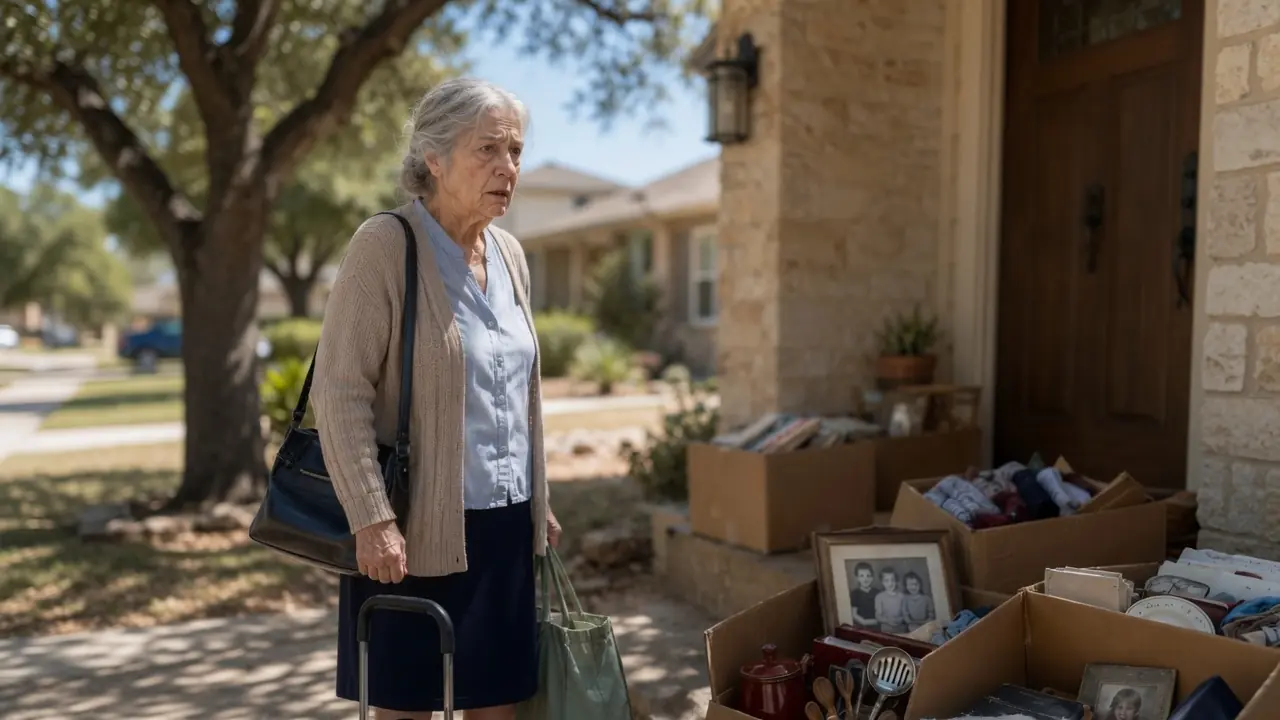
Thanks for everything, but we need the space.
I read the sentence twice while the grocery bag cut into my fingers. Strawberries pressed against one another inside their plastic container, already softening in the Texas heat. The cruelest part was not the message itself. It was understanding that my son and his wife had discussed this, planned it, packed my life, and changed the locks while I was buying fruit for their child.
My name is Dorothy Hale, and I was sixty-nine years old that summer.
Three years earlier, my husband, Samuel, died of pancreatic cancer with his hand wrapped around mine. He had always been the quieter one in our marriage, but pain stripped unnecessary words from him near the end. On his final night, he opened his eyes, tightened his weak fingers around mine, and gave me the last warning I ever heard from him.
“Dot, don’t ever let them treat you like you don’t matter.”
I promised him they would not.
Then I broke that promise one small silence at a time.
For thirty-seven years, Samuel and I owned Hale’s Neighborhood Market on the east side of Austin. It had creaky wooden floors, handwritten sale signs, and a bell above the front door that rang even when the door barely moved. Customers knew Samuel’s bad knee, my habit of giving children an extra piece of fruit, and our son Michael’s dislike of stocking canned vegetables after school.
That store paid for Michael’s college tuition. It covered his first apartment deposit, his wedding suit, and the emergency room bill when his appendix ruptured at twenty-seven. It also carried Samuel and me through lean years, rising rents, broken refrigerators, and the first devastating months after cancer entered our lives.
Every dollar we saved came from early mornings and aching feet.
Four years before the boxes appeared, I sold the store.
Michael came to me with gray skin beneath his eyes and a stack of unpaid bills inside a blue folder. His construction management company had lost two major contracts, and one client had refused payment after filing bankruptcy. His wife, Vanessa, had lost her real-estate job, their roof leaked above the upstairs hallway, and the bank had begun foreclosure proceedings.
My grandson, Lucas, was six at the time.
He fell asleep beside me on the couch while Michael explained that the family could lose the house within thirty days. Lucas’s small hand remained curled around the sleeve of my sweater. I looked at him and remembered Michael sleeping the same way when he was a child.
I did what mothers sometimes do when love makes fools of us.
I liquidated most of my retirement account, sold municipal bonds Samuel and I had held for twenty-two years, and used the emergency savings we had built dollar by dollar. The total came to a little more than three hundred and ten thousand dollars. It was enough to satisfy the bank, repair the roof, clear several business debts, and prevent Michael’s family from being forced into a rental they could not afford.
Michael cried when I told him.
Vanessa hugged me and called me the heart of the family.
For a while, I believed her.
What neither of them discussed afterward was how the rescue had legally occurred. My attorney, Margaret Sloan, had insisted that the property be purchased through the Hale Family Property Trust rather than simply transferred to Michael. She knew I had emptied nearly everything Samuel and I had accumulated, and she refused to let grief turn generosity into financial recklessness.
The trust bought the house from the bank during the foreclosure settlement.
I became sole trustee and legal owner.
Michael and Vanessa signed an occupancy agreement allowing them to live there while contributing to taxes, insurance, and maintenance. The document stated clearly that they could not sell, refinance, transfer, or borrow against the property. It also protected Lucas by granting him future consideration if the trust remained stable.
Margaret explained every page to us at her office.
Michael nodded without reading closely.
Vanessa read enough to understand but pretended otherwise.
Soon afterward, they asked me to move into the guest room “just for a while.” My apartment lease was ending, and Michael said the family needed time to recover before they could help me find something suitable. Vanessa said Lucas missed me and that having me nearby would bring comfort after Samuel’s death.
Just until work improved, they said.
Just until the roof was finished.
Just until life settled down.
“Just for a while” became four years.
During those years, I cooked dinner five nights a week, cleaned the floors, folded laundry, packed school lunches, and collected Lucas whenever Michael or Vanessa ran late. I paid for groceries whenever their checking account was low and never asked how often that seemed to happen after Vanessa began carrying new handbags. I told myself gratitude sometimes arrived late.
Disrespect arrived right on time.
At first, it came in small pieces. Vanessa moved my teacups into a cabinet above the refrigerator because she said they made the kitchen look old. Michael began asking me not to speak when business friends visited because my stories about the grocery store embarrassed him. When family photographs were taken at Thanksgiving, Vanessa asked me to step aside for “one picture of the actual household.”
I laughed as though it did not hurt.
The next wound came dressed as humor.
One afternoon, I was making Samuel’s beef stew when Vanessa walked into the kitchen, wrinkled her nose, and lit a lavender candle before the broth had even begun to simmer. She opened two windows and told me the house smelled like arthritis cream and onions.
Another day, her friends came over for lunch.
I carried lemonade onto the patio, and one woman asked whether I was Vanessa’s mother. Vanessa laughed before I could answer.
“That’s just my husband’s mother,” she said. “She’s staying with us for now.”
For now.
As though I were an unwanted guest who had overstayed.
As though my money had not saved the roof above her head.
Michael heard about the comment later. I expected him to defend me, or at least tell Vanessa it was disrespectful. Instead, he rubbed his forehead and said I was too sensitive because I had not fully recovered from Samuel’s death.
That became their answer for everything.
If I questioned a purchase, I was grieving.
If I asked why they had stopped contributing to the property taxes, I was controlling.
If I reminded them that I had an ownership interest in the house, Vanessa said legal documents should not interfere with family relationships.
I gradually stopped mentioning the trust.
Then came locked doors.
Vanessa installed a keypad on the home office and said private financial documents were inside. Michael changed the password to the family computer after I noticed overdue tax notices in his email. Birthday dinners were arranged without telling me, though I was still expected to cook or watch Lucas while they celebrated elsewhere.
My son stopped saying “Ma” warmly.
He began saying it like I was an inconvenience.
I excused every wound.
Stress.
Debt.
Exhaustion.
Young people forgetting their manners.
The truth became impossible to ignore one Tuesday evening when I passed Vanessa’s office and heard her speaking on the phone. The door was partly open, and her laughter carried into the hallway. I stopped because she mentioned my name.
“Once we kick Dorothy out,” she said, “we’ll finally make this house ours.”
I froze with one hand against the wall.
Another voice answered through the speaker, but I could not understand the words. Then Michael spoke from inside the room.
“We need to do it carefully. She’ll make it emotional.”
My knees weakened.
Vanessa replied that I had no money left, no apartment, and nowhere else to go. She said I would complain for a few weeks, then move into an inexpensive senior complex once I accepted reality.
I waited for Michael to object.
He did not.
Still, I stayed.
Some foolish part of me believed that if I remained useful enough, my son might remember who I was. I began doing more, not less. I washed his work shirts, prepared his favorite meals, and paid for Lucas’s school field trip when Michael said money was tight.
I thought usefulness might protect me from abandonment.
In reality, it only made them believe I would tolerate anything.
The Thursday morning they expelled me began quietly. Lucas had asked for strawberry cobbler, so I took my little wheeled cart and walked to the neighborhood market before the heat became unbearable. I selected the ripest berries, bought flour, and added a small carton of vanilla ice cream as a surprise.
I was thinking about Samuel on the walk home.
He loved strawberry cobbler and always stole the first corner piece before dinner. I could almost hear him teasing me about using too much sugar. The memory made me smile until I turned onto our street and saw the porch.
Boxes covered the steps.
My boxes.
Winter sweaters, photo albums, kitchen tools, and the red kettle Samuel bought on our twentieth anniversary were exposed beneath the Texas sun. My clothes had been pushed into plastic bags. Framed photographs of Michael as a little boy leaned against a box filled with cleaning supplies.
My entire life had been stacked outside like unwanted donations.
I moved closer, barely feeling the pavement beneath my shoes.
“Why are my boxes out here?” I asked.
The front door opened.
Vanessa stepped onto the porch with her arms crossed. She wore white pants, a floral blouse, and the expression of someone who had rehearsed being firm. Michael appeared behind her but remained just inside the doorway.
“Because this is our house now, Mom,” he said. “We need you gone.”
I stared at him.
He avoided my eyes.
“I sold everything to save this family,” I said. “And this is how you repay me?”
Vanessa answered before Michael could speak.
“We appreciate what you did, Dorothy, but four years is long enough. Lucas needs the room, and we need privacy.”
“Lucas has his own bedroom.”
“We want a study area for him.”
I looked toward my son. “You packed your father’s things into garbage bags for a study area?”
Michael stepped forward but did not leave the doorway.
“Please don’t make this harder.”
I gently set down the groceries. The strawberries rolled together inside the container, bruising one another. For some reason, that small sound broke the last excuse I had been protecting.
“Did you change the locks?”
Vanessa lifted her chin. “Yes.”
“You locked me out of the house I paid for?”
“You helped us,” she corrected. “That does not mean you control us forever.”
Michael finally looked at me. His face contained guilt, but not enough courage to stop what he was doing.
“We found a senior residence,” he said. “They have openings.”
“Who will pay for it?”
“There are government programs.”
I almost laughed.
He had used my retirement money, my bonds, and the proceeds from the store to save his life, then planned to place me somewhere funded by strangers. The little boy I had protected from every fear now stood behind a locked door because protecting me required disappointing his wife.
“Move the boxes back inside,” I said.
Vanessa stepped between me and the door.
“No.”
Her answer was sharp enough to attract the attention of a neighbor watering flowers across the street. Vanessa lowered her voice, embarrassed by the possibility of witnesses.
“You need to leave before sunset.”
“And if I don’t?”
Michael’s mouth tightened. “We’ll call the police.”
I opened my purse.
Vanessa gave a satisfied smile, perhaps believing I was reaching for a bus pass or the number of a shelter. Instead, I removed my phone and found Margaret Sloan’s contact.
She answered on the second ring.
“Dorothy?”
“Margaret,” I said, looking directly at Michael. “My son has changed the locks and put my belongings outside.”
There was a pause.
“Are you at the property now?”
“Yes.”
“Do not leave.”
Vanessa’s confidence shifted.
Margaret asked whether they had damaged anything and whether I had been threatened. I explained what had happened while Michael whispered something to his wife. Margaret told me she was fifteen minutes away and that I should contact the police if anyone touched me.
Then she said the sentence that returned strength to my legs.
“You are the legal owner, Dorothy. They cannot remove you from your own property.”
I ended the call.
Vanessa folded her arms again. “Your lawyer cannot change reality.”
“No,” I said. “But she can explain it to you.”
Michael stepped onto the porch. “Mom, don’t turn this into a legal war.”
“You changed the locks.”
“We were trying to set a boundary.”
“You put your father’s photographs beside the trash.”
His face flinched.
Vanessa insisted that I had given them the house years earlier. I reminded her of the trust documents, but she dismissed them as temporary paperwork used during foreclosure. Michael said the arrangement was “basically ownership” because he had lived there and maintained the property.
“You stopped paying the taxes two years ago,” I replied.
He looked startled that I knew.
Margaret arrived in a silver sedan eighteen minutes later. She was seventy-one, impeccably dressed, and carried a leather case that had frightened more careless people than shouting ever could. Behind her came Daniel Price, a property investigator she employed for complex trust disputes.
Margaret walked past the boxes without greeting Michael.
She handed him a copy of the deed.
“The Hale Family Property Trust owns this residence,” she said. “Dorothy Hale is the sole trustee and legal controller.”
Vanessa refused to take the document.
“That cannot be right.”
“It was right when you signed the occupancy agreement,” Margaret replied.
She removed a second set of papers.
“You and Michael have permission to reside here. You do not own it, and you have no authority to exclude the trustee.”
Michael read the first page, then looked at me.
“You knew this?”
“I paid attention when the lawyer explained where my life savings were going.”
Vanessa’s face hardened. “Then she has been holding this over us for four years.”
I felt something inside me finally become still.
“I never mentioned it until you put me on the porch.”
Margaret explained that changing the locks violated the occupancy agreement. Placing my belongings outside could be treated as unlawful exclusion and property damage. She also revealed that the trust allowed me to terminate their right to live there after serious misconduct.
Michael looked frightened for the first time.
“Mom, we can fix this.”
Vanessa grabbed his arm. “Do not apologize before we speak to our own lawyer.”
Margaret looked toward Daniel.
He opened a folder and removed copies of loan applications, property estimates, and emails. The documents showed that Vanessa had applied to refinance the house for four hundred thousand dollars. She had represented herself and Michael as owners, using the property as collateral for a new investment company called Whitestone Development Partners.
My hands became cold.
“How did you get those?” Vanessa demanded.
“The lender contacted the recorded owner after discovering conflicting title information,” Margaret answered.
Michael stared at his wife.
“You filed the application?”
Vanessa’s eyes shifted rapidly between us. “It was only preliminary.”
“You used my name,” Michael said.
“You knew we needed capital.”
“I did not know you claimed we owned the house.”
She turned on him. “You told me your mother would never challenge us.”
The words ended whatever unity remained between them.
Daniel explained that the refinancing package also included a forged trustee-consent form bearing my signature. The signature looked similar enough to fool someone unfamiliar with my handwriting, but the date placed me in the hospital for cataract surgery.
Vanessa began insisting the broker prepared everything.
Margaret informed her that forgery and false ownership declarations were not family misunderstandings. The lender had already frozen the application and referred it for investigation.
Michael lowered himself onto the porch step.
He looked at the boxes, the red kettle, and the photographs he had helped remove from the house. For the first time that afternoon, he seemed to understand that he had not merely hurt my feelings. He had aligned himself with someone willing to steal the last thing his father and I had protected.
“Mom,” he whispered, “I’m sorry.”
I wanted to believe him.
A mother’s heart does not stop loving simply because the person it loves becomes cruel. That is what makes boundaries so painful. I could remember Michael at five years old, feverish against my chest, while looking at the grown man who had threatened to call police on me.
“I need more than sorry,” I said.
Margaret handed both of them formal notices terminating the occupancy agreement. They had thirty days to leave. Because Lucas needed stability, I offered to let him remain with me until Michael secured appropriate housing.
Vanessa tore her copy in half.
Margaret calmly reached into her case and produced another.
“That was only a duplicate.”
The police arrived after a neighbor reported the argument. Margaret showed them the deed, and the officers instructed Michael to return my keys and restore access immediately. Vanessa protested, but one officer warned her that interfering with the legal owner could lead to removal.
I entered the house while Michael carried my boxes back inside.
For four years, I had moved quietly through those rooms as though permission could be withdrawn at any moment. That afternoon, I walked slowly and touched the kitchen counter, the stair rail, and the doorframe of my bedroom. Nothing had changed physically, yet the house felt entirely different.
I had changed.
The following month exposed more than the attempted refinancing. Whitestone Development Partners was connected to a broker named Elliott Crane, who had persuaded Vanessa to invest borrowed money into properties that did not exist. She had already transferred seventy-eight thousand dollars from Michael’s business account without telling him.
The investment collapsed.
Vanessa’s brokerage terminated her after learning about the false loan documents. Elliott disappeared before investigators could question him and was later arrested in Arizona. The state charged him with fraud involving seven families.
Michael and Vanessa separated before their thirty days expired.
Michael moved into a modest apartment and sold his truck to settle part of the business debt. Vanessa stayed with her sister and communicated mainly through attorneys. Lucas remained with me during the week and visited his parents according to a temporary custody arrangement.
Six months later, Michael came to the house alone.
He stood on the porch without using his old key. That small gesture mattered more than I expected. He waited until I invited him inside.
“I knew the house was in the trust,” he admitted. “I told myself it was only paperwork because I wanted to feel like I owned something.”
I said nothing.
He continued.
“When Vanessa said we should put you out, I knew it was wrong. I stayed silent because I thought you would forgive me the way you always had.”
“That was not forgiveness,” I said. “That was fear of losing my son.”
His eyes filled with tears.
“I used your love as protection from consequences.”
“Yes.”
Michael did not ask me for money, the house, or another rescue. He said he had found stable employment with a smaller construction company and begun counseling. He had also opened an account to repay the property taxes I had covered, though the monthly amount was small.
For the first time in years, the size of the payment did not matter.
The responsibility did.
I did not restore his occupancy rights. Love did not require me to return to the arrangement that had nearly erased me. We rebuilt our relationship through Sunday lunches, school events for Lucas, and conversations that ended when disrespect entered them.
Some weeks were hopeful.
Others were not.
Vanessa eventually accepted a plea agreement related to the forged documents. She received probation, restitution obligations, and mandatory financial counseling because investigators determined Elliott had manipulated her, though she had knowingly submitted false statements. I did not celebrate her punishment.
Consequences were not revenge.
They were simply the point at which excuses stopped protecting harmful choices.
I amended the trust the following year.
Lucas would receive educational support and, when he was older, the opportunity to inherit part of the property under conditions protecting it from debt and manipulation. Michael would not automatically control the house after my death. He understood why.
The red kettle returned to its place on the stove.
The afghan went across the back of my chair, and Samuel’s photographs lined the hallway again. I turned the guest room into a small reading room for myself, though Lucas often used the desk for homework.
Sometimes I thought about Samuel’s final warning.
I had believed keeping my promise meant making other people treat me well. I understood now that I could not control their character. The promise meant refusing to cooperate with my own erasure.
The most important word I said that summer was not “lawyer,” “deed,” or “trust.”
It was “no.”
No, you may not throw me away after spending my sacrifice.
No, love does not grant you permission to humiliate me.
No, being your mother does not mean I must become homeless so you can avoid discomfort.
That word did not destroy my family.
It ended the behavior that was already destroying it.