At Thanksgiving dinner, my son looked across the table and said, “Shut up, Mom. Nobody cares.”
He said it quietly, almost casually, as if he were asking someone to pass the salt. His wife smirked into her wine glass, my grandchildren stared down at their plates, and the room went so still that I could hear the candle flames crackle. I did not argue, cry, or plead.
I simply stood up and left.
The next morning, I stopped paying their loans, withdrew the money I had been keeping available for them, removed myself from everything I could legally remove myself from, and disappeared to a quiet place where the ocean was louder than my heartbreak. The next day, my phone showed fifty-five missed calls.
My name is Joan Patterson. I am a retired nurse, a widow, and a mother who once believed love meant sacrifice.
For many years, I thought that if I gave enough, worked enough, and forgave enough, my son would always know he was loved. I thought he would remember the nights I came home from double shifts with swollen feet, the birthdays I made special with money I did not really have, and the future I built for him one exhausted paycheck at a time. I thought love, when planted deeply enough, always grew back toward the person who gave it.
I was wrong.
The apartment was quiet the night everything inside me began to change. The only sounds were the soft tick of the clock and the low hum of the refrigerator. The scent of lavender lingered in the air, mixing with the faint smell of old paper from the photo albums stacked beside my chair.
On my lap lay a faded wedding photograph. David and I stood outside our first apartment, young and smiling, as if the whole world belonged to us. I traced his face with my thumb, remembering how alive he looked that day, how certain we were that time would be kind if we worked hard enough.
It had been nearly thirty years since his heart stopped without warning. I could still hear the doctor’s voice, calm and devastating, telling me there was nothing more they could do. I could still remember the hush that followed, the way the hospital hallway seemed to stretch forever as I stood there with my hands over my mouth.
After everyone left that night, I locked myself in the bathroom. The mirror showed me a woman I did not recognize, red-eyed, trembling, and suddenly alone with a ten-year-old boy who had just lost his father. I pressed both hands to the sink and whispered, “My son will have every opportunity we never had. He will never know want. I will make sure of it.”
That vow became the engine of my life.
From then on, my days blurred into endless motion. At Christ Hospital, I worked double shifts until exhaustion became routine. My feet swelled inside old nursing shoes, my back ached like an old wound, and dinner was often canned soup eaten quickly in the break room before the next call light blinked.
When co-workers went out for drinks, I smiled and said I was too tired. The truth was simpler than that. I could not afford it, because every dollar already had a destination.
My old Honda rattled down the same roads for nearly twenty years. I mended uniforms by hand, wore clean but outdated clothes, and cut coupons like prayers. The small account I called Sterling’s Future Fund was my lifeline, not only because it held money, but because it held meaning.
Every deposit was a promise kept to the woman who had cried in the bathroom mirror. Every extra shift was another brick in the future I was building for my son. When Sterling brought home report cards filled with A’s, I pinned them above the kitchen sink and smiled through tears.
His victories were my reward. His laughter was my paycheck. His future was the reason I could keep going when my body begged me to stop.
I remember the night he told me he wanted to go to college out of state. He sat at the kitchen table, pushing a brochure back and forth between his hands, his face glowing with hope and fear. I nodded calmly, pretending I was not terrified of how I would ever pay for it.
After he went to bed, I sat alone with my calculator and a mug of lukewarm tea. Tuition, housing, books, travel, food, fees. I rearranged numbers until the impossible became barely manageable.
People said I gave up too much. Maybe I did. But when you love deeply, sacrifice stops feeling like loss. It becomes your breath.
When Sterling’s acceptance letter from New York University arrived, he tore it open at the kitchen table. His hands shook, and his eyes filled with disbelief before he even finished reading. “I got in,” he whispered. “Mom, I got in.”
I pulled him into my arms. For the first time in years, I cried from pure joy. That night, after he left to celebrate with friends, I sat alone with my calculator again and stared at the numbers until they blurred.
The cost was more than I made in a year. But I did not hesitate. I cashed out savings, took out a personal loan, and volunteered for overtime before anyone even asked.
My body ached, but my heart was full. Every double shift, every blurry sunrise, every meal eaten standing up in a hospital break room felt like a step toward his future. If my son could walk through doors David and I had never reached, then every sacrifice was worth it.
Four years later, I stood at his graduation, a small figure among hundreds. When they called his name, I watched him raise both arms in triumph. My chest swelled with pride, and I clapped until my palms burned.
He did not see me in the crowd. That did not matter. I had kept my promise.
Then came Ila.
The first time I met her, she swept into my apartment wearing high heels and perfume that filled the room. She was polite but distant, her eyes drifting over my simple furniture, the old curtains, the thrift-store lamp, and the framed photographs on the wall. Sterling looked at her the way I used to look at David, as if she were his entire world.
When they became engaged, Ila described her dream wedding. A country club by the river, white roses, a live band, a photographer with an editorial style, and a dinner menu that sounded like something from a magazine. I nodded while silently calculating costs I could not afford.
I understood before he said anything else. I broke into my retirement fund and wrote the check. I told myself it was love.
At the wedding, Ila glowed beneath chandeliers while Sterling spun her across the floor. The music was beautiful, the guests radiant, and the flowers more expensive than my first year’s rent as a young wife. I stood at the edge of the room holding a glass of champagne, smiling through exhaustion.
I told myself this was happiness. My son was happy, and that was supposed to be enough.
A few months later, they wanted to buy a house. Ila wanted Hyde Park, two stories, a big yard, marble counters, and a kitchen that would look good in photos. I warned them that it was expensive, but Sterling brushed it off.
“It’s an investment, Mom. We’ll manage.”
When the bank hesitated, I provided the down payment with the last of David’s life insurance and co-signed the mortgage. Sterling squeezed my hand afterward and said, “You’ve always believed in me.”
I smiled, though the signature felt heavier than any shift I had ever worked.
The house was stunning. Polished floors, high ceilings, bright windows, a kitchen Ila referred to as the heart of the home, although I never saw her cook in it. Every time I visited, I felt out of place, like a guest in a life I had helped purchase but did not truly belong to.
Still, I kept coming every Sunday with a homemade pie.
It was my ritual, my anchor, my proof that I was still part of something. I arrived early, helped set the table, and told Leo and Chloe stories about their grandfather. I told them how David once dropped a Thanksgiving turkey on the floor and laughed so hard he had to sit down.
They used to giggle. Later, they began looking at their mother before they laughed.
I pretended not to notice.
Those dinners kept me going. They were proof that all the sacrifices, sleepless nights, and quiet denials meant something. I did not yet see the cracks forming beneath the polished surface.
The change happened slowly. That was what made it so dangerous.
One Sunday, as I started telling a familiar story about Sterling’s first day of school, he let out a soft sigh. It was barely audible, but sharp enough to cut through the warmth of the dining room. “Mom,” he said with a thin smile, “we’ve heard that one before.”
I laughed it off, pretending not to hear the impatience in his voice. But the air shifted. The space I once filled with comfort now felt borrowed.
Ila’s reactions came next, quiet and deliberate. When I offered to help in the kitchen, she would say, “Oh no, Joan. You sit. You’ve done enough.” Her smile was polite, but her tone carried a distance I could not name.
At first, I thought I was imagining it. Then her little jokes became regular, tiny jabs wrapped in charm. One evening, when I tried to show her my old recipe for pot roast, she laughed and said, “You’re so cute with your old-fashioned cooking. These days, we use air fryers, not crockpots.”
Sterling chuckled. Not out of cruelty, maybe, but out of habit.
I smiled too, though it stung.
The dismissals grew bolder. During conversations, Ila would glance at her phone whenever I spoke, or exchange knowing looks with Sterling. If I offered advice, she tilted her head and said, “Oh, that’s interesting,” in the way people do when they mean irrelevant.
Still, I excused them.
I told myself they were stressed. Young families had pressures I could not understand. Sterling had a demanding job, Ila had her social circle, and the children had schedules that looked more complicated than hospital rotations.
But denial has a way of turning pain into routine.
One Sunday, I brought something special, a family photo album I had kept for decades. The cover was worn and the pages yellowed, but inside were pieces of our lives. David holding baby Sterling at the zoo. Sterling’s first bike. Our old house in winter. A snapshot of me in my nurse’s uniform, smiling through exhaustion.
I wanted Leo and Chloe to see where they came from. I wanted them to know the faces and moments that shaped them before marble counters and private schools and curated holidays. After dinner, I placed the album gently on the coffee table and said, “I thought maybe we could look through some of these together.”
Ila did not even look up from her wine glass.
“Oh, Joan, not now,” she said lightly. “Nobody wants to look at those dusty old things. They’re just cluttering up the coffee table.”
Clutter.
The word hit me like a slap.
I froze, my hands still resting on the leather cover. Sterling looked uneasy for a moment, then glanced at Ila and said softly, “Maybe later, Mom.”
His eyes slid away before mine could meet them.
I nodded, forcing a smile as I lifted the album back into my lap. “Of course,” I said. “Later.”
Leo and Chloe were whispering nearby, laughing at something on their tablets. I sat quietly and flipped through the pages alone, my fingers trembling. Every photograph that once carried warmth now felt like proof of something lost.
In the weeks that followed, the distance grew heavier.
The children began to echo their parents’ tone without realizing it. “We’ve heard this one before, Grandma,” Chloe said when I started another story. Leo giggled and said, “Yeah, we already know.”
Their laughter was light and innocent, but it cut deep.
I tried to laugh with them. “You’re right,” I said softly. “Grandma does repeat herself.”
At night, I replayed every moment in my head. The sighs, the smirks, the interruptions. I told myself I was too sensitive. I told myself every family goes through phases.
“They’re just tired,” I whispered while washing the same plate three times. “Sterling is under pressure. Ila doesn’t mean it. The children are only copying what they hear.”
Beneath the denial, something inside me began to shift.
There was a quiet awareness taking root, too painful to name. I was becoming invisible in the home I had helped build. A ghost sitting at a table I had paid to set.
One evening, as I left after dinner, I glanced through the front window before getting into my car. Ila was laughing as she cleared the table, and Sterling was pouring her another glass of wine. The photo album still sat on the shelf where I had left it, untouched.
I stood there for a long moment, watching the light flicker on the glass.
I did not cry that night. Not yet. But as I sat in my car with my hands folded in my lap, something inside me began to harden.
Something small and silent, but alive.
It was the sound of the first crack forming.
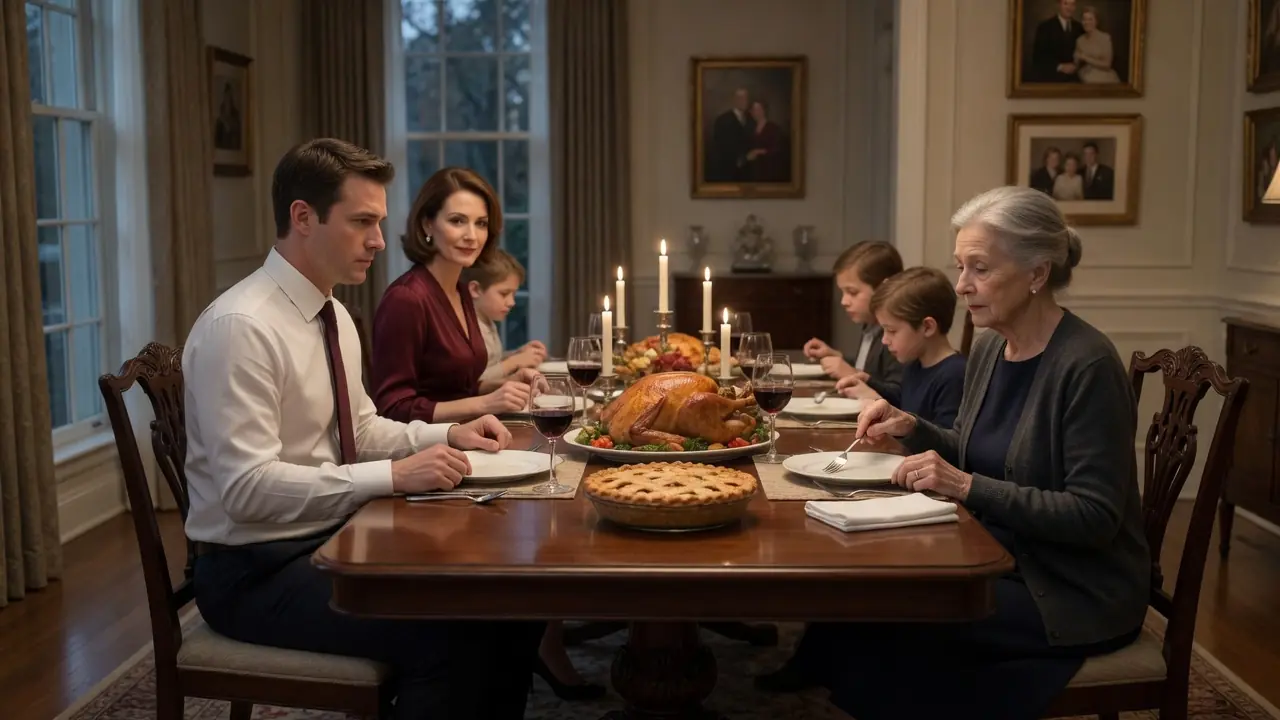
Thanksgiving arrived with polished floors, soft music, and candlelight flickering across a table set for perfection. The smell of roast turkey and rosemary filled the air, warm and rich. I had baked two pies that morning, even though Ila insisted the caterers would handle dessert.
“It’s tradition,” I said.
She smiled thinly. “If it makes you happy, Joan.”
Now I sat at the far end of the long table, surrounded by laughter that did not quite reach me. Ila was elegant in burgundy silk, pouring Sterling another glass of wine. The children spoke politely, careful and quiet, as if they sensed the rules of the room before anyone explained them.
Everything looked perfect.
Yet I felt like an ornament, something placed for effect rather than meaning.
I kept my smile fixed and focused on little things. The clink of silverware. The scent of cinnamon. The faint hum of conversation. I told myself this was family, success, and proof that my sacrifices had mattered.
When Ila raised a toast “to home, to health, and to everything we’ve built,” glasses clinked all around the table.
Everything we’ve built.
I looked down at my plate and thought of the years I spent making that sentence possible. The loans, the double shifts, the empty savings account, the old Honda, the canned soup, the retirement fund I cracked open without telling anyone how scared I was.
Dinner moved on to vacations and promotions. I chimed in where I could, careful not to interrupt. Then came a quiet lull, the kind that invites memory to step forward.
I smiled, feeling the pull of nostalgia.
“You know,” I began softly, “your grandfather and I spent our first Thanksgiving with nothing but a roasted chicken. We couldn’t afford a turkey that year. He burned it completely, and we ended up eating boxed mashed potatoes, laughing the whole night. It was…”
“Shut up, Mom.”
The words were quiet but hard as glass.
I froze.
Sterling did not even look up from his plate. “It’s so boring,” he said, his tone flat. “Nobody cares.”
The room went utterly still.
Ila smirked into her wine glass, pretending to hide it behind a sip. The children stared down at their plates, eyes wide and cheeks flushed. For a moment, I could not breathe.
My hand trembled as I set my fork down. The sound of metal against porcelain seemed deafening. I waited for Sterling to realize what he had said, for his eyes to soften, for one flicker of remorse to appear.
None came.
He kept cutting his turkey as if nothing had happened.
Ila finally looked up. “Oh, Sterling,” she said lightly. “You’re terrible.”
Her laugh was brittle, rehearsed, and it made everything worse.
The humiliation burned through me. My chest tightened. My throat went dry. I looked at my son, my only son, and saw not anger, but indifference.
That hurt more than cruelty ever could.
I folded my napkin neatly, though my hands shook.
“Excuse me,” I whispered, rising slowly. “I think I need some air.”
No one stopped me.
In the hallway, the laughter started again, soft at first, then louder, as if nothing had happened. I stood by the front door, gripping the edge of my coat, listening to my place at the table close behind me.
Outside, the cold night air hit my face. I walked down the porch steps, my heels clicking against the stone path. The lights from the house glowed behind me, warm and bright, like a world I no longer belonged to.
I reached my car, but I did not start it.
Instead, I sat behind the wheel and stared through the windshield as my breath fogged the glass. My reflection stared back at me, tired eyes, drawn mouth, a woman stripped of her place at the table she had built.
For a long time, I sat there.
I thought of the promise I had made to David all those years ago, that our son would have every opportunity, every comfort, every chance. I had kept that promise. I had given everything.
Then I realized something with terrible clarity.
This was not a bad moment.
It was a revelation.
In my son’s eyes, I was no longer his mother. I was background noise, clutter, and an inconvenience to be managed. The laughter inside the house grew louder, muffled through the glass, and I knew I could not go back inside.
Not that night.
Maybe not ever.
I drove away slowly. The road shimmered with streetlights and frost, and with each mile, the tightness in my chest eased slightly. I did not cry then. I had no tears left.
Something had broken, deep and irreversible.
That night, the woman who built her life around love and sacrifice quietly disappeared. In her place, something new was born.
A silence sharper than any word her son had ever spoken.
I did not drive straight home at first. I parked a few blocks away beneath a leafless oak where I could still see the lights from Sterling’s house glowing through the trees. From that distance, the house looked perfect, like a photograph of happiness.
Through the glass, I saw shadows moving. My family. My life’s work. My sacrifice.
And yet, I sat outside in the cold, unseen.
That was when the tears came. Silently at first, then harder until I could not stop. My hands gripped the steering wheel as years of exhaustion and heartbreak spilled out in the quiet night.
When the tears finally stopped, I sat still, eyes swollen, breath shaky. The house glowed like a jewel in the distance, but it did not feel like mine anymore. It did not even feel like something I wanted to enter.
That was the moment I understood.
My sacrifices had never been seen as love. They had been taken as duty. My care had become routine. My devotion had become invisible.
I was not loved for what I gave.
I was useful for what I provided.
The realization hollowed me out. But inside that emptiness, something new began to form. The ache hardened, cooled, and sharpened into something clear and unbreakable.
I whispered into the dark, “Enough.”
By the time I returned to my apartment, I knew what I needed to do. I turned on the kitchen light, and its glow fell softly over the small room. The silence I used to fear now steadied me.
I went to the closet and pulled down an old metal box. Its hinges squeaked as I opened it. Inside were decades of responsibility, folders, documents, receipts, policies, deeds, statements, and all the paperwork I had kept because nurses learn early that documentation matters.
I spread everything across the kitchen table.
The mortgage paperwork for the Hyde Park house, with my name still attached. The title for Ila’s SUV, legally under my name because their credit had been too weak at the time. The emergency fund statements, showing every contribution from me. Loan records, transfer receipts, tuition payments, and the old documents related to David’s life insurance.
For years, I had kept those things neatly filed away, thinking they were just paperwork.
That night, they became something else.
Proof.
Power.
I ran my fingers over the documents, my pulse steady.
“He thinks I’m old and powerless,” I whispered. “He mistook my patience for weakness.”
The words settled into my bones.
“He forgot who he is dealing with.”
The refrigerator hummed softly in the background. The clock ticked on the wall. My tears had dried, replaced by an unfamiliar calm.
I gathered the papers into a neat stack, aligning the corners carefully. They had told me to stop talking, to stay quiet, to fade away.
But silence was no longer surrender.
It was strategy.
The morning after Thanksgiving, I woke before sunrise. The apartment was still, the sky outside a soft gray. For a moment, I sat at the edge of the bed, listening to the distant sound of a passing train.
My heart was calm.
My mind was clear.
I had spent a lifetime reacting to other people’s needs. Now it was time to act.
I pulled a small suitcase from the closet and laid it open on the bed. I did not need much. A few changes of clothes, my nursing license, my medications, the wedding photograph of David, and the metal box of documents.
That was all.
The rest could stay behind. The furniture, the linens, the quiet remnants of my old life. I had carried them long enough.
When everything was packed, I took one last look around the apartment. The framed pictures on the wall, the clock above the stove, the vase of fading flowers on the counter. They all felt like memories that no longer belonged to me.
I did not leave a note.
There was nothing left to explain.
I started the car just as the first light broke over the horizon. The city streets were empty, the air cool and sharp. As I drove south, the miles rolled beneath me like a slow shedding of skin.
Ohio faded into Kentucky, then Tennessee, then Georgia. The air grew warmer and softer, carrying the scent of pine and ocean salt. I stopped only for gas and coffee, never long enough to regret.
By the time I reached Florida, the sun hung low above the water.
I found a small apartment in Saint Augustine, a simple sunlit place with white walls, clean floors, and a balcony facing the sea. The landlord, an older woman with kind eyes, handed me the keys without asking many questions. Perhaps she recognized the look of a woman who had left more behind than luggage could hold.
That night, I stood outside barefoot on the cool balcony tiles. Waves broke under the moonlight, steady and eternal. The ocean roared softly, and for the first time in years, something inside me loosened.
The next morning, I brewed coffee and carried it to the balcony.
The sea breeze swept through my hair.
It was time.
I opened my phone and began making calls, each one quiet, deliberate, and final.
First, I called my lawyer in Cincinnati.
“Good morning, Susan,” I said when she answered. My voice did not shake. “I need to update my will.”
“Of course, Joan,” she said carefully. “What changes are you thinking?”
“I want to establish a fund,” I said. “The David Patterson Nursing Scholarship. It will provide tuition support for nurses in training. Everything I own goes to that fund.”
A pause.
“And Sterling?” she asked gently.
“Sterling is to be disinherited explicitly. Leave no room for challenge.”
There was silence on the other end. Then she said, “Understood. I’ll make it happen.”
Next, I called my financial adviser.
“I’d like to liquidate the joint emergency fund,” I said. “Transfer the full amount into a new account under my name only.”
He hesitated. “Joan, are you sure? That fund was…”
“It was my money from the start,” I said. “I just allowed someone else to forget that.”
When that was done, I reached for the next set of calls.
“This is regarding the mortgage for the Hyde Park property,” I told the bank representative. “I intend to remove myself as co-signer as soon as the required process allows.”
Her tone shifted into professional caution. “Mrs. Patterson, that will require refinancing from the primary borrower.”
“I’m aware,” I said. “Send the notice today.”
I could almost see Sterling’s face when he opened that letter. Confusion first, then panic, then the slow realization that the safety net was gone.
My final call was to the insurance company and the lienholder connected to Ila’s Lexus.
“The vehicle is registered under my name,” I said. “It is no longer in my possession or authorized for use. Please begin the recovery process.”
When the last call ended, I set the phone down and exhaled.
The sun had risen higher now, glinting off the water below. Gulls wheeled in the wind. My coffee had gone cold, but I did not mind.
For the first time in decades, every decision belonged to me.
The calls started three days later.
At first, there were only one or two. Then dozens. By the end of the week, my phone looked like a storm cloud of missed connections.
Fifty-five missed calls.
I did not answer a single one.
Instead, I let the voicemails pile up and listened to them once a day, the way a person checks the weather to know what kind of storm is passing through.
The first messages were almost casual.
“Mom, where are you?” Sterling said, his tone impatient but still composed. “This isn’t funny. Call me back.”
I pictured him sitting at that expensive kitchen island, tapping his fingers against the marble, assuming I would come around like I always had.
I smiled faintly and deleted it.
By the second day, the tone shifted.
Ila’s voice trembled through the speaker. “Joan, the tow truck took my car. They said it’s registered in your name. I don’t understand what’s happening. Please call us. Please.”
Her panic trembled through every word.
Consequences are not always loud. Sometimes they arrive on paperwork and a tow truck.
By the fifth message, Sterling’s composure had cracked.
“Mom,” he shouted, rage breaking through every syllable. “The bank called. They said you’re being removed from the mortgage and we have thirty days to refinance. What the hell are you doing? You can’t do this to us. This is our children’s home. You’re destroying this family.”
Destroying this family.
The irony made me laugh softly to myself.
Families do not break in a day. They erode little by little until one sentence at a dinner table finishes what years of silence began.
I sat on the balcony with the Florida sun warming my face and deleted every message.
My silence was my answer.
In the days that followed, I settled into my new life. Coffee, ocean air, and quiet purpose became my routine. I began volunteering at a small clinic near the coast, and the familiar motion of caring for people steadied me in a way nothing else could.
For the first time in years, my hands were guided not by obligation, but by peace.
Sometimes after work, I walked along the beach barefoot, letting the waves lap at my ankles. The world felt new, cleaner, softer. I did not think about the Hyde Park house every hour anymore.
I thought about breathing.
How strange it felt to do it freely.
One morning, I stood on the balcony with coffee in hand, the ocean shimmering before me. I was not only a mother or a widow anymore. I was Joan.
My son wanted me silent.
He got his wish.
My silence took everything he had taken for granted and gave me back my life.
Weeks passed before Sterling stopped calling every day. The voicemails came less often, then only once in a while. His anger softened into pleading, then confusion, then something close to fear.
“Mom, please,” he said in one message. “We need to talk.”
I listened, then deleted it.
There had been years when I would have answered immediately. Years when his need would have pulled me back no matter how badly he had hurt me. But the woman who lived inside those years had been left behind somewhere on the highway between Ohio and Florida.
I was not punishing him.
I was refusing to rescue him from the consequences of disrespect.
There is a difference.
One afternoon, a letter arrived from my lawyer. The new will had been drafted. The scholarship paperwork was moving forward. The house, accounts, and remaining assets would be directed toward training future nurses in David’s name.
I held the pages in my hands and cried, not from pain this time, but from release.
David would have understood. He had loved Sterling deeply, but he had also believed in decency. He would never have asked me to spend the rest of my life being humiliated in the name of motherhood.
Months passed. I made friends at the clinic, women who invited me for lunch after shifts and never made me feel like I was taking up space. I learned which bakery sold the best cinnamon rolls, which stretch of beach was quietest at sunrise, and how to sleep through the night without waking in guilt.
My apartment filled slowly with new things. A blue bowl from a local market. A white linen curtain. A small painting of the ocean. Not expensive things, just mine.
One evening, as I watered the basil plant on my balcony, my phone rang.
Sterling.
I watched his name glow on the screen until it stopped.
A moment later, a voicemail appeared.
I waited until morning to listen.
His voice was different this time. Not angry, not demanding. Tired.
“Mom,” he said. “I don’t know if you’ll ever listen to this, but I’m sorry. The house is gone. We couldn’t refinance. Ila is staying with her sister and the kids are with her for now. I’m in a rental near work.”
He paused, and I heard him breathe.
“I keep thinking about Thanksgiving. About what I said. I don’t know why I said it like that. I don’t know why I let things get so ugly. Maybe I do know, and I just hate admitting it. I got used to you always being there, always paying, always fixing things. I treated you like you were part of the furniture.”
My eyes closed.
He continued, voice breaking.
“You deserved better. I don’t know if I can ever fix it. I just wanted you to know I finally understand that I broke something.”
For the first time, I did not delete the message.
I saved it.
Not because forgiveness had arrived fully formed, but because honesty had. And honesty, even late, deserved to be witnessed.
A week later, I wrote him a letter.
Not a long one.
Sterling,
I heard your message. I believe you are beginning to understand. That matters, but understanding is not the same as repair.
You cannot rebuild trust with one apology. You rebuild it with time, humility, and changed behavior. I am safe. I am well. I need space, and I expect you to respect that.
Your father and I loved you. I still love you. But I will never again confuse love with surrender.
Mom
I mailed it and felt no urge to say more.
Life did not become perfect. It became mine.
Some mornings, grief still found me. I missed the version of Sterling I thought I had raised. I missed the grandchildren who used to laugh at David’s stories before they learned to check their mother’s face first. I missed the fantasy of being cherished in old age by the family I had sacrificed for.
But missing something does not mean returning to it.
Pain can be a place you visit without moving back in.
A year after that Thanksgiving, I stood at the clinic while a young nursing student named Maribel cried in the supply room. She had failed an exam, missed rent, and was thinking of quitting the program.
I sat beside her and handed her tissues.
Then I told her about David Patterson, the man whose name would be on a scholarship soon. I told her he believed nurses were the hands of mercy in a frightened world. I did not tell her everything about Sterling. I did not need to.
When the scholarship was approved months later, Maribel became one of the first recipients.
Watching her accept it, I felt something inside me come full circle.
For decades, I had poured every resource into one future, believing it was my sacred duty. Now that same love, redirected, would help many people rise. David’s name would live not in a house where I was silenced, but in the hands of nurses who would carry kindness into rooms where fear waited.
That felt right.
One quiet evening, I sat on my balcony with the wedding photograph in my lap. David smiled up at me from another lifetime. I traced his face with my thumb, just as I had that first night, but this time the ache was gentler.
“I kept my promise,” I whispered. “Maybe not the way I thought I would, but I kept it.”
The ocean answered with its steady roar.
I still love my son.
That is the truth.
But I no longer pay for the privilege of being dismissed. I no longer mistake access to my money for access to my heart. I no longer sit at tables where my memories are treated like clutter.
Strength does not always roar. Sometimes it gets up from Thanksgiving dinner, folds its napkin, walks out the door, and lets silence finish the conversation.
My name is Joan Patterson.
I was a widow, a nurse, and a mother who believed love meant sacrifice.
Now I know better.
Love without dignity is not love. It is erosion.
And peace, once reclaimed, is worth more than any house I helped buy for people who forgot I was the foundation beneath it.