My son said there was “no space” left for me in the cabin during our family reunion and told me I should stay at a motel twenty minutes down the road.
Everyone stood around on the porch, pretending to fuss with coolers and folding chairs, while my daughter-in-law smiled as if she had neatly fixed one awkward little issue.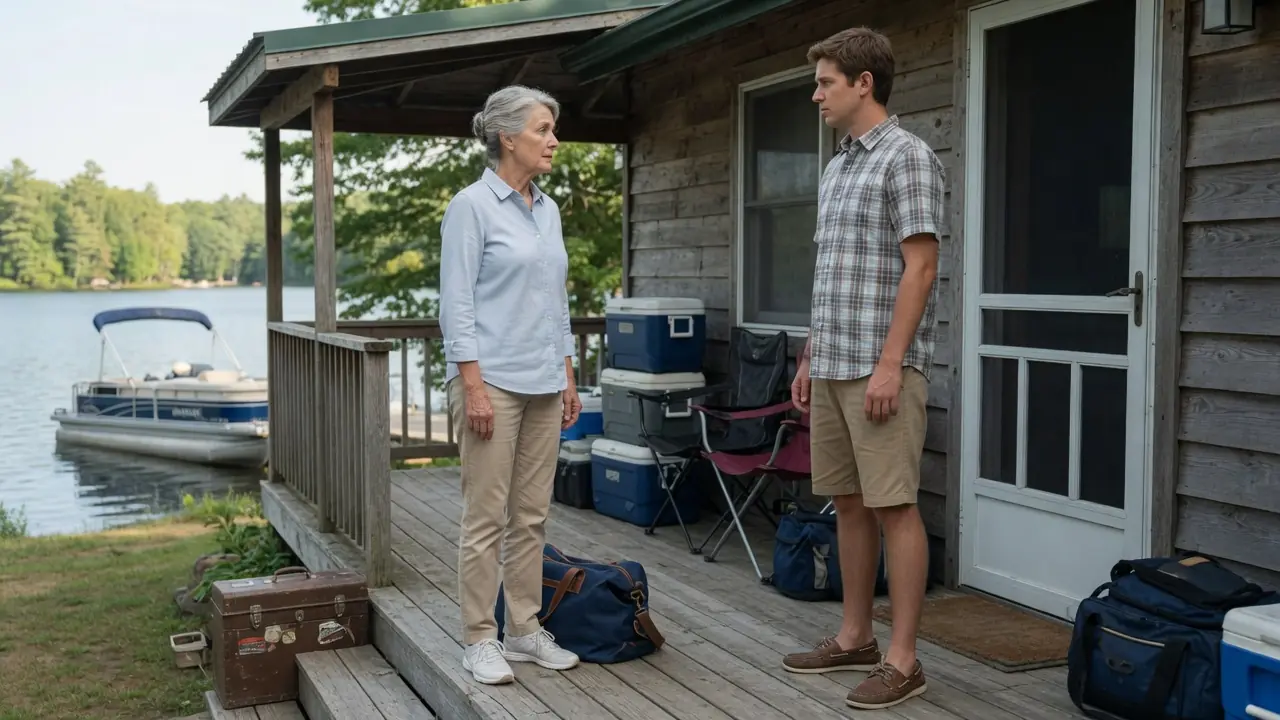
Then the marina manager came walking up the gravel driveway with a clipboard in his hand and asked, “Mrs. Dawson, would you still like to keep your son listed as an authorized operator on your pontoon?”
That was the moment the entire porch fell silent.
Because all at once, the woman holding the overnight bag was not the guest being pushed out.
She was the name written on the dock contract.
My name is Linda Dawson.
I am sixty-nine years old, and every July for twenty-eight years, my family came together at a small lake cabin outside Branson, Missouri.
The cabin is not anything fancy.
Brown siding.
A screen door that bangs shut too loudly.
A kitchen with one drawer that never sits straight.
A porch filled with rocking chairs that never quite match.
A bathroom sink that whistles if the hot water runs too long.
But to me, that place carried my marriage, my children’s summers, my husband’s fishing poles, and every birthday cake that ever tilted too far to the left because lake humidity is cruel to frosting.
After my husband Frank passed away, I kept the cabin running.
Property taxes.
Dock fees.
Insurance.
Boat registration.
Repairs after spring storms.
Fresh gravel when the driveway washed out.
A roof patch the contractor promised would hold for ten years and barely survived two.
I never complained.
I wanted the family to keep having a place.
That is what mothers do, sometimes foolishly. We keep the lights burning in rooms where people stop remembering who pays the bill.
My son Eric only seemed to notice when he needed something.
“Mom, can I take the pontoon out this weekend?”
“Mom, where did you put the marina key?”
“Mom, did you renew the slip?”
“Mom, can Jessica bring her parents this year?”
Jessica was my daughter-in-law.
She had a talent for making taking control sound like helping.
“Linda, you shouldn’t have to host anymore.”
“Linda, you have already done enough.”
“Linda, we’ll take care of the reunion this year so you can just relax.”
Relax.
That word has walked many older women out of the very places they built.
At first, I let her manage the decorations.
Then the food list.
Then the cabin schedule.
Then the group text, where my name slowly shifted from Mom to Linda, and then from Linda to we’ll let you know.
This year, I arrived on Friday afternoon with my canvas overnight bag, a cooler full of peach cobbler, and Frank’s old tackle box because my grandson Mason had asked me to teach him the knot his grandpa used.
The driveway was already full.
Jessica’s parents were there.
Her sister’s family was there.
Two couples I barely recognized were there.
Through the screen door, I could see my own family laughing in the kitchen beneath the string lights Frank and I had hung twenty summers earlier.
Eric came out onto the porch before I even stepped inside.
“Mom,” he said in a low voice, “there was a little mix-up with the sleeping arrangements.”
Jessica appeared behind him, holding a plastic cup and wearing that soft, careful smile.
“It’s just really crowded, Linda. We thought you might be more comfortable at the Lakeside Motor Inn.”
I looked past her toward the couch, where her brother’s teenage son had already tossed his backpack.
“There’s no room for me?”
Eric rubbed the back of his neck.
“It’s only one weekend.”
One weekend.
At my cabin.
With my boat tied up in my slip.
With my name still printed on every bill they had stopped asking about.
I was standing there while the peach cobbler softened in the cooler when Mason came down the steps, his face flushed with embarrassment.
“Grandma, I didn’t know,” he whispered.
Before I could say anything, a white marina golf cart rolled up the driveway.
Tom Alvarez, the manager at Cedar Bend Marina, stepped out with a clipboard tucked under his arm.
“Mrs. Dawson,” he called. “Sorry to interrupt, but I need your signature before anybody takes the pontoon out.”
Jessica’s smile pulled tight.
Eric froze.
Tom looked down at his paperwork.
“Also, would you like to keep Eric Dawson listed as an authorized operator, or should I remove that access today?”
The porch seemed to stop breathing.
And for the first time all weekend, every person waiting to use my cabin began looking at me as if they had just remembered whose lake keys were in my purse.
The cabin had been Frank’s idea.
Most of the finest and worst ideas in our marriage had belonged to Frank.
He found the place in a newspaper ad in 1996, circled it with a red pen, and set the paper beside my coffee mug like a man leaving proof of his own foolishness.
I was standing at the sink, rinsing breakfast plates, when I saw the ad.
Small Lake Cabin. Needs Work. Private Dock Access. Motivated Seller.
I picked it up, read it once, and looked at him.
“No.”
Frank was already smiling.
“You haven’t heard my pitch.”
“I have been married to you for twenty-one years. Your pitch is already making my wallet nervous.”
He came behind me and wrapped his arms around my waist.
“Linda, think about it. Somewhere for the kids. Somewhere for summers. Somewhere we can go when the world gets too loud.”
“The world is loud because we have two children, a mortgage, and you keep finding projects.”
“This one has a lake.”
“It also says needs work.”
“That means potential.”
“That means rot.”
He kissed my cheek.
“Rot can be repaired.”
“Not by optimism.”
“No,” he said. “By me. And you telling me I’m doing it wrong.”
That was Frank.
He could make foolishness sound like a future.
We drove to see it the following Saturday.
Eric was eleven. Our daughter, Marcy, was fourteen. They fought in the back seat for the first hour, then fell asleep against opposite windows, their faces slack and sun-warmed. Frank drove with one hand on the wheel and the other resting near my knee, tapping along to an old country song on the radio.
The cabin looked worse than the ad.
The porch sagged.
The kitchen smelled like dust and mouse droppings.
The screen door had a tear big enough to invite every mosquito in Missouri.
The dock boards were gray and splintered.
I stood in the doorway with my purse over my shoulder and said, “Frank Dawson, this place is one storm away from becoming firewood.”
He stood beside me, hands on his hips, looking out toward the lake.
The water was shining through the trees.
Eric had already run down toward the dock.
Marcy pretended not to care, but I saw her face soften when she looked at the lake.
Frank turned to me.
“It has good bones.”
I rolled my eyes.
“You say that about everything broken.”
“Because broken and worthless are not the same thing.”
I wanted to argue.
Then Eric shouted from the dock, “Dad! There are fish!”
Frank looked at me with the grin that had talked me into marriage, two babies, three used cars, and more half-finished household repairs than I could count.
“We could make memories here,” he said.
I looked around at the cracked windows, the warped siding, the leaning porch, and the lake beyond it all.
Then I sighed.
“You are painting every inch of this place yourself.”
He kissed my forehead.
“Deal.”
Of course, I painted half of it.
That first summer, we spent every weekend working.
Frank replaced porch boards and taught Eric how to hold a hammer properly. I scrubbed cabinets, sewed curtains, and threatened to throw away every dead mouse I found directly into Frank’s pillowcase. Marcy painted one wall of the small bedroom a pale blue and declared it hers forever.
At night, we sat on the porch with paper plates balanced on our knees, eating grilled hot dogs and watermelon while lightning bugs moved through the trees.
The cabin became ours by labor.
Not because papers were signed.
Because our hands changed it.
We sanded the dock.
We fixed the roof.
We bought mismatched rocking chairs from yard sales.
We hung string lights because Frank said every good porch needed at least one thing that made it look like a celebration.
Over the years, the cabin became the family’s summer heartbeat.
Birthdays.
Fourth of July cookouts.
Fishing mornings.
Rainy afternoons with cards spread across the kitchen table.
Eric’s teenage friends sleeping on the floor in damp beach towels.
Marcy crying on the dock after her first breakup while I sat beside her and pretended not to know she wanted company.
Frank teaching both children how to drive the pontoon slow and careful.
Then later, Frank teaching Mason.
My first grandchild.
Mason was eight when Frank first placed his small hands on the pontoon wheel.
“Easy now,” Frank told him. “A boat doesn’t like being bossed around. You guide it. Same as people.”
Mason looked serious enough to be sworn into office.
“I’m guiding it, Grandpa.”
“That you are.”
I took a picture from the back bench.
Frank in his faded cap.
Mason standing in front of him.
The lake wide and bright ahead of them.
I did not know then how precious that photograph would become.
Frank died seven years ago.
A heart attack.
Sudden.
Unfair.
Ordinary in the terrible way death can be ordinary.
One morning he was standing at the kitchen counter arguing that coffee tasted better in chipped mugs because they had history. That afternoon, he was gone before the ambulance reached the hospital.
People always say a death like that happens fast.
That is true for the person who leaves.
For the person left behind, it happens slowly for years.
It happens when you reach for the second coffee mug.
It happens when the porch light burns out and no one tall is there to change it without a step stool.
It happens when the first summer comes and the cabin waits like a question you do not know how to answer.
Everyone told me I could sell it.
No one would blame you.
It is too much to manage alone.
Frank would understand.
Maybe he would have.
But I would not have understood myself if I let it go that soon.
So I kept it.
I kept paying.
I kept arranging repairs.
I kept calling Cedar Bend Marina every spring.
I kept renewing the dock slip, the pontoon registration, the insurance, the property tax, the cabin association fee, the trash service, and the small emergency fund Frank and I had always kept for surprise repairs.
At first, the children thanked me.
“Mom, you’re amazing,” Marcy would say.
“Thanks for keeping Dad’s place going,” Eric told me the first summer after the funeral.
Dad’s place.
I did not correct him.
Maybe I should have.
Because slowly, over the years, everyone began speaking about the cabin as if Frank had built it and I had merely kept a key.
Then even that changed.
Eric began calling it “the family cabin.”
Jessica began calling it “the lake place.”
Her parents called it “the Dawson cabin,” though they had never once paid a dock fee or swept leaves off the porch.
I became the woman who brought cobbler.
The woman who knew where the extra towels were.
The woman who arrived early to open windows and left late to count life jackets.
I did not notice the demotion all at once.
No one does.
You lose ownership by inches when you keep saying, “It’s fine.”
It is fine if Jessica handles the group text.
It is fine if Eric keeps the pontoon key between weekends.
It is fine if Jessica’s parents come again.
It is fine if her sister’s family sleeps in Marcy’s old room.
It is fine if I take the smaller bed.
It is fine if the reunion happens on the weekend that works best for everyone else.
It is fine.
It is fine.
It is fine.
Until one day you arrive carrying your overnight bag, your dead husband’s tackle box, and the peach cobbler everyone expects you to bring, and your son tells you there is no space left for you in the house you never stopped paying for.
I stood on that porch hearing Tom Alvarez’s question hang in the air.
“Mrs. Dawson, would you still like to keep your son listed as an authorized operator on your pontoon?”
The silence that followed was almost beautiful.
Jessica’s father stopped pretending to organize the cooler.
Her mother’s smile vanished.
Eric’s friend, whose name I could not remember, lowered a folding chair slowly, as if sudden movement might make the situation worse.
Mason stood on the steps with his eyes fixed on me.
My grandson was fifteen now, tall and thin, with Frank’s serious eyebrows and my habit of noticing too much. He had texted me three days earlier.
Grandma, are you still bringing Grandpa’s tackle box? I want to learn that knot.
I had replied with three hearts and a promise.
Now he looked ashamed of a decision he had not made.
Eric cleared his throat.
“Tom, this isn’t really the time.”
Tom was a kind man, but not a foolish one.
He had managed Cedar Bend Marina for thirteen years. He knew every dock contract, every boat owner, every family that treated lake property like magic instead of maintenance. He also knew who actually signed checks.
He looked at Eric, then at me.
“I’m sorry,” Tom said. “I was told the family needed the pontoon by six, and the renewal authorization still requires Mrs. Dawson’s signature.”
Jessica laughed softly, but the sound came out brittle.
“Of course. Linda can sign it before she heads to the motel.”
Before she heads to the motel.
I turned my head slowly and looked at her.
For the first time in years, I did not soften my face to make someone else more comfortable.
Jessica’s smile faltered.
Eric stepped down one porch stair.
“Mom, nobody meant anything by it.”
That sentence has excused more cruelty than honest people realize.
I looked at my son.
He had Frank’s chin.
My eyes.
A stranger’s spine.
“You told me there was no space for me,” I said.
He rubbed the back of his neck again.
A habit from childhood.
“I said there was a mix-up.”
“No. You said there was no space.”
“Mom, come on. Don’t make this into something.”
I glanced toward the open cabin door.
Inside, someone laughed nervously.
A blender started in the kitchen, then shut off quickly.
My peach cobbler sat in the cooler at my feet.
The screen door banged once in the wind, the same door Frank had replaced twice because it never closed gently no matter what he did.
I thought of all the summers I had opened that door before everyone arrived.
I thought of sweeping mouse droppings from the pantry.
I thought of standing on the dock at sunrise after Frank died, holding his old coffee mug and wondering whether grief could drown a person on dry land.
I thought of Eric as a boy, asleep on the porch swing with his mouth open, sunburned nose peeling.
I thought of the man standing in front of me now, embarrassed not because he had hurt me, but because Tom Alvarez had made the ownership visible.
I turned back to Tom.
“Remove him.”
The porch went completely still.
Eric’s head snapped up.
“Mom.”
I kept my eyes on Tom.
“Remove Eric Dawson as an authorized operator on the pontoon. Effective immediately.”
Tom nodded once.
“Yes, ma’am.”
Jessica stepped forward.
“Linda, that’s unnecessary.”
I looked at her.
“No, Jessica. What was unnecessary was inviting half your family and several people I don’t know to sleep in my cabin, then sending me to a motel with my own cobbler.”
Her face reddened.
“We were trying to make everyone comfortable.”
“Not everyone.”
“Linda—”
“Mrs. Dawson,” I said.
The correction came out before I planned it.
But once it was in the air, I did not regret it.
Jessica blinked.
I looked toward Eric.
“You may call me Mom. She may not use my first name while treating me like an inconvenience.”
Mason made a sound that might have been a laugh if the moment had been less painful.
Eric heard it and flushed.
“Mom, please. Let’s talk inside.”
“No.”
“We don’t need to do this in front of everyone.”
“You were comfortable doing it in front of everyone when I was the one being sent away.”
That landed.
For a moment, Eric looked like the boy he used to be when he had been caught lying about a broken lamp. But he was not a boy anymore, and I was too old to mother a grown man out of consequences he had earned.
I bent down, picked up my cooler, and handed it to Mason.
“Put this in the kitchen, please.”
Mason came down the steps quickly.
“Yes, Grandma.”
Jessica’s sister shifted near the porch rail.
“Are we still taking the boat out?” she whispered to her husband.
Tom heard her.
So did I.
I turned toward her.
“No.”
Her mouth opened.
I smiled.
It was not a warm smile.
“No one is taking my pontoon out tonight.”
Eric exhaled sharply.
“Mom, the kids have been looking forward to it.”
“Then perhaps their parents should have made sure the woman who owns it had a bed.”
Jessica crossed her arms.
“This is becoming really dramatic.”
I looked at her carefully.
“You are standing on a porch my husband rebuilt after working ten-hour days. You are sleeping under a roof I pay to insure. You are drinking from a refrigerator I replaced last summer. Your relatives have their bags in bedrooms my children grew up in. And you just tried to send me to a motel so your sister’s family could be more comfortable.”
Her expression tightened.
“So yes, Jessica. I suppose it is dramatic when the furniture speaks.”
No one moved.
Tom looked like he wanted to be anywhere else and also like he was proud of me.
He cleared his throat.
“I can update the operator form now, Mrs. Dawson.”
“Please do.”
I signed where he pointed.
Then I took the marina key from my purse and held it in my hand.
Eric stared at it.
“Mom, are you serious?”
“Yes.”
“What are we supposed to do all weekend?”
There it was.
Not apology.
Not shame.
Concern over lost entertainment.
I tucked the key back into my purse.
“I imagine you will have time to think.”
Then I turned toward the cabin.
Jessica stepped in front of the door before she seemed to realize what she was doing.
It was a small movement.
Instinctive.
Possessive.
A younger woman guarding an older woman from entering the house that younger woman had decided was hers for the weekend.
For the first time that afternoon, anger rose in me clean and bright.
“Move,” I said.
Jessica did.
I stepped inside.
The cabin smelled like sunscreen, lake towels, grilled onions, and too many people. Bags were stacked against the wall. Snacks covered the counter. Someone had moved Frank’s fishing hat from its hook and set a Bluetooth speaker there instead.
I stopped.
The hat lay on the side table near a pile of plastic cups.
Not damaged.
Not ruined.
Just displaced.
Something about that nearly broke me.
Not the sleeping arrangement.
Not the motel.
The hat.
I picked it up gently.
Frank had worn that faded blue cap for twenty years. There was a little tear near the brim where a fish hook had once caught. I had washed it after he died, then cried because it no longer smelled like him.
I placed it back on the hook by the door.
The room behind me stayed silent.
I turned around.
“Who put their things in my bedroom?”
Jessica’s mother looked down.
Her sister suddenly became very interested in a bag of chips.
Eric said, “Mom—”
“My bedroom,” I repeated.
He swallowed.
“Jessica’s parents are using it.”
I nodded once.
“Then they can move.”
Jessica’s mother, Carol, flushed.
“I’m sorry, Linda. I had no idea—”
“Mrs. Dawson,” I said again, though more gently this time. “And I believe you did not know everything. But now you do.”
Carol looked at her husband.
They began gathering their bags.
Jessica hissed, “Mom, don’t. This is ridiculous.”
Carol snapped her head toward her daughter.
“No, Jessica. What is ridiculous is that you let me unpack in a widow’s bedroom while sending her to a motel.”
Jessica looked stunned.
Her father, Bill, lifted both suitcases without a word.
That was the first crack in Jessica’s control.
The second came when Mason walked into the kitchen holding the peach cobbler.
“Grandma,” he said, voice tight, “I can sleep on the porch swing. You can have my bed.”
I looked at my grandson.
The anger in me softened at the edges.
“No, sweetheart. You are not responsible for fixing what adults broke.”
“But I want you here.”
My throat tightened.
“I know.”
Eric looked wounded by that.
Good.
He needed to be.
The next twenty minutes were chaos wrapped in politeness.
Bags were moved.
Sleeping arrangements collapsed.
People whispered.
Jessica tried to reorganize everything with a strained smile, but no one followed her instructions quite as quickly anymore. Her parents packed into the small guest room instead of mine. Her sister’s family moved their things from the living room to an air mattress. The two couples I barely recognized suddenly remembered they had booked a hotel “just in case” and left before dinner.
The cabin exhaled as strangers removed themselves from rooms where they never should have been.
I went into the bedroom Frank and I had shared.
The quilt was turned down.
Jessica’s mother’s perfume lingered faintly in the air.
I set my overnight bag on the cedar chest at the foot of the bed.
Frank had built that chest for our twenty-fifth anniversary.
Inside were old blankets, photo albums, the first flag Eric ever drew in kindergarten, Marcy’s camp letters, and a stack of birthday cards from Frank that I still could not read all the way through.
I sat on the edge of the bed.
For a moment, my legs shook.
I had not realized how hard I had been holding myself upright.
There was a soft knock.
“Mama?”
It was Marcy.
My daughter had arrived late, after the porch scene but before dinner. She came in quietly, closed the door behind her, and sat beside me.
Marcy was forty-seven now, with two grown daughters of her own and a job at a dental office that had taught her how to smile through nearly anything. She lived four hours away and called me every Sunday, though she had not known about the sleeping arrangement either.
Her face was pale with fury.
“I swear to you,” she said, “I did not know.”
“I know.”
“If I had known, I would have dragged Eric by his ear down the driveway.”
I almost smiled.
“You always were better at fighting him than I was.”
“That’s because you loved him soft.”
I looked at her.
She took my hand.
“You did, Mom. You loved both of us soft. And maybe we got too used to it.”
Tears stung my eyes.
“Not you.”
“Sometimes me too.”
She squeezed my hand.
“But not today.”
We sat there in the room that still held the shape of my marriage.
Outside, I heard Jessica’s voice rising, then Eric’s low response, then Mason saying something sharp enough that both adults went quiet.
Marcy looked toward the door.
“That boy has Grandpa in him.”
“Yes,” I whispered. “He does.”
Dinner that night was the strangest meal ever served in that cabin.
The dining table was too crowded, as always. Folding chairs were pulled in from the porch. The plates did not match. The potato salad had too much mustard because Jessica had insisted on making it “lighter,” which is what people say when they ruin a perfectly good recipe.
No one knew what to talk about.
Usually, reunions had a rhythm.
Children first.
Weather.
Traffic.
Lake level.
Who forgot sunscreen.
Who burned hot dogs.
Which cousin was dating someone new.
This year, every sentence seemed to bump into what no one wanted to say.
The pontoon stayed tied to the dock.
The marina key stayed in my purse.
Eric kept glancing at me.
Jessica kept laughing too brightly.
Mason sat beside me and refused to move.
After dinner, he brought Frank’s tackle box to the porch.
“You still want to show me the knot?” he asked.
I looked toward the dock.
The sun had begun to lower over the lake, turning the water copper and gold. Frank used to say that evening light made every fisherman feel forgiven.
“Yes,” I said. “Go get the old green practice line from the side pocket.”
Mason opened the tackle box carefully.
Frank’s lures were still arranged in the top tray. Silver spoons. Plastic worms. Hooks in little boxes. A pocketknife with a cracked handle. A photograph of Frank holding a bass he claimed was bigger before the camera “made it modest.”
Mason touched the photograph.
“I miss him,” he said.
I nodded.
“Me too.”
“Dad doesn’t talk about him much.”
“No.”
“Why?”
I looked across the yard.
Eric stood near the firepit with a beer in his hand, Jessica beside him, both of them speaking in low tense voices.
“Sometimes people avoid grief because they think not looking at it means it can’t look back.”
Mason considered that.
“Grandpa wouldn’t have let them send you away.”
“No,” I said. “He would not have.”
Mason’s jaw tightened.
“I should have said something sooner.”
“You did not know.”
“I saw them moving bags. I thought maybe you were coming tomorrow. Then Dad said you’d be at the motel and I…” He stopped.
I touched his arm.
“You are fifteen. You are not responsible for your father’s choices.”
“He is responsible, though.”
“Yes.”
“And Jessica?”
“Yes.”
He nodded slowly.
“Okay. Teach me the knot.”
So I did.
The Dawson loop was not really called that. Frank had stolen it from some fishing magazine and renamed it after himself because that was the kind of nonsense he enjoyed. It was a strong knot, useful, simple once you understood the turns.
Mason watched closely.
“Through once,” I said. “Around twice. Back through the loop. Then pull steady, not hard.”
“Why not hard?”
“Because forcing it ruins the shape.”
He looked at the knot.
Then at me.
“That’s probably true for other things too.”
I smiled.
“You sound like your grandpa.”
“Good.”
We tied knots until the porch grew dark.
One by one, people drifted inside.
Eric came over after a while and stood near the railing.
“Mason, can I talk to Grandma alone?”
Mason looked at me.
I nodded.
He went inside, but not before giving his father a look that would have made Frank proud.
Eric sat in the chair across from me.
For a while, he said nothing.
The lake made soft sounds below the hill.
Finally, he said, “I messed up.”
“Yes.”
He winced.
“I didn’t think about it the way it looked.”
“How did you think about it?”
He rubbed his hands over his face.
“Jessica handled most of the arrangements. Her sister’s family decided to come last minute. Then her parents wanted the big room because Bill’s back has been hurting. The kids wanted to stay together. Everything got complicated.”
“And I became the easiest person to move.”
His shoulders sagged.
“Yes.”
That honesty was small, but it was something.
I looked at my son.
“Eric, do you know what hurt me most?”
He swallowed.
“The motel?”
“No.”
He looked up.
“That you were not surprised by your own suggestion. It came out of your mouth like it made sense.”
He stared down at his hands.
I continued.
“You have used this cabin every summer of your life. You learned to swim here. Your father taught you to fish here. Your son learned to steer the pontoon here. I kept it after your father died because I wanted you and Marcy and the grandchildren to still have a place that felt like him.”
My voice trembled, but I did not stop.
“And today you looked at me standing in the driveway with my bag and my food and your father’s tackle box, and you decided I was the one who could be sent away.”
Eric’s eyes filled.
“I’m sorry.”
I had imagined those words many times.
I had thought they would feel better.
They did not.
Maybe because an apology is not the same as repair.
“I believe you,” I said. “But sorry cannot be the end of it.”
“What do you want me to do?”
I looked toward the dock.
“I want you to start remembering that this place has never been free.”
He nodded.
“I can help with expenses.”
“That is not what I said.”
He looked confused.
I leaned back in the rocking chair Frank had bought at a flea market in 2004.
“Money matters. Yes. But I am talking about respect. I am talking about calling me before inviting extra people. I am talking about not treating my name on the paperwork as a technicality. I am talking about remembering that I am your mother, not leftover space.”
A tear ran down his cheek.
“I don’t know when I started doing that.”
“That is something you need to think about.”
He nodded.
“I will.”
“Good.”
He looked toward the house.
“Jessica is upset.”
“I imagine she is.”
“She feels embarrassed.”
“She should.”
His mouth opened, then closed.
I was tired of softening truth so no one else had to feel its edges.
“She has treated this cabin like a stage for her family,” I said. “And you let her because it was easier than disagreeing.”
Eric looked toward the screen door.
Then back at me.
“You’re right.”
Those two words mattered more than sorry.
Not enough.
But more.
The next morning, I woke before everyone else.
Old habits.
I made coffee in the dented percolator Frank had refused to replace because he said newer coffee makers lacked moral character. The lake was still under a thin mist. The porch boards were cool under my bare feet. Somewhere near the trees, a bird called once, then again.
For the first time in years, I did not begin the reunion by making breakfast for everyone.
I poured myself coffee.
I sat on the porch.
I watched the water.
At 7:15, Jessica came outside.
She wore yoga pants, a cream sweater, and no makeup. Without her careful smile, she looked younger. And more nervous.
“Mrs. Dawson,” she said.
The name sounded strange in her mouth.
I looked at her.
She sat carefully in the chair Eric had used the night before.
“I owe you an apology.”
“Yes,” I said.
She swallowed.
“I took over.”
“Yes.”
“I told myself I was helping because you had done so much for so long.”
I said nothing.
“But that isn’t the whole truth.” She looked down at her hands. “I liked being in charge of the cabin. I liked planning things. I liked having my family here. And somewhere along the way, I started acting like your history here was just background.”
That was closer to truth than I had expected from her.
She looked at me with damp eyes.
“I am sorry. Not because of the boat. Not because everyone saw. Because it was wrong.”
I studied her face.
Jessica was not a monster.
That would have been simpler.
She was a woman who had mistaken access for ownership, convenience for kindness, and my silence for permission.
“I accept your apology,” I said.
Relief crossed her face.
“But I am changing things.”
The relief paused.
“What things?”
“This is the last reunion organized without me.”
She nodded quickly.
“Of course.”
“I will approve the guest list.”
“Yes.”
“No one stays here unless I invite them.”
Her face tightened slightly, but she nodded.
“Yes.”
“The pontoon is not for general use. Eric may not operate it unless I restore his authorization. That will not happen this weekend.”
Jessica looked down.
“All right.”
“And Frank’s things do not get moved for speakers, decorations, or anyone’s convenience.”
Her eyes filled.
“I’m sorry about the hat.”
So she had noticed.
Good.
“Then remember it,” I said.
By nine, the household had begun waking.
The reunion became smaller in spirit even though most people were still there. Jessica’s sister’s family left after lunch, claiming one of the kids had a headache. The remaining extra guests found reasons to go into town. By Saturday evening, the cabin held only my children, my grandchildren, Jessica, and her parents.
For the first time all weekend, it felt almost like family.
Not repaired.
But less crowded with entitlement.
That afternoon, Marcy and I went through the old photo albums with Mason and his younger cousins. We showed them pictures of the cabin when the porch still sagged, Eric with missing front teeth holding a bluegill, Marcy sunburned and furious after losing at cards, Frank asleep in a lawn chair with a paper plate on his stomach.
Mason held up one picture of me standing on the dock in 1999, younger, laughing, one hand shielding my eyes from the sun.
“You look happy,” he said.
“I was.”
He looked at the photo longer.
“You should be in more pictures.”
I laughed softly.
“Mothers are usually the ones taking them.”
Marcy took out her phone.
“Not anymore.”
She took a picture of me before I could protest.
Then one with Mason.
Then one with Eric, though he approached carefully, like a man asking permission to stand in a frame he had nearly lost.
I let him.
Sunday morning, before everyone left, I called a family meeting on the porch.
No one looked thrilled.
That was fine.
I had spent years hosting gatherings designed around everyone else’s comfort. They could survive fifteen minutes of discomfort for me.
I sat in the center rocking chair with Frank’s tackle box beside me.
Eric stood near the railing.
Jessica sat beside him.
Marcy leaned against the porch post.
Mason sat on the steps.
“This cabin is going into a trust,” I said.
Eric blinked.
Marcy straightened.
“I have already spoken to an attorney.”
That part was not entirely true. I had left a voicemail with one Saturday morning and had an appointment Tuesday. At my age, intention counted close enough.
“I am doing this because I want the cabin protected. Not fought over. Not assumed. Not controlled by whoever is loudest in a group text.”
Jessica lowered her eyes.
I continued.
“The trust will state that I have lifetime control. After I am gone, Eric and Marcy may share use of the property if they also share expenses and responsibilities. If either of you cannot respect that, the cabin will be sold and the proceeds divided.”
Eric looked stricken.
“Mom, you don’t have to—”
“I do.”
He closed his mouth.
“Family places become family wounds when nobody writes down the truth,” I said. “Your father and I built this place with work. I kept it with work. Love does not mean leaving things vague so people can behave badly later.”
Marcy nodded slowly.
“I think that’s smart.”
Eric looked at his sister.
Then at me.
“I do too,” he said quietly.
I looked toward Mason.
“And there will be a provision that Mason, and any grandchild who wants to learn the cabin properly, may spend time here with me. Not just for boating. For upkeep. Cleaning. Dock maintenance. Storm prep. The real parts.”
Mason sat up.
“Really?”
“Really. You wanted to learn Grandpa’s knot. You can also learn how to seal deck boards.”
He grinned.
“That sounds less fun.”
“It is.”
“Okay.”
Everyone laughed softly.
The tension eased, but only a little.
Some tension should remain until people learn from it.
After the meeting, Eric followed me down to the dock.
The pontoon rocked gently in the slip, its blue cover snapped tight. Frank had wanted a fishing boat. I had insisted on the pontoon because I wanted room for children, coolers, chairs, and my knees. Frank complained for three weeks, then loved it more than anyone.
Eric stood beside me.
“I don’t deserve access back yet,” he said.
“No.”
He nodded.
“I know.”
We watched the water.
Then he said, “Dad would be disappointed in me.”
I looked at him.
“Yes.”
He flinched.
I touched his arm.
“But he loved you. Those two things can stand beside each other.”
Eric wiped his eyes.
“I miss him.”
“I know.”
“I think I stopped coming here to remember him. I started coming because it was easy.”
“That happens.”
“I don’t want to be that man.”
“Then don’t.”
He let out a shaky breath.
“What do I do?”
“Start by showing up in October to help close the cabin for winter.”
He nodded quickly.
“I will.”
“And bring Mason.”
“Yes.”
“And leave Jessica’s cousins home.”
He laughed through tears.
“I will.”
That October, Eric came.
So did Mason.
Marcy came too, surprising all of us by arriving with work gloves, old jeans, and a cooler full of sandwiches. Jessica did not come that weekend. She sent a note with Eric, handwritten, brief, and careful.
Mrs. Dawson,
Thank you for allowing us to keep learning what this place means. I am sorry again. I hope one day my actions here show more respect than my words did.
Jessica.
I read it twice.
Then I put it in the kitchen drawer that never sat straight.
We spent the weekend closing the cabin.
We pulled the pontoon cover tighter.
Cleared gutters.
Stacked porch chairs.
Drained lines.
Swept the dock.
Checked the roof.
Mason learned how to coil rope properly and complained that adults made everything more complicated than necessary.
Eric repaired the loose porch rail without being asked.
Marcy labeled storage bins with a marker and said, “If men had invented labels, civilization would be further along.”
For the first time in years, I did not do the work alone.
At sunset, we sat on the dock with mugs of coffee and hot chocolate.
The lake was quiet.
The trees had gone red and gold along the shore.
Eric leaned forward, elbows on his knees.
“Mom?”
“Yes?”
“I thought keeping the cabin was just something you wanted.”
I looked at him.
He stared at the water.
“I didn’t understand it was something you were giving us.”
My eyes burned.
“Well,” I said, because mothers are not always good at receiving what they have waited years to hear, “now you do.”
Mason leaned against my shoulder.
“I’m glad you didn’t go to the motel.”
I kissed the top of his head.
“Me too.”
The next July reunion was different.
Smaller.
Clearer.
The guest list came to me first.
Jessica asked before inviting her parents. I said yes. She did not ask about her sister’s family that year, and I appreciated the restraint.
Eric paid the dock fee before I reminded him.
Marcy handled groceries.
Mason arrived two days early to help me air out the cabin and test the smoke detectors.
When Tom Alvarez came by with the marina paperwork, he smiled at Eric and then looked at me.
“Mrs. Dawson, any changes to authorized operators this year?”
The porch went quiet again, but this time it was not shock.
It was waiting.
I looked at Eric.
He stood straight, hands at his sides, no entitlement in his face.
“I would like to add Eric back,” I said. “Limited family use. No guests operating. No after-dark runs. My rules.”
Tom nodded.
“Yes, ma’am.”
Eric swallowed.
“Thank you, Mom.”
I pointed one finger at him.
“You scratch my pontoon, and I remove you until retirement.”
He smiled.
“Mine or yours?”
“Yours.”
Mason laughed.
That evening, Eric drove the pontoon slowly across the lake with me beside him and Mason sitting up front. Jessica sat in the back with Marcy, both women quiet as the water opened around us.
The sunset spread pink and orange across the lake.
For a moment, I could almost see Frank near the rail, one hand on his faded cap, pretending not to smile because he never liked making emotional scenes.
Eric glanced at me.
“What?”
“You’re steering like your father,” I said.
“Is that good?”
“Mostly.”
He laughed.
Then his eyes filled.
Mine did too.
The pontoon moved steady through the water.
Not rushed.
Not careless.
Guided.
Same as people, Frank would have said.
A year later, the trust was finished.
The cabin rules were written plainly.
Ownership.
Expenses.
Use.
Guest limits.
Maintenance responsibilities.
Respect.
That last word was not legal language, according to the attorney.
I told him to put it in anyway.
He did.
Because sometimes families need to see on paper what love should have taught them already.
I am seventy-one now.
The cabin still has brown siding.
The screen door still bangs too loudly, though Mason has tried to fix it twice.
The kitchen drawer still does not sit straight.
The rocking chairs still do not match.
Frank’s hat still hangs by the door.
The pontoon still sits in the Cedar Bend slip, under my name.
Every July, we gather.
Not perfectly.
Families are not perfect just because one hard truth is spoken.
Eric still slips sometimes into assuming. Jessica still likes a plan more than she likes being corrected. Marcy still says exactly what she thinks before checking whether anyone asked. Mason is nearly grown now, and the world is already trying to pull him away from old knots and porch stories.
But now, when I arrive, no one asks where I am sleeping.
My room is my room.
My rocking chair is left open.
My name is on the group text.
Not Linda.
Not we’ll let you know.
Mom.
Grandma.
Mrs. Dawson when respect needs remembering.
And every time I walk down the gravel driveway with my overnight bag in one hand and peach cobbler in the other, I feel the old ache and the new strength standing side by side.
I think that is what getting older teaches a woman if she lets it.
Love is not proven by disappearing so everyone else has more room.
Family does not mean surrendering the chair you built, the bed you made, the dock you paid for, or the memories you kept alive when everyone else was too busy enjoying them to notice the cost.
For years, I thought keeping the cabin meant keeping everyone together.
Now I know better.
Keeping the cabin means keeping the truth together.
Frank and I bought that place with hope, repaired it with tired hands, filled it with children, grief, laughter, burnt hot dogs, bad frosting, wet towels, and summers that went too fast.
I kept it after he died because love needed somewhere to sit.
But I will not be pushed out of love’s house by people who mistake my generosity for weakness.
That day on the porch, my son told me there was no space for me.
Then Tom Alvarez walked up with a clipboard and reminded everyone whose name was on the dock contract.
But the contract was never the real point.
The real point was this:
Sometimes the person carrying the overnight bag is not asking permission to belong.
Sometimes she is the reason the place exists at all.
And if a family forgets that, then the kindest thing an old woman can do is stop smiling, take back her keys, and make them remember.