On Christmas Eve, my own son looked me in the eye and said, “You’re not invited. Only Erica’s parents are coming.”
I smiled.
I held my head high.
Then I walked away without a word.
Mitchell thought that was the end of it. He thought his tired old mother would go home, cry into a cup of tea, and come back later with another check, another apology, another quiet sacrifice to keep his perfect life standing.
What he did not know was that every bill, every luxury, every polished corner of that house rested on my shoulders.
The pool that sparkled in the backyard.
The dining room set his wife showed off to her friends.
The private school tuition for my grandchildren.
The repairs on Erica’s expensive SUV.
The taxes, the utilities, the maintenance, the little emergencies that somehow always found their way to my bank account.
They thought I was just helping.
They never understood that I was holding up the whole house.
So the next morning, Christmas morning, I picked up the phone.
And with one calm call, I canceled every automatic payment.
That was when their perfect world began to crack.
My name is Laverne Middleton. I am sixty-eight years old, a widow, and for most of my life, I believed hard work and loyalty could build a fortress strong enough to protect a family for generations.
My husband, Harold, and I spent thirty-eight years running a small food business in Seattle. It was nothing fancy, just a modest company that made pies, preserves, and holiday desserts for local stores and family restaurants. We worked before sunrise, cleaned after dark, and came home smelling of cinnamon, butter, and tired bones.
We were never rich in the way people in Bellevue liked to use that word. We did not wear designer clothes or take photographs beside blue swimming pools. But we owned what we had. We paid what we owed. And every dollar that came into our hands had been earned honestly.
When Harold passed away, I sold the business.
People assumed I sold it because I wanted rest. They said I deserved comfort after all those years.
But the truth was simpler.
I sold it because I wanted to secure something permanent for my son.
Mitchell was my only child. He was thirty-eight, clever, quick with computers, always chasing the next opportunity but rarely willing to stay with one thing long enough for it to become real. His wife, Erica, was thirty-five, beautiful in a glossy way, with a smile that looked practiced and an appetite for luxury that could never be satisfied.
Together, they lived in Bellevue, in one of those neighborhoods where the lawns looked trimmed by angels and every driveway seemed to hold a vehicle worth more than my first home.
When Mitchell and Erica bought their house, I was proud.
It was worth a little over 1.2 million dollars, a grand place with a wide staircase, a bright kitchen, tall windows, a pool in the backyard, and a dining room Erica said was “made for entertaining.”
They could not afford it on their own.
So I helped.
That was the word I used at the time.
Helped.
Harold and I had paid sixty percent of the purchase price through money we had set aside before he died. Later, after Harold was gone, I continued to cover what Mitchell and Erica could not.
Twenty-five thousand dollars for the dining room set Erica insisted was essential.
Pool maintenance every month.
Car repairs whenever Erica’s SUV had a problem.
Private school tuition for my grandchildren.
Property taxes when the bill made Mitchell “too stressed to think.”
I even opened a separate account just to make everything easier. From that account, payments went out quietly, smoothly, without drama. The taxes got paid. The pool stayed clear. The school never called. The mechanics got their checks. The household ran as if Mitchell and Erica were managing it themselves.
They never asked how much I was paying.
And I never told them.
Maybe that was my mistake.
But love, for me, had always looked like sacrifice. When you lose your husband and wake up each morning to an empty side of the bed, you cling harder to the family that remains. You tell yourself that giving is useful. That useful means loved. That if you keep showing up with open hands, eventually someone will look at those hands and say, “Thank you.”
The first crack appeared around the pool.
It was a ridiculous thing, that pool, glittering blue in a city where half the year felt wet and gray. Erica loved it because it looked good in photographs. Every summer, she hosted little parties where women in white linen drank sparkling wine and said things like, “This is the life.”
I paid the maintenance bill every month.
One afternoon, I stopped by with groceries for the children and overheard Erica on the phone in the kitchen.
“Mitchell always keeps our pool perfect,” she said, laughing. “He’s so attentive.”
I stood in the hallway with a bag of oranges in my arms.
Mitchell did not balance chemicals. Mitchell did not clean filters. Mitchell did not write the checks.
I did.
But to Erica’s friends, he was the attentive husband, and I was invisible.
Then came the SUV.
Erica drove a massive white vehicle with leather seats, heated everything, and a payment that made me wince. When the transmission failed, Mitchell called me in a panic.
“Mom, it’s a bad time,” he said. “We’re stretched thin this month. The kids’ tuition is due, and Erica needs the car.”
So I paid.
A week later, I was at their house for dinner when Erica’s father, Kenneth Henderson, looked at me across the table and smiled.
Kenneth was a retired marketing executive, the kind of man who still introduced himself as if his job title had been carved into stone. His wife, Vicki, wore pearls to casual lunches and treated charity events like coronations.
“At least Erica married well,” Kenneth said, lifting his wine glass. “Unlike some people who spend their lives being boring and frugal.”
A few people laughed politely.
Erica smirked.
Mitchell stared down at his plate.
I smiled because that was what I had trained myself to do.
But inside, I burned.
I had signed the check that kept his daughter’s precious vehicle on the road. I had done it without asking for praise, and still he spoke to me as if I were a dusty little woman who had never known refinement.
The school tuition hurt even more.
My grandchildren, Oliver and Sophie, were the softest part of my heart. Oliver was nine, serious, thoughtful, always building things out of blocks and scraps of cardboard. Sophie was six, bright-eyed and dramatic, with a laugh that reminded me of bells.
Their education meant everything to me.
So I paid.
One semester, after transferring another tuition payment, I asked Mitchell gently, “Did the school confirm everything is settled?”
He looked annoyed.
“That’s a parent’s job, Mom. Don’t interfere.”
A parent’s job.
I wanted to tell him that the school had my account on file. That the receipts came to my email. That his pride was being financed by the mother he was dismissing.
Instead, I swallowed the words.
I swallowed many things in those years.
I swallowed Erica telling her friends, “If it weren’t for us, Laverne would have nothing better to do,” after I had spent three evenings babysitting so she could host a dinner.
I swallowed Vicki whispering at my grandson’s birthday party that the red bicycle I bought him “looked working class.”
I swallowed Kenneth calling the food company Harold and I had built “a mom-and-pop little thing,” as if honest labor were something to be ashamed of.
And I swallowed the insult that hurt most of all.
My pumpkin pie.
That recipe came from my mother, and from her mother before her. It was never just dessert. It was memory pressed into crust. It was Thanksgiving mornings in a small kitchen. It was Harold standing behind me, stealing a bite of filling from the spoon and pretending he had not.
Every Christmas, I offered to bring it.
Every Christmas, Erica refused.
“We need fine dining standards, Laverne,” she would say. “Not peasant dishes.”
Peasant dishes.
She said it the way one might say dirt.
Still, I kept showing up.
Still, I kept paying.
Still, I told myself Mitchell would remember who I was.
Then came the gray afternoon in December when he knocked on my door.
He did not come inside.
He stood on my porch with his hands in his coat pockets, looking anywhere but at me.
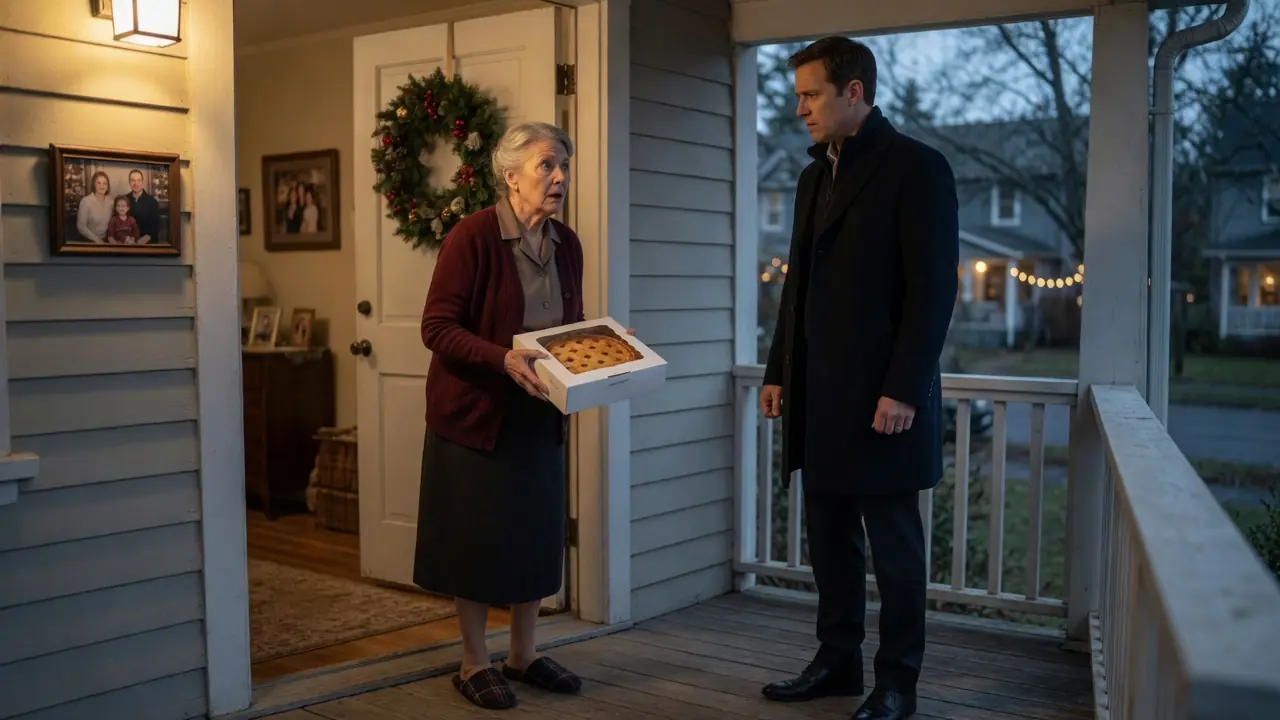
“Mom,” he said, “Erica and I have decided Christmas Eve will just be her parents this year.”
I waited.
He shifted his weight.
“You’re not invited. Only Erica’s parents.”
The words landed quietly.
That made them worse.
I looked at my son, the boy I had fed and clothed and worked double shifts for. I remembered him at seven years old, asleep in the back office of our bakery because we could not afford a sitter. I remembered Harold lifting him onto the counter and letting him sprinkle cinnamon over pie filling.
Now he stood before me, grown and polished and ashamed of the woman who had made his life possible.
“Why?” I asked.
He sighed.
“Please don’t make this hard.”
“Why, Mitchell?”
His mouth tightened.
“Erica’s parents want a refined atmosphere. They don’t want things to feel awkward.”
A refined atmosphere.
I almost laughed.
Instead, I nodded.
“I see.”
“Mom, it’s just one night.”
“No,” I said softly. “It isn’t.”
He frowned, but I did not explain.
I simply stepped back and closed the door.
That night, I sat alone in my kitchen. The pumpkin pie filling was already mixed in a bowl. The crust waited beneath a clean towel. My hands smelled of nutmeg and brown sugar.
I stared at the counter for a long time.
Then my phone rang.
It was Kenneth Henderson.
His voice came through rich with satisfaction.
“Laverne, just so there’s no confusion, you can come after the party to help clean up. That seems more appropriate.”
In the background, I heard Vicki laugh.
Then Mitchell’s voice, distant but clear.
“Mom, please just let us live our own lives. Stop interfering.”
Something inside me went still.
Not broken.
Still.
There is a difference.
After the call ended, I walked to Harold’s old study.
The room still smelled faintly of pipe tobacco, even though he had been gone for years. His file cabinet stood in the corner, heavy and dented, full of our old life.
I do not know why I opened the bottom drawer that night.
Maybe grief knows where truth is hidden.
Maybe Harold guided my hand.
I found the envelope near the back, thick and yellowed, with his handwriting across the front.
Property and estate papers.
I had read the will once after he died, in that numb fog when every sentence felt like it belonged to someone else. But I had never studied it carefully.
That night, I did.
Under the desk lamp, I unfolded the documents page by page.
And there it was.
The Bellevue house.
Harold and I had contributed sixty percent of the purchase price. Harold’s portion, upon his death, had transferred fully to me. The ownership agreement had been recorded clearly.
I legally owned sixty percent of the house.
For a long time, I simply stared at the words.
The house where I was no longer welcome.
The house where Erica displayed the furniture I bought.
The house where Kenneth and Vicki drank wine and insulted me.
The house my son told me not to enter on Christmas Eve.
More of it belonged to me than to them.
The next morning, I called my lawyer, Paul Brenner. He had known Harold and me for years and had handled the sale of our food business.
“Bring the papers,” he said.
Two hours later, I sat across from him in his office while he read in silence.
He adjusted his glasses once.
Then again.
Finally, he looked up.
“Laverne, this is clear. You own sixty percent of that property.”
My hands tightened around my purse strap.
“What does that mean?”
“It means Mitchell and Erica have two options. They can buy out your share for roughly seven hundred and twenty thousand dollars, based on current value, or they can pay you monthly rent for the portion they occupy and use.”
“How much?”
“At least thirty-five hundred a month.”
I sat very still.
For the first time in years, I felt something rise in my chest.
Not anger.
Power.
Quiet, legal, undeniable power.
Paul leaned back.
“Do you want to proceed?”
I thought of Mitchell’s face at my door.
I thought of Erica calling my pie peasant food.
I thought of Kenneth telling me I could come clean up after the party.
“Yes,” I said. “But first, I want the truth shown clearly.”
Paul studied me for a moment.
Then he nodded.
“Then we will do it properly.”
That afternoon, I called the bank and stopped every automatic payment tied to Mitchell and Erica’s household.
Property taxes.
Pool service.
Vehicle repairs.
School tuition support.
Household maintenance.
The silent engine beneath their life stopped humming.
Then I began gathering proof.
Bank statements.
Receipts.
Tuition records.
Maintenance invoices.
Screenshots of Erica’s social media posts.
The dining room set captioned: Our masterpiece.
The pool captioned: Our luxury life.
Vicki’s comment under one photo: Good thing you have a generous maid.
And finally, the recorded call from Kenneth.
You can come after the party to clean up. That seems more appropriate.
Paul helped me organize everything into folders.
Fifteen copies.
Bound neatly.
Each one with red paper and a gold ribbon, like a Christmas gift.
On each tag, I wrote:
With love, Laverne.
Then I took my navy dress from the back of my closet, the one I had worn to Mitchell’s wedding. I pressed it carefully. I pinned my silver hair neatly. I put on the pearl earrings Harold had given me on our thirtieth anniversary.
When I looked in the mirror, I did not see a discarded mother.
I saw a woman who had finally remembered her own name.
Their house glowed like a palace that night.
Every window blazed with golden light. Wreaths hung from the front door. Music drifted across the snowy lawn. Cars lined the driveway, expensive and polished.
I arrived with Paul beside me.
He carried the legal documents.
I carried the first folder.
Erica saw me at the door.
Her smile vanished.
“You can’t be here,” she hissed.
I took out my key.
Then I held up the deed.
“I am co-owner of this house,” I said clearly. “I have more right to be here than most of the people inside.”
Her face went pale.
Before she could stop me, I stepped past her.
The party was in full bloom.
Kenneth stood near the fireplace with a whiskey glass in his hand. Vicki glittered in pearls. Mitchell stood beside Erica, looking startled and embarrassed.
“Mom,” he said. “What are you doing?”
“What I should have done long ago.”
The room quieted.
I walked to the center of the room.
“This house,” I said, “is not Mitchell and Erica’s achievement. I own sixty percent of it. I also paid more than three hundred thousand dollars over the years to keep this household running.”
A murmur passed through the guests.
Kenneth laughed loudly.
“This is absurd.”
I looked at him.
“No, Kenneth. What was absurd was you calling me a servant while standing in a house my money built.”
Paul stepped forward and handed a folder to the nearest guest.
Then another.
Then another.
Soon, people were unwrapping the red and gold packages beneath the tree. Instead of chocolates or ornaments, they found bank records, receipts, legal documents, screenshots, and transcripts.
A man near the dining room table looked up sharply.
“She paid for the furniture?”
Another guest flipped pages.
“Private school tuition too.”
A woman gasped.
“The pool. The car repairs. The taxes.”
The room began to shift.
Not physically.
Morally.
People turned toward Mitchell and Erica, then toward Kenneth and Vicki.
Erica rushed forward.
“She volunteered! Nobody forced her!”
Paul’s voice cut through the room.
“Voluntary support does not erase legal ownership. Mrs. Middleton owns sixty percent of this property. That is not an opinion. It is recorded fact.”
Kenneth’s face darkened.
“You dare come into this house and humiliate us?”
I smiled faintly.
“This house, Kenneth?”
His jaw clenched.
“Careful.”
“No,” I said. “I was careful for years. Tonight, I am honest.”
Then Paul dimmed the lights and started the slideshow.
The first slide showed the purchase contribution.
The second showed the ownership agreement.
The third showed the tuition payments.
Then came the furniture receipt.
The pool service.
The SUV repair.
The maintenance transfers.
Every number appeared bright and cold on the wall.
Then came Erica’s posts.
Our masterpiece.
Our luxury life.
Our dream home.
Not once did she mention me.
Then Vicki’s comments appeared.
Generous maid.
Working-class taste.
Peasant food.
Vicki made a small choking sound.
Finally, Kenneth’s voice filled the room through the speakers.
“Laverne, you can come after the party to help clean up. That seems more appropriate.”
Then Vicki’s laughter.
Then Mitchell’s voice.
“Mom, please just let us live our own lives. Stop interfering.”
The recording ended.
No one moved.
Kenneth’s whiskey glass trembled in his hand.
One woman near the tree whispered, “She paid for all of this, and they shut her out of Christmas?”
A man beside her muttered, “Shameful.”
Vicki tried to smile.
“It was just a joke. People say things.”
“No one is laughing,” someone said coldly.
Mitchell looked like the floor had disappeared beneath him.
He stared at the dining room set. Then toward the glass doors leading to the pool. Then at Erica’s SUV through the front window.
Piece by piece, the truth settled on him.
“Mom,” he whispered.
I looked at him.
“I gave up my dream so you could have this life. I sold the business your father and I built. I paid bills you never thanked me for. I loved you the only way I knew how.”
His eyes filled.
“And you told me I was not invited to Christmas.”
Erica’s face twisted.
“You’re ruining everything.”
“No,” I said. “I am no longer paying to preserve a lie.”
Kenneth slammed his glass down so hard whiskey splashed across the table.
“This is slander.”
Paul turned to him calmly.
“It is not slander if it is true.”
A guest near the doorway put on his coat.
“I won’t be part of this,” he said, and left.
Then another.
Then two more.
The party began to collapse around them.
Not with shouting.
With silence.
The kind of silence that comes when people realize they have admired cruelty because it was dressed well.
The next morning, I sat across from Mitchell and Erica in that glittering dining room.
Paul sat beside me.
Mitchell looked as if he had not slept. Erica’s eyes were swollen. The table between us was the same one I had bought, polished to a mirror shine.
I placed the document in front of them.
“You have two options,” I said. “You may buy out my share for seven hundred and twenty thousand dollars, or you may pay thirty-five hundred dollars a month in rent.”
Erica’s mouth opened.
Nothing came out.
Mitchell stared at the paper.
“We can’t afford either.”
“I know.”
His eyes lifted.
“Mom, please.”
There it was.
The word he should have used years ago.
Please.
But it came too late to be a command.
“You will have to sell,” I said.
Erica began to cry.
Mitchell covered his face with one hand.
I did not enjoy their pain.
That surprised me.
I had imagined satisfaction. I had imagined triumph. But sitting there across from my son, I felt only the ache of wasted years.
Still, I did not soften.
There is a difference between forgiveness and surrender.
I had surrendered for too long.
Within weeks, their life changed.
The pool service stopped.
The private school called when tuition was not automatically paid.
Erica returned half her holiday purchases.
The SUV was listed for sale.
The house went on the market before spring.
Kenneth lost his position on a local business council after word of the Christmas party spread. Vicki stopped receiving invitations to charity luncheons. Their refined circle became very quiet around them.
As for me, I drove to Tacoma on Christmas Day with my pumpkin pie in the passenger seat.
My sister Agnes opened the door before I even knocked.
“Laverne,” she said, pulling me into her arms.
Inside, her children and grandchildren welcomed me with real warmth. No polished cruelty. No hidden laughter. No one called my food peasant.
They ate my pumpkin pie until only crumbs remained.
My nephew took one bite and closed his eyes.
“Aunt Laverne, this tastes like Christmas.”
I had to turn away for a moment.
Not because I was ashamed.
Because I was seen.
In January, I opened a small bakery in Seattle.
Nothing grand.
A corner shop with warm windows, six tables, and a sign painted in cream letters:
Laverne’s Heritage Pumpkin Pie.
The first morning I turned the sign to Open, my hands trembled.
By noon, I had sold every pie.
A week later, a local newspaper ran a small story.
A Widow Finds Freedom Through Her Family Recipe.
People came because of the story.
They stayed because of the pie.
In February, Mitchell came to the bakery.
He stood near the door for several minutes before walking to the counter.
He looked thinner.
Older.
For the first time in years, he looked like my son, not like a man performing success.
“Mom,” he said quietly. “I’m sorry.”
I wiped my hands on my apron.
“For what?”
He swallowed.
“For letting Erica and her parents disrespect you. For taking your money. For acting like I earned things you gave me. For shutting you out.”
I listened.
“I was ashamed,” he admitted. “Not of you. Of myself. And somehow I turned that shame on you.”
That was the first honest thing he had said in a long time.
Then came the old hesitation.
“Could you help us again? Just until we get back on our feet?”
My heart hurt.
But it did not break.
“No, Mitchell.”
His face fell.
“I will not fund you anymore. I will love you. I will speak to you. I will be your mother. But I will not be your wallet.”
He nodded slowly.
“I understand.”
“I hope you do.”
He looked around the bakery, at the pies cooling on racks, at the customers waiting near the counter, at the life I had built for myself after he tried to push me out of his.
“I’m proud of you,” he said.
I studied his face.
For once, I believed he meant it.
“Thank you,” I said.
That was enough for that day.
Kenneth and Vicki never apologized.
Erica never came.
I heard later that she blamed me for everything, then blamed Mitchell, then blamed her parents, then everyone except herself. That was her burden to carry, not mine.
The bakery grew.
I hired two women from the neighborhood. Then a third. I started teaching weekend baking classes for young mothers, widows, and anyone who needed to remember that their hands could still create something good.
Every morning, I roll dough beneath my palms and think of my mother.
Every Thanksgiving, I bake one pie from the first batch and set it aside for Harold.
Every Christmas, I invite people who have nowhere else to go.
No one is ever turned away for lacking refinement.
Looking back, I understand now that the greatest gift I gave myself was not the house, the bakery, or even the money I reclaimed.
It was the line I finally drew.
For too long, I mistook sacrifice for love.
I believed that if I gave enough, endured enough, paid enough, someone would eventually recognize my worth.
But love without respect is not family.
It is exploitation wearing a familiar face.
On Christmas Eve, my son told me I was not invited.
On Christmas morning, I stopped paying for the life that had taught him to forget me.
And in the silence that followed, I finally heard my own voice again.
Strong.
Clear.
Free.