The candlelight made shadows jump across the white tablecloth like small, nervous animals.
I watched my son, Mark, adjust his tie. Silk, expensive, the kind his father never would have bothered with, and raise his wine glass.
Thirty faces turned toward him in the Lake View Inn, the same room where I had served countless birthday dinners, anniversary celebrations, and business meetings. The floorboards creaked in all the familiar places when people shifted in their chairs.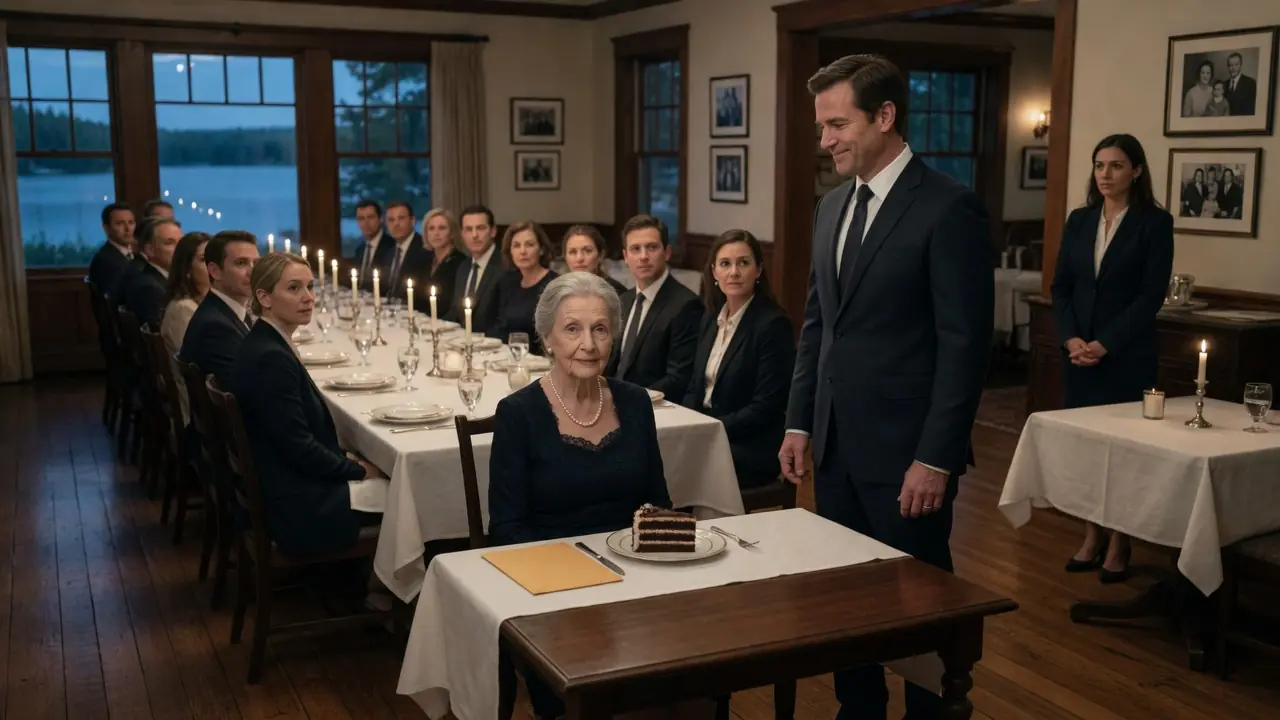
“To my mother,” Mark said, his voice carrying that smooth tone he used when closing deals. “Katherine Wells, who has given forty years of her life to this place.”
I kept my hands folded in my lap, watching him.
At forty-three, he had inherited his father’s broad shoulders, but none of his father’s gentle manner. The men in expensive suits at table six, his investors, leaned forward slightly, like dogs hearing the dinner bell.
“This is the last time we’ll celebrate together.”
The room went still.
A fork stopped halfway to someone’s mouth.
I smiled at my son, keeping my eyes steady on his face.
I had been waiting for him to say exactly those words.
“Well,” I said, standing slowly as my napkin slid to the floor. “Since we’re all here, I have an announcement too.”
But to understand what I was about to tell them, you would have to know what happened two weeks before.
The tea was getting cold in my cup, but I didn’t mind.
Lily sat across from me in the sunroom, picking at the blueberry scone I had made that morning. My granddaughter had her father’s dark hair, but her grandfather’s honest eyes, the kind that couldn’t hide much even when she tried.
“Grandma,” she said, not looking at me. “Dad’s been saying you should maybe think about slowing down.”
Through the sunroom windows, I could see the lake stretching out gray and flat under the March sky. A loon called from somewhere near the far shore, that lonesome sound that always made visitors stop and listen.
The Lake View Inn had been built right here for that view, back when my husband Tom’s grandfather thought city folks would pay good money to hear loons and eat fresh-caught fish.
“Slowing down from what?” I asked.
I had been up since five that morning, same as always, making biscuits for the breakfast guests, checking that the Phillips boy had shoveled the walkways properly.
Lily’s spoon clinked against her teacup.
“He says the inn needs a fresh start. That you’ve been carrying it all by yourself since Grandpa died.”
Tom had been gone three years now. Heart attack while splitting wood behind the carriage house. Gone before the ambulance could wind its way up the long gravel drive.
I had found him lying peaceful as you please next to the pile of maple logs, his old flannel shirt dusted with sawdust.
“Your father used to help here,” I said. “Remember summers when you were little? He’d carry luggage and show the guests where to park.”
“He remembers.”
Lily looked out at the lake.
“But he says that was different. He says now it’s too much for one person.”
I watched her face, the way she pressed her lips together when she was holding something back. That was her mother’s habit, though Julie had been gone from Mark’s life for two years now.
Another woman who couldn’t keep up with his ambitions, he had said, as if ambition were something that required speed.
“What else does your father say?” I asked.
The color rose in Lily’s cheeks.
“He says he doesn’t think you’ll be here much longer.”
Outside, a pickup truck crunched up the gravel drive. Danny Morrison delivering firewood, most likely. Or maybe Carl Jennings coming to fix the loose shutter on the east side.
The sounds of the inn going about its business the way it had for decades.
The way it would for decades more, if I had anything to say about it.
That night, I heard voices on the back porch.
Voices that didn’t belong to any of the overnight guests. I knew all their cars, and besides, guests didn’t use the family entrance.
I had been in the kitchen putting away the last of the dinner dishes when the murmur of conversation drifted through the screen door.
“In a month, she’ll be out, and the papers will be signed.”
Mark’s voice, low and confident.
I set down the dish towel and stepped closer to the door, keeping to the shadows.
“Good,” said a woman’s voice I didn’t recognize. Sharp, impatient. “The developers want to break ground by summer. They’ve already got the permits lined up.”
“Trust me, Sarah. My mother thinks I’m saving her from property taxes. She’ll sign anything I put in front of her.”
My bare feet found a loose floorboard, the one Tom had always meant to fix, and it gave the smallest creak.
I froze, but their voices continued.
“What about the historic designation?” Sarah asked. “The town council’s been making noise about protecting the old buildings around the lake.”
Mark laughed, the sound coming through the screen like cold air.
“The town council doesn’t have any real power. Besides, once the inn’s gone, there’s nothing for them to protect.”
I stepped backward away from the door, my heart hammering against my ribs like a bird trapped in a cage.
Through the window, I could see their silhouettes on the porch. Mark in his pressed khakis, gesturing with a cell phone in his hand. The woman, Sarah, leaning against the railing, her blonde hair catching the porch light.
“What about your daughter?” Sarah asked.
“Lily?”
Mark’s voice carried a dismissive note.
“She’s twenty-five and works at a nonprofit. What’s she going to do?”
They talked for another few minutes about timelines and contracts and something called transition costs, business words that turned my home into columns of numbers.
When their footsteps finally moved off the porch and around toward the front of the inn, I stayed in the kitchen, one hand gripping the edge of the counter.
The grandfather clock in the dining room chimed eleven times.
In all the years Tom and I had run this place, through busy summers and quiet winters, through good years and lean ones, I had never once felt like a stranger in my own house.
I felt like one now.
I didn’t sleep that night.
Couldn’t.
Instead, I sat at the kitchen table with a cup of chamomile tea that went cold while I stared out at the lake. The moon made a silver path across the water, the kind of view that had guests pulling out their phones for pictures they would never look at again.
Forty years Tom and I had poured into this place. Forty years of fixing burst pipes in January, of changing sheets for honeymooners, of serving breakfast to families who came back summer after summer.
Our whole life was in these walls.
The pencil marks on the pantry door where we had measured Mark’s height each birthday. The burn mark on the kitchen counter from the time I had set down a hot pan without thinking.
I could confront him. Walk right up to Mark tomorrow morning and ask him what the hell he thought he was doing.
But I knew my son.
He would put on that smooth face, the one he had learned in business school, and tell me I had misunderstood. That he was only trying to help. That maybe I should think about seeing Dr. Brennan about my memory.
No.
You don’t beat a snake by poking it with a stick.
The old house settled around me with its familiar sounds. The furnace clicking on. The refrigerator humming. The loose board in the upstairs hallway that always groaned when guests walked to the bathroom.
Sounds that said home.
Sounds that said mine.
By the time the sun came up over the lake, I knew what I had to do.
I called Harold Benson at 8:30 sharp.
Harold had been handling the inn’s legal work since before Mark was born, back when lawyers still kept their files in metal cabinets instead of computers. His secretary tried to give me an appointment for next week, but I told her it was urgent.
“Katherine.”
Harold’s voice carried concern when he picked up the phone twenty minutes later.
“Susan said you sounded upset. Everything all right?”
“I need to see you today, Harold, and I need you to bring everything you have on the inn. Property deeds, tax records, all of it.”
“Of course. Can you tell me what this is about?”
I looked out the kitchen window. Mark’s car was pulling into the driveway right on schedule. He had been coming by every few days lately, always with some excuse.
Today, it would probably be checking on the heating bills or asking about summer reservations.
“Someone’s trying to steal my home,” I said. “And I’m not going to let them.”
Mark let himself in through the front door like he owned the place, which I suppose he thought he did.
“Morning, Mom.”
He kissed my cheek, the same perfunctory peck he had given me since high school. His cologne was expensive, something woody that probably cost more than most people spent on groceries.
“How are you feeling?”
There it was.
The careful tone, like I was made of glass.
“Fine as ever. Coffee’s fresh if you want some.”
He poured himself a cup, adding cream from the little pitcher I kept on the counter. Tom used to drink his coffee black. Said cream was for people who didn’t actually like coffee.
Mark had never learned that lesson.
“I’ve been thinking,” he said, leaning against the counter, “about what we discussed. The future of this place.”
“We didn’t discuss anything, Mark. You talked. I listened.”
He smiled.
That practiced smile.
“You’re right. I should have asked for your input first. That’s why I’m here.”
I watched him over the rim of my cup.
He had his father’s height, but none of his father’s stillness. Mark was always moving, adjusting his watch, checking his phone, tapping his fingers against whatever surface was handy.
Energy without purpose.
“The thing is, Mom, this place is getting to be too much for you. The maintenance costs alone are—”
“None of your business.”
“But they are.”
He set down his cup.
“When you’re gone, I’ll inherit this place. And frankly, I can’t afford to keep it running. The property taxes have tripled in the last five years. The heating bills—”
“When I’m gone,” I said, keeping my voice level. “Planning my funeral already?”
“That’s not what I meant.”
But his face flushed, and I knew it was exactly what he meant.
“I’m trying to be practical here. The smart thing would be to sell now while the market’s good. You could buy a nice condo in town, something manageable. Maybe travel a little.”
Travel.
As if I wanted to spend my remaining years looking at other people’s homes instead of living in my own.
“I’ll think about it,” I said.
He brightened.
“Really?”
“I said I’d think about it.”
After he left, I called Lily at her office in Portland. She worked for something called the Historic Preservation Trust, which turned out to be exactly what I needed.
“Grandma, is everything okay? You never call during work hours.”
“I need to ask you something, honey, and I need you to keep it between us for now.”
A pause.
“Okay.”
“If someone wanted to protect an old building from being torn down, how would they go about it?”
“Well, there are several ways. Historic designation is the strongest protection. If a building has historical significance, it can be placed on the National Register, or sometimes there are local historic districts.”
I listened while she explained about surveys and applications, about architectural significance and community value, about how the process could take months, but once approved, made demolition nearly impossible.
“Why are you asking?” she said when she finished.
“Research,” I said. “For a friend.”
But I could hear the suspicion in her voice when she said goodbye.
Lily was smart. She would figure it out soon enough.
And when she did, I had a feeling she would be on my side.
I spent the rest of the morning walking through the inn with a notebook, writing down everything that made it special.
The hand-carved newel post at the bottom of the main staircase. The original plank flooring in the dining room. The fieldstone fireplace that Tom’s great-grandfather had built with stones from the lake shore.
By noon, I had six pages of notes, more than enough to keep any developer from putting a shovel in the ground.
At least for now.
Harold Benson’s office smelled like old leather and coffee that had been sitting too long. He spread the inn’s documents across his mahogany desk like a hand of cards, his reading glasses perched on the end of his nose.
“Everything’s in order, Katherine. The deed is clear. No liens, no complications. You own this property free and clear.”
“That’s what I thought.”
I pulled out my notebook.
“Now tell me about historic designation.”
Harold’s eyebrows went up.
“Historic designation?”
“Lily explained the basics, but I need to know the legal side. If the inn were protected as a historic property, what would that mean for any future sale?”
He leaned back in his chair, the leather creaking.
“Well, it would complicate things considerably. Depending on the level of protection, it could restrict or prevent demolition entirely. Buyers would have to preserve the historical character of the building, which would make it less attractive to developers.”
He paused.
“Significantly less attractive.”
He studied my face.
“Katherine, what’s this really about?”
I told him everything.
Mark’s late-night conversation, his dismissive attitude, the mysterious Sarah and her timeline for breaking ground.
Harold listened without interrupting, his fingers steepled in front of him.
“I see,” he said when I finished. “And you want to make the property essentially unsellable to developers.”
“I want to make sure this inn stays an inn after I’m gone.”
Harold was quiet for a long moment.
“There are other options we should consider. A conservation trust, for instance. You could transfer ownership to a trust that would preserve the property’s character in perpetuity.”
“What kind of trust?”
“An irrevocable heritage trust. You would maintain lifetime residence rights, but the property could never be developed or substantially altered. It would pass to your chosen beneficiary under the trust’s terms.”
I thought about Lily, about the way her eyes lit up when she talked about preserving old buildings, about how she had spent summers here as a child, helping me set tables and arrange flowers for the dining room.
“The beneficiary wouldn’t have to be my son.”
“Not at all. The trust creator, that’s you, designates the beneficiary.”
“How long would this take to set up?”
“A few weeks if we move quickly,” Harold said, pulling out a legal pad. “But Katherine, once it’s done, it can’t be undone. An irrevocable trust means exactly that.”
“Good,” I said. “Let’s do it.”
That afternoon, I drove to the town hall to file the historic designation application. The clerk, a young woman named Jessica who had been in my Sunday school class years ago, smiled when she saw me.
“Mrs. Wells, what brings you here?”
“I want to apply for historic protection for the Lake View Inn.”
“Oh, what a wonderful idea. That place is such a landmark. My grandmother used to take me there for birthday dinners when I was little.”
She handed me a stack of forms that looked thick enough to choke a horse.
“Fair warning, the process can take several months. The historic commission has to review everything. Sometimes they require additional documentation.”
“That’s fine,” I said. “I’m not in a hurry.”
But I was thinking about Mark’s timeline.
One month, he had said.
Papers signed by summer.
We would see about that.
That evening, Lily called.
“Grandma, I’ve been thinking about our conversation today, about your friend who needs historic protection.”
Her voice carried that knowing tone she had inherited from her grandfather.
“This friend wouldn’t happen to live at a certain lakeside inn, would she?”
I sighed.
“You always were too smart for your own good.”
“Dad’s been pushing you to sell, hasn’t he?”
“Your father thinks he knows what’s best for everyone.”
“And you don’t agree.”
“I think,” I said carefully, “that people should get to decide their own futures.”
There was a pause.
“What can I do to help?”
“I need you to be my eyes and ears,” I told Lily. “Your father doesn’t watch what he says around you. He never has.”
I could hear the hurt in her voice.
“To him, I’m just the kid who couldn’t make it in the real world.”
That stung.
Mark had always been dismissive of Lily’s work, calling it “playing with old buildings” when she told him about her job, as if preserving history was somehow less important than whatever deal he was chasing that week.
“Your work is going to save this place,” I said. “And I need to know everything he’s planning.”
Over the next few days, Lily fed me information like a spy passing secrets.
Mark had been meeting with investors at the marina in town, showing them photographs of the inn and talking about development potential. He had told them the sale was practically guaranteed, that it was just a matter of waiting for the right moment.
“He’s got them believing you’re some doddering old woman who can’t manage her own affairs,” Lily reported after overhearing one of these conversations. “One of them actually asked if you’d been declared incompetent yet.”
My hand tightened on the phone.
“Is that what your father told them?”
“Not in so many words, but he didn’t correct them either.”
I thought about Mark as a boy. How he would sit at the kitchen table doing homework while I cooked dinner for the guests. How proud he had been the day he graduated college, the first in Tom’s family to get a degree.
When had he learned to think of people as obstacles instead of people?
“There’s something else,” Lily said. “He’s been asking me about your daily routine. What time you get up, when you go to bed, whether you’ve been forgetting things.”
“Building a case.”
“That’s what it sounds like.”
She paused.
“Grandma, what if he tries to have you declared incompetent? Could he do that?”
I thought about Harold’s reassurances, about the trust documents sitting in his safe, about the historic designation application slowly working its way through the town bureaucracy.
“He can try,” I said. “But he’s in for a surprise.”
The next morning, Mark called with news that made my blood run cold.
“Mom, I’ve been talking to some people, and I think we should have you evaluated by a specialist. Dr. Morrison at the medical center does cognitive assessments.”
“I don’t need a cognitive assessment.”
“Just to be safe. You know, establish a baseline for insurance purposes.”
Insurance purposes.
The way he said it, so smooth and reasonable, made me want to throw the phone across the room.
“I’m seventy-three years old, Mark, not ninety-three. My mind is fine.”
“Of course it is. But wouldn’t it be good to have that documented in case you ever need care or if there are legal questions down the road?”
Legal questions.
There it was.
“I’ll think about it,” I said, the same words I had been giving him for weeks.
But this time, I had a plan.
I called Dr. Brennan that afternoon. George Brennan had been my physician for twenty years, had seen me through Tom’s death and my own minor health scares.
If anyone could vouch for my mental state, it was him.
“Katherine,” he said when I explained what I needed, “you want me to formally assess your cognitive function.”
“I want documentation that I’m of sound mind in case someone tries to claim otherwise.”
There was a pause.
“Is there something I should know about?”
“Let’s just say I want all my ducks in a row.”
The appointment was scheduled for the following week.
In the meantime, I had one more call to make.
“Harold,” I said when he picked up, “I want to add something to my will. If anyone ever challenges my mental competency, I want it on record that I was evaluated by my physician and found to be completely sound.”
“Covering all the bases,” he said approvingly. “Smart thinking.”
Smart thinking.
Yes, it was.
Mark had taught me that, actually, back when he was young and still believed in doing the right thing. He had shown me how important it was to plan ahead, to think through all the possibilities.
I just don’t think he expected me to use those lessons against him.
The cognitive assessment with Dr. Brennan went exactly as I had hoped. Twenty-six out of thirty on the mental status exam, perfect recall on recent events, and a blood pressure reading that would make a woman half my age jealous.
“Katherine, you’re sharper than most people I see,” Dr. Brennan said, signing the evaluation form. “Whoever suggested you needed this assessment clearly doesn’t know you very well.”
“My son is concerned about my ability to manage my affairs.”
Dr. Brennan’s pen stopped moving.
He had known Mark since he was a boy, had treated him for everything from strep throat to a broken arm from falling out of the old oak tree by the lake.
“I see,” he said carefully. “Well, you can tell your son that, in my professional opinion, you’re fully competent to make your own decisions. I’ll file this with your medical records, and I’ll give you a copy for your files.”
I tucked the letter into my purse next to Harold’s business card and the historic designation receipt.
My armor was getting heavier, but I felt lighter somehow.
That afternoon, Mark called with news that made him sound positively giddy.
“Mom, great news. I found a buyer who’s willing to close quickly. Cash offer, no inspection needed, and they’re offering twenty percent over market value.”
Twenty percent over market value.
The greed in his voice was so thick, I could practically taste it through the phone.
“That’s very generous of them.”
“It is. The thing is, they want to move fast. Like next week fast. I told them that might be tight, but—”
He paused, probably calculating commission rates in his head.
“I think we should seriously consider it.”
“Next week?”
“I know it sounds rushed, but Mom, this is the kind of offer you don’t see every day. These developers, they’ve got projects lined up all around the lake. They’re willing to pay premium prices to get the properties they want.”
Developers.
He had finally said it out loud.
“What kind of development?” I asked, though I already knew.
“Luxury condos, high-end vacation rentals, the kind of thing that would really boost the local economy.”
The local economy.
As if tearing down a hundred-year-old inn and putting up condos was some kind of community service.
“I’ll need to think about it, Mark.”
“Of course, but don’t think too long. They made it clear this offer has an expiration date.”
After he hung up, I sat in the kitchen, staring out at the lake. A pair of loons floated near the dock, their black and white patterns stark against the dark water.
They had been coming to this lake for longer than the inn had existed, longer than the first settlers had arrived.
They knew this place belonged to them.
So did I.
I called Lily at work.
“They’re moving faster,” I told her. “Next week, your father says.”
“Next week?”
Her voice went up an octave.
“But the trust isn’t finalized yet. The historic designation is still pending.”
“I know.”
I watched the loons dive and surface.
Dive and surface.
“Which means we need to move faster too.”
“What do you need me to do?”
“I need you to find out exactly who these investors are. Names, company information, everything you can dig up. And I need you to do it today.”
“Consider it done.”
That evening, Mark stopped by with a bottle of wine and a folder full of papers.
“I thought we could celebrate,” he said, pulling out a chair at the kitchen table. “And maybe go over some of the paperwork, just so you know what to expect.”
The wine was expensive, something French with a label I couldn’t pronounce. The papers were purchase agreements, disclosure forms, title transfer documents, everything needed to sell the inn except my signature.
“You’ve been busy,” I said, flipping through the stack.
“I wanted to be ready. You know how these deals can fall through if you don’t move quickly.”
I poured myself a small glass of wine and pretended to study the contract terms. Mark watched me with the intensity of a cat watching a mouse hole.
“The closing is scheduled for Friday,” he said. “At Johnson and Associates downtown. Very routine. Shouldn’t take more than an hour.”
Friday.
Four days away.
“That does seem fast.”
“Like I said, they’re motivated buyers.”
He leaned forward.
“Mom, this is our chance to set you up for the rest of your life. You could buy a nice place in town. Maybe that new senior community they’re building near the medical center. You’d have neighbors, activities, people to look after you.”
People to look after me.
As if I were a houseplant that needed watering.
“It sounds wonderful,” I said.
And for the first time since this whole mess started, I meant it.
It did sound wonderful.
For him.
Lily called the next morning while I was making breakfast for the three guests staying in the upstairs rooms. The Hendersons from Boston, here for their fortieth anniversary, and Mrs. Blake, a widow who came every spring to paint watercolors of the lake.
“I found them,” Lily said, her voice tight with anger. “Clearwater Development Group. They’re the ones who tore down the old Morrison farmhouse last year to build those ugly townhouses.”
I flipped a pancake and watched it land perfectly golden.
“What else?”
“They specialize in lakefront acquisitions, which is a fancy way of saying they buy old properties and flatten them. The company’s registered to James Kirkland. And this is the interesting part. Sarah Kirkland.”
“Sarah.”
The woman from the porch that night.
“His wife and business partner, according to the state records. And get this, they’ve got three other properties under contract around the lake. All old places, all being sold by family members who claim the maintenance is too much.”
I slid the pancakes onto a plate and added two strips of bacon. Mrs. Blake liked her breakfast light, but the Hendersons were hearty eaters.
“Any connection to your father?”
“Working on it. But Grandma, there’s something else. I called the town planning office yesterday asking about development permits around the lake. The clerk let slip that Clearwater has been working with someone local, someone who’s been identifying properties for them.”
Someone local.
My stomach tightened.
“I think we both know who that someone is,” I said.
After breakfast, I drove into town to see Harold. His secretary ushered me into his office immediately, which told me he had sensed the urgency in my voice when I called.
“The trust documents are ready,” he said, pulling a folder from his desk drawer. “I’ve reviewed everything three times. Once you sign these, the inn becomes the property of the Katherine Wells Heritage Trust. With you as lifetime beneficiary and Lily as successor trustee, no one can sell it, develop it, or substantially alter it without violating the trust terms.”
“And if someone tries?”
“They would face federal charges. Heritage trusts are protected under federal law.”
I picked up the pen.
“What if I’ve already signed something else? Hypothetically.”
Harold’s eyebrows drew together.
“What kind of something else?”
“A purchase agreement. Sale contract.”
“Katherine, you can’t sell property you don’t own. Once this trust is executed, you don’t own the inn anymore. The trust does. Any prior agreement would be void, even if the buyer thinks they have a legal contract. Especially then. They would have grounds to sue whoever misrepresented the ownership.”
He leaned forward.
“Katherine, please tell me you haven’t signed anything yet.”
“Not yet.”
I signed my name on the trust documents, each signature feeling like a small victory.
“But I might.”
That afternoon, Mark called with barely contained excitement.
“Mom, I have incredible news. The buyers want to meet you tomorrow. Just a quick introduction. Sign the papers and we can close on Friday as planned.”
“They want to meet me.”
“It’s a courtesy thing. Big sale like this. They like to shake hands with the seller. Very professional people.”
Professional people who tore down historic farmhouses and built ugly townhouses.
“Where?”
“I thought we could meet at the inn. Let them see what they’re buying. Maybe around two.”
Two.
That would give me time to prepare.
“That sounds fine,” I said.
“Great. Oh, and Mom, you might want to tidy up a bit. Maybe put away some of the clutter. First impressions matter.”
Clutter.
As if the photographs of four generations of guests, the handmade quilts from local artists, the antique furniture Tom and I had collected over the years, as if all of that was just clutter to be swept away.
“I’ll make sure everything looks nice,” I said.
After he hung up, I called Lily.
“Tomorrow at two,” I told her. “Can you be here?”
“Wouldn’t miss it.”
She paused.
“Grandma, are you sure about this? Once you confront them, there’s no going back.”
I looked around the kitchen at the copper pots hanging from their hooks, at the recipe box full of cards written in my mother’s careful handwriting, at the window that looked out over the lake where Tom had proposed forty-seven years ago.
“Honey,” I said, “there was no going back the minute I heard your father planning to steal my home.”
That night, I made a list, not of what I wanted to say, but of what I wanted them to understand.
The difference between a house and a home.
Between property and heritage.
Between what something costs and what it is worth.
By the time I went to bed, I knew exactly how this was going to go.
They arrived in a black BMW that crunched up the gravel drive like it owned the place.
Mark got out first, straightening his tie, followed by a blonde woman in a sharp business suit and a tall man with silver hair who moved like he was used to people getting out of his way.
“Mom, I’d like you to meet Sarah and James Kirkland from Clearwater Development.”
Sarah’s handshake was firm and professional.
“Mrs. Wells, what a lovely property. You must have wonderful memories here.”
James spread architectural drawings across my dining room table like he was claiming territory.
“We’re very excited about this project. The plans are quite spectacular.”
I looked down at the drawings where my inn stood now.
They had sketched a complex of luxury condos, glass and steel rising from the lake shore, a marina where the old dock stood, parking lots where Tom’s vegetable garden had been.
“Demolition starts Monday,” James said cheerfully. “We’ve got the crews lined up, permits in place. Very efficient timeline.”
Monday.
Three days after the closing.
“We’ve done our homework,” Sarah added. “The architectural survey confirms the existing structure has no historic value. Makes everything much simpler.”
No historic value.
I thought about my application sitting in some clerk’s inbox at the town hall.
“The best part,” Mark said, “is how quickly everything can move once the papers are signed tomorrow. By summer, this whole area will be transformed.”
I stared at the drawings until the lines blurred together.
They had planned everything down to the last detail.
“Mrs. Wells.”
Sarah’s voice seemed to come from very far away.
“Do you have any questions about the project?”
I looked up from the drawings, forcing a smile.
“Actually, I do have one request. Tomorrow is my seventy-fourth birthday, and I’m having a small celebration here at the inn. Nothing fancy, just family and friends. I’d love for you both to join us.”
Sarah and James exchanged glances.
“That’s very thoughtful,” Sarah said.
“It seems appropriate,” I continued, “to celebrate one last time before everything changes. Seven o’clock. We’ll have dinner in the dining room.”
“We’d be honored,” James said. “What a lovely way to mark the transition.”
Mark beamed like I had just handed him a gift.
“Mom, that’s a wonderful idea. A real celebration.”
After they left, I sat alone at the dining room table, staring at the drawings they had forgotten to take.
Tomorrow night, they would understand exactly what kind of celebration this was going to be.
The phone rang.
Mark, probably wanting to confirm details.
I didn’t answer.
Friday morning came with the kind of crisp spring air that made the lake sparkle like scattered diamonds.
I was up before dawn, same as always, but today felt different. Today felt like the first day of something instead of the last.
I called the caterer in town, Jenny Morrison, whose mother used to clean rooms at the inn back when Jenny was in high school.
“Mrs. Wells, happy birthday. Everything’s ready for tonight. Prime rib, roasted vegetables, and that chocolate cake you requested.”
The cake had been Tom’s favorite.
Seemed fitting.
Mark called at 8:30.
“Mom, I just wanted to confirm everything’s set for tonight. The Kirklands are really looking forward to it.”
“I’m sure they are.”
“And tomorrow morning, we’ll meet at Johnson and Associates at ten sharp. I’ve got all the paperwork ready. Shouldn’t take more than an hour to finalize everything.”
“About that, Mark.”
“I know. I know it’s a big step. But Mom, this is really the best thing for everyone involved.”
Best thing for everyone.
I watched Mrs. Blake pack her easel into her car, heading home to Boston with three new watercolors of the lake. She had been coming here for fifteen years. Always the same room, always the same view from her window.
“I’ll see you tonight,” I told Mark.
By five o’clock, the dining room was transformed. White tablecloths, the good china that only came out for special occasions, candles in the silver holders that had belonged to Tom’s grandmother.
Jenny had outdone herself. The prime rib smelled like heaven, and the chocolate cake sat on the sideboard like a crown jewel.
Lily arrived early, looking nervous but determined.
“How are you feeling, Grandma?”
“Like a woman about to have the best birthday of her life.”
She hugged me tight.
“I still can’t believe they’re actually coming tonight.”
“Honey, the mouse always comes to the cheese.”
Guests began arriving at seven.
The Hendersons, who decided to extend their stay another night. Dr. Brennan and his wife. Harold Benson, with a wrapped gift under his arm. Old friends from church. Neighbors from around the lake. People who had known me and Tom for decades.
And at 7:15, right on time, Mark walked in with Sarah and James Kirkland.
“Happy birthday, Mom.”
Mark kissed my cheek and handed me a bouquet of roses.
“To many more.”
Sarah offered a wrapped jewelry box.
“Just a little something to commemorate the day.”
I set both gifts aside without opening them.
There would be time for gifts later.
By 7:30, all thirty guests were seated, the room humming with conversation and the clink of silverware against china. Mark kept checking his watch, probably calculating how many hours until he could get my signature on those papers.
The irony was delicious.
At eight o’clock, I stood and tapped my spoon against my water glass. The room quieted, faces turning toward me with expectant smiles.
“Thank you all for being here tonight,” I began. “Birthdays at my age are about more than just marking another year. They’re about celebrating what matters most.”
Murmurs of agreement.
A few “hear, hear” comments from the back of the room.
Mark raised his wine glass.
“Before you continue, Mom, I’d like to say something.”
I nodded graciously.
“Of course, dear.”
He stood, that practiced smile spreading across his face.
“To my mother, Katherine Wells, who has given forty years of her life to this place.”
The room was silent, waiting.
“This is the last time we’ll celebrate together.”
Conversation stopped midsentence.
Someone set down their wine glass with a soft clink.
I smiled at my son, keeping my eyes steady on his face.
I had been waiting for him to say exactly those words.
“Well,” I said, standing slowly as my napkin slid to the floor. “Since we’re all here, I have an announcement too.”
Mark’s smile faltered slightly.
Across the table, Sarah and James leaned forward with polite interest.
“You’re absolutely right, Mark. This is the last time we’ll celebrate together, but not for the reason you think.”
I reached into my purse and pulled out a manila envelope.
“Two weeks ago, I discovered something interesting. My son has been working as a property scout for Clearwater Development, identifying old homes around the lake for demolition.”
Sarah’s wine glass froze at her lips.
James’s fork clattered against his plate.
“He’s been telling people, including his investors here tonight, that I’m a doddering old woman who can’t manage my own affairs. That I’d sign anything he put in front of me.”
Mark’s face had gone white.
“Mom, what are you—”
“Quiet, dear. I’m not finished.”
I opened the envelope and pulled out the first document.
“This is a cognitive assessment from Dr. Brennan, completed three days ago. Perfect score. Fully competent to make my own decisions.”
Dr. Brennan raised his coffee cup in a small salute.
Several guests chuckled.
“This,” I continued, pulling out the second document, “is the deed to the Lake View Inn, transferred into the Katherine Wells Heritage Trust. Irrevocable. Protected under federal law. The inn can never be sold, developed, or substantially altered.”
James half rose from his chair.
“What are you saying?”
“I’m saying your demolition crews can go home, Mr. Kirkland. There’s nothing for them to tear down.”
The room erupted in murmurs.
Mark’s mouth opened and closed like a fish gasping for air.
“And this,” I said, pulling out the third paper, “is my updated will. Everything I own, including my rights in the Heritage Trust, passes to my granddaughter, Lily, who works for the Maine Historic Preservation Trust and understands the value of protecting our heritage.”
Lily’s eyes filled with tears. She started to stand, but I held up my hand.
“I’m still not finished.”
I turned to face Sarah and James directly.
“You see, I know about the Morrison farmhouse you destroyed. I know about the three other families you’ve convinced to sell their heritage for your profit. And I know that my son has been your inside man, feeding you information about vulnerable property owners.”
Sarah’s composure cracked.
“This is absurd. We have a signed purchase agreement.”
“You have a worthless piece of paper,” Harold Benson said from table four, his voice carrying the authority of forty years of legal practice. “Mrs. Wells can’t sell property she doesn’t own. Any contracts based on false representation of ownership are null and void.”
Mark found his voice.
“Mom, you can’t do this. The deal is already—”
“The deal is dead, Mark.”
I folded the papers and put them back in the envelope.
“Just like your access to this family.”
The silence stretched like a held breath.
Then Mrs. Henderson started clapping.
Dr. Brennan joined in.
Soon the whole room was applauding, except for three people who sat frozen in their chairs.
James stood abruptly.
“This isn’t over. We’ll sue for fraud. Misrepresentation.”
“You’ll lose,” Harold said cheerfully. “I’d be happy to recommend some good lawyers for when that happens.”
Sarah grabbed James’s arm.
“We need to leave.”
They pushed back from the table, James’s chair scraping against the old wooden floor. Mark started to follow them, then stopped, turning back to me with something like desperation in his eyes.
“Mom, please. We can work this out. There has to be a way.”
“There is a way,” I said. “You can apologize to your daughter for dismissing her life’s work. You can apologize to me for trying to steal my home. And you can learn to live with the consequences of your choices.”
He stared at me for a long moment, then shook his head.
“You’ll regret this.”
“The only thing I regret,” I said, “is raising a son who thinks love is something you can foreclose on.”
After they left, Mark following the Kirklands out into the night like a lost dog, the party found its rhythm again. People wanted to hear the whole story. They wanted to see the trust documents, to understand how I had outmaneuvered three people who thought they were so much smarter than one old woman.
“To Katherine Wells,” Harold said, raising his glass, “who just taught us all a lesson about underestimating our elders.”
“To Grandma,” Lily added, her voice thick with emotion, “who saved our family’s home.”
The toasts went on for another hour, but the best moment came later, when most of the guests had gone home and only Lily and I remained in the dining room, surrounded by empty plates and flickering candles.
“I can’t believe you did it,” she said. “I can’t believe you actually beat them.”
I looked around the room at the hand-carved woodwork, at the windows that framed the moonlit lake, at the grandfather clock that had been keeping time in this house since before any of us were born.
“Honey,” I said, “they never had a chance. This is my home. You don’t beat someone on their own ground.”
Outside, the loons called across the dark water, their voices carrying the sound of things that endure, things that know where they belong, things that aren’t for sale.
Later, after Lily had gone home and the inn was quiet again, I sat on the back porch with a cup of tea and Harold’s birthday gift, a bottle of champagne he had been saving for a special occasion.
The lake stretched out black and silver under the moon, peaceful as a prayer. Somewhere in the distance, a loon called to its mate, and the answer came back clear and sure.
I raised my glass to the empty chair beside me, the one where Tom used to sit on nights like this, planning improvements to the inn or just watching the water change color with the sky.
“We did it, old man,” I said to the night air. “Nobody’s taking our home.”
The champagne was excellent, French and expensive, the kind Mark would have appreciated if he had stuck around long enough to taste it.
But some victories are meant to be savored alone.