For one long moment, the whole kitchen seemed to stop breathing.
The casseroles from neighbors sat untouched across the counter, covered in foil and handwritten labels.
Henry’s favorite coffee mug rested beside the sink, exactly where he had left it three mornings before he went into the hospital for the last time.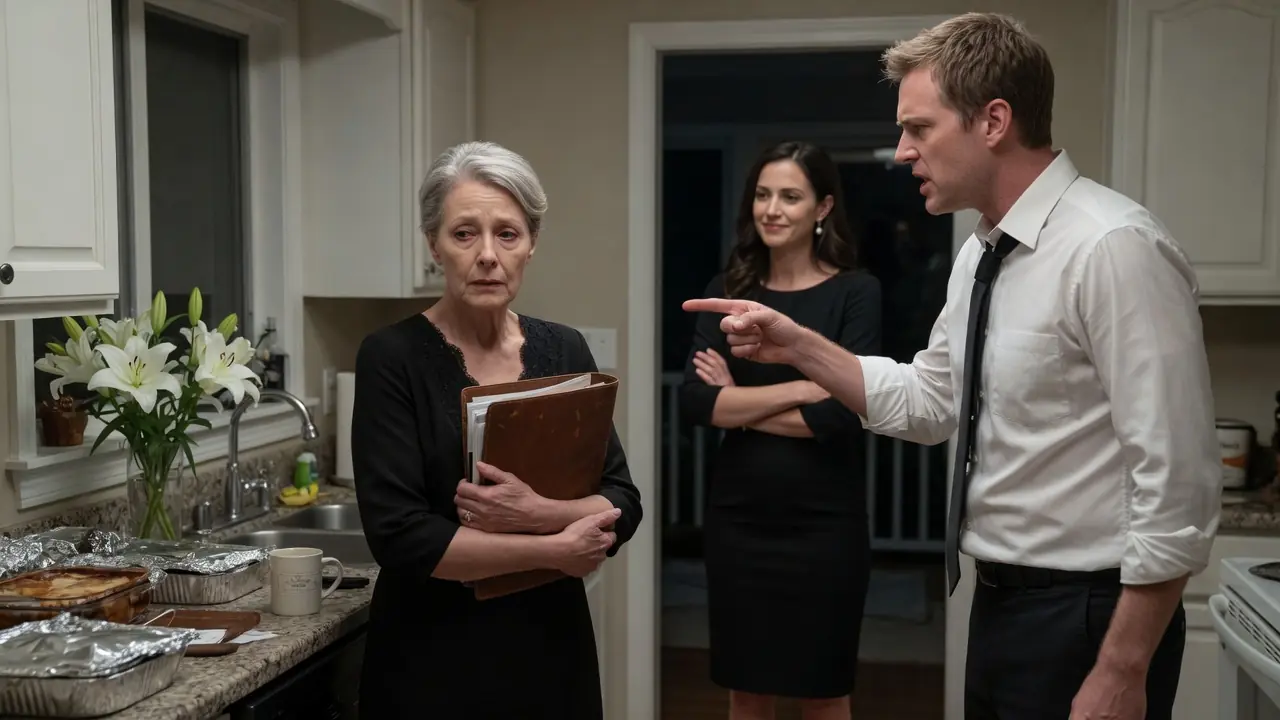
My cheek burned.
My heart burned worse.
My son, Chase Hollowell, stood in front of me with his tie loose, his jaw tight, and his eyes full of a hunger that had nothing to do with grief. Behind him, his wife, Talia, leaned against the doorway with her arms folded, watching me like a woman waiting for a tenant to accept eviction.
They thought grief would make me weak.
They did not know that grief had only made me quiet.
And quiet, in my life, had never meant helpless.
My name is Mina Hollowell. I was sixty-eight years old when my husband, Henry, died, and until the day of his funeral, I believed our only child still remembered what kind of man his father had been. Henry was careful, decent, patient, and stubborn about paying bills before buying comfort. He believed that a home was not a thing you took from someone. It was a thing you protected for the people you loved.
He protected ours for thirty-one years.
The house stood on Briarwood Lane in Charlotte, North Carolina, a two-story brick home with white shutters, a deep front porch, and azaleas that bloomed pink every spring beside the walkway. Henry and I bought it when Chase was seven years old. We did not inherit it. We did not win it. We built our lives around the monthly payment, year after year, through overtime, careful grocery lists, canceled vacations, and the kind of discipline that does not look romantic until decades later.
Henry used to call it our “slow miracle.”
I used to laugh at that.
But he was right.
The house was not grand, but it carried everything. Chase’s height marks penciled inside the pantry door. The dent in the hallway wall from the year he learned to ride a scooter indoors. The kitchen table where Henry taught him multiplication. The upstairs bedroom where I sat through storms when Chase was little because thunder frightened him, and he did not want to admit it.
It was home.
Not an investment opportunity.
Not an inheritance waiting for my death.
Home.
The air inside St. Mark’s Episcopal Church that afternoon had been heavy, chilled by the hum of the air conditioning and thick with the smell of lilies. I stood near the front pew, clasping the folded funeral program between my palms. Henry’s name looked too final printed in black ink, framed by verses that promised peace I could not yet feel.
Henry Thomas Hollowell.
Beloved husband, father, neighbor, and friend.
Seventy-two years old.
The dates beneath his name seemed impossible. A whole life reduced to two numbers and a dash. A dash that held our wedding day, Chase’s birth, thirty-nine Christmas mornings, every argument, every forgiveness, every bill paid, every room repaired, and the last night Henry squeezed my hand and told me not to let anyone make me feel small when he was gone.
At the time, I thought he was speaking generally.
Now I wonder if he saw more than he told me.
Neighbors, former coworkers, church friends, and distant cousins passed by in soft waves. Their condolences blurred together. “So sorry, Mina.” “He was a good man.” “Henry helped me more than once.” “You call if you need anything.” I nodded and thanked them because that was what widows were expected to do. We become managers of other people’s discomfort before we have even learned how to carry our own loss.
But even in grief, my eyes kept drifting toward the corner.
Chase stood there with Talia.
My son wore a black suit that Henry had helped him buy years earlier for job interviews. Talia wore a fitted black dress, pearls, and a small veil pinned into her hair. From a distance, they looked appropriately solemn. Up close, they looked occupied.
Not mourning.
Planning.
I had spent thirty-seven years as an accountant before retiring. Numbers had been my profession, but people had become my unofficial study. I had learned to recognize the difference between confusion and concealment, between worry and calculation, between grief and greed pretending to lower its eyes.
Chase leaned toward Talia.
“Equity’s strong right now,” he muttered.
His voice was low.
Not low enough.
Talia answered without looking at me.
“Seller’s market. We redo the kitchen fast, get granite, stainless appliances. Modern buyers want clean lines.”
The words cut deeper than any hymn comforted.
Equity.
Seller’s market.
Granite.
They were not speaking of Henry’s life. Not the father who had driven Chase to baseball practice in a truck with no air conditioning. Not the man who had once worked three Saturdays in a row so Chase could attend a summer science program. Not the husband whose hand I had held as his breathing slowed.
They were speaking of the house.
The house Henry and I had built payment by payment, year after year, with sacrifices Chase had either forgotten or never bothered to see.
I pressed the funeral program tighter in my hands.
Grief has a way of hollowing you out.
Betrayal fills the hollow with fire.
Still, I said nothing.
There are times to confront and times to collect evidence. Henry used to say every problem had a moment where emotion wanted to speak first, but wisdom needed ten more minutes. I gave wisdom more than ten. I gave it the rest of the funeral.
At the graveside, Chase stood beside me while the pastor spoke about dust, mercy, and eternal rest. I watched the casket lower and felt something in me descend with it. When the first shovel of earth sounded against the lid, Talia dabbed at dry eyes with a handkerchief.
Chase did not touch my shoulder.
Not once.
Afterward, at the house, neighbors filled the kitchen with food. Foil pans of macaroni, baked chicken, green beans, banana pudding, lemon cake, potato salad, and more casseroles than any widow could eat in a month. Mrs. Alvarez from across the street held my hand for a long time near the sink.
“You come stay with me tonight if you need to,” she whispered.
I almost said yes.
Then I looked toward the living room where Chase and Talia were speaking to a man I did not recognize, a man in a navy blazer with a real estate company pin on his lapel.
“No,” I said softly. “I need to stay here tonight.”
Mrs. Alvarez followed my gaze.
Her mouth tightened.
“She always watches the walls like she’s measuring them.”
I looked at her.
“Talia?”
Mrs. Alvarez nodded.
“And Chase lets her.”
That was the first time someone said aloud what I had been trying not to name.
By evening, the guests had gone.
The house settled into a silence that did not feel peaceful. It felt watched. The kind of silence that enters after people leave but their intentions remain behind.
I stood in the kitchen, still wearing the black dress, still holding myself upright because I feared if I sat down, I might not get back up.
That was when Chase cornered me.
“Mom,” he began.
The word sounded formal.
Not tender.
Not grieving.
Just a label placed at the start of an unpleasant transaction.
I turned toward him.
“Yes?”
He glanced at Talia, who stood in the doorway with one shoulder against the frame.
“You should pack up.”
I stared at him.
“I’m sorry?”
“This house is my inheritance,” he said. “You can’t just stay here alone. Talia and I need it now.”
Need it now.
Those words nearly made me laugh from the sheer ugliness of them.
“Chase,” I said carefully, “we buried your father today.”
His face tightened.
“I know that.”
“Do you?”
Talia stepped forward.
“Mina, don’t make this emotional.”
I looked at her.
“My husband is dead. I am allowed emotion.”
Her eyes narrowed, but she stayed quiet.
For the moment.
I turned back to Chase.
“This is my home. Your father and I—”
His hand cut through my words.
The impact cracked across my cheek, sharp and hot.
For a second, I heard nothing.
No refrigerator hum.
No hallway clock.
No breath.
My knees weakened, but I caught the edge of the counter and refused to fall.
I had seen anger in Chase before. As a boy, he had thrown tantrums when told no. As a teenager, he slammed doors. As a man, he had developed the smoother cruelty of someone who believed apologies were optional if he felt justified enough.
But this was different.
This was not anger.
This was entitlement finally removing its mask.
“Get out,” he bellowed. “This was never your home. It’s ours, and you’re just in the way.”
Behind him, Talia smiled.
Not widely.
Just enough.
Her voice was quiet, poisonous.
“You’re nothing here but dead weight. It’s time.”
Shock froze me, but my mind did not empty.
It sharpened.
That was something years of ledgers had taught me. When numbers go wrong, panic is useless. You do not scream at the page. You find the error. You trace the line. You locate the assumption that failed.
My son had made one very large assumption.
He thought grief had made me powerless.
I said nothing.
Sometimes silence is not weakness.
Sometimes it is calculation.
Without another word, I walked past them, down the hall, and into the bedroom Henry and I had shared for thirty-nine years. I took one small suitcase from the closet. I packed two changes of clothes, my medication, Henry’s watch, my wallet, the old leather folder from the top shelf, and the flash drive where I kept scanned copies of our most important records.
Then I opened Sarah’s old cedar box.
No, not Sarah.
That was another woman’s name from another life.
My box held no romance now. Only survival.
Inside, beneath Henry’s cuff links, our wedding photo, and a folded letter he had written me on our thirtieth anniversary, were the documents Chase had never bothered to understand.
The deed.
The mortgage note.
The home equity line agreement.
Henry Hollowell and Mina Hollowell.
Husband and wife.
Borrowers of record.
Tenants by the entirety.
Then, by survivorship, mine.
I slid them into the leather folder.
When I walked back through the kitchen, Chase stood with his arms crossed, trying to look like a man who had won something.
Talia did not move from the doorway.
“Where are you going?” Chase demanded.
“You told me to get out.”
His expression flickered.
He had wanted begging.
Perhaps tears.
Perhaps a performance of weakness that would make his cruelty feel less dangerous.
I gave him none of it.
I stepped onto the porch and closed the door behind me.
The house, my house, stood behind me in the dark, its windows reflecting my disbelief back at me. For a moment, I stood under the porch light with my suitcase in one hand and Henry’s watch ticking cold against my wrist.
Then I walked to my car.
The motel smelled of disinfectant and despair.
The kind of place people stay when life has broken too suddenly for better arrangements. Neon buzzed outside the window, casting harsh pink light against the thin curtains. The bedspread was scratchy. The air conditioner rattled. Somewhere down the hall, an ice machine groaned and dropped cubes into plastic emptiness.
I set my suitcase on the bed and locked the door.
My cheek still burned, but my hands were steady.
At 3:07 a.m., after hours of staring at the ceiling, I opened my laptop and logged into the bank portal.
The numbers lit up like small beacons of truth.
First mortgage: Henry Hollowell and Mina Hollowell.
Home equity line: Henry Hollowell and Mina Hollowell.
Autopay: Mina Hollowell checking account.
Mailing address: Briarwood Lane, the house.
Authorized users: none.
Chase’s name appeared nowhere.
Not once.
Relief and fury braided together inside me.
I took screenshots of every balance, every payment history line, every confirmation. I downloaded statements from the last twelve months, then the last twenty-four. I opened the folder Henry had always kept too organized for anyone’s liking, and I smiled despite everything because his neatness now felt like one last act of love.
Henry believed in paper.
“Paper beats memory,” he used to say. “Memory gets emotional. Paper stays put.”
By the time the first hints of dawn pressed against the motel curtains, I had created a digital folder labeled: Briarwood Evidence.
Inside it went the mortgage statements.
The HELOC agreement.
The deed.
The screenshots.
Photos of my cheek taken under the harsh bathroom light.
A typed account of what happened after the funeral, with the date, time, location, and exact words I remembered.
Then I pulled out the motel notepad and wrote four words.
Bank.
Freeze.
Inspection.
Evidence.
I set a 7:30 a.m. alarm on my phone.
The label I gave it was simple.
Own the Note.
Henry’s watch ticked softly on the nightstand.
For the first time since the funeral, I smiled.
Not with joy.
With steel.
Morning light spilled across the polished wooden tables of the Copper Cup, a café in Dilworth where young professionals tapped away at laptops and mothers compared strollers near the front window. I sat in the corner with my own laptop, Henry’s worn leather folder, and a legal pad already bearing the faint ring of my cappuccino cup.
Nobody gave me a second glance.
To them, I was only a silver-haired widow in black slacks, sitting alone with paperwork.
They did not know I was building a wall around my life one document at a time.
One by one, I laid out the papers.
Marriage certificate.
Henry’s death certificate, still creased from too many hands.
Mortgage statements showing every payment made on time, never late, not once in twenty-six years.
Home equity line documents.
Insurance records.
My driver’s license.
The deed showing Henry’s and my ownership.
These were not just documents.
They were weapons.
At 8:31, I dialed the bank.
After the polite maze of recorded options, a calm male voice came on the line.
“This is Carter, branch manager. How can I help you today?”
I steadied my tone.
“Mr. Carter, this is Mina Hollowell. There is a residency and occupancy dispute concerning my home. There has also been what I believe may qualify as elder abuse. I need administrative protections placed while you verify borrower status.”
There was a pause.
Then the quiet clicking of keys.
“Mrs. Hollowell, I see you are a named borrower.”
“Yes,” I said. “My husband and I signed both the mortgage and the home equity line. He passed away last week. I am the surviving borrower. My son has entered and remained in the property without my consent and has attempted to take control.”
More typing.
“I understand. First, I’m very sorry for your loss.”
“Thank you.”
“Second, we need to protect the collateral and account integrity. What action are you requesting?”
“I want autopay on the first mortgage temporarily canceled until I confirm the payment source and mailing address. I request suspension of all HELOC draws until you complete identity and occupancy verification. I also want all third-party communication restricted.”
“That is reasonable under these circumstances,” he said, his voice tightening with professional seriousness. “I will flag this for administrative hold and schedule a property inspection. We will also add enhanced identity verification so no one else can call in and attempt to impersonate you.”
“Good.”
“Would you like your mailing address changed?”
“Yes,” I said firmly. “Send everything to my P.O. box from now on. No exceptions.”
As he typed, I imagined Chase standing in my kitchen, dreaming of countertops and open floor plans, unaware that the foundation beneath his fantasy was already slipping.
Mr. Carter gave me a secure email address for documents. I scanned each page with an app on my phone and sent everything within fifteen minutes. Then I added screenshots of text messages Chase had sent after I left the house.
Get out, Mom. You’re done here.
Don’t make this ugly.
Dad’s gone. Stop acting like you own everything.
You have until Sunday to get the rest of your stuff.
My hand trembled as I attached the files.
Not with fear.
With anger distilled into purpose.
Before closing the folder, I dialed another number.
“Mrs. Alvarez,” I said when her voicemail picked up, “it’s Mina. I know you may have seen part of what happened through your kitchen window last night. If you are willing to make a statement, I would be grateful. I need to protect myself.”
My voice cracked at the end.
But the words remained steady.
Then I called Elena Park.
Elena had been my friend since college, a sharp attorney with a voice like glass and a mind that made men in expensive suits sit straighter. We met in an accounting elective neither of us wanted to take. She became a lawyer. I became an accountant. We both became women who learned early that calm could make people underestimate you.
She listened without interrupting as I laid out the facts.
When I finished, she said, “As the surviving spouse and borrower, you have significant leverage. More importantly, if the property was held by tenancy by the entirety, you need to confirm title immediately, but there is a strong chance the house is yours by operation of law. We will verify the deed.”
“I have it.”
“Good. Send me a copy.”
“I already scanned it.”
“Of course you did,” she said, and for the first time that morning, I heard warmth in her voice. “Mina, the bank will follow the note and title records, not Chase’s feelings. If he escalates, we file for protection. If he attempts to list or borrow against the house, we move quickly.”
“I don’t want to destroy my son.”
There was a pause.
Then Elena said, “Your son placed his hand on you after burying your husband, tried to remove you from your home, and is attempting to treat your property as his asset. You are not destroying him. You are declining to let him destroy you.”
Her words settled me.
For years, I had lived with the quiet rhythm of ledgers. Debits and credits. Totals and footnotes. Numbers that had to reconcile. Now, the same discipline would save me.
After ending the call, I slipped Henry’s watch from my wrist into my purse, feeling the cool weight of it against the leather.
Time was no longer my enemy.
It was my ally.
Somewhere across town, while I fortified my position, Chase and Talia were probably dragging my framed photos off the walls and tossing my life into boxes marked yard sale.
Let them laugh.
Walls could be repainted.
Frames could be rehung.
Paper, however, decided everything.
My phone buzzed on the table.
A text from the bank.
Inspection scheduled. Tomorrow, 10:00 a.m.
I stared at the glowing screen.
Then I allowed myself the smallest smile.
“Good,” I whispered.
The morning after I sent the bank my files, the house Henry and I built was alive with the wrong kind of energy.
I was not there, but I could picture it. Chase strutting through the front yard with his phone in his hand, already bragging to Talia that he would have the house listed by Friday. Talia opening cabinets, making notes, planning updates with money she could not legally touch.
Mrs. Alvarez later told me Chase waved his arms toward the house as though he were already the owner, already flipping it for profit.
“He looked like one of those men on television,” she said. “The ones who call everything potential and respect nothing already standing.”
Inside, Talia opened her laptop on my dining table.
The same table where Henry once pored over tax returns and amortization schedules with a calculator and steady patience. She typed into the bank portal, confident she could draw thousands from the home equity line.
The screen blinked.
Declined.
She tried again.
Declined.
Chase leaned over her shoulder.
They called the bank.
The conversation started smooth. Within minutes, his voice grew sharp. The agent repeated the same phrase every time.
Suspended pending verification.
Administrative hold.
Borrower restriction.
The more Chase explained, the more he must have realized his plans were unraveling.
Not long after, my phone rang at the motel.
Chase.
I let it ring three times before answering.
His voice came through jagged and hot.
“Mom, what did you do? The bank says the line is frozen. Fix it now.”
I let his fury settle before I spoke.
“I am the borrower of record, Chase. I initiated a hold until occupancy is verified.”
“This is ridiculous.”
“You wanted the house,” I said. “Then make the payments yourself.”
There was a silence on the line.
A dangerous one.
Then his voice dropped.
“I’ll change the locks. I’ll sell the furniture. Don’t think you can freeze me out of what’s mine.”
My thumb slid across the screen, tapping the record button on a voice memo app.
In North Carolina, one-party consent was enough.
Every threat.
Every cruel word.
Captured.
“You are threatening to sell property inside a home you do not own,” I said.
“You abandoned it.”
“You forced me out.”
“You’re lying.”
“The bank has documents. So does my attorney.”
That quieted him.
For three seconds.
Then he said, “You’re going to regret this.”
“I already regret many things,” I replied. “Protecting myself will not be one of them.”
When the call ended, I saved the file and labeled it carefully.
Exhibit A — Chase Threats.
Into the evidence folder it went.
That day, I played my moves like chess.
First, I called the homeowner’s insurance company. I explained Henry’s death, the occupancy dispute, and the possibility of unauthorized changes to the property. The representative’s tone sharpened instantly. Risk departments never ignore words like unauthorized occupancy and disputed property access.
They promised a note in the file.
Next, I confirmed with the bank that all mail would be sent to my P.O. box.
No more letters lying around for Chase to intercept.
Then I opened the camera on my phone and took the photos I had avoided: the faint outline on my cheek where his hand had struck me. I logged the date, time, and my account of the incident in a contemporaneous note.
Numbers and records.
Neat as ledgers.
Henry would have approved.
Later that afternoon, I walked to a small park near the motel. Oaks stretched high above me, their branches whispering in the late morning wind. I sat on a bench, closed my eyes, and remembered Henry at our kitchen table explaining amortization schedules in his patient drawl.
“The note decides the story,” he used to say.
At the time, I thought it was just numbers.
Now I knew it was truth.
When I returned to the motel, my phone buzzed with a message from the bank.
Mr. Carter will attend inspection.
Almost at the same time, somewhere across town, Chase’s phone would have received a different alert.
Payment past due in 3 days. Autopay canceled.
The float was gone.
His key still opened the door, but his hands no longer reached the accounts.
For the first time since the funeral, I felt the balance of power tilt.
Morning came with a gray sky, the kind that seemed to hold its breath.
Verification day.
The day truth would be measured not by sentiment or family titles, but by paper, signatures, and law.
At ten sharp, a white sedan with the bank’s logo rolled into my driveway.
I was not at the house.
Elena had advised me not to go there while Chase was still volatile, and I had listened. Instead, I waited at the bank branch, seated in a glass-walled conference room that smelled faintly of toner and polished wood.
But later, Mr. Carter told me how it unfolded.
Chase stepped onto the porch with his chin high, acting the part of rightful heir.
Talia stood beside him, smooth as glass, ready with her bluffs.
“Morning,” Carter said politely. “Borrower of record present?”
“Yes,” Chase announced. “I’m the homeowner.”
He had no folder.
No deed.
No note.
Nothing but entitlement.
Talia leaned forward.
“His father left the house to him. You can talk to us about the account.”
Carter’s expression did not flicker.
“Names on the note?”
Silence.
Chase tried again, louder this time, but Carter did not bite. The inspector photographed boxes stacked high in the living room, measuring tape stretched across the kitchen wall, realtor flyers lying on the counter, and my framed wedding photo leaning face-down beside a box labeled donate.
The report would read what it saw.
Occupants failed to produce proof of ownership.
Borrower absent after documented dispute.
Evidence of imminent sale preparation.
Property at risk of unauthorized modification.
Each click of the camera was another nail in Chase’s illusion.
At the branch, Carter’s assistant, a young woman with careful eyes, clicked through the copies I had provided.
Henry’s death certificate.
My driver’s license.
Marriage certificate.
The note.
The deed.
Each page stamped.
Each detail in place.
“I will resume payments immediately,” I told her, sliding forward a written statement in my steady hand. “But only once the unauthorized occupants vacate or once the bank confirms no additional unauthorized access to the line can occur. Until then, the HELOC remains frozen.”
She nodded and made notes.
I withdrew my checkbook, wrote a full month’s payment, and watched her stamp the deposit slip.
Suspense account.
A signal to the bank that the money was ready, set aside in good faith, waiting to be applied properly.
The paper slid back to me, warm from the press of ink.
An hour later, Mr. Carter joined me in the conference room.
His posture was professional, but his tone carried a note of respect.
“Mrs. Hollowell, here is where we stand. The bank must protect its collateral and ensure payments continue. With your dispute on file, the home equity line remains suspended.”
“And the first mortgage?”
“The first mortgage can resume after internal review. Since you have provided payment in good faith, that will be noted. If there is any lapse, policy requires notices, but as the surviving borrower, you may cure swiftly.”
“I intend to keep the asset current,” I said. “In return, note that any third-party communication must come through me. No exceptions.”
He studied me for a moment.
I aligned the edges of my papers while he watched.
No longer a grieving widow begging to be believed.
A counterparty.
A borrower.
A woman who knew the power of a note.
By late afternoon, his email went out.
I could almost hear the chime on Chase’s phone when it landed.
Pending verification complete. Borrower Mina Hollowell will resume payments. HELOC draws remain suspended. Unauthorized occupants must demonstrate legal claim or vacate.
I pictured Chase reading it once.
Then twice.
Then a third time, searching for his name.
It was not there.
It would never be there.
The house still stood, but the ground beneath my son’s feet had started to crumble.
Two days later, Chase came to the motel.
The security camera in the hallway caught his shadow pacing before he reached my door. Then his fist hammered against it hard enough to make the frame rattle.
“Mom, open up!” he shouted. “You’re destroying this family. You’re destroying me.”
I stood on the other side, still as stone.
My suitcase remained half-unpacked on the chair. Henry’s watch was on my wrist. My phone was in my hand.
I did not open the door.
Instead, I called the non-emergency line.
When the officer arrived, Chase tried to become calm too late. Men like my son often imagine volume as power until a uniform turns it into evidence.
I gave the officer everything.
The funeral night.
The slap.
The threats.
The pounding on my motel door.
He wrote quickly in his notebook, then handed me a card.
Case number.
Documentation.
Proof.
Another brick in the wall I was building around myself.
The next morning, I called Elena.
“You have done everything right,” she said. “Two paths now. Civil no-contact order, or hold that as leverage if he vacates. If he tries to list, rent, borrow, or represent ownership, we issue cease and desist immediately. If he interferes with title, we pursue it.”
“Will it work?”
“Mina,” she said, “law is not magic, but it respects records. And you have records.”
That calmed me.
Law was slow, but it was firm like numbers.
It followed rules.
Meanwhile, cracks began to show in Chase’s world.
Without my autopay, my grocery account, my credit line, my quiet management of household expenses, bills began landing in his lap. Utilities. Internet. Insurance questions. Property upkeep. Small things I had always handled without applause now appeared like traps beneath his feet.
For years, I had been the silent force that kept the lights on and the fridge full.
Now the silence echoed differently.
Louder.
Harsher.
Talia’s patience wore thin first.
Mrs. Alvarez called me one evening and said Talia had stormed out onto the porch, shouting that she had not married Chase to get trapped in his mother’s financial drama.
“Then she threw a decorative pillow into the yard,” Mrs. Alvarez said.
I almost smiled.
“Was it mine?”
“No. Hers. The ugly yellow one.”
“Good.”
At the motel desk, I drafted a boundary letter.
I wrote carefully, as if preparing an audit report.
Conditions for any future contact:
A written apology for putting his hand on me.
Acknowledgment that the house belongs to me.
Restitution for any sold, removed, or damaged property.
Counseling.
No threats.
No discussions of inheritance.
No use of Henry’s name to justify greed.
I folded the letter and tucked it into a folder labeled Boundaries.
Maybe I would send it.
Maybe I would not.
Sometimes writing the boundary matters even before anyone else reads it.
Then Mrs. Alvarez sent another message.
A photo.
Grainy from her front window, but clear enough.
A man in a realtor’s jacket shaking Chase’s hand on my porch.
The caption read:
They’re taking photos inside. Looks like a listing.
I stared at the screen.
Anger sharpened into clarity.
A handshake deal.
A coming-soon sign prepared illegally.
Chase thought he could cheat paper with confidence.
But I had the calculator.
I had the note.
And I had patience.
The next move would be mine.
Three days later, we met at the bank.
The conference room had glass walls that made everything feel exposed. Outside, customers moved through ordinary banking routines, unaware that inside one small room, a family was being reduced to records.
Mr. Carter sat at the head of the table, his file open, pages neatly stacked like a verdict waiting to be read.
To my left, Chase leaned back in his chair with his arms crossed, chin lifted in false confidence. Talia sat beside him with crossed legs, lips pursed, eyes sharp with the same disdain I had seen at the funeral.
I set my manila folder on the polished wood in front of me.
Henry’s watch ticked on my wrist like a metronome.
Carter cleared his throat.
“Let us be very clear about the file. Borrowers of record: Henry Hollowell and Mina Hollowell. Surviving borrower: Mrs. Hollowell. Payments current through Mrs. Hollowell. Home equity line suspended at the borrower’s direction.”
Chase stiffened.
Carter tapped the inspection report.
“Inspection notes: occupants on property could not produce documentation. No deed, no note, no power of attorney. Evidence of imminent sale preparation: boxes, measuring tape, realtor flyers, and interior photography activity reported.”
Chase leaned forward.
“This house is mine by inheritance. My father is gone. That means the house transfers to me.”
Carter’s gaze did not waver.
“Mr. Hollowell, probate and title transfer are legal processes. They do not override the obligations of a note. Nor do they create authority over a home equity line. The bank enforces the note, and the note is signed by your parents, not you.”
“I’m the son.”
“Yes,” Carter said. “But you are not the borrower.”
The silence that followed was thick.
Talia tried next.
“We only wanted to pull a little equity and do quick upgrades. It would have increased the value. Isn’t that reasonable?”
Carter’s tone hardened.
“Unauthorized access or attempted draws against a credit line without borrower consent is not reasonable. It may create legal exposure.”
The color drained from Talia’s face.
Chase muttered something under his breath.
It sounded less like defiance and more like desperation.
I leaned forward then.
My voice was low.
Even.
“Chase, I will make this clear. Vacate the house within seventy-two hours. Leave it in broom-swept condition. Do not remove anything belonging to me or your father. In return, I will not immediately pursue every available remedy for the assault, threats, attempted unauthorized use of the HELOC, and interference with the property.”
Talia turned toward Chase.
“We can’t afford a fight,” she whispered.
Not low enough.
I opened my folder.
One by one, I placed the contents on the table.
Photos of my cheek.
Transcripts of threatening texts.
Mrs. Alvarez’s signed statement.
The police case card.
Printed emails from the bank confirming my actions.
The evidence lay there in silence, heavier than any raised voice.
Chase’s last card was the oldest one.
He slammed his palm against the table.
“You’re ruining this family!”
I met his eyes without flinching.
“No, Chase. You mistook kindness for weakness and family for free collateral.”
For a moment, no one spoke.
The ticking of Henry’s watch seemed to echo in the room.
Carter stood and gathered his file.
“We are done here. Mrs. Hollowell, we will confirm vacancy.”
Chase’s face fell.
The false bravado drained.
Talia looked away first.
And in that moment, I knew this was no longer a battle of family. It was a matter of records, law, and truth.
On every line that mattered, my name remained.
On the morning of their departure, I stood a little way down the block beneath a damp gray sky.
Mrs. Alvarez stood on her porch, arms crossed, pretending to water a hanging fern that had already drowned from attention. Chase and Talia hauled boxes into a dented U-Haul. Their movements were stiff and angry, not triumphant.
Each slam of a box against the truck bed sounded more like defeat than progress.
At one point, I saw Chase slip something small into his pocket.
Henry’s old tape measure.
The yellow one with the cracked clip.
A final pettiness.
I felt the ache of it.
Then I let it go.
If he needed that relic to nurse his pride, he could have it. The house itself remained. The walls remained. The ledger remained. The peace would return to me.
By the time the truck pulled away, I was already on the phone with the locksmith.
New locks.
New codes.
New keys.
Mine alone.
Within the hour, I called my insurance agent and updated the policy. Then the bank. Autopay reinstated, but this time under my chosen account controls, with all correspondence secured.
Every detail tucked back into order.
That afternoon, I walked into the house.
It smelled faintly of dust, stale anger, and cold coffee.
The residue of occupation.
The living room was half empty. The family photos had been removed from the walls, some stacked carelessly against the fireplace. In the kitchen, cabinet doors hung open. The dining table was scratched where someone had dragged boxes across it. Upstairs, the bedroom Henry and I had shared still held its shape, but the closet had been opened and searched.
I stood in the foyer for a long time.
Then I took Henry’s watch from my wrist and placed it back onto its small dish on the polished foyer table.
It ticked softly.
Filling the silence.
“I’m home,” I whispered.
The days that followed became a quiet reset, each action a reclamation.
I rehung our wedding photo in the hallway, straightened at last, no longer shoved into a closet. I repainted the kitchen walls soft sage, the color Henry had once said reminded him of Carolina spring. I ordered new curtains for the living room, not because the old ones were bad, but because I needed the house to know a different season had begun.
I cleaned the pantry.
I donated Talia’s abandoned decorations.
I boxed up anything that carried the wrong kind of memory and took it to the garage. Some went to charity. Some went into the trash. A few things, mostly Chase’s childhood items, went into a storage container labeled with his name.
I was angry.
Not cruel.
There is a difference.
One evening, I drove to the office of a local nonprofit that helped older homeowners protect themselves from financial exploitation. The director, a woman named Denise Caldwell, welcomed me into a small office with framed thank-you notes on the wall.
I handed her a check from Henry’s life insurance.
Not all of it.
Enough.
“I want this used for workshops,” I said. “Mortgage education. Title protection. Elder abuse resources. Whatever helps people know what belongs to them before someone tries to take it.”
“In whose name?” she asked gently.
“Henry Hollowell.”
She clasped my hands.
“We will make it matter.”
For the first time since his funeral, I felt my grief transform into something useful.
On the porch, the azaleas bloomed as if they too had been waiting for peace.
One morning, Mrs. Alvarez strolled by and paused at the gate.
She looked at me with something more than curiosity.
Something like respect.
“You’re stronger than most,” she said softly.
I smiled, rocking gently on the porch swing.
“I didn’t just keep the house,” I told her. “I kept my peace.”
A few days later, a letter came.
The handwriting was familiar.
Hurried.
Messy.
Chase.
I stood in the kitchen for a long moment before opening it.
Mom,
I know things got out of hand. I was grieving too. Talia and I are under a lot of stress. I should not have yelled. I should not have touched you. But you have to understand, Dad always said the house would stay in the family. I thought I was doing what made sense.
We need some help until we get back on our feet. Just temporary. Maybe you could let us stay in the guest room while we figure things out. I’m sorry for how everything happened.
Chase
I read it once.
Then twice.
Half-apology.
Half-excuse.
A plea wrapped in entitlement.
He wrote, I should not have touched you, as if the problem had been bad manners and not the moment my son became someone I had to protect myself from.
I slid the letter into the folder labeled Boundaries.
I did not answer that day.
Or the next.
Some apologies are not doors.
Some are tests to see whether the old lock still works.
Weeks passed.
Chase called a few times, then less often. Talia never called. I heard through a cousin that they were staying in a rental across town and arguing constantly. I heard she blamed him for “misunderstanding the inheritance situation.” I heard he blamed me for embarrassing him.
People always prefer the version where accountability feels like someone else’s attack.
I continued living.
Quietly.
Fully.
I took walks in the morning. I returned to church on Sundays and sat in the same pew where Henry and I had sat for twenty-two years. People whispered at first, because families enjoy gossip even when they dress it in concern. Eventually, they stopped. My presence became ordinary again.
That was one of the hardest victories.
To become ordinary after public humiliation.
To sit upright where people expected you to collapse.
Two months after Chase left, Elena came to the house for dinner.
I made chicken stew and cornbread because Henry had loved both. Elena brought peach cobbler and a bottle of wine, though she knew I rarely drank. We sat at the kitchen table under the new light fixture I installed myself with help from a handyman who did not speak to me like I was fragile.
Elena looked around.
“It feels like you again.”
I smiled.
“I wasn’t sure I was still here.”
“You were,” she said. “You were under everyone else’s expectations.”
After dinner, she brought out a folder.
“Estate planning,” she said.
I groaned.
She laughed.
“I know. But you need it.”
“I just survived one paperwork war.”
“Good. Then you know why the next one matters.”
She was right.
We updated everything.
My will.
My healthcare directives.
Power of attorney.
Trust arrangements.
House instructions.
Chase was not disinherited completely. That surprised Elena, though she did not say it at first. I could see the question in her eyes.
“He is still my son,” I said.
“Yes,” she replied. “But he is not automatically safe.”
That was the sentence I needed.
Not safe.
A painful phrase for a mother.
We created conditions. Chase could inherit certain assets only through a controlled structure. The house would not pass directly to him. If I chose later to change that, I could. But for now, the home Henry protected for me would be protected after me too.
A portion would go to the nonprofit.
A portion into education funds for any grandchildren Chase might someday give me, if I ever trusted the path enough.
The house itself would be held in trust, with strict protections.
When I signed, my hand trembled.
Elena placed one hand over mine.
“You are not punishing him,” she said. “You are refusing to leave your life’s work unguarded.”
I nodded.
That helped.
A year after Henry’s funeral, Chase came to the house.
This time, he called first.
That mattered.
His voice on the phone was quieter than I remembered.
“Mom, may I come by?”
May I.
Not I’m coming over.
Not we need to talk.
May I.
I stood in the kitchen, looking at the soft sage walls and Henry’s mug beside the sink.
“Are you alone?”
“Yes.”
“Then you may come at two.”
He arrived wearing jeans, not a suit. He looked thinner. Tired. The arrogance that once filled his face had loosened, though shame had not yet taught him grace completely.
I opened the door but did not hug him.
He noticed.
His eyes dropped.
“Can I come in?”
“Yes.”
He stepped into the foyer and stopped.
Henry’s watch sat on the table.
His eyes went to it immediately.
“I thought I took his tape measure,” he said softly.
“You did.”
“I don’t know why.”
“I do.”
He looked at me.
“You do?”
“You wanted to leave with something that felt like victory.”
He swallowed.
“Maybe.”
We sat in the living room.
Not the kitchen.
The kitchen had witnessed enough.
For several minutes, Chase stared at his hands.
Then he said, “Talia left.”
I was not surprised.
“I’m sorry you’re hurting.”
He nodded.
“She said I ruined everything. She said if I’d handled you better, we’d be set.”
Handled me.
The phrase landed between us.
Chase closed his eyes.
“I heard it too. After I said it, I heard how ugly it was.”
Good.
That was something.
He reached into his jacket pocket and pulled out Henry’s tape measure.
He placed it on the coffee table.
“I shouldn’t have taken this.”
“No.”
“I shouldn’t have done a lot of things.”
“No.”
He looked at me then.
Tears filled his eyes.
“I hit my mother on the day we buried my father.”
The sentence broke something open.
Not because it was new.
Because he finally said it without shrinking it.
He did not say touched.
He did not say lost control.
He did not say things got out of hand.
He named it.
I folded my hands in my lap.
“Yes,” I said. “You did.”
His face crumpled.
“I am sorry.”
I watched him carefully.
For a year, I had imagined this moment. I had imagined anger, tears, forgiveness, refusal, collapse. But real moments are quieter than imagination. They arrive imperfectly and ask you to decide who you are now.
“What are you sorry for?” I asked.
He wiped his face.
“For hitting you. For letting Talia talk about the house like you were already dead. For thinking Dad’s death meant I could take what you and he built. For treating you like an obstacle instead of my mother.”
I took a slow breath.
That was not everything.
But it was enough to continue.
“I am not ready to trust you,” I said.
He nodded quickly.
“I know.”
“You cannot live here.”
“I know.”
“You cannot ask me for money.”
“I know.”
“You cannot use your father’s name to pressure me ever again.”
His voice broke.
“I know.”
I looked toward Henry’s watch.
“Your father loved you.”
Chase closed his eyes.
“I know.”
“But he protected me.”
A tear slid down his cheek.
“I know that now too.”
We sat in silence for a long time.
Then I said, “There is coffee.”
His eyes opened.
“Coffee?”
“Yes.”
“You’ll let me stay for coffee?”
“Coffee is not forgiveness. It is coffee.”
For the first time, he almost smiled.
“I understand.”
“No,” I said, standing slowly. “You are learning.”
He followed me to the kitchen, not as an owner, not as a claimant, not as the man who had once thrown me out.
As a guest.
That difference mattered.
We drank coffee at the kitchen table while afternoon light fell across the floor.
He did not ask for anything.
That mattered too.
Over time, Chase and I built something cautious.
Not the relationship we once had. That one had died somewhere between the funeral and the bank conference. But something smaller, more honest, less sentimental. He came by once a month, then sometimes twice. He helped repair the back fence. He carried heavy bags of mulch into the garden. He asked before opening closets.
He began therapy.
He told me that anger had been easier than grief.
I told him that explanation did not excuse harm.
He said he knew.
Sometimes he did.
Sometimes he had to learn again.
I did not rush myself into comfort.
That was new for me.
Mothers are trained to forgive quickly because everyone wants peace restored before truth finishes speaking. But I had learned that peace without boundaries is only silence with better manners.
The house remained mine.
Not just legally.
Emotionally.
Spiritually.
Practically.
I paid the mortgage until it was finally gone. On the day I made the last payment, I went to the bank in person. Mr. Carter was still there. He shook my hand and said, “Congratulations, Mrs. Hollowell. The home is yours free and clear.”
I smiled.
“It always was.”
He understood.
That afternoon, I brought the stamped payoff letter home and placed it beside Henry’s watch.
Then I sat on the porch as the azaleas bloomed.
The air was warm. The neighborhood was quiet. Mrs. Alvarez waved from across the street. Somewhere down the block, a dog barked once and gave up. The house stood behind me, steady and familiar, no longer filled with boxes, threats, or raised voices.
Only the metronome of Henry’s wall clock marking time in quiet dignity.
I thought about the church.
The lilies.
The funeral program.
Chase whispering about equity.
Talia smiling about granite.
The slap.
The motel.
The bank app glowing at 3:07 in the morning.
The conference room where documents spoke louder than blood.
I had believed grief would be the hardest thing I faced after Henry died.
It was not.
The hardest thing was learning that family can love what you own more than they love your peace.
But I learned something else too.
I learned that a widow is not a vacancy.
A mother is not collateral.
A home is not an inheritance until the person living there is finished living.
I learned that silence can be power when it is gathering facts.
I learned that boundaries are not cruelty.
They are the locks on the doors of your dignity.
That night, after watering the azaleas, I stepped back inside and touched the wall beside the foyer. Henry had painted that wall twice because I kept changing my mind about the color. He complained both times and kissed me both times.
“This is still ours,” I whispered.
Then I corrected myself.
“No. This is mine now. And I will keep it well.”
The house seemed to settle around me.
Not lonely.
Not empty.
Remembering.
I was not just the note holder.
I was not just the surviving borrower.
I was not just Henry’s widow or Chase’s mother.
I was Mina Hollowell.
The woman whose name was on the deed.
The woman who kept the records.
The woman who left with one suitcase and returned with the truth.
And finally, after everything, the home remembered me.