My son canceled my hotel room and texted me, "Sleep in the lobby."
I just smiled, booked the presidential suite, and exposed them at their wedding.
My name is Norine Callahan, a 68-year-old widow from Pine Ridge, Oregon.
Morning sunlight spilled across the wooden floor of my little home in Pine Ridge, filling the air with the clean scent of pine.
I sat by the window, the moss green wool scarf resting in my lap. Its color reminded me of the Oregon forests, deep, steady, alive. I ran my fingers across the soft yarn, feeling every stitch I had woven with love and pride.
It was not just a scarf. It was a story of the boy who once ran barefoot through the yard, dreaming of changing the world.
The phone rang, breaking the quiet.
"Walter," I said, smiling before I even answered.
"Hey, Mom," came his voice, warm but clipped in that busy, polished way he had picked up since moving to San Francisco. "Big news. I'm getting the Innovator of the Year award next month. You've got to come."
My chest swelled.
"Oh, Walter, that's wonderful. Of course I'll be there."
"I'll send you a hotel link," he said. "Use that to book your room under the company's corporate rate. Just pay with your card. It'll be easier for the event team."
I laughed softly.
"You think I'd let your company pay for me? All right, sweetheart. I'll use it."
"Thanks, Mom. Lindsay and I have a meeting. See you soon."
The line went dead.
I sat for a long time, phone still in hand, imagining him on stage, confident and brilliant. Everything I had hoped he would become.
For years, our calls had been shorter. Our conversations had become polite, but this invitation felt like a door reopening.
My son wanted me there.
That was enough.
I opened my laptop and clicked the link. The hotel, the Azure Spire, was sleek and modern. The kind of place where people like Walter belonged. I booked a suite, paying with my own card, smiling at the thought of walking into the lobby as the proud mother of the award winner.
Over the next few days, I prepared as if for something sacred. I polished my shoes, pressed my navy dress, and wrapped the moss green scarf in white tissue paper, tying it with a silver ribbon.
I imagined the moment I would place it around his shoulders, whispering, "For you, my love. For everything you've achieved."
The morning of the flight, Oregon was still wrapped in mist. I locked the door, took one last look at my home, and carried my suitcase to the waiting cab.
On the plane, I sat by the window, watching the forests blur into clouds. My heart felt full of hope, pride, and something like peace.
I was not just flying to San Francisco. I was flying toward the proof that a mother's sacrifices had meant something.
I pictured Walter's smile, the applause, the warmth of the scarf against his suit.
I had no way of knowing that this trip, the one I had dreamed of for years, would be the one to change everything.
The taxi stopped in front of the Azure Spire just as the sun slipped behind the skyline, coating the glass tower in gold. I stepped out, clutching my purse and the little gift box that held Walter's scarf.
The hotel rose above me, cold and magnificent. Its mirrored walls reflected a city that no longer felt like mine.
Inside, the lobby stretched wide and gleaming. Marble floors, silver columns, and the faint scent of lilies mixed with money.
I told myself not to feel small.
I was here for my son, and that was enough.
I approached the front desk, heart light with anticipation.
The receptionist smiled politely and began typing. The rhythmic tapping grew longer than it should have.
"I'm so sorry, Mrs. Callahan," she said finally. "Your reservation appears to have been canceled."
I blinked, sure I had misheard.
"Canceled? No, that can't be. I booked through the company link my son sent me. I already paid."
"Yes, I see that," she replied carefully. "But it seems your son's office modified the guest list earlier today. It says the cancellation was part of a corporate adjustment."
A nervous laugh escaped me.
"There must be a mistake. My son wouldn't..."
My phone buzzed.
I glanced down, expecting a text from Walter explaining everything.
Instead, I read the message from Lindsay.
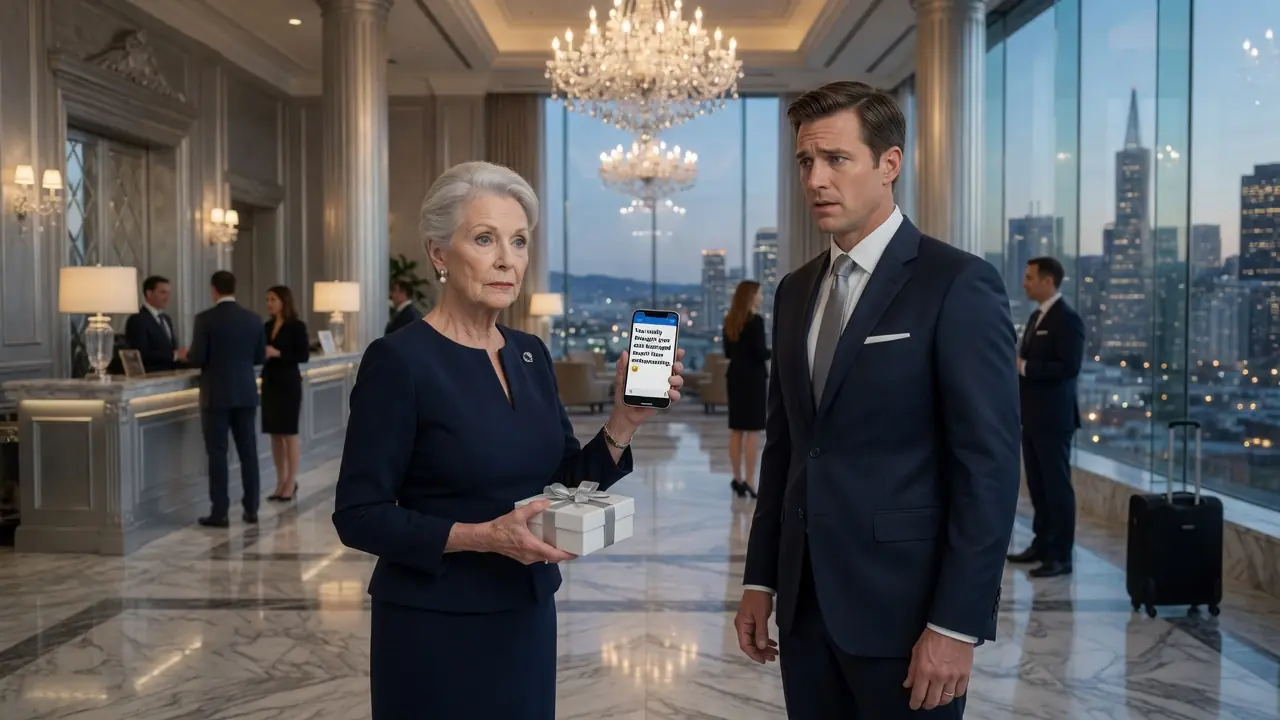
The suite is for Walter's business partners. Just sleep in the lobby.
For a moment, I could not breathe.
The world tilted, and all the polished surfaces around me blurred. I reread the words again and again until they no longer made sense.
Just sleep in the lobby.
My knees weakened. I stepped aside from the counter before my voice could crack. I found a small armchair tucked into a quiet corner near the window and sat down, gripping the box in my lap.
Around me, the lobby buzzed with life. Laughter, heels clicking against marble, suitcases rolling across the floor.
I tried to tell myself it was fine, that there had been some misunderstanding. I did not want to embarrass Walter. Whatever the reason, I would wait.
That was what mothers did.
Minutes passed.
Then an hour.
The ache in my back deepened, but I did not move. I just sat staring at the chandelier above me, its light cold as ice.
"Excuse me, ma'am."
I looked up.
A tall security guard stood beside me, polite but firm.
"Are you a guest here? The lobby is for registered guests only."
My cheeks burned.
"I had a reservation," I stammered. "I'm waiting for family."
He studied me for a long second, then gave a tight nod and walked away.
The humiliation stung worse than the words. I wanted the floor to open and swallow me whole. I pressed my palms together and whispered under my breath, "Don't cry, Norine. Don't make a scene."
Just then, a familiar voice called out.
"Mrs. Callahan, what a surprise."
I turned and saw Richard Coleman, one of Walter's business partners, striding across the lobby. He looked delighted.
"I didn't know you were here. Where's Walter? I thought he'd be showing you around."
My lips trembled, but I forced a smile.
"Oh, hello, Richard. He's... I think I'm just waiting for a friend."
"That's wonderful," he said cheerfully. "Can't wait to see you both at the ceremony."
He walked away, and the moment he disappeared, I felt my shoulders collapse. The mask slipped.
My hands were trembling, but not from cold.
Shame is its own kind of fever. It burns without mercy.
People moved around me, laughing, drinking, living their perfect, busy lives. No one saw the old woman sitting alone in the corner, clutching a gift box she no longer had the courage to give.
I thought of Walter as a boy running through the yard in the rain, his small hand gripping mine.
"Don't let go, Mom," he used to say.
And I never had.
Until now.
When I realized he already had, the lights above shimmered, beautiful and distant. Somewhere high in that tower, my son was probably checking in, smiling beside Lindsay, never imagining his mother was sitting below, invisible.
I closed my eyes and drew a slow breath.
There was no point in waiting anymore.
Something inside me began to shift. Small and quiet, like the first crack in ice before it breaks apart.
The night outside deepened, and the city lights reflected in the marble floor beneath my feet.
I rose, straightened my dress, and walked back toward the desk, not yet knowing that this humiliation would be the moment that changed everything.
The hours passed in heavy silence. The lobby's soft hum had become a dull ache in my head. I had sat so long the cushion seemed molded to me. The gift box with Walter's scarf remained untouched in my lap.
People drifted by, their laughter like a language I no longer understood.
When the evening light spilled through the glass walls, I finally stood. I walked back to the front desk.
The woman who had helped me earlier was gone. A younger clerk stood in her place, his name tag reading Ethan. His smile was polite, professional, and practiced.
"Good evening," he said. "How may I assist you?"
I steadied my voice.
"I was here earlier. My reservation under Norine Callahan was canceled. I need to know who authorized it."
He began typing, his eyes scanning the screen. After a moment, his expression shifted slightly, almost imperceptibly.
"Yes, ma'am. It says here that the change was requested this afternoon by Mr. Walter Callahan."
The words landed like glass shattering in my chest.
My son's name.
I had known deep down, but hearing it confirmed stripped away the last layer of denial.
The pain did not bring tears.
It brought clarity.
Cold, perfect clarity.
"I see," I said softly.
He looked uncertain, as if waiting for me to protest, to crumble.
Instead, I straightened my shoulders.
"Do you have any rooms available?"
He hesitated.
"I'm afraid we're nearly full, ma'am. There's only one suite left. The presidential suite. It's... well, it's quite expensive. Usually reserved for CEOs attending major conferences."
I met his gaze.
"Then tonight," I said, my voice like glass cutting through still air, "let it be occupied by a mother who raised a CEO."
The young man blinked, caught between surprise and admiration.
I reached into my purse and took out my platinum credit card.
"Charge it to this," I said calmly.
Within minutes, a bellhop appeared to escort me upstairs.
The higher we climbed, the more I felt the shift within me. Somewhere between the lobby and the top floor, something inside me hardened into steel.
When the doors opened, silence greeted me.
The suite unfolded like another world. Marble floors. Glass walls. San Francisco glowing beneath the dusk. The skyline shimmered, a sea of gold and silver.
This was the kind of space Walter and Lindsay thought was reserved for people like them.
I walked through the room, touching the silk drapes, the leather sofa, then let out a quiet, bitter laugh.
They had no idea the woman they dismissed had spent a lifetime saving. Building my Oregon home alone was worth more than they imagined.
I set the gift box down on the marble table and took out my phone.
My hand no longer shook.
I did not call Walter.
I called someone else.
"Hello, Mr. Davidson. It's Norine Callahan."
My tone was steady. Precise.
"I need to rewrite my will. Everything. I'll meet you as soon as I return to Oregon."
He hesitated for a moment before answering.
"Of course, Mrs. Callahan. I'll prepare the documents."
When I ended the call, I stood in silence, listening to the faint hum of the city below.
Somewhere out there, my son was likely giving speeches, shaking hands, smiling for cameras. I no longer felt the urge to be in that crowd.
I did not need to prove anything to him or to anyone.
I poured myself a glass of water from the crystal decanter and walked toward the window. The city stretched endlessly, glowing against the night sky like a living thing.
My reflection stared back at me.
Older, yes.
But unbroken.
For the first time in years, I felt powerful. Not because of what I owned, but because of what I had just reclaimed.
My dignity.
My control.
My peace.
I pressed a hand lightly against the glass and whispered, "You raised a CEO, Norine. Now raise yourself."
The lights of San Francisco sparkled below, indifferent and eternal.
As I stood there, bathed in their glow, I understood something simple and absolute.
I was no longer a mother waiting for kindness.
I was a woman who had finally remembered her worth.
That night, sleep never came.
The city glittered beneath me, a living constellation of ambition and noise. But the suite around me was silent, too perfect, too still.
I walked barefoot across the marble floor, feeling the coolness rise through my skin like a current. Every surface gleamed. Every corner whispered of wealth and power.
This was their world. Walter's and Lindsay's.
And for one brief night, I was the queen of it.
Not because they had invited me in, but because I had claimed it.
The gift box sat on the table where I had left it. White paper against dark marble. A ghost of what I had intended to give.
I untied the silver ribbon and lifted the moss green scarf from its wrapping. The fabric was soft and familiar, still carrying the faint scent of my home, pine soap, and the warmth of hands that had worked too long.
I ran my fingers along each row of stitches, remembering the rhythm of the knitting needles, the sound of the yarn slipping through my fingers as I thought of my son.
I sat on the edge of the bed, the scarf pooled in my lap, and for the first time, I spoke aloud to the empty room.
"I knitted all my love into this," I whispered.
My voice trembled, not with tears, but with the weight of understanding.
"If you've forgotten my love, Walter, then I must forget you in order to live."
The words hung in the air, fragile but final.
They were not born of anger. They were the sound of something ending, the slow unraveling of a mother's hope.
Outside, the city lights pulsed like distant stars, indifferent and eternal.
I folded the scarf carefully and placed it back in the box. But this time, it felt different.
It was no longer a gift.
It was a memory I was ready to bury.
When morning came, I packed my things and left the Azure Spire without looking back.
The doorman greeted me with the same polished smile as before, unaware that I was no longer the same woman who had arrived in trembling anticipation.
I stepped into the taxi, and as the city receded in the mirror, a calm settled over me. A quiet storm gathering beneath the surface.
Weeks passed.
I returned to my home in Oregon, to the familiar smell of pinewood and rain-soaked earth. I filled my days with small rituals, watering the plants, folding the laundry, baking bread.
But the silence in the house had changed.
It was no longer empty.
It was mine.
Then one afternoon, as I was tending to the garden, my phone buzzed with a new email.
The sender's name caught my eye.
Lindsay Callahan.
I opened it slowly.
Dear Norine,
Walter and I want to sincerely apologize for the misunderstanding at the hotel. It was all such a terrible mix-up. We'd love for you to join us at our wedding next month. It would mean the world to us if you could attend.
No warmth. No remorse.
Just the careful, empty politeness of someone who wanted to clean a stain off her public image.
I read it twice, then smiled.
A small, humorless smile.
It was not forgiveness they were after.
It was appearances.
I clicked reply.
Dear Lindsay,
Thank you for the kind invitation. I'd be delighted to attend. Looking forward to celebrating with you both.
I pressed send and leaned back in my chair.
The faintest spark of something sharp flickered to life.
It was not revenge.
Not exactly.
It was balance.
A few weeks later, I found the contact information for the wedding planners. I called, my tone gentle and polite.
"Hello, this is Norine Callahan. Walter's mother. I have a special photo I'd like to include as a surprise for the bride and groom. Could you help me add it as the very last slide during the family speeches?"
They were thrilled.
"Of course. Of course, Mrs. Callahan. That would be lovely."
I thanked them, my voice warm and steady.
When I ended the call, I sat in the stillness of my kitchen, the moss green scarf resting beside me on the table.
The plan was simple, quiet, precise.
Outside, the rain had begun to fall, soft, steady, relentless. I watched it through the window, feeling its rhythm echo the calm inside me.
There was no rage left.
Only purpose.
They had written me out of their story.
But I had learned something they had not.
The power of silence before the storm.
And this time, when it came, it would be mine.
The hall shimmered like a scene from a dream. Gold chandeliers, crystal glasses, and the soft murmur of expensive laughter.
I stood at the entrance for a moment, taking it all in.
The air smelled faintly of roses and champagne, and every surface gleamed as if it were trying to impress the gods.
I could almost hear Lindsay's voice in the details. The towering floral arrangements. The candlelight reflections. The photographer circling like a hawk, hunting for perfection.
They had built this night for admiration.
And yet, as I walked inside, every step I took carried the quiet certainty that before the evening ended, their perfection would collapse.
When Walter saw me, his face lit up in the exaggerated way people perform when others are watching.
"Mom, you made it."
His tone was bright. Rehearsed.
Lindsay followed. Her smile stretched tight enough to crack porcelain.
"We're so glad you're here, Norine," she said sweetly, her manicured hand brushing my arm. "We were worried the travel might be too much for you."
"I wouldn't miss it," I said, matching her tone, though mine was steadier. "It's not every day a mother gets to see her son begin a new life."
Walter laughed, glancing at the nearby guests to make sure they were watching.
"Everyone, this is my mother," he announced proudly. "The woman who made me who I am today."
His hand rested on my shoulder just long enough for the cameras to flash.
Then he turned away, already caught in another conversation.
I found my seat at a table near the front, close enough to the stage to see the giant screen behind it cycling through photos. Walter's childhood. His college graduation. The engagement pictures in Napa.
They had even used one of my old snapshots. Walter as a little boy in a red sweater, standing in the snow, grinning as I held his hand.
For a moment, my throat tightened.
That boy had once looked at me with unguarded love.
Somewhere along the way, that boy had vanished.
Dinner passed in a blur of speeches and laughter, none of which touched me. I sipped my water, waited, and listened to the rhythm of the evening until the host's voice finally echoed through the microphone.
"And now, a few words from the groom's family. Mrs. Callahan, would you like to come up?"
A hush fell as I rose from my chair. I could feel the weight of hundreds of eyes following me as I walked to the stage.
The screen behind me flickered softly, displaying a photo of Walter hugging me at his college graduation.
Another perfect image.
I stood at the microphone and smiled, steady and calm.
"Good evening," I began. "First, I want to congratulate Walter and Lindsay. You've built something remarkable together. Success, partnership, admiration. It's what every parent hopes to see for their child."
I paused, letting the polite applause ripple through the crowd before raising my hand slightly.
"But tonight, I'd like to share a story. A small one. About family, about love, and about the things we forget when we chase too much of the world."
I turned slightly, meeting the technician's eye at the back of the room, and gave a single nod.
The next slide appeared.
The screen went white for a heartbeat.
Then black letters appeared, magnified across the hall.
The suite is for Walter's business partners. Just sleep in the lobby.
For a moment, there was nothing.
No sound.
No movement.
Just silence so sharp it hummed in my ears.
Then came the gasps, quick and disbelieving, followed by whispers cutting through the air like paper tearing.
Heads turned toward the bride and groom.
Lindsay's face went pale, her hand frozen halfway to her glass. Walter stared at the screen as if seeing a ghost.
I let the silence stretch before I spoke again, my voice clear enough to carry across the hall.
"That message was sent to me by Lindsay Callahan, the woman who now calls me Mom. It arrived moments after I learned that my hotel room, the one I paid for, had been canceled by my son."
A murmur rippled through the crowd, the sound of judgment shifting direction. I could see it in their faces, disbelief curdling into something colder.
I took a deep breath and continued.
"Success and ability are meaningless without morality. A man can build an empire, but if he treats his own mother with cruelty, then in my eyes, he is still a failure."
Walter shot up from his chair.
"Mom, stop. You're confused," he said, his voice cracking under the weight of panic. "You don't know what you're talking about. This is ridiculous."
Lindsay joined in, her voice sharp with hysteria.
"You're just jealous. You've never been able to handle how successful Walter is. You're trying to ruin our day."
I turned toward them, my hands steady on the microphone.
"No parent is ever jealous of their child's success," I said softly.
My words carried through the room like a verdict.
"But not every child understands the meaning of decency."
The room fell silent again.
No one dared move.
Even the music had stopped somewhere in the background.
I looked at my son one last time, his eyes wide, his face flushed with anger and humiliation, and felt only a quiet pity.
I stepped away from the microphone and walked down the aisle, the sound of my heels echoing against the marble floor.
The guests parted without a word.
When I reached the gift table, I placed the small white box wrapped with a silver ribbon gently among the presents.
My voice was calm, but it carried enough for those nearby to hear.
"This gift," I said, touching the lid. "I suppose you no longer have a need for its warmth."
I turned and walked toward the exit.
Behind me, I heard the low hum of whispers rising again, the sound of reputations cracking under their own weight.
The photographer had stopped shooting.
The lights seemed too bright, too revealing.
As I stepped into the cool night air, the wind brushed against my face, carrying away the noise of the hall.
For the first time in years, I felt light.
Free.
Untethered.
The world behind me was collapsing in on itself, but I did not look back.
I had already said everything that needed to be said.
The morning after the wedding, I woke to a silence that felt different.
Not empty.
Free.
The house in Oregon stood as it always had, neat and quiet, the scent of pine still drifting through the windows.
The moss green scarf lay folded on the nightstand, untouched.
I looked at it without tears. The grief had burned itself out. What remained was resolve.
That week, I met with my lawyer, Mr. Davidson. His office smelled faintly of cedar and old books.
When I told him my decision, his brow furrowed.
"Mrs. Callahan, are you certain you want to change your will entirely?"
"Yes," I said. "Everything. My house and my savings should go to education funds and elder care charities. Let them help people who still understand kindness."
He nodded and began the paperwork.
When I signed the final page, I felt lighter, as though I had just closed the door to a room that no longer belonged to me.
Within a month, I sold the house in Pine Ridge. I packed what little I cared to keep, a few photos, my favorite books, and the scarf I had once meant for Walter.
The rest I left behind.
I did not cry when I drove away.
I had already said my goodbyes to the woman I used to be.
I drove south with no destination, following the Pacific until I reached Monterey, a town where the ocean breathed against the cliffs like something alive.
There, I found a small white cottage with blue shutters and a porch that faced the sea. It was not grand, but it was mine. I could hear the waves from my bedroom at night and the gulls in the morning.
For the first time in years, I slept without dreams.
Though I had enough money to live comfortably, I wanted something to fill my days.
That was how I found The Foggy Page, a little bookstore tucked between a cafe and an antique shop.
The owner, a gentle man with ink-stained hands, smiled when I asked if he needed help.
"Only if you don't mind dust and quiet," he said.
I told him quiet was exactly what I wanted.
My life found a new rhythm.
I opened the store each morning, breathing in the smell of paper and rain. The bell over the door chimed softly whenever someone came in. I wrapped their books in brown paper and listened to them talk about stories that made them dream.
In those quiet exchanges, I rediscovered the beauty of ordinary kindness.
Evenings belonged to the sea. I walked along the sand with a cup of tea, the sky turning gold over the water.
Sometimes I thought of Walter, but never with anger. The ache had softened into understanding.
I had stopped waiting for apologies, for calls that would never come.
Now my life was simple and honest.
My days began with the ocean and ended with peace.
I no longer needed to be anyone's mother to feel whole.
I was simply myself.
Alive, unburdened, and finally free.
The afternoon light slanted through the wide windows of The Foggy Page, painting long golden streaks across the rows of books. The air smelled of paper and salt, of stories waiting to be found.
I stood behind the counter, stacking a few hardcovers into neat little towers. The same quiet rhythm I had come to love.
Outside, the ocean murmured in the distance, steady and eternal, a reminder that time always moves forward.
I had learned to move with it.
The bell above the door chimed, and a young woman stepped inside, her arms full of books. She could not have been older than 25, bright-eyed and curious, the kind of person who still believed in the magic of small things.
She approached the counter, setting her stack down with a soft thud. Her gaze lingered for a moment before she said, "That's a beautiful scarf, ma'am. That shade of green is so warm and classic."
I glanced down at the moss green wool draped around my neck. It felt softer than I remembered, as though time had gentled it.
I smiled, the kind of smile that rises from somewhere deep and calm.
"Thank you, dear," I said. "My son once told me this color was old-fashioned. But now, I think that sometimes the old things are what keep us the warmest."
She smiled back, not knowing that her simple kindness had brushed against something sacred.
After she left, I turned back to the counter, adjusting the stack of books once more. The light had shifted, flooding the room with a soft glow that touched every corner.
I could see my reflection faintly in the glass.
A woman with silver hair standing in her own quiet story.
I was not lonely.
I was warm.
I still could not believe how far I had come from the woman sitting alone in that cold hotel lobby to someone who had finally found peace by the sea.
Life has a way of breaking us just enough to show what truly matters.
Dignity.
Kindness.
And the courage to start again.