“Elanora, from this month forward, all of your pension checks will be deposited directly into my account.”
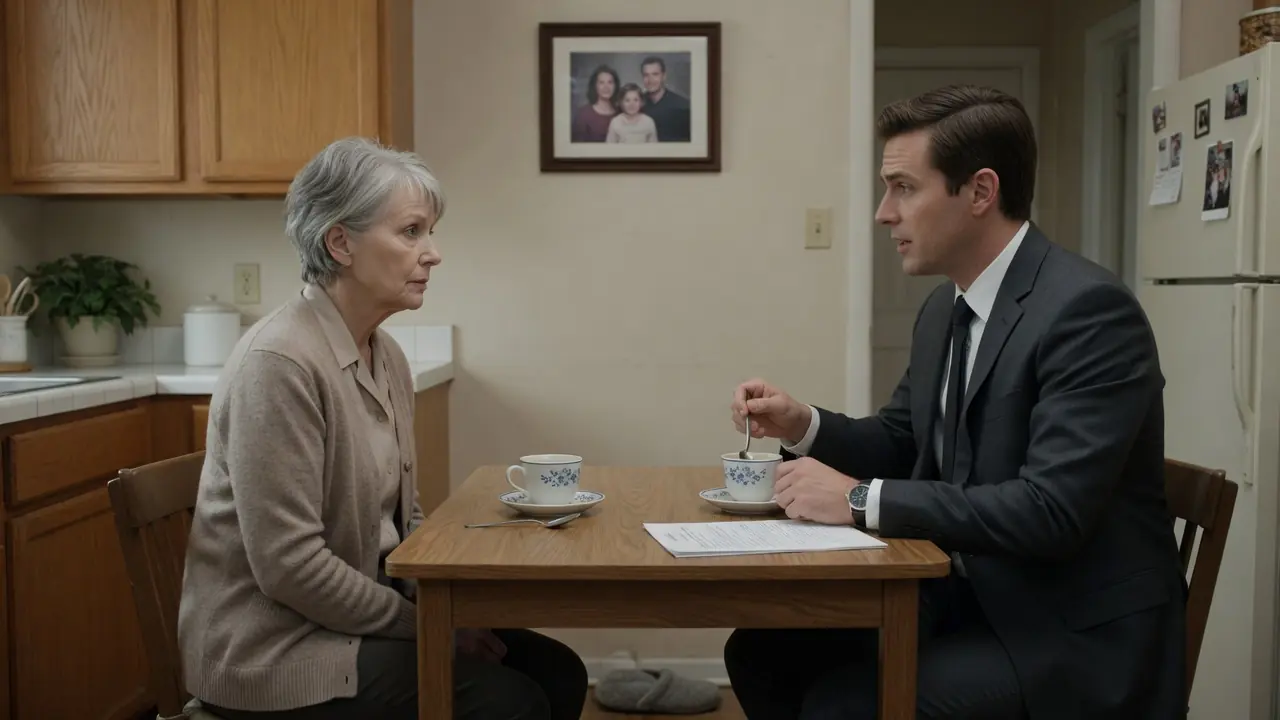
Those were the words my son Julian spoke on a gray Thursday afternoon while sitting in my kitchen as if he owned the chair beneath him.
He stirred his coffee slowly, the spoon clinking against the porcelain cup in small, neat sounds.
His voice was calm, almost bored, as if he were merely telling me rain was expected by evening.
I sat across from him, my hands folded in my lap.
For several heartbeats, I said nothing. I only stared at him, searching his face for the child I had once carried through fevers, snowstorms, hunger, and every sharp edge life had ever aimed at him.
I looked for the little boy who used to run into my arms when thunder shook our apartment windows.
I looked for the teenager who once cried because he thought we would lose our home.
I looked for the young man I had proudly watched cross a graduation stage while my feet ached from the night shift I had worked only hours before.
I found none of them.
There was only Julian now.
Thirty-six years old, well dressed, confident, comfortable, and smiling with the unsettling patience of someone who had already calculated my surrender.
He leaned back in his chair and tapped one finger against the table.
“It just makes sense, Mom,” he said. “You’re getting older. Bills are confusing. Banks are confusing. If the pension goes straight to me, I can handle everything for you.”
For me.
That was how he said it.
Not from me.
Not through me.
For me.
As if I were a helpless old woman who had not spent her life surviving on numbers so tight they could cut skin.
I took a slow breath.
The air felt thin and cold in my lungs, though the kitchen heater was running.
“I see,” I said.
Julian’s smile widened.
I knew that smile.
He wore it when he had already won in his own mind.
“You don’t have to worry about anything anymore,” he said. “I’ll pay your bills, manage the accounts, make sure you don’t get overwhelmed.”
I looked down at the table.
The table was old, scratched, and polished thin from decades of use. Julian had eaten his first solid meal at that table, had done homework there, had cried over college applications there, had once carved his initials into the underside with a pocketknife when he thought I would not notice.
I had not thrown the table away because love makes fools into archivists.
“That sounds fine,” I said softly.
Julian’s shoulders relaxed.
“Good. I knew you’d understand.”
I looked up at him.
“Of course I trust you.”
The words tasted like ashes.
He stood, leaned over, and pressed a dry, fleeting kiss to my forehead. It felt less like affection than a stamp on property already claimed.
“It’s for the best, Mom,” he murmured. “You’ll thank me later.”
Then he gathered his coat and left.
I stayed in the kitchen after the sound of his car faded down the street.
For my own good.
The phrase seemed to cling to the walls.
For my own good, my son wanted my pension.
For my own good, he wanted control.
For my own good, I was supposed to hand over the last dependable income I had left and smile while doing it.
I sat alone until the coffee in his cup went cold.
That same night, as was his custom, Julian returned.
It was Friday.
He never came alone on Fridays. He always arrived with his wife, Alana, and he always arrived expecting the same thing: a hot meal, a clean table, and a mother who asked for nothing in return.
For three years, Friday dinner at my house had been their ritual.
Not my ritual.
Theirs.
They let themselves in with the spare key I had given Julian when he was younger, back when a key meant emergency, not entitlement.
I heard the scrape of metal in the lock.
I heard the front door open.
Then I heard Alana scream.
It was not a scream of fear.
It was a high, sharp wail of outrage, the sound of someone confronting a reality they had not authorized.
I remained seated in my wooden chair in the cavernous silence of my kitchen.
My empty kitchen.
My empty house.
I listened as that single ugly sound echoed through rooms where my furniture had once stood.
I did not move.
I did not go see what was wrong.
I already knew.
Julian burst into the kitchen seconds later, his face pale with disbelief.
Alana hovered behind him, her perfectly painted mouth open, her eyes wide as she looked around the bare room.
“Mom,” Julian yelled. “What did you do?”
I looked at him calmly.
He glanced behind him toward the living room.
“Where is everything? The sofa? The television? The cabinet? The dining chairs? Where is everything?”
I folded my hands on the table.
“I sold a few things.”
His eyes snapped back to me.
“You what?”
“I needed the money,” I said. “After all, if you are going to be managing my finances, I thought I should ensure I had some liquidity first.”
For a moment, his face did not move.
Then the color returned all at once, fast and violent, rising up his neck and spreading across his cheeks.
Shock vanished.
Rage took its place.
“You’re crazy,” he hissed.
There it was.
Not concern.
Not fear for me.
Not a single question about whether I was safe, pressured, scammed, ill, or desperate.
Just fury.
“You are completely insane,” he said, stepping closer. “How could you sell everything without asking me?”
Without asking him.
I stared at him.
The words landed with a strange, almost holy clarity.
Alana moved beside him, her perfume sharp in the empty kitchen.
She was thirty-two, polished, ambitious, and always dressed as if a camera might appear. She had married Julian four years earlier and had never once called me Mom, though she had no trouble calling my house “our Friday place.”
“Elanora,” she said, her tone cold, “this is selfish.”
I almost smiled.
Selfish.
Me.
The woman who had spent thirty-six years hollowing herself out so Julian could feel full.
“You are only thinking about yourself,” she continued. “We come here every week to keep you company, to make sure you are all right, and this is how you repay us?”
Keep me company.
Those words nearly made me laugh.
They came every Friday, sat at my table, ate food I paid for, checked their phones, criticized the seasoning, discussed their vacations, and left before the dishes were dry.
That was not company.
That was consumption.
Julian pointed toward the empty living room.
“What are we supposed to do when we come over now? How are we going to be comfortable here?”
That sentence severed the final thread of my denial.
Not, Are you okay, Mom?
Not, Why did you feel you had to do this?
Not, What happened?
His concern was not for his mother.
It was for the loss of comfort.
My house was not my sanctuary to him.
It was an amenity.
I rose from the chair.
My body felt light, almost hollow, but my voice was steady.
“Dinner is not ready.”
Julian blinked.
“What?”
“There is no dinner,” I said. “If you are hungry, you can find somewhere else to eat.”
The silence that followed was thick.
Julian stared as if I had spoken in a language he had never heard. Alana let out a bitter little laugh and shook her head.
“This is unbelievable,” she muttered.
Julian’s face hardened.
“Maybe suggesting the bank account was a mistake,” he said.
His tone changed.
It became cold.
Clinical.
“Maybe you are not in a condition to be making sound decisions. Maybe you need more help than I thought.”
More help.
I knew what that meant.
Control.
He was beginning to build a story around me, one where I was unstable, confused, reckless, and in need of management.
He had not only come for my pension.
He had come prepared to take my dignity too.
I looked at him and felt something inside me grow still.
“Leave,” I said.
His mouth fell open.
“Mom.”
“Leave my house.”
Alana grabbed her purse from the counter, though there was nothing left near it to match her outrage.
Julian stepped closer instead of leaving.
“You should be careful,” he said quietly.
His voice lowered.
“A woman your age, alone, without family who truly cares about her, could end up in a very bad place.”
I held his gaze.
“I am all you have,” he continued. “You should remember that before you do something else this stupid.”
There it was.
The threat wearing the clothes of concern.
They left soon after, slamming the front door so hard that the old frame rattled.
I heard their car engine roar to life.
I heard the tires squeal as they pulled away.
Then I stood alone in the empty kitchen and felt something inside me crack.
It was not a small crack.
It was not the kind that heals with time, apology, or a better explanation.
It was final.
My son did not see me as his mother.
Perhaps he had not for many years.
I had become a resource.
A utility.
A source of food, money, comfort, access, and silence.
I sat back down in my chair and looked at the bare walls.
There were pale rectangles on the floor where the sofa and television stand had stood. Dust lines marked the absence of things I had bought with years of work. The room looked stripped and strange, but also honest.
For the first time in what felt like a lifetime, I smiled.
Julian did not know the truth.
I had not sold the furniture because I needed money.
I had sold it to send a signal.
To rattle the cage.
To see exactly how he would react when something he believed belonged to him disappeared without his permission.
He had reacted exactly as I expected.
Not with concern.
With possession.
Not with love.
With rage.
That night, surrounded by the shadows of my stripped-bare life, I made a decision.
I would not scream.
I would not cry.
I would not beg for love I now knew was conditional.
I would observe.
I would wait.
I would let Julian believe his threat had frightened me into submission.
Then, when he was most confident, when he was most certain he had control, I would show him exactly who Elanora Vance really was.
Not the submissive mother.
Not the convenient widow.
Not the free restaurant.
Not the old woman waiting to be managed.
I was the woman who had survived abandonment, poverty, exhaustion, betrayal, and decades of relentless work.
I was the woman he should never have underestimated.
There was a time I believed motherhood was a currency.
I believed love given would become love returned. I believed sacrifice built an invisible fortress between my child and me, strong enough that nothing could destroy it.
I was wrong.
Julian was born on a blizzard night thirty-six years earlier.
The hospital windows were frosted white, the streets were buried under snow, and his father, Malcolm, held my hand and cried when our son opened his eyes.
Two years later, Malcolm left.
He said he needed to find himself.
He said life had become too much.
He said I would understand one day.
I never did.
He left me with a toddler, a third-floor apartment with drafty windows, and a secretarial job that paid just enough to stay poor with discipline.
I did not waste time waiting for him to return.
Waiting was a luxury.
I worked.
My days began before sunrise.
I dressed Julian while he was still sleepy, buttoning his little coat, packing crackers into a plastic bag, and carrying him down three flights of stairs while my own shoes leaked in the snow.
During the day, I answered phones at a legal office.
At night, I cleaned corporate buildings.
I scrubbed toilets used by people who never saw me. I emptied trash beneath desks where men earned more in a week than I earned in a month. I came home with aching wrists and chemical burns on my fingers, then slept for four hours before doing it again.
Mrs. Genevie Croft, my neighbor, watched Julian at night.
She was a widow with soft gray curls and a sharp tongue, and she accepted too little money because she knew I had no more to give.
“Your boy is smart,” she used to tell me.
I would smile, exhausted but proud.
I built my life around that sentence.
Your boy is smart.
Your boy has a future.
Your boy will not end up trapped the way you are.
When Julian wanted a pair of expensive sneakers in middle school, I bought them.
They cost one hundred and fifty dollars.
My monthly income was fourteen hundred dollars.
That one hundred and fifty dollars was two weeks of groceries, but I could not bear the way he looked down when other boys laughed at his worn shoes.
So I bought them.
He walked into school with his head high.
I ate oatmeal and potatoes for most of that month and told myself hunger was easier than watching him feel small.
When he wanted to attend a private university, I signed loan papers I did not fully understand.
The tuition nearly knocked the breath out of me.
But Julian had been accepted, and everyone said it was the opportunity of a lifetime.
So I borrowed against my own future.
I took extra cleaning jobs.
I skipped medical appointments.
I wore coats with repaired linings and bought dented cans from discount shelves.
On the day Julian graduated, he crossed that stage in a black gown, and I stood in the crowd clapping until my palms hurt.
He looked so handsome.
So polished.
So far from the little boy with the worn shoes.
I thought, I did it.
I saved him.
After graduation, he got a job in finance.
Four thousand dollars a month right out of school.
I was proud beyond words.
Then he stayed with me.
He said he needed to save money for a solid foundation. He said rent was a waste. He said living at home for a little while made sense.
A little while became five years.
For five years, Julian lived in my home without paying rent, utilities, or groceries.
He saved nearly every dollar he earned while I kept working two jobs.
When he finally moved out, it was not to a modest apartment.
It was to a two-hundred-and-fifty-thousand-dollar house in the suburbs.
He paid cash.
A quarter of a million dollars.
Saved while I clipped coupons.
I told everyone how proud I was.
And I was proud.
That is the terrible thing about love. It can remain proud even while bleeding.
I thought maybe, now, I could rest.
Maybe I could leave the night cleaning job.
Maybe I could repair my own life after spending so many years financing his.
But rest never came.
Julian married Alana two years later.
The wedding cost forty thousand dollars. I contributed what I could, though no one asked whether I could afford it.
At the reception, I sat at a table near the kitchen.
Julian explained that the main tables were for important clients and networking. He said this as if a mother could be placed near the swinging kitchen doors and still feel honored.
I smiled anyway.
I danced when asked.
I went home alone that night and sat on my bed without taking off my shoes.
After the wedding, the Friday dinners began.
At first, I was thrilled.
I thought Julian missed me.
I thought marriage had made him value family.
Every Friday, I cooked his favorite dishes: chicken casserole, roast beef, baked pasta, sweet carrots, mashed potatoes, apple pie.
I cleaned all day.
I set the table with the good plates.
I bought fresh flowers when I had a few dollars extra.
Then Julian and Alana arrived.
They ate.
They scrolled through their phones.
They discussed restaurants, home renovations, vacations, and people from work.
They rarely asked about my week.
They never brought groceries.
They never offered money.
They left within an hour, often with containers of leftovers.
One night after they drove away, I sat down with the grocery receipt and calculated the cost of that evening’s meal.
Fifty dollars.
Fifty dollars I had pulled from my utility budget.
That was when I first understood I had not regained my son.
I had become his free restaurant.
The small cuts followed.
When my car broke down, Julian said he was swamped.
When my refrigerator started failing, he said, “Just buy a new one, Mom. You need to stop stressing over every little thing.”
When my arthritis flared and I asked if he could help carry boxes from the basement, he said his back was sensitive from the gym.
The deepest cut was my sixtieth birthday.
Julian arrived two hours late.
No gift.
No card.
Alana said traffic was terrible, though her makeup was freshly applied and her hair looked as if she had come from a salon.
They ate the cake I had bought for myself.
They left after twenty minutes because they had dinner reservations with friends.
I wept that night.
Not delicate tears.
Deep, ragged sobs that came from somewhere old and forgotten.
I finally understood I was no longer important.
I was only available.
The worst part was that I had allowed it.
I had never demanded respect.
I had never pointed out the imbalance.
I was terrified that if I complained, if I asked for anything, Julian would disappear completely.
The thought of losing him, even this hollow version of him, had frightened me more than my own degradation.
So I remained the convenient mother.
The silent mother.
Until that Thursday, when he came for my pension.
The following Monday, Julian returned with documents.
He arrived at ten in the morning, carrying a leather folder and wearing the pleasant expression of a man coming to finish business.
He spread the papers across my kitchen table.
“Mom, this is simple,” he said. “Just sign here, here, and here.”
I looked at the pages.
He explained that the forms would make it easier for him to manage my pension deposits.
“This way, I pay all your bills,” he said. “You won’t have to lift a finger.”
I picked up the first page.
Then the second.
Then the third.
The words blurred at first because my heart was beating too hard, but I forced myself to read.
Authorization.
Financial control.
Account access.
Durable power of attorney.
Transfer authority.
My fingers went cold.
“Julian,” I said carefully, “this gives you complete control.”
He nodded, unbothered.
“Yes. That’s the point. It’s just easier that way.”
“For whom?”
He looked up, surprised by the question.
“For you, Mom.”
I held the pen he offered me.
For one terrifying second, I nearly signed.
It was the motion I had practiced my entire life.
Give.
Trust.
Surrender.
Make things easier for Julian.
Then I saw his face from Friday night.
A woman your age could end up in a very bad place.
I set the pen down.
“You know, dear,” I said softly, “give me a few days. I want to read it carefully.”
A flash of irritation crossed his face.
It was fast.
But I saw it.
Then the smile returned.
“Mom, there is nothing complicated here.”
“I would still like time.”
He stared at me for a long moment.
Then he gathered his coat.
“Fine,” he said. “Take your days.”
He left the papers on my table like a flag planted in conquered land.
That night, I did not sleep.
The next morning, I was at the bank before it opened.
I stood outside in the cold with my purse clutched under one arm, watching employees move behind the glass doors. My reflection looked pale in the window. Smaller than I felt inside.
At nine exactly, they unlocked the doors.
I asked for six months of bank statements.
The teller was young, kind, and efficient. She printed the pages while I stood at the counter with my hands tucked together so she would not see them shake.
I sat in a waiting chair and reviewed every line.
At first, everything looked ordinary.
Pension deposit.
Pharmacy payment.
Grocery store.
Electric bill.
Then I saw it.
Cash withdrawal.
$1,500.
Three months earlier.
A withdrawal I had never made.
My breath stopped.
I read the line again.
Then again.
The branch was on the other side of the city, near Julian’s neighborhood.
I went back to the teller and asked for details.
She checked the system.
“It was made with your debit card,” she said.
“My card has never left my purse,” I replied.
Even as I said it, the memory rose.
Three months earlier, Julian had stopped by unannounced. I had been in the shower and called for him to let himself in.
When I came out, he was in the living room.
My purse was on the coffee table.
I had gone into the kitchen to make coffee.
He had been alone with it for five minutes.
Five minutes.
Long enough to take my card.
Long enough to write down information.
Long enough to use it later and put it back.
I left the bank with the world tilting beneath my feet.
But I did not file a claim yet.
Not immediately.
I needed to know how deep the rot went.
At home, I pulled an old shoebox from the closet.
It held insurance papers, medical bills, receipts, tax forms, and statements I had kept without knowing they might one day save me.
I spread everything across the floor.
Then I began digging.
Two years earlier, when I had been hospitalized with pneumonia, someone had used my health insurance for a series of consultations I had never attended.
Those claims had reduced my available coverage and left me paying out of pocket for medications I should not have had to pay for.
I remembered that year.
I remembered standing at the pharmacy counter, embarrassed, counting bills slowly while a line formed behind me.
I remembered choosing which prescription to delay.
At the time, I thought insurance had simply failed me.
Now I wondered whether my son had.
Then I found a credit card statement.
It was addressed to me.
The account balance was $4,500.
I had never applied for that card.
I called the company.
The woman on the phone asked security questions, then confirmed the account had been opened eighteen months earlier.
The purchase history included hardware stores, electronics, high-end furniture outlets, and home improvement centers near Julian’s house.
I sat very still.
Julian had renovated his home using my credit.
The floor seemed to disappear beneath me.
It was not just the money.
It was the planning.
The patience.
The coldness.
He had stolen from me while eating dinner at my table.
He had built comfort in his house by burying debt in my name.
He had told me I needed his help managing money while quietly taking mine.
I wept until my eyes went dry.
Then I wiped my face.
I gathered the papers.
And I made another decision.
I would not confront him yet.
He would deny everything.
He would call me confused.
He would say I was aging badly, remembering wrong, misunderstanding forms, misreading statements.
He would twist the truth until I doubted my own mind.
No.
I needed proof so solid it could not be softened, explained away, or buried under his charm.
That Friday, Julian and Alana arrived as if nothing had happened.
They expected the empty house to have been a momentary episode, a tantrum I would regret. They expected me to restore everything because their discomfort had become my problem.
But this time, I had cooked.
I made Julian’s favorite chicken casserole, the dish I used to make when he was small and sick. Creamy sauce, tender chicken, vegetables, buttered breadcrumbs across the top.
The smell filled the kitchen like memory.
They sat.
They ate.
They talked about a movie they had seen and Alana’s new coworker who apparently lacked “executive energy.”
I watched Julian.
He ate the food of his childhood with the same vacant entitlement he would give a takeout order.
No gratitude.
No softness.
No love.
When he finished, he wiped his mouth and pushed the bank papers across the table, right beside his empty plate.
“Mom, your days are up,” he said. “You thought about it. Sign.”
I looked at the papers.
Then at him.
“I am still not sure, Julian. I need more time.”
Alana scoffed.
“Elanora, this is ridiculous. He is trying to help you. Why are you being so distrustful?”
Distrustful.
She was right.
Just not in the way she imagined.
Julian stood.
The caring-son mask slipped.
His expression hardened.
“Mom, this is for your own good. You cannot manage this alone. Look at the irrational decisions you are making.”
Irrational.
Selling my own furniture was irrational.
Stealing from his mother, apparently, was not.
I held his gaze until he looked away.
They left that night without dessert.
The days that followed were quieter than any I had known.
Julian did not call.
He did not visit.
He was punishing me with absence, confident my loneliness would break me.
He believed I would crawl back and sign his papers just to hear his voice again.
He miscalculated.
For the first time, silence did not feel like loneliness.
It felt like a war room.
I spent those days digging deeper.
The deeper I went, the darker it became.
Three years earlier, Julian had claimed he lost his ID and borrowed mine to pick up an urgent package. I had not thought much of it then.
Now I checked old utility documents and discovered an electricity account at his address had been opened in my name around that same time.
For three years, his utility bills had been tied to my credit.
When payments were late, my credit score took the damage.
That explained why I had been denied a small car repair loan the year before.
I had sat across from the loan officer humiliated, wondering how my credit had fallen so badly.
Now I knew.
It was not misfortune.
It was sabotage.
I called the utility company.
The representative told me I would need to file a sworn fraud affidavit.
Fraud.
Committed by my own son.
The word made me nauseous.
The next morning, I did something I had never done before.
I went to see a lawyer.
His office was downtown, on the second floor of a narrow brick building between a tax service and a dental clinic. The sign on the door read: Aris Thorne, Attorney at Law.
Mr. Thorne was in his early fifties, with kind eyes, a sharp suit, and the steady patience of a man who had heard terrible things and still believed in procedure.
I walked in feeling like a fool.
A sixty-four-year-old woman tattling on her child.
But Mr. Thorne did not make me feel foolish.
He listened.
I told him about the pension forms.
The $1,500 withdrawal.
The credit card.
The insurance claims.
The utility account.
The threat.
The empty house.
I spoke for nearly forty minutes, stopping only when my voice shook too hard to continue.
When I finished, Mr. Thorne leaned back.
“Mrs. Vance,” he said carefully, “what you are describing is a systematic pattern of financial elder abuse, identity theft, and fraud.”
The words landed heavily.
Elder abuse.
I looked down at my hands.
“I do not feel elderly.”
“You do not have to feel elderly to be exploited as someone vulnerable,” he said.
I swallowed.
“He is my son.”
“I understand.”
“I do not want to ruin his life.”
Mr. Thorne’s expression softened, but his voice remained firm.
“Mrs. Vance, he is already in serious legal trouble. You did not create that trouble. His actions did.”
I looked toward the window.
Traffic moved outside.
People crossed the street carrying coffee, briefcases, groceries, ordinary lives.
Mine felt as if it had been split open on a lawyer’s desk.
“What do I do?” I asked.
“First, sign nothing. Second, change all bank accounts, passwords, PINs, and cards. Third, file fraud disputes. Fourth, document every interaction from this point forward. Fifth, you should consider limiting his access to you and your home.”
He paused.
“And if he becomes threatening, we discuss a restraining order.”
A restraining order against Julian.
My baby.
My son.
The idea was grotesque.
“I cannot imagine that,” I whispered.
Mr. Thorne looked at me with weary compassion.
“I know. But I need you to imagine protecting yourself.”
I left his office with a folder of forms and a spine that felt newly made.
I went directly to the bank.
I closed the compromised debit card.
Changed account numbers.
Added verbal passwords.
Removed old emergency permissions.
Opened a separate account Julian did not know existed.
Then I called the credit card company and formally disputed the fraudulent account.
Each step exhausted me.
Each step also made me lighter.
That evening, Julian finally called.
His voice was tight.
“Mom, we need to talk. Come to my house for dinner tomorrow.”
It was not an invitation.
It was a command.
The old me would have obeyed.
“I cannot tomorrow, Julian,” I said.
A sharp silence followed.
“You can’t?”
“No.”
“Busy with what?”
“Other things.”
He gave a short laugh.
“What other things? This is important.”
“Maybe for you.”
His tone hardened.
“You need to stop being stubborn and sign those papers. This is for your own good.”
Those words again.
The same old leash.
Something in me went cold.
“Julian,” I said, “I am not signing anything. And I think we need to have a serious conversation.”
“About what?”
“About fifteen hundred dollars that vanished from my account. About a forty-five-hundred-dollar credit card I never applied for. About a utility account in my name at an address where I have never lived.”
The silence was absolute.
I could hear faint static on the line.
Then he stammered, “I don’t know what you’re talking about.”
“I think you do.”
“Mom, you’re confused.”
There it was.
Right on schedule.
“You are getting older,” he said quickly. “Maybe you’re mixing things up. Maybe we should get you checked by a doctor.”
“I am not confused.”
“You are acting paranoid.”
“I have the papers,” I said. “I have the records. And I have already spoken with a lawyer.”
Another silence.
This one was different.
He was not calculating yet.
He was panicking.
“You spoke to a lawyer?” he whispered.
“Yes.”
“Why would you do that?”
“Because my son is stealing from me.”
His breathing changed.
“I did everything to help you.”
“You stole from me.”
“I never stole.”
“You did,” I said. “And now you know that I know.”
His voice dropped.
“I am coming over.”
“No.”
“We are talking now.”
“No, Julian. If you want to talk, we can do it with our lawyers present.”
“You are crazy,” he shouted. “Completely crazy. After everything I have done for you.”
“All the times you came to eat,” I said. “Where were you when I needed you?”
Then I hung up.
My hand shook as I placed the phone on the table.
But I did not feel weak.
I felt awake.
The next morning, I went to the one savings account Julian did not know about.
It held $8,200.
Not much for a lifetime, perhaps.
But it was mine.
I withdrew it and opened a new account at a different bank across town. I used a password Julian could never guess because it had nothing to do with him.
Then I filed the utility fraud affidavit.
Then I contacted the credit bureaus.
That was when I discovered the personal loan.
Seven thousand dollars.
Taken out in my name two years earlier.
The listed contact email was one I did not recognize, but the recovery phone number belonged to Julian.
I stared at the paper until the room blurred.
The total was growing.
Fifteen hundred.
Forty-five hundred.
Three years of utilities.
Insurance misuse.
Seven thousand in loans.
My son had not taken from me once.
He had built a system.
That afternoon, I went to see Mrs. Genevie Croft.
She was eighty-one now, still living in the apartment next to my old one, still sharp enough to slice bread with a glance. She opened the door and looked at my face.
“Come in,” she said.
I had not even spoken yet.
I told her everything.
She listened without interrupting, her hands folded over her cane.
When I finished, she cursed so fiercely that I almost laughed.
“I knew it,” she said. “I saw how that boy looked through you, not at you.”
“I need a favor.”
“You have it.”
“If Julian tries to say I am confused or senile, I need someone who knows me to say I am not.”
Mrs. Croft stood slowly and crossed to her desk.
She returned with a spare key.
“My door is open. If you feel unsafe, you come here.”
Then she pointed one crooked finger at me.
“And you give me copies of everything.”
“I already brought them.”
For the first time that day, she smiled.
“Good girl.”
I handed her a sealed envelope containing copies of the bank records, credit documents, utility affidavits, Mr. Thorne’s card, and a written note explaining what I feared.
If anything happened to me, I wanted the truth to survive me.
It was a terrible thing to think.
It was also necessary.
On Wednesday, Julian and Alana came to my house.
I saw their car pull up.
I heard the angry ringing of my doorbell.
I opened the door but blocked the threshold with my body.
Julian’s face was tight.
“We need to talk.”
“We can talk right here.”
He tried to step past me.
I did not move.
Alana gave a brittle laugh.
“This is ridiculous, Elanora. Stop acting like we are enemies.”
“You are not enemies,” I said. “Enemies are honest. You are thieves who hide behind smiles.”
Julian’s face went purple.
“How dare you?”
“I have the records.”
“You don’t know what you’re talking about.”
“I know exactly how much you have taken. I know about the card, the loan, the utilities, the insurance, and the cash withdrawal.”
Alana’s eyes widened slightly.
That was when I understood something.
She knew some of it.
Not all.
But some.
I looked at her.
“You knew.”
Her mouth opened.
No sound came.
Julian snapped, “Do not drag her into this.”
“She is already in it.”
Alana stepped back, her face pale beneath her makeup.
I turned back to my son.
“You have two options. You repay every cent, or I file criminal charges for fraud and identity theft.”
Alana whispered, “You wouldn’t. He is your son.”
“That is what makes it unforgivable.”
Julian exploded.
The mask tore off completely.
“You owe me,” he screamed. “Do you understand that? You owe me.”
I stood very still.
“I owe you?”
“I grew up without a father because of you. I watched you struggle. I watched you make everything miserable and call it sacrifice. You chose to have me. I did not ask to be born.”
His words landed like blows.
But they did not destroy me the way they would have years earlier.
I saw them for what they were.
A cornered man trying to turn his crimes into my fault.
“You are right about one thing,” I said softly. “You did not ask to be born.”
His chest heaved.
“But I chose you every day after that,” I continued. “Every shift. Every meal I skipped. Every bill I paid. Every dream I postponed. I chose you.”
My voice grew colder.
“That did not give you the right to steal from me.”
“I did not steal,” he said. “I took what was owed.”
Nothing in my life had ever sounded as final as that sentence.
Nothing was owed to you.
I said it slowly.
Clearly.
With thirty-six years of grief behind every word.
Alana grabbed his arm.
“Let’s go, Julian. She’s lost her mind.”
They left.
This time, I did not shake after closing the door.
The days that followed became a new kind of warfare.
Julian had failed to intimidate me privately, so he went public.
He began posting vague messages online.
Family challenges are painful, but sometimes you have to protect your peace.
Then another.
Love does not mean tolerating toxicity.
Then a photo of him and Alana at a lavish restaurant.
The caption read: Releasing negative energy and surrounding ourselves with people who bring value.
I was the negative energy.
Apparently, I had brought food, money, credit, shelter, and years of labor, but no value.
The final betrayal came on a Friday, the night he would once have been at my table.
He posted an old photo of us.
I was holding him as a toddler, both of us smiling.
The caption was a masterpiece of manipulation.
He wrote about how sometimes the people you love most become the people who hurt you.
He wrote about the pain of creating distance from a toxic family member.
He wrote about mental health, boundaries, and his difficult decision to step away from abuse.
Abuse.
The word sat under a photo of me holding him as a baby.
He had stolen my money.
Now he was trying to steal my history.
Comments flooded in.
So brave.
Protect your peace.
You deserve better.
Family can be toxic too.
I read every one.
Not because I wanted to suffer.
Because I needed to remember who I was dealing with.
He believed shame would silence me.
He believed I would rather be privately robbed than publicly judged.
Once again, he miscalculated.
I went back to Mr. Thorne.
By then, the bank investigations had advanced. The total, including fraudulent credit, unauthorized loans, utility charges, insurance misuse, and the cash withdrawal, had passed $22,000.
Mr. Thorne reviewed the file.
“We can send a private demand letter first,” he said. “Give him a chance to settle quietly.”
I thought about Julian’s post.
The baby photo.
The word abuse.
The sympathy he had harvested from lies.
“No,” I said.
Mr. Thorne looked up.
“No private letter?”
“No. I want to file a civil lawsuit today. Public record.”
A small smile of respect appeared on his face.
“As you wish, Mrs. Vance.”
Julian was served on a Thursday afternoon.
Less than an hour later, my phone began to ring.
Call after call.
I let every one go to voicemail.
The first message was panicked.
“Mom, this is a misunderstanding. Call me. We can fix this.”
The second was pleading.
“You are ruining my life. Please think about what you’re doing. I am your son.”
By the fifth message, the pleading was gone.
“You are going to regret this,” he said, voice shaking with rage. “My lawyers will prove you are unstable. You will be the villain in this.”
I saved every message.
Then I sent them to Mr. Thorne.
Julian tried to control the narrative online again.
He posted about being legally attacked by a confused family member. He wrote about the tragedy of mental decline. He asked for prayers.
But civil lawsuits are public.
The court filing contained dates, account numbers, dollar amounts, documents, affidavits, and the itemized record of what he had taken.
His friends found it.
His colleagues found it.
Alana’s family found it.
Mrs. Croft made sure the neighborhood found it.
People who had praised him for setting boundaries were suddenly reading about credit cards opened in his mother’s name.
The comments changed.
Some disappeared.
Some apologized.
Some asked questions he could not answer.
His carefully built victim story collapsed under the weight of paperwork.
His own lawyers, after reviewing the evidence, told him he had no defense.
The settlement negotiations were swift.
He had no leverage.
His only goal became avoiding public trial and possible criminal referral.
Mr. Thorne called me on a Tuesday morning.
“They have agreed to repayment,” he said. “Full amount. Twenty-two thousand dollars, plus five thousand in damages and all legal fees.”
I sat quietly.
“That is good.”
“There is one issue,” he said. “Your final condition.”
I knew the one.
Julian had fought that harder than the money.
He had to issue a public statement on the same social media account he had used to slander me.
Not vague.
Not emotional.
An admission.
The post appeared three days later.
It was sterile, clearly drafted by lawyers, and absolutely beautiful to me.
It stated that Julian Vance had accessed his mother’s financial accounts without permission. It admitted unauthorized use of credit lines and utilities. It acknowledged that prior public statements implying confusion, toxicity, or abuse were inaccurate and harmful.
It ended with a sentence I read three times.
I deeply regret my actions and the harm caused to my mother, Elanora Vance.
There was no love in it.
No true remorse, perhaps.
But truth does not always need tears.
Sometimes it only needs to stand where lies once stood.
Payments began arriving in my new account every month.
On time.
Julian knew that one missed payment would invalidate the agreement and allow Mr. Thorne to pursue the criminal complaint.
For the first time in his adult life, my son was afraid of consequences.
With that money, I bought a plane ticket.
Not for a vacation.
For escape.
I sold the empty house.
People asked whether that was hard.
Of course it was.
That house held Julian’s childhood, my exhaustion, my loneliness, my prayers, my denial, and every version of myself I had mistaken for strength.
But it also held too many echoes.
The kitchen where he demanded my pension.
The dining room where he pushed legal papers beside an empty plate.
The doorway where he threatened me.
Some homes stop sheltering you after betrayal enters too deeply.
I bought a small cottage in a coastal town three hours away.
It had white shutters, blue hydrangeas, a narrow garden, and a porch just big enough for one chair and a table.
I did not give Julian the address.
Mrs. Croft had it.
Mr. Thorne had it.
The bank had it.
My son did not.
The first morning I woke there, I made coffee and carried it outside.
The sea air smelled of salt and damp earth. Gulls cried overhead. The garden was overgrown, but alive, full of weeds, stubborn flowers, and possibility.
I sat on the porch and waited for the guilt to come.
It did.
Of course it did.
Mothers are trained to feel guilt even when they are the ones bleeding.
But the guilt did not stay long.
Peace arrived behind it.
Quietly.
Steadily.
The way sunlight enters a room without asking permission.
Julian called once after the final payment was made.
His voice sounded smaller than I remembered.
“Mom,” he said. “Can we talk?”
I looked out at the garden.
“What would you like to say?”
“I miss you.”
I closed my eyes.
There had been a time those three words would have undone me.
Now they only made me tired.
“I don’t know how things got this bad,” he said.
“I do.”
He was quiet.
“Is reconciliation possible?”
I listened to the wind moving through the hydrangeas.
Then I answered.
“The son I raised, Julian, either never existed or died a long time ago. He was replaced by a stranger who looked at my love and saw a bank account.”
His breathing hitched.
“I hope you find peace in your life,” I continued. “But you will find it far away from me. I have closed this door, not out of hatred, but out of self-preservation.”
“Mom,” he whispered.
“No,” I said gently. “You do not get to use that word as a key anymore.”
He made a sound, a sharp intake of breath that might have been a sob.
Then the line went dead.
I set the phone down.
I did not cry.
A year has passed since then.
I live by the sea now.
I drink coffee in my garden and watch my flowers grow. I joined a book club at the library, take walks along the pier, and buy fresh bread from a bakery where the woman behind the counter knows my name.
My cottage is small.
My life is smaller than the one I once imagined.
But it is mine.
Every bill is paid from my account.
Every key belongs to me.
Every chair in my house is there because I chose it.
Sometimes, I still think of Julian as a little boy.
That is the cruelty of motherhood. Memory does not obey evidence.
I remember his small hand in mine.
His fevered forehead.
His graduation smile.
His first apartment key.
Then I remember the bank statement.
The credit card.
The threats.
The public lies.
And I remind myself that loving who someone once was does not require surrendering to who they became.
I finally understand that true love cannot exist where respect is absent.
Sacrifice is not virtue if it demands your annihilation.
A boundary is not cruelty.
It is architecture.
It is the wall you build when someone keeps entering your life only to take.
I closed the door on my son, not as revenge, but as dignity.
I did not win by destroying him.
I won by refusing to remain my own victim.
And every morning, when the sea wind moves through my garden and the coffee warms my hands, I remember the woman who sat in an empty kitchen and finally smiled.
She had lost her furniture.
She had lost her illusion.
But she had found herself.
And that was worth more than anything Julian ever tried to steal.